This is a great question. Firstly, there are different types of shared writing.
Sharing your writing
There is quite literally the idea of sharing your writingby crafting mentor texts for your class to discuss and read. These texts should match what you’re expecting the children to produce as part of a class writing project. Research has shown that this kind of practice can yield an effect size of +0.76 (+0.94 for children with SEND). For context, anything over +0.4 is considered to have a significant positive effect on children’s writing development. You can read more about this here.
Incidentally, if you establish product goals for a class writing project in response to studying a variety of mentor texts, this can yield an effect size of +2.03 You can read more about this here.
Shared writing
Next, there is shared writing. Modelling how to use certain craft moves before inviting children to use these craft moves for themselves in that day’s writing time can yield an effect size of +1.75. For children with SEND, this can be anything up to +2.09. Case studies show that the most effective writing teachers use shared writing when teaching ‘craft knowledge’ (Young et al. 2021), ‘sentence-level strategies’ (Young & Ferguson 2022c) and ‘functional grammar lessons’ (Young & Ferguson 2021b). You can read more about shared writing here.
‘Write alouds’
You also have the idea of write alouds. This is the writing version of ‘read aloud’ time. This is an opportunity for teachers and children to come together and write something collaboratively (shared), for pleasure, as a community of writers (Young & Ferguson 2020). This can be done on an IWB or some flipchart paper. Write alouds can be done in a single sitting or over multiple sessions.
Sharing the writer’s life
Finally, there is the concept of sharing your writer’s life. This is about modelling how to be and live as a writer. You can read more about this here. Sharing your writer’s life and writing alongside your pupils during writing time can yield an effect size of +0.54. For children with SEND, this can be anything up to +2.48 (Young & Ferguson 2023b).
Motivation (also related to ideas around goal theory; self-determination; engaging instruction; writer attitude and interest, and value theory) is closely associated with the concept of writing for pleasure (Young & Ferguson 2021).
Teachers should give special attention to practices which foster a positive disposition; children need to feel the relevance and importance of writing because, as Bruning and Horn (2000) rightly say, motivation is often what gets them through this cognitively demanding act successfully.
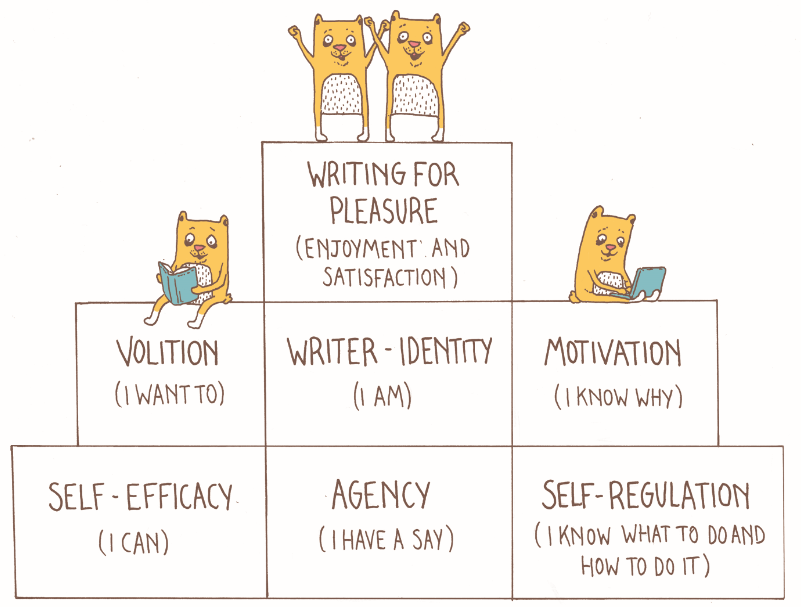
A possible hierarchy of children’s affective emotional writerly needs as articulated by Young & Ferguson 2021
The body of research looking specifically into children’s motivation to write is strong and growing (Young & Ferguson 2021, 2023). A lack of motivation can often be at the heart of writing underperformance, and attending to this is just as important for academic attainment as focusing on cognitive learning. Empirical findings consistently show how motivational factors are positively and directly related to students’ writing performance and achievement (Young & Ferguson 2021, 2023).
There are many different types of motivation that can be felt in the writing classroom. They all involve children knowing the value of writing and of being a writer. They are also about children knowing for themselves why they are making the writing they are crafting.
Attainment motivation – feeling a sense of wanting to write the best text they can.
Utility motivation – feeling a sense that learning about writing will be important in the future.
Intrinsic motivation – feeling a sense of personal enjoyment and satisfaction from producing the writing they are working on.
External motivation – feeling a sense of external pressure or punishment if they don’t produce their best writing. Alternatively, knowing a reward will be given for producing the best writing they can.
Situational motivation – feeling a sense of excitement about writing from those around them in class. This is about feeling part of a community of writers.
Teachers can help improve children’s motivation by employing the following strategies:
Develop yourself as an enthusiastic writer-teacher (Young & Ferguson 2020, 2021a).
Pursue purposeful and authentic class writing projects (The Writing For Pleasure Centre 2023).
Establish publishing goals for class writing projects (LINK).
Show children mentor texts which match the kind of writing they are about to make (Ferguson & Young 2023).
Establish product goals (success criteria) for a class writing project with your class (Young & Hayden 2022). Discuss how these goals are orientated towards helping the class produce their very best writing.
Let children generate their own writing ideas within the parameters of a class writing project. Let children write on topics they are knowledgeable and/or passionate about (Young & Ferguson 2022, 2023; Young et al. 2022).
Teach writerly techniques and processes through self-regulation strategy instruction. Ensure you explain why the technique will be useful to children before inviting them to use and apply the technique in the context of their developing composition that day (LINK).
Setting clear process goals for writing sessions (LINK).
Ensure children have opportunities to pursue their own personal writing projects at school and at home (Young & Ferguson 2021b).
Show enthusiasm for children’s compositions through your daily pupil-conferencing. Make sure you always celebrate quality craft (Ferguson & Young 2021).
Give children an opportunity to check their drafted piece against the goals established for the class project (Young & Hayden 2022).
Break proof-reading down into short, small and manageable chunks (Young & Ferguson 2022b).
Organise a ‘publishing party’ to celebrate the end of a class writing project (LINK).
If we want to attract children like bees to the idea of writing for pleasure, we must treat our classroom as a field and fill it with the sweetest of nectar – good literature.
Research has shown that there is a profound connection between effective writing instruction and reading. For example: reading, studying and discussing mentor texts, texts which match the kind of writing children are being invited to make for themselves, can yield a positive effect of +0.76 (Young & Ferguson 2021, 2023a). For children with SEND, it can be +0.94 (Young & Ferguson 2023b). To put those numbers in context, anything above a +0.4 is generally considered to have a significant positive impact on children’s writing development.
With this in mind, please find a list of some of our absolute favourite mentor texts that we like to use as part of Writing For Pleasure class writing projects (2023).
Research has shown that there is a profound connection between effective writing instruction and reading. For example: reading, studying and discussing mentor texts, texts which match the kind of writing children are being invited to make for themselves, can yield a positive effect of +0.76 (Young & Ferguson 2021, 2023a). For children with SEND, it can be +0.94 (Young & Ferguson 2023b). To put those numbers in context, anything above a +0.4 is generally considered to have a significant positive impact on children’s writing development.
Too often we see teachers explaining to children that a story must have a problem and a solution. Children groan as another story mountain planning sheet is handed out (Young & Ferguson 2023). Problem-solution stories don’t regularly match the types of picturebooks, short stories, flash-fiction and other literature children love to read. It’s therefore important that the mentor texts we share with children reflect the different types of fiction that are available to them. This way, children know they can write in these ways too as part of a class writing project. The six most common story arcs used in children’s literature are:
Steady rise (rag to riches)
Steady fall (riches to rags)
Fall-rise (man in hole)
Rise-fall (Macbeth)
Rise-fall-rise (Cinderella)
Fall-rise-fall (The boy who cried wolf)
In addition you have circular (a character returning to the place or the circumstances where the story began) and cumulative stories (with a new thing on every page adding to what’s gone before).
Below is the list of the poetry class writing projects we provide on our website and to our Writing For Pleasure affiliate schools.
You can see how children are introduced to early poetry anthology making through picturebooks in KS1 (Young & Ferguson 2022). This includes writing their first ever poetry anthology and a collection of Haikus.
In Lower Key Stage Two, children are invited to write poems about Animals, The Natural World and SensoryPoetry. The focus of these projects is to begin embedding key poetic craft moves, moves which will not only enhance children’s poetry writing but also their non-fiction and narrative writing too. In Upper Key Stage Two, children are invited to write Inspired By… Poetry, Poetry That Hides In Things, Anthology Of Life and Social & Political Poetry. Not only do these projects have a positive impact on the quality of children’s non-fiction and narrative writing but they also provide opportunities for children to learn more sophisticated and lesser-known poetic craft moves.
What’s wonderful about this progression is that, by the end of their time at primary school, children will have written hundreds of poems and learnt a whole host of poetic craft moves. In the process, they will have learnt to paint with words and understand the reasons poets are moved to write.
Suggested class writing projects
For more information on these specific Class Writing Projects, click the link next to the project title.
This writing project is based on a couple of mentor books: The Puffin Book Of Fantastic First Poems edited by June Crebbin and Here’s A Little Poem: A Very First Book Of Poetry by Jane Yolen. With that said, it’s not necessary to have a copy of these books to undertake this project with your class – it will just help. It’s great to show a collection of poems to children (or a collection you’ve written) before inviting children to do the same. This is a classic: ‘Hey, I saw this book and thought it was cool – why don’t we make one like it?’ kind of writing project. You might want to explain what Edited by… means and perhaps ask the children to be the editors of their own class anthology of poetry.
This writing project is based on a mentor book called Haiku Baby by Betsy E. Snyder. With that said, it’s not necessary to have a copy of the book to undertake this project with your class – it will just help. Haiku Baby is a collection of haikus written for babies. It’s great to show this collection (or a collection you’ve written) before inviting children to do the same. This is a classic: ‘Hey, I saw this book and thought it was cool – why don’t we make some like it?’ kind of writing project.
Writing a series of haikus gives children the opportunity to write an impression, to capture a moment, to use poetry as a symbol and to make something familiar seem unfamiliar.
The poetry of the earth is never dead – John Keats
Children enjoy writing about the world outside. British poetry has a long tradition of connection with landscape and nature. We cannot separate ourselves from the natural world, and young people are increasingly concerned about it. This project allows you and your class to bring into sharper focus the joyful, healing, subtle, delicate or terrifying aesthetics of nature. Children can share their experiences of nature with others, and this is the most important aspect of the project. When writing a nature poem, children are aiming to share a particular experience, and we have to resist the temptation to write generally about it. It’s about choosing a diamond moment. We are lucky enough to have many experiences with nature, in urban jungles, streets, allotments, gardens, weather, woods, parks, beaches, rivers, seas, peaks, hills and playgrounds. Many of these experiences will be enjoyable – some may not!
This poetry project gives children the opportunity to write an impression, to capture a moment, to use poetry as a symbol and to make something familiar seem unfamiliar. Perhaps the children could even produce a literary magazine showcasing the power and fragility of nature.
Until one has loved an animal, a part of one’s soul remains un-awakened – Anatole Frances
Children love animals. They often ask each other what their favourite animals are and why. Many have pets. Regardless of where we live, we see a variety of animals, and they are important to us for many reasons. Poets write about animals in various ways, and many people enjoy reading or hearing such poems.
Writers sometimes simply focus on an animal in order to be playful and descriptive with language. Others use animals (such as snakes, wolves and foxes) as a metaphor to describe human behaviour, psychology and even philosophy. Some write odes to a particular animal. Poems can be memoir-based (prose poems). Of course, others will write about mythical creatures, as Lewis Carroll did in Jabberwocky.
Finally, if you read nonfiction texts about animals, you may notice that writers often use figurative language, or what we call painting with words, to classify and describe animals. With this writing project you can begin to introduce the idea that poetry and non-fiction can work in harmony.
Poetry: the best words in the best order – Samuel Taylor Coleridge
All poetry is in some way sensory, and much narrative text is sensory too. Writers use the senses to express a feeling that is very personal. The feelings may be quite specific but are often also universal in that others will recognise them and relate to them. Writers might draw on their senses as they reflect on objects that bring back hidden memories. They might use their senses to bring nostalgic moments to mind. The senses can also be used to evoke a mood, to deliberately show things or to explore experiences in different ways.
This poetry project will give children opportunities to practise using sensory description; showing, not telling; observing and expanding on small yet significant details; making comparisons; and painting with words for the pleasure of the artistry.
As this writing project is similar to a writing exercise, it will help children to see the benefits of techniques that writers often practise and use. Children will absorb these techniques as part of their repertoires and will be able to draw on them again in all kinds of future writing.
Imitation is not just the sincerest form of flattery – it’s the sincerest form of learning – George Bernard Shaw
Writer Michael Rosen says the easiest way to write a poem is to read a poem by someone else and then say to yourself ‘I could write like that,’ and this is what this writing project is all about.
Sometimes it can be hard for writers to generate original ideas all the time, and it doesn’t represent how they always work. Poets and story writers alike find themselves inspired by things they see, read or hear from other writers, whether consciously or not. This is called ‘intertextuality’ or ‘found poetry’. You only need to look inside a writer’s notebook to see that they are forever collecting, investigating and imitating little diamond moments that they have found lying around in other texts.
The best way to understand poems is to read a lot of them and to read them often. Children begin to think about what writers are writing and why.
Alongside this writing project, you could read Love That Dog by Sharon Creech as your class book. It is written in a free-verse diary format, from the perspective of a young boy (Jack) who initially resists poetry assignments set by his teacher. As time moves on, Jack’s confidence grows, and he is able to respond to and take inspiration from poems with increasing sophistication. This book makes for an engaging, child-friendly and incredibly valuable demonstration of intertextuality.
Why else are we here if not to live with unreasonable passion for things – poet ‘butterflies rising’
This project focuses on poetry that hides in things. It provides children with an opportunity to showcase sensory detail in poems about ‘things’ that can often be touched, smelled, observed, tasted, heard and thought about. The things children own, find interesting, or are disconcerted by will also tell them a lot about themselves. This personal connection makes for a great writing project.
Writing about things can lead children to share and suggest something they might have in common with their reader. They might notice the same things or show something in a new light. The familiar can suddenly become unfamiliar.
Children will learn about symbolism. They will understand that the things we hold at a distance or the things we love can be a symbol for something else – once we dig a little deeper for those diamond moments.
Objects often carry within them memories that can be shared through poetry. This project could culminate in an exhibition for families and the local community to visit. The exhibition could be a great opportunity for others to reflect on and reminisce about things from their past.
The project also has strong connections to memoir. Children will be able to bring what they have learnt about writing effective memoirs into their poems.
Memoir is a unique opportunity to revisit yourself… You have to find the poetry in it. You have to find the poetry in yourself – Joshua Mohr
This project seems somehow fitting for children in Year 6 to mark an important time of transition from primary to secondary school. Children are going to create anthologies of poems about growing up and childhood. We highly recommend that you read What I’ll Remember When I Am a Grown Up by Gina Willner-Pardo with your class throughout this class writing project.
Poetry is a wonderful medium for looking back on our lives because children’s impressions and memories can be captured in a shorter, simpler and more natural way than in prose.
Not only is an ‘anthology of life’ a means for children to connect with themselves, it can also bring the writing community in your classroom together. This is a purposeful project. It is something that will be cherished and great care will be taken over it.
Children will achieve an anthology of personal poetry based on their memorable experiences. This writing project will give children the time and space to draw on their experiences of the past four years of writing poetry, to look back at poems already written and to write lots of new ones. They will select the best and publish them in any arrangement they choose.
In the very end, civilizations perish because they listen to their politicians and not to their poets – Jonas Mekas
Throughout the history of this country, there have been radical ballads, songs and poems written with the aim of publicising and protesting against certain social and political issues.
They have been shared and performed publicly to create a sense of communality and to be an inspiration for radical action and change. They have been about class oppression, race, gender, war, injustice, inequality, disability, freedom, poverty, religion – whatever have been the preoccupations of the age in which they were written, so that a particular piece of history could be passed on from generation to generation and not lost. Spoken word poetry is also becoming increasingly popular amongst young people, and this project can harness that interest.
We all know that today’s children are very concerned about many social issues – human, animal and environmental. They learn about social injustice through the media; it may also affect their lives in a personal way. Writing political and protest poetry is important because it gives children a way of expressing their feelings and worries, asking questions about the world and their dreams and hopes for the future. Sharing their fears and concerns, challenging those who have responsibility and influence, and using their voice for social change can feel empowering and maybe even a little reassuring. And of course it’s a perfect example of the whole idea of writing personally, persuasively and for a purpose.
Below is the list of the non-fiction class writing projects we provide on our website and to our Writing For Pleasure affiliate schools.
You can see how children are introduced to early picturebook making in the EYFS (Young & Ferguson 2022). This includes making ‘list books’ and traditional information books with the focus being to teach someone something new on each page. Within these projects, children also learn to write ‘browseable’ information texts (Young & Ferguson 2023).
From here, when in KS1, children continue their book-making apprenticeship by producing information picturebooks and ‘chapter books’ (Young & Ferguson 2022). They also learn to make Instruction Books, A Class Magazine and Information & MeBooks which share more of their voice and personality. In addition, they have an early taste of writing to persuade and give their opinion through our Curiosity Letters project. We believe this gives them a solid foundation in non-fiction – ready to be developed further once they go into KS2.
In Year Three, children are expected to write Information Texts and Curiosity Letters. This continues into Year Four where children will once again write Information Texts and Instructional Texts. At this point, children learn about the six different approaches to non-fiction writing (Young & Ferguson 2023). Children also focus on using specific non-fiction craft moves, defining their topic, and using cohesive devices to keep their readers on track. In Year Five, children build on this knowledge and experience to write Explanation Texts. This is an opportunity to classify their topic(s) and explain key principles objectively or with wild imagination. Finally, in Year Six, children use all that they’ve learnt about non-fiction to write quality Explanation and Discussion pieces.
We believe that this progression provides ample opportunity for children to achieve the STA teacher assessment writing statements. For more information on this, please follow these links LINK and LINK.
The great strength of this project is that children already know this genre of text. They will have seen them at home or in the classroom library. It also allows them to engage in their phonics learning from the perspective of a writer and teacher. By inviting them to write their own ABC books, we can also sow the seeds of intertextuality – that you can copy the types of writing and books that you like. You can then make them your own. Once this lesson is taught, children can make books with ease.
Making a counting book is a project which the youngest of writers will find very appealing. It’s a genre which they will have been familiar with from a very early age and so they will be confident with it. They will enjoy showing off their counting skills, and choosing their own favourite objects to be counted. They will also get pleasure from teaching their readers and listeners something, and from the interactive element of everyone counting together when they share their book.
You only have to sit with your class at lunchtime to know that food is a popular topic of conversation for small children. The great strength of this project is that children already know this genre of text. They will have seen food books at home or in the classroom library. Children also like list books – where something different is shared on each page. They see them as an opportunity to share about the things they know about or that are important to them. It’s nice to invite children to make their Food Book for an audience younger than them like babies or toddlers.
It makes sense to invite children to make a book of first words as this is probably one of the first books they’ve seen and read themselves growing up. I would hope that you would have similar books in your classroom library too. Children like list books – where something different is shared on each page. They also see it as an opportunity to share about the things they know about or that are important to them. It’s nice to invite children to make their Book Of First Words for an audience younger than them. For example babies and toddlers.
Children love animals and will regularly ask one another which is their favourite. I also suspect that animal books are some of the most popular books in your classroom library. Why not take advantage of this fact and invite children to make their own?
Hopefully, children will already know about these types of books by learning about people who help us. They are also a popular board book for younger children – where each page shares about a different person. Children like making their own versions of these books. They will tell you about people they know, people who help them, and about fantasy characters that they love from the games they play and from the films and programmes they watch. It’s this kind of project that also lays the foundations for young writers understanding where they can find characters for their stories too.
Spend any time at all in a Nursery or Reception class and you’ll have children come up to tell you about things they are interested in or love most. It’s often spontaneous and they often have plenty to say! This is why they love making All About… Books so much.
This book-making project will show children that they can be knowledgeable about a subject and that sharing this knowledge is an enjoyable, social and satisfying thing to do. You and your class will begin to appreciate the pockets of ‘communities’ that make up a writing classroom – with children talking and sharing with each other their passions, interests and aspects of their lives. It is important for children to understand the power of writing as information giving but also to experience it as a social resource.
What’s wonderful about this particular project is that it can be adapted easily and can be repeated many times across the year. For example, once experienced with the genre, children can make All About… Books about what they are learning in the wider curriculum. You can also make similar books such as:
Children like to tell people who don’t know about the important places in their life and what happens there. Making a picturebook about a place gives them an early notion of information sharing and storytelling. This project can actually be done a number of times throughout the year with a different focus each time. For example: an information text explaining all the different things that can be seen at a certain place, a memoir text about a favourite place and what they did there, and finally, a story with a strong setting where something happens!
Children love to tell each other about the most important people in their lives, who may include not only family members but also carers and close family friends. Making a ‘list’ picturebook about some of them lets children write about what they know and make links between home and school. Other children will enjoy having this extra information about the friends they meet every day but who they may only know in the context of the classroom – so a great way to get to know everyone better!
These picture books are an early form of non-fiction writing, but they can also be seen as containing elements of personal narrative and even autobiography. The writers themselves will undoubtedly want to share them with those at home.
This project is quite versatile and can be approached in a number of different ways. For example:
An information text explaining who all the favourite people are.
A memoir text with stories about their favourite people.
A story with their favourite people as the characters.
All About Me Books give children the opportunity to share about themselves. They can tell you what they like, what they don’t like and other important information about them and their lives they think you ought to know. It’s a combination of non-fiction and personal narrative. Children enjoy reading about one another and finding out about things they have in common and things that are different.
Children accumulate lots of information every single day. It is vital to their development as writers that they are given the opportunity to share their knowledge and expertise with others and to experiment with the language and organisation of non-fiction genres.
This class writing project will show children that they can be knowledgeable about a subject and that sharing this knowledge is an enjoyable, social and satisfying thing to do. You and your class will begin to appreciate the pockets of ‘communities’ that make up a writing classroom – with children talking and sharing with each other their passions, interests and aspects of their lives. It is important for children to understand the power of writing as information giving but also to experience it as a social resource.
When children write about the things for which they are passionate and have a high degree of understanding, experience and knowledge, they bring themselves to their texts. Two genres begin to merge. We call this ‘memoiration’. The texts become a rich mix of memoir (personal narrative) and information. You’ll notice that not only do children make a connection with their topic but they also try to connect with their readership too. For obvious reasons, this project works best when children have already had experience in writing Information and Memoir books.
Instructional writing – the recounting of processes – is an important genre that is vital to science, business, and art and design. It is also, perhaps surprisingly, a remarkably rich genre, offering children many possibilities for innovative writing and for creating hybrids with, for example, information, explanation, memoir, poetry, ‘faction’ and persuasion. A good book that showcases exactly this is How To by Julie Morstad. Children can write instructions for a number of reasons: to share their expertise with the community; to enable others to take part in pleasurable, useful or necessary activities; and sometimes simply to help themselves remember how to do something they have just learnt. It is a genre of writing that they can stretch, expand and take in different directions. Why not be enthusiastic, entertaining, ironic, poetic, sarcastic and experimental and let your own voice come through?
Children like the idea of letters. They are full of curiosity about the world, and this is a chance for them to ask the ‘experts’ about any of the things that puzzle them. They’re usually very good at formulating their own personal questions themselves, so probably the only support they’ll need from you during this project is finding an addressee who is likely to be able to give an answer to their query. It’s exciting when the (often local) addressee replies, showing children another powerful and authentic function of writing.
This project offers you and your class a new and refreshing perspective on the usual ‘recount’ or ‘newspaper’ writing assignment, when, for example, children are asked to write about their visit to the farm or the local museum, and you inevitably end up with thirty very similar pieces.
The idea here is that you invite the children to write about something they’ve seen, noticed or experienced recently – the kind of thing that they are so often bursting to share with you and everyone when they come into school in the morning. Alternatively, they can simply write about something they are interested in and want to ‘get off their chest’. You can then collect all the pieces and make a class magazine, which you can read aloud time and again to the children and place in the class library for everyone to read whenever they like.
What a great thing to do – to give children access to a class collection of different pieces which tell about all the various happenings, big or small, in their lives.
Incidentally, there are now quite a few magazines on the market aimed at children from as young as three to seven years old. For example: Dot, Chirp and Okido. They should have a place in your class library too and can act as great mentor texts.
KS2
Information [Year Three – LINK Year Four – LINK – Year Five – LINK]
By writing about what they know and care about, children learn that they can use their expertise to inspire and awaken the minds and hearts of others.
Children accumulate lots of information every single day. It is vital to their development as writers that they are given the opportunity to share their knowledge and expertise with others and to experiment with the language and organisation of non-fiction genres.
This class writing project will show children that they can be knowledgeable about a subject and that sharing this knowledge is an enjoyable, social and satisfying thing to do. You and your class will begin to appreciate the pockets of ‘communities’ that make up a writing classroom – with children talking and sharing with each other their passions, interests and aspects of their lives. It is important for children to understand the power of writing as information giving but also to experience it as a social resource.
Instructional writing – the recounting of processes – is an important genre that is vital to science, business, and art and design. It is also, perhaps surprisingly, a remarkably rich genre, offering children many possibilities for innovative writing and for creating hybrids with, for example, information, explanation, memoir, poetry, ‘faction’ and persuasion. A good book that showcases exactly this is How To by Julie Morstad. Children can write instructions for a number of reasons: to share their expertise with the community; to enable others to take part in pleasurable, useful or necessary activities; and sometimes simply to help themselves remember how to do something they have just learnt. It is a genre of writing that they can stretch, expand and take in different directions. Why not be enthusiastic, entertaining, ironic, poetic, sarcastic and experimental and let your own voice come through?
By writing about what they know and care about, children learn that they can use their expertise to inspire and awaken the minds and hearts of others.
Explanation texts are a gift. All of us ‘own’ knowledge capital. Indeed, many people make great sums of money from disseminating this capital. Others, though, choose to share their knowledge freely because of the joy and the benefits it can bring to other people. It teaches your reader something, and this is the wonderful thing that children will learn during the project. This introduction itself is an explanation text. You can tell because it does three things:
It says what an explanation text is.
It says why it is a useful genre for children to write.
It says how it is best taught.
By Year Six, children will be very familiar with reading and writing information texts. Explanation texts are very similar, but where an information text simply tells you what something is like, an explanation text goes on to explain how and why things happen. Explanation texts are probably the type of non-fiction that children will read most as they go through school.
Children know about many things that their peers or adults around them know nothing about. It can be very rewarding and self-affirming to share this knowledge through writing. Children will become aware that they have valuable expertise to pass on to others. This class writing project will show children that sharing knowledge is often an enjoyable, social and satisfying thing to do. You and your class will begin to appreciate the pockets of ‘communities’ that make up a writing classroom, with children talking and sharing with others their passions, interests and parts of their lives. It is important that children understand the power of writing to explain and inform but also experience it as a social resource.
Every day, children explain things so that others can understand them. They often have to explain things to adults. There may be many topics from the lives and cultures of your pupils that you don’t know much about, so this writing project is an opportunity for your pupils to teach you a thing or two!
Explanations can be about something physical in the world (such as geography), things people do or even abstract ideas. It is best to write an explanation text on a topic you know a lot about. Think: do I know exactly why something happens? Or exactly how something works? Could this be useful to somebody else?
Discussion is an exchange of knowledge; an argument, an exchange of ignorance – Robert Quillen
This discussion writing project builds on what children have learnt in other non-fiction projects in previous years. For example, they have learnt how to recount. They’ve learnt how to tell stories and write memoirs of their past. They’ve learnt how to give information to others and how to explain themselves. They’ve learnt how to account for and explain why things happen in both history and science and, finally, they’ve learnt how to hold a position on something they care about through persuasion. However, there are subtle differences between this project and all of the others we provide. Discussion isn’t just explanation. It’s not about simply giving facts or writing about the consequences of something, nor is it just a persuasive piece. It’s not there simply to promote and champion your position, nor is it there simply to challenge or destroy another’s. Instead, discussion brings all of these skills together. Children will learn to consider more than one point of view and use recounts, poetic metaphor, evidence, explanation and persuasion to better understand both sides. Writing discussion pieces is about being both thoughtful and penetrative.
We discuss things all the time. We weigh things up and discuss things in our heads. We hear people out – we might challenge their thinking from time to time and we will probably try to justify our thoughts with some kind of explanation. We might also challenge what we’ve heard but still be open to changing our own opinion. In the world of social media, globalisation and political polarisation, discussion is an important life and academic skill that children should be exposed to, and they should know how to use it for themselves.
Persuasive letters for personal gain [Year Four – LINK]
Sometimes we get the things we want and sometimes we get the things we don’t want. When children make requests, whether at home or school, they are often denied. It usually happens like this: their point of view is briefly acknowledged, then a list of rational reasons as to why they cannot have what they want follows, and so the status quo is maintained. Being given the opportunity to put forward a point of view and make a successful request through persuasive writing should capture children’s interest. At last they will learn a way of possibly getting what they want!
This project is about learning to write a persuasive letter for personal gain. Children will be writing to someone in a position of power or influence such as family members, celebrities, organisations, or to you, their teacher! Children are likely to focus on the following opportunities:
Purchase something or have something purchased for them.
Get a response from a celebrity, expert or organisation.
Do something or go somewhere.
Change their circumstances, responsibilities or level of independence.
Advocacy Journalism, as the title suggests, is when you advocate for something. It means you champion it, support it and try to stand up for it. This project will give children first-hand experience of undertaking and writing up original research. It will also provide the opportunity for them to learn about local causes and the power of community action. It is a legitimate way for them to learn how news/magazine articles are used to inform, entertain and persuade people.
This can be a truly collaborative project that brings home and school together. Parents and carers can be involved and children will see their writing ‘get to work’ by informing others in the local community about their chosen charity. They see what writing an article in a journalistic style can do. You will be struck by the sheer variety of local charities and the children’s personal commitment to them. You may want to compile a list of charities yourself which the children could potentially use. A great many children will, however, be able to choose charities that they, or someone close to them, have been directly involved with or received help from. This will make the project feel even more important to them personally.
Community activism letters and articles [Year Six – LINK]
This writing project sits comfortably amongst the other projects you might do this year, such as Discussion pieces and Social and Political Poetry. The project will move children on from the Advocacy Journalism project they undertook in Year Five and will give them a final opportunity to see that writing, if they use it carefully and intelligently, can be a powerful tool for good. This time, it’s about your class coming together and using their writing voices to try to influence decision makers, such as local government representatives, or raise awareness of the need for a positive change to occur in their local community.
If we want children to react and impose themselves on the world, then they must talk about, read and observe what’s going on in their own community. We as teachers must be observant to what the children themselves are concerned about. For example, it may be the case that children don’t all want to write yet another poem about Greta Thunberg, write out into the ether about saving the planet from plastic waste or receive a generic letter in response to their own from a multinational corporation.
People’s history [Year Three – LINK Year Four – LINK]
If history were taught in the form of stories, it would never be forgotten – Rudyard Kipling
Many interesting things have happened to ordinary people which are almost forgotten. By writing them down for others to read, we make sure they are remembered. Even though these events or experiences are not well-known or previously recorded in detail, they are still an important part of human history. Everyday events can be incredibly interesting, and it is important to write about them so that they are not hidden. Everyone in our society has a story to tell. By sharing these stories publicly, children learn that they can give a voice to those people who would never otherwise have had an audience.
People’s history writing has strong elements of Memoir, although the writer will not be writing about their own experiences. Instead they will be writing about other people they know personally or have heard of through family members, friends or the community. This project encourages a great sense of community. By bringing in and celebrating stories from outside your school, you can strengthen and enhance the sense of community and connection inside the classroom. There may well be gains, too, for the person being interviewed.
Biography is history seen through the prism of a person – Louis Fischer
This writing project will show children how they can document the lives of people in their communities. They will discover how the lives of ordinary people they know can be sources of great historical, social and personal interest – not only to themselves as the writer but to others too. All people’s lives are interesting, but we don’t always realise it ourselves. Everyone in our society has a story to tell, and by asking the right questions and sharing these stories publicly, children learn that they can give a voice to those people who would never otherwise have had an audience.
Biography writing has strong elements of Memoir, although it will be about other people that the writer knows personally or has heard of through family members, friends or the community. At their very best, biographies can carry within them great opportunities for poetic description and rich anecdote. One of the great benefits of this writing project is that the writer can bring in and celebrate stories that can strengthen and enhance the sense of community and connection inside the classroom. There may well be gains, too, for the person being interviewed and written about.
A good biography topic creates the possibility for reflection, empathy or a shared understanding of a person or an experience. Children will come to understand the role biographers have in documenting and preserving people’s past.
History is not contained in thick books but lives in our very blood – Carl Jung
People are interesting. Everyone has a story to tell – and an audience eager to read and enjoy it. You might write your autobiography mostly for yourself, perhaps for the pleasure of looking back and being reflective, explaining to yourself how you became who you are, understanding yourself, telling your side of the story. Or you might write it for others to learn new things about you, or for friends to remember you by, or for future readers to learn about the time and the place in which you live. It’s a way of making and leaving your mark on the world.
This writing project has a connection to The Anthology of Life Poetry Project, which children will also undertake this year too. Your young writers will also be drawing on their experiences of writing Biography and Memoir in other years. Like Biography, People’s History and Memoir, children’s autobiographies will inform, educate, entertain and give pleasure to themselves and their readers.
To present a scientific subject in an attractive and stimulating manner is an artistic task, similar to that of a novelist or even a dramatic writer – Max Born
Reporting a science experiment clearly and accurately is important because every experiment can, in effect, offer new knowledge. In writing a description of the aims and methodology, writers are able to share this new knowledge with their community and perhaps inspire others to repeat the experiment or take it a step further. We suggest children devise their own experiments, which can be linked to the current class science topic or be an investigation into something of personal interest. We say this because the science reporting should be genuine and shared with others in the class. There is little point, and little to be learnt, by asking 30 children to write up the same science experiment.
Below is the list of the narrative class writing projects we provide on our website and to our Writing For Pleasure affiliate schools.
You can see how children are introduced to early picturebook making in the EYFS (Young & Ferguson 2022). This includes writing stories and personal narratives with a focus on people and places. Within these projects, children also learn common narrative plot patterns.
From here, when in KS1, children continue their book-making apprenticeship by producing narrative picturebooks and ‘chapter books’ (Young & Ferguson 2022). They are also introduced to Fables, Fairytales as genres. We believe this gives them a solid foundation in plot – ready to be developed further once they go into KS2.
In Year Three, children are expected to write Fairytales and Fables. Again, the focus of these projects is on plot and understanding different emotional story arcs. Next, in Year Four, children learn to write Character-Driven and Setting-Focused Short Stories. Here they learn a host of important narrative craft moves. In Year Five, they build on this knowledge and experience to write Developed Short Stories and Graphic Novels. This is an opportunity to embed their understanding of setting, character and atmosphere. During Year Six, children use all that they’ve learnt to write a collection of Flash-Fiction pieces. This collection will showcase their abilities to attend to settings, characters and atmosphere.
Finally, it’s important to point out the progression of personal narrative writing through the medium of memoir. The idea of memoir writing is subtly introduced in the EYFS via the Story About Me and True Story projects. Once children arrive into KS1, they have regular opportunities to produce Memoir picture and ‘chapter’ books. This apprenticeship continues into KS2. Across KS2, children learn that they can use the same literary craft moves they are learning in their story projects to enhance their memoirs. Year Six becomes a time for celebration. Children are encouraged to gather together their memoirs from the previous six years to inform their Anthology Of Life poetry and Autobiographies.
We believe that this progression provides ample opportunity for children to achieve the STA teacher assessment writing statements. For more information on this, please follow these links LINK and LINK.
Children like to tell people who don’t know about the important places in their life and what happens there. Making a picture book about a place gives them an early notion of including and focusing on a setting for their stories and memoirs. This project can actually be done a number of times throughout the year with a different focus each time. For example: an information text explaining all the different things that can be seen at a certain place, a memoir text about a favourite place and what they did there, and finally, a story with a strong setting where something happens!
Sometimes we like to use writing as a means for ‘social dreaming’. Our writing can sometimes be whimsical, aspirational and help us consider an imagined future. Children love to write in this way too and so this project gives them an opportunity to do just that.
Pattern books teach children about what makes a great picture book. Children enjoy patterns, rhythm and surprises in their books and this project helps them to make their own. It also helps children write with confidence as each page will begin in the same way. For example, I’m scared of… or I’m happy when… These books also allow children to make books which are a mixture of information sharing and personal narrative.
There is unlimited scope for the different openings children can come up with and so lots of different types of pattern books can be made. Therefore this project can be returned to throughout the year and can actually be a series of individual writing projects. The concept is simple. For example:
I can… I saw a… When I’m older… I go… I like to eat… Sharks can…
Children generally love bringing their out-of-school experiences into the classroom – it’s a way of sharing who they are and keeping a link between home and school. There is a lot of scope for making a picturebook about a family or friend. For one thing, it’s easy to write about what you know, and, for another, there are so many possibilities of sharing little stories and even facts about someone they know outside of school. Children like seeing and hearing books about their peers’ chosen people, and they will also want to share their book with their own family or friends.
They can write about a family member, friend or another familiar adult that they like. For example, their karate teacher. These will usually be personal narratives. However, they can sometimes be read as non-fiction texts too.
Animals have always been popular as characters in picture books for small children, and are much loved in the media programmes aimed at today’s young audiences. They have a huge emotional appeal for children: they can be endearing, they can be funny and they can be vulnerable. They can be given human qualities, making it easy to identify with them and feel that they are friends. So it is no surprise that young writers will want to make animal picture books themselves. Hence this project.
We recommend inviting children to create a series of picture books which follow a format of Lucy The Lonely Cat or Craig The Flying Crocodile. This is an easy way for children to identify their character and their predicament whilst still giving them enough scope to develop their own story.
Friends are a very important part of children’s lives, so making a book about a friend will be something they will really enjoy doing and sharing with the community of writers in their classroom. There are so many opportunities here – to entertain, be funny or sad, make a record of something that happened that they don’t want to forget, and reflect on friendship itself. What could be better than to make something which can be given to a friend as a gift, in token of the friendship? This is writing that brings people together.
This narrative project helps children realise that stories have settings and that characters can travel across the pages of their picturebook. This means a character can find themselves in a different place on each page, or else they develop an understanding that they can write about the same setting across pages. As such, this project helps children develop beyond making ‘list books’ and marks a significant developmental shift in their book making abilities.
Children love telling others stories or facts about the people they know and like outside school. They may have overheard or been told a funny or a serious anecdote about someone, or perhaps remember something they did together, and this is a great opportunity to entertain or inform others about it, make a record of something to look back on, and maybe also to express affection for someone important to them. Alternatively, this is an opportunity for children to write their own ‘fan fiction’ by taking a character from popular culture and using them in their own story. This helps introduce children to the idea of intertextuality (that your stories can be based on others you know or like).
Making a book about someone who belongs to the wider circle of family friends and acquaintances offers children extra possibilities for making links between home and school and for writing about what they know. Their book may contain elements of both personal narrative (memoir) and information.
This class writing project shows children that they can share heartfelt moments from their lives or from the lives of people they know. These can be funny, sad, happy, strange, surprising, or maybe even scary. The best true stories are little vignettes of things that occur which they think their peers will relate to. Writing a true story helps children understand the power of writing as a reflective tool; sharing them makes them into a social resource which creates empathy and brings the whole community together. They show us how others see and experience the world, and help us appreciate all the things we have in common.
Children are natural memoirists. They possess a fund of ready material for writing, and of course, like all of us, they love embellishing their stories with details that don’t always tell the whole truth. In memoir as a genre, they can be playful and experimental, and try out many of the things they love about writing.
Stories contain characters and the best stories concentrate on their characters. Writers share their characters’ feelings and reactions as they travel through their story. This writing project helps teach this valuable lesson in a developmentally appropriate way. What are your class’ favourite books? What are their favourite films or TV programmes? Who are their favourite characters? Who do they love? Who do they really really hate? Who do they wish was their friend? Who would they like to write a story about most?
This class writing project shows children that they can share heartfelt moments from their lives – funny, sad, happy, strange, surprising, or maybe even scary. The best Story About Me books are little vignettes of things that occur in their everyday lives to which their peers might all relate. These, of course, are often the things that matter. Writing a memoir helps children understand the power of writing as a reflective tool; sharing them makes them into a social resource which creates empathy and brings the whole community together. They show us how others see and experience the world, and help us appreciate all the things we have in common.
Memoir is a kind of storytelling, and children are natural memoirists. They possess a fund of ready material for writing, and of course, like all of us, they love embellishing their stories with details that don’t always tell the whole truth. In memoir as a genre, they can be playful and experimental, and try out many of the things they love about writing.
This class writing project shows children that they can share heartfelt moments from their lives or from the lives of people they know. These can be funny, sad, happy, strange, surprising, or maybe even scary. The best true stories are little vignettes of things that occur which they think their peers will relate to. Writing a true story helps children understand the power of writing as a reflective tool; sharing them makes them into a social resource which creates empathy and brings the whole community together. They show us how others see and experience the world, and help us appreciate all the things we have in common.
Children are natural memoirists. They possess a fund of ready material for writing, and of course, like all of us, they love embellishing their stories with details that don’t always tell the whole truth. In memoir as a genre, they can be playful and experimental, and try out many of the things they love about writing.
Making picturebooks is the most obvious writing project of them all. It’s a familiar and much loved genre. Children will already know a lot about picturebooks and how they work from their years of book-making in Nursery and Reception. They give children freedom to write as little or as much on a page as they like. One word or a whole paragraph. The format lends itself to writing a new idea on each page – an early form of paragraphing. They are an artefact to be picked up, handled, passed round, displayed, treasured, taken home and given as a gift. They ensure children see themselves as real writers because they are making books just like the authors they love.
Stories have to be told or they die, and when they die, we can’t remember who we are or why we’re here – Sue Monk Kidd
Simple recounts tell what is remembered but not perhaps why it is remembered. They are preoccupied with ‘information’. This class writing project is different. It shows children that they can share heartfelt moments from their lives – funny, sad, happy, strange, surprising, or maybe scary. The best memoirs are little vignettes of things that occur in everyday life to which we can all relate. These, of course, are often the things that matter. Writing a memoir helps children understand the power of writing as a reflective tool; sharing them makes them into a social resource which creates empathy and brings the whole community together. They show us how others see and experience the world, and help us appreciate all the things we have in common.
Memoir is a kind of storytelling, and children are natural memoirists. They possess a fund of ready material for writing, and of course, like all of us, they love embellishing their stories with details that don’t always tell the whole truth. In memoir as a genre, they can be playful and experimental, and try out many of the things they love about writing.
In every story there hides a hundred other stories
If we want reading to raise the quality of children’s writing, we should give them the choice over the books they might want to take from in their writing. It’s important that we teach writing and reading in a connected way and so show children how all writers will use their favourite literature and other reading to influence their writing. When writers do this, it’s called intertextuality.
Intertextuality is the idea that writing (and therefore writers) will be influenced or inspired by things read, watched or heard. We must first let our young apprentice writers know that this is an utterly natural thing for writers to do and then encourage them to do it for themselves.
Children don’t only show their comprehension when they write in response to the books they’re reading; they give something of themselves to the text too. A fair exchange of ideas is made between the reader and what’s read. When this happens, we believe it’s evidence of children achieving the greater-depth standard.
Making a picturebook series as a joint project is a great way of building a community of writers. As you’ll see from the mentor texts we provide as part of this project’s Genre Booklet, we decided to make our own series based on Meg & Mog. A much loved favourite amongst KS1 children. You’ll need to do the same with your class. Decide what favourite characters from your class library the children would like to create their own picture book about.
There are lots of options here. The whole class can contribute a book to a single series. For example, all the children in your class could write their own Meg & Mog books. Alternatively, you could let the children decide for themselves. In the process, they could work in their groups. For example, some children might write their own Elmer The Elephant series while others decide to make their own picture books using Max from Where The Wild Things Are.
Making chapter books is something children naturally want to do as they develop as writers. They want to write the same things they enjoy reading. This project was originally planned to suit the needs of one little boy who wished to make his own chapter book. It worked beautifully. The children in the class understood that a ‘chapter book’ gave them the freedom to write as little or as much on a page as they liked. Some children write single words while others write whole paragraphs. Indeed, a chapter book in our classroom could be a single page long!
What the children enjoyed most, and what made it a ‘chapter book’ in their eyes, was the fact that they made their books portrait. The format for this project lends itself to writing a new idea on each page – an early form of paragraphing. Chapter books are also an artefact to be picked up, handled, passed round, displayed, treasured, taken home and given as a gift. Finally it ensures children see themselves as real writers because they are making real books just like the authors they love.
Making a chapter book series as a joint project is a great way of building a community of writers. As you’ll see from the mentor texts we provide as part of this project’s Genre Booklet, we decided to make our own series based on Frog & Toad. A much loved favourite amongst KS1 children. You’ll need to do the same with your class. Decide what favourite characters from your class library the children would like to use for their chapter books. There are lots of options here. The whole class can contribute a book to a single series. For example, all the children in your class could write their own Frog & Toad books. Alternatively, you could let the children decide for themselves. In the process, they could work in their groups. For example, some children might write their own Worst Witch series while others decide to make their own chapter books using Captain Underpants.
If you read the fables… you will know something about the person who writes them, and I like that. Secondly, they will not be about individuals; they will be about community. Thirdly, they’re all about moralising. Fourthly, the way they express themselves takes its tone from the oral tradition – Jim Crace
We often tell each other cautionary tales of mishaps, near misses and comeuppances where we have had to learn a lesson the hard way. Perhaps, like me, you learnt that you really should not play with scissors after you accidentally almost cut your friend’s finger off! We might also remember our grandparents, parents, teachers and people in authority telling us stern warning stories. Children can’t escape fables!
Historically though, fables have been the main way of socialising children into the norms of society. Some of those stories are new and original, while others have been told and loved by people across the ages. Many tales are still told and retold today because of their universal messages and because they are short, snappy and easy to remember.
Writing fables with children gives them the opportunity to communicate a message or moral in an entertaining way, building narratives from their own experience of being told what to do (and what not to do) and how to behave with and around others. They can then share these fables with their friends, younger children or even foolish parents! Furthermore, children get to express a little bit of themselves in their stories. Writing fables, alongside our Fairytale writing project, gives children in KS1 a strong basis for future story writing.
You might want your class to look at how fables are part of their lives. When do they hear fables, and from whom – their grandparents, parents, teachers or friends? Do they tell cautionary tales to the people they know? Allow children to identify the elements that make fables so popular and discuss where they can be found within our lives today.
Fairytales were not my escape from reality as a child; rather, they were my reality – for mine was a world in which good and evil were not abstract concepts, and like fairytale heroines, no magic would save me unless I had the wit and heart and courage to use it wisely – Terri Windling
Fairytales and folktales have a high status in literature for children. They are a part of cultural heritage; they express and transmit the values and wisdom of a community; they appeal strongly to the imagination and include familiar, much-loved stories that sprang out of an oral story-telling tradition.
There are various interpretations of what fairytales might mean, why they were composed and how they could be related to a child’s psychological development. These interpretations range from psychoanalytical (the subconscious), to historical and material (folk tales: stories for and about peasants), to political (feminism, class, power structures).
Writing a fairytale is likely to give the children in your class pleasure and enjoyment because they will be confident with the familiar characters, strong narrative shapes, language patterns and structures. They may also enjoy creating the sense of moral justice with which so many fairytales end. Also, of course, the possibility of subverting the genre or writing from the perspective of another character means that there are many opportunities for a writer to entertain and be humorous, ironic and surprising. Just as Shakespeare is continually reinvented for modern times, the same is true of fairytales.
KS2
Memoir [Year Three – LINK Year Four – LINK Year Five – LINK]
Stories have to be told or they die, and when they die, we can’t remember who we are or why we’re here – Sue Monk Kidd
Simple recounts tell what is remembered but not perhaps why it is remembered. They are preoccupied with ‘information’. This class writing project is different. It shows children that they can share heartfelt moments from their lives – funny, sad, happy, strange, surprising, or maybe scary. The best memoirs are little vignettes of things that occur in everyday life to which we can all relate. These, of course, are often the things that matter. Writing a memoir helps children understand the power of writing as a reflective tool; sharing them makes them into a social resource which creates empathy and brings the whole community together. They show us how others see and experience the world, and help us appreciate all the things we have in common.
Memoir is a kind of storytelling, and children are natural memoirists. They possess a fund of ready material for writing, and of course, like all of us, they love embellishing their stories with details that don’t always tell the whole truth. In memoir as a genre, they can be playful and experimental, and try out many of the things they love about writing.
Finally, there is no doubt that what children learn in this project they will use in their fictional story writing. Real moments from our lives can be reimagined and transformed to create other worlds. Maybe all fiction comes out of memoir – the remembered personal narratives we tell ourselves and others.
If you read the fables… you will know something about the person who writes them, and I like that. Secondly, they will not be about individuals; they will be about community. Thirdly, they’re all about moralising. Fourthly, the way they express themselves takes its tone from the oral tradition – Jim Crace
We often tell each other cautionary tales of mishaps, near misses and comeuppances where we have had to learn a lesson the hard way. Perhaps, like me, you learnt that you really should not play with scissors after you accidentally almost cut your friend’s finger off! We might also remember our grandparents, parents, teachers and people in authority telling us stern warning stories. Children can’t escape fables!
Historically though, fables have been the main way of socialising children into the norms of society. Some of those stories are new and original, while others have been told and loved by people across the ages. Many tales are still told and retold today because of their universal messages and because they are short, snappy and easy to remember.
Writing fables with children gives them the opportunity to communicate a message or moral in an entertaining way, building narratives from their own experience of being told what to do (and what not to do) and how to behave with and around others. They can then share these fables with their friends, younger children or even foolish parents! Furthermore, children get to express a little bit of themselves in their stories. Writing fables, alongside our Fairytale writing project, gives children in KS2 a strong basis for future story writing.
You might want your class to look at how fables are part of their lives. When do they hear fables, and from whom – their grandparents, parents, teachers or friends? Do they tell cautionary tales to the people they know? Allow children to identify the elements that make fables so popular and discuss where they can be found within our lives today.
Fairytales were not my escape from reality as a child; rather, they were my reality – for mine was a world in which good and evil were not abstract concepts, and like fairytale heroines, no magic would save me unless I had the wit and heart and courage to use it wisely – Terri Windling
Fairytales and folktales have a high status in literature for children. They are a part of cultural heritage; they express and transmit the values and wisdom of a community; they appeal strongly to the imagination and include familiar, much-loved stories that sprang out of an oral story-telling tradition.
There are various interpretations of what fairytales might mean, why they were composed and how they could be related to a child’s psychological development. These interpretations range from psychoanalytical (the subconscious), to historical and material (folk tales: stories for and about peasants), to political (feminism, class, power structures).
Writing a fairytale is likely to give the children in your class pleasure and enjoyment because they will be confident with the familiar characters, strong narrative shapes, language patterns and structures. They may also enjoy creating the sense of moral justice with which so many fairytales end. Also, of course, the possibility of subverting the genre or writing from the perspective of another character means that there are many opportunities for a writer to entertain and be humorous, ironic and surprising. Just as Shakespeare is continually reinvented for modern times, the same is true of fairytales.
You must learn to be three people at once: writer, character, and reader – Nancy Kress
We tell stories all the time and so it is natural for apprentice writers to want to write them. Children at this age can, however, have the misconception that engaging stories are simply based on action and plot alone. Our writing projects for Year Four show children how writers think carefully and deeply about their characters – and also about their settings. One should develop children’s ability to write stories which focus on creating a vivid setting, while this one focuses on character-driven stories. When children get to Year Five, they will be able to combine what they have learnt in our developed short story project.
In this project, children will learn that settings can be treated as additional ‘characters’ and take on human traits and emotions. They will learn how characters can be developed through sensory description and dialogue, but that there is much more to it than this. For example, they will learn that writers associate their character with a specific emotion or quality. The children can also use what they have learnt about comparison, simile, metaphor and symbolism in our poetry projects to develop their characters further.
One of the biggest mistakes writers make in developing their story is neglecting the importance of setting. Character, plot, and dialogue are all essential to story progression; however, so is setting. It serves a purpose far beyond a backdrop for the action. Setting can frame mood, meaning, and thematic connotations – Haley Newlin
We tell stories all the time and so it is natural for apprentice writers to want to write them. Children at this age can, however, have the misconception that engaging stories are simply based on action and plot alone. Our writing projects for Year Four show children how writers think carefully and deeply about their characters – and also about their settings. One should develop children’s ability to write stories which are character-driven, while this one focuses on creating a vivid setting. When children get to Year Five, they will be able to combine what they have learnt in our Developed Short Story project.
In this project, children will learn that settings can be treated as additional ‘characters’ and take on human traits and emotions – this is known in writing circles as ‘pathetic fallacy’. Seeing settings as characters influences how they are described and how they behave.
Additionally, children will learn that setting descriptions can be based on how the setting is observed through a character’s eyes at the time. For example, two people may well describe the same place in very different ways depending on their mood, morality or intentions.
Finally, this writing project builds on what the children have learnt in Year 3 and prepares them for what they will tackle in Years 5 and 6. You will also see techniques learnt in this project influencing their other writing, including Memoir and Sensory Poetry.
Writing stories is a kind of magic – Cornelia Funke
In Year Three, children will have experimented with Fairytales, Fables and the typical story arcs that writers employ. Last year, they will have written stories with a greater focus on character development and creating vivid settings. The role of this writing project is to build on those experiences and give children an opportunity to bring together and develop all they have learnt so far.
When you hold a graphic novel in your hands, you’re holding artist blood made ink – Molly Chabapple
Traditionally, graphic novels have been politically charged and have now become a vital part of contemporary culture. Many of the books children love have taken on the multimodal nature of graphic novels. Children are reading them and also watching them come alive on the big screen.
This project is all about narrative writing. Historically, the narrative themes that tend to inspire graphic novels have included good versus evil, strengths and weaknesses, revenge, betrayal, haunting back-stories, understanding one’s self and saving the people and the things we love. They are universal themes which have been sources of great writing for centuries.
What will be new and interesting for you and your class is the concept of using pictures to do some of the story-telling for you. You will begin to appreciate how much readers enjoy learning about characters through the images that graphic novelists create. Graphic novelists consider their characters with real care and attention, just as more traditional narrative writers do. The hope is that, as a result of undertaking this writing project, children will consider their characters in more detail in their future narrative writing too.
I would suggest that any aspiring writer begin with short stories. These days, I meet far too many young writers who try to start off with a novel right off, or a trilogy, or even a nine-book series. That’s like starting in at rock climbing by tackling Mt. Everest. Short stories help you learn your craft – George R.R. Martin
Sometimes called ‘micro-fiction’ or ‘sudden fiction’, flash fiction isn’t just a very short story, it’s a flash moment – part of a much larger untold story, where much is left unexplained.
It is typically no longer than 1000 words, but can be as short as 100 words (when it’s called a ‘drabble’) or even 20–50 words (a ‘dribble’). Flash fiction challenges children to move forward in their narrative writing from Years 3-5 where they are asked to write short stories, to become more discerning with words and to infuse their pieces with aspects of poetry. Indeed, flash-fiction can be seen as an extension of free-verse poetry.
Children tend to enjoy writing flash-fiction, as it encourages them to come away from the habit of writing at length and to think more carefully about how they can say the things they wish to say. Flash-fiction shows children that their narrative writing in the past may have sometimes ‘lost its way’ by becoming rambling and disorganised. The hope with this writing project is that it has a lasting positive effect on their future story writing. Writers have to be disciplined at the revision stage, deleting rather than adding, and being honest with themselves as to whether that particular adjective or adverb is really vital to the piece. Flash-fiction will become a genre enjoyed by the children in your class and is a pleasure to hear read aloud.
In this blogpost, we are going to share free articles and resources which we think can help you develop a cohesive approach and progression for writing in your school.
The first article is about the importance of developing a whole-school vision for writing teaching [LINK].
Next, this article shares the Writing For Pleasure centre’s complete programme of study. This could act as inspiration for creating your own programme of study [LINK].
The following links provide guidance and inspiration for establishing a progression of key genres, including: narrative [LINK], non-fiction [LINK] and poetry [LINK].
This resource provides exemplification of how children’s writing typically develops through the EYFS-KS2. It also provides details on how children’s writing in key genres progresses over time and the types of craft moves they should be typically using and applying [LINK].
This article shares the long-term planning advice for our Writing For Pleasure schools. This is obviously important. We share this to help you consider your own long-term planning [LINK].
This article shares advice on how to plan a successful writing unit [LINK].
Here is an article about the components of an effective writing lesson [LINK].
This article is about how to get writing instruction right during a writing lesson [LINK]
These articles may also be useful. The first is an article about conducting Author’s Chair and class sharing [LINK]. The next is about how Writing For Pleasure teachers are always teaching [LINK].
Finally, we share guidance on teaching writing and the new Ofsted framework [LINK].
***
Don’t forget that we provide INSET and residency training. Please get in touch if this is something you’re interested in.
In this blogpost, we are going to share articles and resources which we think can help you with your school’s action plan.
The first article is about the importance of developing a whole-school vision for writing teaching [LINK].
Next, we have an article which challenges you and your colleagues to consider what sort of writing teachers you are and want to be [LINK].
This article shares the 14 principles of effective writing teaching. This can help you evaluate your school’s current approach to writing against evidence-based research recommendations [LINK].
This resource will help your staff audit their existing practice against these 14 principles of effective writing teaching. This is a great place to start and is something we routinely do during our school residency training with schools [LINK].
You can invite teachers to consider how well they are currently meeting the EYFS Early Learning Goals and STA Writing Framework Statements (including the greater-depth statements) by using this audit. If there are certain statements teachers are routinely finding hard to achieve, we have supplied a list of teaching practices and resources which will help. Again, this is something we typically use during our school residency training with schools [LINK].
You may find these handouts useful. They explain what the KS1 and KS2 STA Writing Statements really mean and how they can be achieved [KS1 – LINK] [KS2 – LINK].
It’s also important to investigate the thoughts and feelings of your pupils. Our Children As Writers survey helps you collect valuable data and even provides you with a report, suggesting certain teaching practices to help you improve your teaching [LINK].
Finally, we share guidance on teaching writing and the new Ofsted framework [LINK].
***
Don’t forget that we provide INSET and residency training. Please get in touch if this is something you’re interested in.
Working at the expected standard: Write simple, coherent narratives about personal experiences and those of others (real or fictional)
To achieve this standard, we’d expect to see a selection of writing which showcases a child’s ability to write stories and personal narratives (memoirs).
To help achieve this statement, consider the following teaching practices:
Make sure you have taught a variety of class writing projects [LINK].
Read as writers and undertake genre study to understand what craft moves may be required for the project [LINK].
From your genre study, establish a list of product goals for the project. This is a list of things you and the class think you will need to do or include to write successfully [LINK].
Working at the expected standard: Write about real events, recording these simply and clearly
To achieve this standard, we’d expect to see a selection of writing which showcases a child’s ability to write personal narratives (memoirs) and information texts.
To help achieve this statement, consider the following teaching practices:
Make sure you have taught a variety of class writing projects [LINK].
Read as writers and undertake genre study to understand what craft moves may be required for the project [LINK].
From your genre study, establish a list of product goals for the project. This is a list of things you and the class think you will need to do or include to write successfully [LINK].
Working at the expected standard: Demarcate most sentences in their writing with capital letters and full stops, and use question marks correctly
To achieve this standard, we’d expect to see children using certain punctuation craft moves and see evidence that they have attended to their punctuation through proof-reading.
To help achieve this statement, consider the following teaching practices:
Working at the expected standard: Use present and past tense mostly correctly and consistently
To achieve this standard, ensure there is evidence showing how children have attended to their verb tense use to ensure that it remains consistent. For children with English as an additional language, this is often a particular area of focus [LINK].
To help achieve this statement, consider the following teaching practices:
Read as writers and undertake genre study to understand what grammar craft moves may be required for the project [LINK].
Plan Use Of Vocabulary sessions at the proof-reading stage [LINK].
Working at the expected standard: Use some co-ordination and subordination to join clauses
To achieve this standard, we’d expect to see children using certain grammar and sentence-level craft moves in their writing.
To help achieve this statement, consider the following teaching practices:
Working at the expected standard: Segment spoken words into phonemes and represent these by graphemes, spelling many of these words correctly and making phonically-plausible attempts at others
To achieve this standard, we’d expect to see children writing ‘sound spellings’. We’d also see evidence of children attending to their spellings by proof-reading.
To help achieve this statement, consider the following teaching practices:
Teach children encoding strategies and how to write ‘sound spellings’ [LINK].
Plan Spelling sessions at the proof-reading stage [LINK].
Working at the expected standard: Form capital letters and digits of the correct size, orientation and relationship to one another and to lower-case letters
To achieve this standard, we’d expect a child’s writing portfolio to showcase some examples of correctly formed letters and the use of capital letters.
To help achieve this statement, consider the following teaching practices:
Working at greater depth: Write effectively and coherently for different purposes, drawing on their reading to inform the vocabulary and grammar of their writing
To achieve this standard, we’d expect to see a selection of writing which showcases a child’s ability to write for different purposes. To help with this, we provide children and teachers with the six most common reasons we are moved to write. These are the typical purposes for writing. They include:
Of course, these aren’t static. They can be used in conjunction with one another. Indeed, by combining different writing purposes together, children and teachers can enhance their texts. For example, teaching people in a way that is entertaining can enhance our audience’s reading experience. Alternatively, writing a reflective memoir whilst painting with words can bring an artistry and literary quality to our memories. This is something to look out for when assessing a child’s portfolio.
To help achieve this statement, consider the following teaching practices:
Make sure you have taught a variety of class writing projects [LINK].
Read as writers and undertake genre study to understand what craft moves may be required for the project [LINK].
From your genre study, establish a list of product goals for the project. This is a list of things you and the class think you will need to do or include to write successfully [LINK].
Working at greater depth: Make simple additions and revisions to their own writing
To achieve this standard, we’d expect to see evidence of children making changes to their writing and illustrations.
To help achieve this statement, consider the following teaching practices:
Have revision checklist sessions where children can reflect on their use of the product goals and ‘try out’ any that they may have overlooked [LINK].
Working at greater depth: Make simple proof-reading corrections to their own writing
To achieve this standard, we’d expect to see evidence of children proof-reading their manuscripts for capitalisation, use of vocabulary, punctuation and spelling.
To help achieve this statement, consider the following teaching practices:
Working at greater depth: Use the punctuation taught at Key Stage One mostly correctly
To achieve this standard, ensure that, across a portfolio of writing, children have used the range of punctuation taught at Key Stage One. This includes: capitalisation, end marks (full stops, questions marks and exclamation marks), commas for a list, apostrophes for singular possession and apostrophes for contractions.
To help achieve this statement, consider the following teaching practices:
Plan Spelling sessions at the proof-reading stage [LINK].
Working at greater depth: Use the diagonal and horizontal strokes needed to join some letters
To achieve this standard, we’d expect a child’s writing portfolio to showcase some examples of diagonal and horizontal strokes and some joined handwriting.
To help achieve this statement, consider the following teaching practices: