News

What the KS2 STA teacher assessment writing statements really mean and how to achieve them

Working at the expected standard: Write effectively for a range of purposes and audiences, selecting language that shows good awareness of the reader

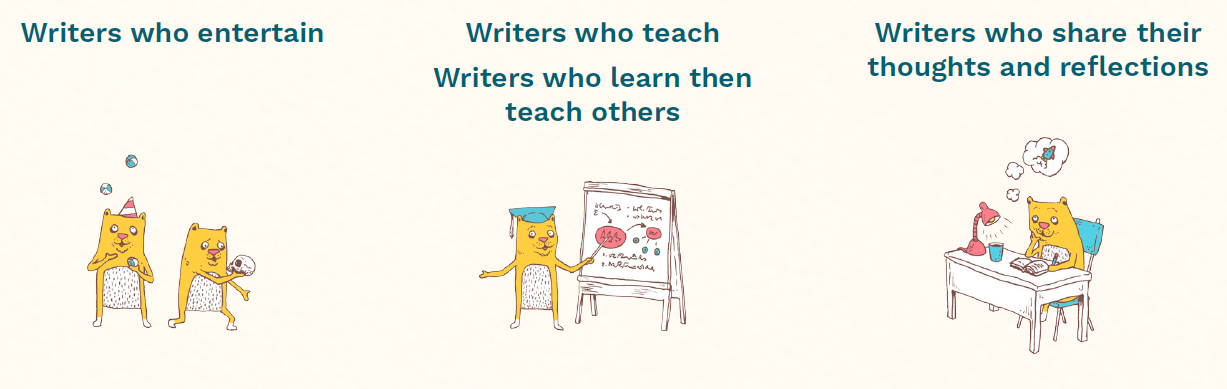
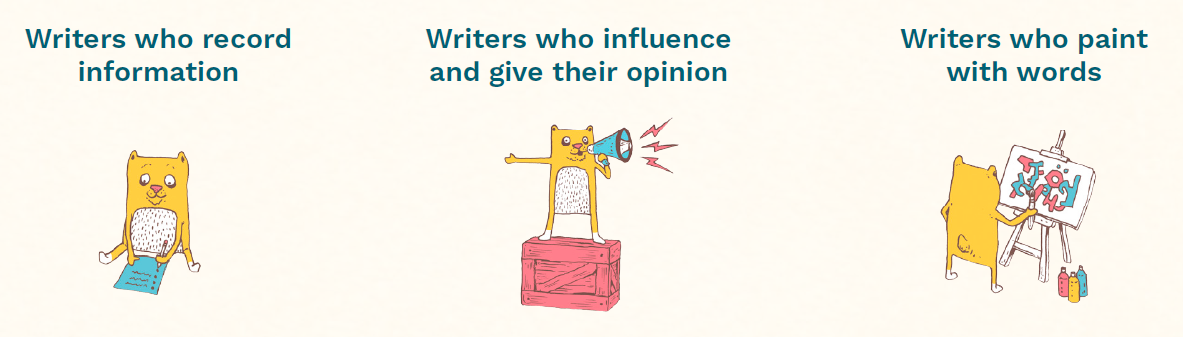
To achieve this standard, weโ€™d expect to see a selection of writing which showcases a childโ€™s ability to write for different purposes and for different audiences. To help with this, we provide children and teachers with the six most common reasons we are moved to write. These are the typical purposes for writing. They include:

(Figures from Young & Ferguson 2020 p.5-7)

Of course, these arenโ€™t static. They can be used in conjunction with one another. Indeed, by combining different writing purposes together, children and teachers can enhance their texts. For example, teaching people in a way that is entertaining can enhance our audienceโ€™s reading experience. Alternatively, writing a reflective memoir whilst painting with words can bring an artistry and literary quality to our memories. This is something to look out for when assessing a childโ€™s portfolio.

In terms of audience, a childโ€™s portfolio should show how theyโ€™ve written for or to different people. For example, you might see them writing for younger children, writing for their peers and writing to people in positions of power and influence. You might see how they are writing to people they know well or to people theyโ€™ve never met. You will notice how they have taken their audiences’ needs and tastes into account when writing.  

To help achieve this statement, consider the following teaching practices:

  • Make sure you have taught a variety of class writing projects [LINK].
  • Set a publishing goal for class writing projects [LINK].
  • Discuss your audiences and what they might want or need from you [LINK].
  • Read as writers and undertake genre study to understand what craft moves may be required for the project [LINK].
  • From your genre study, establish a list of product goals for the project. This is a list of things you and the class think you will need to do or include to write successfully [LINK].
  • Have revision checklist sessions where children can reflect on their use of the product goals and โ€˜try outโ€™ any that they may have overlooked [LINK].

Working at the expected standard: In narratives, describe settings, characters and atmosphere 

To achieve this standard, weโ€™d expect to see children writing flash-fiction and short story pieces. These narratives would showcase their use of setting, character and atmosphere craft moves. To help with this, we provide an apprenticeship and progression across Key Stage Two. In Year Three, children are expected to write fairytales and fables. The focus here is on plot and understanding different emotional story arcs. Next, in Year Four, children learn to write character-driven and setting-focused short stories. Here they learn a host of important narrative craft moves. In Year Five, they build on this knowledge and experience to write developed short stories and graphic novels. This is an opportunity to embed their understanding of setting, character and atmosphere. Finally, in Year Six, children use all that theyโ€™ve learnt to write a collection of flash-fiction pieces. This collection will showcase their abilities to attend to settings, characters and atmosphere. 

To help achieve this statement, consider the following teaching practices:

  • Teach narrative craft moves and ensure there is a progression and development of these craft moves across KS1 and KS2 [LINK].

Working at the expected standard: Integrate dialogue in narratives to convey character and advance the action

To achieve this standard, weโ€™d expect to see children using dialogue as a way of revealing something about a character you wouldnโ€™t have otherwise known. You gain just a little insight into their history, psyche, motivation or morality. How characters talk to each other and what they choose as topics of conversation tells you a lot about them. In addition, itโ€™s an opportunity to move the story forward. 

To help achieve this statement, consider the following teaching practices:

  • Read as writers to see how other writers use dialogue [LINK].
  • Teach craft moves about dialogue and invite children to use these moves in their writing that day [LINK].

Working at the expected standard: Select vocabulary and grammatical structures that reflect what the writing requires

To achieve this standard, weโ€™d expect to see how children have applied certain grammar craft moves taught by their teacher and have used them in the context of their very own writing. In addition, weโ€™d see evidence that children have (re)considered their use of vocabulary, ensuring that their audiences will understand them easily. If they are unsure, they will take time to explain certain terms.

To help achieve this statement, consider the following teaching practices:

  • Discuss your audience(s) and what they might want or need from you [LINK].
  • Read as writers and undertake genre study to understand what grammar craft moves may be required for the project [LINK].
  • From your genre study, establish a list of product goals for the project. This is a list of things you and the class think you will need to do or include to write successfully [LINK].
  • Teach grammar craft moves which match the needs of the class writing project [LINK].
  • Have revision checklist sessions, where children can reflect on their use of the product goals and โ€˜try outโ€™ any that they may have overlooked [LINK].
  • Plan Use Of Vocabulary sessions at the proof-reading stage [LINK].

Working at the expected standard: Use a range of devices to build cohesion within and across paragraphs

To achieve this standard, weโ€™d expect to see children using cohesive craft moves to prevent their reader from becoming confused and to keep them on track. For example, within their portfolio of writing, you would expect to see some craft moves like colons, semi-colons, relative clauses, parenthesis, modal verbs, fronted adverbials, synonyms, headings, paragraphs, pilcrows, bullet points, conjunctions, prepositions and adverbs being used. 

In addition, itโ€™s important to remember that a writerโ€™s planning is also a device they use to ensure cohesion so donโ€™t forget to include these in a childโ€™s writing portfolio. 

To help achieve this statement, consider the following teaching practices:

  • Make sure you teach children a variety of planning strategies and include their planning in their writing portfolios [LINK].
  • Read as writers and undertake genre study to understand what grammar craft moves may be required for the project [LINK].
  • From your genre study, establish a list of product goals for the project. This is a list of things you and the class think you will need to do or include to write successfully [LINK].
  • Teach grammar craft moves which match the needs of the class writing project [LINK].
  • Teach sentence-level craft moves which match the needs of the class writing project [LINK].
  • Explicitly teach proof-reading [LINK].

Working at the expected standard: Use verb tenses consistently and correctly throughout their writing

To achieve this standard, ensure there is evidence showing how children have attended to their verb tense use to ensure that it remains consistent. For children with English as an additional language, this is often a particular area of focus [LINK].

To help achieve this statement, consider the following teaching practices:

  • Read as writers and undertake genre study to understand what grammar craft moves may be required for the project [LINK].
  • Plan Use Of Vocabulary sessions at the proof-reading stage [LINK].

Working at the expected standard: Use the range of punctuation taught at Key Stage Two mostly correctly

To achieve this standard, ensure that, across a portfolio of writing, children have used the range of punctuation taught at Key Stage Two. This includes: capitalisation, end marks (full stops, question marks and exclamation marks), commas for a list, apostrophes for singular and plural possession, direct speech punctuation, brackets, dashes, semi-colons, colons, hyphens, ellipsis and commas.

To help achieve this statement, consider the following teaching practices: 
  • Teach grammar craft moves [LINK].
  • Explicitly teach proof-reading [LINK].

Working at the expected standard: Spell correctly most words from the Year 5-6 spelling list and use a dictionary to check the spelling of uncommon or more ambitious vocabulary

To achieve this standard, weโ€™d expect to see evidence of children attending to their spellings. This includes ensuring they have spelt any words from the Year 5-6 spelling list correctly. It may be useful for teachers to broaden their definition of what a dictionary actually constitutes. For example, children can check their spellings using Google search, electronic spell checkers, the book they are currently reading, common word lists, smart speakers, iPads and online dictionaries. They of course should be invited to ask their friends how certain words are spelt if they are unsure. 

With regards to the use of ambitious vocabulary, there should be evidence that children have (re)considered their vocabulary choices and used synonyms for certain words where theyโ€™ve felt it was appropriate. 

To help achieve this statement, consider the following teaching practices: 

  • Deliver explicit spelling instruction [LINK].
  • Plan Spelling sessions at the proof-reading stage [LINK].
  • Plan Use Of Vocabulary sessions at the proof-reading stage [LINK].

Working at the expected standard: Maintain legibility in joined handwriting when writing at speed

To achieve this standard, weโ€™d expect a childโ€™s writing portfolio to showcase some examples of legible handwriting. Having a genuine purpose and audience for your writing is a great reason for ensuring others can read your writing. In addition, being given time to publish and focus solely on the legibility of your handwriting is particularly useful for children who otherwise struggle. 

To help achieve this statement, consider the following teaching practices: 

  • Deliver explicit handwriting instruction [LINK].
  • Provide additional instruction and practice for children who need it [LINK].
  • Integrate your handwriting instruction and pupil-conferencing into publishing sessions.

Working at greater depth: Write effectively for a range of purposes and audiences, selecting the appropriate form and drawing independently on what they have read as models for their own writing

To achieve this standard, weโ€™d expect to see a selection of writing which showcases a childโ€™s ability to write for different purposes and for different audiences. You can see that they have selected the right genre for what it is they wanted to achieve. In addition, they have used craft moves which are appropriate to the type of writing they have produced. 

In addition, we expect to see children using intertextuality when coming up with their own writing ideas. Intertextuality, also known as creative play(giarism), cross-fertilization, creative reconstruction, remixing, borrowing, or โ€˜writing under the influenceโ€™ (Ferguson & Young 2023), is the idea that we consciously or subconsciously draw on what we read to help us with our own writing. Children will naturally use their own wider reading as mentor texts, so itโ€™s imperative that in school they are given copious amounts of time to read independently and for pleasure, with a library of rich and varied books readily to hand. In addition, children must have time to read as writers and undertake genre study. Finally, children must be taught idea generation strategies which encourage them to engage in intertextuality.

To help achieve this statement, consider the following teaching practices: 

  • Ensure children have time to pursue their own personal writing projects [LINK].
  • Read as writers and undertake genre study to understand what craft moves may be required for the project [LINK].
  • Ensure children generate their own ideas for writing by teaching them a variety of idea generation strategies, particularly strategies which encourage them to use intertextuality [LINK].
  • Ensure children have access to mentor texts throughout a class writing project [LINK].

Working at greater depth: Distinguish between the language of speech and writing and choose the appropriate register

Linguist Michael Halliday (cited in Young & Ferguson 2021) suggests that a piece of writing will be made up of three interrelated โ€˜metafunctionsโ€™. These metafunctions affect the type of language we use when writing in different genres and for different audiences. According to Halliday, the โ€˜registerโ€™ of a piece of writing is composed of field, tenor, and mode.

  • Field is about the child choosing an appropriate idea or topic for their audience. It involves children sharing their knowledge, opinion, thoughts, creative artistry, stories, and/or reflections in a way their reader will understand, appreciate and enjoy. Put simply, does the child regularly choose suitable topics to share with their audiences?
  • Tenor is about the child considering their role as the writer and how they will talk, relate to, and interact with their readership. Put simply, do they regularly โ€˜talkโ€™ to their readers in a way that is appropriate?
  • Mode is about discussing how best to share their information in terms of structure, visual devices and organisation, and how best to publish or perform their writing. Put simply, is their writing well organised and easily understood?

At times, youโ€™ll meet children who understand the conventions of certain genres so well that they will actually deliberately play around or subvert them for effect. These children should certainly be considered to be achieving this statement too.

To help achieve this statement, consider the following teaching practices:

  • Make sure you have taught a variety of different class writing projects [LINK].
  • Set a publishing goal for class writing projects [LINK].
  • Discuss your audiences and what they might want or need from you [LINK].
  • Read as writers and undertake genre study to understand what craft moves may be required for the project [LINK].
  • From your genre study, establish a list of product goals for the project. This is a list of things you and the class think you will need to do or include to write successfully [LINK].
  • Have revision checklist sessions where children can reflect on their use of the product goals and โ€˜try outโ€™ any that they may have overlooked [LINK].

Working at greater depth: Exercise an assured and conscious control over levels of formality, particularly through manipulating grammar and vocabulary to achieve this

This statement places particular focus on childrenโ€™s ability to choose an appropriate โ€˜tenorโ€™ for their writing. Put simply, has the child considered their role as the writer and how they will talk, relate to, and interact with their readership? Do they regularly address their readers in a way that is appropriate? Do they use vocabulary that their reader will understand? If they are unsure, have they taken time to explain key terms or ideas?

To help achieve this statement, consider the following teaching practices:

  • Make sure you have taught a variety of different class writing projects [LINK].
  • Set a publishing goal for class writing projects [LINK].
  • Discuss your audiences and what they might want or need from you [LINK].
  • Read as writers and undertake genre study to understand what craft moves may be required for the project [LINK].
  • From your genre study, establish a list of product goals for the project. This is a list of things you and the class think you will need to do or include to write successfully [LINK].
  • Teach grammar craft moves [LINK].
  • Have revision checklist sessions where children can reflect on their use of the product goals and โ€˜try outโ€™ any that they may have overlooked [LINK].
  • Plan Use Of Vocabulary sessions at the proof-reading stage [LINK].

Working at greater depth: Use the range of punctuation taught at Key Stage Two correctly and, when necessary, use such punctuation precisely to enhance meaning and avoid ambiguity

To achieve this standard, ensure that, across a portfolio of writing, children have used the range of punctuation taught at Key Stage Two. This includes: capitalisation, end marks (full stops, question marks and exclamation marks), commas for a list, apostrophes for singular and plural possession, direct speech punctuation, brackets, dashes, semi-colons, colons, hyphens, ellipsis and commas.

To help achieve this statement, consider the following teaching practices: 
  • Teach grammar craft moves [LINK].
  • Teach sentence-level craft moves [LINK].
  • Explicitly teach proof-reading [LINK].

14 Ways To Improve The Writing Teaching In Your School

In this blogpost, we are going to cover three things: 

  • Firstly, we are going to share with you what cognitive science has to say about childrenโ€™s writing development. Spoiler – writing is really hard.
  • Next, we are going to discuss how important it is that we attend to childrenโ€™s affective writerly needs and their connection to academic performance.
  • Finally, we are going to share what research evidence has long told us are the 14 principles of effective writing teaching.

Before we start, weโ€™d like to give a little bit of background about ourselves. The Writing For Pleasure Centre was set up to disseminate what is presently known from research about the principles of world-class writing teaching. At The Writing For Pleasure Centre, we are continually interpreting these principles with our own school partners so we can better understand how these principles can be realised in our classrooms (Young & Ferguson 2023a). Thatโ€™s what we spend the majority of my time doing. We are also invited to work generally with schools who may not wish to become โ€˜Writing For Pleasureโ€™ schools but are still interested in how evidence-based practices could influence and contribute to their existing teaching.

We simply share these 14 principles as the professionโ€™s current โ€˜best betโ€™ and as the closest thing we have at the moment to a โ€˜sure thingโ€™ (Young & Ferguson 2023a).

Itโ€™s important that we recognise that you, as teachers, as dedicated and informed professionals, bring valuable experience and expertise to your own writing classrooms. There will be things that you know โ€˜workโ€™. Therefore the job of this blogpost is to share the fourteen โ€˜ingredientsโ€™ of effective practice, and for you to think about how you might want to use them – to make your own โ€˜recipeโ€™ – a recipe which works best for you and your school.

To give you some background, some years ago, my colleague Felicity Ferguson and I were teaching at our local primary school and we came to the conclusion that we were probably the worst teachers of writing in the whole entire world. We hated doing it, we hated teaching it, and our students got terrible results. Our students also hated writing and they hated us teaching it too! 

We tried all the popular approaches in the UK at the time and none of them worked. We were frustrated. We wanted to do something about it. We decided that we would build a writing pedagogy from scratch and base it on what the science and research evidence said was the most effective and affecting practice (Young & Ferguson 2021a, 2022a, 2023a). We were no longer going to leave things to chance.

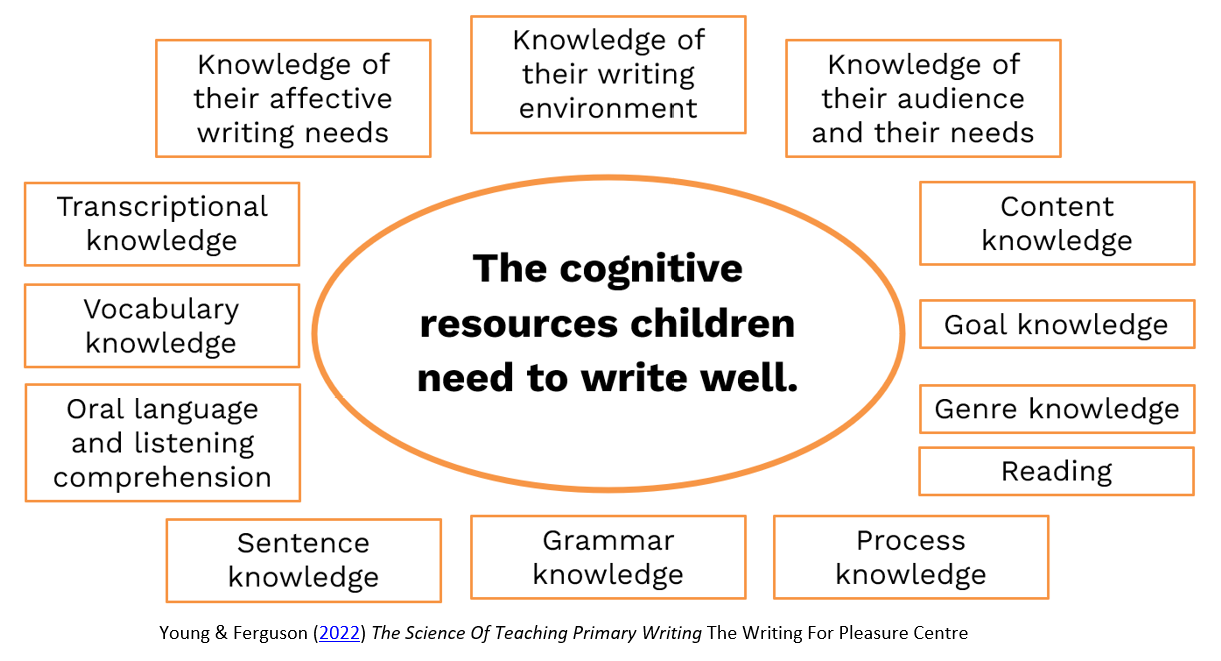
The first thing we need to acknowledge is that writing is really really hard. Itโ€™s probably the most cognitively demanding thing children have to do while they are at school. As this diagram, taken from our publication The Science Of Teaching Primary Writing, shows, children have to draw on at least thirteen different cognitive resources to write well. These include: knowledge of their writing environment; knowledge of their audience and their needs as readers; their content knowledge; goal knowledge; genre knowledge; their reading abilities; their knowledge of the writerโ€™s process; grammar knowledge; sentence-level knowledge; oral language and listening comprehension; vocabulary knowledge; transcriptional knowledge, and knowledge of their own emotional and affective writerly needs.

So writing is cognitively challenging. But it also means itโ€™s incredibly rewarding. Children are built to desire literacy. They love making and sharing meaning, through writing, with others. They can quickly become addicted to it as a pursuit. There is no doubt about that. However, if our teaching practices donโ€™t attend to their affective needs, children can soon find themselves hating writing and underachieve as a result. For example, research by the National Literacy Trust has shown that children who enjoy writing are eight times more likely to write above the expected standard. Children who dislike writing are seven times more likely to write below the expected standard. At present, childrenโ€™s writing enjoyment is at its lowest since records began. This means we have a significant number of pupils underachieving (unnecessarily) in writing due to a lack of enjoyment. 

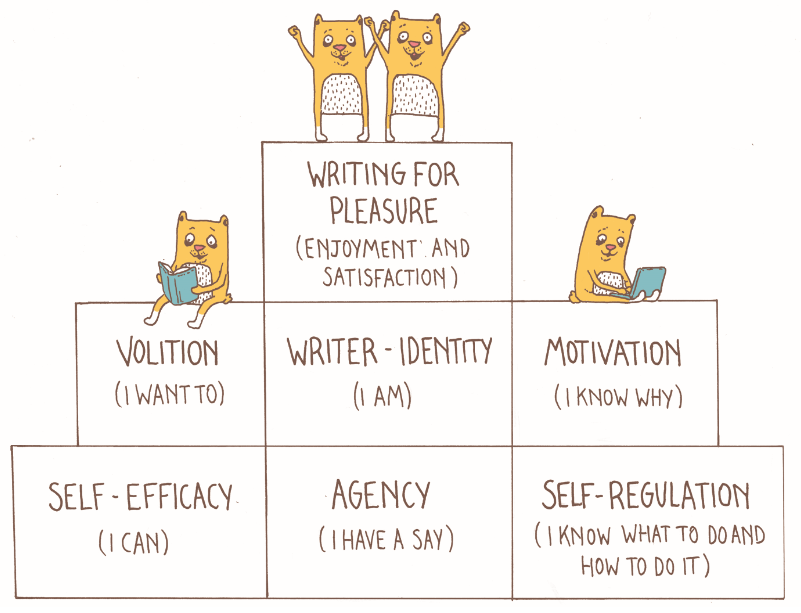
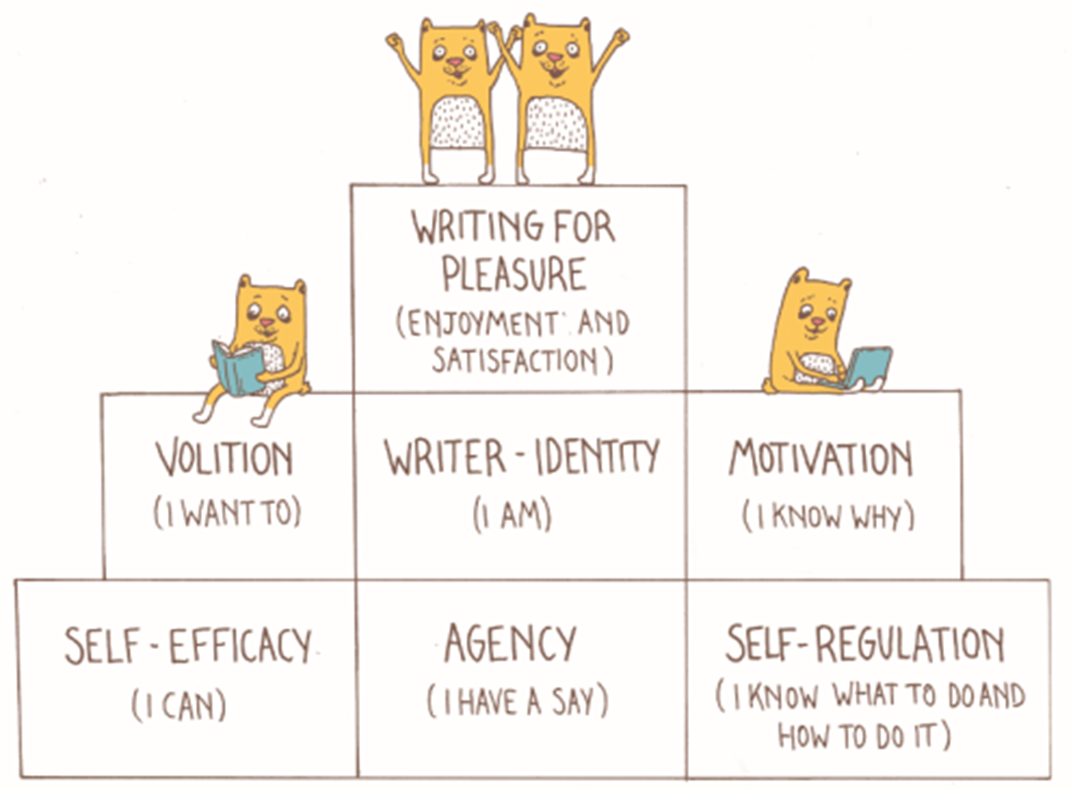
This diagram, taken from our publication Writing For Pleasure, shows children have certain affective (what we can call emotional and motivational needs) that must be attended to if they are going to produce their best writing. Research has shown that there is a clear link between children having these needs met and exemplary writing teaching and exceptional academic progress being achieved. These affective needs include:ย 

  • Self-efficacy – a sense of confidence.
  • Agency – feeling like they have ownership over their writing and what they would like to write about.
  • Self-regulation – a feeling of competence and an ability to write well independently – without constant adult intervention.
  • Volition – a need, a deep desire, to write.
  • Motivation – knowing why they are producing the writing they are making – knowing what has moved them to write what they are writing.
  • Writer-identity – feeling a sense that they are a real writer who does the same things other adult writers do.

If we attend to these needs, children write for pleasure. This means they not only enjoy making writing but they also feel a deep satisfaction and pride from producing writing that is of the highest possible quality.

To date, The Writing For Pleasure Centre has conducted a total of forty-six research reviews spanning more than fifty years of scientific research. First, we started with the meta-analyses. For those who might not be familiar with the term, a meta-analysis is where a researcher will group many scientific studies on a particular subject in order to identify recurring patterns of effectiveness. We then read what case studies tell us about what the best performing writing teachers do in their classrooms which makes the difference. 

We discovered that there are 14 things these teachers seem to do consistently. They are enduring principles which represent the most effective teaching practice. These principles all have a solid track record of raising standards and accelerating progress in writing. These principles are:

  • Build a community of writers
  • Treat every child as a writer
  • Read, share, think and talk about writing
  • Pursue purposeful and authentic class writing projects
  • Teach the writing processes
  • Set writing goals
  • Be reassuringly consistent
  • Pursue personal writing projects
  • Balance composition & transcription
  • Teach daily mini-lessons
  • Be a writer-teacher
  • Pupil-conference: meet children where they are
  • Connect reading & writing
  • Interconnect the principles

Once these principles were identified, we reviewed the research on each one to help us better understand what we could be doing in our classroom to make the difference. In the end, we decided to call our approach the Writing For Pleasure pedagogy. And now, Writing For Pleasure is just a nicer sounding synonym for the pursuit of world-class writing teaching and evidence-based practice. What we found out from all this work has since been published as a book called Writing For Pleasure: Theory, Research & Practice (Young & Ferguson 2021a).

So weโ€™ve achieved the first aim for this blogpost – weโ€™ve told you what the effective practices are. We now need to tell you why. Itโ€™s then up to you to decide how you might use these principles in your school. And of course, weโ€™re hoping that many of these principles arenโ€™t new to you. We suspect you will hear many things that you already currently do in your school. With that said, Weโ€™re hoping you hear about a few new things you might like to investigate further.

To help us, weโ€™re going to share the โ€˜effect-sizesโ€™ taken from the meta-analyses research with you. Now, anything above a +0.4 is generally considered by researchers to have a significant positive effect on childrenโ€™s writing performance.

Build a community of writers – (+0.89)

Why? Because โ€˜classroom community is a more potent factor in studentsโ€™ academic success than any particular instructional methodโ€™ and โ€˜little or no growth in student writing can take place in a superficial writing environmentโ€™ (Tompkins & Tway 2003; De Smedt & Van Keer 2014). This is about children coming into the writing classroom every day expecting to undertake important work. They expect to be taught and treated like writers and that they are going to be making writing for real people. Knowing that there is always a real readership for their manuscripts sets the highest possible expectations.

Treat every child as a writer – (these 14 principles support all learners)

Why? The most effective writing teachers do not confine their lower-achieving pupils to mundane writing exercises or worksheets. Instead, all children are supported to participate in class writing projects (Young & Ferguson 2022c, 2023b). The best performing teachers:

  1. Hold more pupil conferences.
  2. Encourage co-operative learning with more experienced friends.
  3. Give short additional mini-lessons through group teaching to their pupils with SEND or EAL.
  4. Write alongside their least-experienced writers.

Read, share, think and talk about writing – (+0.89)

Why? Children learn from each otherโ€™s developing compositions and from hearing how certain writing strategies, techniques, literary devices or what we call โ€˜craft movesโ€™ are being applied by others (including their commercial authors, their peers and their writer-teacher) (Graham et al. 2012; Graham & Harris 2019; Young & Ferguson 2023c).

Pursue purposeful and authentic class writing projects – (+1.07)

Why? Because childrenโ€™s writing outcomes are improved if they engage in challenging and extended class writing projects where they write for authentic purposes and real and varied audiences (Graham & Perin 2007; Dombey 2013; Grossman et al. 2013; Morizawa 2014).

Teach the writing processes – (+1.26)

Why? Because explicitly teaching children about the writing processes and how to use them in a self-regulating way is shown to be highly effective practice (Graham et al. 2012; Graham & Perin 2007; Morizawa 2014). The writing processes include: generating ideas, planning, drawing, talking, sharing, drafting, re-reading, revising, proof-reading and publishing (Young & Ferguson 2022d, 2022b, 2022e, 2023d).

Set writing goals – (+2.03)

Why? Goal setting is by far the most effective practice teachers can employ to improve childrenโ€™s writing outcomes (Koster et al. 2015; Young & Hayden 2022). It involves setting:

  1. publishing goals (children knowing who they are giving their writing to at the end of a project). LINK
  2. product goals (what they need to do or include to write a great piece). LINK
  3. process goals (little deadlines which are set along the way to publishing). LINK

Be reassuringly consistent (+1.75)

Why? Having a reassuringly consistent and comprehensive approach to writing teaching across your whole-school improves the quality of childrenโ€™s writing (LINK, LINK, LINK). From the EYFS onwards, children need some explicit instruction, a sustained and meaningful period in which to engage in writing, and some time to share and get feedback from their teacher/peers every single day (Hall and Harding 2003; Graham et al. 2012; Morizawa 2014; Graham & Perin 2007; Graham & Sandmel 2011).

Pursue personal writing projects (+0.94 and +1.75)

Why? Children become better writers by writing (Graham et al. 2012, 2015). Giving children additional daily time to work on self-chosen personal writing projects is shown to have a positive effect on their writing development (Gadd 2014; Dombey 2013; Young & Ferguson 2021b). Giving children access to a Writing Centre, modelling how to use it, and modelling how to take materials to other areas in the provision gives us the positive effective size of +0.94 in the EYFS context (Hall et al. 2015; Young & Ferguson 2022b).

Balance composition & transcription (+0.54, +0.58 and +0.36)

Why? Early on in a writing project, the best writing teachers teach lessons focused on composition to ensure quality. Towards the end of a project, they move their focus towards teaching about transcription to ensure accuracy. This means teachers give children specific instructional time to come up with ideas, draw and/or plan (+0.54)(+1.55 for children SEND) and specific time to revise (0.64) and then proof-read their pieces prior to publication (+0.58) (Dombey 2013; Graham et al. 2015b; Graham & Harris 2019; Young & Ferguson 2022d, 2022e, 2023d). 

Additional and dedicated instruction in spelling and handwriting yields an effect size of (+0.36). However, for children with SEND who need it, it can have an effect size of +2.40 (Young & Ferguson 2023b). 

Finally, teachers in the EYFS and KS1 should focus their attention on developing childrenโ€™s โ€˜writing fluencyโ€™ (LINK).

Teach daily mini-lessons (+1.75, +0.46, and -0.4)

Why? Teaching โ€˜craft knowledgeโ€™ through โ€˜self-regulation strategy development instructionโ€™ is the most validated teaching practice a teacher of writing can employ (LINK). The key here is teaching a single strategy before inviting children to apply that taught strategy to their writing that day (+1.75)(+2.09 for children with SEND). The same concept applies to grammar and sentence-level teaching (+0.46) (Graham and Perin 2007; Graham et al. 2012; Grossman et al. 2013; Koster et al. 2015; Young et al. 2021; Young & Ferguson 2022f; Young & Ferguson 2021c).

Be a writer-teacher (+0.54, +2.48 for children with SEND)

Why? Put simply, itโ€™s difficult to employ the most effective teaching practices if you arenโ€™t a writer-teacher (Hillocks 1986; Cremin & Oliver 2017; Parr & Limbrick 2011; Troia 2014; Hall et al. 2015). Not being a writer-teacher is like trying to teach a tuba lesson without ever having played the tuba (Graves 1983, LINK, LINK).

Pupil-conference: meet children where they are (+0.80)

Why? Excessive written feedback or extensive error correction has little to no positive impact on young writersโ€™ academic progress. Indeed, negative comments and heavy marking repeatedly result in children feeling less enthusiasm for writing, writing less, and having a low opinion of themselves as writers. In turn, this results in children doing the minimum to get by (Young & Ferguson 2021a).

However, when children receive short, positive, and focused verbal feedback from their teachers while they are actually engaged in writing, they revise their compositions to a significantly higher standard. Itโ€™s the combination of personalised instruction and immediate verbal feedback that appears to be the reason why pupil-conferencing is such a highly effective practice (Hillocks 1986; Dombey 2013; Graham & Perin 2007; Graham et al. 2012; Grossman et al. 2013; Morizawa 2014; Ferguson & Young 2021).

Connect reading & writing (+0.50, +0.76, +0.94 for children with SEND)

Why? This is what we currently know about the reading/writing connection:

  • Giving children ample time to read enhances the quality of their writing.
  • The more children are given an opportunity to write in reading lessons, the more their reading comprehension improves. There is also a modest improvement in their writing (+0.50). However, we have to say using a reading scheme as your writing approach is nowhere near an adequate substitute for an explicit writing approach and explicit writing lessons.
  • Explicit writing instruction supports childrenโ€™s reading development.

We also know that when children study mentor texts – texts which match the kind of texts they are actually going to go on to write themselves, children perform better (+0.76)(+0.94 for children with SEND).

(Koster et al. 2015; Graham & Hebert 2011; Graham et al. 2018; Young & Ferguson 2023c)

Interconnect the principles

Why? The best performing writing teachers try to blend all these principles of practice (Graham & Perin 2007; De Smedt & Van Keer 2014; Grossman et al. 2013; Gadd 2014, Morizawa 2014; Young & Ferguson 2021a).

***

We hope that you found this blogpost really affirming. As dedicated professionals, we are sure youโ€™ve heard much of your current practice described. We therefore hope that this blogpost was reassuring but hopefully itโ€™s given you a few new things to go away and explore too. With this in mind, youโ€™ll find lots of free-to-access articles and examples of practice on our website. However, if youโ€™d like to access our paid resources and support the work we do, please may we invite you to consider becoming a member. This gives you access to our complete programme of study, planning, resources and eBooks.

We also provide INSET and residency training. Please get in touch if this is something youโ€™re interested in.ย 

References

  • Cremin, T., Oliver, L. (2017). Teachers as writers: A systematic review. Research Papers in Education, 32(3), 269โ€“295
  • De Smedt, F., and Van Keer, H. (2014). A research synthesis on effective writing instruction in primary education. Procedia Social and Behavioral Sciences, 112, 693โ€“701
  • Dombey, H. (2013). Teaching Writing:What the Evidence Says UKLA Argues for An Evidence-informed Approach to Teaching and Testing Young Childrenโ€™s Writing. London: UKLA
  • Ferguson, F., Young, R. (2021) A Guide To Pupil-conferencing With 3-11 Year Olds: Powerful Feedback & Responsive Teaching That Changes Writers Brighton: The Writing For Pleasure Centre
  • Gadd, M. (2014). What is Critical in the Effective Teaching of Writing? Auckland:The University of Auckland.
  • Graham, S., and Perin, D. (2007). Writing Next: Effective Strategies to Improve Writing of Adolescents in Middle School & High Schools.Washington, DC:Alliance for Excellent Education
  • Graham, S., and Sandmel, K. (2011). The process writing approach: A meta-analysis. Journal of Educational Research, 104, 396โ€“407.
  • Graham, S., McKeown, D., Kiuhara, S., and Harris, K. (2012). A meta-analysis of writing instruction for students in the elementary grades. In Journal of Educational Psychology, 104(4), 879โ€“896.
  • Graham, S., Harris, K., Santangelo, T. (2015). Research-based writing practices and the common core. Elementary School Journal, 115(4), 498โ€“522
  • Graham, S., Hebert, M., & Harris, K. R. (2015b). Formative assessment and writing: A meta-analysis. The Elementary School Journal, 115(4), 523โ€“547
  • Graham, S., Xinghua, L., Aitken, A., Ng, C., Bartlett, B., Harris, K., and Holzapfel, J. (2018). Effectiveness of literacy programs balancing reading and writing instruction: A metaanalysis. Reading Research Quarterly, 53(3), 279โ€“304.
  • Graham, S., and Harris, K. (2019). Evidence-based practices in writing. In Best Practices in Writing Instruction, Graham, S., MacArthur, C., and Hebert, M. (Eds.) (3rd Ed.) (pp. 3โ€“31). New York:The Guilford Press.
  • Graves, D. (1983) Writing: Children & Teachers At Work Portsmouth: Heinemann
  • Grossman, P.L., Loeb, S., Cohen, J., and Wyckoff, J. (2013). Measure for measure:The relationship between measures of instructional practice in middle school English Language Arts and teachersโ€™ value-added scores. American Journal of Education, 119(3), 445โ€“470
  • Hall, K., Harding, A. (2003). A Systematic Review of Effective Literacy Teaching in the 4 to14 Age Range of Mainstream Schooling. London: Institute of Education.
  • Hall, A., Simpson, A., Guo, Y., Wang, S. (2015) Examining the Effects of Preschool Writing Instruction on Emergent Literacy Skills: A Systematic Review of the Literature, Literacy Research and Instruction, 54:2, 115-134
  • Hillocks, G. (1986). Research on Written Composition: New Directions for Teaching. Urbana, IL: National Council of Teachers of English.
  • Koster, M.,Tribushinina, E., De Jong, P.F., and Van de Bergh, B. (2015).Teaching children to write: A meta-analysis of writing intervention research. Journal of Writing Research, 7(2), 249โ€“274
  • Morizawa, G. (2014). Nesting the Neglected โ€˜Rโ€™ A Design Study:Writing Instruction within a Prescriptive Literacy Program (Doctoral dissertation). University of California, Berkeley.
  • Parr, J.M., and Limbrick, L. (2010). Contextualising practice: Hallmarks of effective teachers of writing. Teaching and Teacher Education, 26(3), 583โ€“590.
  • Tompkins, G.E., and Tway, E. (2003).The elementary school classroom. In Handbook of Research on Teaching the English Language Arts, Flood, J., Lapp, D., Squire, J.R., and Jensen, J.M. (Eds.) (2nd Ed.) (pp. 501โ€“511). Mahwah, NJ: Lawrence Erlbaum Publishers
  • Toria, G. (2014). Evidence-based practices for writing instruction. In CEEDAR. Lansing, MI: Michigan State University.
  • Young, R., Ferguson, F. Hayden, T., Vasques, M. (2021) The Writing For Pleasure Centreโ€™s Big Book Of Mini-Lessons: Lessons That Teach Powerful Craft Knowledge For 3-11 Year Olds Brighton: The Writing For Pleasure Centre
  • Young, R., Ferguson, F. (2021a) Writing For Pleasure: Theory, Research & Practice London: Routledge
  • Young, R., Ferguson, F. (2021b) A Guide To Personal Writing Projects & Writing Clubs For 3-11 Year Olds Brighton: The Writing For Pleasure Centre 
  • Young, R., Ferguson, F. (2021c) The Writing For Pleasure Centreโ€™s Grammar Mini-Lessons For 5-11 Year Olds Brighton: The Writing For Pleasure Centre
  • Young, R., Ferguson, F. (2022a) The Science Of Teaching Primary Writing Brighton: The Writing For Pleasure Centre
  • Young, R., Ferguson, F. (2022b) Getting Children Up And Running As Book-Makers: Lessons For EYFS-KS1 Teachers Brighton: The Writing For Pleasure Centre
  • Young, R., Ferguson, F. (2022c) A Teacherโ€™s Guide To Writing With Multilingual Children Brighton: The Writing For Pleasure Centre
  • Young, R., Ferguson, F. (2022d) No More: I Donโ€™t Know What To Writeโ€ฆ Lessons That Help Children Generate Great Writing Ideas For 3-11 Year Olds Brighton: The Writing For Pleasure Centre
  • Young, R., Ferguson, F. (2022e) No More: โ€˜My Pupils Canโ€™t Edit!โ€™ A Whole-School Approach To Developing Proof-Readers Brighton: The Writing For Pleasure Centre
  • Young, R., Ferguson, F. (2022f) The Writing For Pleasure Centreโ€™s Sentence-Level Instruction: Lessons That Help Children Find Their Style And Voice Brighton: The Writing For Pleasure Centre
  • Young, R., Ferguson, F. (2023a) Handbook Of Research On Teaching Young Writers Brighton: The Writing For Pleasure Centre
  • Young, R., Ferguson, F. (2023b) Supporting children with SEND to be great writers A guide for teachers and SENCOS Brighton: The Writing For Pleasure Centre
  • Young, R., Ferguson, F. (2023c) Reading in the writing classroom: A guide to finding, writing and using mentor texts with your class Brighton: The Writing For Pleasure Centre
  • Young, R., Ferguson, F. (2023d) No More: I Donโ€™t Know What To Write Nextโ€ฆ Lessons That Help Children Plan Great Writing Brighton: The Writing For Pleasure Centre

How we can improve the confidence of struggling writers

Self-efficacy, also described as self-belief, self-esteem, self-worth, self-affirmation, self-integrity, positive self-image, is recognised as one of the affective domains of Writing For Pleasure. This is because it’s a vital force in children’s academic success and their writerly well-being (Young & Ferguson 2021, 2023a, 2023b).

Low self-efficacy affects young writers in profound ways. Children with low self-confidence as writers generally dislike writing. They believe they cannot improve and therefore do not seek writing advice. They write the minimum required, have low aspirations, feel a sense of learned helplessness, and have little commitment to writing projects. They express negative views of themselves, and may even be depressed (Young & Ferguson 2023a, 2023b).

Importantly, research shows that self-efficacy alone is not guaranteed to improve childrenโ€™s writing performance. Instead, our teaching needs to be directed towards giving children self-efficacy alongside agency and self-regulation (Young & Ferguson 2021).

A possible hierarchy of childrenโ€™s affective emotional writerly needs as articulated by Young & Ferguson 2021

Teachers can help improve struggling writers’ sense of self-efficacy by employing the following strategies:

  1. Enacting a mastery through repeated practice orientation towards writing progress rather than creating a high-stakes performance culture (LINK and LINK).
  2. Give children regular opportunities to share what they are crafting with their friends (LINK).
  3. Establish a publishing goal with the children for class writing projects and let children hear the impact their writing has had on their readership (LINK).
  4. Set product goals for class writing projects in collaboration with the students (Young & Hayden 2022).
  5. Set a clear process goal for each writing session (LINK).
  6. Have a clear daily routine of instruction, writing time and class sharing (Kaufman & Young 2022; Young 2023).
  7. Deliver writing instruction which is in response to the classโ€™ needs. Enact a โ€˜teach and inviteโ€™ routine for instruction (LINK).
  8. Undertake daily pupil-conferencing (Ferguson & Young 2021).

Reading different types of nonfiction in the writing classroom

By writing about what they know and care about, children learn that they can use their expertise to inspire and awaken the minds and hearts of others.

Research has shown that there is a profound connection between effective writing instruction and reading. For example: reading, studying and discussing mentor texts, texts which match the kind of writing children are being invited to make for themselves, can yield a positive effect of +0.76 (Young & Ferguson 2021, 2023a). For children with SEND, it can be +0.94 (Young & Ferguson 2023b). To put those numbers in context, anything above a +0.4 is generally considered to have a significant positive impact on childrenโ€™s writing development. Based on the work of Stewart & Correia (2021), we consider there to be six major types of nonfiction that children like to read and write. Itโ€™s therefore important that the mentor texts we share with children reflect these options. This way, children know they can write in these ways too as part of a class writing project. The six popular types of nonfiction are:

  • Traditional nonfiction (objective straight teaching)
  • Browseable nonfiction (teaching through grazing)
  • Narrative nonfiction (teaching through telling a story)
  • Literary nonfiction (teaching and painting with words)
  • โ€˜Doingโ€™ nonfiction (teaching by getting them doing)
  • Faction (teaching about fantasy)

***

To find out more about reading effectively in the writing classroom, why not take a look at our eBook: Reading In The Writing Classroom: A Guide To Finding, Writing And Using Mentor Texts With Your Class.

What does the research say about reading in writing lessons?


Really, I do one thing. I read books. I write books. I think about books. Itโ€™s one job. – Toni Morrison 

Writing is the most cognitively demanding activity we ask our pupils to undertake while they are at school. It requires them to draw on at least thirteen different cognitive resources simultaneously. Cognitive psychology has revealed the amazing complexity of what children need, and need to know, in order to learn how to write competently (Young & Ferguson 2022a). It is therefore necessary for teachers to have a pedagogy for writing which takes account of all the many different elements involved in helping children not just to write, but to write well.

Research has shown that there is a profound connection between effective writing instruction and reading (Kim et al. 2023). For example: reading, studying and discussing mentor texts, texts which match the kind of writing children are being invited to make for themselves, can yield a positive effect of +0.76 (Young & Ferguson 2021, 2023a). For children with SEND, it can be +0.94 (Young & Ferguson 2023b). To put those numbers in context, anything above a +0.4 is generally considered to have a significant positive impact on childrenโ€™s writing development.

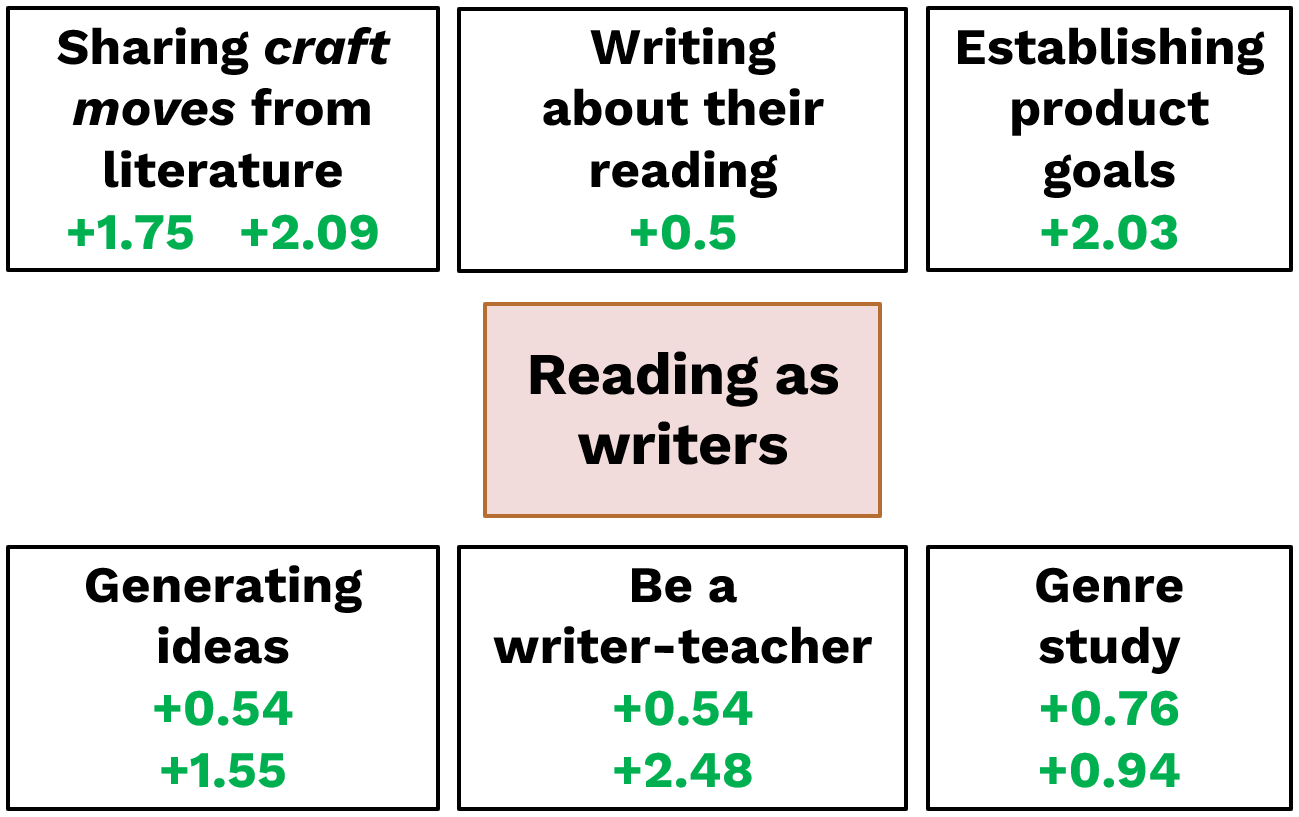
The table above shares what we currently know about the connection between reading and effective writing teaching.

In addition:

  • Having children write about their reading in reading lessons can yield an effect size of +0.5 (Young & Ferguson 2020, 2021).
  • Establishing product goals for a class writing project in response to studying a variety of mentor texts can yield an effect size of +2.03 (Young & Hayden 2022).
  • Sharing and modelling how to use certain craft moves taken from literature before inviting children to use these craft moves for themselves in that dayโ€™s writing time can yield an effect size of +1.75. For children with SEND, this can be anything up to +2.09 (Young et al. 2021).
  • A major part of reading in the writing classroom is children having an opportunity to read, discuss and hear about how you crafted your own writing. Modelling how you use your reading to support your writing, providing pupils with mentor texts youโ€™ve written, and writing alongside your pupils can yield an effect size of 0.54. For children with SEND, this can be anything up to +2.48 (Young & Ferguson 2023b).
  • Inviting children to generate and plan their own ideas for their writing (including how they can take ideas from their favourite reading) can yield an effect size of 0.54. For children with SEND, this can be +1.55 (Young & Ferguson 2022b).

***


In our eBook Reading In The Writing Classroom: A Guide To Finding, Writing And Using Mentor Texts With Your Class, we shine the spotlight on these particular aspects of research-based instructional practice and show how it can help young writers to write effectively, successfully and engagingly. We explain how teachers and students should come together to share, discuss and study mentor texts as part of a class writing project (The Writing For Pleasure Centre 2023). Writing For Pleasure teachers refuse to allow writing to remain a mystery to their pupils. Instead, through a combination of mentor texts and high-quality literature, they make writing techniques utterly explicit for their young writers. We emphasise that all children need mentor texts, from the EYFS to Year 6 and beyond.

Why Writing For Pleasure teachers are always teaching

Whole-class direct instruction, group and individualised instruction, and responsive instruction are all part of a Writing For Pleasure teacherโ€™s practice. As the most experienced writer in their classroom, they make sure they are teaching at the beginning of a writing lesson, in the middle of it and at the end.

Whole-class direct instruction: Mini-lessons

Writing For Pleasure teachers deliver direct and explicit instruction through the principles of self-regulation strategy development instruction. This is what we like to call mini-lessons. SRSD instruction is an evidence-based teaching recommendation. Research has shown that it can result in a positive effect size of +1.75 (+2.09 for children with SEND). For context, anything over +0.4 is deemed to have a significant positive effect on childrenโ€™s progress. Thatโ€™s why โ€˜teach mini-lessonsโ€™ appears as one of our 14 principles of world-class writing teaching (Young & Ferguson 2020, 2021a, 2022a, 2022b).

SRSD instruction is about teaching children strategies which enable them to be independent writers by using for themselves what theyโ€™ve been taught. Itโ€™s one of the most validated and effective practices a teacher of writing can employ in their classroom (Young & Ferguson 2022a).

All children need high-quality teaching and explicit instruction if they are to fulfil their potential as writers. This is why SRSD instruction works so well. The concept is simple. Teach your class one writerly technique, process or strategy (what we call a craft move) before inviting them to use the move for themselves in their writing that day. Case studies show that the most effective writing teachers deliver instruction in keeping with SRSD when teaching โ€˜craft knowledgeโ€™ (Young et al. 2021), โ€˜sentence-level strategiesโ€™ (Young & Ferguson 2022c) and โ€˜functional grammar lessonsโ€™ (Young & Ferguson 2021b).ย 
It can be useful to compare SRSD instruction with The Gradual Release Of Responsibility model for instruction (Pearson & Gallagher 1983).

  • I did or I do – The teacher either shares how theyโ€™ve used the craft move or models how to use it live.
  • We do – The class is invited to use and apply the craft move in their own writing that day.
  • You do – Children understand the value of the craft move and so continue to use it in their future writing, including in their personal writing projects (see Young & Ferguson 2021b).

I, We & You sits in stark contrast to the ineffective but common habit of โ€˜front loadingโ€™ writing instruction at the beginning of a writing project or lesson and proceeding to โ€˜cross your fingersโ€™ in the hope that the children will remember everything youโ€™ve tried to teach them. This kind of practice doesnโ€™t help children to write well – least of all children with SEND (Young & Ferguson 2023).

A mini-lesson typically goes something like this:

Group and individualised instruction: Pupil-conferencing 

Pupil-conferencing is about providing children with live verbal feedback and responsive individualised instruction during writing time. Itโ€™s a mini-lesson for that individual pupil (Ferguson & Young 2021). However, in a quiet and organised classroom, โ€˜overhearersโ€™ all benefit from these conversations. Pupil-conferencing is an evidence-based teaching recommendation. Research has shown that it can result in a positive effect size of +0.80. Thatโ€™s why โ€˜pupil-conferencingโ€™ appears as one of our 14 principles of world-class writing teaching (Young & Ferguson 2020, 2021a, 2022a, 2022b).

Conferencing is about spending a short amount of time with individuals or groups of children who you know would benefit most. In a conference, focus on one thing and teach it well. A good conference is about teaching something and being confident that, once you leave, the child will use and apply what youโ€™ve just taught them.

A successful pupil-conference follows a very similar structure to a mini-lesson:

Responsive instruction: Authorโ€™s Chair 

Giving children a daily opportunity to read aloud their developing compositions and discuss their pieces with their teacher and peers is an evidence-based teaching recommendation. Research has shown that it can result in a positive effect size of +0.89. Thatโ€™s why โ€˜read, share, think and talk about their writingโ€™ appears as one of our 14 principles of world-class writing teaching (Young & Ferguson 2020, 2021a, 2022a, 2022b).

At the end of daily writing time, children should be given the opportunity to talk with their friends about how their writing pieces are coming along. This can then lead into a period of Authorโ€™s Chair. This is where the whole class gathers around an โ€˜authorโ€™s chairโ€™ together. This can be an opportunity for teachers to teach responsively. Writing For Pleasure teachers are always keeping an eye out for certain craft moves or writerly behaviours children have used that they would like the rest of the class to use too. Hereโ€™s a nice routine for this kind of responsive instruction:

In summary, Writing For Pleasure teachers are always teaching. They utilise whole-class direct instruction, group and individualised instruction, and responsive instruction as part of their daily teaching practice. However, itโ€™s important to point out that this isnโ€™t the only routine Writing For Pleasure teachers will use. Once comfortable, there are endless ways in which you can play around with these key combinations (see LINK).

Type of instructionEffect size
Whole-class direct instruction: Mini-lessons+1.75 +2.09 (SEND)
Group and individualised instruction:Pupil-conferencing+0.80
Responsive instruction: Class sharing and Authorโ€™s Chair+0.89

Trust the process: setting process goals

Setting process goals is arguably the most effective thing a teacher of writing can do in the classroom. Research has shown that it can result in a positive effect size of +2.03. For context, anything over +0.4 is deemed to have a significant positive effect on childrenโ€™s progress. Thatโ€™s why goal setting appears as one of our 14 principles of world-class writing teaching (Young & Ferguson 2020, 2021, 2022, 2023a).

All children, but particularly struggling or less experienced writers, need to know exactly what they are meant to be doing during writing time (the process goal) and how to do it (the mini-lesson) (Young & Ferguson 2023b). Therefore a writing lesson should typically go something like this:

A process goal is the thing you want children to get done in that dayโ€™s writing session. The more explicit and elegant the goal can be – the better. For example:

  • Today, our goal is to plan our stories using the Story River technique. 
  • Today, our goal is to write the opening chunk of our story.
  • Today, our goal is to draft five lines – and only five lines!
  • Today, our goal is to write the second page of our Information Books.
  • Today, our process goal is to draft the end chunk to our discussion texts.
  • Today, our goal is to make the final page of our picturebooks.
  • Today our goal is to check our writing against our Revision Checklist.
  • Today, our goal is for the last few children to finish revising their pieces.
  • Today, our process goal is to check for capitalisation. 
  • Today, our goal is to check our use of tense.
  • Today, our process goal is to check punctuation – specifically our speech punctuation.
  • Today, our goal is to check our common word spellings.
  • Today, our process goal is to correct our โ€˜temporary spellingsโ€™.

You know youโ€™ve set an appropriate process goal if it can be easily achieved by all pupils in the time allocated. In Writing For Pleasure schools, children know that once theyโ€™ve achieved the process goal for that lesson, they are free to work on their own personal writing project (see our eBook A Guide To Personal Writing Projects for more details). This ensures children get the maximum opportunity possible to write for a sustained period every day.

Therefore, if you find your class isnโ€™t routinely finishing writing sessions by working on their personal writing projects, you know youโ€™ve got a problem.

Establishing publishing goals for class writing projects

A young writer not receiving opportunities to share their writing with an audience is similar to an actor who rehearsed a play that they never get to perform – Alan Wright

Seems strange to have to point this out, but – children find it difficult to consider their audienceโ€™s needs when no real audience exists for a class writing project. Too often children are asked to write on the back of unnatural stimuli, contrived topics, and fake writing situations. Situations where there will be no โ€˜realโ€™ audience to receive their writing at the projectโ€™s end. Then teachers ask us why childrenโ€™s writing lacks voice and quality. Children with SEND can have even greater difficulty connecting with these sorts of writing tasks (Young & Ferguson 2023a).

Itโ€™s important that a class has time to discuss any new writing project with their teacher. This should include establishing a clear publishing goal for the project, giving children an opportunity to consider the purpose for their writing and who they are going to be giving their writing to at the projectโ€™s end (Young & Ferguson 2021; The Writing For Pleasure Centre 2023). To help with this, Writing For Pleasure schools share with children the six most common reasons we are moved to write:

(Figures from Young & Ferguson 2020)

Of course, these arenโ€™t static. They can be used in conjunction with one another. Indeed, by combining different writing purposes together, we can enhance our texts. For example, teaching people in a way that is entertaining can enhance our audienceโ€™s reading experience. In addition, teachers would do well to focus on developing childrenโ€™s abilities to: infer, understand othersโ€™ perspectives and utilise their โ€˜theory of mindโ€™. For example, some questions teachers can ask their pupils at the beginning of a new class writing project are: 

  • Who are we making this writing for?
  • What do we know about our readers?
  • What do we think our readers will want?
  • What do we think our readers will like?
  • What will our readers be looking for?
  • What should we do and include to ensure our readers appreciate, understand and enjoy our texts?

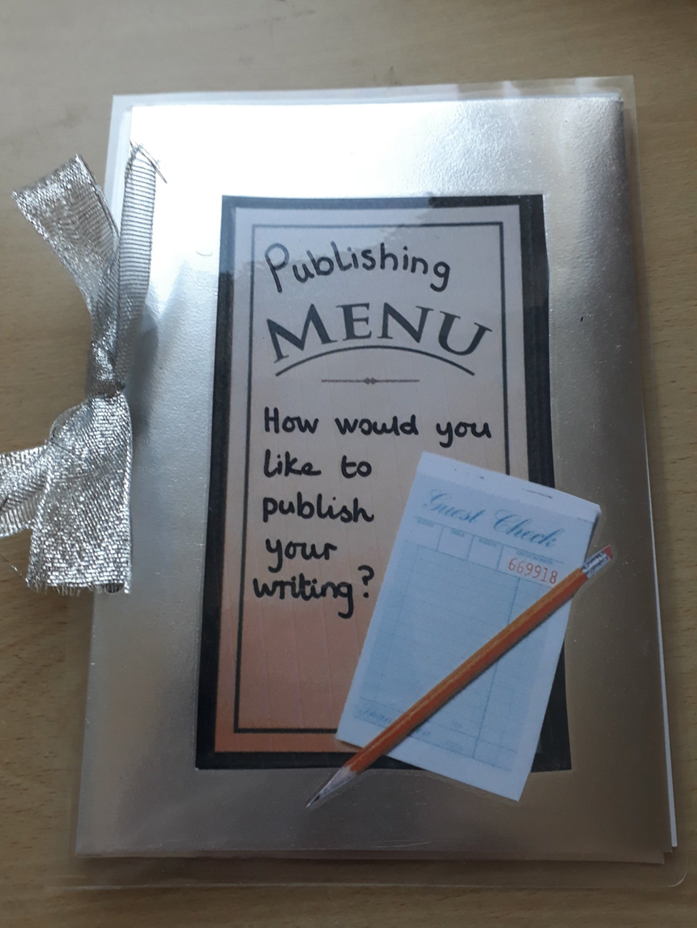
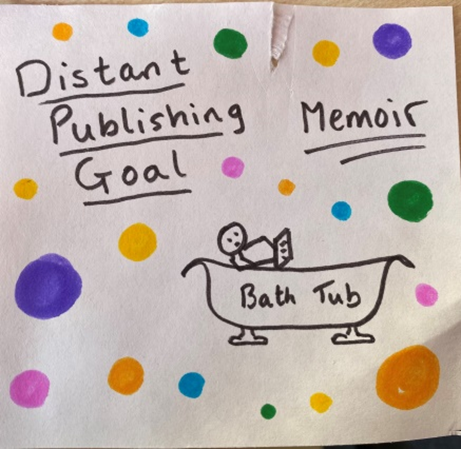
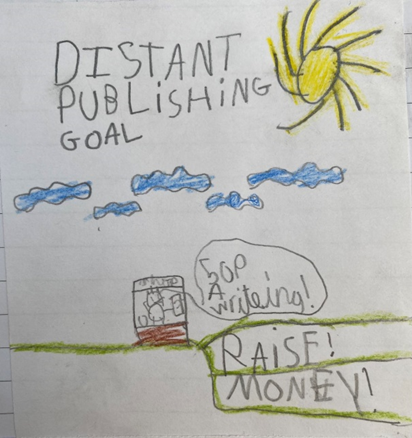
As part of our Class Writing Projects resources, we provide teachers and children with our Publishing & Performing Menu. The idea behind this resource is to help teachers and children decide together what the publishing goal for a class writing project will be. At the end of the project, the children will publish and deliver their writing to their chosen audience.

Publishing & Performing Menu

Letโ€™s choose how weโ€™d like to publish or perform our finished writing!

  • Read it out during class sharing times (in your own or in another class).
  • Have a live debate or political discussion evening centred around the writing.
  • Read it out during assembly.
  • Have a slam poetry evening.
  • Have a lunchtime or after school โ€˜coffee houseโ€™ read-aloud club.
  • Have a publishing party or a writersโ€™ picnic.
  • Hold special writing celebration evenings or exhibitions where the community can be invited in to read, hear or see live/videoed performances.
  • Put it in a frame or give it as a gift.
  • Put it on your bedroom wall.
  • Put it in the bathroom for people to read on the loo or while theyโ€™re in the bath.
  • Leave it in the car to read during traffic jams.
  • Turn it into a presentation.
  • Turn it into a film.
  • Turn it into a piece of artwork.
  • Add it to the class or school library.
  • Send it to another school either here or abroad.
  • Send it in the post to a friend or a family member.
  • Take it home to share with the family.
  • Mail it to a person who needs to read it.
  • Send it to an expert, charity or association to see what they think.
  • Collect it together with other pieces to make an anthology.
  • Share with another class via their class library.
  • Enter it into a year group, school, local or national writing competition.
  • Send it to a local or national newspaper, magazine or fanzine.
  • Publish it online.
  • Publish it in the school newsletter or newspaper.
  • Have a โ€˜lecture dayโ€™ where people can sign up to hear different speakers discuss what theyโ€™ve learnt during class topics.
  • Put on a book or poetry sale. You can sell your writing – especially if people know itโ€™s going to a good cause. It can feel good knowing your thoughts, passions and ideas are worth money. 
  • Make an audio recording for the class library or school website.
  • Suggest that it be used as an โ€˜exemplar-textโ€™, when the writing is kept by your teacher to help teach next yearโ€™s class.
  • Ask if you can place it anonymously in local establishments such as: libraries, places of worship, local history centres, museums, art galleries, train stations, bus stops, bookshops, cornershop windows, lamp posts, gates, fences, takeaways, retirement homes, cafes, coffee-houses, pubs, sports-clubs, dentistsโ€™ or doctorsโ€™ surgeries, on buses or trains.

Filling in the GAP

Over the years, Iโ€™ve noticed how I typically โ€˜sellโ€™ a new class writing project to my class. I fill in the GAP. I do this implicitly. However, there is no reason why a teacher couldnโ€™t make this explicit by filling out a table with their class, like the one below. GAP stands for Genre, Audience & Purpose

Itโ€™s so important on the first day of any new writing project that you introduce the genre the class will be studying and creating for themselves. You also need to decide on the audience that is going to receive the writing once itโ€™s made, and the purpose youโ€™re looking for the writing to serve. For example:

The key thing to remember is: wherever you see writing out in the world, thatโ€™s where your childrenโ€™s writing can go. Think of people who regularly get written to – your class can send them their writing too.

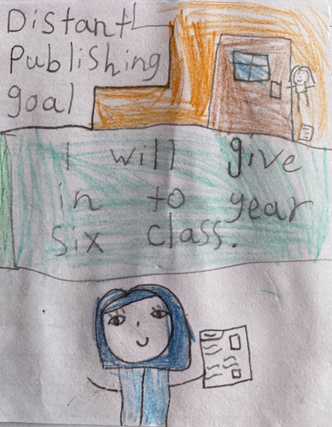
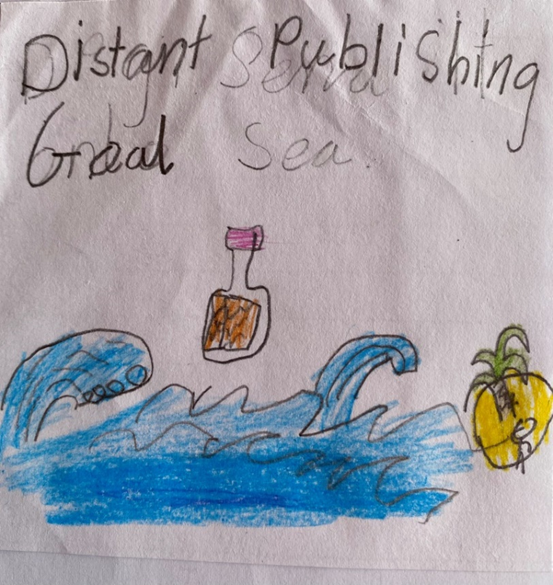
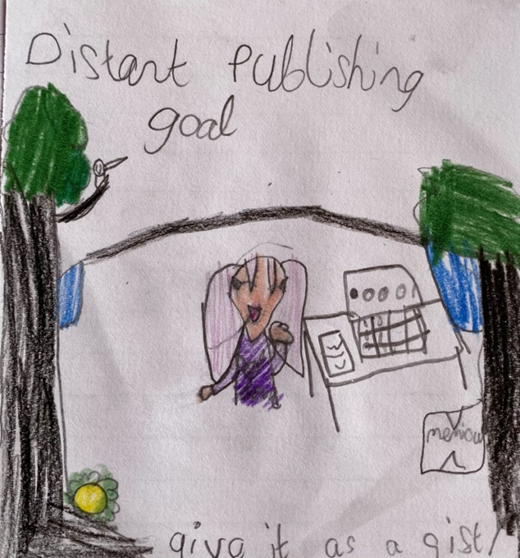
Writer-teacher Tobias Hayden has taken the concept of the Publishing Menu one step further. Instead of an audience chosen by the whole class, children are invited to fill out a โ€˜publishing slipโ€™ where they draw who they plan to give their writing to at a projectโ€™s end. These slips are then put on display for the rest of the project – as a constant reminder of who they are making their writing for and why

Beyond setting publishing goals, itโ€™s imperative that teachers put aside time during a writing session for children to share what they have been crafting that day. Itโ€™s an opportunity for them to โ€˜check inโ€™ with readers to see if they are reacting to and comprehending their text as the authors would like them to. There are a number of ways in which this can be done. One popular way is to conduct an Authorโ€™s Chair session (Young & Ferguson 2020).

How do we develop writing fluency?

Writing is language on paper, and over 85% of people worldwide can do it. Yet many children leave school unable to write well, which limits their academic, social, and career opportunities. In England, writing outcomes remain poor. A quarter of children miss the early learning goal for writing, and about one in four leave primary school below the expected standard. Only one in five write above the basic level at KS2.

In a bid to turn the tide on writing underachievement, educators have rightly been interested in developing childrenโ€™s โ€˜writing fluencyโ€™. This typically means developing childrenโ€™s oral language, sentence-level, and transcriptional skills so that they can write freely and happily. This is sensible because we know that children who donโ€™t internalise these โ€˜basicโ€™ skills of writing early into their educational journey can go on to underperform and even experience school failure.ยน In contrast, when these skills are well established, children have the cognitive space to focus on other aspects of writing and being a writer (Young & Ferguson 2022a).

This has led some to erroneously suggest that these skills should be taught first and only. It’s only after these skills have been somehow โ€˜masteredโ€™ that children โ€˜earn the right to writeโ€™. However, research suggests that this is an instructional mistake and is inefficient at achieving its own aims.ยฒ Indeed, despite its increasing theoretical popularity, we donโ€™t know of a single research study that provides evidence for taking up such a perspective (Young & Ferguson 2025a).

Cognitive science has repeatedly shown that expertise in composition and transcription influence each other and support each otherโ€™s acquisition in profound ways.ยณ Research points towards teachers using daily direct instruction to model oral language, sentence-level, and transcriptional skills and inviting children to use and apply what theyโ€™ve just learnt in the context of authentic and purposeful writing.โด This way, we develop childrenโ€™s skill and the will to be writers; transcriptional fluency progresses right alongside compositional fluency.

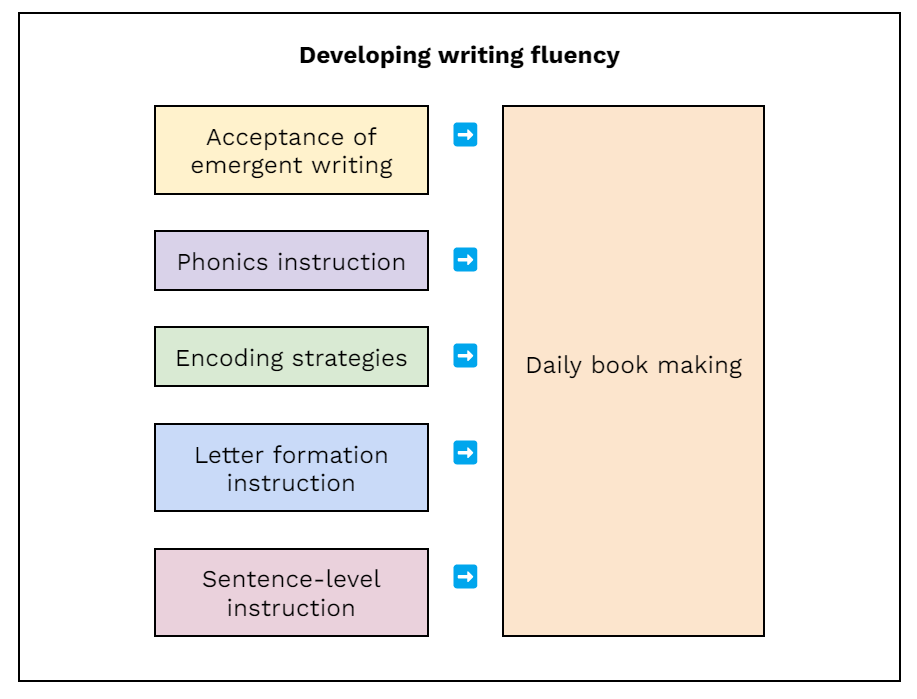
In Writing For Pleasure schools, this is achieved by first accepting childrenโ€™s emergent writing practices as a temporary scaffold when they first arrive at school. Children are weaned off such practices through daily phonics instruction, handwriting instruction, and by teaching children key encoding strategies (Young & Ferguson 2022b).

Book-making time is when we get to โ€˜playโ€™ writing! – Reception child

I love this quote from one of the children at our Writing For Pleasure schools. This child was undertaking one of the most cognitively demanding things you can do while youโ€™re at school (Young & Ferguson 2022a). However, as far as he was concerned, it was childโ€™s play.

Throughout their time in the EYFS and KS1, children are invited to use and apply these strategies every day during dedicated โ€˜book-making timeโ€™. Itโ€™s through this daily book-making that children also learn to apply fundamental sentence-level skills (Young & Ferguson 2022c, 2023c, 2025b). As a brief example, children learn very early on in their writerly apprenticeship that a book should have a picture and a sentence on every page. Once this rule is well understood, it can be broken!

In Writing For Pleasure schools, this kind of systematic, rigorous and daily routine ensures each child between Nursery and Year Two composes thousands of sentences and makes hundreds of books. In the process, they internalise all the key skills that allow them to write fluently, happily and accurately.

In summary, to develop childrenโ€™s writing fluency, it would be useful for nurseries and schools to focus on the following:

Donโ€™t delay teaching about writing. Start on the very first day (Young & Ferguson 2022b).

Encourage children to use their emergent writing practices, especially โ€˜kid writing,โ€™ while they transition themselves towards โ€˜adult writingโ€™ (Young & Ferguson 2022b).

Interconnect your phonics, encoding and letter formation instruction and provide this kind of instruction daily. Encourage children to use the encoding strategies they learn when writing (Young & Ferguson 2022b).

Once encoding and letter formation are internalised, deliver regular, short and explicit handwriting and spelling instruction (Young & Ferguson 2023b).

Regularly model sentence-level craft moves before inviting children to use and apply these craft moves in their own writing that day (Young & Ferguson 2022c, 2023c, 2025b). 

Teach a daily lesson about an aspect of writing and being a writer. This instruction can typically last anywhere between 1-15 minutes (Young et al. 2021; Young & Ferguson 2022b, 2023c; Ferguson & Young 2023).

Teach young writers the โ€˜book-making processโ€™, study mentor texts, and undertake specific book-making/writing projects (The Writing For Pleasure Centre 2023; Young & Ferguson 2022b, 2023c, 2023d).

Invite children to discuss and draw what they are planning to write about before they write it (Young & Ferguson 2022a, 2023a, 2023d).

Set aside anywhere between 30-90 minutes every day for children to book-make/write. Invite children to use and apply what youโ€™ve taught them that day in their own writing (Young & Ferguson 2022b).

Teachers and assistant teachers should make their own writing/books alongside small groups of children during daily writing time (Young & Ferguson 2023a). During this time, they can provide intensive live verbal feedback and additional responsive instruction through pupil conferencing (Ferguson & Young 2021a).

Ensure children can access book-making and other writing opportunities throughout the day. For example, through a well-maintained Writing Centre or by pursuing their own personal writing/book-making projects (Ferguson & Young 2021b).

Footnotes

  1. See Berninger et al. 2002; Abbott et al. 2010; Kent & Wanzek 2016; Wen & Coker 2020; Torrance et al. 2021; Young & Ferguson 2021 for more.
  2. See Young & Ferguson 2021, 2022a, 2023a; Rohloff et al. 2022; Dahl & Freppon 1995; Ferreiro 1982; Avineri et al. 2015; Dunsmuir & Blatchford 2004; Quinn & Bingham 2018; Johnston 2019; Lancaster 2007; Puranik & Lonigan 2014; Rowe & Wilson 2015; Harmey & Wilkinson 2019; VanNess et al. 2013; Graham 2019; Graham et al. 2011, 2012, 2018a, 2018b, 2020; Daniels 2014; Roser et al. 2014; Thomas 2005; Bruyรจre & Pendergrass 2020; Hall et al. 2015; Hรฅland et al. 2019; Bradford & Wyse 2020; Tolchinsky 2017; Snell & Andrews 2017; McCutchen 2011; Harris 2021; Harris et al. 2022a, 2022b, 2023) for more.
  3. See Young & Ferguson 2022a; Berninger & Winn, 2006; Fitzgerald & Shanahan 2000; Graham 2018, 2020a, 2020b; Mayer 2007; Wen & Coker 2020; Kim 2020, Kim et al. 2014, 2017, ย 2021, 2022; Truckenmiller & Chandler 2023; Ferguson & Young 2023 for more.
  4. See Snyders 2014; Rowe 2018, 2021; Hall et al. 2015, 2022; Gerde et al. 2012; Graham et al. 2012; Ouellette & Sรฉnรฉchal 2017; Morin & Pulido 2022; Byington & Kim 2017; Gerade et al. 2012; Barratt-Pugh et al. 2021; Copp et al. 2019; Santangelo & Graham 2016; Lรณpez-Escribano et al. 2022; Puranik & AlOtaiba 2012; Malpique et al. 2017, 2020; Harris et al. 2023; Zhang & Bingham 2019; Quinn et al. 2021; Arrimada et al. 2019; Roitisch et al. 2021; Young & Ferguson 2023a for more.

Full references

  • Abbott, R. D., Berninger, V. W., & Fayol, M. (2010) Longitudinal relationships of levels of language in writing and between writing and reading in grades 1 to 7. Journal of Educational Psychology, 102, 281-298
  • Arrimada, M., Torrance, M., & Fidalgo, R. (2019). Effects of teaching planning strategies to first-grade writers. British Journal of Educational Psychology, 89(4), 670โ€“688
  • Avineri, N., Johnson, E., Brice-Heath, S., McCarty, T., Ochs, E., Kremer-Sadlik, T., Blum, S., Zentella, A.C., Rosa, J., Flores, N., Alim, H.S. and Paris, D. (2015), Invited Forum: Bridging the โ€œLanguage Gapโ€ Journal of Linguistic Anthropology, 25: 66-86
  • Barratt-Pugh, C., Ruscoe, A.,. Fellowes, J. (2021) Motivation to Write: Conversations with Emergent Writers Early Childhood Educ J 49, 223โ€“234
  • Berninger, V., & Richards, T. (2002) Brain literacy for educators and psychologists New York, NY: Academic Press
  • Berninger, V.W., & Winn, W.D. (2006) Implications of advancements in brain research and technology for writing  development, writing instruction, and educational evolution. In C.A. MacArthur, S. Graham, & J. Fitzgerald (Eds.), Handbook of Writing Research (pp. 96-114). New York, NY: Guilford Press
  • Bradford, H., Wyse, D. (2013) Writing and writers: the perceptions of young children and their parents, Early Years, 33:3, 252-265
  • Bruyรจre, J., Pendergrass, E. (2020) Are Your Students Writing or Authoring? Young Authorโ€™s Milieux Early Childhood Education Journal 48 pp.561-571
  • Byington, T., Kim, Y. (2017) Promoting Preschoolersโ€™ Emergent Writing National Association for the Education of Young Children 72(5) pp.74-82
  • Copp, S., Cabell, S., Invernizzi, M. (2019) Kindergarten Teachersโ€™ Use of Writing Scaffolds to Support Childrenโ€™s Developing Orthographic Knowledge Literacy Research and Instruction 58:3 pp.164-183
  • Dahl, K., Freppon, P. (1995) A Comparison of Innercity Children’s Interpretations of Reading and Writing Instruction in the Early Grades in Skills-Based and Whole Language Classrooms Reading Research Quarterly 30(1) pp.50-74
  • Daniels, K., (2014) Cultural agents creating texts: a collaborative space adventure Literacy 48(2) pp.103-111
  • DfE (2022a) Special educational needs and disability: an analysis and summary of data sources London: Department for Education
  • DfE (2022b) Special educational needs in England London: Department for Education
  • DfE (2022c) Academic Year 2021/22 Key stage 2 attainment London: Department for Education
  • Dunsmuir, S. and Blatchford, P. (2004) Predictors of writing competence in 4- to 7-year-old children. British Journal of Educational Psychology, 74: 461-483
  • Ferguson, F., Young, R. (2021a) A Guide To Pupil-conferencing With 3-11 Year Olds: Powerful Feedback & Responsive Teaching That Changes Writers Brighton: The Writing For Pleasure Centre
  • Ferguson, F., Young, R. (2021b) A Guide To Personal Writing Projects & Writing Clubs For 3-11 Year Olds Brighton: The Writing For Pleasure Centre
  • Ferguson, F., Young, R. (2023) Reading In The Writing Classroom: A Guide To Finding, Writing And Using Mentor Texts With Your Class Brighton: The Writing For Pleasure Centre
  • Fitzgerald, J., Shanahan, T. (2000) Reading and writing relations and their development Educational Psychologist 35 pp.39-50
  • Gerde, H.K., Bingham, G.E., Wasik, B.A. (2012) Writing in Early Childhood Classrooms: Guidance for Best Practices, Early Childhood Education Journal, 40, pp.351โ€“359
  • Graham, S., (2018) A Revised Writer(s)-Within-Community Model of Writing, Educational Psychologist, 53:4, 258-279
  • Graham, S. (2019) Changing how writing is taught. Review of Research in Education, 43(1), 277โ€“303
  • Graham S. (2020a) Reading and Writing Connections: A Commentary. In: Alves R., Limpo T., Joshi R. (eds) Reading-Writing Connections. Literacy Studies (Perspectives from Cognitive Neurosciences, Linguistics, Psychology and Education), vol 19. Springer, Cham
  • Graham, S. (2020b) The Sciences of Reading and Writing Must Become More Fully Integrated. Reading Research Quarterly, 55(S1), S35โ€“ S44
  • Graham, S., & Hebert, M. (2011) Writing to read: Evidence for how writing can improve reading Washington, DC: Alliance for Excellent Education, Carnegie Corporation
  • Graham, S., Bollinger, A., Booth Olson, C., Dโ€™Aoust, C., MacArthur, C., McCutchen, D., Olinghouse, N. (2012) Teaching elementary school students to be effective writers: A practice  guide (NCEE 2012โ€“4058). Washington, DC: National Center for Education Evaluation and Regional Assistance, Institute of Education Sciences, U.S. Department of Education
  • Graham, S., Harris, K., Adkins, M. (2018a) The impact of supplemental handwriting and spelling instruction with first grade students who do not acquire transcription skills as rapidly as peers: a randomised control trial, Read Writ, 31:1273-1294
  • Graham, S., Liu, K., Aitken, A., Ng, C., Bartlett, B., Harris, K. R., & Holzapel, J. (2018b). Balancing reading and writing instruction: A meta-analysis. Reading Research Quarterly, 53, 279โ€“304.
  • Graham, S., Kiuhara, S., MacKay, M. (2020) The effects of writing on learning in science, social studies, and mathematics: A meta-analysis, Review of Educational Research, 90(2), 179โ€“226
  • Hรฅland, A., Frafjord Hoem, T., Margaret McTigue, E. (2019) Writing in First Grade: The Quantity and Quality of Practices in Norwegian Classrooms Early Childhood Education Journal 47:63โ€“74
  • Hall, A., Simpson, A., Guo, Y., Wang, S. (2015) Examining the Effects of Preschool Writing Instruction on Emergent Literacy Skills: A Systematic Review of the Literature, Literacy Research and Instruction, 54:2, 115-134
  • Hall, A. H., Gao, Q., Guo, Y., Xie, Y. (2022) Examining the effects of kindergarten writing instruction on emergent literacy skills: a systematic review of the literature, Early Child Development and Care, 1-13
  • Harmey, S., Wilkinson, I. (2019) A Critical Review of the Logics of Inquiry in Studies of Early Writing Development Journal of Writing Research 11(1) pp.41-78
  • Harris, K. (2021) Evidence-based writing practices: A close look at obstacles in todayโ€™s writing instruction. Literacy Today, 39 (2), 26-27.. 39. 26.
  • Harris, K., Mckeown, D. (2022) Overcoming Barriers and Paradigm Wars: Powerful Evidence-Based Writing Instruction. Theory Into Practice. 61.
  • Harris, K., Kim, Y-S,. Yim, S., Camping, A., Graham, S. (2023) Yes, they can: Developing transcription skills and oral language in tandem with SRSD instruction on close reading of science text to write informative essays at grades 1 and 2, Contemporary Educational Psychology, 73, 102150, https://doi.org/10.1016/j.cedpsych.2023.102150
  • Johnston, P. (2019) Talking Children Into Literacy: Once More, With Feeling Literacy Research: Theory, Method, and Practice 68(1) pp.64-85
  • Kent, S.C., & Wanzek, J. (2016) The Relationship between component skills and writing quality and production across developmental levels. Review of Educational Research, 86(2), 570โ€“601
  • Kim, Y.-S.G. (2020) Structural relations of language and cognitive skills, and topic knowledge to written composition: A test of the direct and indirect effects model of writing, Br J Educ Psychol, 90: 910-932
  • Kim, Y.-S.G., and Schatschneider, C. (2017). Expanding the developmental models of writing: A direct and indirect effects model of developmental writing (DIEW). Journal of Educational Psychology, 109(1), 35โ€“50.
  • Kim, Y.-S., Al Otaiba, S., Folsom, J. S., Greulich, L., & Puranik, C. (2014). Evaluating the dimensionality of first-grade written composition. Journal of Speech, Language, and Hearing Research, 57, 199โ€“211
  • Kim, Y., Yang, D., Reyes, M., Connor, C. (2021) Writing instruction improves studentsโ€™ writing skills differentially depending on focal instruction and children: A meta-analysis for primary grade students Educational Research Review (34)
  • Kim, Y.-S. G., & Graham, S. (2022) Expanding the Direct and Indirect Effects Model of Writing (DIEW): Readingโ€“writing relations, and dynamic relations as a function of measurement/dimensions of written composition, Journal of Educational Psychology, 114(2), 215โ€“238
  • Lancaster, L. (2007) Representing the ways of the world: How children under three start to use syntax in graphic signs Journal of Early Childhood Literacy 7(2) pp.123-154
  • Lรณpez-Escribano, C., Martรญn-Babarro, J., Pรฉrez-Lรณpez, R. (2022) Promoting Handwriting Fluency for Preschool and Elementary-Age Students: Meta-Analysis and Meta-Synthesis of Research From 2000 to 2020, Frontiers in Psychology, 13, 841573
  • Malpique, A., Pino-Pasternak, D., Valcan, D. (2017). Handwriting automaticity and writing instruction in Australian kindergarten: An exploratory study Reading & Writing 30(8) 1789-1812
  • Malpique, A., Pino-Pasternak, D., Roberto, M. (2020) Writing and reading performance in Year 1 Australian classrooms: associations with handwriting automaticity and writing instruction Reading & Writing 33 pp.783-805
  • Mayer, K. (2007) Emerging knowledge about emergent writing YC Young Children 62 pp.34-40
  • McCutchen, D. (2011). From novice to expert: Implications of language skills and writing-relevant knowledge for memory during the development of writing skill, Journal of Writing Research, 3(1), 51โ€“68
  • Morin, M. F., Pulido, L. (2022) Interventions for the Development of Orthographic Knowledge Based on Invented Spellings, International Journal of Early Childhood, 1-18
  • Ouellette, G., Sรฉnรฉchal, M. (2017) Invented Spelling in Kindergarten as a Predictor of Reading and Spelling in Grade 1: A New Pathway to Literacy, or Just the Same Road, Less Known? Developmental Psychology 53(1) pp.77-88
  • Puranik, C., AlOtaiba, S. (2012) Examining the contribution of handwriting and spelling to written expression in kindergarten children Read Writ 25:1523-1546
  • Puranik, C., Lonigan, C. (2014) Emergent Writing in Preschoolers: Preliminary Evidence for a Theoretical Framework Reading Research Quarterly 49(4) pp.453-467
  • Quinn, M. F., Bingham, G. E. (2018) The Nature and Measurement of Childrenโ€™s Early Composing Reading Research Quarterly 54(2) pp.213โ€“235
  • Quinn, M. F., Bingham, G. E., & Gerde, H. K. (2021). Who writes what when?: Examining childrenโ€™s early composing. Reading and Writing, 34(1), 79โ€“107
  • Rohloff, R., Tortorelli, L., Gerde, H.K., Bingham, G. (2022) Teaching Early Writing: Supporting Early Writers from Preschool to Elementary School, Early Childhood Education, https://doi.org/10.1007/s10643-022-01365-8
  • Roitsch, J., Gumpert, M., Springle, A., Raymer, A. (2021) Writing Instruction for Students with Learning Disabilities: Quality Appraisal of Systematic Reviews and Meta-Analyses, Reading & Writing Quarterly, 37:1, 32-44
  • Roser, N., Hoffman, J., Wetzel, M., Price-Dennis, D., Peterson, K., Chamberlain, K. (2014) Pull Up a Chair and Listen to Them Write: Preservice Teachers Learn From Beginning Writers, Journal of Early Childhood Teacher Education, 35:2, 150-167
  • Roser, M., Ortiz-Ospina, E. (2016) “Literacy”. Published online at OurWorldInData.org. Retrieved from: ‘https://ourworldindata.org/literacy’ [Online Resource]
  • Rowe, D. (2018) The Unrealized Promise of Emergent Writing: Reimagining the Way Forward for Early Writing Instruction Language Arts 95(4) pp.229-241
  • Rowe, D. W., & Wilson, S. J. (2015) The Development of a Descriptive Measure of Early Childhood Writing: Results From the Write Start! Writing Assessment. Journal of Literacy Research, 47(2), 245โ€“292
  • Rowe, D., Shimizu, A., Davis, Z. (2021) Essential Practices for Engaging Young Children as Writers: Lessons from Expert Early Writing Teachers, The Reading Teacher, pp.1-10
  • Santangelo, T., Graham, S. (2016) A Comprehensive Meta-analysis of Handwriting Instruction Educational Psychology Review 28:225-265
  • Snell, J., Andrews, R. (2017) To what extent does a regional dialect and accent impact on the development of reading and writing skills?, Cambridge Journal of Education, 47:3, 297-313
  • Snyders, C. (2014) โ€˜I Wish We Could Make Books All Day!โ€™ An Observational Study of Kindergarten Children During Writing Workshop Early Childhood Education Journal 42 pp.405-414
  • Thomas, P. (2005) Fostering composing pre-K and beyond – avoiding the artificial nature of writing and teaching Journal of teaching writing 22(1) pp.64-82
  • Tolchinsky, L. (2017). From text to language and back: The emergence of written language. In C. MacArthur, S. Graham, & J. Fitgerald (Eds.) Handbook of writing research New York, NY: Guilford
  • Torrance, M., Arrimada, M., & Gardner, S. (2021) Child-level factors affecting rate of learning to write in first grade. British Journal of Educational Psychology, 91(2), 714โ€“734
  • Truckenmiller, A., Chandler, B.. (2023) Writing to Read: Parallel and Independent Contributions of Writing Research to the Science of Reading, The Reading League, 4(1) pp.5-11
  • VanNess, A., Murnen, T., Bertelsen, C. (2013) Let Me Tell You a Secret: Kindergartners Can Write! International Literacy Association 66(7) pp.574-585
  • Wen, H., & Coker, D. L. (2020) The role of discourse knowledge in writing among first graders. Journal of Writing Research, 12(2), 453โ€“484
  • Young, R., Ferguson, F. (2021) Writing For Pleasure: Theory, research and practice London: Routledge
  • Young, R., Ferguson, F. (2022a) The Science Of Teaching Primary Writing Brighton: The Writing For Pleasure Centre
  • Young, R., Ferguson, F. (2022b) Getting Children Up & Running As Book-makers: Lessons For EYFS-KS1 Teachers  Brighton: The Writing For Pleasure Centre
  • Young, R., Ferguson, F. (2022c) Sentence-Level Instruction: Lessons That Help Children Find Their Style & Voice For 3-11 Year Olds Brighton: The Writing For Pleasure Centre 
  • Young, R., Ferguson, F. (2023a) Supporting Children With Send To Be Great Writers: A Guide For Teachers And SENCOS Brighton: The Writing For Pleasure Centre
  • Young, R., Ferguson, F. (2023c) No More: โ€˜My Pupils Canโ€™t Edit!โ€™ A Whole-School Approach To Developing Proof-Readers Brighton: The Writing For Pleasure Centre
  • Young, R., Ferguson, F. (2023d) No More: I Donโ€™t Know What To Write Nextโ€ฆ Lessons That Help Children Plan Great Writing Brighton: The Writing For Pleasure Centre
  • Young, R., Ferguson, F. (2025a) Handbook Of Research On Teaching Young Writers Brighton: The Writing For Pleasure Centre
  • Young, R., Ferguson, F. (2025b) Sentence-Building Mini-Projects Brighton: The Writing For Pleasure Centre
  • Zhang, C., Bingham, G. (2019) Promoting high-leverage writing instruction through an early childhood classroom daily routine (WPI): A professional development model of early writing skills Early Childhood Research Quarterly 49 pp.138โ€“151

Being a reader-writer-teacher


For some children, you may be the only teacher they ever meet who is a passionate reader-writer-teacher.

All children, but particularly struggling or less experienced writers, need high-quality teaching and explicit instruction if they are to fulfil their potential as writers. This is why SRSD instruction works so well. The concept is simple. Teach your class one writerly technique, process or strategy (what we call a craft move) before inviting them to use the move for themselves in their writing that day. Case studies show that the most effective writing teachers deliver instruction in keeping with SRSD when teaching โ€˜craft knowledgeโ€™ (Young et al. 2021), โ€˜sentence-level strategiesโ€™ (Young & Ferguson 2022c) and โ€˜functional grammar lessonsโ€™ (Young & Ferguson 2021b).

Readers need to read and hear language used skilfully by master writers. The topic for your writing lessons is always dictated by the needs of your class. If you have noticed a deficit or an issue in your classโ€™ writing development, a mini-lesson is where you attend to it. Use pieces of literature or other writings to illustrate the specific technique or strategy you want your class to use and apply in their compositions before inviting them to use it during that dayโ€™s writing time. You should be able to begin this sort of mini-lesson by saying something along the lines of: โ€˜the reason Iโ€™m showing you this craft move is because I think it will really add value to our piecesโ€ฆโ€™ or โ€˜check out this amazing craft move I saw [David Almond] use, I thought we could try using it today tooโ€™. Show them what the writer has done and how they achieved it. Next, show them how youโ€™ve used it. At the end of any mini-lesson, you want your class to be able to say: โ€˜I can see what [David Almond] and my writer-teacher did โ€“ I can do that too!โ€™

Writing instruction, using literature, can typically go something like this:

Thereโ€™s no better advice I can give you than to suggest that you develop yourself as a reader-writer-teacher (Ferguson & Young 2023). This is the best way to gain knowledge of writerly techniques and strategies, knowledge about genres, knowledge about sentence structures, and knowledge about how grammar really works. So, read. Read personally and for pleasure. Read with a professional eye. Read as a writer reads.

***

For more information on how to use literature and other high-quality texts in the writing classroom, consider purchasing our eBook: Reading in the writing classroom: A guide to finding, writing and using mentor texts with your class