Giving children a daily opportunity to read aloud their developing compositions and discuss their pieces with their teacher and peers is an evidence-based teaching recommendation. Research has shown that it can result in a positive effect size of +0.89. For context, anything over +0.4 is deemed to have a significant positive effect on children’s progress. That’s why ‘read, share, think and talk about their writing’ appears as one of our 14 principles of world-class writing teaching (Young & Ferguson 2020, 2021a, 2022a, 2022b).
At the end of daily writing time, children should be given the opportunity to talk with their friends about how their writing pieces are coming along. This can then lead into a period of Author’s Chair. This is where the whole class gathers around an ‘author’s chair’ together.
A class writing project (or writing unit) is an opportunity for a whole class to come together and learn more about a type of writing. It’s also where teachers can explicitly teach children about the processes involved in writing. Research has shown that teaching children about the writer’s process can result in a positive effect size of +1.26. For context, anything over +0.4 is deemed to have a significant positive effect on children’s progress. That’s why teaching the writing processes appears as one of our 14 principles of world-class writing teaching (Young & Ferguson 2020, 2021, 2022, 2023a, 2023b).
An effective writing unit typically involves a reassuringly consistent (though adaptable) routine of: introduce, read as writers, establish product goals, generate ideas, plan, draft, revise, proof-read and publish.
The table below explains why these different components are so useful and effective.
This type of routine provides an excellent foundation for your writing units. However, once you and your students are comfortable with this kind of structure, you can begin to play around with it. Routine doesn’t mean rigidity – a good routine always has a component of flexible response. The routine’s importance is found in knowing what a good class writing project typically involves and having a shared language you can use with your class and across school. Your students will soon get used to language like: publishing goals, reading as writers, mentor texts, product goals, generating ideas, planning, drafting, process goals, revising, proof-reading and publishing and performing.
It’s important to point out that not every writing unit needs to go through all of these components. Teachers should use their own professional judgement to plan their own units. For example, a teacher could feel it appropriate to remove, shorten or otherwise rearrange particular components based on their class’ needs and the amount of time they want to spend on a particular project. However, with that said, to routinely omit or neglect certain processes would certainly result in children receiving an incomplete writerly apprenticeship and would inevitably lead to unnecessary writing underachievement.
There are endless ways in which you can play around with these key combinations. As writer-teacher Doug Kaufman (2022) suggests, we recommend that you plan your writing units in a graphic form of boxes. This can help you to clarify what components you want to cover and how many sessions you might want to spend on each component. This helps you envision the multiple possibilities for structuring your units in response to your pupils’ needs and personal agendas. Here are some examples:
Below, we provide some examples of what a classic unit can look like across multiple lessons.
Here are some other ways in which teachers have planned a writing unit:
On the next few pages, we show how the components of an effective writing unit support the requirements of The EYFS Framework, Development Matters and the KS1/KS2 STA Writing Statements.
Finally, whilst class writing projects are the perfect place for introducing and teaching children about the writer’s process, it’s crucial to remember that, over time, young writers should have an opportunity to develop their own idiosyncratic ways of writing (Young & Ferguson 2020, 2021a, 2022, 2023). We must provide opportunities for children to play around with these processes for themselves – away from the demands of class writing projects. We believe this is best done by ensuring children have opportunities to pursue their own personal writing projects (Ferguson & Young 2021). This way, they can learn about the recursive nature of the writer’s process and how they can move between these different processes for themselves. It’s also a place for them to learn about other processes writers go through, such as: abandoning, reimagining, returning and updating. For more information, see our eBook: A Guide To Personal Writing Projects & Writing Clubs For 3-11 Year Olds
***
For more information on planning your class writing units, consider downloading our Class Writing Projects and other eBooks.
Reading In The Writing Classroom will tell you everything you need to know about mentor texts. It shows you how to draw on children’s literature, including fiction, poetry and non-fiction, in the quest to find just the right texts to use as models, and then how to get the very most out of them during a class writing project. More than that, you’ll learn how easy it is to find your own literary mentors, write your own great texts tailored to your class, and, as a reader-writer-teacher, be confident that you are helping children create their own best texts too.
In this eBook, we cover:
How to read deeply as a writer reads.
How to teach children to read deeply as a writer reads.
What mentor texts do for writers.
How using mentor texts makes writing techniques visible and utterly attainable for teachers and children.
How to find craft moves from your reading to use in your own writing.
How children can find craft moves from their reading to use in their own writing.
The untold benefits of writing your own mentor texts as a writer-teacher.
Advice and activities which help children get the most out of studying mentor texts.
A booklist of great texts which teach great writing: mentor texts for 3-103 year olds.
Using mentor texts brings reading and writing together in profound ways and is therefore an essential part of developing yourself as a world-class teacher of both reading and writing. By studying mentor texts with your class, you will be able to show them in an explicit way what writers do. Put simply, through reading and discussing powerful models, children see what ‘good writing’ is before producing it for themselves in their very own pieces.
Plans are of little importance, but planning is essential – Winston Churchill
Planning strategies have been shown to help children craft better texts (Young & Ferguson 2023a, 2023b). These include (but aren’t limited to) the use of graphic organisers and planning grids. By using graphic organisers or planning grids, we can make available to our classes the typical journey writing in a particular genre goes through to be successful. For example, a biography can follow a sequence of:
Introduction
Early life
What led to the subject’s most important achievement
The subject’s main achievement
What the person did afterwards
Why the person is significant for the writer
There are obvious benefits (and also limitations) to providing children with such grids. Planning grids and graphic organisers are like directions, giving inexperienced writers a reassuring road map they can follow to help them maintain the cohesiveness of their piece. They help children get a handle on their ideas and their intentions. Of course, once they get going with their drafting, they don’t have to stick to what they’ve put down on their planning grid – but it’s always there to orientate them if they get lost. However, it’s right to say that, for some children, a planning grid can limit any unique interpretations or innovations of the genre they might have had. These children might benefit more from our other planning strategies. For example, ‘adventuring’ (see our eBook No More: I Don’t Know What To Write Next… Lessons That Help Children Plan Great Writing for more details).
It’s important that children know that even the best laid plans can often go awry and that everything can be subject to change once they begin drafting.
Research suggests that teaching and modelling a planning strategy before inviting children to use it for themselves during that day’s writing time is effective practice (Young & Ferguson 2023a, 2023b). The key here is to show students a planning strategy, don’t just tell them.
Steps for teaching planning strategies
Step One:
Orientate Remind the children of the class writing project you are currently working on. This includes checking they know what they are writing and who they are writing it for.
– Then be a salesperson. Tell your class why this planning strategy is so fantastic and how its use could transform their writing. Share how you’ve used it in the past.
Step Three:
Share Models or Model Live Share models. Show children examples of where other writers have used this planning strategy in their writing. There should certainly be an example of where you’ve used it to help you plan a piece of your own writing. You should also show examples from other students in previous years or classes. Invite children to ask you questions.
Or
Model using the planning strategy live in front of your class. Tell them about an idea you’re currently working on and show how you’re going to use the strategy to help you with your draft. Invite children to ask you questions.
Step Four:
Provide Information We always recommend turning your instruction into a poster or resource which the children can refer to throughout writing time. This helps them memorise the planning strategy. For example, you might make a poster to accompany a lesson on using a Planning River (see our eBook No More: I Don’t Know What To Write Next… Lessons That Help Children Plan Great Writing for more details). The poster can almost always be pre-prepared to save time and can remain up in the classroom over many days, weeks or even months. Children will be showing independent, self-regulating behaviour every time they consult the poster.
Step Five:
Invite – Invite children to use the planning strategy during that day’s writing time.
– Monitor children’s use of the strategy during your daily pupil-conferencing (Ferguson & Young 2021).
Step Six:
Evaluate You can invite children to share how they used the planning strategy during class sharing and Author’s Chair (Young & Ferguson 2020). If you have noticed a student who has used the strategy in a particularly powerful, innovative or sophisticated way during your pupil-conferencing, you should invite that child to share their work with the class. The class can then discuss their friend’s planning and its impact.
It can be useful to compare this kind of instruction with The Gradual Release Of Responsibility (Pearson & Gallagher 1983).
I did or I do – The teacher either shares how they’ve used the planning strategy or models how to use it live.
We do – The class is invited to use the planning strategy for themselves during that day’s writing time.
You do – Children understand the value of the planning strategy and so continue to use it in their future writing, including in their personal writing projects (see Young & Ferguson 2021b).
Top tips
One thing we would certainly recommend is that teachers don’t ask children to stick their plans in their book prior to drafting. We want children to be looking at their plans and so have them in front of them as they draft.
Consider giving the class more than one session on their plans if you think enough children would benefit. Children who have finished what seems to be a good plan can work on their personal writing project. This allows you to work with children who may need a bit of extra support. For more information on setting up personal writing projects in your class, see our eBook: A Guide To Personal Writing Projects & Writing Clubs For 3-11 Year Olds (Young & Ferguson 2021).
Children find planning easier when there is a genuine purpose and future audience for their writing (beyond their teacher’s evaluation), and when they’ve been allowed to generate their own writing idea within the parameters of the class writing project.
Give children time to talk about their writing ideas before they begin any kind of formal or informal planning. When the plan is completed, give them another opportunity to talk it through with a friend or peer.
Whatever planning strategy you choose to teach your class, avoid asking them to do much writing. Instead, where possible, encourage them to use diagrams, symbols or drawings. For example, there is no reason why children can’t draw on planning grids or graphic organisers. Drawing stops children from ‘treading on their own writing toes’ when they come to draft their piece. How many times have you seen a child who has been asked to plan ending up writing their whole story out in the plan? This needn’t happen.
In this podcast episode, I give an overview of the 14 principles of world-class writing teaching. I also share key ideas to keep in mind when writing with children who have special educational needs and disabilities. Enjoy! ☺️
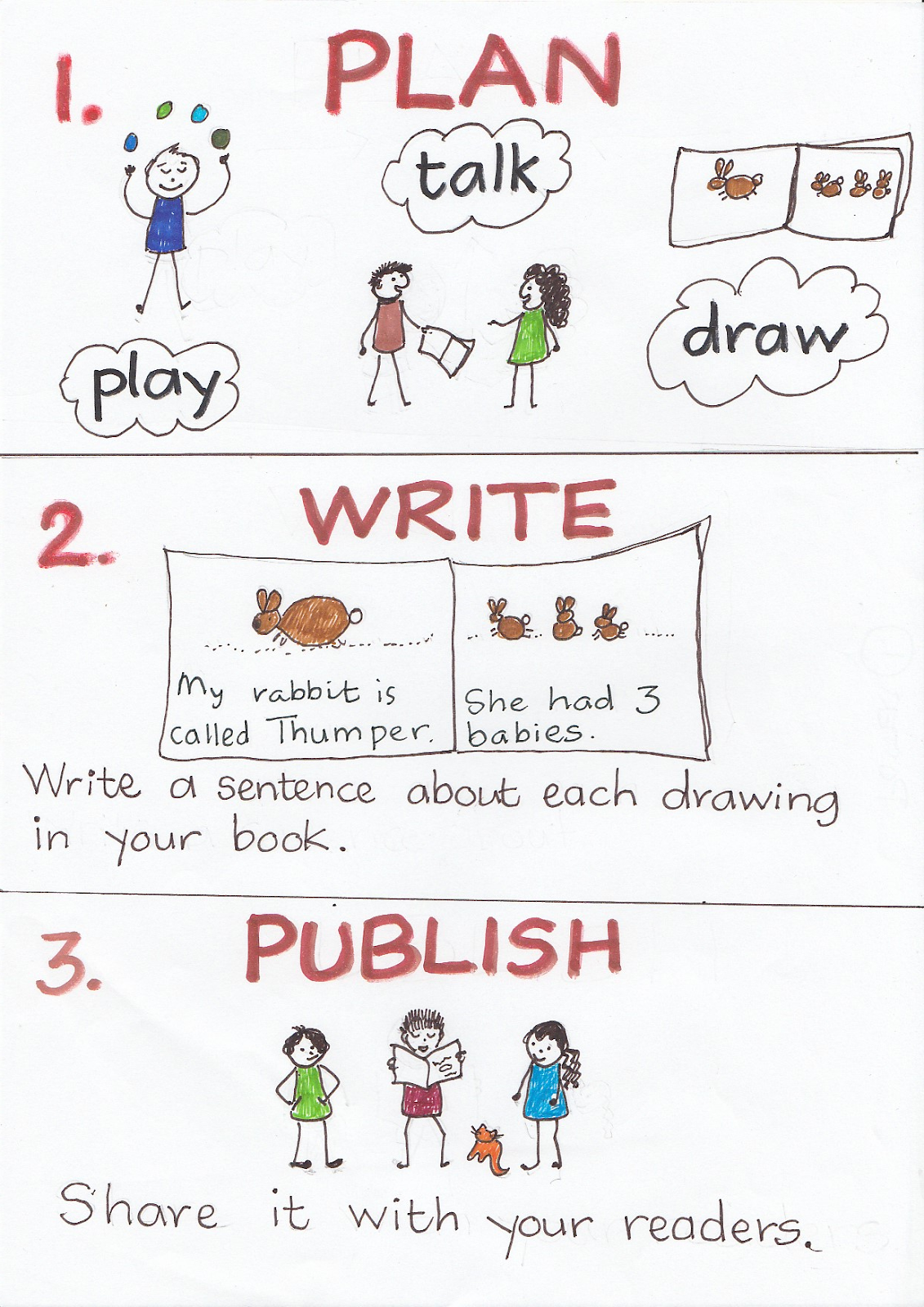
In Writing For Pleasure schools, children in the EYFS and KS1 are invited to make books every day (Young & Ferguson 2022a). We find that book-making is the most developmentally appropriate writer’s process for children this age (Young & Ferguson 2022a, 2023a). It is also particularly effective for children with SEND (Young & Ferguson 2023b).
One of the best ways to improve the quality of young children’s writing is to give them copious amounts of time to plan (Young & Ferguson 2023c). And one of the best ways for young writers to plan or rehearse their writing is through play, drawing and talking (Young & Ferguson 2023a, 2023b, 2023c).
The importance of drawing as a form of planning cannot be underestimated. We stress this because we have heard of instances where children are only allowed to draw after they do their writing. This is a serious instructional mistake because drawings are the fuel for children’s writing. A drawing immediately allows the teacher and the child to discuss their content, teasing out lots of information and then dabbling and playing with key words, phrases or ideas for their writing.
When students who struggle with talking or writing can put down their ideas in a visual format other than words, they have the cognitive capacity to consider important aspects of quality writing (Young & Ferguson 2022). For example:
Daniel, a bilingual preschooler, is composing a written narrative to accompany his book illustrations.
Daniel: Mario!
Teacher: Ah, ok. And what is Mario doing? [prompting verb elaboration]
Daniel: Running! [child enacts running and rapidly gestures running movement with hands]
Teacher: Ooh, is Mario running really, really fast? [showing excitement and interpreting child’s enactment to suggest further elaboration]
Daniel: Yeah! [accepting elaboration and repeating enacted movements]
Teacher: ‘This is Mario. He is running really, really fast!’ [adding character introduction and repeating words aloud as Daniel begins encoding the sentence into his picturebook]
Daniel: Yeah! Mario is running really, really fast! [begins encoding the sentence under his illustration]
Teacher: Ah that’s brilliant. Your friends are going to love it when you read them that page [reminder that books are made for sharing with others]
Encouraging writing is linked to the quality of children’s ‘planning’ and their ability to look at their illustrations prior to composing their text. As we can see in the example above, teachers can respond to children’s illustrations during a pupil-conference and in the process help children find what it is they want to write down.
We recommend that, when book-making, children start by making their front cover (Young & Ferguson 2022a). This is unconscious planning, helping them focus on what their book is going to be about. We want them to spend a good amount of time on their front cover. Next, we ask them to do all the drawings for their book (Young & Ferguson 2022a). Again, this acts as their planning, and makes the drafting part of the book-making process a lot easier.
When their drawings are done, you can invite the child to write about them underneath each one. The most inexperienced writers may write just a single word, short phrase or single sentence, while others may write a paragraph. Incidentally, this is an ideal time to teach at the sentence-level (Young & Ferguson 2023d).
This is the real beauty of book making. Every child can access writing, but there’s no ceiling.
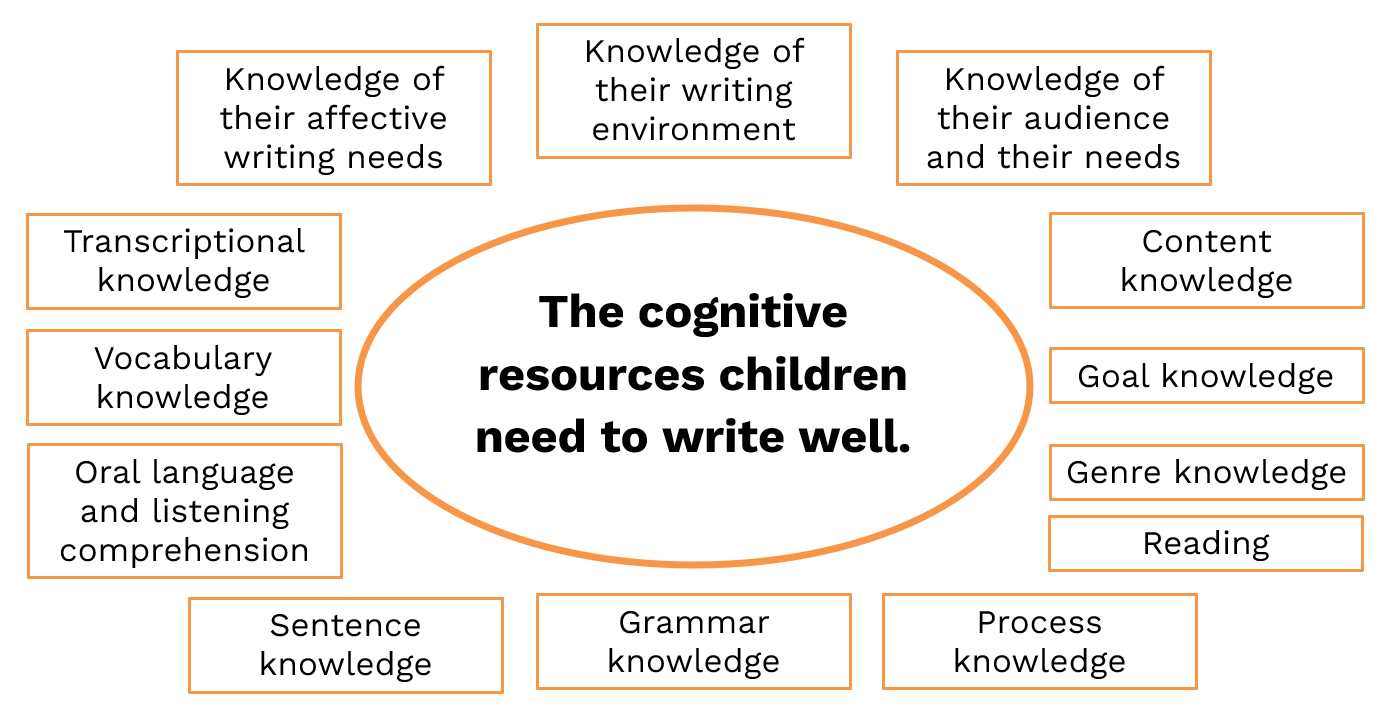
Children unnecessarily (but routinely) underperform in writing classrooms simply because they are required to write on topics for which they have limited knowledge and little motivation to write about (Young & Ferguson 2022a, 2022b, 2022c). This is particularly true for children with SEND (Young & Ferguson 2023a). Writing is probably the most cognitively challenging thing children have to do while at school. Writing requires them to coordinate at least thirteen different cognitive resources simultaneously (Young & Ferguson 2022a). One of these cognitive resources is content knowledge.
(Writing is hard (but rewarding). The cognitive resources children have to draw on to write well. Adapted from The Science Of Teaching Primary Writing by Young & Ferguson 2022a)
Having been brought up on a diet of scheme-supplied writing prompts, contrived topics, and artificial writing situations, many children learn to detest the writing classroom (Clark et al. 2021; Young & Ferguson 2022c, 2023a). Children can find that the quality of their writing is actually being judged on their ability to remember the stuff they’ve been required to write about by their teacher or scheme-writer rather than on the quality and accuracy of their craft. Teachers too end up spending the majority of their writing lesson giving out content knowledge and not writerly knowledge (Young et al. 2021; Young & Ferguson 2022a). Children’s writing development suffers as a result.
In contrast, in Writing For Pleasure schools, we know that when children are allowed to choose and access a topic they are familiar with and emotionally connected to, their writing performance improves and they produce higher quality texts (Young & Ferguson 2021, 2022b, 2023b). This is particularly true for children who traditionally struggle with writing (Young & Ferguson 2023a). This is because, perhaps for the first time, they can write from a position of cognitive strength, confidence and expertise. They get to access content which is not only stored in their long-term memory but they are also extremely keen to write about. This frees them up to focus on all the other demanding cognitive resources required to write successfully!
However, the move from being assigned writing topics to sourcing their own isn’t always an easy transition for some children. Therefore, as their writer-teacher, they may need your support in finding a writing topic that’s going to be fruitful and serve them well.
Giving children choice doesn’t mean you can’t give advice or direction
Despite what some might think, the Writing For Pleasure approach isn’t actually a child-centred pedagogy (Young & Ferguson 2021). We do not support the naturalistic/self-expressionist approach to teaching writing. Writing For Pleasure is neither child-centred or teacher-centred. Instead, it is utterly centred around helping children write the very best texts that they can. Although we recommend that children are given choice over the topics for their writing, this shouldn’t be taken to mean that teachers shouldn’t care about the probability and quality of their pupils’ choices.
A Writing For Pleasure teacher is always looking to give their honest opinion and feedback on children’s writing – from idea generation all the way through to proof-reading and publishing. As the most experienced writer in the room, you should always be pupil-conferencing with the children and sharing your advice and expertise (Ferguson & Young 2021). This means that, from a position of care, you can intervene and help children make decisions about their topic choices. The best time to do this is during Ideas Parties and when you’re taking your Writing Register. Some teachers, when taking the Writing Register, like to meet with children in small groups to discuss their writing ideas and give their advice, recommendations, and, when necessary, definite direction! The rest of the class can be working on their personal projects during this time. Sometimes, when they feel it necessary, teachers will set aside a couple of sessions to do this. This means they get to spend quality time with every child.
Giving direction might mean a teacher asks a pupil not to write about football again for a class writing project and instead suggest that they do that kind of writing in their personal project time. Teachers can be direct and tell children to choose something else – as long as they can explain to the child why. For example, ‘I think it’s important that you develop as a well-rounded writer’.
Teachers should also support children’s decision making during Ideas Parties. This can be done in a number of ways:
Take part yourself. Spend time with each group and add your own ideas to their flipchart paper. This is also a lovely opportunity to get into conversation with your young writers and give feedback on their possible ideas.
Add recommended ideas to children’s flipchart paper before an Ideas Party begins. For example, you could write certain narrative genres (scary, adventure, love, sci-fi, fan-fiction) in the middle of their flipchart paper. Alternatively, you could provide some suggested characters or settings they could use. You could also stick pictures of front covers taken from some of the children’s favourite books onto the paper and encourage children to ‘leapfrog’ off of these texts to come up with their own story ideas.
For non-fiction, there is nothing stopping you from suggesting that they write about certain topics or a topic they are currently learning about in the wider-curriculum. For example: Ancient Egyptians or Rivers. In fact, this is the perfect opportunity to see how much children are currently enjoying their topic learning! If children don’t take you up on your very kind offer, this often tells you something! The point here though is that they don’t have to write on your suggested topics if you think they have a more fruitful idea of their own.
Let them choose the same (or a similar) writing idea as their friend(s).
Specifically challenge individual children or ask the class if anyone would be willing to write on a particular topic. For example: ‘could anyone write me a story a bit like Harry Potter?’, ‘Dylan, I would love it if you would write a pirate adventure story for me. You’ll be so good at it, I just know it’ or ‘could someone make an information book about the Romans for me to read to my daughter?’ Children are so nice – many will be happy to oblige.
We have to say that teachers are usually frustrated by children’s topic choices when they have failed to put aside enough instructional time to work with their pupils. As we always say, if you rush certain processes, you get disappointing and rushed outcomes. As a writer-teacher, put your instructional focus into the things that are bothering you most. If you’re unhappy with the quality of children’s writing ideas – spend more time with them on it.
Plans are of little importance, but planning is essential – Winston Churchill
How often when we are talking with children during writing time do we hear: ‘I’m stuck’ or ‘I don’t know what to write next’? Research has consistently shown that planning is one of the best ways to improve the fluency, quantity and quality of children’s writing (Young & Ferguson 2021, 2022, 2023a, 2023b), yet it is often an underdeveloped and underappreciated part of the writing process in schools.
Planning becomes important when ideas need to be captured on paper or screen as external representations. Plans discover, make visible, and organise our insights and ideas. Children who spend time planning have been shown to produce more complete stories and improve their writing performance (Young & Ferguson 2023c). They also understand more about the writer’s craft and are able to use these techniques successfully in future writing.
Planning strategies are many and varied and can include: talking, drawing, physical and dramatic play, thinking, daydreaming, observing, reading, gathering notes from the internet, mind mapping, webbing, drawing diagrams or maps, making tables and lists, noting possible phrases, writing an outline, creating or filling in a planning grid, free writing, or discovery drafting.
Planning is a matter of personal preference. Children may benefit from drawing rather than talking when they are undertaking an early attempt at a composition, whilst others like to arrive at a plan through talking to peers. Some children like planning grids and graphic organisers, while others prefer to undertake what is in effect a discovery draft. Some children like to use post-it notes creatively. And, as Sharples (1999) reminds us, plans are also there to be altered and updated. What is important is that the child has a general idea of where their writing is going, while planning at a more micro level is unlikely to be useful (Kellogg 2008). Finally, research shows that the quality of children’s writing is improved when their planning is informed by an explicit publishing goal and when there is a defined and definite audience to receive the writing at the project’s end (Young & Ferguson 2021).
This article looks to share the most effective writing instruction for children who present challenging behaviour. Writing problems are common among students with behavioural disorders and ADHD. Most of these recommendations come directly from research specific to pupils who have emotional or behavioural disorders (Young & Ferguson 2023). Otherwise, the recommendations are based on improving students’ self-efficacy (confidence) and self-regulation (feeling of competence), both of which are typically low amongst pupils identified as presenting challenging behaviour or are struggling inexperienced writers (Young & Ferguson 2021a).
Focus on confidence building, a daily sense of success, a daily feeling of competence, getting things done, making progress on a project, knowing what they have to do and how to do it, and giving them a sense of agency, ownership and personal autonomy (Young & Ferguson 2021a, 2023).
Mini-lessons, taught through the principles of SRSD instruction (Young et al. 2021; Young & Ferguson 2022a, 2023b).
Goal setting (Young & Hayden 2021; Young & Ferguson 2023).
Help pupils with their writerly problems by providing pupil-conferencing and allowing them to ask others for assistance. When conferencing, always give a positive personal response to what they are writing about before looking to teach them something (Ferguson & Young 2021).
Give pupils access to a variety of mentor texts as they are writing. These provide children with a sense of security (Young & Hayden 2021; Young & Ferguson 2023).
Provide children with ample time in which to plan. Over time, teach a variety of planning strategies so that pupils can choose their favoured one (Young & Ferguson 2023c).
Don’t limit students’ participation or decision making during writing lessons. For example, teach pupils how to generate their own writing ideas and allow them to write on a selected favoured topic – which they are motivated by (Young & Ferguson 2022b).
Teach responsively. Adapt to what your students need instruction in most. Teachers shouldn’t be planning their writing lessons well in advance. Always keep an eye out for what your class is unconfident about and give them the instruction they need in that lesson or the next day (Young et al. 2021; Young & Ferguson 2022a, 2023b).
As long as they are being productive each day, allow students to write at their own pace, using a writing process which suits them (Young & Ferguson 2023).
Provide children with personal writing project books that they can use whenever they are tired of working on a class project or else have finished what they wanted to do for that lesson (Young & Ferguson 2021b).
Provide time for pupils to share their writing with friends to hear their reactions and responses.
Always ask pupils with challenging behaviour what they think they did well during that writing session.
Allow students who are competent typers to write using computer technologies (including the use of electronic spell checkers and smart speakers during proof-reading).
Be a role model by writing alongside the students in your class. Write for your own pleasure – and enjoy their company (Young & Ferguson 2023).
Allow pupils to use ‘temporary’ spellings while drafting (temporary spellings are then corrected at the proof-reading stage) (Young & Ferguson 2023).
Focus handwriting instruction on students’ ability to write fluently and happily as opposed to insisting on a particular style (LINK).
Research-based writing practices specific to the EYFS
Interconnect your phonics, encoding and letter formation instruction and provide this kind of instruction daily. Encourage children to use ‘sound spellings’ while writing (Young & Ferguson 2022).
Encourage children to engage in emergent writing practices – especially using ‘kid writing’ (Young & Ferguson 2022).
Teach a daily mini-lesson about an aspect of writing and being a writer. This instruction could last anywhere between 1-15 minutes (Young & Ferguson 2022).
Teach young writers the ‘book-making process’ and undertake specific book-making projects (The Writing For Pleasure Centre 2023; Young & Ferguson 2023).
Set aside anywhere between 30-90 minutes every day for children to write and make books. Invite children to use and apply what you taught them that day in their own writing (Young & Ferguson 2022).
Teachers and assistant teachers should make their own books alongside small groups of children during daily book-making time (Young & Ferguson 2023). During this time, they can provide live verbal feedback and additional responsive instruction through pupil conferencing (Ferguson & Young 2021).
Ensure children can access book-making and other writing opportunities throughout the day.
Don’t delay teaching about writing. Start on the very first day.
This table is based on following research evidence:
Wharton-McDonald, R., Pressley, M., & Hampston, J. (1998) Outstanding literacy instruction in first grade: Teacher practices and student achievement, Elementary School Journal, 99, 101–128 [LINK]
Wray, D. & Medwell, J. (1999) ‘Effective teachers of literacy: knowledge, beliefs and practices’, in International Electronic Journal For Leadership in Learning 3(9) [LINK]
Pressley, M., Wharton-Mcdonald, R., Allington, R., Block, C. C., Morrow, L., Tracey, D., Baker, K., Brooks, G., Cronin, J., Nelson, E., & Woo, D. (2001) A study of effective first grade literacy instruction, Scientific Studies of Reading, 5, 35-58 [LINK]
Louden, W., Rohl, M., Barrat-Pugh, C., Brown, C., Cairney, T., Elderfield, J., House, H., Meiers, M., Rivaland, J., & Rowe, K. J. (2005) In teachers’ hands: Effective literacy teaching practices in the early years of schooling, Australian Journal of Language and Literacy, 28, 173-252 [LINK]
Graham, S., Kiuhara, S., McKeown, D., & Harris, K. R. (2012). A meta-analysis of writing instruction for students in the elementary grades, Journal of Educational Psychology, 104(4) [LINK]
Gerde, H.K., Bingham, G.E., Wasik, B.A. (2012) Writing in Early Childhood Classrooms: Guidance for Best Practices. Early Childhood Education Journal 40, pp.351–359 [LINK]
Dombey, H. (2013) What we know about teaching writing, Preschool & Primary Education, 1, 22-40 [LINK]
Hall, A., Simpson, A., Guo, Y., Wang, S. (2015) Examining the Effects of Preschool Writing Instruction on Emergent Literacy Skills: A Systematic Review of the Literature, Literacy Research and Instruction, 54:2, 115-134 [LINK]
Hall, A., (2019) Every Child is a Writer: Understanding the Importance of Writing in Early Childhood Institute for Child Success [LINK]
Managhan, E. (2020) Effective Practices to Balance Literacy Instruction in Early Childhood, Learning to Teach, 9(1) [LINK]
Rowe, D., Shimizu, A., Davis, Z. (2021) Essential Practices for Engaging Young Children as Writers: Lessons from Expert Early Writing Teachers, The Reading Teacher, pp. 1-10 [LINK]
Hall, A. H., Gao, Q., Guo, Y., Xie, Y. (2022) Examining the effects of kindergarten writing instruction on emergent literacy skills: a systematic review of the literature, Early Child Development and Care, 1-13 [LINK]
Young, R., Ferguson, F. (2023) The Writing For Pleasure Centre’s Handbook Of Research On Teaching Young Writers Brighton: The Writing For Pleasure Centre [LINK]