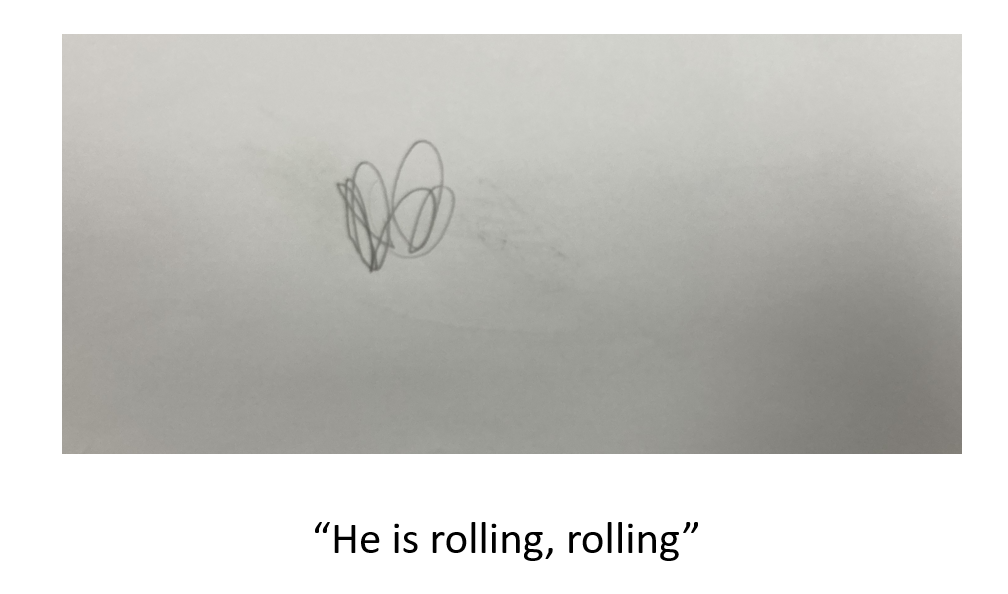
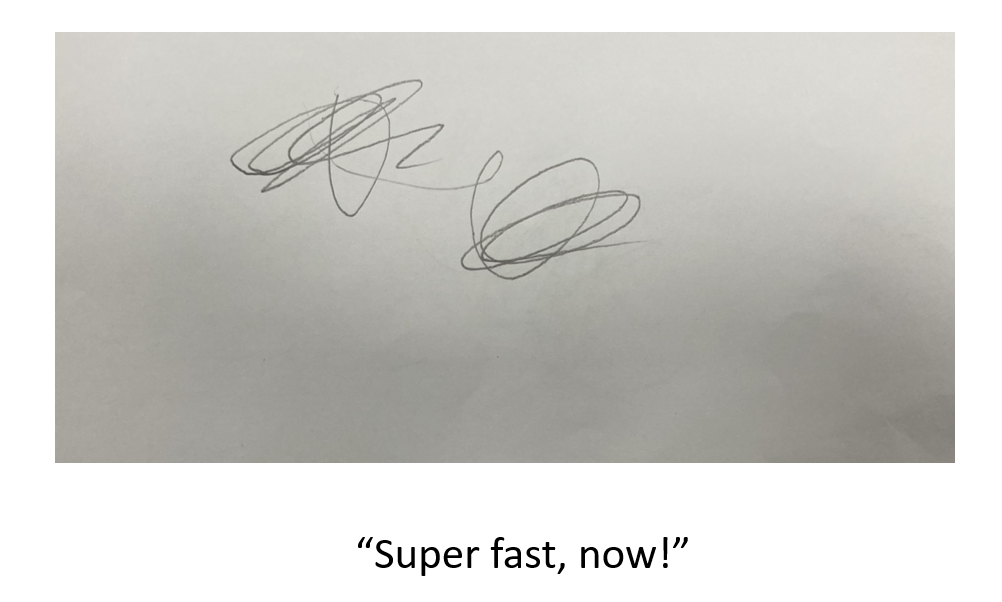
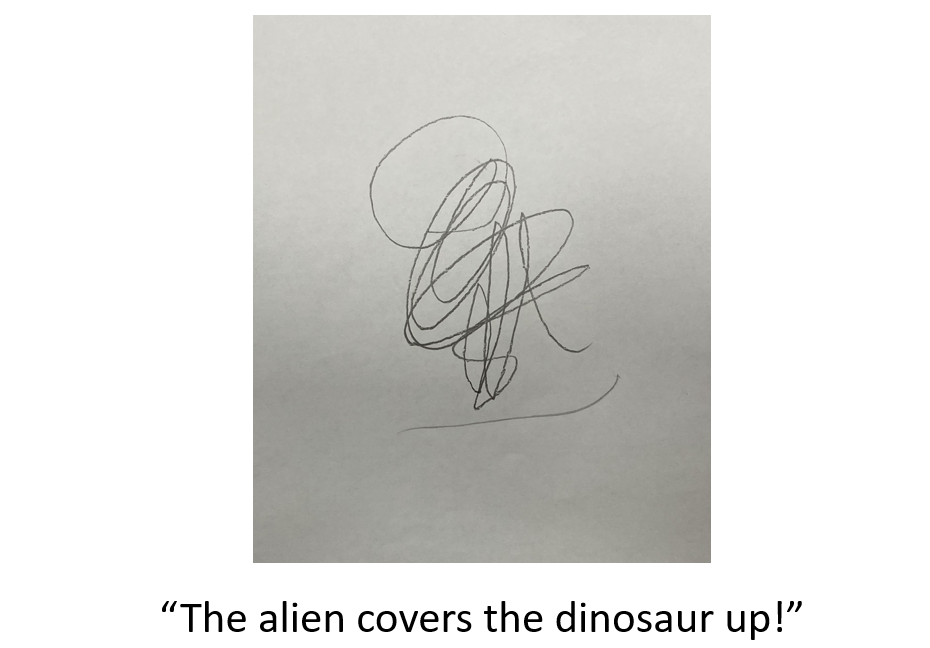
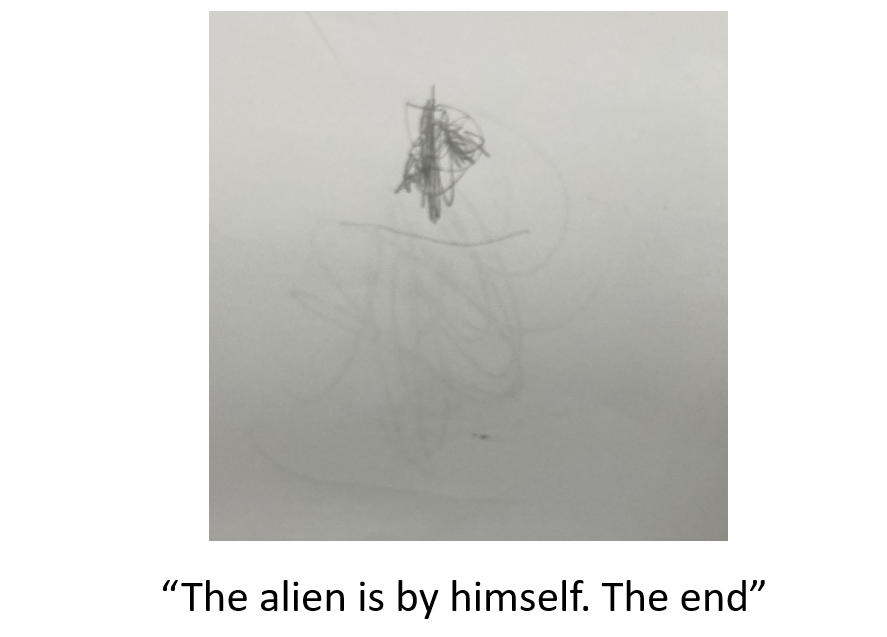
“You’re the most important writer-teacher a child ever meets because you’re their first one. The messages and lessons you teach them about writing, and what it means to be a writer, will stay with them forever”
Many children who start Nursery or Reception are already less experienced writers compared to their peers. As a result, they can struggle to keep pace with their classmates when it comes to key writing skills. Research highlights that students most at risk for writing challenges are those with limited experiences with:
Oral language
Phonological awareness
Alphabet knowledge
Early print concepts
This issue is a widespread concern that educators across the globe face. The challenge is clear: early and effective interventions in Reception are critical for supporting children to succeed. Simply waiting for children to ‘catch up’ is not a viable solution.
Identifying At-Risk Students
To support at-risk learners, teachers must be well-informed about the writing skills children should develop by the end of Reception. Knowing these benchmarks allows educators to identify students who need additional support early on.
Key Writing Skills For Reception
Children start developing their writing skills from birth, with progress dependent on their exposure to literacy experiences and concepts. By the end of Reception, students should:
1. Understand That Written Language Can Represent Their Oral Language
Understand concepts about print, such as how sounds and words work on the page, how texts flow, and the purpose of making books/writing.
Recognise book features, including titles, writing, illustrations and author names.
2. Develop Phonological Awareness
Segment spoken words into smaller units (e.g. syllables and sounds).
Use their phonological awareness to begin encoding the words they want to write down onto paper (or screen).
3. Recognise And Write Alphabet Letters
Identify letters and their corresponding sounds.
Print letters (with support from sound mats), write ‘informed spellings’ and write out high-frequency words, including their name.
4. Find Purpose & Pleasure In Making Writing
See themselves as writers and makers of picturebooks.
Write and make books for meaningful purposes.
5. Enjoy Reading Books As A Writer Of Books
Actively study stories and informational books, before making their own.
Explore books independently, with friends, and with their teacher – fostering a love for reading.
Cultivating A Strong Foundation
For students to succeed, schools must provide a robust writing programme that caters to all their learners, particularly those who may traditionally struggle. Effective early writing programmes should focus on the five points listed above.
Interventions should aim to build on what is already occurring in your writing programme. For example:
Provide additional opportunities for children to develop their oral language skills through book-making.
Strengthen children’s phonological awareness by providing them with additional opportunities to make books alongside a teacher and their friends. Additional instruction during these sessions should focus on modelling encoding strategies and how to use sound mats to write down the words you say.
Foster a sense of purpose and enjoyment for writing by giving children additional opportunities to write and make books alongside their teacher and friends, creating a positive attitude towards being a writer.
The Importance Of Early Success
Research underscores the significance of entering Key Stage One with a solid foundation in writing. As Snow (2017) emphasises, students who develop positive attitudes and essential knowledge about writing in the EYFS are better equipped to succeed at Primary School. By focusing on early interventions and evidence-based teaching practices, educators can help support their at-risk students, setting them on a path to lifelong literacy success.
Conclusion
As their first ever writing teachers, we play a pivotal role in identifying and supporting at-risk learners in Nursery and Reception. By developing foundational writing skills and providing targeted interventions, we can ensure that all children have the opportunity to thrive. With early support, at-risk children can transition into Key Stage One ready to continue learning, growing, and succeeding alongside their peers.
***
For more, download our publications: Getting Children Up & Running As Writers In EYFS & KS1 [LINK]and Supporting Children With SEND To Be Great Writers [LINK]. These publications are free for our members. To become a member, click here.
Early and comprehensive intervention is key for children at risk of writing failure. Children who are ‘at-risk’ often have difficulties with both transcription (encoding, spelling, letter formation, handwriting) and text generation (translating their ideas into words). Interventions should therefore target both these areas.
Here are some practices that we recommend for helping children who are at risk of writing failure:
Intensive intervention: At-risk pupils may need intensive intervention (through Writing Club) to help them catch up to their peers. Our Writing ClubIntervention involves one-on-one support and small group instruction that targets children’s needs. Children should be attending Writing Club to address their very specific identified needs. For example, students with low fluency will benefit from focused instruction at the sentence-level, while those struggling with cohesion might need more support in how writers plan and organise their ideas.
Handwriting and spelling intervention: At-risk pupils may benefit from additional instruction and practice in handwriting and spelling. For older pupils, this may need to include explicitly modelling encoding strategies [LINK].
An evidence-based approach to whole-class teaching: Given the broad writing difficulties often exhibited by at-risk pupils, an evidence-based approach to unit planning and writing instruction is recommended. Class writing projects should include instruction in all the components of the writing process, including: reading as writers, generating ideas, planning, translating ideas into words, developing sentences, paragraphs and texts. This invariably involves explicitly modelling and teaching students how to generate ideas, plan, draft, revise, and proof-read their writing [LINK].
Executive function skills: Support children’s self-regulation, planning, and organisation of the writing process by providing them with a more developmentally appropriate writing process – for example PicturebookAnd Chapter Book Making.
Transcription skills: Schools should have a clear policy and instructional routine for teaching spelling and handwriting. For more guidance, see our Handwriting & Spelling Provision Checklist.
Put simply, we can’t emphasise enough (1) the importance of evidence-based writing teaching being delivered across the school and (2) early identification and intervention for children who are at risk of writing failure. If disparities in writing proficiency are already present in Reception and Year One, they are likely to persist without effective intervention and the use of evidence-based practices. Addressing these issues early on can help children develop the necessary skills to be successful and happy writers.
***
For more, download our publication: Supporting Children With SEND To Be Great Writers [LINK]. Our publications are free for our members. To become a member, click here.
Sometimes called micro-fiction or sudden fiction, flash fiction isn’t just a very short story, it’s a flash moment – part of a much larger untold story, where much is left unexplained. They are typically no longer than 1000 words, but can be as short as 100 words (when it’s called a drabble) or even 20–50 words (a dribble). Flash fiction challenges children to move forward in their narrative writing from Years 3-5 where they are often asked to write a single short story. For this project, they are essentially creating a whole anthology of micro stories! In the process, they become more discerning with words and learn to infuse their pieces with aspects of poetry and literary technique. Indeed, flash fiction can sometimes be seen as an extension of free-verse poetry.
Children tend to enjoy making their flash fiction anthologies, as it encourages them to come away from the habit of writing at length and to think more carefully about how they can say the things they wish to say. Flash fiction shows children that their narrative writing in the past may have sometimes ‘lost its way’ by becoming rambling and disorganised. The hope with this writing project is that it has a lasting positive effect on their future story writing. Writers have to be disciplined at the revision stage, deleting rather than adding, and being honest with themselves as to whether that particular adjective or adverb is really vital to the piece. Flash-fiction will become a genre enjoyed by the children in your class and is a pleasure to hear read aloud.
Finally, this project couldn’t be better suited for collecting evidence for the greater-depth writing standard.
Making a counting book is a project which the youngest of writers will find very appealing. It’s a genre which they will have been familiar with from a very early age and so they will be confident with it. They will enjoy showing off their counting skills, and choosing their own favourite objects to be counted. They will also get pleasure from teaching their readers and listeners something, and from the interactive element of everyone counting together when they share their book.
Writing is more than putting words on paper; it’s a way of making and sharing ideas, knowledge and emotions. To improve children’s writing skills, teachers and researchers are continually exploring what factors contribute to writing success. Among these, creativity stands out. Creativity helps students think outside the box, come up with unique ideas, and express themselves effectively. But what role does creativity actually play in writing, and how do other factors like motivation, self-confidence, and attitude toward writing come into play? This study dives into these questions.
How creativity boosts writing skills
Creativity fuels children’s writing in four key ways:
Fluency – Generating ideas and translating them into writing.
Flexibility – Making connections between ideas.
Originality – Thinking up new and intriguing ways to share ideas.
Elaboration – Developing and refining writing ideas.
These skills don’t just come naturally, they need to be nurtured. Creative students tend to excel in writing because they can craft original ideas, add vivid details, and use language effectively. Neuroscience even shows a connection between creative thinking and areas of the brain responsible for language and idea generation. However, creativity alone isn’t enough. Not every creative student automatically becomes an exceptional writer. Other factors like self-efficacy, motivation, and attitude also play critical roles.
The power of belief: Writing self-efficacy
Self-efficacy is a pupil’s belief in their ability to succeed. For writing, this means having the confidence to tackle writerly challenges, persist through setbacks, and put in the effort needed to improve. Research shows that students who believe in their writing skills are more likely to write often, try harder, and achieve more (LINK). On the flip side, students with low confidence are more likely to avoid writing. Self-efficacy doesn’t just make students feel good – it also reduces anxiety and encourages perseverance (LINK). Teachers can foster this confidence by providing constructive verbal feedback and setting daily process goals and celebrating these daily successes.
Motivation: The driving force behind writing success
Motivation is what gets students started on a writing project and keeps them going, even when it’s difficult (LINK). Writing motivation pushes students to approach writing with interest, effort, and joy. Highly motivated students are more likely to plan their writing carefully, revise their compositions, and reflect on their progress – all habits linked to better writing outcomes (LINK). Teachers can build motivation by inviting children to connect class writing projects to their personal interests, offering choice in topics, and creating an encouraging community of writers (LINK). When students see writing as meaningful and enjoyable, their performance can improve.
Writing disposition: A love for writing
Writing disposition goes beyond motivation – it’s about forming a positive, lasting attitude toward writing. Students with positive writing dispositions enjoy writing, persist through challenges, and take pride in their published manuscripts (LINK). This mindset develops through repeated positive experiences, support from teachers, and opportunities to express themselves (LINK). Research shows that students with positive writing disposition tend to perform better (LINK). They’re also more likely to see writing as a valuable pursuit and carry that enthusiasm into adulthood.
Connecting the dots
Writing success isn’t just about mastering grammar or organising paragraphs. It’s a combination of creativity, confidence, motivation, and attitude. These factors work together to help students not only write well but also enjoy the process (LINK). By nurturing these elements in the classroom, teachers can unlock their students’ potential as confident and creative writers.
This study explores how these pieces fit together, particularly for primary-aged pupils, and sheds light on what teachers can do to inspire a new generation of writers.
Findings
Creativity and writing go hand-in-hand: Students who are more creative tend to have stronger writing motivation, confidence, and positive attitudes about writing – all of which lead to better results.
Confidence matters: Writing self-efficacy (the belief in one’s writing abilities) plays a big role in determining children’s writing success. Students who think they can succeed usually do.
Motivation is key: Motivation is a driving force behind excellent writing. Engaged and inspired students are far more likely to produce high-quality writing.
Attitude counts: A positive disposition toward writing significantly impacts children’s outcomes, as students who enjoy the process and value their published writing tend to perform better.
Implications for teachers
Creativity is a catalyst: The study shows that inviting children to generate their own writing ideas doesn’t just make writing more interesting – it can directly boosts writing confidence, motivation, and attitudes, which in turn enhance their writerly success. Encouraging creative idea generation can help struggling students unlock their potential
Build confidence: Offer regular, constructive verbal feedback that emphasises children’s growth as a writer. Provide opportunities for students to share their compositions.
Spark motivation and develop positive attitudes:Establish publishing goals for class writing projects so children can see the value of writing as a tool for personal expression and real-world communication.
By prioritising creativity and emotional factors alongside foundational writing skills, we can inspire children to write with confidence, passion, and purpose. Let’s build classrooms where every student feels capable of creating something extraordinary!
The great strength of this project is that children already know this genre of text. They will have seen them at home or in the classroom library. It also allows them to engage in their phonics learning from the perspective of a writer and teacher.
By inviting them to write their own ABC books, we can also sow the seeds of intertextuality – that you can copy the types of writing and books that you like. You can then make them your own. Once this lesson is taught, children can make books with ease.
Hi Ross. We really want to use books during our writing lessons in the EYFS. Do you have any advice on how this could be done?
Absolutely! Teachers should use mentor texts to inspire and guide the youngest of writers to create their own engaging and informative non-fiction picture books. To put it simply, mentor texts are texts that can teach children about great writing.
Finding mentor texts: You can find mentor texts in your classroom library and use picture books written by children from previous years or even ones you have written yourself as a writer-teacher. It is important to make sure that the mentor texts you select match the kind of writing your pupils are doing; if you’re asking your class to create a six-page non-fiction picture book, you should study mentor texts that are also short non-fiction picture books. We have a list of great mentor texts here.
Reading as writers: After reading your mentor texts for pleasure with your pupils, read one again and encourage them to think about the text as writers. You can help guide them with open-ended questions, such as: ‘What’s the writer done to make his picture book the best in the world?‘ or ‘What do you see that you would like to do in your books too?!’ You can then record their responses on a flip chart to use as product goals (success criteria) for your own picture book project [LINK].
Craft moves: You can teach children to recognise craft moves that authors use in their picture books. For instance, in the book Do Whales Have Whiskers?, author Emily James uses a question and answer format to present information and vivid verbs and prepositional phrases to make the writing more engaging. Another example is I Am Angry by Michael Rosen, where he uses repetition, onomatopoeia, contractions, ellipses, and exclamation marks, as well as changes in font size and style to make the book more interesting.
Mini-lessons: When teaching mini-lessons, select a craft move used in a mentor text you have been looking at with your class. For example, if you want to teach your pupils to include a new piece of information on each page, you can show them how the picture book you are making does so. You can then invite them to do the same during that day’s writing time.
It’s important to note that you should use commercially published picture books and teacher-created texts as mentor texts. You can also use children’s texts from the previous years. This is very effective!
Developing the youngest of writers is a multifaceted process, influenced by the interplay between transcription (the mechanical aspects of writing) and composition (the generation and sharing of ideas).
Research from the past few decades would suggest a centralist (sensible) approach to teaching early writing [LINK]. An approach which includes a focus on teaching emergent writing, transcription and composition. An approach that acknowledges the need for foundational transcription skills while also fostering children’s communicative competence. A nuanced integration of these elements creates an environment in which children develop both the technical fluency necessary for writing and the cognitive flexibility to engage in developmentally appropriate writing projects [LINK and LINK].
Start With Emergent Writing
Emergent writing is the early writing that all children bring to school. Developed through experimentation and exploration, it progresses through stages of scribbling and attempts at letter formation before evolving into conventional words and sentences.
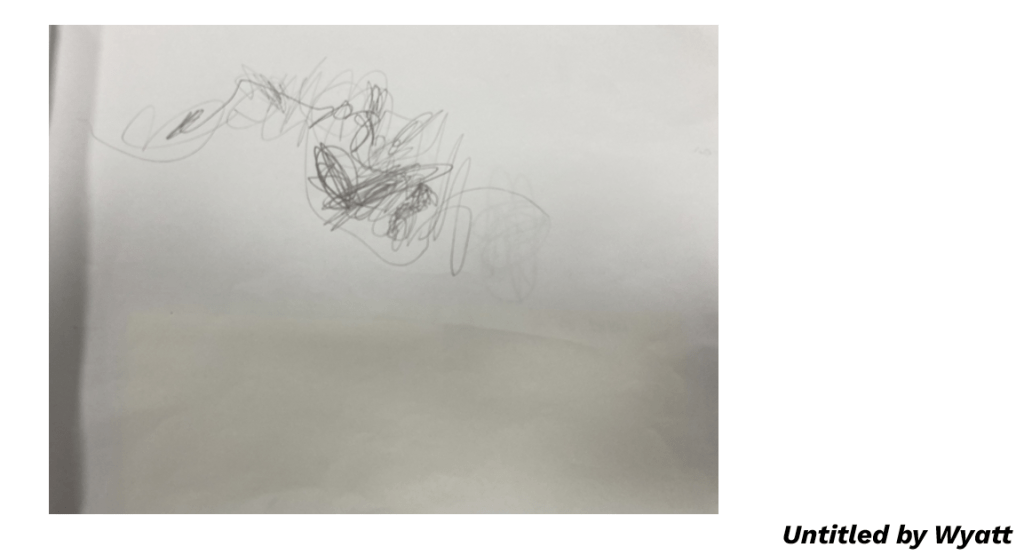
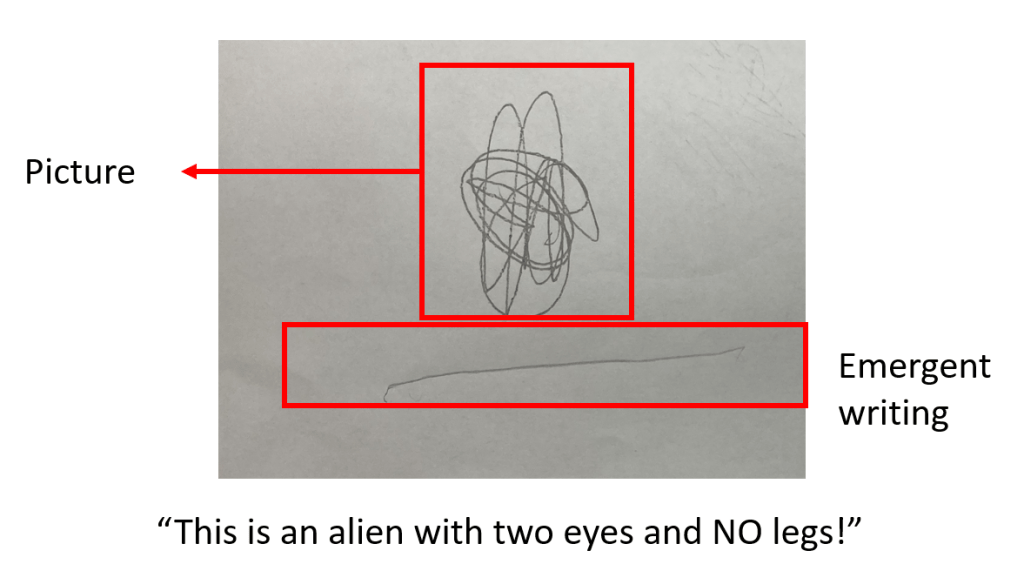
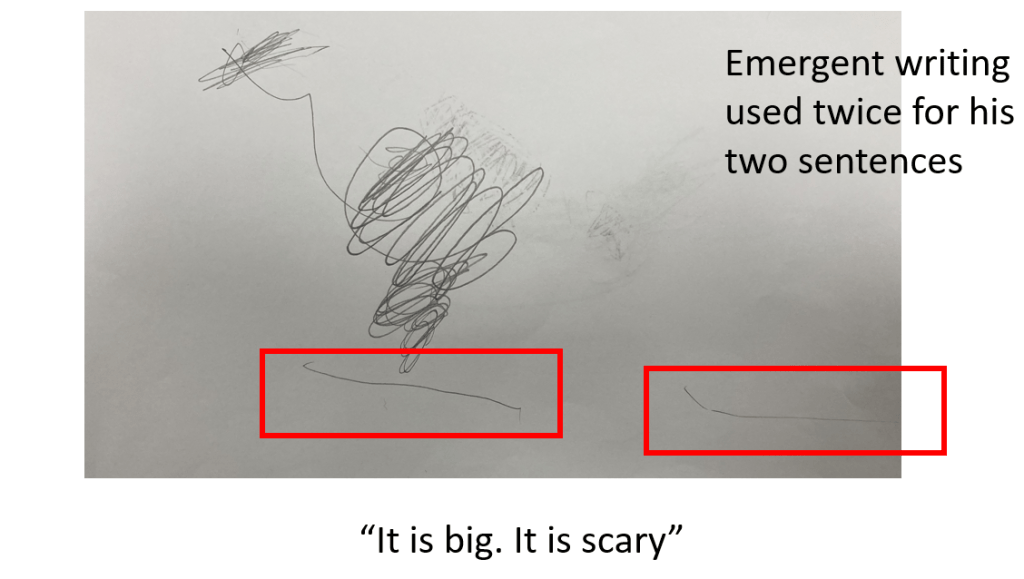
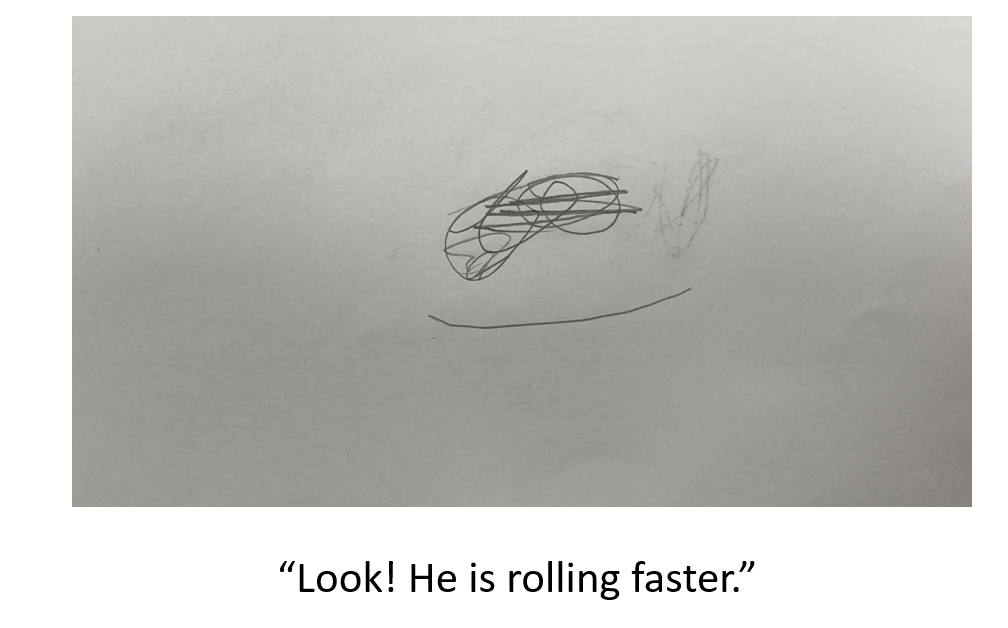
The youngest children, even before they begin to master conventional writing, convey meaning through written symbols – when given the opportunity. Take Wyatt as an example. Below is the first picturebook Wyatt ever made. Wyatt attends a school in an economically-underserved area of Leeds. Wyatt produced this book on his first week at Nursery.
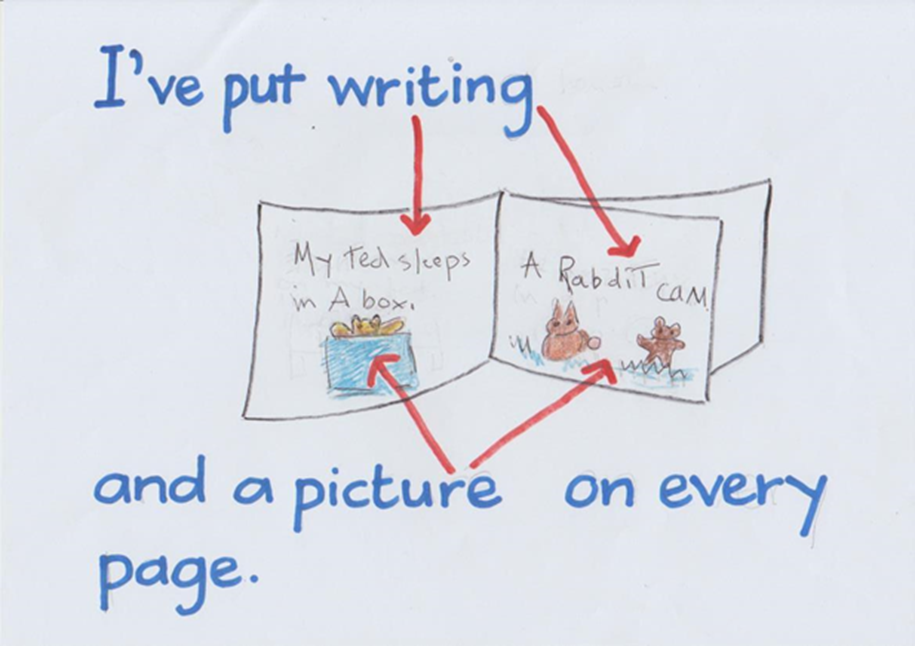
Isn’t that a brilliant story? I should explain that Wyatt is already learning a number of things about writing. He is learning that a book should have a picture and some emergent writing on every page. He has also learnt that when you are ‘telling’ your book – you should ‘tickle your writing’. This involves moving your finger across your emergent writing so you can tell people what it says (oral language development anyone?).
Far from being a mere precursor to conventional writing, emergent writing is seen as a foundational phase that children go through and ensures they engage with written language as a tool for communication. It’s this emergent writing that helps them understand why developing their transcription is so necessary – because it will help them make and share meaning with others more successfully.
As you can see from Wyatt’s book, the development of composition – the ability to generate ideas, organise them, and express them is a critical aspect of emergent writing. However, once letter formation and encoding instruction is introduced, children transition quickly towards using informed spelling, writing sentences, and making simple stories and information texts. Therefore, emergent writing only acts as a very temporary scaffold [LINK].
Emergent writing develops children’s communicative competence from the earliest stage of their writing development. By allowing children to express themselves, we develop children’s motivation and confidence. As a result, they want to learn more about writing and being a successful writer. Emergent writing helps children know the reason why they are being apprenticed in transcription. This leads nicely into our next section…
The Importance Of Transcription In Early Writing Development
As you can see in the table shared earlier, emergent writing does not dismiss the importance of transcription skills. Transcription is, in fact, a necessary foundation for successful composition.
The work of Berninger & Amtmann (2003), among others, highlights the cognitive demands involved in writing. Transcription, particularly when children are first learning to write, requires a lot of cognitive effort. Our young writers must focus on letter formation, encoding, and punctuation while simultaneously thinking about their writing ideas.
Berninger & Amtmann simply wanted to remind us that during this early stage in their writerly lives, children might not always fully engage with the content of their ideas or the organisation of their writing. But over time, with repeated practice, and with explicit instruction in handwriting and encoding, this gets better and better. It’s important to note that, according to Berninger & Amtmann,transcription does not need to be mastered before composition can take place. Instead, research recommends developing both concurrently but with a particular focus on transcription [LINK].
An Evidence-based Centralist Approach
Given the intertwined nature of transcription and composition, a centralist approach to early writing instruction is essential. Instead of strictly separating transcription and composition, or focusing exclusively on one at the expense of the other, teachers should aim to provide an approach that supports both aspects of writing in tandem. The balance lies in prioritising transcription without excluding opportunities for meaningful composition. This centralist approach acknowledges that:
1. Transcription supports composition: Secure transcription skills serve as a foundation for more complex writing projects [LINK]. When children are able to write without excessive effort spent on forming letters or encoding words, they have more cognitive resources available to focus on their ideas and revising their manuscripts. Teachers will see that as children’s transcription improves – so their compositions improve too.
2. Composition supports transcription: It’s important to remember that dictation isn’t writing. Writing is about expressing ideas and communicating meaning [LINK]. By engaging in composition from an early age, children actually understand the purpose behind learning about transcription. Writing is a tool for communication – not the nonsensical forming of letters and the encoding of sounds for no apparent reason (dictation). Early compositional opportunities ensure children are always using and applying their newly acquired transcriptional skills [LINK].
3. Early writing experiences foster motivation: Children who are encouraged to write stories, draw, and share ideas through writing, even while their spelling and handwriting is still developing, are more likely to have a positive attitude towards being a writer [LINK]. This motivation is the fuel that supports children’s engagement with writing, leading to greater proficiency in both transcription and composition over time.
Practical Implications For Instruction
A centralist approach to early writing development can be implemented by utilising several key instructional strategies:
1.Explicit Handwriting Instruction & Practice
The research is clear [LINK]. Children benefit from explicit handwriting instruction and practice. The more this becomes automated, the more cognitive space children have to focus on the compositional aspects of their writing.
2. Explicit Encoding Instruction & Practice
Again, the research is clear [LINK]. Children benefit from explicit encoding instruction and practice. This involves teachers modelling strategies for encoding the words you want to transcribe to paper (or screen) before inviting children to use these strategies for themselves during writing time [LINK]. The more this becomes automated, the more cognitive space children have to focus on the compositional aspects of their writing.
3. Integrated Writing Activities: Teachers can design simple writing projects that allow children to engage in both transcription and composition. For example, children can be encouraged to write simple stories, make little information books, draw pictures and share what their writing says orally [LINK and LINK]. As children continue to develop fluency in their transcription, the focus can shift towards revising their compositions, expanding ideas, and using more complex sentence structures [LINK].
4. Realistic Expectations: Writing development covers the lifespan [LINK]. In the earliest stages of writing development, we should be flexible in our expectations for transcriptional accuracy. While basic transcription skills should be developed as a matter of priority, children should also be encouraged to experiment with writing in ways that offer them opportunities for idea generation and meaning-making. Informed spelling, irregular letter formation, and incomplete sentences should not be seen as sinful and unforgivable errors but part and parcel of the natural progression towards producing more refined writing. After all, these are young apprentice writers we are talking about!
5. Providing Instruction & Feedback On Both Aspects: Educators can provide instruction and feedback that supports both transcription and composition. For example, they might praise a child’s creative ideas during Author’s Chair, offer feedback to children’s encoding attempts, and provide corrections during handwriting practice. Feedback should be supportive and encouraging, helping children understand the value of both accurate transcription and meaningful composition [LINK].
6. Encouraging Writing Across Contexts: Writing should not be confined to dictation sessions, handwriting practice and formal writing lessons. Encouraging children to write during continuous provision and in response to their reading during reading lessons in important too. Continuous provision is an excellent way of providing additional authentic opportunities for both transcription and composition to develop simultaneously.
7. Focus On Developing Children’s Writing Fluency. Writing fluency refers to a child’s ability to write quickly, smoothly, and happily without frequent pauses to think about letter formation or spelling. It can be measured by either the amount written within a certain time or the frequency of pauses during writing. Skilled writers tend to write longer sections without pausing, which reflects their ease in translating thoughts into words. Factors like spelling, handwriting speed, working memory, attention, and motivation all influence writing fluency. Enhancing these skills can help children express their ideas more easily and improve the quality of their writing overall [LINK].
Conclusion
The development of writing skills in young children is a dynamic process that requires a focus on both transcription and composition. By integrating emergent writing with specific attention on foundational transcription skills, we can create a writing pedagogy that fosters both creative expression and technical proficiency. This approach ensures that children have the opportunity to engage meaningfully with writing (and being a writer) from the earliest stages, while gradually developing the skills needed to express themselves more fluently and effectively. In doing so, we empower young writers to develop the cognitive, affective, motor, and linguistic skills necessary for success.
Recommended publications:
Getting Children Up & Running As Writers by Ross Young & Felicity Ferguson [LINK]
Already Ready: Nurturing Writers in Preschool and Kindergarten by Katie Wood Ray & Matt Glover [LINK]
Kid Writing: A Systematic Approach to Phonics, Journals, and Writing Workshop by Eileen Feldgus & Isabell Cardonick [LINK]
What Changes In Writing Can I See? by Marie Clay [LINK]
Handbook On The Science of Early Literacy by Sonia Cabell, Susan Neuman, and Nicole Patton Terry [LINK]
Recommended articles:
How do children start learning to write before they start school? [LINK]
How can you teach children to write before they know their letters? [LINK]
This article explores the evolution of student agency within recent educational reforms and highlights empirical research from various classroom settings to demonstrate the impact of agency across different contexts. It aims to propose a collaborative approach to understanding and promoting student agency, emphasising the importance of structures and supports that facilitate its development [LINK].
The article also notes that structural inequalities often inhibit student agency, particularly for marginalised groups [LINK]. It explores how creating agentic spaces in schools could transform educational experiences for students and teachers.
Understanding student agency
Student agency refers to the capacity of students to act independently and make their own choices in the writing process. It encompasses several dimensions, each of which contributes to how students engage with their writerly education and exert influence over the writing classroom.
Historical and theoretical perspectives
John Dewey: Dewey emphasised that agency is about choice and deliberation, highlighting that human nature involves active decision-making rather than being solely driven by extrinsic motivation.
Lev Vygotsky: Vygotsky’s view of agency is rooted in social interaction. He suggested that individuals develop agency through their engagement with social practices and contexts.
Albert Bandura: Bandura’s social cognitive perspective associates agency with self-efficacy—the belief in one’s own capabilities—and the effort to control one’s writerly apprenticeship.
Contesting norms: Some scholars argue that agency involves challenging writing norms and practices [LINK] or is viewed as a motivational concept where individuals make choices and decisions [LINK]
Identity and dialogue: Other perspectives emphasise that agency is about using writing to reshape one’s world and construct a writer-identity by bring your funds-of-knowledge and funds-of-identity to your writing [LINK].
A model of student agency
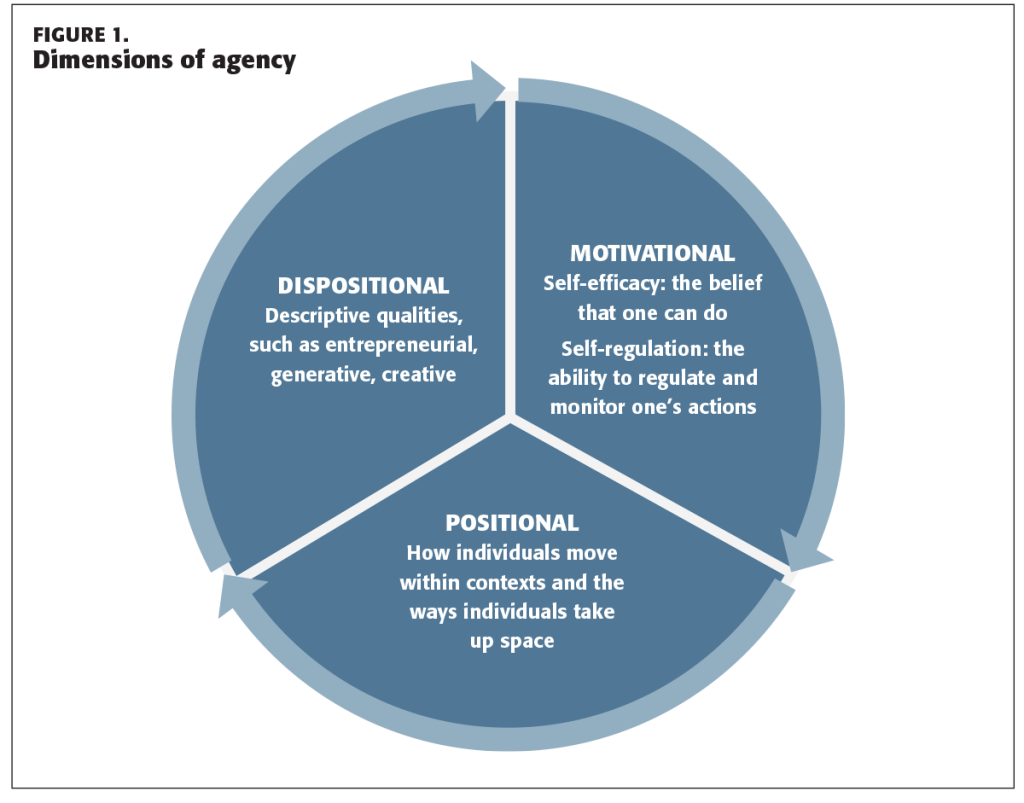
The model of student agency proposed in this article includes three key dimensions:
Dispositional dimension: This dimension focuses on students’ personal dispositions, such as creativity, goal-setting, and resilience. It involves students acting on their intentions and purposes. For example, Ms. Edward’s class initiated and organised a class-wide poetry anthology project based on Christmas to raise money for the charity Shelter.
Motivational dimension: This aspect of agency is concerned with students’ ability to regulate their actions, persist through challenges, and make decisions [LINK]. An example is Ned’s efforts to make a graphic-novel despite his initial setbacks, showcasing his motivation and persistence in the face of obstacles.
Positional dimension: Agency is also shaped by how students interact within the writing classroom. It involves co-creating agency through interactions with peers and teachers. For example, Mr. Robinson’s class developed dual-language books in collaboration with Ukrainian refugees, illustrating how agency is constructed through collective efforts with classmates [LINK].
Supporting student agency
To foster student agency in the writing classroom, teachers can:
Talk with your pupils: Involve students in the process of planning class writing projects and adapt your instruction based on their feedback [LINK, LINK, LINK and LINK]. For example, Ms. Vann gave her class sticky notes asking them what they would like to learn about writing [LINK].
Integrate children’s cultural and linguistic backgrounds: Invite students to use their cultural and linguistic backgrounds in class writing projects [LINK and LINK]
Make writing projects real world projects: Connect class writing projects to students’ interests and real-life experiences [LINK]. For instance, Mr. Palmer’s project where children wrote curiosity letters to people of interest [LINK].
Cultivate a students as knowledge creators and sharers: Develop a classroom culture that views students as active participants and knowledge generators. This involves creating opportunities for students to exert influence and contribute their own funds-of-knowledge to their writing. For example, by inviting children to make a class encyclopedia of knowledge [LINK].
Student agency is a dynamic and multi-dimensional concept that involves students’ personal dispositions [LINK], motivational aspects [LINK], and interactions within social contexts [LINK]. By adopting practices that support these dimensions, educators can create writing classrooms where students are empowered to actively participate in and shape their writerly apprenticeship. Engaging students in meaningful ways [LINK], adapting instruction based on their needs and interests [LINK], and integrating their cultural backgrounds [LINK] are all essential strategies for cultivating agency in the writing classroom.
Conclusion
In schools that foster student agency, opportunities arise when students are empowered to make choices, act on their intentions, and shape their learning experiences [LINK and LINK]. These writing schools allow students to be proactive and influential, positioning them as knowledgeable contributors and leaders within the classroom. Writer-teachers obviously play a crucial role in these contexts by working collaboratively with their students, employing flexible and adaptive teaching strategies that respond to students’ most pressing needs and interests. When students and teachers engage in this dynamic and reciprocal process, it creates rich and meaningful writing space that enhances the writerly experiences for both parties. Such classrooms and schools not only support academic growth but also cultivate a sense of agency that prepares students for future writing challenges and opportunities.
Supporting early writing development is essential for children’s future literacy and academic success. While many early childhood classrooms offer writing centres with paper and writing tools, teachers often miss opportunities to provide intentional support for key writing skills. Specifically, there is a lack of focus on the language-based skills needed to help children generate and translate their ideas into writing [LINK]. Instead, writing instruction in early childhood typically emphasises isolated skills like name writing, letter formation, and encoding. While these activities support children’s transcriptional development, they do not support children’s compositional development, which is crucial for children’s long-term academic success [LINK].
When children are not given opportunities to compose their own writing – they can struggle as they move through school and writing projects become more demanding [LINK]. It can often be a lack of compositional development which leads to children’s frustration and avoidance for writing and prevents them from discovering the pleasures of expressing their thoughts, knowledge and creativity (Young in press).
By developing children’s compositional skills early on, teachers can help students build both the skills and confidence they need to write effectively. This paper provides practical strategies from successful early childhood classrooms that teachers use to reduce children’s cognitive load and improve their development during writing time.
***
Isolated skill practice in letter formation and encoding, while essential, is not enough to provide a well-rounded writerly apprenticeship [LINK]. Composing involves multiple cognitive steps, beginning with idea generation. For example, a teacher might ask, “What could the story books we are making be about?” This question encourages children to generate ideas with a clear goal in mind. They then translate those ideas into drawings and language, using their vocabulary, grammar, and understanding of conversations. Finally, children transcribe their ideas onto the paper in developmentally appropriate ways — whether through emergent writing or conventional adult writing [LINK].
It’s this translation of thoughts into written form that propels children’s writerly growth [LINK]. It’s these sorts of opportunities which draw children’s attention to the magic of writing – and how you can use it to make and share meaning with others. They begin to understand that writing is a means of expressing yourself – and it’s fun! When teachers intentionally support this process, they help students not only improve their writing skills but also cultivate a deeper connection with them as people [LINK].
If children are given a well-rounded writerly apprenticeship in the early years, we typically see them go through the following milestones:
Ages 2 – 5: Children translate their ideas for their writing into short phrases. For example, “Pirate ship crashes. BOOM!”.
Ages 4-6: Children begin using sentences, including the use of modifiers and more precise vocabulary. For example, “The pirate ship is on the ocean”.
Ages 5-7: Children often verbalise multiple sentences, using their growing understanding of grammar to tranlsate their ideas for writing. Their ability to use the correct verb tenses improves. For instance, “There was a terrible storm. The pirates were jumping overboard! Ahhh!” Here, the child not only shifts focus between the storm and the pirates but also shows an emerging ability to handle tense changes.
At this stage, children’s sentence structures can move away from being relatively simple to expressing more intricate ideas by combining ideas through compound and complex sentences [LINK].
***
Research has consistently shown that writing stories, expressing opinions, and creating informational texts – activities that demand children to compose writing – contribute far more to children’s writing achievement than isolated skill practice like spelling drills or handwriting exercises [LINK, LINK, LINK]. In other words, it’s through writing their own stories and ideas that children become better writers. This type of generative practice also strengthens their oral language and listening comprehension, reading, vocabulary, sentence structure, and overall literacy skills too. Classroom environments that foster interactive and supportive writing activities, where teachers engage with students about their topics, structure, and language choices, can lead to higher-quality writing [LINK, LINK].
***
Despite its importance, many early years teachers can feel underprepared to provide effective writing instruction. Writing in the early years does requires direct and intentional teaching (Young & Ferguson 2023, 2024a, 2024b).
Practical strategies for fostering idea generation and compositional development
Below are the sorts of effective strategies that teachers in high language-growth classrooms employ to support their children’s writing development.
One effective way to help children generate ideas is by focusing on their memory retrieval. Start by reminding them of the writing project and its purpose. For example, if the project is making their own ABC Book,show them an example. This narrows their attention and directs their memory to retrieve relevant information about the ABC books they’ve read previous – for example, they have a picture and a word on every page.
Expand children’s ideas by repeating what they said as a question. Expansions are a great way to help children build on their initial ideas. For example, if a child says, “My parrot went to bed,” you might respond, “Your parrot went to bed?” “Yes, it goes right into his cage and daddy puts a blanket over it – night night.” “Whoa, cool. Let’s definitely write that down!” Expansions like this extend children’s thinking and help them construct more detailed pieces of writing than they would otherwise [LINK].
For classrooms with a high proportion of bilingual learners, these strategies can be especially useful, as English language learners may need extra support in memory retrieval and language construction. For more details, see our eBook: A Teacher’s Guide To Writing With Multilingual Children [LINK].
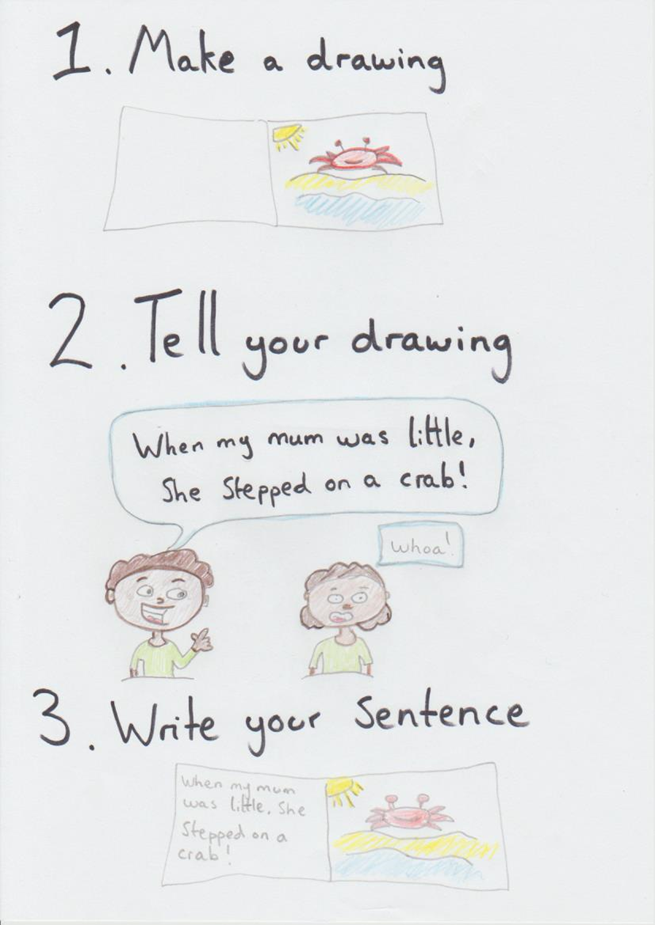
Use a developmentally appropriate writing process where children are encouraged to talk, draw and talk about their drawings before writing about what their drawing ‘says’. Once their writing is finished they should share what they’ve made with others [LINK].