This is the second of a series of blogs, written by a teacher for teachers, aimed at helping you prepare yourself as a Writing For Pleasure practitioner. This particular blog asks you to think about all of the children in your class and their own interests and experiences so that you can better understand them as individuals and their writerly identities.
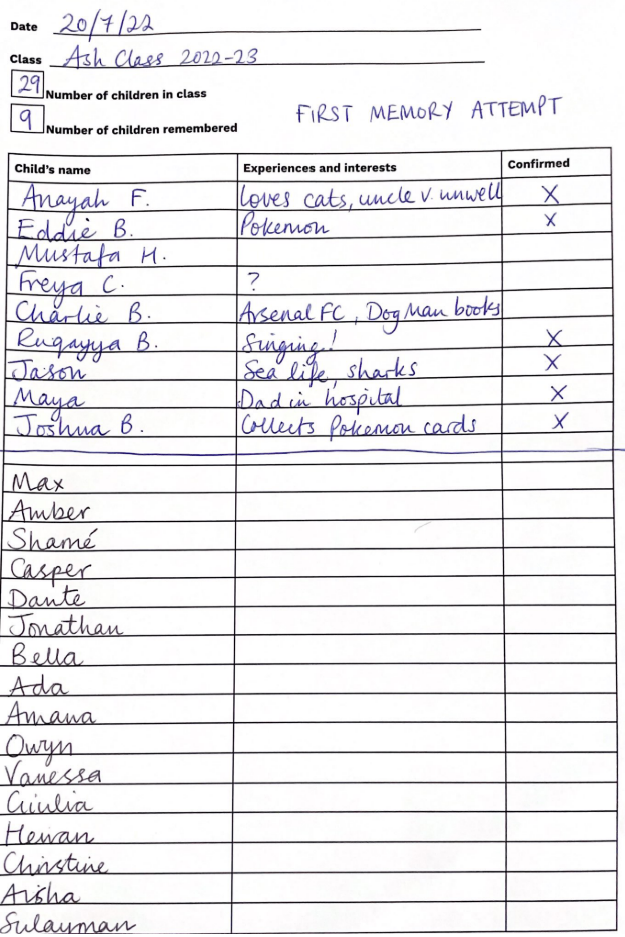
In Donald Graves’ book Writing: Teachers and Children at Work, he says ‘I think I know students […] until I challenge myself to write their names from memory’. When he would ask teachers to do the same, ‘most had some blanks’. He would do a memory activity (see the task below) with teachers as a way to get them thinking about their pupils – in particular about the ‘missing children’ who were not remembered – and write down the particular interests and knowledge funds of every child in the class.
After you have met your new class for the first time – and hopefully this has happened before the end of the Summer term – try out a memory activity, like that suggested by Graves. Without knowing the children well enough in the first place, our teaching will not be as good as it could be. Make this a priority – try this now and keep doing this memory task once you’re with the class from September – at least once a half-term but preferably more often.
Task 1: Test yourself to remember all of the children’s names in your class & list their experiences and interests. 10 mins each time.
See the appendix for a blank version that can be copied.
When you do this, it is so important to check afterwards anddraw a line to show the bottom of your list and then write down the names of all the children you did not remember below this line. You will find out lots about what the children enjoy, know and spend time thinking about from informal conversations, in items they bring to school or during sharing times (as well as from the next task). Put an X in the ‘confirmed’ column when their experiences and interests that you think they have are confirmed during such opportunities from September onwards.
Each time you do this, compare how your understanding of the children’s experiences and interests changes and keep reflecting upon which children you still don’t remember (and why that might be). Those children should (must) become your priority.
Those children for whom it is most difficult to come up with a territory or information are those who need it most. They are often the children who find it difficult to choose topics, to locate a territory of their own. They perceive themselves as non-knowers, persons without turf, with no place to stand. Such an exercise works on a child’s voice, and begins the oral process of authenticating experience.
From Writing: Teachers & Children at Work (Graves 1983 p.22)
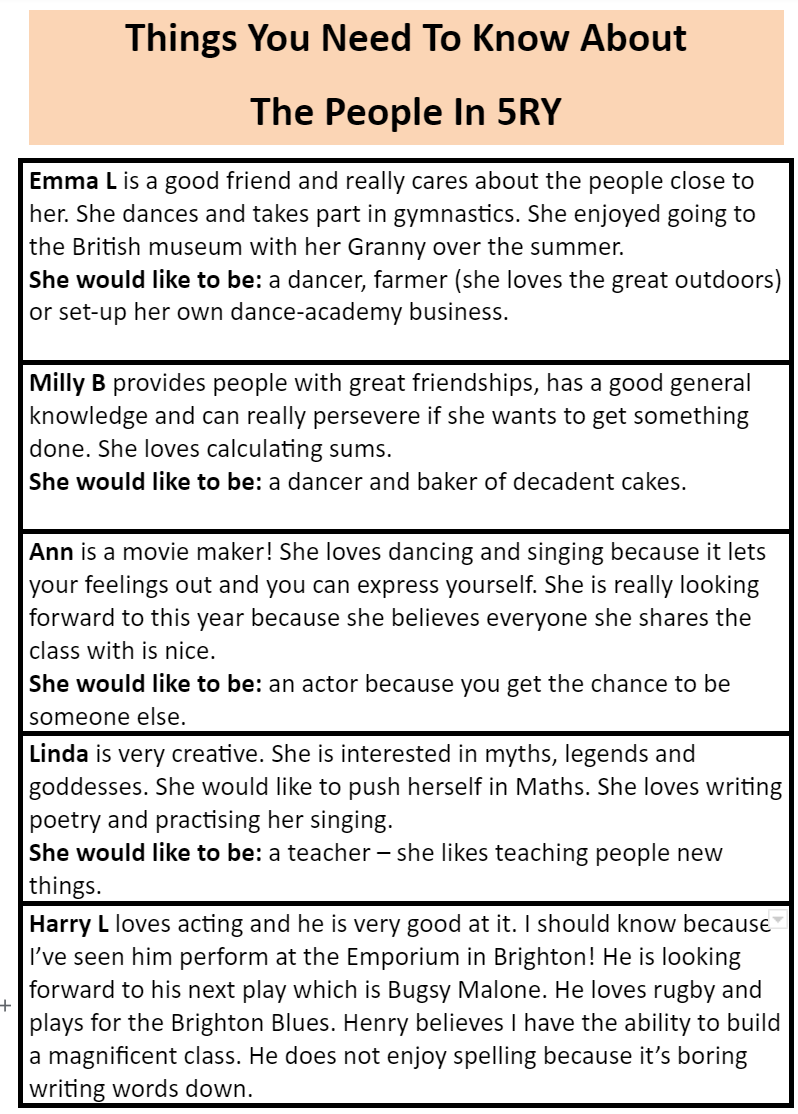
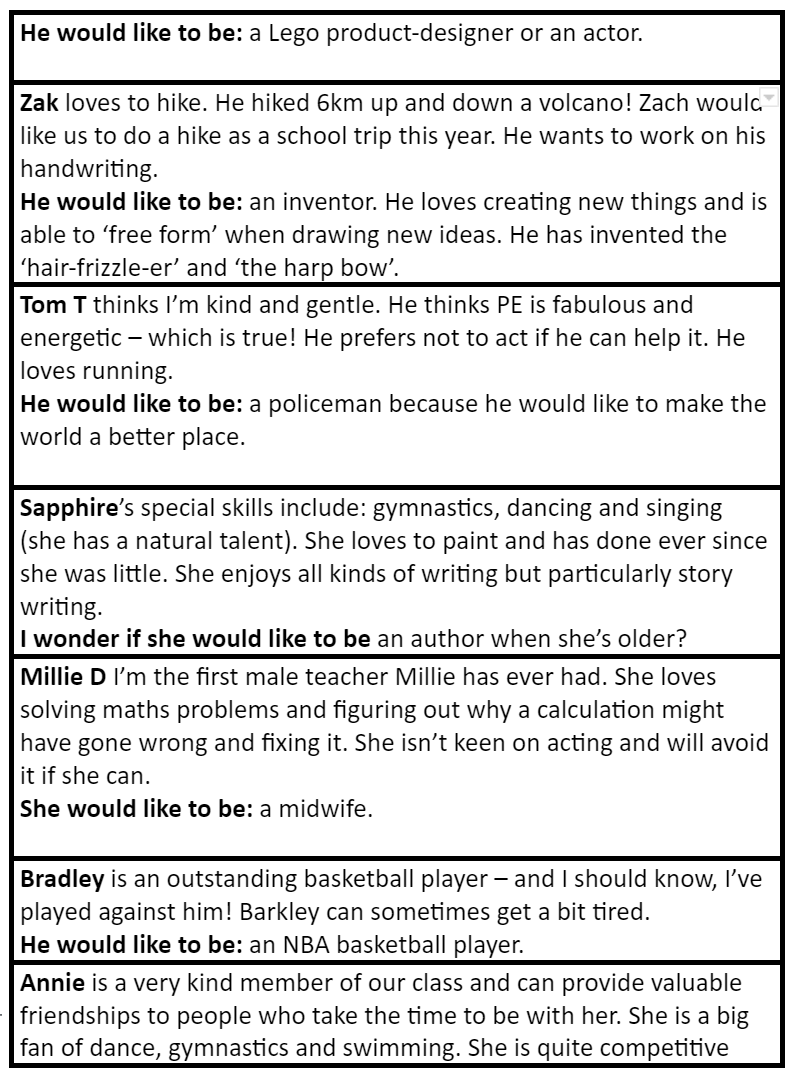
When the new academic year begins, you can also ask the children directly about their interests and experiences (see the suggested proforma in the appendix) and use what the children tell you in order to create a document such as a ‘Things You Need to Know About [insert class name]’ book, which you could laminate and put into the class library for the children to read.
Task 2: Survey the children about themselves and their interests. With their permission, use this to create a ‘Things You Need to Know About…. ‘ book for the class library. 10 mins for survey; between 45-60 mins to create class book.
See the appendix for the blank survey. This can also be adapted for younger children, such as for those in KS1.
Along with your own writing river and reflections upon yourself as a writer and teaching of writing (see the previous blog in this series, DIY CPD for Writing for Pleasure 1. Being a Writer-Teacher), you will know yourself and your pupils better and therefore be an even better teacher.
By Ellen Counter. Ellen has been a primary teacher for the past 15 years, working in three different London boroughs. She has enjoyed teaching every age group during that time – from Nursery to Year 6. She completed her MA in Children’s Literature in 2013. Ellen is currently the Strategic English Lead in a seven-form primary school in East London.
With huge thanks to the late Donald Graves and his lasting inspiration.
Experimental and random control trials, systematic reviews, meta-analyses and case studies together with research into what the most effective schools do (Young & Ferguson 2021a, 2022) all point to the efficacy of a Writing For Pleasure approach for conducting daily writing lessons.
The components of an effective writing lesson typically involve a reassuringly consistent (though adaptable) routine of: mini-lesson, writing time, and class sharing. What is innovative here is that, after a mini-lesson, children are invited to apply what’s just been taught in a way that is relevant to their own writing (you can read more about this here).
The table below explains why this consistent approach is so useful and effective.
An excellent foundation and a good rule of thumb when you’re first setting up a routine for writing lessons is to follow this kind of order and timings:
Depending on the circumstances of your new class, you may find you need to build up to these kinds of timings at the beginning of the year. For example, your class may not have the emotional maturity or be developmentally ready to deal with a 10 minute mini-lesson. Similarly, they may not yet have the stamina to engage in writing for 40 minutes.
Once you and your students are comfortable with this kind of routine, you can begin to play around with it. Routine doesn’t mean rigidity –a good routine always has a component of flexible response. The routine’s importance is found in knowing what a good writing lessontypically involves and having a shared language you can use with your class. Your students will soon get used to language like: workshop time,mini-lesson, writing time, silent writing, social writing, conferencing time, class sharing and Author’s Chair (Harris 2021).
Once comfortable, there are endless ways in which you can play around with these key combinations. Doug Kaufman (2022) suggests thinking about your daily schedule in a graphic form of boxes that help you to clarify the time you want to spend on different events and envision the multiple possibilities for structuring the daily routine to respond to pupils’ needs and personal agendas. Here are just a few examples:
It’s vital that we think carefully about the process goals we set for writing time too (Young & Ferguson 2021a, 2022). A process goal is something we would like children to achieve or get done by the end of a writing session. It’s important to say that by writing time we don’t necessarily mean drafting. Writing time simply means time engaged in the processes of writing. For example, writing time might mean: making front covers; working on plans; drafting a picturebook page; producing a single paragraph of writing; reading; conducting research; discussing and revising some already crafted writing; proof-reading for spellings; or publishing.
Here are some examples of the sorts of ways that you can set process goals for writing time:
The reason these components are so brilliant is because they offer the potential for explicit instruction, meaningful practice and formative assessment every single day. These are the absolute bedrocks of all teaching and learning.
By Doug Kaufman & Ross Young
References
Ferguson, F., Young, R. (2021) A Guide To Pupil-conferencing With 3-11 Year Olds: Powerful Feedback & Responsive Teaching That Changes Writers Brighton: The Writing For Pleasure Centre
Harris, B. (2021) Author’s Chair [Online: writing4pleasure.com/authors-chair ]
Kaufman, D. (2022) Teacher, Inventor: How to Take Your Teaching Back from the Pre-Packaged Writing Program. Manuscript accepted for publication.
Whittick, L. (2020) Write a little – share a little [Online: writing4pleasure.com/write-a-little-share-a-little ]
Young, R., Ferguson, F. (2021) Writing For Pleasure: Theory, Research & Practice London: Routledge
Young, R., Ferguson, F. (2021b) GuideTo Personal Writing Projects & Writing Clubs For 3-11 Year Olds Brighton: The Writing For Pleasure Centre
Young, R., Ferguson, F. (2022) Handbook Of Research On Teaching Young Writers Brighton: The Writing For Pleasure Centre
Young, R., Hayden, T. (2022) Getting Success Criteria Right For Writing Brighton: The Writing For Pleasure Centre
The Standards & Testing Agency, rightly, wants schools to develop independent writers (STA 2018a, 2018b). However, it’s clear that many writing pedagogies aren’t fit for this purpose. They aren’t orientated towards teaching children to be motivated and independent writers (Young & Ferguson 2021a, 2022). In these pedagogies, children have become dependent on their teachers – what Donald Graves called being on ‘writers’ welfare’.
Please sir, can I have another writing prompt?
Graves warned us that this would happen over forty years ago (Graves 1976, 1983). He told us that children will be content to sit patiently and wait until they are told what they must write. Children will learn that to write is to write for an audience of one – their teacher. They will be dependent and controlled within an inch of their writing lives. They won’t be required to make any kind of writerly decisions. It will all be planned and done on their behalf. They will also learn that to write well is to write about the things your teacher likes (Young et al. 2022). We now have a generation of children who have received a writing apprenticeship which has left them listless and indifferent. They are consumers rather than producers, reciters not writers, responders not composers (Young & Ferguson 2020). They believe writing is an artificial act which they are disconnected from.
I often visualise a child sitting outside their primary school on the last day of Year Six. They have in their hand a suitcase labelled ‘writing and being a writer’. The suitcase should be full of everything they will need to go on and write successfully and happily (Young & Ferguson 2022). At the moment, I wonder what it is we put in their suitcase that is helpful to them. I wonder whether children will be able to write well when there is no teacher to do it for them.
A question worth asking is this: what would happen if you gave the children in your class a series of open-ended writing sessions every day across a few weeks? What do you predict your class would do? A school which teaches their children how to be independent writers would be pretty confident (Young & Ferguson 2021b). Others, I suspect, would be terrified. Their students would be like fish out of water. They’ve never been asked to write anything independently. They’ve not been taught the metacognitive or self-regulation strategies they would need to be successful and productive (Young et al. 2021).
‘We need to break the teaching cycle that places young people on writer’s welfare. Children won’t learn if we think for them… We want independent learners and thinkers. We want independent writers.’ – Donald Graves
Graves’ messages have often been misunderstood – that somehow he was telling us that teachers shouldn’t teach. Yet he called for:
Explicit instruction to be coupled with self-regulation.
Children to have a daily, sustained and meaningful opportunity to practise writing.
Children to receive verbal feedback and additional individualised instruction while they are writing.
These all remain bedrocks of what we know about world-class writing teaching today (Graves 1983, 1994; Wyse 2019; Young & Ferguson 2022b).
‘Children want to write. They want to write the first day they attend school… The child’s marks say, “I am”. “No you aren’t,” say most school approaches to the teaching of writing… We take the control away from children and place unnecessary road blocks in the way… Then we say, “They don’t want to write. How can we motivate them?”’ – Donald Graves
It’s important to point out that Graves predicted that teachers too would lose their sense of ownership and professionalism in the writing classroom. They too will be put on ‘writers’ welfare’. He talks of how there will be an increasing mistrust of accountability measures and that these measures will spread paranoia and suspicion around the profession. This has certainly come to pass. As we have said, the Standards & Testing Agency wants schools to develop independent writers. However, because of the high-stakes nature of the DfE’s use of schools’ results, some feel that they must put their children on writers’ welfare to get the results they need. However, this ‘writers’ welfare’ pedagogy has not led to a rise in standards.
In 2021, around one in three children left primary school without meeting the basic ‘met’ standard for writing.
In 2020, children’s writing enjoyment was at its lowest since records began.
In 2019, a quarter of children failed to achieve the early learning goal for writing at the end of the early years foundation stage (EYFS).
In 2019, around 30% of children failed to achieve the ‘met’ standard at KS1. Only 16% of children at KS1 were able to demonstrate that they could write above the basic ‘met’ standard.
In 2019, prior to the pandemic, only one in five KS2 children in England were able to write above the ‘met’ standard. Approximately, one in four children left primary school without meeting the standard for writing.
This was predicted by academic George Hillocks when he concluded that a ‘writers’ welfare’ model for teaching writing is the least effective of all the orientations a school could adopt (Hillocks 1986; Young & Ferguson 2021a, 2022). But it doesn’t have to be this way. There are schools who are doing fantastic work and teaching their children how to live the writer’s life (LINK).
I’ll finish with Graves and his gentle reminder to us all: the only way we can get children off writers’ welfare is to put writing back where it belongs – in the hands of the child.
References
Graves, D. (1976) Let’s Get Rid of the Welfare Mess in the Teaching of Writing, Language Arts, 53(6) pp.645-651
Graves, D. (1983) Break the welfare cycle: let writers choose their topics, The English Composition Board, 3(2) pp.75-78
Graves, D. (1983) Writing: Teachers & Children At Work Portsmouth: Heinemann
Graves, D. (1994) A Fresh Look At Writing Portsmouth: Heinemann
Hillocks, G. (1986) Research on Written Composition: New Directions for Teaching, Urbana, IL: National Council of Teachers of English
Wyse, D., (2019) Choice, Voice and Process – Teaching Writing in the 21st Century: Revisiting the Influence of Donald Graves and the Process Approach to Writing, English in Australia, 53 (3) pp.82-91
Young, R., Ferguson, F. (2020) Real-World Writers: A Handbook For Teaching Writing With 7-11 Year Olds London: Routledge
Young, R., Ferguson, F. (2021a) Writing For Pleasure: Theory, Research & Practice London: Routledge
Young, R., Ferguson, F. (2021b) GuideTo Personal Writing Projects & Writing CLubs For 3-11 Year Olds Brighton: The Writing For Pleasure Centre
Young, R., Ferguson, F. Hayden, T., Vasques, M. (2021) The Writing For Pleasure Centre’s Big Book Of Mini-Lessons: Lessons That Teach Powerful Craft Knowledge For 3-11 Year Olds Brighton: The Writing For Pleasure Centre
Young, R., Ferguson, F. (2022) The Science Of Teaching Primary Writing Brighton: The Writing For Pleasure Centre
Young, R., Ferguson, F. (2022b) Handbook Of Research On Teaching Young Writers Brighton: The Writing For Pleasure Centre
Young, R., Ferguson, F., Kaufman, D., Govender, N. (2022) Writing Realities Brighton: The Writing For Pleasure Centre
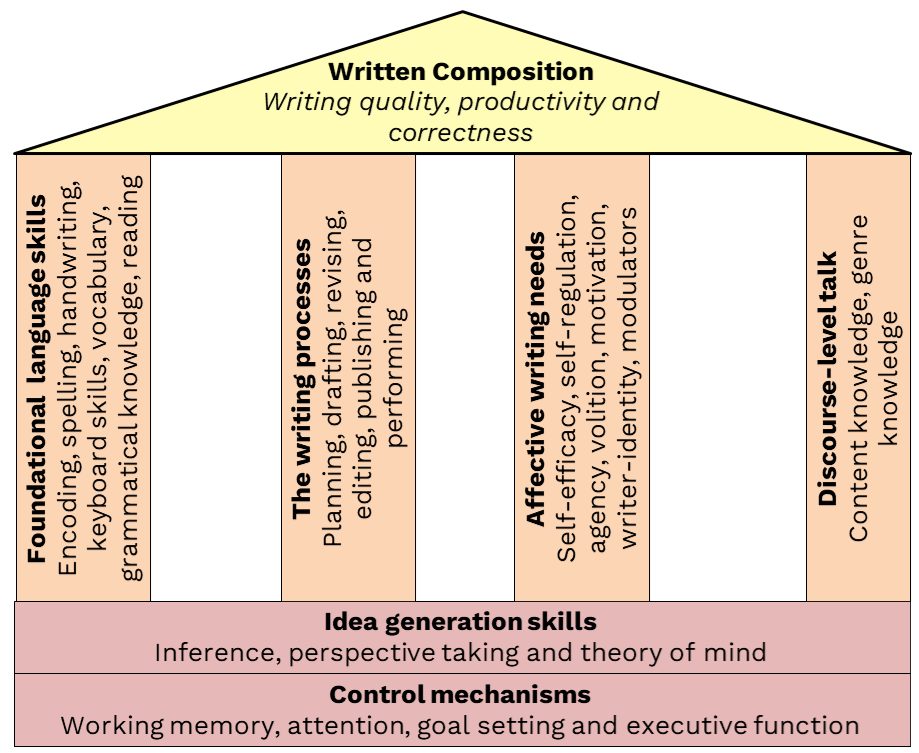
The Direct And Indirect Effects Model Of Writing (DIEW) is one of the latest models to try and expand our thinking around writing development (Kim & Schatschneider 2017; Kim & Park 2019; Kim 2020; Kim & Graham 2022). DIEW is largely the work of educational psychologist Young-Suk Grace Kim. Kim wanted to better understand the development and processes of six-year-old writers. Unlike The Simple View Of Writing, the DIEW model provides greater focus on how young children develop the compositional elements of their writing and, importantly, their writing ideas.
Kim’s model can be organised as a house. According to Kim, the foundations of writing are built on control mechanisms. In layman’s terms, this means children having the maturity to plan, manage and review their writing. Next comes one of the most interesting aspects of Kim’s model – her focus on idea generation skills. Kim shows us how children draw on skills like inference, perspective taking and theory of mind in order to generate great ideas for writing (Young & Ferguson 2022a).
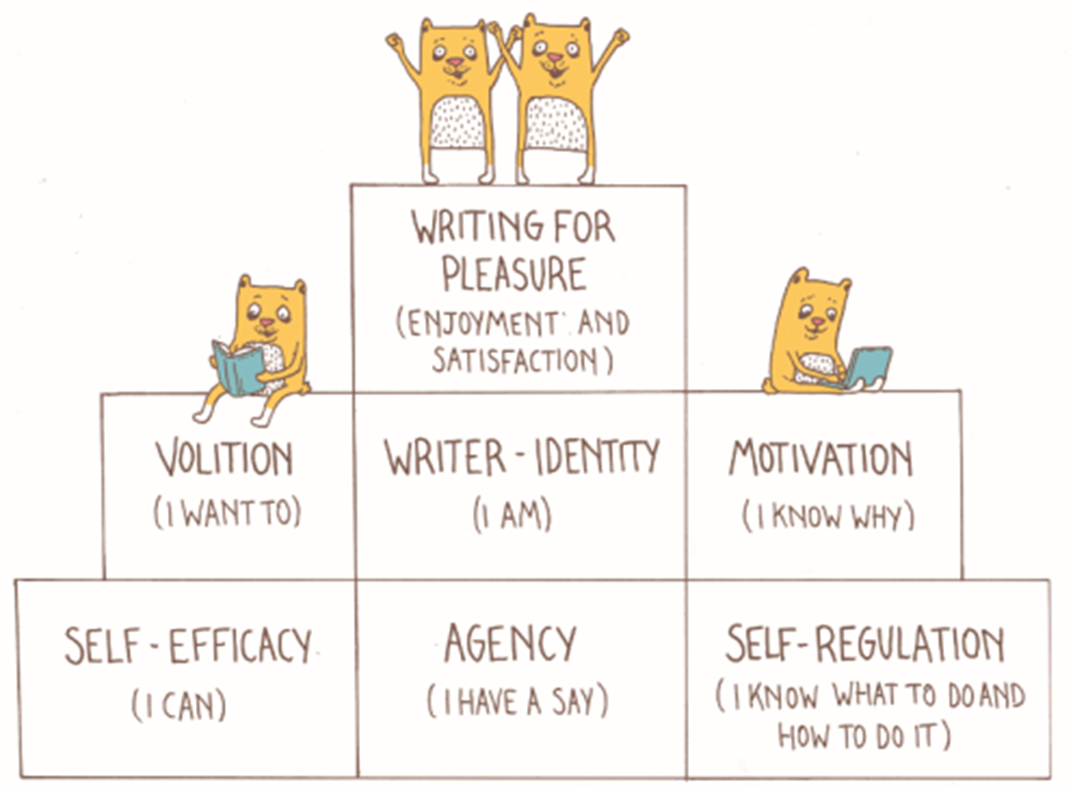
After laying down their foundations, Kim believes children build their ‘writing house’ using four pillars: foundational language skills, knowledge of the writing processes, children’s affective needs and discourse-level talk.
Foundational language skills includes using their transcriptional skills such as encoding, spelling, handwriting, typing but also their knowledge of vocabulary, grammar and their ability to read.
Children need to be knowledgeable of the processes writing goes through including: planning, drafting, revising, editing, publishing/performing.
Children’s affective needs must be developed and attended to. This includes attending and developing their sense of: self-efficacy, self-regulation, agency, volition, motivation, writer-identity (Young & Ferguson 2021a, 2022b; Young et al. 2022). This also includes attending to, and regulating, their emotions (Young & Ferguson 2022c).
Finally, we have discourse-level talk. This is essentially Kim’s phrase for content and genre knowledge.
All of these pillars are required and they all need to be strong if children’s ‘writing houses’ are to stay up. If the house is stable, children can produce writing fluently, accurately, happily and of quality.
Why is Kim’s model useful to us? Well, it highlights the importance of certain cognitive resources which all too often can be overlooked and underdeveloped in schools. Hence, the name direct and indirect effects model of writing. Kim’s calls our attention to:
Explicitly teaching children how to manage themselves as writers and their writing process (Young et al. 2021, Young & Ferguson 2022b).
Explicitly teaching children how to generate quality writing ideas (Young & Ferguson 2022a).
The fact children write better texts when they can draw on content that they are knowledgeable of and passionate to write about (Young & Ferguson 2022c)
The impact children’s reading has on their abilities to write (Young & Ferguson 2020, 2021a, 2022b).
Teachers must attend to children’s emotional and affective needs (Young & Ferguson 2021a, 2022b, 2022c).
Children draw on their genre knowledge to help them write. This includes making decisions at sentence and grammatical levels (The Writing For Pleasure Centre 2022, Young & Ferguson 2021b, Young & Ferguson 2022d).
Our hope is that by sharing this model for writing, we can help turn the tide on the pernicious underachievement of writing in schools (Ofsted 2009, 2012; DfE 2012, 2017, 2019, 2021). Indeed, the problem teachers and schools often face is knowing how to develop all these cognitive resources efficiently and effectively in their classrooms (Young & Ferguson 2021a, 2022b, 2022c).
References
DfE. (2012). What is the Research Evidence on Writing? Education Standards Research Team. London: Department for Education.
DfE. (2017). National Curriculum Assessments at Key Stage 2 in England, 2017 (revised). London: Department for Education
DfE. (2019). National Curriculum Assessments at Key Stage 2 in England, 2019 (revised). London: Department for Education.
DfE. (2021). The reading framework: teaching the foundations of literacy London: Department for Education.
Kim, Y.-S.G. (2020) Structural relations of language and cognitive skills, and topic knowledge to written composition: A test of the direct and indirect effects model of writing, Br J Educ Psychol, 90: 910-932
Kim, Y.-S. G., & Schatschneider, C. (2017) Expanding the developmental models of writing: A direct and indirect effects model of developmental writing (DIEW), Journal of Educational Psychology, 109(1), 35–50
Kim, YS.G., Park, SH. (2019) Unpacking pathways using the direct and indirect effects model of writing (DIEW) and the contributions of higher order cognitive skills to writing, Read Writ, 32, 1319–1343
Kim, Y.-S. G., Yang, D., Reyes, M., Connor, C. (2021) Writing instruction improves students’ writing skills differentially depending on focal instruction and children: A meta-analysis for primary grade students, Educational Research Review, 34, 100408
Kim, Y.-S.G. (2022) Co-Occurrence of Reading and Writing Difficulties: The Application of the Interactive Dynamic Literacy Model, Journal of learning disabilities, doi:10.1177/00222194211060868
Kim, Y.-S. G., & Graham, S. (2022) Expanding the Direct and Indirect Effects Model of Writing (DIEW): Reading–writing relations, and dynamic relations as a function of measurement/dimensions of written composition, Journal of Educational Psychology, 114(2), 215–238
Naumann, N. J. (2023). Assessment Measures in Reading that May Be Useful for Writing. In The Routledge International Handbook of Research on Writing (pp. 563-572). Routledge.
Ofsted. (2009). English at the Crossroads. London: Ofsted
Ofsted. (2012). Moving English Forward. London: Ofsted
Young, R., Ferguson, F. (2020) Real-World Writers: A Handbook For Teaching Writing With 7-11 Year Olds London: Routledge
Young, R., Ferguson, F. (2021a) Writing For Pleasure: Theory, Research & Practice London: Routledge
Young, R., Ferguson, F. (2021b) The Writing For Pleasure Centre’s Grammar Mini-Lessons For 5-11 Year Olds Brighton: The Writing For Pleasure Centre
Young, R., Ferguson, F. Hayden, T., Vasques, M. (2021) The Writing For Pleasure Centre’s Big Book Of Mini-Lessons: Lessons That Teach Powerful Craft Knowledge For 3-11 Year Olds Brighton: The Writing For Pleasure Centre
Young, R., Ferguson, F. (2022a) No More: I Don’t Know What To Write About. Lessons That Help Children Generate Great Ideas Brighton: The Writing For Pleasure Centre
Young, R., Ferguson, F. (2022b) Handbook of Research On Developing Young Writers Brighton: The Writing For Pleasure Centre
Young, R., Ferguson, F. (2022c) The Science Of Teaching Primary Writing Brighton: The Writing For Pleasure Centre
Young, R., Ferguson, F. (2022d) The Writing For Pleasure Centre’s Sentence-Level Instruction: Lessons That Help Children Find Their Style And Voice Brighton: The Writing For Pleasure Centre
Young, R., Ferguson, F., Kaufman, D., Govender, N. (2022) Writing Realities Brighton: The Writing For Pleasure Centre
The Standards & Testing Agency, rightly, wants schools to develop independent writers (STA 2018a, 2018b). However, it’s clear that most writing pedagogies being used in schools at the moment aren’t always fit for this purpose. They aren’t orientated towards teaching children to be motivated and independent writers (Young & Ferguson 2021a, 2022a). As a result, there is pernicious underachievement in writing attainment.
To help, we wanted to share how our Writing For Pleasure affiliate schools ensure that children are writing independently every day.
A culture of independence is built into our whole programme of study (link). For example, in Nursery, children are being encouraged to write independently every day.
Children are taught how to take a germ of an idea and see it through to publication or performance independently (link).
Our schools know that independence starts with children choosing their own topics within the parameters of a class writing project (link, link). Teachers know that they are going to receive 30+ different pieces of writing by the project’s end. No two pieces of writing will look the same.
Teachers’ daily instruction is built on the principles of self-regulation strategy instruction (link). Every day, children apply what’s just been taught in a way that is relevant to their own writing (link, link, link).
Children write meaningfully and for a sustained period every day.
Teachers provide live verbal feedback and responsive individualised instruction daily. Again, the expectation is that children will use and apply, independently, what they’ve just been taught (Ferguson & Young 2021).
Children are taught a whole host of metacognitive and self-regulation writing strategies (Young et al. 2021). Children know what to do when they don’t know what to do.
Children learn to set themselves goals for each writing session (Young et al. 2021; Young & Hayden 2022).
Children are taught a whole host of co-regulation strategies (Young et al. 2021). They know how to help one another.
English language learners are taught how to be independent writers from their very first day (Ferguson & Young 2022).
Children are encouraged to develop their own personal writing projects at school and at home (Young & Ferguson 2021c).
Children know how to extract great craft moves from their reading and use it in their writing (Young & Hayden 2022).
Children develop plans so that they can draft quickly and happily.
Children are taught a whole host of fluency strategies so that they can draft largely independently (Young et al. 2021).
Children learn revision strategies, and they experiment with craft moves on their ‘trying things out pages’ before making the authorial decision as to whether or not to include them in their final composition (Young et al. 2021).
Children learn how to proof-read (Young & Ferguson in press).
Teachers are confident when it comes to moderation and assessment because they know everything that has been written by their class has been written independently. (link).
Importantly, children know that writing independently doesn’t mean writing alone. They live and work every day in a community of writers (Young & Ferguson 2020, 2021a). They share their developing compositions with one another every day and they engage in writerly conversations with their teacher every day too.
Finally, and most importantly, children have been taught how they can live the writer’s life after they leave school (link).
References
Ferguson, F., Young, R. (2021) A Guide To Pupil-conferencing With 3-11 Year Olds: Powerful Feedback & Responsive Teaching That Changes Writers Brighton: The Writing For Pleasure Centre
Ferguson, F., Young, R. (2022) The Writing For Pleasure Centre’s Guide To Writing With Multilingual Children Brighton: The Writing For Pleasure Centre
Young, R., Ferguson, F. (2020) Real-World Writers: A Handbook For Teaching Writing With 7-11 Year Olds London: Routledge
Young, R., Ferguson, F. (2021a) Writing For Pleasure: Theory, Research & Practice London: Routledge
Young, R., Ferguson, F. (2021b) The Writing For Pleasure Centre’s Grammar Mini-Lessons For 5-11 Year Olds Brighton: The Writing For Pleasure Centre
Young, R., Ferguson, F. (2021c) The Writing For Pleasure Centre’s Guide To Personal Writing Projects & Writing Clubs For 3-11 Year Olds Brighton: The Writing For Pleasure Centre
Young, R., Ferguson, F. (2021d) The Writing For Pleasure Centre’s Writing Development Scales & Assessment Toolkit Brighton: The Writing For Pleasure Centre
Young, R., Ferguson, F. Hayden, T., Vasques, M. (2021) The Writing For Pleasure Centre’s Big Book Of Mini-Lessons: Lessons That Teach Powerful Craft Knowledge For 3-11 Year Olds Brighton: The Writing For Pleasure Centre
Young, R., Ferguson, F. (2022) The Science Of Teaching Primary Writing Brighton: The Writing For Pleasure Centre
Young, R., Ferguson, F. (2022c) No More: I Don’t Know What To Write About. Lessons That Help Children Generate Great Ideas Brighton: The Writing For Pleasure Centre
Young, R., Ferguson, F. (2022d) The Writing For Pleasure Centre’s Sentence-Level Instruction: Lessons That Help Children Find Their Style And Voice Brighton: The Writing For Pleasure Centre
Young, R., Hayden, T. (2022) Getting Success Criteria Right For Writing Brighton: The Writing For Pleasure Centre
Writing is not simple. It’s probably the most cognitively demanding thing children have to do while they are at school. It is also incredibly rewarding – both emotionally and socially.
This is the problem with the theoretical framework The Simple View Of Writing (Gough & Tunmer 1986; Berninger et al. 2002). In essence, it tells us that writing is about having some ideas and writing them down. While this is interesting to cognitive psychologists, such a common-sense perspective is possibly bordering on the offensive if shared with teachers. We suspect the model comes as little surprise to anyone who teaches children to write.
Others think so too. This model has been continually revised and expanded upon (see Kim & Schatschneider 2017; Graham 2018; Kim & Park 2019; Kim 2020; Kim et al. 2021; Kim & Graham 2022; Young & Ferguson 2022). Indeed, Berninger & Amtmann (2003) revised the model only a year later, producing their still very limited Not So Simple View Of Writing.
This time, executive function was included to acknowledge that writers have to plan, manage and review their writing as they are crafting it. Again, we suspect this doesn’t surprise you.
The temptation is to say that the Simple & Not So Simple View Of Writing are out-of-date and of little practical use. We wouldn’t go that far. It’s important to know how theoretical models for writing have been developed (see Young & Ferguson 2022 for more details). However, we do think the devil is always in the detail. If details are routinely left out of cognitive models for the purposes of ‘simplicity’ then it can quickly result in bizarre and narrow teaching practices being suggested and used in schools – practices which won’t always align with what children actually need to develop as writers (Harris 2021; Young & Ferguson 2022, 2022b).
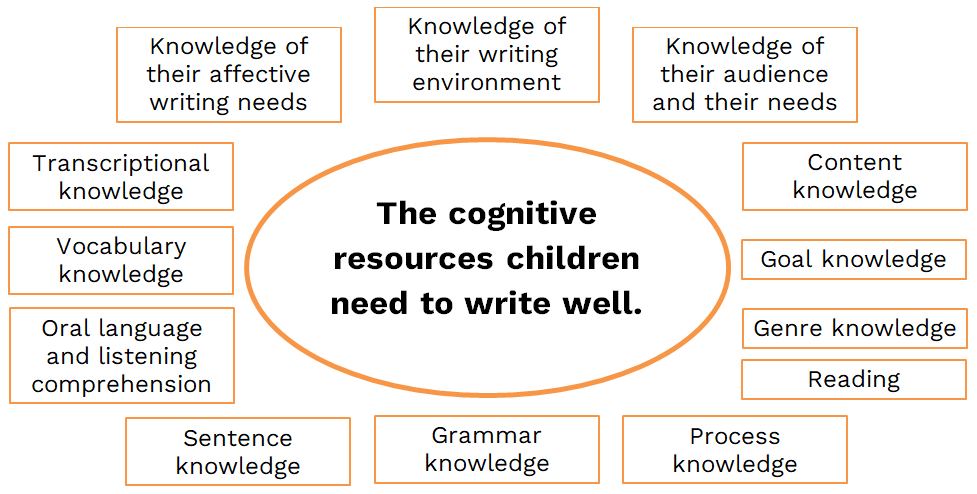
The latest understanding around ‘the science of writing’ is that to become great writers, children have to draw on at least 13 cognitive resources simultaneously. This can also be called their writerly knowledge. Our book The Science Of Teaching Primary Writingshares how teachers can develop this writerly knowledge in their classroom and across school.
The 13 cognitive resources children have to draw on to write well (Young & Ferguson 2022)
Our hope is that by sharing a more complete view of writerly development, we can help turn the tide on the pernicious underachievement of writing in schools (Ofsted 2009, 2012; DfE 2012, 2017, 2019, 2021). Indeed, the problem teachers and schools often face is knowing how to develop all these cognitive resources efficiently and effectively (Young & Ferguson 2021, 2022b).
References
Berninger, V. W., Abbot, R.D., Abbot, S. P., Graham, S., RIchards, T. (2002). Writing and reading: Connections between language by hand and language by eye. Journal of Learning Disabilities, 35(1), pp 38-56
Berninger, V.W., Amtmann, D. (2003). Preventing written expression disabilities through early and continuing assessment and intervention for handwriting and/or spelling problems: Research into practice. In Handbook of Learning Disabilities, Swanson, H.L., Harris, K.R., and Graham, S. (Eds.) (pp. 345–363). New York: Guilford Press
DfE. (2012). What is the Research Evidence on Writing? Education Standards Research Team. London: Department for Education.
DfE. (2017). National Curriculum Assessments at Key Stage 2 in England, 2017 (revised). London: Department for Education
DfE. (2019). National Curriculum Assessments at Key Stage 2 in England, 2019 (revised). London: Department for Education.
DfE. (2021). The reading framework: teaching the foundations of literacy London: Department for Education.
Gough, P.B. & Tunmer, W.E. (1986) Decoding, reading, and reading disability, Remedial and Special Education, 7, pp.6-10
Graham, S., (2018) A Revised Writer(s)-Within-Community Model of Writing, Educational Psychologist, 53:4, 258-279
Kim, Y.-S.G. (2020) Structural relations of language and cognitive skills, and topic knowledge to written composition: A test of the direct and indirect effects model of writing, Br J Educ Psychol, 90: 910-932
Kim, Y.-S. G., & Schatschneider, C. (2017) Expanding the developmental models of writing: A direct and indirect effects model of developmental writing (DIEW), Journal of Educational Psychology, 109(1), 35–50
Kim, YS.G., Park, SH. (2019) Unpacking pathways using the direct and indirect effects model of writing (DIEW) and the contributions of higher order cognitive skills to writing, Read Writ, 32, 1319–1343
Kim, Y.-S. G., Yang, D., Reyes, M., Connor, C. (2021) Writing instruction improves students’ writing skills differentially depending on focal instruction and children: A meta-analysis for primary grade students, Educational Research Review, 34, 100408
Kim, Y.-S.G. (2022) Co-Occurrence of Reading and Writing Difficulties: The Application of the Interactive Dynamic Literacy Model, Journal of learning disabilities, doi:10.1177/00222194211060868
Kim, Y.-S. G., & Graham, S. (2022) Expanding the Direct and Indirect Effects Model of Writing (DIEW): Reading–writing relations, and dynamic relations as a function of measurement/dimensions of written composition, Journal of Educational Psychology, 114(2), 215–238
Ofsted. (2009). English at the Crossroads. London: Ofsted.
Ofsted. (2012). Moving English Forward. London: Ofsted.
Young, R., Ferguson, F. (2021) Writing for Pleasure: Theory, Research and Practice London: Routledge
Young, R., Ferguson, F. (2022) The Science of Teaching Primary Writing Brighton: The Writing For Pleasure Centre
Young, R., Ferguson, F. (2022b) Handbook of Research on Teaching Young Writers Brighton: The Writing For Pleasure Centre
This is the first of a series of blogs, written by a teacher for teachers, aimed at helping you prepare yourself as a Writing For Pleasure practitioner. This particular blog asks you to think about your relationship with writing and being a writer-teacher.
The last half term of the academic year is usually my favourite. Not just because of the upcoming summer holiday, but also because I usually feel exceptionally proud. Proud of myself for getting through the year, no matter what challenge presented itself; proud of the children I have taught, how they’ve grown and learnt new things. And always that little bit anxious; anxious about my new class – having to start the cycle all over again and try my best to teach thirty entirely different children with very different interests and needs.
I imagine that, like me, during the months of June and July, you’ll want to start thinking about what you’re going to be teaching next year and how you’re going to do it. How you’re going to teach your class to write will inevitably form a huge part of that thinking, as well as the children’s writing needs. Perhaps you’re also reading this because you’re not entirely happy with how you’ve been teaching writing so far, or because you are keen to find out more about Writing For Pleasure and what this means for you and your pupils. Either way, I hope that the advice below will enable you to be a better and more confident teacher of writing, and will put you in a good position to introduce Writing For Pleasure from September. The plan is to make this a series of blogs which can each act as a small piece of CPD. Each blog will provide you with a ‘task’, with approximate times for completion (I realise we are all incredibly time-poor as teachers). I want them to be manageable and achievable, and, most importantly, to have the potential to bring about significant change in the way you think, write and teach.
The best place to start is to think about yourself as a writer.
Getting to know yourself as a writer and teacher of writing
Questions to consider: Reflections on yourself as a writer:
The questions below are adapted from the UKLA’s Teachers As Writers project. It was a project conducted by Teresa Cremin and I was extremely fortunate to participate in the project. For more information, see the UKLA’s publication Teaching Writing Effectively: Reviewing Practice.
You can choose to undertake this task privately or with colleagues.
What is your overall feeling or sense of yourself as a writer?
What types of personal writing activities do you carry out regularly at home?
Out of these activities, which gives you the most satisfaction/pleasure – and why do you think that is?
What are your earliest memories of writing? Are they positive/negative – why?
What feedback (positive or negative) had the biggest impact on you and how you felt about writing? Why do you think that is?
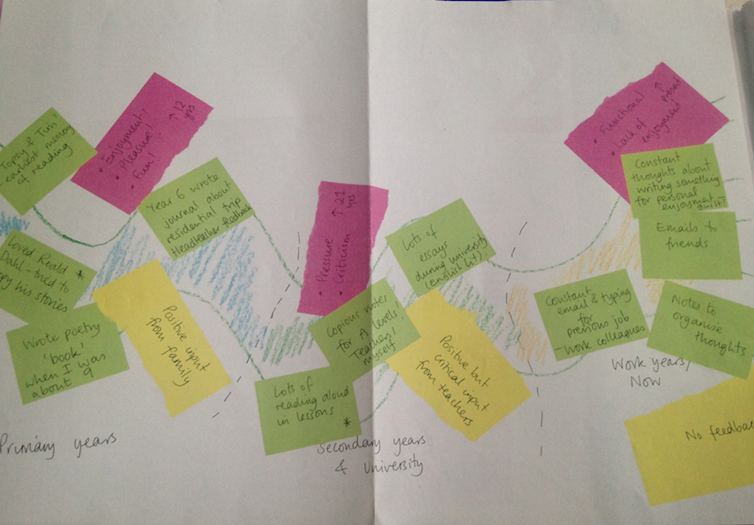
Task 1: Create your own writing river.20-30mins. Use the questions above and your own writing memories to create a Writing River. Divide your river into three sections: early and primary years; secondary & university years; and adult life. For each section, consider and write down (i) the different writing tasks that you remember doing that really stick in your mind (for whatever reason, negative or positive); (ii) the type of feedback that you received and from whom; (iii) the purpose of your writing. What do you notice? When you think about your childhood writing experiences, how might this relate to the experiences your pupils have?
When I did this, I remembered that I actually hid a lot of my writing from my teachers when I was at school. I wrote lots of poetry and stories at home that never made it into the classroom. We had a creative writing teacher who banned the word ‘nice’ and told me off for using it once in class. I hated her lessons ever since and would never talk to her about my writing. Thankfully my parents encouraged me to write and provided me with lots of opportunities to celebrate my endeavours. But, what if I hadn’t had that experience at home? I also thought about how controlling I had become in my own teaching and felt terrible about it. I was in danger of becoming just like my old creative writing teacher, even down to banning words from the classroom and being obsessed with checklists of punctuation. Something needed to change in my classroom – the subject I loved (and wanted my pupils to love) was not at all pleasurable to teach or to be a part of.
Questions to consider: Reflections on yourself as a teacher of writing:
Do you and your pupils see you as a writer inside or outside of school?
How regularly do you think out loud and model the different processes of writing?
How often do you write pieces for your pupils to enjoy and learn from?
How often do you discuss the future readers for your writing when you’re teaching?
How often do you explicitly teach about the craft of writing, such as the strategies and techniques that writers might use at different stages of the writing process (Young et al. 2021)?
How often do you write alongside children, taking part in the same class project that they are undertaking?
How regularly are the children given choice over things like purpose, genre, content and audience for their writing?
Don’t let this activity make you feel anxious if you’ve answered ‘no’ or ‘hardly ever’ to these questions. If that’s the case, then great! You’ve got something to work with. Remind yourself that this is the starting point for making a number of positive changes.
By Ellen Counter. Ellen has been a primary teacher for the past 15 years, working in three different London boroughs. She has enjoyed teaching every age group during that time – from Nursery to Year 6. She completed her MA in Children’s Literature in 2013. Ellen is currently the Strategic English Lead in a seven-form primary school in East London.
Eleanor Keegan. Eleanor is a Nursery teacher at Telferscot Primary School in South London. She has been teaching for six years and has been lucky enough to work in all key stages.
She has worked with children all her life, spending 10 years as a swimming teacher and as an assistant teacher in a primary school in Croydon. She has recently completed her masters in Child, Youth & International Development.
I would love to say that the idea of a daily book-making session came from me but it came in fact from my delightful class. In keeping with a Writing For Pleasure approach (Young & Ferguson 2021a, The Writing For Pleasure Centre 2022), they started the year already keen to mark-make, so I experimented with lots of different ways to engage them, one of which was having a basket of empty ‘books’ ready for them to fill. I let them explore independently everything I had on offer in the writing area. Book-making became a firm favourite and the children would encourage each other to have a go. Seeing how excited they were to make marks with meaning into a story or information book convinced me that I should foster this enjoyment of book-making and make it grow.
I would always put out a supply of handmade books, each with a bright coloured card front and 4 pages of white paper inside. We knew that children have preferences for different tools, so my team and I put out chunky pens, crayons, pencils, highlighters, biros, chalk and much more. Not all these tools were necessarily out at the same time, but they were close by and my children knew they could help themselves to anything at any time.
Sometimes I just let children know that book-making materials were out on a particular table, and sometimes I would go and sit there myself. I started by not giving too much instruction about how to make a book because I didn’t want anyone to feel overwhelmed. I would just sit and talk out loud about what I was doing, and children would come over and usually end up copying me or doing something similar (Ferguson & Young 2021). However, I would tell confident children that they could do things like putting writing and a picture on every page.
Towards the end of Autumn 2, many children were becoming very independent when book-making, so I decided to dedicate some carpet sessions that week to it (Young et al. 2021). We had an ‘Ideas Party’ where I got children to name their favourite things, and I wrote/drew a mind map.
Here’s an example of Nursery children in Marcela Vasques’ class being invited to have an Ideas Party.
I then said that they could turn their favourite things into a story. That day, I saw a few more children feeling confident enough to give book-making a go and my heart swelled with pride! I sat at the table and asked children to help me with my story because I couldn’t think of an idea. They loved feeling that they had all the knowledge and it encouraged some of the quieter children at the table to ask the same questions of me and their peers. By the end of the week every child in the class had had a go! I made their books very special by putting an ‘About The Author’ page at the back, with a picture of the author and some facts about them. They gave them to their parents as a Christmas present.
Fast forward to today, and we have now made a dedicated Author Table, on which are copies of our book-making checklist (Young & Hayden 2022) and a basket full of empty books. It’s a permanent part of our classroom environment.
Here’s one example of what a book-making checklist poster can look like (Young & Ferguson 2021a).
Here, we were learning about minibeasts, and some children wanted to make a fact book so they could teach their friends about them. They wanted to write accurate names because they are really interested in letters and sounds, so they copied the letters from a friend’s book.
When this book was written we were learning about the Lochness monster. This child decided she wanted to do a fact book (The Writing For Pleasure Centre 2022) showing the body parts of the monster so people would be able to spot it easily when they visit Scotland! She was really interested in letters and had long moved on from scribble writing. She asked me to write the letters for her, but instead I sounded out the words and let her have a go at writing them independently. As you can see, she was completely successful.
In this story, the child independently wrote his name on the front cover and, because he had spotted that all front covers have a picture, drew a Lochness monster.
This child, having created a front cover, then turned to the first page and did some writing. I asked him what he was writing and he told me that, when you open a book, there is always writing on the first page that isn’t the story, and that sometimes it says who the story is for. I was really impressed by this knowledge, and praised him for thinking to include it.
This child decided on his own to do page numbers as ‘that’s what they have in the books mummy reads to me.’ The story flows, with something different happening on each page.
Book-making has increased the confidence and independence of all the children in my Nursery class. I have made it something they can take ownership of, and where they can showcase their favourite things (Young et al. 2022). We share the books we’ve written at the end of every day. They sit on my chair, just as I do when I read aloud, which helps them feel that what they have written and created is real and important. If they don’t feel confident, I will read it for them.
In conclusion, it is essential to create a safe space for children where they can happily make books without feeling they will be judged. Praise for everything and anything that children achieve is key. For me, one of the stand-out moments since introducing book-making was when one of my children, who was very unconfident and had not yet ventured to the writing table, finally did. He came over and got an empty book and pencil but was still hesitating. I told him to just have a go, perhaps make a book about his favourite ninjas. He started to draw on the front, and a friend next to him said his drawing was amazing. But he was reluctant to write, saying he couldn’t do it. I told him to write however he wanted to, and that he didn’t have to write letters like I do (Byington & Kim 2017; Young & Ferguson 2021b). From that moment on he flew through the book, drawing and writing on every page! I was so very proud of him and he was extremely proud of himself. To see the smile that was on his face when I read out his book during story time was unforgettable. He, like all children of his age, was ready to be an author (Young & Ferguson 2021a).
Writing Realities is a framework which we hope teachers and schools will use to help their pupils feel they can present themselves and others in the writing classroom successfully and meaningfully. After a brief explanation as to why we believe a Writing Realities framework is necessary, we explain how it is currently split into six key principles. These principles include: writer-identity, critical literacies, culturally sustaining pedagogy, multiliteracies, translanguaging and intertextuality. We then provide a whole variety of examples of how principles of Writing Realities have been used and applied in classrooms around the world. Finally, we share the framework in the hope that it will help you or your school develop your own ways of Writing Realities.
Why Writing Realities?
All young people deserve an opportunity to share what they know, think, and care about, demonstrating who they are through their writing. We must see them not only as readers but also as writers who wish to share their meaning with others. With the renewed interest in ensuring that classroom libraries reflect the realities of school children’s lives (Huyck et al. 2019; Ramdarshan Bold 2019; Best et al. 2020), it’s also time to examine the role that we as teachers play in honouring, valuing, and sustaining the realities of children’s lives through writing. It could be said that the objectives of Reflecting Realities (CLPE 2021)cannot and will not be truly realised until we simultaneously attend to the objectives of Writing Realities set forth in this document.
One reason we still do not see many authors from a variety of social positions, including those from diverse cultural and ethnic backgrounds, entering classroom libraries is because young people do not typically receive an apprenticeship in how to be autonomous and confident writers who carry with them a strong personal and collective writer-identity once they leave school. However, if schools can instil the principles laid out in this Writing Realities framework into their writing curriculum,young people will have a chance to take on personal responsibility for their writing and be taught how to harness their own authorial agency. They will also learn how to live, work and represent others within an inclusive, outwardly loving community of writers. At present, we often ask our pupils to leave their own identities, cultural capital, thoughts, opinions and knowledge outside the writing classroom door. Through rigid interpretation of curriculums and published schemes, they are required to take on a monocultural identity that doesn’t honour or take advantage of the richness of their minds or lives.
However, we also see many teachers who are applying innovative practices to support their pupils as they write their realities. In their classrooms, not only does the writing matter, the writers matter, too. This framework will share examples of such exciting practices later in the document and we thank these teachers for the important work they carry out in their classrooms every day.
In a Writing For Pleasure framework, teacher writing—your writing—is essential to success. When we assume identities as writers, actually writing with and for our children, we generate powerful learning. Among the benefits are that we:
model topic finding and idea generation practices (Young & Ferguson 2022),
model important craft moves of writers—strategies and processes (Young et al. 2021),
prove to students that we actually value the activities that we expect them to engage in,
help students take risks and explore, as we do the same,
develop a trusting culture in which students are more willing to engage with you because you’ve shown your respect to them by writing and sharing.
Yes, the benefits are tremendous. But at one time or another we have all also felt that it is hard to actually live that writer’s life on a daily basis (Kaufman 2002, 2009). Some of this may be because of our fear of feeling vulnerable—opening our writing up to others’ gazes. But another excuse that I regularly hear—and have often given, myself—is, “I don’t have time to write!” It’s understandable in today’s school culture, where we are regularly asked to add some new task to our already bloated day or concentrate on the micro-level knowledge that targets standardised test requirements.
I feel your pain deeply. But I have also learned through time that there are several ways to set up your classroom, your schedule, and your life habits that will ensure you can be the epitome of the writer teacher, crafting, sharing, and mentoring daily from the perspective of the practising author (The Writing For Pleasure Centre 2022). Keep these in mind, and then go in to school tomorrow and start writing!
You Should Write Every Day, But There Is A “However…”
The great Don Murray, Pulitzer Prize-winning writer and writing teacher, taped to his typewriter (and later to his computer) the Latin phrase, Nulla Die Sine Linea: “Never a Day Without a Line.” This was his reminder to write every single day of his life. This is important for most writers because it establishes habits, teaches us how to think as writers think, and generates a lot of writing. However, what most people don’t know is that Murray set a goal for himself of generating only 500 original words a day. For a professional writer whose entire day was defined by writing, 500 words is not a lot. Now, we are practising teachers with tremendous multi-tasking responsibilities daily. For us, 500 words is a lot. So, the key is to find a comfortable number we can commit to daily and then stick to it. Not 500? Well, then, maybe 250. Still too much? How about 100? Pushing the boundaries? Then 50 or even 25 original words a day. What we will find is that, over the days, we will reach our limit and then continue on because we are inspired by what we have just written. Murray strove for 500 but actually averaged over 700 a day (yes, he counted). You’ll often write more than 25, but you can always be satisfied once that 25 is accomplished. Here, daily, habitual activity is much more important than volume.
Write every day, committing to a word count that is manageable, even if it seems low
You Don’t Have To Write For Long Stretches At A Time
When we think “writer,” we often envision a quiet room where a patient genius devotedly scratches out prose from a quill pen, enjoying the uninterrupted solitude of the “artist at work.”
This is an impossibility during frenetic classroom days filled with schedule items and constant surprises. However, we don’t need long chunks of time to write, and we can easily carve out smaller chunks during which no one can interrupt us. One of my former students, Sabrina Dziubek, wanting to write during class writing time but frustrated that her second-year pupils interrupted her with their questions and requests, brought in an egg timer to class and announced, “For the first five minutes of writing time, I am going to write for myself. You are not allowed to interrupt me until the bell goes off.” For two days, the students stood and stared at her anxiously, waiting for the bell, but Sabrina refused to look up, and she kept pen to paper. As soon as the bell went off they rushed at her, their own writing in hand, pressing her to read and respond. However, by the third day they got bored waiting. They started conferring with one another, and the precedent was set. Sabrina wrote with easy regularity at the beginning of each session, then went on to confer for the rest of writing time (Whittick 2021).
Another student, Devon Tiani, did something I found both simple and brilliant in her year-one class: when writing time began, she placed her opened writer’s notebook on a table and then went to confer with her pupils. However, in between conferences she would wander over to her notebook, stare at it intently, add or revise a few lines, and then move on to the next child. By the end of each class time, she had done some significant work through several very short sessions.
These are a couple of successful strategies for writing in class with students. At the beginning of the year you might even write for longer stretches of time with the kids in order to model how it should be working for them (Walker 2021; Hayden 2022). Once they have established clearer identities as writers and greater proficiency at sustaining writing through time, you can shorten your own writing times and spend more time conferring with them (Ferguson & Young 2021).
And, of course, you also look through your entire daily agenda, formally scheduling a few minutes of writing into appropriate places. It does not have to be long. You just have to be consistent, sticking to the schedule no matter what other demands present themselves. You will address the demands in a shorter, more efficient amount of time afterward.
Break your daily writing in school into short chunks that can fit into any schedule
You Don’t Have To Produce “Lesson” Writing
We lose time when we force our writing into a topic or a form exclusively to meet a curriculum agenda or scheduled teaching point. Ideas we don’t care about are hard to become invested in (Langer 1984; McCutchen 1996; Ackerman 1991; Benton et al. 1995; Kellogg 2001; Olinghouse et al. 2015; Graham 2018; Young & Ferguson 2022). Yes, we often use our writing to model both strategy and product, but forced writing never feels authentic and is always less effective. Instead, daily, we should be writing about the things that are striking us at the time—ideas with which we care to engage. Some days it will fit the current Class Writing Project, on other days it won’t. On days that it doesn’t, our mentor texts will come from other sources: professional authors’ writing or pupils’ writing. Also know that authentically felt writing will give rise to lessons that you hadn’t dreamed about yet—lessons that are usually better than the ones we originally planned.
Write about things you enjoy and care about, knowing that ideas will come more quickly and smoothly
You Don’t Have To Produce “Good” Writing Or Feel That You Are A Writing “Expert”
When we are first draft perfectionists, we can get very frustrated and waste time, futilely struggling to find just the right word before it escapes our pen or lands on our computer screen. We all sometimes have this tendency, worrying that we will never write anything good again. However, when we remind ourselves that early writing is ugly writing, rarely meeting our final intentions, our writing flows more quickly and more easily. We produce greater volume more quickly, knowing that we can revise over time the way professional authors do.
Of course, there are many teachers who struggle to begin because they think that their writing is never good enough to share—that no matter how much time they put into it, only the naturally gifted can make words come alive. I don’t have an answer that may satisfy you if you currently feel this way except to say that you are wrong (sorry for being harsh). Children are extraordinarily receptive to any teacher writing. They are the kindest readers you’ll ever meet. Further, even if you feel your writing is poor now, as you continue to try to improve it publicly—in front of your children—you are modelling the very processes that will help children who feel uncomfortable about their own writing to become better and more confident. You may even be a better teacher of writing than a confident “good” writer-teacher because your public attempts to overcome big challenges will be the authentic activity that young writers need to see.
Write with shamelessness—don’t worry about initial quality, because you can always revise (the way professional authors do)
“Writing” Doesn’t Always Mean “Drafting”
Getting new, original words down on the page is often the most difficult and time-consuming part of our tasks. Further, we sometimes erroneously count only drafting as the measure of daily success. Yes, we want new words every day, but authors are always doing so much more during their working days: brainstorming and generating new ideas, making lists, reading over previously composed writing, conferring with friends and colleagues, and revising and editing. If you are engaged in any of these practices at home or publicly in the classroom, you are doing what writers do. You are modelling how to be a writer in more comprehensive ways.
Conduct and share all aspects of your writing processes during the school day, with the confidence that it all counts as “writing”
So, in conclusion, cut yourself a break from thinking that your writing day has to look like an eight-hour-a-day job (Billy Bean 2021a, 2021b). You can write in organic, authentic ways that look different than your traditional notions of writing. The important thing is to get in there and do it—enjoying it as a writer, not as a teacher—in the midst of your young writers. The changes you see will be profound.
By Douglas Kaufman
Douglas Kaufman is Associate Professor of Curriculum and Instruction at the University of Connecticut’s Neag School of Education and a University of Connecticut Teaching Fellow. He received his doctorate from the University of New Hampshire, where he worked with distinguished literacy educators Donald Graves, Donald Murray, and Jane Hansen. His publications include Conferences & Conversations: Listening to the Literate Classroom; Beyond the Boundaries: A Transdisciplinary Approach to Learning and Teaching; and several articles and chapters examining the characteristics of exemplary writing teachers and effective writing classrooms. His upcoming book looks at how teachers can move past formulaic instruction and be responsive to young writers. He has served as Co-Lead Editor of the Journal of Literacy Research, and he currently directs an international education program through which students teach and learn in Cape Town, South Africa. His recent work examines connections between writing education and issues of equity and social justice.