News

Why diversity in writing matters! Exploring the Writing Realities framework

Ross was recently interviewed by Kala Williams about The Writing For Pleasure Centre’s Writing Realities framework. You can watch their interview here

Alternatively, you can read their transcript interview below.

Kala Williams: How did the Writing Realities framework come about?

  • Well, it came off the back of the excellent work being done around renewing teachers’ interest in ensuring that their classroom libraries reflect the realities of school children’s lives. 

  • At The WfP Centre we felt we needed to extend this thinking to the writing classroom. My colleagues and I (Professor Doug Kaufman, Felicity Ferguson and Dr Navan Govender) believe strongly that all young people deserve an opportunity to represent themselves – share who they are and what they know – through writing.
  • And if you look at what’s been going on with some writers and publishers in the news recently, it’s never been more important that children learn how to represent others in their writing in a way that is respectful, informed and meaningful. So it all came from conversations around that really. 

There are 6 main principles: writer-identity, critical literacies, culturally sustaining pedagogy, multiliteracies, translanguaging and intertextuality. Can you briefly outline what is meant by each of these?

Definitely. So:

  • Writer identity is the idea that our writing and who we are can’t really be separated. Everything we write will either share an aspect of who we are, what we think, what we care about, what we know or how we feel. Therefore, as teachers, one of our roles is to nurture and develop children’s writer identities. 

  • Critical literacies is the idea that, as writers, we sometimes need to stand back and look at our writing critically. And by critically, I don’t necessarily mean negatively – but we need to sometimes meditate on what we are writing. For example, sharing our composition with others to get their perspective or it might be actively subverting dominant narratives by writing a graphic novel. Another example is reimagining the traditions in fairytales. You know, how often it’s a woman who needs to be saved by a man. Things like that. 

  • Culturally sustaining pedagogy is about creating a writing community in the classroom which looks to invite, sustain and nourish everyone’s identity. It’s about celebrating who your peers are and what they have to say. But it’s also about sustaining the lives and cultures of people who might not be present in the classroom itself. Essentially writing about people who may not be like you, or maybe are like you but in different ways. It’s about writing about them in an informed and respectful way.

  • Multiliteracies is the idea that writing is just one of many ways in which we can share meaning. Writing can be undertaken in lots of different ways. You know – multi – literacies. So, this can mean children writing and working together. Teachers can give instruction which is responsive to their individual classes. Children can be teachers in the writing classroom. Classes can get together and think about the different ways they might want to publish or perform their writing at the end of a project. Things like that.

  • Translanguaging is when young writers are given choice over how they decide to use language according to different circumstances and in response to the purpose they have for their writing and their audience. This means children can write in multiple languages, use different dialects, language varieties if they want to, and write in different registers (use different levels of formality). Depending on who they are writing for. 

  • Intertextuality is the idea that what we write is influenced by our reading, our play, the things we watch and listen to, the video games we play and our various life experiences – what can be called ‘life texts’. These texts not only affect what we write about but how we write it and who we are as writers. Intertextuality is kind of like remixing or ‘playful-plagiarism’. It’s about children taking a text they know (whatever that text might be) and making something new with it.

Clearly a lot of research has gone into this framework but do tell us how the book Real-World Writers helps teachers to incorporate the framework in everyday practice?

  • Firstly, children are explicitly taught idea generation techniques that writers use to generate their own ideas for class (and their personal) writing projects. This helps develop their writer-identities.

  • The book has a chapter devoted to helping children share what they know and, importantly, their personal response to what they are learning about, in the wider curriculum. 

  • We have a chapter devoted to helping children develop their sense of intertextuality. How they can use and write about their reading profitably in the writing classroom.

  • We explain how teachers can engage children in talking about their writing in a critical way during class sharing, through activities like Author’s Chair, and through daily pupil-conferencing with their teacher. 

Let’s get into more detail about writer identities. How do primary teachers pinpoint such identities in developing writers in order to build writing confidence? 

Well this is the interesting thing. It’s not the teacher’s job to pinpoint children’s identities on their behalf. Instead, the teacher explicitly teaches idea generation techniques which help children identify the subjects they wish to write about for themselves. 

So, for example, in the Nursery and Reception classes in our affiliate schools – this is sometimes done by having what we call an ‘Ideas Party’. The teacher simply gets some flipchart paper out and asks the most beautifully simple question: ‘what would you like to write about today?’. It’s wonderful. Children shout out all sorts of things and the teacher draws little pictures onto the flipchart in response. Takes about 5-10 minutes. When ready, children choose something from the board and off they go to write.

Another example for slightly older children, and this is actually a lesson by writer-teacher Georgia Heard, involves children making what’s called an ‘Ideas Heart’. Children write in their heart all the things that are important to them. They can then choose one of these things to write an information text or maybe a personal narrative. And actually, what’s really interesting about this particular technique, is that these two genres often merge and you get some beautifully informative but also very moving non-fiction texts – great for greater-depth I must say. And actually they are a real joy to read. You get to know your pupils so much more in this type of writing classroom. It’s a real privilege being a Writing For Pleasure teacher I have to say. 

Critical Literacies is an interesting principle. However, it can be challenging to develop writing projects that take into account social action of relevance to a wide spread of cultures and classes within a classroom. Any practical tips for teachers to take into account the backgrounds of their pupils in order to come up with projects that appeal to all writers in their classroom?

Certainly, in terms of writing for social action, we suggest a number of projects. 

We have our Letter For Personal Gain project. This is where children write to someone who they think can get them something they really want – or make something happen. All the children send their letters off at the end of the project – and you see what happens. This introduces the idea that writing can be used as a tool for persuasion and action. You can then build on this by undertaking our Advocacy Journalism project. This is where each child writes an article about a local charity they are personally moved by. They advocate for that charity in their article. You can run this project like a competition – so the best articles actually win a cheque for their charity. Regardless, all the children send their articles (with a covering letter) to their specific charity inviting them to read it and use it if they want to. 

Finally, we have a Community Activism project. Children identify a local issue which they are moved to write about. They can send articles or letters to the local press and other local magazines and things. Or they write to the council department or any other body which is responsible for the issue they’ve identified.

Can you give some primary based examples of how culturally sustaining pedagogy has been prioritised so as to shed some light on the impact of research and care in the writing journey? 

I think my favourite example of this personally has always been People’s History. It’s a project which invites children to interview someone at home or in their community and write a brief personal narrative from their life. A small moment from that person’s life that has stayed with them – for whatever reason. These can then be put on public display in the school hall (along with some artwork) and families and the local community can be invited to come read, talk and share – a bit like a gallery exhibition really. Again, it’s such a pleasure to read these pieces. Children take such care over them and it brings the community together. 

Primary writers often struggle with connections to audience and tend to write from an ‘inverted position’ not necessarily taking into account the reader. How does the approach of multiliteracies develop critical thinking? 

This is a really good point you make. It’s true that children are often, usually unnecessarily, asked to write for – you know – ‘pseudo-authentic’ reasons. Essentially, ‘fake reasons’. A diet of this kind of writing results in children as you say writing from an ‘inverted position’ or not being able to take into account a reader – usually because there is no genuine reader beyond their teacher’s evaluation. A good example of this is requiring children to write letters to glue sticks persuading them to come back into the classroom. 

Multiliteracies, I suppose, invites a class to get together to talk about their goals for a class writing project. Questions can be asked like: 

  • Who do we want to receive our writing at the end of this project? 
  • What might they need from us? 
  • What are we going to need to do and think about to ensure that our writing is seen as successful and meaningful by these people? 

It’s very difficult for children to give genuine answers to these sorts of questions if there isn’t a genuine reader to discuss. You know?

Let’s talk more about translanguaging. It is important children are able to demonstrate their writers flair and often this means personalities through characterisation coming through their descriptive and expressions. We always as primary teachers encourage Standard English with some degree of informal colloquial language based on English dialects but is this inclusive enough? 

Dr Ian Cushing is doing some wonderful work about this at the moment. He would be a great guest to have. I would like to listen to him answer this question. But you’re right. Standard English is what is asked for by the curriculum. Writing in Standard English for a long time has granted people access and credibility. Ian Cushing is sociolinguist and so can talk about the problems with that. Certainly, we need to teach Standard English because, rightly or wrongly, at the moment, it continues to give people that access and credibility. However, we also need to make sure that children don’t come to see Standard English as the standard. Instead, Standard English is just one of many English varieties which they can choose to write in. Choice is the key word here. Choice based on what they think their audience will actually want, expect or need from them.

Intertextuality as referenced in the framework seems to be an ultimate outcome of readers who write to me but can you break down how primary teachers can get children to develop written responses to what they read in terms of when on the writing journey (this question is more about handling lower abilities who might struggle with this cognitive level of critical response)?

It’s funny because I see it a bit differently to you. I always consider intertextuality to be something that starts very early. For example, when I write with children in Nursery or Reception, they absolutely love to play around in intertextuality. They will make me Frozen-inspired picturebooks or they’ll write about when they crashed their motorbike on the playground and it exploded into a ball of flames. These pieces of writing are artefacts which represent children’s responses to what they’ve read or their ‘life texts’.

For example, if I read The Mole Who Knew It Was None Of His Business by Werner Holzwarth & Wolf Erlbruch to a Reception class just before I invite them to go make books – I know for a fact I’m going to get a lot of pooey – messy stories back by the session’s end!

One thing our Nursery and Reception teachers do is they will show children a well-loved book. A book they’ve read a few times for pleasure. They’ll bring it to the writing classroom and they’ll flick through the pages and they’ll simply ask: what do you see on this page that we could do in our books today? This is intertextuality too. 

The easiest way to see intertextuality in action – and this goes for teachers of any age – is to read them a poem and invite them to draw or write ‘something’, ‘anything’ after they’ve heard it. You’ll receive 30+ different personal responses in return. These personal responses can then be shared with each other as a whole class and they become your class’ collective response to that poem. And through this process, through hearing other people’s responses – children develop a much deeper understanding of that poem than they would otherwise. It’s a beautiful thing. 

Your framework mentions some interesting case studies where all 6 principles of Writing Realities are evidenced. Do share some key examples of how the principles have led to enriching writing outcomes in a British context.

Oh my goodness I know! The case studies are just all so wonderful and inspiring to read aren’t they! It’s very difficult for me to choose a favourite. Today, I think I’ll choose the case study of Chris Searle. He was an amazing teacher in Stepney – London – well worth investigating him online. He created a true community of writers in his classroom. They wrote People’s History of the lives of women in the local area. They helped people translate all their home language writing into English. They published commercially available poetry and memoir anthologies about working-class life in Stepney. They started their own community action group to help save the docklands. They would regularly write in response to what they were reading in the local papers. Really transformative stuff.

Children proof-reading and cognitive overload

We’ve heard a lot about the problems of cognitive overload, but has anyone pinpointed this as a possible reason why children seem to find proof-reading so difficult? 

Showing a class how to proof-read in a systematic and orderly way, in manageable daily chunks, with a specific focus in each session, will go a long way towards solving the problem of children being overburdened by having too many things to edit at once.

Classroom posters and children’s editing checklists in Writing For Pleasure schools are tailored to fit neatly into an editor’s system we like to call CUPS. The end result is that children will not only proofread more successfully, but will actually come to internalise the conventions of transcription more quickly and happily.

An example of what a Year Three CUPS checklist can look like.

If you are interested in reading about how to develop a whole-school approach to developing proof-readers, buy our latest eBook:

In No More: My Pupils Can’t Edit, Felicity Ferguson & Ross Young invite schools and teachers to make proof-reading a rigorous and meaningful part of their class writing projects. Despite the fact that expectations for transcriptional accuracy have never been higher, schools and teachers often find it difficult to teach children to proof-read with precision and enthusiasm. This book looks to change that.

This practical guide offers an overview of The Writing For Pleasure Centre’s approach, and provides a progression for proof-reading from the EYFS-KS2. It also contains over 50 exemplar lessons taken from their affiliate schools. These lessons cover the EYFS Framework and National Curriculum objectives efficiently and effectively.

What’s special about this book is the way in which each lesson teaches children the whys of proof-reading procedures and illustrates how, as editors, they can use them for themselves. Children learn to make their writing ‘reader-friendly’ and ‘reader-ready’ prior to publication for real audiences.

I taught a lesson about full-stops, so why aren’t students using them correctly?

This kind of question indicates that the teacher’s expectations may be developmentally inappropriate, and that they are not taking conventions and proof-reading at all seriously enough. I mean, if they think one lesson is enough, they’re wrong. Fluency with conventions requires seven things:

  • Explicit instruction and much reteaching.
  • A poster showing how the convention is used must be on display, and be large enough for the child furthest away to read it.
  • Lots of time allowed for reading, and seeing how authors use the convention.
  • Examples of the teacher using the convention in the mentor texts they write and sharing them with their class.
  • Daily and sustained opportunities to write. 
  • Plenty of meaningful experiences in proof-reading for that particular convention.
  • Time.

Approximation and over-applying the rule are to be expected at first. However, it’s important that we always praise these approximations before providing clarification. It’s also important that we don’t get into the habit of blaming our students for their failures. Rather than blame our pupils, we need to look at the list above and think about what we can be doing to help children’s application of the convention in question.

If you are interested in reading about how to develop a whole-school approach to developing proof-readers, buy our latest eBook:

In No More: My Pupils Can’t Edit, Felicity Ferguson & Ross Young invite schools and teachers to make proof-reading a rigorous and meaningful part of their class writing projects. Despite the fact that expectations for transcriptional accuracy have never been higher, schools and teachers often find it difficult to teach children to proof-read with precision and enthusiasm. This book looks to change that.

This practical guide offers an overview of The Writing For Pleasure Centre’s approach, and provides a progression for proof-reading from the EYFS-KS2. It also contains over 50 exemplar lessons taken from their affiliate schools. These lessons cover the EYFS Framework and National Curriculum objectives efficiently and effectively.

What’s special about this book is the way in which each lesson teaches children the whys of proof-reading procedures and illustrates how, as editors, they can use them for themselves. Children learn to make their writing ‘reader-friendly’ and ‘reader-ready’ prior to publication for real audiences.

Imaginative writing: Our viewpoint

Imaginative writing is important. It’s important to children and adult writers alike. Imaginative writing can be found in all aspects of a writer’s life. For example, knowing how to write with imagination is great currency. Writing for political or civic reasons – sharing your knowledge and opinions with clarity and vision is essential. We want children to write for personal reasons – as an act of reflection or social dreaming. Finally, we want them to know how to write for reasons of pure pleasure and playful escapism – feeling a sense of joy and accomplishment in sharing their artistry with themselves or others in ways that are profound and creative. We want children to live the writer’s life fully after they leave school.

We have absolute belief and faith in children. We think they are really funny, original, interesting, thoughtful, and super smart. It’s our view that they are in the prime of their imaginative lives. Yet the sad truth is that, in many schools, children are often ‘denied the chance to share with their teacher their own imaginative topic ideas’ (Young & Ferguson 2020 p.45). Instead, there is an insistence by a scheme writer (or a teacher) that thirty near-identical newspaper articles or diary entries must be written, whether children have a say in it or not and whether children are motivated by it or not. This does not represent to us a vibrant, creative and imaginative community of writers. 

We do not have an issue with the imaginative aspect of ‘the letter to Dumbledore,’ ‘the newspaper article about Tutankhamun,’ ‘the letter begging glue sticks to come back into the classroom’ or ‘a diary entry about finding a dragon egg on the playground’ in themselves. The issue resides in how unimaginative it is to ask every child to write about exactly the same thing in exactly the same way (Barton et al. 2023). We want to develop a nation who produces writing, not a generation who has only ever learnt to consume and regurgitate other people’s creative ideas. Therefore, an important question to ask is: who gets to conceive these imaginative ideas, and why? If the topic is solely the brainchild of a scheme writer or teacher, it can often feel like ‘enforced fun’, and is actually more in keeping with traditional teaching than imaginative writing (Young & Ferguson 2021; Barton et al. 2023). It’s traditional teaching, but with a few party streamers, bells and whistles attached to act as ploys to coax children into doing what is really a writing assignment for teacher evaluation.

When scheme writers or teachers routinely come up with the ideas for imaginative class writing projects, there are a number of issues:

  • Children suffer from ‘learnt helplessness’ and begin to rely on a scheme or their teacher for writing ideas. In the process, children become dependent, not independent, writers (Young & Ferguson 2022a, 2022b).
  • Scheme writers or teachers who regularly choose topics derived from their own interests and cultures are only ever helping children who are most ‘like them’ (Young et al. 2022).
  • Children fail to establish key cognitive and affective resources which The Science Of Writing identifies as being essential to children’s writing development. For example, their knowledge and skills surrounding conceptualisation and reconceptualisation, ideation, inference, intertextuality, perspective taking, and ‘theory of mind’ (Young & Ferguson 2022b).  

In our view, imaginative writing can only be crafted by children if their classroom is headed up by a writer-teacher who isn’t ego-centric. Why should it be scheme writers in their offices or teachers in their PPA time that get to have all the fun? A teacher who cares deeply that children get to write imaginatively creates the conditions for children to be imaginative. They help children construct their own imaginative writing projects. These teachers understand that their job is to support children to write the most successful text they possibly can based on the idea that they’ve chosen to pursue (Young & Ferguson 2021 p.114). 

It’s time we trusted children and put imaginative writing back into their hands.

So how can we encourage them to write imaginatively?

  • We can ensure we teach them a variety of idea generation techniques that other writers use to write imaginatively (Young & Ferguson 2022). This includes how writers enjoy ‘writing in role’ or writing for and within their favourite fictional worlds.
  • By helping them identify a readership for their writing that goes beyond just their teacher’s evaluation.
  • By reassuring them that we will teach them loads of craft moves which will make their writing really great (Young et al. 2021). 
  • By acknowledging the power of imaginative play. With their writer’s notebooks within touching distance, children can play with ideas and, when one strikes, they can quickly write it down (Young & Ferguson 2020).
  • We can introduce children to the concept of ‘faction’ (The Writing For Pleasure Centre 2022). This is when writers will play with narrative-based non-fiction.
  • We can invite children to have an Ideas Party and come up with different ways in which they can write in imaginative response to the book the class is reading (Young & Ferguson 2020, 2021a). Of course, as writer-teachers, teachers can participate and make contributions to these Ideas Parties too.
  • Again, children and writer-teachers can have an Ideas Party together in imaginative response to what they are learning in the wider curriculum (Young & Ferguson 2021, 2022).

Put simply, you know a class writing project is imaginative if you don’t know what the children are going to produce. If you can teach a writing project a hundred times and never be sure what your class will write about, you’re on the right lines. Ultimately, a writing project has gone well if you receive 30+ playful and varied pieces. These pieces are not only successful in terms of the objectives of the curriculum but also meaningful to the young authors who decided to make them.

References

  • Alexander, G. (2023). From Inspiration to Elaboration: Examining the Interrelationship between Creativity and Writing. In The Routledge International Handbook of Research on Writing (pp. 511-530). Routledge.
  • Barton, G., Khosronejad, M., Ryan, M., Kervin, L., & Myhill, D. (2023). Teaching creative writing in primary schools: a systematic review of the literature through the lens of reflexivity. The Australian Educational Researcher, 1-20.
  • Young, R., Ferguson, F. (2020) Real-World Writers London: Routledge
  • Young, R., Ferguson, F. (2021) Writing For Pleasure: Theory, Research & Practice London: Routledge
  • Young, R., Ferguson, F., Hayden, T., Vasques, M. (2021) The Writing For Pleasure Centre’s Big Book Of Mini-Lessons: Lessons That Teach Powerful Craft Knowledge For 3-11 Year Olds Brighton: The Writing For Pleasure Centre 
  • Young, R., Ferguson, F. (2022a) No More: I Don’t Know What To Write… Lessons That Help Children Generate Great Writing Ideas For 3-11 Year Olds Brighton: The Writing For Pleasure Centre 
  • Young, R., Ferguson, F. (2022b) The Science Of Teaching Primary Writing Brighton: The Writing For Pleasure Centre
  • Young, R., Ferguson, F., Govender, N., Kaufman, D. (2022) Writing Realities Brighton: The Writing For Pleasure Centre

The secret to children doing great proof-reading

Successful proof-reading by pupils depends on their believing that they’ve crafted something worth proof-reading in the first place. They won’t proof-read with enthusiasm and precision if they are doing it simply for their teacher’s evaluation. When we asked our class what motivated them to proof-read their pieces (Young & Ferguson 2020), they replied with these comments:

  • More people will be happy to read my writing.
  • It improves my writing for the people who read it.
  • I don’t do it for you [the teacher] – I do it for my readers.
  • I want my reader to read it all and not give up on it.
  • I want everyone in the class to understand it.
  • If I know it’s not going to be seen by anyone, I won’t bother to proof-read it so well.

All these comments are orientated towards a reader beyond me as their teacher. This is why our authentic and purposeful class writing projects were so important (The Writing For Pleasure Centre 2022). It’s my experience that if children love what they’ve written, if they think it’s a quality piece, a piece they know is destined to reach a defined audience, a piece that’s going to be ‘put to work’ in terms of genuine publication or performance, then they proof-read with focus and the motivation to make their writing ‘reader-friendly’ and ‘reader-ready’.

If you are interested in reading about how to develop a whole-school approach to developing proof-readers, buy our latest eBook:

In No More: My Pupils Can’t Edit, Felicity Ferguson & Ross Young invite schools and teachers to make proof-reading a rigorous and meaningful part of their class writing projects. Despite the fact that expectations for transcriptional accuracy have never been higher, schools and teachers often find it difficult to teach children to proof-read with precision and enthusiasm. This book looks to change that.

This practical guide offers an overview of The Writing For Pleasure Centre’s approach, and provides a progression for proof-reading from the EYFS-KS2. It also contains over 50 exemplar lessons taken from their affiliate schools. These lessons cover the EYFS Framework and National Curriculum objectives efficiently and effectively.

What’s special about this book is the way in which each lesson teaches children the whys of proof-reading procedures and illustrates how, as editors, they can use them for themselves. Children learn to make their writing ‘reader-friendly’ and ‘reader-ready’ prior to publication for real audiences.

*NEW PUBLICATION* Getting Children Up & Running As Book-makers: Lessons For EYFS-KS1 Teachers

In Getting Children Up & Running As Book-makers, Ross Young & Felicity Ferguson show that, when children are invited to make books every day, starting on their very first day of nursery or school, their academic progress as writers accelerates phenomenally. 

Based on the research around how young children learn to write, the book shares the fundamental concepts that need to be developed for children to write happily and successfully. These include:

  • Helping even the youngest of children write down what it is they want to say so others can read it.
  • How even the most inexperienced writers can use the strategies and techniques of adult writers.

The most important teacher a writer ever meets is their first one, and within this eBook Ross & Felicity share the 24 most important lessons that teacher could possibly teach.

£5.95 – Individual license

£29.75 – School/Institution license

or FREE for members

More top tips when talking to children about editing

In a previous blog post, we said that if the cost of delivering an error-free piece of writing is that children feel they never want to write again, then that cost is too high.

We pointed out how we’ve leant over children’s shoulders – jabbed with our finger. ‘Where are your fullstops?!’ ‘These children don’t even know how to write a sentence!’ ‘Not a single capital letter in the whole piece!’ And spend hours putting red pen all over children’s writing – while they learn nothing. 

There is a far more effective alternative. 

Rather than wielding the red pen and making everyone’s lives a misery, we suggest that you and your assistant teacher engage in pupil-conferencing (Ferguson & Young 2021). Here are some phrases you can use to help you teach about proof-reading:

  • Did you have a reason for deciding… [to put a semi-colon here?]
  • Tell me about your choice to… [use commas around this extra bit of information.]
  • I noticed that you… Explain what you’re thinking. [I’ve noticed the book you’re making hasn’t got a title – is there a reason for that?]
  • Show me where you’ve tried to make your writing ‘reader friendly’… [Bringing conventions back to their purpose – to help our readers]
  • Let me show you how I help my readers understand my writing so you can do it too… [Sometimes, children need an additional example beyond the whole-class mini-lesson]
  • Let’s look in the book you’re reading to see how the writer has done it [Let’s look at how the author used the conventions for speech punctuation]

As you will see, framing your teaching comments like this is a sympathetic way of drawing children’s attention to errors or omissions, clearing up possible misunderstandings, and getting them to re-think and talk about the function of conventions.

If you are interested in reading about how to develop a whole-school approach to developing proof-readers, buy our latest eBook:

In No More: My Pupils Can’t Edit, Felicity Ferguson & Ross Young invite schools and teachers to make proof-reading a rigorous and meaningful part of their class writing projects. Despite the fact that expectations for transcriptional accuracy have never been higher, schools and teachers often find it difficult to teach children to proof-read with precision and enthusiasm. This book looks to change that.

This practical guide offers an overview of The Writing For Pleasure Centre’s approach, and provides a progression for proof-reading from the EYFS-KS2. It also contains over 50 exemplar lessons taken from their affiliate schools. These lessons cover the EYFS Framework and National Curriculum objectives efficiently and effectively.

What’s special about this book is the way in which each lesson teaches children the whys of proof-reading procedures and illustrates how, as editors, they can use them for themselves. Children learn to make their writing ‘reader-friendly’ and ‘reader-ready’ prior to publication for real audiences.

Top tips when talking to children about editing

If the cost of delivering an error-free piece of writing is that children feel they never want to write again, then that cost is too high.

Leaning over children’s shoulders – jabbing with your finger and demanding ‘Where are your fullstops?’  Hours spent putting red pen all over children’s writing.  Despairing cries of ‘These children don’t even know how to write a sentence!’ or ‘Not a single capital letter in the whole piece!’

It doesn’t have to be like this.

Rather than wielding the red pen and making everyone’s lives a misery, we suggest that, at the beginning of proof-reading sessions, you and your assistant teacher engage in pupil-conferencing (Ferguson & Young 2021). Always begin a conference with a child by celebrating the conventions children are using. Here are some phrases you can use:

  • Whoa, I can certainly see that you’re a writer who knows to…
  • Wow, look at all those…
  • I really love how you’ve used … that’s really going to help your reader out.
  • This is a very reader-friendly piece of writing you’ve put together here because you’ve…
  • These are fantastic. You’re really thinking about your reader.
  • Would you look at that? This is great! Why did you use…. ?
  • I can tell you’re a great proof-reader, look at how you’ve…

If you are interested in reading about how to develop a whole-school approach to developing proof-readers, buy our latest eBook:

In No More: My Pupils Can’t Edit, Felicity Ferguson & Ross Young invite schools and teachers to make proof-reading a rigorous and meaningful part of their class writing projects. Despite the fact that expectations for transcriptional accuracy have never been higher, schools and teachers often find it difficult to teach children to proof-read with precision and enthusiasm. This book looks to change that.

This practical guide offers an overview of The Writing For Pleasure Centre’s approach, and provides a progression for proof-reading from the EYFS-KS2. It also contains over 50 exemplar lessons taken from their affiliate schools. These lessons cover the EYFS Framework and National Curriculum objectives efficiently and effectively.

What’s special about this book is the way in which each lesson teaches children the whys of proof-reading procedures and illustrates how, as editors, they can use them for themselves. Children learn to make their writing ‘reader-friendly’ and ‘reader-ready’ prior to publication for real audiences.

Eight tips for developing great proof-readers

Expectations for children to produce transcriptionally accurate pieces of writing have never been higher (DfE 2022). Yet, school-leaders and teachers tell us this is something they regularly struggle with.

Teachers can certainly lack confidence in how to explicitly teach proof-reading. For far too long, too many of us have simply announced towards the end of a writing session: ‘don’t forget to check for capital letters and fullstops!’. This kind of approach isn’t doing anyone any favours.

Eight tips for developing great proof-readers

One real problem teachers face when trying to develop great proof-readers is the lack of thought and support around how children develop as proof-readers throughout their time at school.

Perhaps an even bigger issue is that pupils need to believe that they’ve crafted something worth proof-reading in the first place. Children report that they will proof-read with motivation and precision when they know they are preparing their writing for an audience beyond just their teacher’s evaluation (Young & Ferguson 2020). 

We can help our pupils by finally taking editing seriously – explicitly teaching them the kind of proof-reading techniques and procedures other authors and editors use. A quick example is when a writer will circle their ‘unsure’ spellings as they draft – ready to look up at a later date.

Here are eight top tips schools can use as a starting point for supporting teachers and improving children’s writing:

  1. Ensure children are writing things they believe are worth proof-reading.
  2. Ensure children are proof-reading their compositions in preparation for genuine publication or performance and for audiences beyond their teacher’s evaluation.
  3. Deliver regular and explicit instruction in conventions and model how to proof-read for those conventions.
  4. Pupil-conference with children during proof-reading sessions. 
  5. Give equal focus to what children can do as well as what they can’t do – yet.
  6. Involve children in determining what gets added to a class’ editing checklist.
  7. Have a clear vision of how they expect children’s proof-reading to develop year on year. 
  8. Have appropriate expectations of what individual pupils can do based on their writing experience and any special educational needs they might have.

If you are interested in reading about how to develop a whole-school approach to developing proof-readers, buy our latest eBook:

In No More: My Pupils Can’t Edit, Felicity Ferguson & Ross Young invite schools and teachers to make proof-reading a rigorous and meaningful part of their class writing projects. Despite the fact that expectations for transcriptional accuracy have never been higher, schools and teachers often find it difficult to teach children to proof-read with precision and enthusiasm. This book looks to change that.

This practical guide offers an overview of The Writing For Pleasure Centre’s approach, and provides a progression for proof-reading from the EYFS-KS2. It also contains over 50 exemplar lessons taken from their affiliate schools. These lessons cover the EYFS Framework and National Curriculum objectives efficiently and effectively.

What’s special about this book is the way in which each lesson teaches children the whys of proof-reading procedures and illustrates how, as editors, they can use them for themselves. Children learn to make their writing ‘reader-friendly’ and ‘reader-ready’ prior to publication for real audiences.

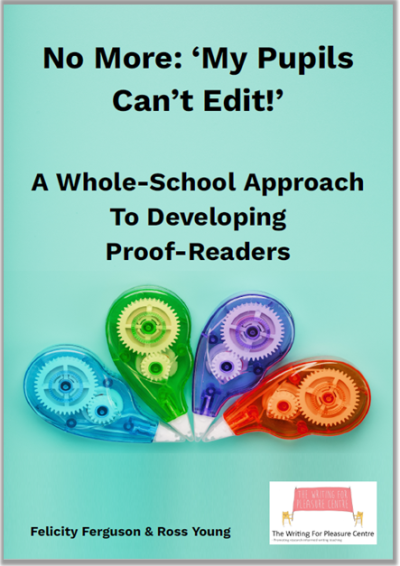
*NEW eBook* No More: ‘My Pupils Can’t Edit!’ A Whole-School Approach To Developing Proof-Readers

In No More: My Pupils Can’t Edit, Felicity Ferguson & Ross Young invite schools and teachers to make proof-reading a rigorous and meaningful part of their class writing projects. Despite the fact that expectations for transcriptional accuracy have never been higher, schools and teachers often find it difficult to teach children to proof-read with precision and enthusiasm. This book looks to change that.

This practical guide offers an overview of The Writing For Pleasure Centre’s approach, and provides a progression for proof-reading from the EYFS-KS2. It also contains over 50 exemplar lessons taken from their affiliate schools. These lessons cover the EYFS Framework and National Curriculum objectives efficiently and effectively.

What’s special about this book is the way in which each lesson teaches children the whys of proof-reading procedures and illustrates how, as editors, they can use them for themselves. Children learn to make their writing ‘reader-friendly’ and ‘reader-ready’ prior to publication for real audiences.

£10.95 – Individual license

£50.75 – School/Institution license

or FREE for members