Poems, not a poem: Reimagining poetry projects

By Sam Creighton

One of the key principles of a Writing for Pleasure pedagogy is being ‘reassuringly consistent’. If pupils know how a writing project typically progresses (LINK), and how a writing lesson proceeds (LINK), then they internalise this ‘writer’s discipline’ and feel at ease with the logistics of daily writing. The outcome of this is that children effortlessly understand the where and when or their writing and so can focus all their cognitive energies on the what and why (LINK).


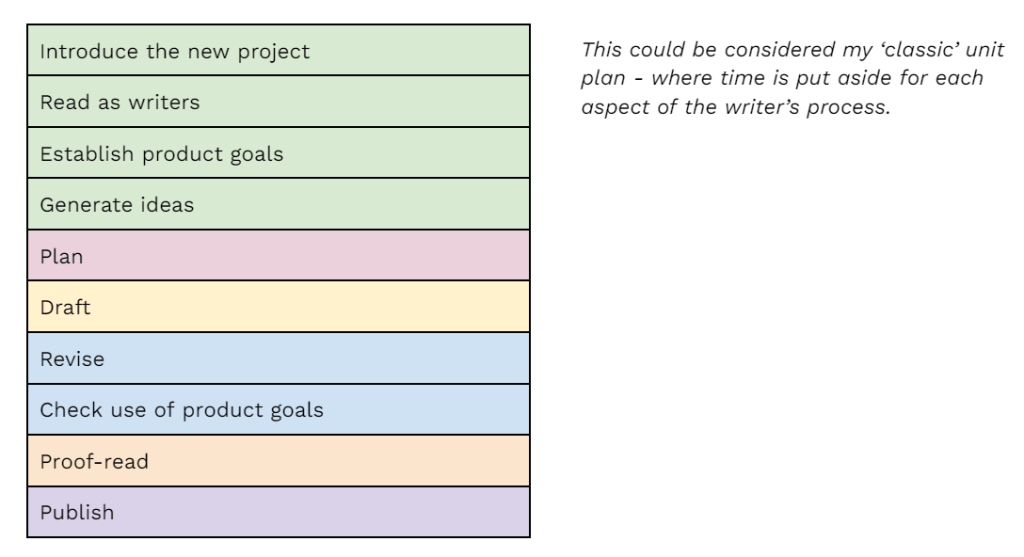
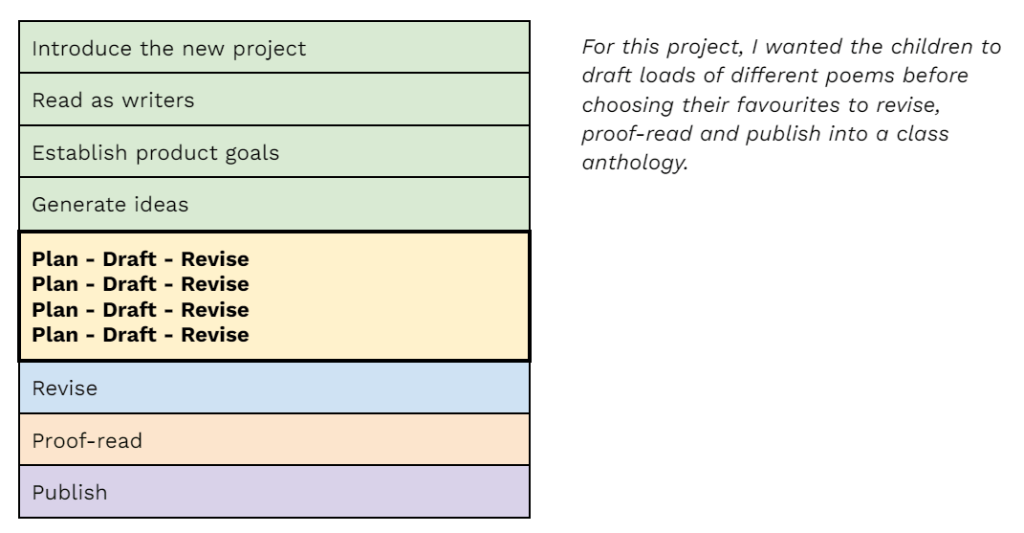
However, as I began to consider our forthcoming poetry unit The Poetry That Hides In Things, I felt there was a problem with my project structure of moving through idea generation, planning, drafting, revising, proof-reading and publishing. This was because instead of producing just one poem, I wanted the children to produce an anthology of multiple and varied poetry.

Why was it important to me that they write their own collection of poetry? In other projects, for example Setting-Focused Short Stories, my young writers had been able to authentically and usefully include all our co-constructed product goals within a single piece (Young & Ferguson 2023). However, a single poem would not be able to hold all the literary craft moves the children wanted to use (and that I wanted to teach and see evidenced) without the piece sounding naff and forced.

Moving from asking children to produce a single poem to making multiple pieces required a change in unit structure: if they, as usual, did the bulk of their idea generation and planning at the start of the unit, it could lead to confusion as they tried to plan several poems at once, but also, by the time they came to drafting some of the poems, their plans might be a distant memory and perhaps less useful. The solution? We decided to try having each drafting lesson as its own mini-unit, where they planned, drafted and even revised a number of poems each day.

Below is the structure we used for each of these drafting lessons:

1. Thinking about why we are moved to write

Because our project was The Poetry That Hides In Things, it was vital that children had time to focus on the meaning that ‘hides’ in their chosen object(s) and to consider the message they wanted to really share with their audience. The best way to explain this was to discuss how we thought about this when we wrote our own mentor text poems as writer-teachers.

2. Introduce, explain and sell the craft move:

During our usual genre week, where we read as writers (Young & Ferguson 2023), the children had co-constructed their product goals. These are the craft moves we liked most in the poems we read and thought we wanted to use in our own poetry too. These included: similes, metaphors, personification, alliteration, repetition, onomatopoeia and sensory description. Each of these formed the basis of a writing lesson.

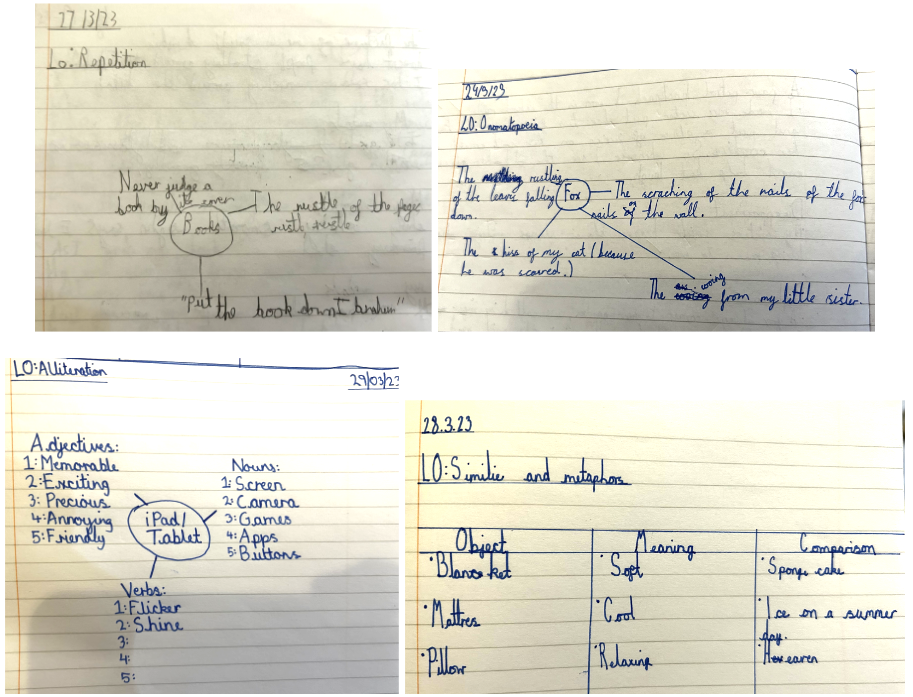
3. Trying the craft move out Each day, once the craft move was modelled and discussed, children were then invited to ‘try out’ or apply that day’s craft move to one or more of their poems. For example:

4. Provide children with structures that lend themselves to the focus craft move

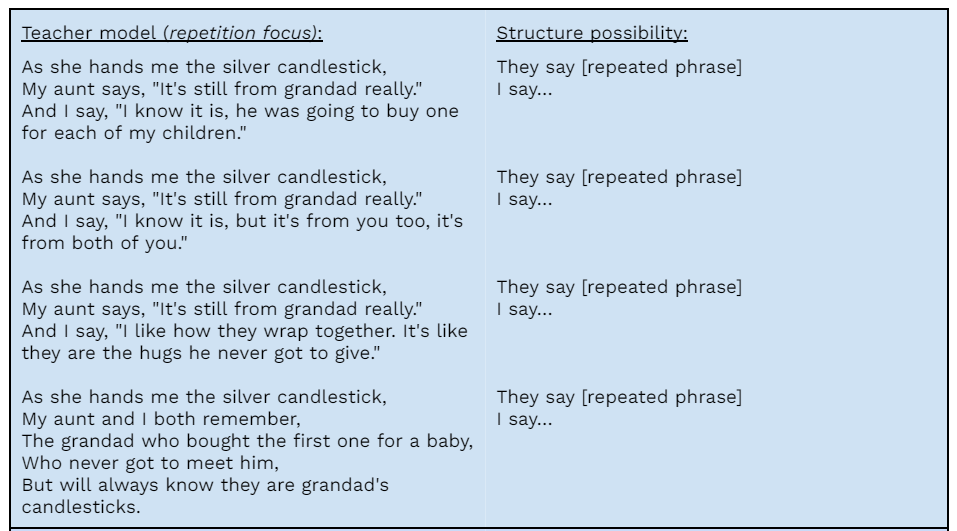
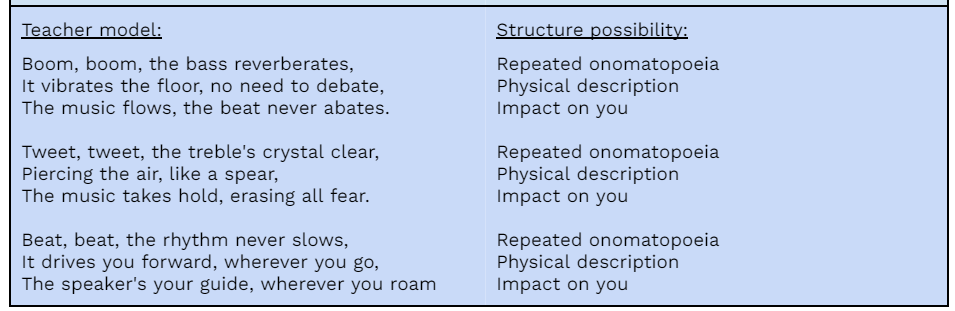
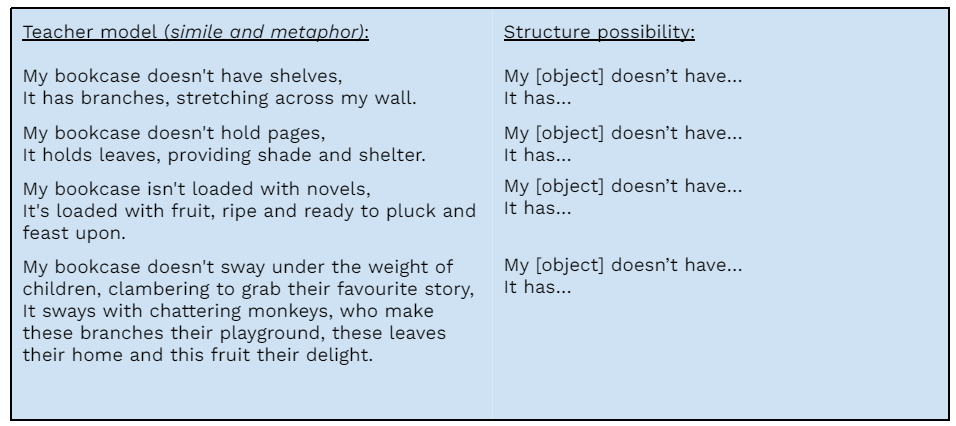
Teaching structure was something that caused us the most consternation. As a year-group, we decided that each teacher should write their own mentor text, using some of the craft moves the class had identified. This gave children possibilities. ‘I can see what you did – I could do that too!’ 

The children were presented with these mentor texts and the teachers explained their decision making. As a consequence, children felt able to craft multiple versions of their poems and mix-and-match different structures and craft moves to their heart’s content. Below are some of the teacher mentor texts and the structures they shared:

5. Invite children to write. Invite children to ‘paint with words’

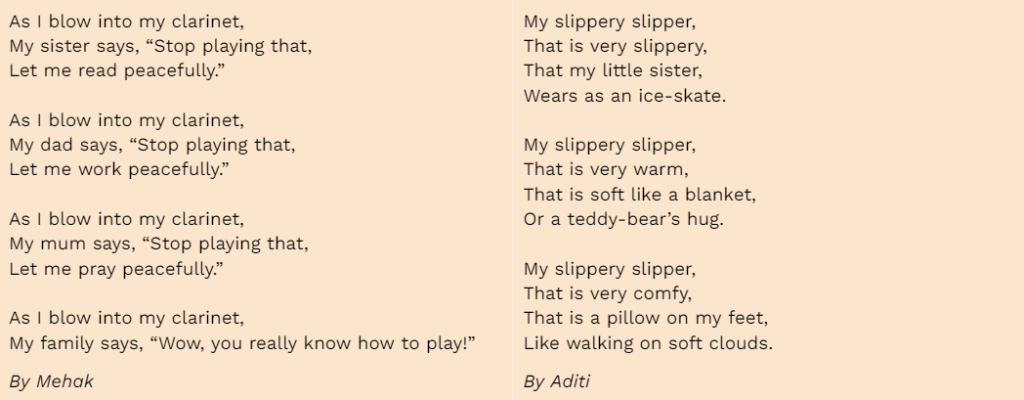
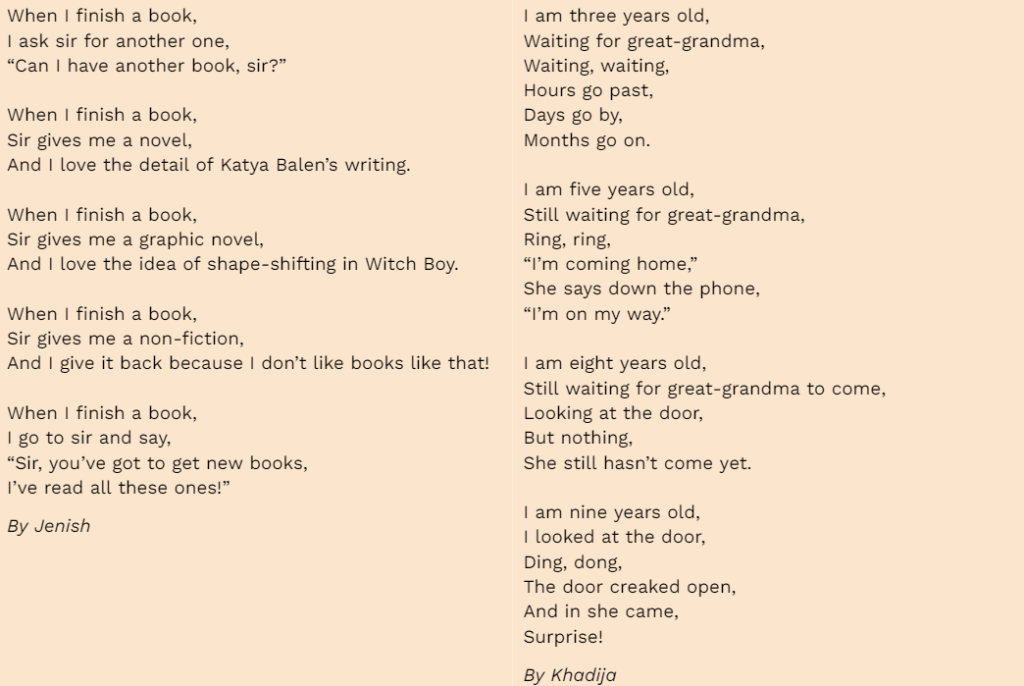
As always, the proof is in the poems and we have been incredibly proud of what the children produced across this project. Despite the rapid pace of the drafting, the children have crafted some deeply personal and meaningful poems which are also effective in their application of the taught craft moves. Here is a sample:

Importantly, children were given time to discuss and revise their pieces with their friends and teachers (LINK), but we admit that this process was probably under-developed in this unit. Apart from the revisions made while drafting, many students made few, or even no, changes. After proof-reading, the children chose the one or two poems they were most proud of to publish into a class anthology, which they wanted to sell to the school community to raise money for charity.

In conclusion, we found that breaking our poetry project into ‘mini-projects’ allowed children to write a number of poems, focusing on different poetic techniques. This, as opposed to either trying to overload a single ‘mega poem’ with multiple (often awkward) craft moves or having to plan multiple poems all at once. 

This is definitely a unit plan we will try in other year groups, and again ourselves next year.

Reviewing the EEF’s writing practice review. Understanding current practice and research priorities in teaching writing

Original report: LINK

The EEF’s review discusses how schools approach the teaching of writing and the challenges they face. To support teachers in addressing these challenges, we have provided links to a host of evidence-based training, resources, articles and publications which we know can help.

  • Primary schools often use approaches that aren’t always explicitly focused on the teaching of writing. Instead, they try to integrate writing across multiple subjects. Due to its complexity, this is an instructional mistake. If this is a concern for your school, you may benefit from reading our book: The Science Of Teaching Primary Writing (LINK).
  • Schools often decide to change their writing approach due to reasons such as low performance in assessments, an increase in students with English as an additional language (EAL) or because of students with special educational needs and disabilities (SEND). These factors typically prompt schools to adopt more structured approaches. If your school is suffering from low performance in assessments, you may benefit from reading this article. It details 14 evidence-based practices that could improve the quality of the writing teaching in your school. For advice on supporting your EAL pupils, see our book: A Teacher’s Guide To Writing With Multilingual Children (LINK). 
  • There is no consistent evidence base used by schools to decide on writing interventions. Rather worryingly, most schools do not have formal, structured interventions specifically for writing. Many teachers express a desire to develop writing interventions but lack the knowledge or resources to do so. To combat this, schools may wish to purchase our book: Supporting Children With SEND To Be Great Writers (LINK).
  • Despite the current attainment crisis (LINK), teachers receive minimal professional development specifically focused on teaching writing. There is a strong desire among teachers for more training, especially in areas like handwriting (LINK) and spelling (LINK). We have provided links to resources which can support teachers in these areas. 
  • Schools face challenges such as motivating students to write and ensuring a consistent evidence-based approach is used across the whole school. With this in mind, you may wish to read our Motivating Writing Teaching publication (LINK) and our book How To Teach Writing (LINK).
  • Many teachers lack confidence in teaching pupils how to revise and edit their writing. Explicitly teaching writing conventions is also seen as challenging, especially for struggling writers who have difficulty adhering to conventions. If this sounds like you or your school, you may benefit from reading our book: No More: ‘My Pupils Can’t Edit!’ A Whole-School Approach To Developing Proof-Readers (LINK). 

The EEF’s review also discusses how schools have aligned their writing programmes to promising evidence-based practices:

  • Teachers provide structured guidance on writing in different genres (LINK for more).
  • Schools balance writing and reading by integrating reading as writers sessions into their writing units (LINK for more).
  • Schools develop children’s understanding of writing conventions by explicitly teaching grammar and punctuation in the context of class writing projects (LINK and LINK).

Evidence-based practices which aren’t being utilised as much as they probably should be are:

  • Teachers modelling the writing strategies or craft moves they want children to use in their own writing that day (LINK for more).
  • Students giving feedback on each other’s drafts (LINK for more).

Overall, while many primary schools are adopting some effective writing strategies, they face challenges in areas like peer assessment and the teaching of writing conventions. Engaging students through reading as writers activities is also seen as key in improving children’s writing proficiency.

This year, we will be focusing on providing training in all the areas outlined in this review. If you think you or your school would benefit from such training, you can contact us at: hello@writing4pleasure.com

The ABCs of children’s writing motivation

Original article: LINK

By Aline Alves-Wold, Bente Rigmor Walgermo, Erin McTigue & Per Henning Uppstad

***

Children’s motivation is crucial to their writing success (Young & Ferguson 2024). However, studies on writing motivation in young students often miss out on what the students themselves think and rely too much on what teachers and researchers observe. This literature review emphasises the importance of listening to students’ perspectives. It combines findings from studies in classrooms with children aged 5-11.

The authors’ analysis revealed nine key factors that affect writing motivation, which they organise as the ABCs of Writing Motivation:

This framework could serve as a helpful guide for teachers when planning writing lessons or interventions.

***

Writing is a crucial skill for success in school, work and daily life. However, many students find it hard to master (Young & Ferguson 2023). Learning to write well takes years of practice and is challenging not only because of the skills involved but also the motivation needed (Young & Ferguson 2022). Many studies have explored ways to improve students’ writing, but they often overlook the importance of writing motivation (Young & Ferguson 2021, 2024).

Learning to write involves becoming part of a community of writers. Writing is a social activity influenced by the cognitive abilities and characteristics of the community (Young & Ferguson 2021, 2022).

Becoming a skilled writer is a complex process that requires formal instruction, lots of practice, and several years to master (Young & Ferguson 2022). Early years practitioners often focus on the ‘basic skills’ needed for writing. These skills are usually handwriting, encoding, and composing. Essentially, writing is seen as forming letters (handwriting), putting them together into words (encoding), and arranging those words into meaningful texts (composing). Practising handwriting, spelling, and composing is essential for children’s writing development, but it’s not enough. Success in writing also depends on motivation (Young & Ferguson 2024).

Motivation to write

Writing motivation is what energises and directs children’s attention towards writing and being writers (Young & Ferguson 2024). It provides children with the strength and persistence needed to act and gives purpose and goals to their writerly actions. Motivation comes from various sources, including beliefs, goals, values, emotions, needs, and the classroom environment. There are many theories we can use to explain children’s writing motivation. These include: expectancy-value theory, attribution theory, social cognitive theory, goal-orientation theory, and self-determination theory.

Researchers have identified several key components of writing motivation, often finding similarities in their models. For example, Troia et al. (2012) suggested four main components:

  1. Self-efficacy beliefs – confidence in one’s ability to write well.
  2. Goal orientations – including mastery goals (improving our writing skills for personal satisfaction) and performance goals (proving our competence).
  3. Task interest and value – how interesting and valuable we believe the writing project to be.
  4. Outcome attributions – beliefs about the causes of our successes and failures.

Boscolo & Gelati (2018) identified three main factors:

  1. Attractiveness and value of the writing project.
  2. Perceived writing competence.
  3. Beliefs about what writing and being a writer is all about.

Graham (2018) emphasised the role of beliefs in writing motivation too, proposing seven sets of beliefs:

  1. Value of the writing project.
  2. Personal enjoyment of writing.
  3. Perceptions of competence, influenced by self-efficacy and beliefs about ability.
  4. Motivations for writing, including intrinsic (internal pleasure) and extrinsic (external satisfactions) factors.
  5. Likelihood of success or failure.
  6. Writer identity.
  7. The culture of the writing classroom, including what it values, what purposes it looks to serve, the audiences it writes for, and the types of routines and tools it uses.

Fostering Children’s Motivation to Write

To foster students’ motivation to write, several key elements from these different models are commonly recommended. Bruning & Horn (2000) suggest four main conditions:

  1. Nurturing positive self-beliefs – helping students feel confident in their writing abilities.
  2. Engaging students with authentic writing projects – making writing meaningful and relevant.
  3. Creating a supportive environment – encouraging positive interactions between teachers and students, as well as peer collaboration.
  4. Building a positive environment that promotes autonomy and positive attitudes towards writing.

Young & Ferguson (2021, 2022, 2024) have found that these conditions are also consistent with evidence-based teaching practices.

Appeal

The appeal of class writing projects significantly influences students’ motivation to write, as identified in more than half of the studies reviewed. Studies highlight that enjoyable, fun, or engaging class writing projects increase motivation.

Class writing projects, which allow for self-expression, are recommended for both younger and older students. For younger students, emphasis on writing to communicate and share meaning with others is particularly beneficial.

A notable finding is the importance of actually consulting students about the appeal of class writing projects.

Beliefs

Approximately two-thirds of the reviewed studies identified beliefs as a significant factor influencing children’s motivation to write. Three main types of beliefs were highlighted: self-beliefs, beliefs about writing, and beliefs about reasons for success or failure.

Self-beliefs encompass various aspects such as: students’ confidence in writing, self-concept, and writer identities. Positive self-beliefs about writing abilities and writer identities are crucial for motivating students to write. As Young & Ferguson (2024 p.13) share, “the better pupils get at writing, the more likely they are to value it. The more they value it, the better they want to get at it. That chasing is the motivational sweet spot and highlights why success is so important to pupils’ writing motivation”.

Another beneficial practice is the use of writing portfolios, which help foster positive self-beliefs. The effectiveness of portfolios also relies on the feedback children receive. For example, student-led conferences where children can discuss their best pieces, helps students identify their strengths and weaknesses, leading to positive changes in their self-perception as writers.

Students’ beliefs about the value of class writing project significantly impacts their motivation. If students do not see writing as valuable or important, even if they feel competent, they may lack motivation (Young & Ferguson 2024).

Additionally, beliefs about what constitutes ‘good writing’ affect students’ self-beliefs and motivation. Some students, particularly in the younger years, equate good writing with neat handwriting, while others focus on communication and the sharing of ideas with others (Hall & Axelrod 2014). These differing beliefs influence students’ perceptions of their writing confidence and their overall motivation to write.

Attribution theory (students’ beliefs about the reasons for their successes or failures) influences children’s writing motivation. Children with higher rates of writerly achievement typically attribute their success to internal factors like effort, while those with lower achievement often blame external factors (their teachers). Similarly, students who adopt a growth mindset and recognise their effort’s role in their writerly success show the most motivational growth. Teacher feedback and promoting a growth mindset are fundamental to this process (Young & Ferguson 2023, 2024).

Choice

Choice is highlighted as a significant condition for enhancing children’s motivation to write. Young & Ferguson (2021, 2024) emphasise that giving students choice about what they write about is crucial for motivation. However, students also value the ability to choose how to write, where to write and who they write for too!

What to write

Allowing students to choose what to write, including the topic or genre, can significantly boost their motivation. Students often report that writing becomes more enjoyable when they can generate their own writing ideas within the parameters of a class writing project (Young & Ferguson 2021, 2024).

However, the effectiveness of choice as a motivating factor depends on teachers’ abilities to explicitly teach children idea generation techniques and to devote instructional time to generating great writing ideas (Young & Ferguson 2022). Children appreciated their teacher’s assistance when generating their own writing ideas (LINK).

How to write

Choosing how to write also influences motivation. While collaborative activities are often seen as motivational, some students prefer working alone. Additionally, students value the choice of writing tools, with preferences varying between digital and paper-based writing.

Where to write

Students appreciate having a choice over where to write, particularly between home and school settings. For instance, some young writers find it easier to concentrate at home, while others report having difficulties.

Who to write for

Choosing who to write for is another significant factor. Students generally prefer writing for real audiences beyond the classroom (LINK). However, publishing their writing is not always seen as a positive, especially for older students. Some children express discomfort with sharing personal (or what they deem as low-quality) writing. It was noted how positive attitudes toward sharing are more likely to be observed in classrooms which have a supportive sharing culture (LINK).

Difficulty

The difficulty and effort required for writing emerged as a significant factor affecting children’s motivation. As the science of writing shows (Young & Ferguson 2022), writing is cognitively challenging, and this complexity can impact students’ motivation. Children’s reported dislike for writing can often be traced back to finding it too hard!

As Young & Ferguson (2024) share: “teachers should concentrate on making the process of learning to write feel easy, whilst keeping the content of their lesson(s) challenging.” Difficulty in the writing classroom is not inherently demotivating. Tasks that are too easy can certainly be demotivating. While some students, particularly less experienced writers, prefer simpler daily tasks, others express disdain for low-challenge tasks, describing them as “boring, meaningless, and minimally challenging.” This indicates a need for a balanced approach where daily writing is neither too easy nor too effortful (LINK).

To ensure tasks are both challenging and motivational, they must be perceived as manageable and should result in pleasing outcomes (Young & Ferguson 2024). Given the diversity of skill levels in a typical classroom, it is essential that teachers plan their class writing projects carefully, using evidenced-based teaching practices wherever they can (LINK). Linked to this is the amount of time teachers allocate to class writing projects. Students often mention that having too little time to complete class writing projects (to the best of their ability) is demotivating.

Environment

The classroom environment emerged as a significant factor influencing students’ motivation to write in nearly 40% of the reviewed studies. Students highlighted three types of environments that impacted their writing motivation: the physical, the social, and the psychological.

Students indicated that environments conducive to writing were often quiet and free from noise. For example, a young writer described her ideal writing location as being “the quietest building in the quiet world that has quiet things with no intercoms and no cameras” (Hall & Axelrod 2014). Conversely, noise and distractions were frequently mentioned as having a negative influence on motivation.

However, students also reported how positive interactions were. This included collaborating with peers and communicating with others through writing as being motivating. These interactions occur in supportive and pleasant classroom rather than miserable, judgmental and critical ones.

Feedback

Students value positive reactions to their writing as well as constructive and concrete feedback. Constant negative feedback, focused solely on what they haven’t done, has an adverse effect on children’s motivation to write (Young & Ferguson 2023).

Positive feedback, especially from teachers, is seen as encouraging for students. For example, one child expressed that writing was enjoyable “when [their teacher] makes good and exciting comments about my work” (Zumbrunn et al. 2019).

While students predominantly prefer positive feedback, they also recognise the value of constructive feedback that is delivered to actually aid their long-term development as a writer (Young & Ferguson 2023). When children really believe that their teacher’s feedback is coming from a place where the teacher wants their writing to be the best it can be for their future readership, they appreciate critical and honest feedback (Young & Ferguson 2021).

Goals

The goals of students’ writing emerged as a significant factor influencing their motivation. Students’ goals fall into two broad categories: mastery goals and performance goals.

Mastery goals are about a motivation for self-improvement. Children want to improve their own writing skills for own satisfaction. Evidence-based writing practices that support children’s pursuit of mastery goals include co-constructing success criteria as a class and developing students’ writing portfolios (Young & Ferguson 2021).

In contrast, performance goals involve pleasing your teacher or trying to outperforming your peers. This can also include performance-avoidance, where students write for fear of punishment or to avoid failure.

The type of goals students set themselves is closely linked to their classroom environment the teacher creates. Children’s goal orientations often match the kind of culture their teachers create in their classrooms.

Troia et al. (2012) suggest that mastery goals are associated with positive learning outcomes and recommend that teachers help students set specific and challenging goals which focus on personal improvement. This can be facilitated through the use of child-generated success criteria, student portfolios, and verbal feedback (Young & Ferguson 2021).

Students’ writing goals significantly influence their motivation. Mastery goals, which focus on personal improvement and learning, are generally associated with more positive writing outcomes. In contrast, performance goals, while sometimes linked to high achievement amongst certain students, can also lead to anxiety and avoidance behaviours, amongst others. This is particularly true in unsupportive classroom environments. Teachers play a crucial role in shaping children’s goals by fostering supportive classroom environments and encouraging students to set specific, challenging, and personal goals (Young & Ferguson 2024).

Help

Help emerged as an important motivational factor in more than one-third of the studies reviewed. This factor encompasses both the assistance received from others, such as teachers and peers, and the use of helpful strategies and resources that facilitate the writing process.

Students valued help from others at various stages of the writing process. This includes assistance during the idea generation (LINK), planning (LINK), revision (LINK) and proof-reading (LINK) phases of a class writing project. Students appreciate receiving opinions, reactions and reflections from their teachers and peers.

Students also appreciate tips and strategies that facilitate their understanding and management of the writing process. For example, children value SRSD instruction. This is where teachers explain and model a writing strategy or craft move technique before inviting children to use it for themselves in their own writing that day (LINK).

Instructor

Teachers play a crucial role in shaping students’ motivation to write and a teacher’s influence is multifaceted:

  • Planning enjoyable class writing projects. Students who perceived their teachers as enjoying class writing projects tended to report higher enjoyment themselves.
  • Attending to children’s affective needs: Teachers who focus on attending to children’s affective writerly needs are associated with classrooms that have more joy and sustained motivation among students (Young & Ferguson 2021; Young et al. 2022). Conversely, teacher-centered (or scheme-centered) approaches, which just emphasise conventions and strict control over children’s writing, are linked to lower motivation.

Implementing motivating writing teaching

In summary, implementing the ABCs of Writing Motivation requires teachers to integrate the recommendations made in this article into their teaching practice. By utilising motivational strategies, teachers can effectively enhance students’ motivation to write. These practices not only have the potential to cultivate lifelong writing engagement but are also linked to practices which improve children’s writing proficiency (Young & Ferguson 2021).

If you enjoyed this article, you may like to read our latest book: Motivating Writing Teaching

Producing passionate student writers

The goal of any comprehensive writerly apprenticeship is clear: to develop students’ competency and proficiency and to foster their love for writing.

Writing solely for intrinsic joy is satisfying, but to truly excel, students also need to write for extrinsic assessment-based purposes too.

Whole-class writing projects provide pupils with the drive to improve and achieve excellence while maintaining their need for autonomous motivation too. This balance is crucial for creating successful writers.

Class writing projects should ensure:

✅ Students loving writing and embracing their identity as writers.

✅ Students feeling capable and recognised for their writing abilities.

✅Students reaping the lifelong benefits of being competent, connected, and motivated writers.

Two evidence-based practices that can inspire students to write include:

  • Set publishing goals at the beginning of class writing project, ensuring there is an authentic purpose and genuine audience for the writing.
  • Supporting students to choose their own writing topic within the parameters of class project.

By involving students in setting publishing goals and allowing topic choice, we capture and maintain students’ attention, developing in them a genuine passion for writing.

Let’s empower our students to become enthusiastic and skilled writers!

Becoming a motivated (and motivating) writing teacher

Just like our students, we need to feel competent, autonomous, and connected in our writing teaching journey. Here’s how:

1. Build a community of writers

Build a community of writers and treat every child as a writer. Create a space where everyone feels valued and included.

2. Talk about writing

Read, share, think, and talk about writing. Engage students in meaningful discussions to deepen their understanding.

3. Produce real-world writing

Pursue purposeful and authentic class writing projects with your pupils. Make writing relevant and engaging for students by connecting it to real-world contexts.

4. Teach the writing processes

Teach the writing processes and set writing goals. Provide clear guidance and support to help students improve their writing skills.

5. Develop a writer’s discipline in your classroom

Be reassuringly consistent in your approach. Establish routines and expectations to create a sense of stability and security.

6. Explicitly teach about composition and transcription

Balance composition and transcription. Help students develop both their creative and technical writing abilities.

7. Be a writer-teacher

Model the writing process and share your own writing experiences with students.

8. Connect reading with writing

Show students how reading and writing are interconnected and enhance each other.

9. Create your own evidence-based recipe with colleagues

To foster your own teacher autonomy, view these practices as ingredients and create your own recipe.

Together, elevate your writing teaching and empower your students to become confident writers!

Teach ‘craft moves’ to engage your writers.

A craft move is any writerly technique or strategy used by writers to enhance the quality and impact of their writing. They encompass various aspects of writing, including: literary features, grammar and sentence-level techniques, structural choices and stylistic elements.

Craft moves are taught through direct instruction and modelling examples, with the aim to empower young writers with the knowledge and skills needed to apply the technique independently in their own writing.

Teaching craft moves can be really engaging for pupils. Here’s how to do it:

1. Find craft moves

If students help generate success criteria, they’ll be even more invested in using craft moves. Double buy-in equals double motivation!

2. Sell the craft moves

    Start by explaining the rationale behind each craft move you introduce. Students need to understand why it’s valuable and useful to their writing.

    3. Show don’t tell

    Show, don’t just tell. Model the use of craft moves in your own writing to illustrate their effectiveness before inviting children to do the same in their own writing that day.

    Learn more – [Getting Writing Instruction Right]

    Free Fairytales Unit Plan

    Fairy tales were not my escape from reality as a child; rather, they were my reality – for mine was a world in which good and evil were not abstract concepts, and like fairytale heroines, no magic would save me unless I had the wit and heart and courage to use it wisely.  – Terri Windling

    Why write fairytales?

    Fairytales and folk tales have a high status in literature for children. They are a part of cultural heritage; they express and transmit the values and wisdom of a community; they appeal strongly to the imagination and include familiar, much-loved stories that sprang out of an oral story-telling tradition.

    There are various interpretations of what fairytales might mean, why they were composed and how they could be related to a child’s psychological development. These interpretations range from psychoanalytical (the subconscious), to historical and material (folk tales: stories for and about peasants), to political (feminism, class, power structures).

    Writing a fairytale is likely to give the children in your class pleasure and enjoyment because they will be confident with the familiar characters, strong narrative shapes, language patterns and structures. They may also enjoy creating the sense of moral justice with which so many fairytales end. Also, of course, the possibility of subverting the genre or writing from the perspective of another character means that there are many opportunities for a writer to entertain and be humorous, ironic and surprising. Just as Shakespeare is continually reinvented for modern times, the same is true of fairytales.

    A writing for pleasure (and attainment) crisis declared by the National Literacy Trust

    Writing is language on paper. More than 85% of people in the world write, and writing is intimately connected to every aspect of our lives (Roser & Ortiz-Ospina 2016). For example:

    • Academic success. Rightly or wrongly, writing is by far the most popular way of assessing students’ knowledge. Therefore, students’ access to qualifications rests heavily on their ability to write well.
    • Economic success. Most employees need to be able to write to perform their jobs, and people’s writing skills are routinely assessed by employers when making decisions about hiring new staff (Light 2001). Writing is also great currency. For the 15% of self-employed people in the UK, an ability to produce writing is essential to the success of their businesses.
    • Social inclusion. Writing allows us to stay connected with loved ones and to participate in online discourse (including social media) with confidence.
    • Civic and political participation. Writing allows us to persuade others, share theories, give our opinion, and bring about change. 
    • As an art form. Writing allows people to create imaginary worlds, entertain others and to paint with words.
    • Personal well-being. Writing allows us to record the things we don’t want to forget, express our feelings, share who we are, share what we know, better understand ourselves, and potentially heal emotional wounds.

    Children who fail to master writing miss out on many aspects of being a fully-fledged member of our society and find themselves at a severe disadvantage. Poor writing skills limit children’s academic, occupational, cultural, civic and personal ambitions.

    This National Literacy Trust report explored how children and young people felt about writing in 2024. It looks at how many enjoyed writing, how often they wrote in their free time, what motivates them to write, and what kinds of things they wrote. Additionally, it considers how much they enjoyed writing at school.

    In 2023, their report concluded that there was a crisis in writing for pleasure. This year, only around 50% of pupils reported that they enjoy the writing that they do at school. This trend continues with only one third of children and young people enjoying writing in their free time. The frequency in which students write has also decreased dramatically, with only 1 in 9 writing daily in their free time, half the number from the previous year. 

    We have to say, if these statistics represented children and young people’s reading, it would be a national scandal.

    However, it’s not just enjoyment and frequency that are low. Children’s attainment is also at a crisis point.

    • In 2019, a quarter of children failed to achieve the early learning goal for writing at the end of the early years foundation stage (EYFS).
    • In 2019, around 3 in 10 children failed to achieve the basic ‘met’ standard at KS1. Only 16% of children at KS1 were able to demonstrate that they could write above the basic ‘met’ standard. 
    • Again, in 2019, only one in five KS2 children in England were able to write above the basic standard. In 2023, approximately, one in three children left primary school failing to meet the standard for writing. This rises to 43% for children who are economically underserved.
    • For children identified with a special education need or disability (SEND), the picture is even bleaker. According to the DfE (2022a), nearly 90% of children with a SEND didn’t reach the expected standard for reading, writing and maths at KS2. 
    • In 2021, over 80% of pupils with a SEND left secondary school without a ‘pass’ grade in English and mathematics. Only 8% of pupils with an Education, Health and Care plan progressed to higher education, compared to nearly 50% of pupils with no identified SEND.
    • Only 5% of adults with learning disabilities aged 18-64 and who are receiving support from social services are in paid employment. Currently, around 1.5 million pupils in England have a special educational need or disability (DfE 2022b). 

    We appreciate that these statistics make grim reading. They are particularly concerning when you consider the DfE’s ambition for 90% of all pupils to meet the expected standard in writing by 2030 (DfE 2022c).

    Earlier research by the National Literacy Trust has shown that children who enjoy writing are seven times more likely to write above their age level compared to those who did not enjoy writing at all. Children who dislike writing are eight times more likely to write below the expected standard. The steep decline in writing for pleasure and attainment is worrying and coordinated action is going to be required if we are going to turn the tide. Here are five steps we think the profession can take.

    1. Increase children and young people’s feelings of competency by ensuring that schools are utilising the 14 principles of world-class writing teaching

    It’s very difficult to write for pleasure if you feel like you’re not very good at it (Young & Ferguson 2024a). What’s clear from the National Literacy Trust’s work is that there is some kind of correlation between proficiency and feeling a sense of pleasure and satisfaction from writing. Indeed, feeling like you’re good at writing is a big motivator. Success breeds success. And being a successful writer feels valuable.

    Therefore, our first step in addressing this crisis should be to ensure that as many children and young people receive evidence-based writing instruction as possible. This type of instruction has a strong track record of increasing students’ feelings of writerly confidence and competence (Young & Ferguson 2021, 2024b).

    1. Bring motivating writing teaching into more classrooms and schools

    Motivation matters. A failure to employ motivated writing teaching can leave pupils with a sense of apathy (or even disdain) towards writing. There are five core drivers that make up our Motivation For Writing Framework. 

    The five core drivers of  writing motivation  from Young & Ferguson (2024) ‘Motivating Writing Teaching’

    • The first is success. This is about teaching in such a way that we can give students confidence that they will be successful. As already said, we can increase our odds by utilising evidence-based writing practices in classrooms (Young & Ferguson 2024b). 
    • Next, is culture. This is social in nature. It’s about how the attitudes, routines and actions of the classroom and school environment influence pupils’ view of writing and being a writer. 
    • Then we have motives. This is about students locating what is moving them to write and why they are bothering.
    • After, we have identity. This is about building up a bank of positive past experiences with being a writer. Linked to this identity is a student’s self-concept and their long-standing writerly self-esteem (Young et al. 2022).
    • Finally, we have buy-in. This is how we can attend to students’ interests, preferences, and provide them with a sense of choice and control.
    1. Explicitly teach pupils idea generation strategies

    Pupils’ enjoyment of writing at school (54%) isn’t translating into writing in their free time (29%). We suspect this is linked to students’ perceived struggles with generating writing ideas (44%). Explicitly teaching pupils strategies that writers use to generate their own writing ideas is not common practice in UK schools. Instead, the majority of teachers or schemes undertake this important work on students’ behalf. One way schools can increase the amount of writing students do in their free time would be to teach them idea generation strategies and techniques that they can use in the classroom and at home. For more on this, see our book No More: I Don’t Know What To Write… [LINK]

    1. Increase the amount of writing students do ‘for real’

    When interviewed, children regularly struggle to identify the reasons they are moved to write (Young & Ferguson 2021). If pupils don’t know about the multiple ways in which we can be moved to write for a variety of audiences (including just for ourselves), then writing in their free time is going to be less probable. Schools should build their writing curriculums around the key reasons we are all moved to write [LINK] and ensure that students get opportunities to publish to a variety of audiences beyond the classroom [LINK]. Once students see what’s truly possible with writing, they are more likely to pursue these reasons outside of school too.

    1. Make better connections between home and school writing

    Giving pupils time to pursue their own personal writing projects while at school, and encouraging them to continue pursuing these projects while at home too, can bridge the gap between school and ‘free-time writing’. 

    Here’s something to think about. As a nation, we regularly send books home in children’s bags, but do we ask them to also put their writing journals in there too? Do we even give them writing journals? We encourage parents and children to read together at home but do we ask them to do bedtime writing? This is something worth thinking about. 

    Personal writing projects should be celebrated and should be allowed to travel freely between home and school. For more on this, see our book A Guide To Personal Writing Projects & Writing Clubs For 3-11 Year Olds [LINK].

    Final call to action

    We will end this article by quoting the National Literacy Trust’s report directly: 

    ‘extraordinary action must now be taken… these compelling findings must inform action and investment in cultivating and supporting the writing-for-pleasure practices of disadvantaged children and young people… responses highlight the vital role writing for pleasure plays in the lives of young writers.’ 

    It continues: 

    ‘increased awareness of what motivates young writers to write for pleasure and the many benefits it can bring, should inform the development of novel pedagogical approaches aimed at galvanising reluctant writers’.

    The open comments left by pupils in the National Literacy Trust’s findings last year revealed a clear difference between students who enjoyed writing in school and those who didn’t. Students appreciated structured lessons, clear writing instruction, and feelings of support from their teachers. In contrast, those who didn’t enjoy writing disliked the time constraints put on them, assessment activities, being assigned teacher-directed topics all the time, and a lack of freedom in choosing their own writing style and criteria for success. With only about half of students stating that they enjoy writing at school, it’s important to consider these comments.

    Finally, we’ll leave you with this powerful comment from Christina Clark and her colleagues at the National Literacy Trust:

    ‘This report shows that it is now time to provide considered changes in policy and in-school opportunities aimed at reconnecting children and young people with the creative elements that transform writing into a personal pleasurable practice that empowers them to become fully integrated human beings with a rich individual interior life that they can express through their writing.’

    ***

    If you found this article useful, consider downloading or purchasing the following publications:

    LINKLINKLINK

    Developing the youngest of children’s writerly confidence

    It’s very difficult to write for pleasure if you feel like you’re not very good at it.

    Writerly confidence is fragile, especially in the early stages of learning to write. Children’s first encounters with their writer-teachers is therefore crucial because these encounters go on to shape children’s perceptions of themselves as writers.

    1. Writing Is Hard But It Should Feel Like Child’s Play

    In the early years, students must experience multiple successes in writing. It’s essential for them to feel that their writing matters and is valued by others. Writing should feel like child’s play—easy, possible, probable, and enjoyable.

    2. It’s Not You, It’s Me

    When students encounter failure, it’s vital for teachers to reflect on their instructional practices. If students are putting in effort but still struggling, it may indicate flaws in the school’s approach or teachers’ methods…

    3. Success Breeds Success

    Proficiency in writing is a significant motivator. Success breeds success, and being a proficient writer fulfills various needs: involvement in the world, emotional regulation, relief from boredom, social recognition and connection, and curiosity to learn even more about writing! As students improve in writing, they begin to value it more, creating a cycle of motivation and success. This journey requires repeated, positive experiences. Nurturing students’ writerly confidence takes time and a commitment to fostering a writerly culture within the school.

    Free Fables Unit Plan

    If you read the fables… you will know something about the person who writes them, and I like that. Secondly, they will not be about individuals; they will be about community. Thirdly, they’re all about moralising. Fourthly, the way they express themselves takes its tone from the oral tradition.  – Jim Crace

    Why write fables?

    We often tell each other cautionary tales of mishaps, near misses and comeuppances where we have had to learn a lesson the hard way. Perhaps, like me, you learnt that you really should not play with scissors after you accidentally almost cut your friend’s finger off! We might also remember our grandparents, parents, teachers and people in authority telling us stern warning stories. Children can’t escape fables!

    Historically though, fables have been the main way of socialising children into the norms of society. Some of those stories are new and original, while others have been told and loved by people across the ages. Many tales are still told and retold today because of their universal messages and because they are short, snappy and easy to remember.

    Writing fables with children gives them the opportunity to communicate a message or moral in an entertaining way, building narratives from their own experience of being told what to do (and what not to do) and how to behave with and around others. They can then share these fables with their friends, younger children or even foolish parents! Furthermore, children get to express a little bit of themselves in their stories. Writing fables, alongside our Fairytale writing project, gives children in year three a strong basis for future story writing.

    You might want your class to look at how fables are part of their lives. When do they hear fables, and from whom – their grandparents, parents, teachers or friends? Do they tell cautionary tales to the people they know? Allow children to identify the elements that make fables so popular and discuss where they can be found within our lives today.