
By Sam Creighton
One of the key principles of a Writing for Pleasure pedagogy is being ‘reassuringly consistent’. If pupils know how a writing project typically progresses (LINK), and how a writing lesson proceeds (LINK), then they internalise this ‘writer’s discipline’ and feel at ease with the logistics of daily writing. The outcome of this is that children effortlessly understand the where and when or their writing and so can focus all their cognitive energies on the what and why (LINK).
However, as I began to consider our forthcoming poetry unit The Poetry That Hides In Things, I felt there was a problem with my project structure of moving through idea generation, planning, drafting, revising, proof-reading and publishing. This was because instead of producing just one poem, I wanted the children to produce an anthology of multiple and varied poetry.
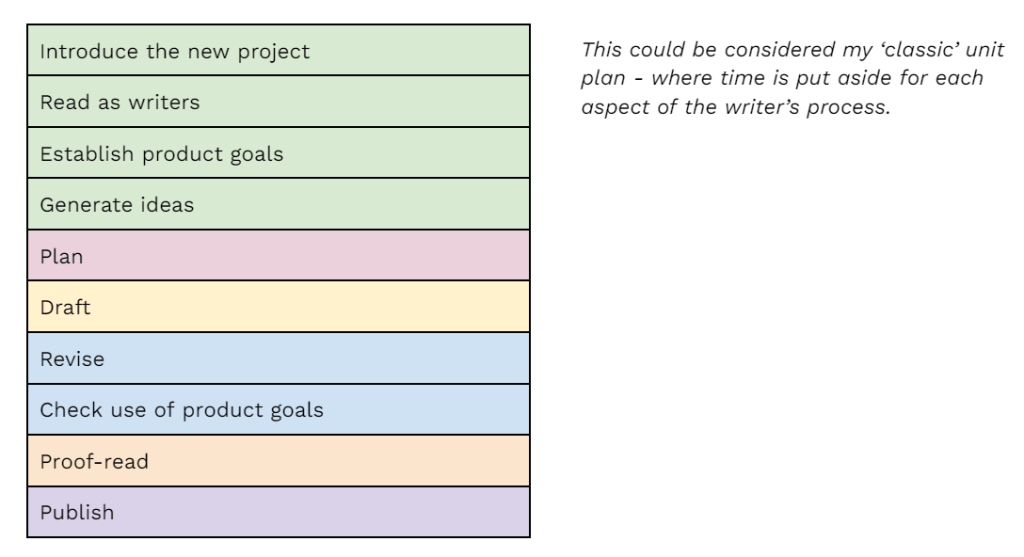
Why was it important to me that they write their own collection of poetry? In other projects, for example Setting-Focused Short Stories, my young writers had been able to authentically and usefully include all our co-constructed product goals within a single piece (Young & Ferguson 2023). However, a single poem would not be able to hold all the literary craft moves the children wanted to use (and that I wanted to teach and see evidenced) without the piece sounding naff and forced.
Moving from asking children to produce a single poem to making multiple pieces required a change in unit structure: if they, as usual, did the bulk of their idea generation and planning at the start of the unit, it could lead to confusion as they tried to plan several poems at once, but also, by the time they came to drafting some of the poems, their plans might be a distant memory and perhaps less useful. The solution? We decided to try having each drafting lesson as its own mini-unit, where they planned, drafted and even revised a number of poems each day.
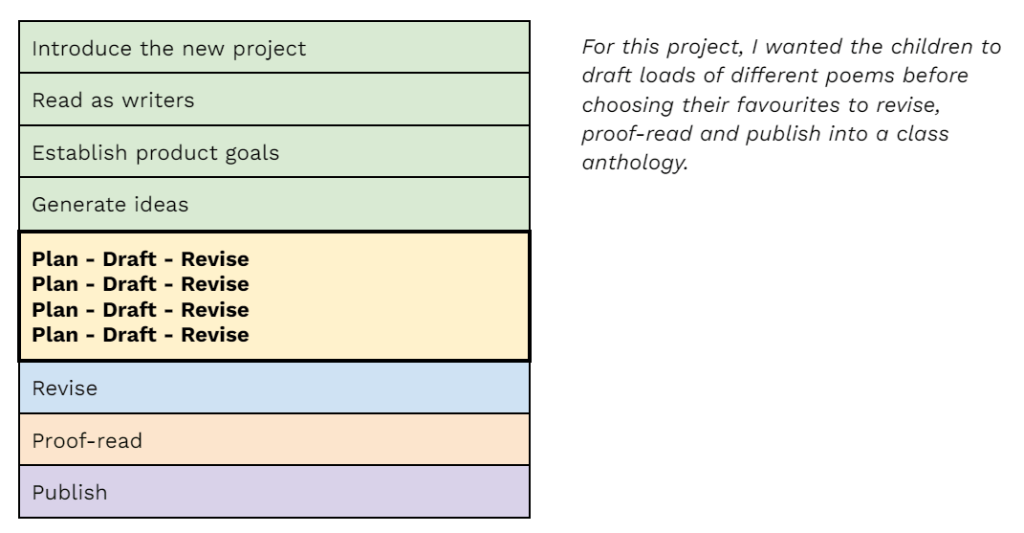
Below is the structure we used for each of these drafting lessons:
1. Thinking about why we are moved to write
Because our project was The Poetry That Hides In Things, it was vital that children had time to focus on the meaning that ‘hides’ in their chosen object(s) and to consider the message they wanted to really share with their audience. The best way to explain this was to discuss how we thought about this when we wrote our own mentor text poems as writer-teachers.
2. Introduce, explain and sell the craft move:
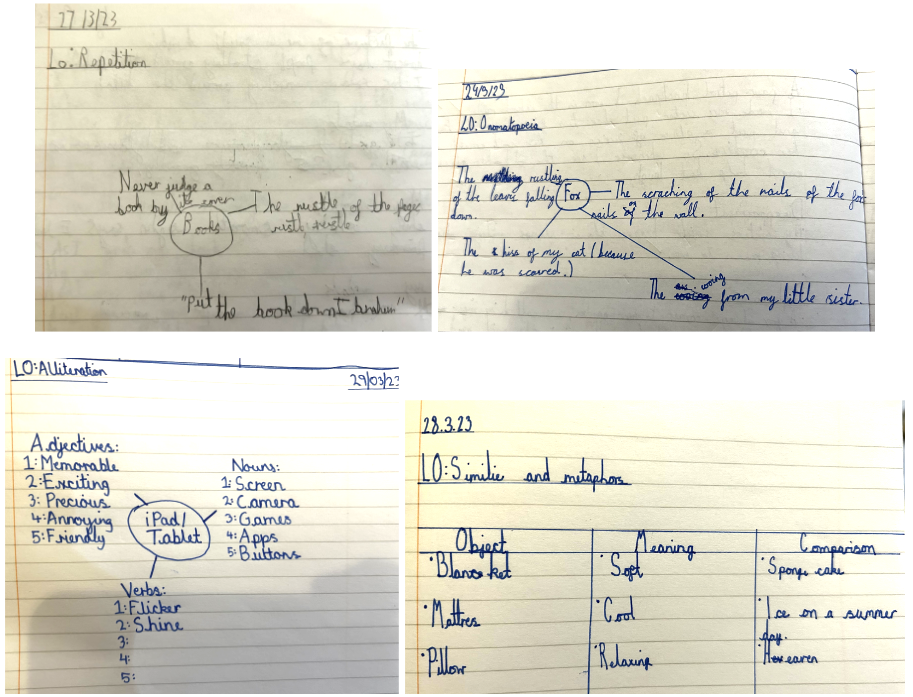
During our usual genre week, where we read as writers (Young & Ferguson 2023), the children had co-constructed their product goals. These are the craft moves we liked most in the poems we read and thought we wanted to use in our own poetry too. These included: similes, metaphors, personification, alliteration, repetition, onomatopoeia and sensory description. Each of these formed the basis of a writing lesson.
3. Trying the craft move out Each day, once the craft move was modelled and discussed, children were then invited to ‘try out’ or apply that day’s craft move to one or more of their poems. For example:
4. Provide children with structures that lend themselves to the focus craft move
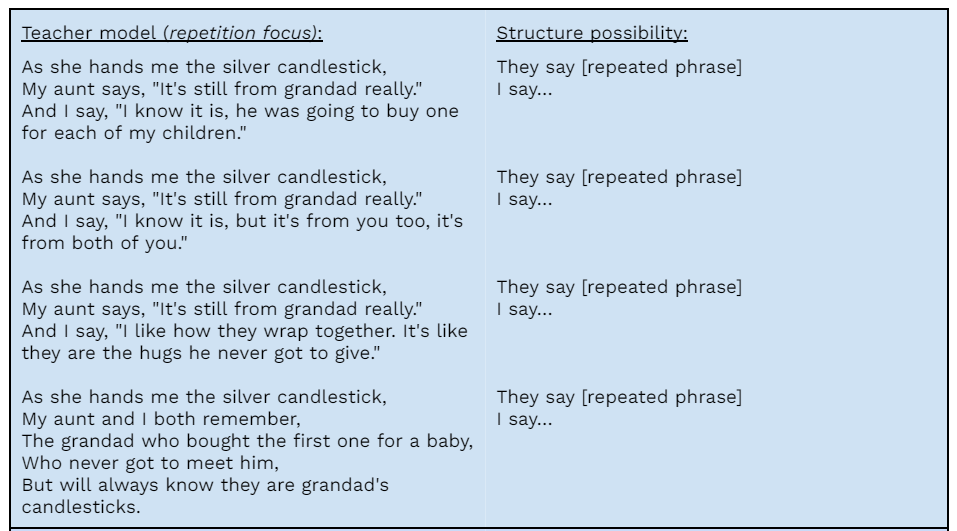
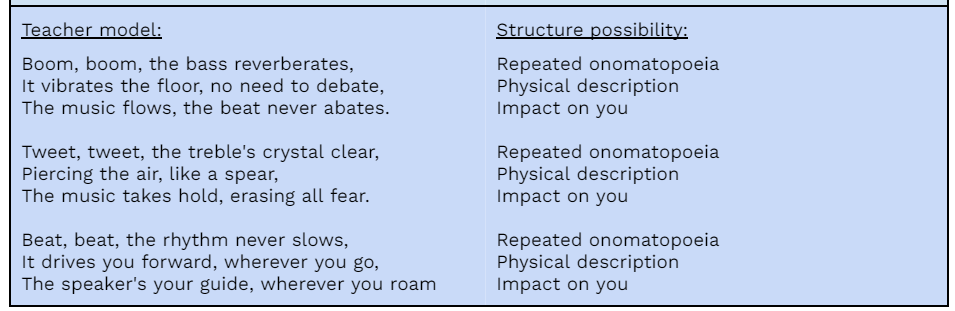
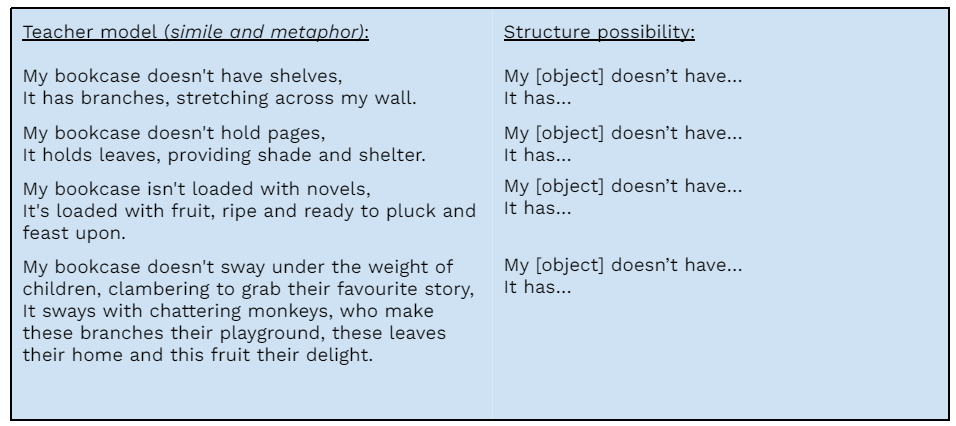
Teaching structure was something that caused us the most consternation. As a year-group, we decided that each teacher should write their own mentor text, using some of the craft moves the class had identified. This gave children possibilities. ‘I can see what you did – I could do that too!’
The children were presented with these mentor texts and the teachers explained their decision making. As a consequence, children felt able to craft multiple versions of their poems and mix-and-match different structures and craft moves to their heart’s content. Below are some of the teacher mentor texts and the structures they shared:



5. Invite children to write. Invite children to ‘paint with words’
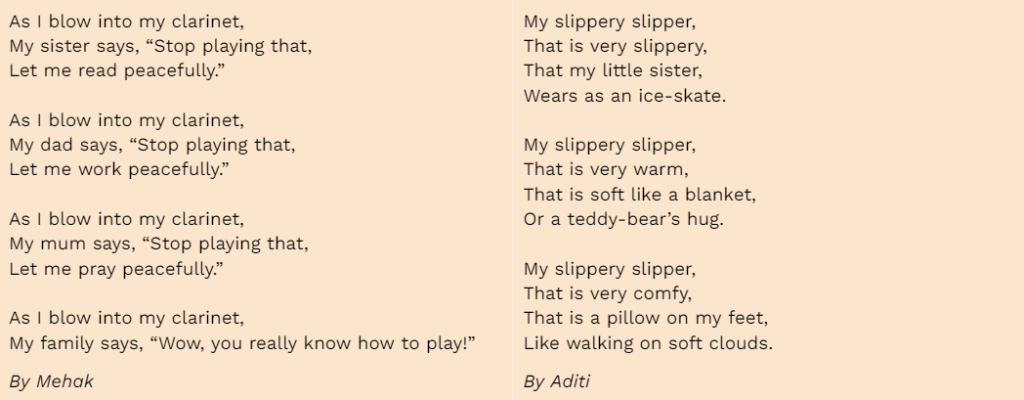
As always, the proof is in the poems and we have been incredibly proud of what the children produced across this project. Despite the rapid pace of the drafting, the children have crafted some deeply personal and meaningful poems which are also effective in their application of the taught craft moves. Here is a sample:

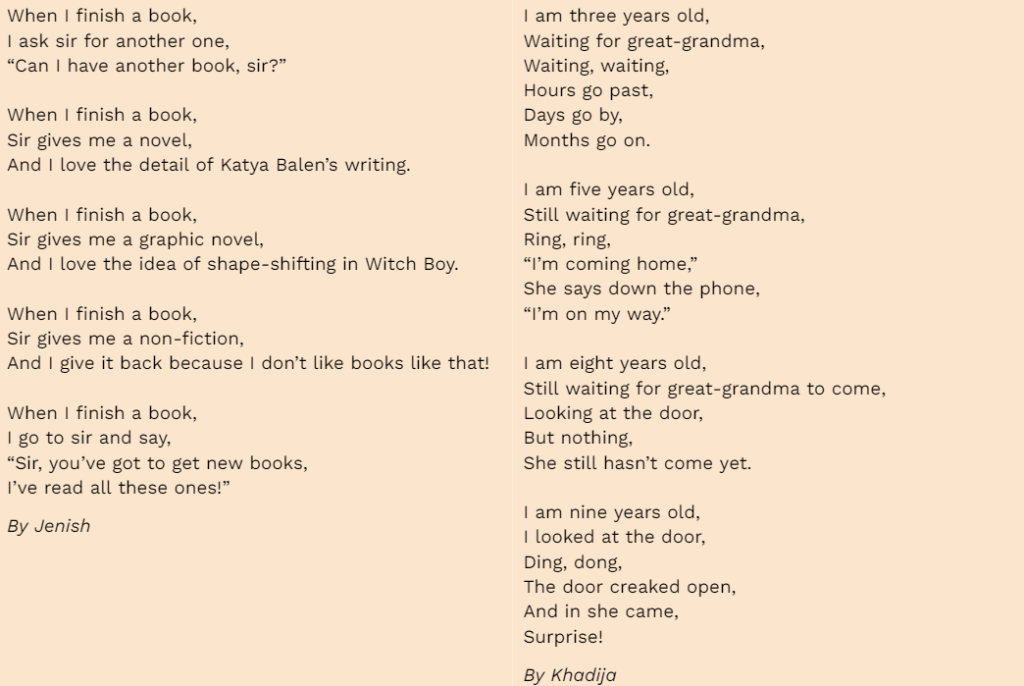

Importantly, children were given time to discuss and revise their pieces with their friends and teachers (LINK), but we admit that this process was probably under-developed in this unit. Apart from the revisions made while drafting, many students made few, or even no, changes. After proof-reading, the children chose the one or two poems they were most proud of to publish into a class anthology, which they wanted to sell to the school community to raise money for charity.
In conclusion, we found that breaking our poetry project into ‘mini-projects’ allowed children to write a number of poems, focusing on different poetic techniques. This, as opposed to either trying to overload a single ‘mega poem’ with multiple (often awkward) craft moves or having to plan multiple poems all at once.
This is definitely a unit plan we will try in other year groups, and again ourselves next year.