Early writing development & the book-making approach
Children start their writing journey earlier than is generally supposed. By the age of two, children begin to understand that writing gives them a voice to share their thoughts, ideas, stories, opinions and messages with the world around them.
Our Writing Map illustrates how early writers develop both their compositional processes, such as idea generation, and the transcription skills needed to ‘translate’ those ideas into readable and enjoyable writing for others. The Writing Map also recognises how early writing experiences serve children’s oral language, reading and writing development because of the interconnected nature of these skills, and shows that, as children receive more instruction in phonics, handwriting, and encoding, the key components of writing success become increasingly linked.
Children start their writing journey using their emergent writing practices. These are the early marks and scribbles they make (see below). It’s clear, therefore, that young children learn about composition before learning about formal transcription. We can take advantage of this when children are in preschool or Nursery by adopting the book-making approach to writing.
With the introduction of letter formation instruction, phonics, and encoding strategies, children in Reception naturally transition away from these early practices and begin producing conventional ‘adult’ writing. By the end of KS1, most children write using common spelling rules and varied sentence structures to create very short yet meaningful pieces.
Our book-making approach
Our “book-making approach” is a teaching method where children write short books, combining drawing, oral language and writing to express their ideas. Through book-making, children quickly learn important things about writing that are strong predictors for future writing success. For example:
Writing moves from left to right and top to bottom in English
The marks we make on paper have meaning and can be ‘read’ or ‘told’
Know how to form letters correctly
Understand letter-sound associations and can encode words quickly and happily
Generate ideas and communicate those ideas by writing complete sentences
Even before children enter Nursery, many have started their writing journey. For example, 67% of three year olds already know to write linearly with over half knowing to write from left to right (LINK). Children recognise that when they make marks, those marks carry meaning and that what one thinks and says can be drawn and written down. We also know that children write for lots of different purposes and so write in different genres.
Our book-making approach helps children develop their ability to generate and organise writing ideas by first drawing, then writing single words, and finally forming sentences about their drawings. Even before they can write conventionally, children in pre-school and Nursery begin to associate their marks with the rhythm or length of sentences. For example, see four-year-old Wyatt’s book about a dinosaur. He uses two marks to represent his two sentences: He is big. He is scary. Isn’t that wonderful?
Here’s another example. Four-year-old Jenny has made a book about Elsa from Frozen. However, when her friend pointed out that her writing doesn’t match her picture (she reads her writing as saying: Elsa was sad), she proceeds to cross out her old writing and writes: Elsa was happy in her emergent writing. Isn’t that interesting?
Letter formation & handwriting development
Fluent handwriting is a strong predictor of future writing success because it allows children to focus on idea generation, as well as sentence and text organisation, rather than the mechanics of transcribing. As shared earlier, an extensive body of research shows how children’s early handwriting progresses from marks and scribbles on a page during Nursery to conventional forms by the time they enter KS1. To support children’s book-making, schools must have strong handwriting provision and deliver short but regular handwriting instruction. For more, see our Handwriting Provision Checklist.
Phonics, encoding & spelling development
As children receive phonics lessons, they learn about the alphabetic principle (connecting letters to sounds) and begin using encoding strategies (breaking words into phonetic components) to write what’s called informed spellings. Learning to write informed spellings is an essential process. As children engage in writing informed spelling, they are mastering their skills in orally segmenting words and transcribing the letters that represent the sounds they can hear.
When children first start on this spelling journey, they may only write the initial or most salient sounds (e.g., “D” to represent dinosaur or “U ct lef” to represent You can’t leave). They may also use a combination of conventional letters and emergent writing. However, with encoding instruction, and more opportunities to make books, they begin to write word endings and long vowel sounds (e.g. cake and choose).
Children’s informed spelling skills are important because, as you can imagine, they are strongly associated with later writing and reading success (LINK and LINK). Indeed, children who learn to write informed spelling outperform children who don’t receive such an early apprenticeship in spelling. Over time, children gradually acquire spelling rules and progress towards writing more and more words conventionally. To support children’s book-making, schools must have strong phonics and spelling provision and deliver explicit phonics and spelling instruction. For more, see our Spelling Provision Checklist.
However, while clear patterns of progression in early writing development have been well documented, as all teachers know, there can be significant variation in this skill among EYFS-KS1 children! This is what makes our book-making such an inclusive approach. From their very first day of preschool or Nursery, all children can participate in book-making lessons by mark-making. While some specific children in Reception and KS1 may still need to rely on mark-making and informed-spellings at times, almost all will write conventional sentences that are readable to others. Most importantly, all children can engage in book-making because it meets them where they are at developmentally. No one needs to receive a different pedagogy. No one needs to be left out. Instead, it might be the case that some children require additional instruction and practice. See our Identifying And Addressing Children’s Writing Needs toolkit for more on this.
Developing children’s writer identities and taking advantage of their intrinsic writing motivation
Young children come to school excited to learn to write with around 75-80% already believing that they are writers who can write successful stories (LINK). Children don’t tend to enter school with negative feelings or beliefs about writing (LINK). However, as children get older, we know this motivation drops dramatically. EYFS-KS1 teachers can take advantage of this early intrinsic motivation by providing children with book-making opportunities. Research shows that young children find meaningful writing opportunities more engaging than transcription-focused practice. While they do come to appreciate the importance of transcription instruction, this only happens if they get to use and apply these skills in meaningful activities like book-making (LINK).
We know that the best EYFS-KS1 classrooms develop children’s early writing by providing them with:
A high-quality Writing Centre where they can access various writing materials and use them during continuous provision and at home
Letter formation, phonics, encoding and spelling instruction
Teacher-directed class writing projects which cover the foundational purposes for writing (e.g. to entertain and to teach people)
High-quality direct instruction, scaffolds, modelling and verbal feedback
The least effective EYFS-KS1 classrooms are those with limited expectations, belief, and knowledge about children’s early writing development. These classrooms may delay writing instruction until children show an interest or else wait until they are producing conventional transcription – both of which are an instructional mistake (LINK).
Oral language development
Book-making is a fantastic way to develop children’s oral language and prewriting rehearsal skills. Nursery and Reception teachers can say: Tell me what your writing says or Read me your writing and in the process capture valuable insights into the quality of children’s compositional development. Research has shown that teachers who do this have preschool children whose writing is more aligned with the conventions of different writing genres, purposes and audiences (LINKandLINK).
The beauty of this approach is that children in the EYFS don’t have their compositional development delayed unnecessarily by their lack of transcription skills. In fact, children’s compositional development is so strong that when they begin developing their formal transcriptional skills in Reception, they naturally start refining their ideas into manageable sentences that they know they can transcribe successfully (LINK). This focus on oral language as part of the book-making process is essential as research has noted that children’s future writing skills can be partially predicted by their oral language development. This is particularly true for children with language delays or for English language learners. Indeed, the book-making approach is perfect for English-language learners for this reason (see LINK for more details on this).
Drawing and writing
Drawing is also a profound scaffold for early writers as it allows them to plan and organise their ideas prior to translating and transcribing them into a sentence or sentences. It just happens to be perfect for fine motor-skill development too! Research shows that children who are encouraged to draw what it is they want to write before they transcribe it to paper produce writing of a greater complexity and quality than they would by writing alone (LINK). This is because drawing is amazing at reinforcing the connections between (1) ideas generated, (2) oral rehearsal of those ideas, and (3) successful transcription of those ideas to paper (LINK). As you can see below, it naturally supports children’s production strategies for writing:
During book-making time, exceptional teachers of writing will model developmentally appropriate writing strategies and engage children in conversations about their drawings and ideas. They will then shift their focus towards transcription-based writing skills, such as letter formation or informed spelling. For example, they’ll undertake Underwriting with pupils (LINK for more details). Evidence clearly points towards the need for children to receive this kind of high-quality interaction when writing (LINK, LINK and LINK).
Explicit instruction has also been identified as a key factor in children’s early writing development. For example, teachers should begin book-making time by modelling the aspect of the writing process they want the children to do for themselves that day. Ideally, this would be done through the principles of SRSD instruction which is one of the most validated and effective things a teacher of writing can do in their classroom to improve children’s confidence and the quality of their writing (LINK for more on this).
Developing children’s writing fluency at the sentence-level
Our book-making approach aims to enhance children’s transcriptional fluency and sentence-level fluency (for more on developing children’s writing fluency see this LINK).
Essentially, to support children’s writing fluency, teachers should scaffold learning and gradually extend children’s writing abilities by encouraging them to work at a level where they can achieve success. School leaders and writing coordinators therefore need to think carefully about how they build up to extended class writing projects over time (LINK for more details on this). Here’s an example:
For example, for some pupils, all they should be asked to do is write a single word or simple sentence about their drawing while others can be asked to write multiple sentences. The links between book-making and teaching at the sentence level are profound. For more information, readers may wish to use our ‘What is a sentence?’ and ‘What is end punctuation’ book-making intervention projects which accompany our book-making method (LINK for more).
Moving forward
Unfortunately, Nursery, Reception, and KS1 teachers too often fail to model writing strategies that support children’s early writing development best (LINK and LINK). There is clearly a need for EYFS-KS1 teachers to access quality resources, planning and professional development opportunities. If you think you could benefit from such CPD, please get in touch with us here. We’d be delighted to come and write with you and your pupils!
To find out more about how you can introduce the book-making approach into your EYFS-KS1 classrooms, download any of the publications below. These can be found in the resources area of our website.
Alternatively, all of our publications and unit plans are FREE to our members. Membership is £28.50 a year. To become a member, follow this link.
Unlock the magic of writing narrative with How To Teach Narrative Writing In Key Stage One. This innovative guide by writer-teachers Felicity Ferguson and Ross Young is designed to transform how young children create and share their stories in the writing classroom.
Based on extensive research and practical experience, this book offers a fresh perspective on teaching fiction and personal narrative. It emphasises the importance of infusing personal voice, humour, and artistry into their stories, making them engaging and memorable for both writers and readers. Within these pages, Ferguson & Young also present The Writing For Pleasure approach, a methodology proven to inspire the youngest of writers and enhance their writing skills.
Inside, you will find:
A detailed progression for teaching narrative writing.
Step-by-step guides for planning and teaching narrative writing projects.
Insights into using mentor texts to inspire and guide your young writers.
Practical advice on delivering effective writing lessons, including idea generation, planning, drafting, revising, proof-reading and publishing.
Strategies to support multilingual learners and children with special educational needs.
Methods for assessing writing in a way that celebrates growth and creativity.
The authors, drawing on their own challenging journey to becoming effective writing teachers, share their story and research findings, providing a compelling argument for a new way of teaching writing that prioritises both rigour and pleasure.
Equip your young writers with the tools and confidence they need to express themselves and share their knowledge with the world. How To Teach Narrative Writing In Key Stage One is your essential guide to fostering a lifelong love of writing in every child.
Our Writing Map highlights the role of oral language in children’s writing development. For example, children’s oral language and writing are strongly interconnected, with oral language skills influencing children’s abilities to generate ideas and translate those ideas into cohesive phrases and sentences.
Implications for schools
Oral language significantly influences the quality of children’s writing, with effects growing stronger as children get older. Therefore, schools should encourage children to talk before writing, during writing and after writing [see LINK for more details].
Incorporate discussion of children’s drawings to develop the youngest of writer’s expressive language skills. For example, by using the: make a drawing -> tell your drawing -> write your sentence strategy.
Have a clear plan for how you plan to offer increasingly complex writing projects to students. These projects should reinforce connections between oral and written expression [see our article Building Up To Extended Writing Projects for more on this].
Develop children’s writing fluency through handwriting instruction, class writing projects, and opportunities for them to pursue personal writing projects away from the demands of school writing [see our article on Developing Writing Fluency for more details].
Encourage children to (re)consider their word choices/vocabularyat the revision and proof-reading stage of class writing projects [see our eBook How To Teach Writing for more details].
Recognise that students with developmental language disorders may struggle with writing. Use explicit writing interventions, like our Writing Club intervention to support both oral and written communication. In addition, provide extra scaffolding, such as sentence starters, graphic organisers and our book-making approach for children who might benefit most [see our eBook Supporting Children With SEND To Be Great Writers for more details].
Our Writing Map shows how transcription and oral language skills contribute significantly to children’s early writing development.
This study also found a strong connection between young children’s transcription skills and the quality of their writing. The ability to transcribe effectively plays a key role in children translating their spoken language onto paper.
While strong oral language skills are linked to better writing, being able to happily and quickly transcribe these “oral tellings” is a much bigger factor in determining how well young children can write. This is one reason why our ‘book-making approach‘ in EYFS and KS1 is such an effective writing process for the youngest of writers. For example, children are regularly required to utilise the following strategy:
Surprisingly, children with particularly good transcription skills but poor oral language skills still tend to produce higher-quality compositions than those with moderate skills in both areas. This is typically because children with strong oral language will attempt more complex compositions than their present transcriptional abilities can cope with. This can lead some people (and some assessments) to assume that the writing is of a lower quality. The study suggests writing assessments are not always sensitive enough to take into account these sorts of young writers.
With this in mind, teachers and SENCOs should consider the individual strengths and weaknesses of a pupil when assessing their writing development and recommend scaffolds and interventions that will actually address children’s specific writing needs. To help, SENCOs and teachers may find our free Identifying And Addressing Children’s Writing Needs tool useful.
Implications for schools:
Teachers should be aware of the significant role transcription skills play in early writing development [see our transcription provision checklist for more – LINK]
EYFS and KS1 teachers should sensitively wean children off their emergent writing practices by teaching them key encoding strategies [see LINK for more].
Schools should have a clear plan for how they build up to extended writing projects [LINK for an example].
Assessing writing in a way that recognises both transcription and content quality is crucial for providing accurate feedback and guiding writing improvement [see our Identifying Children’s Writing Needs tool for more on this].
Transcription instruction can have diminishing returns for children whose transcriptional skills are already high. This is particularly true for older students.
Why do some pupils find it more difficult to learn to write than their peers?
Learning to write is one of the most cognitively demanding yet personally fulfilling and socially rewarding things children undertake while they are at school. Some children find it more difficult than others. The reasons behind this are complex (see our article: Visualising The Science Of Writing: The Writing Map Explained for more details).
Pupils can also struggle more than others to develop writing skills due to persistent absence, undiagnosed medical issues, and factors beyond the classroom that impact their ability to learn. Crucially, inadequate instruction is another common reason why pupils struggle (see our article: The Writing Map & Evidence-Informed Writing Teaching for more on this). We must ensure classroom teaching is effective, not least because this reduces the number of pupils needing support through intervention, allowing us to focus more attention on those who need it most. What are some of the most effective things a teacher of writing can do for all their pupils, but particularly for those who find writing especially challenging?
Plan your writing units so children move through all of the writing process slowly and systematically (the writing process typically includes: establish a publishing goal, reading as writers, planning, drafting, revising, proof-reading, publishing or performing).
Study mentor texts which realistically match the type of writing you’re expecting the children to produce for themselves.
Spend time generating, discussing, drawing, and planning your ideas before starting the draft.
Explicitly model the one craft move you want the children to use in their own writing that day (a craft move can be a grammatical, sentence-level, literary or a rhetorical device or technique. Alternatively, it can be a writerly process like how to use a graphic organiser or how to proof-read your writing for capital letters).
Set a small and very manageable process goal for that day’s writing time. This process goal should match what you just modelled to the class.
Make sure you’re putting aside time (outside of writing lessons) for explicit handwriting and spelling sessions.
Make sure that any assistant teachers are writing alongside the pupils they are working with. They should model how they are applying what the teacher taught that day to their own writing.
Children should be receiving live verbal feedback during writing time. This feedback should be looking to move the child’s writing forward.
All of the above are evidence-informed writing practices for children in general education. They just happen to be evidence-informed writing practices for children who attend special needs schools too. For more, see our publication: Supporting Children With SEND To Be Great Writers.
How can we best support pupils experiencing difficulties in learning to write?
Support for struggling writers begins with identifying their barriers to writing development. Primarily, this involves teachers informally assessing pupils as an ongoing part of handwriting, spelling, and writing instruction and providing timely help. This might mean:
In-the-moment scaffolding
Additional group instruction
Extra time in the school week to help pupils keep up with the class
Interventions designed to help pupils catch up
It’s important to emphasise that the pace at which a class progresses is an arbitrary measure that may not reflect the individual learning needs of all students. While the challenge of teaching large groups means that we aim to help as many students as possible, we must remember that some students will learn at significantly different speeds compared to their peers. Providing additional support to those who struggle with writing is essential, but we must ensure that this does not prevent students from engaging with other important areas of the curriculum in our efforts to help them ‘catch up.’ This is particularly relevant in the early stages of education, where a child’s development in areas such as spoken language, physical skills, and social-emotional growth should take precedence. As a general rule, interventions should focus on increasing the time struggling students dedicate to writing, but extending this time beyond a certain point may result in diminishing benefits or even have negative impacts on their overall school experience. At any one time, a pupil might have barriers that relate to multiple aspects of writing. For example, a pupil might struggle with letter formation, spelling, sentence construction, or the ability to generate and organise ideas. In this situation, it can be hard to know what support to prioritise. The short answer to this question is that we should target the most foundational aspect of a struggling pupil’s writing development, something that will be described in more detail below.
How can we identify which pupils require support and which writing barriers to target?
There is a wide range of assessments that might be used to identify pupils’ writing barriers. In the hands of a special educational needs and disabilities coordinator (SENDCO), these assessments can be employed to identify bespoke support for the minority of pupils who require it. However, beyond this, what is required is a systematic approach to assessment that can be employed with all pupils. One way to achieve this is to use a combination of:
Handwriting assessments (including evaluating fine motor control and letter formation)
Encoding/spelling assessments
Composition assessments
In Reception and KS1, assessment and intervention should focus on pupils’ letter formation and handwriting development – something undertaken as a consistent part of classroom instruction – and their spoken language development – something informally observed by teachers with additional help from the school’s SENDCO where required. In Year Three and beyond, the approach to assessment should involve regular checks on children’s handwriting and spelling alongside writing assessments.
How does a handwriting assessment work?
Handwriting assessments work by giving pupils structured tasks to complete, such as copying sentences, writing dictated words or sentences, or spending some time working on a personal writing project. These tasks allow teachers to observe letter formation, spacing, and overall legibility. Fine motor control may also be assessed through activities that require precise pencil control, such as tracing or pattern copying. If difficulties are observed, additional support will include providing a pencil grip (or an adjustment), and additional handwriting instruction and practice. For more, see our Handwriting Provision Checklist.
How does a spelling assessment work?
A spelling assessment typically involves pupils writing words from memory, either in isolation or within sentences. Ideally, these words should include a mix of high-frequency words and phonically regular words to assess a pupil’s ability to apply phoneme-grapheme correspondences through encoding. A spelling assessment is likely to be included in your school’s phonics or spelling programme. Standardised spelling tests can be used to get a sense of the following:
A pupil’s ability to encode the sounds (phonemes) they can hear in the word they want to write and transcribe those sounds to paper (graphemes).
A pupil’s ability to spell polysyllabic words (words with more than one syllable), use their morphological knowledge (the smallest meaningful units of language e.g. un- help -ful), and apply spelling rules (e.g. there, their and they’re).
To differentiate between (1) and (2), the pupil can be asked to sound out words before writing them. If they struggle with spelling polysyllabic words, additional instruction targeting syllable division and morphology may be necessary.
How does a composition assessment work?
A composition assessment usually involves reading a sample of a pupil’s writing. This allows teachers to assess their sentence construction, cohesion, and their grammar and punctuation use. Alternatively, teachers can give children a blank picturebook of about 4-8 pages and ask the child to write a book for children who are younger than them. Each page should provide an opportunity to draw a picture and write underneath. This will assess a child’s ability to organise their ideas, translate their ideas into a plan (through their drawings) and transcribe those ideas to paper quickly and happily. We can call this their writing fluency.
Pupils who struggle with organising their writing ideas benefit from:
drawing what they plan to write -> using their drawing to orally rehearse what it is they are going to write -> transcribing a single sentence underneath their picture.
Once children achieve a level of mastery, they can be asked to write two sentences, before moving onto writing multiple sentences or a paragraph per a page. We call this our ‘book-making approach’. It’s the approach recommended for all children in EYFS and KS1 and is incredibly effective in building up children’s writing fluency. Indeed, if children can receive such an apprenticeship early on in their writerly lives, the need for such an intervention later on becomes increasingly uncommon.
For children who are beyond the need for our book-making approach, sentence starters and graphic organisers will support children’s writing.
Those who struggle with grammar use and sentence structure may need to increase the frequency in which they engage in writing. Such children should attend ‘writing club’ where children can write alongside a teacher and receive live verbal feedback, quality modelling and additional instruction. For more information on the ‘book-making approach’ and our ‘writing club’ intervention, download our book: Supporting Children With SEND To Be Great Writers. For more on our sentence-level intervention projects, see our book: Sentence-Building Mini-Projects.
What data can help inform interventions?
For struggling writers, assessment data should guide any interventions.
Pupils whose handwriting is illegible will need additional explicit handwriting instruction and practice (see our provision checklist for more details – LINK).
Pupils who make frequent spelling errors may need additional intervention in learning common encoding strategies (see our publication: Getting Children Up & Running As Writers for such strategies).
Writing development is multifaceted, and by systematically identifying and addressing barriers, we can better support all pupils in becoming confident and capable writers.
How does a standardised writing assessment work?
Fortunately, we already have a nationwide standardised writing assessment produced by the STA. These are the Teacher Assessment Frameworks. For teachers in the Early Years, we have the Early Learning Goals. We recommend using these frameworks to assess children’s writing throughout the academic year. Because these assessments are standardised, children who are regularly failing to evidence certain statements of the framework in their writing are likely candidates for additional support.
It is important to remember that assessing a single piece of writing against the assessment framework only ever provides an approximation of a pupil’s current writing ability, as factors such as knowledge of their writing topic, familiarity with the success criteria, and individual motivation and genre preferences can influence children’s outcomes. However, multiple assessments, collected over time, can offer useful insights for teachers and parents/carers. On its own, a writing assessment offers a broad overview of a pupil’s writing skills but has limited diagnostic value. However, when combined with other teacher assessments, it can sometimes highlight pupils whose writing fluency is unexpectedly weak. These pupils often benefit from targeted support to develop their planning strategies and sentence construction. As always, classroom teachers should consult their school’s SENCO when a pupil displays unusual difficulties with an aspect of writing. They can then look up the difficulty, and our evidence-informed recommendations, in our book Supporting Children With SEND To Be Great Writers.
How can we identify the interventions that are likely to be most beneficial for pupils using these assessments?
Using the figure above, let’s consider some example pupils to illustrate how we can identify appropriate interventions:
Pupil A is a boy in the spring term of Year 3. His most recent writing assessment was disappointing compared to his peers. His handwriting fluency is also slower than his peers during handwriting lessons. A follow-up spelling assessment suggests that he is a good encoder. However, he struggles with sentence structure and organising his ideas. As a result, he is added to the ‘writing club’ intervention group focusing on book-making at the sentence-level. He is also monitored regularly to track improvements in his handwriting fluency.
Pupil B is a girl in the autumn term of Year 4. Her writing fluency is not a problem. She regularly writes plenty. However, her spelling is often unconventional and difficult to decode. An assessment of her segmenting and encoding skills suggests she is a weak encoder. As a result, she attends an encoding intervention. By summer term, it’s decided she should attend a spelling intervention.
Pupil C is a girl in the autumn term of Year 5. Her recent writing assessment is in keeping with the rest of her class. Her handwriting fluency suggests no significant issues with speed or legibility, but her organisation of ideas in class writing projects is inconsistent. Based on this, she meets with her teacher in a small group the day after their first planning lesson. Alongside her teacher and peers, she refines her plan in preparation for the drafting phase of the class writing project.
Pupil D is a boy in the summer term of Year 6. His teacher believes his handwriting fluency is strong. However, his most recent writing assessment shows he is producing writing that is significantly weaker than his peers. He is given additional classroom support focused on planning (extra small group session), revising (small-group revision checklist session) and proof-reading (works through an editing checklist one item at a time) his writing. His teacher gives him a personal writing project book and encourages his parents to help him write at home. This should hopefully reinforce the strategies he uses in class.
What might spelling interventions look like?
The structure of spelling interventions depends on available resources. At a minimum, pupils with significant difficulties should be taught encoding strategies (see our book Getting Children Up & Running As Writers for more details).
For pupils with significant gaps in spelling knowledge, they should receive focused instruction on high-frequency spelling patterns and rules, using structured practice sessions (for example see Spelling For Life by Lyn Stone).
What might letter formation and handwriting fluency interventions look like?
The ideal handwriting intervention provides pupils with structured opportunities to develop fluency and legibility. Strategies may include:
One-to-one handwriting support sessions that reinforce correct letter formation and spacing.
Small group interventions where pupils practice copying structured passages to improve speed and accuracy.
Progressive handwriting exercises that move from letter formation to sentence and paragraph-level writing.
For more information on this, see our Handwriting & Spelling Provision Checklist [LINK].
What might writing structure interventions look like?
Most pupils develop writing structure through classroom instruction, but some benefit from additional targeted support. Effective interventions may include:
Pupils struggling with grammar and punctuation should receive support in sentence construction, particularly focusing on subject-verb agreement, punctuation, and complex sentence structures (see our sentence-level intervention projects for more details LINK).
Additional small group instruction and feedback with children who could use a little bit of extra time and guidance (LINK for more details on organising small group instruction).
Are these the only ways to undertake spelling, handwriting or writing interventions?
The interventions described above represent reasonable approaches to addressing barriers to writing development. As long as an intervention is designed to target a specific writing difficulty and includes explicit modelling and guided application, it is likely to be effective. Schools should adapt interventions to meet the needs of their pupils and ensure that writing development remains a central focus of literacy instruction. For more, see our reference book Supporting Children With SEND To Be Great Writers which covers every aspect of writing difficulty with supporting advice and strategies.
Offering small-group or one-on-one interventions for students demands careful allocation of limited resources and adjustments to the timetable, which inevitably limits their exposure to other areas of the curriculum. This is a decision that must be made with great consideration. However, there are few concerns more urgent than ensuring students develop strong literacy foundations, including the ability to write proficiently. As such, making adjustments in this area is often essential.
It is imperative that the impact of any writing intervention is evaluated. Such evaluation should involve assessment of the component of writing addressed in the intervention. It makes sense to use the same type of assessment that was used to identify the barrier to writing development in the first place. For example, if a pupil were assigned to a spelling intervention because a spelling assessment suggested they struggled with encoding, then a similar spelling assessment should be used to see if progress has been made. Equally, the impact of a writing fluency intervention is likely to be best evaluated using assessments of writing ease and speed.
Finally, be cautious in assuming that slow progress means a pupil needs a completely different approach. If assessment has identified a specific barrier to writing, be confident that addressing this barrier directly is the best way forward. Instead of automatically changing tack, consider how the intervention might be supplemented by the two suggestions described in the next section.
How can we adapt our classroom teaching to meet the needs of all pupils in writing?
Naturally, not all pupils will be able to easily ‘keep up’ or ‘catch up’ with their peers through extra support. These pupils will benefit most from sensitive, persistent support that takes into account additional challenges to their motivation and confidence. There is no single ‘correct’ way to achieve this because it will be specific to the needs of the pupil in question. However, here are some adaptations that can be used to support struggling writers while they are in class:
Alter the teacher-pupil ratio at key moments in a writing unit. Small-group instruction can be particularly powerful when you want to give some children some extra time and attention at the planning stage. We can also recommend undertaking ‘revision checklist sessions’, where you can meet with children in small groups to check their writing against the co-constructed success criteria for your class writing project. Finally, breaking proof-reading down into small manageable daily chunks can ensure that all children have ample time to proof-read their manuscripts. For the children who finish their proof-reading early, they can work on a personal writing project, freeing the teacher up to work with the most vulnerable or least experienced writers in the class. For more on this, see our book: How To Teach Writing.
Alter the amount of modelling undertaken by adults. Struggling pupils often require significantly more modelling than is typically seen in writing lessons. If you are lucky enough to have an assistant teacher in your class, they should write alongside your least experienced writers during daily writing time. They should undertake the same task that the children have been asked to do. In the process, children can watch how their ‘writer-teacher’ untakes the task while they do it too.
How can we best support pupils with written expression difficulties and other writing-related special educational needs and/or disabilities (SEND)?
Written expression difficulties (also known as ‘disorder of written expression’) is a specific disorder that encompasses challenges in spelling, grammar, punctuation, and organising ideas coherently in writing. These difficulties often persist over time, emerge during the developmental years, and are not solely attributable to inadequate instruction or other external factors.
Children with written expression difficulties often exhibit:
Limited writerly knowledge compared to their peers.
Reduced understanding of the writing process.
Gaps in genre knowledge.
Negative perceptions about writing and their identity as writers.
They may believe that writing is primarily about mechanics – such as spelling, punctuation, capitalisation, and penmanship – and feel dependent on external assistance to write.
There is no qualitative difference between the writing instruction required for those with written expression difficulties and their peers. However, there is a quantitative difference: these pupils will require significantly more time, scaffolding, and practice than others, often necessitating small-group or one-to-one support. Teachers should also be mindful of the potential impact of writing struggles on a pupil’s confidence and motivation too. Ensuring that support is structured to build both the skill and the will is crucial in helping pupils develop as competent and independent writers.
How might we support pupils with special educational needs and/or disabilities relating to spoken language in writing?
Speech, language, and communication needs (SLCN) encompass a range of difficulties that can impact writing. Pupils with language disorders may struggle with sentence construction, word choice, and coherence in writing.
Language disorders show themselves in a variety of ways. Pupils may struggle to translate their thoughts and ideas into written words, use immature language structures for their age, or have difficulty organising their ideas. Additionally, their writing may reflect difficulties in retrieving words from memory or understanding certain grammatical conventions. Not every instance in which a pupil struggles with writing is a result of a significant, ongoing language difficulty. Some pupils will overcome their struggles through brief, targeted support. However, others might need ongoing intervention beyond the classroom. Early writing interventions, like our ‘book-making approach’ (LINK for more details) and our What is a sentence? and What is end punctuation? intervention projects can be highly effective (LINK for more).
What data should be tracked by teachers and leaders responsible for writing across a school?
All data collection and analysis should have a clearly defined purpose and should be minimised wherever possible. The reasons to gather data relating to pupils’ writing include:
To inform classroom teaching or interventions. Writing assessment data can highlight areas of need, such as audience awareness, development of voice, organisation, sentence-structure and adherence to conventions. This allows teachers to tailor their instruction accordingly.
To assess the impact of teaching approaches. Long-term tracking can reveal the effectiveness of interventions and curriculum adjustments.
To inform parents/carers of their child’s progress. Assessment data can help communicate strengths and areas for development to families in a meaningful way.
Beyond formal assessment data, teachers may also track qualitative aspects of pupils’ writing, such as engagement, writing stamina, and confidence in expressing ideas. By doing so, they can ensure that interventions are tailored to both skill development and motivation. For more on this, download our Children’s Writing Survey.
***
If you want to get in touch, you can use our contact formor email us: hello@writing4pleasure.com
I was sitting in a lecture for my NASENCO course when we were asked to start thinking about research ideas on ways in which we could support our SEN children with an area of need. My mind went back to my Year 6 class and to one autistic boy in particular, Yahya, who came to us at the end of Year 5 with the dreaded label of ‘not being able to read or write’. The child who entered my Year 6 class was full of life and ideas, interested in everything – especially obscure video games! However, by his own admission, he would shrug his shoulders and say matter-of-factly, “I can’t write.” As a school, we had recently introduced the Writing For Pleasure approach, and I knew I had my research project then: Yahya would be a writer!
Autistic children often face significant barriers to writing (Asaro-Saddler 2016) such as cognitive, social, academic, or rigid literal thinking, but arguably, the way we teach writing is the biggest barrier. When talking with Yahya, it was clear that he thought he couldn’t write for a number of reasons: he found handwriting tiring, believed spelling conventionally whilst drafting was essential to being a good writer, wasn’t interested in teacher-assigned topics, and lacked writing role models.
The table below shows the effect-size of best practices in supporting children’s writing development. Understanding these strategies, I set out an action plan for Yahya and other autistic students to think about their writing needs and how to best support them. During my teaching time, I followed these writing approaches and hosted weekly masterclasses with colleagues, where I could explain the approach, share what seemed to be working, and discuss any potential pitfalls.
From Young & Ferguson (2023) Supporting Children with SEND to Become Great Writers [LINK]
Alongside my brilliant TA, we introduced Yahya to what it meant to be taught by a ‘writer-teacher’. We would write alongside him, not for him. We would share our own writerly interests with him and model our writing process in real-time — including our spelling mistakes (and spelling strategies), scrapy handwriting, use of drawings, and even how to deal with writer’s block. Yahya quickly realised that drawing on your own funds-of-knowledge was a big part of our writing process, and he opened up about his love for an obscure Roblox game called Doors.
For Doors, Yahya was the expert. He had willing and ignorant readers, including the class TA and me. He started planning by drawing pictures about the game, explaining what to do, and even writing some fanfiction. He was fully engaged in these projects. Over time, he began writing phrases about the game. More often than not, this writing made little sense to outsiders, but Yahya could explain what he had written and, with support, was beginning to proof-read his own spellings attempts after drafting. Yahya went on to create a whole series of varied picture books about Doors. He then started writing at home too, and combined with targeted mini-lessons, he was becoming a writer.
His classmates were interested in what he was doing, and they bonded over their shared interests. Many autistic children have highly specific interests, and embracing these can be key to engaging them with writing. I began noticing more opportunities in the real world where writing catered to hyper-specific interests. I often scroll through and post on obscure West Ham fanzine forums (which my partner assures me is a niche audience) but there is a market for it! Similarly, for Doors, we found that there are various Reddit communities where people share guides, fanfiction stories, and discuss what they love about it and why. I hope we have given Yahya that same outlet.
Yahya came back to see us in Year 7, seemingly a foot taller! He said that secondary school was quite different, but he was doing okay. He also delivered some writing that he had done in the car on the way down to visit us. I think he is a writer now…
If you’d like to learn more about supporting autistic pupils with writing, I’ll be hosting a FREE masterclasses at the NEU London Region SEND event on Saturday, May 17th. Details are on the flyer below.
In our professional development work, we have found that a clear and structured understanding of writing development is essential for effective teaching. To support this, we created our writing map – an equivalent to Christopher Such’s reading map (which we highly recommend viewing here). Our writing map doesn’t just serve as a theoretical model for writing – it also serves as a practical guide for teachers and school leaders looking to strengthen their writing instruction.
Through our work with schools, we have observed that those with a strong grasp of these underlying principles are more confident and strategic in shaping their writing curriculum. However, many schools seek greater clarity in how to apply this knowledge effectively. This is where the writing map plays a crucial role – it bridges theoretical understanding with effective classroom practices, helping teachers and leaders make evidence-informed decisions about their school’s writing approach.
In this article, we will explore how the writing map aligns with the most effective writing practices, guiding you through its key components step by step. You can find an explanation of the writing map itself here.
Conceptualising Writing
Writing can be defined simply as: the construction of a text to share meaning.
The construction of a text requires a young writer to draw on their knowledge of transcription, composition and other indirect cognitive skills.
Transcription, composition, and indirect cognitive skills become increasingly integrated as a young writer develops. Their proficiency follows a gradual developmental trajectory, where these components become more and more interconnected and automated over time.
Transcription
To help develop children’s transcription, teachers can:
From Nursery onwards, encourage children to engage in emergent writing practices. This includes going through a developmental process of makingscribbles, marks, producing letter-like shapes before eventually using ‘informed spellings’. Emergent writing is a temporary scaffold that children use while they are in the process of developing their letter formation, encoding and spelling knowledge. To find out more, download our article:
How can you teach children to write before they know their letters? [LINK]
Once phonics teaching has been introduced, you can begin to teach children encoding strategies which will wean them off their emergent writing practices towards writing ‘informed spellings’. To find out more, download our article:
We can also recommend our publication Getting Children Up & Running As Writers [LINK] as well as Kid Writing: A Systematic Approach to Phonics, Journals, and Writing Workshop by Eileen Feldgus & Isabell Cardonick.
Next, schools can check their handwriting and spelling provision against our checklist. You can download this checklist separately here.
Composition
To help develop children’s composition:
Content knowledge. Teachers can explicitly teach children idea generation techniques so that they draw on ideas and knowledge held in their long-term memory. You can read more about the motivational and cognitive benefits of supporting children to generate their own writing ideas here.
Knowledge of text structures. Teachers can devote instructional time to the reading and discussion of mentor texts. These are texts which realistically match the type of writing children are being invited to produce for themselves. Through reading and discussion, the teacher and children can collaboratively generate a list of ‘product goals’ (also known as success criteria) that they believe are essential for making their writing meaningful and successful. To find out more, see the following:
How to get success criteria right in the writing classroom [LINK]
Reading In The Writing Classroom: A Guide To Finding, Writing And Using Mentor Texts With Your Class [LINK]
In addition, you can provide children with planning grids or graphic organisers which match the typical structure for the genre of writing they are being invited to plan for themselves. For more on this, see our publication: No More: I Don’t Know What To Write Next… Lessons That Help Children Plan Great Writing [LINK]
Knowledge of sentence structure. Teachers should teach grammar, punctuation, and at the sentence-level through the principles of SRSD instruction. To find out more, see our CPD articles:
The components of effective grammar instruction [LINK]
Craft knowledge. To build up children’s craft knowledge, teachers can use the principles of SRSD instruction to teach children about figurative language, rhetorical devices and other authorial craft moves. To find out more, see our publication: The Big Book Of Writing Mini-Lessons: Lessons That Teach Powerful Craft Knowledge For 3-11 Year Olds [LINK]
To support English language learners, you can invite them to create dual-language texts and engage in translanguaging practices (translanguaging is the practice of using multiple languages fluidly within your writing). To find out more, see our publication: A Teacher’s Guide To Writing With Multilingual Children [LINK].
Finally, to help children develop their own unique writer identity, style, and voice, schools should read our Writing Realities Framework and think about how they can implement its recommendations. You can download it for free here.
Vocabulary. Teachers can put aside instructional time at the editing stage of a class writing project for children to review their use of vocabulary and look for potential opportunities to use synonyms. In addition, teachers can teach functional grammar lessons at the word level (for example, discussing their choice of nouns, verbs and adjectives). To find out more, see our publications:
No More: ‘My Pupils Can’t Edit!’ A Whole-School Approach To Developing Proof-Readers [LINK]
In addition, schools should ensure that they are developing children’s vocabulary in the wider curriculum subjects and through their reading.
Writing Fluency
To develop children’s writing fluency, school leaders and writing coordinators should ensure that there is a clear progression from EYFS through to LKS2. This is achieved by first accepting children’s emergent writing practices as a temporary scaffold when they first arrive at school. Children are weaned off such practices through daily phonics instruction, handwriting instruction, and by teaching children key encoding strategies. Throughout their time in the EYFS and KS1, children should be invited to use and apply these strategies every day during dedicated writing time. It’s through this daily writing time that children also learn to apply foundational sentence-level skills. This kind of systematic, rigorous and daily routine ensures each child between Nursery and Year Two composes thousands of sentences and crafts hundreds of short (and developmentally-appropriate) compositions. In the process, they internalise all the key skills that allow them to write fluently, happily and accurately. To find out more, download our CPD articles:
No more: ‘They don’t know what a sentence is!’ intervention projects [LINK]
Indirect Cognitive Skills
Intimation is the writerly technique of suggesting or hinting at ideas, details, or meanings without explicitly stating them. When teachers comment that certain pupils show a ‘flair’ for writing, it is often because of their ability to use intimation techniques. To help children develop these skills, we can teach them authorial craft moves through the principles of SRSD instruction. To find out more, see our publication: The Big Book Of Writing Mini-Lessons: Lessons That Teach Powerful Craft Knowledge For 3-11 Year Olds [LINK]
Perspective-taking. Perspective-taking involves being able to take on another person’s point of view – for example, trying to understand what your readers’ reactions might be to your text. Teachers can help children receive others’ perspectives on their writing by ensuring there is a daily routine of class sharing and undertaking regular Author’s Chair sessions with their class [LINK].
Alternatively, perspective-taking in narrative writing might mean sharing how a character is feeling at certain moments in a story. Teachers can actively teach writerly techniques authors use to consider their characters’ perspectives. A number of these techniques can be found in our publication: The Big Book Of Writing Mini-Lessons: Lessons That Teach Powerful Craft Knowledge For 3-11 Year Olds [LINK]
Finally, at the beginning of a new class writing project, teacher and children should take some time to discuss the publishing goal for the project. This should include discussion around what they think their readers’ needs are. To help support such discussion, classes can ‘fill in the GAP’. To find out more, see the following CPD article:
Establishing publishing goals for class writing projects [LINK]
Planning and monitoring. To help support children’s ability to achieve writing goals, monitor their progress, and reduce cognitive load, teachers can plan their writing units so that they (1) teach the writing processes, (2) set daily process goals. These are probably the two most effective things a teacher of writing can do to improve children’s competency. To find out more, see the following CPD articles:
The components of an effective writing unit [LINK]
The components of an effective writing lesson [LINK]
How we can support children as they are writing [LINK]
Teachers should also ensure children are given plenty of time to develop (and receive verbal feedback on) their writing plans. For more, see the following CPD articles:
Teaching children how to plan their writing in the EYFS and KS1 [LINK]
Teaching children how to plan their writing in KS2 [LINK]
Finally, teachers should employ further scaffolds for children who need them. We can recommend looking up suitable scaffolds in our reference book: Supporting Children With SEND To Be Great Writers: A Guide For Teachers And SENCOS [LINK]. Despite its title, this book is useful for supporting any child with writing difficulties. You simply look up the aspect of writing that your class (or an individual child) is struggling with most, and there will be a host of research-based scaffolds and strategies waiting for you.
Transcription, composition and cognitive skills are developed via:
Explicit teaching.
Meaningful writing experiences.
These interact with one another. Children use and apply what they learn from explicit teaching when undertaking meaningful writing opportunities. Because children are undertaking meaningful writing experiences, they become increasingly interested in your explicit teaching.
Let’s start with explicit teaching. One of the most validated things a teacher can do to improve their writing teaching is to deliver their instruction through the principles of SRSD instruction (which stands for: self-regulated strategy development). SRSD instruction has been shown to significantly improve the writing of all writers, including those with learning disabilities [LINK]. The beauty of SRSD instruction is that you can use it to teach ‘craft knowledge’ [LINK], sentence-level strategies [LINK], grammatical features [LINK], planning techniques [LINK], revision strategies [LINK] and proofreading [LINK].
Here’s how SRSD instruction typically works:
Step One:
Orientate Remind the children of the class writing project they are currently working on. This includes checking they know what they are writing and who they are writing it for.
Step Two:
Discuss Introduce the craft move you want the children to try out in writing time today. Give the craft move a name. For example ‘show don’t tell’.
Then be a salesperson. Tell your class why this craft move is so fantastic and how its use could transform their writing.
Link the craft move to the class’ success criteria for the writing project. For example: ‘show don’t tell’ is going to help us achieve ‘share your characters’ feelings’, which is one of our success criteria.
Step Three:
Share Models or Model Live
Share models. Show children examples of where other writers have used this craft move in their writing. There should certainly be an example of where you’ve used the craft move in your own writing. You should also show examples from other recreational or commercial authors and/or from previous students’ writing. Invite children to ask you questions.
Or
Model using the craft move live in front of your class. Share some of the writing you are currently working on and show how you’re going to use the craft move to enhance your writing. Invite children to ask you questions.
Step Four:
Provide Information We always recommend turning your instruction into a poster or resource which the children can refer to throughout writing time. This helps them memorise the craft move and any conventions it might involve. For example, you might make a poster to accompany a lesson on punctuating speech. The poster can almost always be pre-prepared to save time and can remain up in the classroom over many days, weeks or even months! Children will be showing independent, self-regulating behaviour every time they consult the poster.
Step Five:
Invite Invite children to use the technique during that day’s writing time.
Monitor children’s use of the craft move during your daily pupil-conferencing.
Sometimes you might feel you want your children to practise the strategy prior to using it in their own writing. However, in all honesty, we find this is rarely necessary.
Step Six:
Evaluate You can invite children to share how they used the craft move in their writing during class sharing and Author’s Chair. If you have noticed a student who has used the craft move in a particularly powerful, innovative or sophisticated way during your pupil-conferencing, you should invite that child to share their writing with the class. The class can then discuss their friend’s writing and its impact.
It’s important to remember that the stages shared above constitute a good guide. However, teachers should also feel free to experiment with them if they want to. The professional judgement made by a particular teacher might be that a certain stage could be omitted altogether and that another stage might need more time devoted to it. For example, some teachers like children to practise the taught craft move prior to using it in their own writing, while others find this an unnecessary distraction. Some like to model the craft move live, and create their poster in front of their class, while others like to have made their poster prior to the lesson, or to share writing they have already crafted.
It can be useful to compare SRSD instruction with The Gradual Release Of Responsibility model for instruction (Pearson & Gallagher 1983). We hope that teachers notice how writing instruction can be delivered and then applied, in context, by children every day.
I did or I do – The teacher either shares how they’ve used the craft move or models how to use it live.
We do – The class is invited to use and apply the craft move to their own writing that day.
You do – Children understand the value of the craft move and so continue to use it in their future writing.
I, We & You sits in stark contrast to the ineffective but common habit of ‘front loading’ writing instruction at the beginning of a writing unit and proceeding to ‘cross your fingers’ in the hope that the children will remember everything you’ve tried to teach them. This kind of practice doesn’t help children to write well.
Another thing to like about SRSD instruction is how it naturally links explicit teaching to meaningful writing experiences. Children are expected to use and apply what they learnt that day to real composition. This is important because explicit instruction and meaningful writing experiences need to interact with one another. Children use and apply what they learn from explicit teaching when undertaking meaningful (and developmentally appropriate) writing opportunities.
Let’s talk about meaningful writing experiences. We know that to build a successful writing classroom, teachers must establish:
A community of writers.
Purposeful and authentic class writing projects.
Writing goals that their class needs to achieve.
Children need to know why they are in the writing class. What is their reason for being there? Writers are moved to write in many ways and these purposes for writing provide a great way for teachers to organise meaningful class writing projects across the year(s).
To support school leaders, we suggest they carefully sequence class writing projects across a pupil’s time in school and ensure that they get to attend to these different purposes for writing in ways that are developmentally appropriate. Ultimately, a writing classroom’s goal is to foster a collective engagement in writing while producing manuscripts which align with the curriculum and resonate meaningfully with their intended audiences.
Beyond whole-class writing projects, children need to be given time and opportunity to pursue their own personal writing projects – both at school and at home.
For more on developing meaningful writing experiences, see the following CPD articles:
Oral language makes a contribution to aspects of writing that we’ve already discussed. However, there are other things a writing teacher can do to use children’s oral language as a supportive resource. For example, while children are in the process of generating ideas and planning their writing, give them time to talk at a ‘discourse level’. This means letting them tell you and their friends their story prior to writing it. Let me draw out their story and tell it again. Let them act out their story too if they would like! In the context of nonfiction writing, the same applies. Let them discuss their topic and let them draw about it (before explaining their drawings orally to others).
Next, we want to make sure that children are given regular opportunities to re-read or ‘tell’ aloud their texts as they are crafting them. The technique of ‘write a little – share a little’ can be useful here as can Author’s Chair [LINK and LINK for more on these strategies].
Oral rehearsal is also something that will need to explicitly modelled to children. This is the idea that we sometimes translate phrases and sentences out loud to ourselves prior to transcribing them down. If you can link this to drawing too, then all the better. This is why picturebook making in the EYFS and KS1 is such a powerful teaching strategy as we can teach children to (1) ‘make a drawing’, (2) ‘tell their drawing’ and (3) ‘write a sentence about your drawing’. The last action can obviously be changed depending on the children you’re working with. For example: ‘write a word’ or ‘write a paragraph’. For more on this, see our publication: Getting Children Up & Running As Writers [LINK] and our CPD article: Building up to extended writing projects [LINK].
For free CPD articles on utilising and developing children’s oral language in the writing classroom, see the following:
Friends and authors: The benefits of children co-authoring [LINK]
Dialogic writing. How to support peer feedback conversations [LINK]
A quick guide to class sharing and Author’s Chair [LINK]
The Reading-Writing Connection
Reading and writing support each other’s development by:
Understanding and analysing mentor texts (these are texts which realistically match the kind of writing children are trying to produce for themselves).
Reading, recognising and using typical text structures and genre features in their own writing.
Reading can help children generate and develop their own writing ideas (this process is called intertextuality).
Regularly rereading their text as they go.
For more on this, download our publication: Reading In The Writing Classroom: A Guide To Finding, Writing And Using Mentor Texts With Your Class [LINK]
Reading comprehension development supports children’s:
Vocabulary.
Knowledge of sentence structures.
Knowledge of text structures.
Craft knowledge.
Content knowledge (For example, when they are asked to write about their reading in reading lessons. This also includes reading and writing about their learning in the wider curriculum subjects).
Intimation.
Perspective-taking.
Decoding mutually supports children’s ability to encode (transcribe the sounds they hear in the words they want to write).
For free CPD articles on the subject of the reading-writing connection, see the following:
What does the research say about reading in writing lessons? [LINK]
What is a high-quality text in the context of the writing classroom? [LINK]
Intertextuality. The glue that binds reading for pleasure and writing for pleasure together? [LINK]
Reading different types of fiction in the writing classroom [LINK]
Reading different types of nonfiction in the writing classroom [LINK]
Motivation
Motivation matters. When students are motivated to write, they pay more attention, put in more effort, persist for longer, and are able to write more independently.
Motivated writers bring care and commitment to their writing. Motivating writing teaching is by its definition effective teaching. Children who receive such practice are more likely to learn more.
When pupils lack writing motivation, they get distracted more easily, they do the bare minimum to get by, they avoid taking any risks that might make their writing more successful, they require constant cajoling and policing to stay on track, and they retain very little of what they learn.
Influenced by Peps Mccrea’s writings on motivation, we produced our own book entitled: Motivating Writing Teaching [LINK]. The chapters of the book are organised around five core drivers of writing motivation.
The first is success. One of the best ways to boost children’s motivation is to teach them well. This is about teaching in such a way that we can give students confidence that they will be successful.
Next is culture. This is social in nature. It’s about how the attitudes, routines and actions of the classroom and school environment influence pupils’ view of writing and being a writer.
Then we have motives. This is about students locating what is moving them to write and why they are bothering.
After, we have identity. This is about building up a bank of positive past experiences with being a writer. Linked to this identity is a student’s self-concept and their long-standing writerly self-esteem.
Finally, we have buy-in. This is how we can attend to students’ interests, preferences, and provide them with a sense of choice and control.
Together, these drivers provide a framework for action that all teachers can use to build pupils’ writing motivation. In our book, we take the best of motivational psychology and match it beautifully to evidence-informed teaching practices.
Social & Cultural Development: Building A Community Of Writers
Writers develop through individual cognitive growth and positive social interactions within a writing community. Being part of a supportive and enthusiastic writing community is essential to children’s writing development.
To find out more, you can access these free CPD articles:
The writer(s)- within- community model and improving the teaching of writing across a school [LINK]
Why effective writing instruction requires a writer-teacher [LINK]
A few years ago, we were lucky enough to travel around England and visit some of the best performing writing teachers in the country. These teachers were experts in creating a community of writers in their classrooms. We wrote about what we observed in our book: Writing For Pleasure: Theory, Research & Practice [LINK].
What now?
While we offer one-off professional development sessions to schools and MATs, and recognise their value in strengthening schools’ conceptual understanding of writing and help them identify areas for improvement, we believe long-term and sustained support is essential for translating this knowledge into effective classroom practice. Most schools we work with ultimately seek more than just theoretical guidance – they want to implement a reassuringly consistent approach to writing teaching that they can adopt, adapt, and use as a foundation for change. In these cases, we typically introduce the theoretical foundations of writing instruction before guiding schools through our Writing For Pleasure approach that balances four key priorities:
Checking the school’s provision for explicitly teaching encoding, handwriting and spelling.
Developing children’s writing fluency in the EYFS and KS1.
Providing opportunities for students to craft purposeful and authentic writing.
Engaging students and teachers in discussions about writing to deepen their understanding of the craft.
To achieve these priorities, we introduce three core writing structures:
Short ‘book-making’ projects: Focused intervention projects which build automaticity and accuracy in encoding and support sentence construction and cohesion.
Reading as writers: Analytical and reflective discussions of mentor texts that help students establish ambitious goals for their own writing.
Class writing projects: Opportunities for students to generate ideas, plan, draft, revise, proof-read and publish extended pieces of writing.
These structures are not anything complex. They simply make practical the principles of world-class writing teaching [LINK for more on this]. They support teachers while allowing them flexibility for adaptation and ongoing improvement.
Our support also extends far beyond writing lessons. We help schools tackle challenges such as assessment, supporting children with specific writing difficulties, helping English language learners, and fostering a school-wide culture of writer-teachers. The majority of our work with schools can be summarised as follows:
Providing constructive feedback on schools’ current approach to writing instruction and their writing curriculum, either through online discussions or in-person consultancy.
Helping classroom teachers and school leaders develop a deeper understanding of writing development so they can make evidence-informed instructional decisions that feel right for their school.
Outlining our Writing For Pleasure approach so that schools can adopt, adapt, or use it as a foundation for further development.
Finally, we work hard to provide free or very affordable alternatives to our consultancy work. We believe passionately in ensuring that high-quality professional development is accessible to as many teachers as possible.
Anyone can send us a message via email, Twitter, Facebook or Blue Sky with any questions, and we’ll do our best to answer them.
We hear from many schools who have used our website to drive their own CPD. You can access all our free CPD materials here.
Individual teachers can purchase our eBook How To Teach Writing for £5.95. Schools can purchase a licence for all their staff to gain access for £54.75 [LINK].
Teachers can purchase an individual licence to our website for £28.50 a year. This gives them access to all our eBooks, unit plans and resources [LINK].
Schools can purchase a whole-school licence to our website for £400 a year. This gives everyone access to our eBooks, programme of study, assessment guidance, CPD materials, units plans and resources. If you’re a smaller school, get in touch as we may be able to provide you with a discount [LINK].
If you want to get in touch, you can use our contact formor email us: hello@writing4pleasure.com
This is a writing map we have started using in our professional development. We tried to create a writing equivalent to Christopher Such’s reading map (which we can highly recommend viewing here).
We see the importance for teachers and school leaders to understand the core principles of writing development – what we refer to as the underlying scienceof writing. We know that writing is something that is both personal and intensely social, both cognitive and emotive.
Our experience consistently shows that schools with a solid understanding of this theory are better equipped to make informed decisions when developing their writing curriculum. We often collaborate with schools that need more confidence in this area, guiding them to deepen their understanding and refine their approach with greater clarity and intentionality. This writing map has therefore become an increasingly essential part of our work.
In this article, we will look to guide you through the writing map one step at a time. You can download a larger presentation version of the map here.
Conceptualising Writing
Writing can be defined simply as: the construction of a text to share meaning.
The construction of a text requires a young writer to draw on their knowledge of transcription, composition and other indirect cognitive skills (Berninger & Amtmann 2003).
Transcription, composition, and indirect cognitive skills become increasingly integrated as a young writer develops (Sedita 2022). Their proficiency follows a gradual developmental trajectory, where these components become more and more interconnected and automated over time.
When composing, early writers will often go through a process of writing-telling. This is where they list their ideas, one after another, without too much thought. Developing writers then start writing-transforming. This is where they will plan and revise their compositions to improve its effectiveness. Finally, advanced writers undertake writing-crafting. This is where they will actively and continually consider the needs of their audience (Bereiter & Scardamalia 1987).
Writing development involves the progressive integration of transcription, composition, and cognitive skills.
Transcription
Transcription includes:
1. Emergent writing – producing scribbles, marks and letter-like shapes before eventually using ‘informed spellings’. Emergent writing is the developmental foundation for later conventional transcriptional skills. It acts as a temporary scaffold.
Emergent writing → develops into → convention transcription
Once letter formation, phonics and encoding instruction are introduced, children’s emergent writing transitions towards using informed spellings.
Informed spellings = words that are spelt as they sound and influenced by the child’s growing phonological awareness and their knowledge of spelling rules and patterns.
2. Handwriting – fluency in forming letters or keyboarding.
3. Spelling – developing phonemic, orthographic, and morphological knowledge.
Transcription is based on our knowledge of → English orthography (the typical conventions used to write the English language) → and is influenced by → etymology (the history of words) → which affects a code of grapheme-phoneme correspondences → which to be used requires → phonemic skills (e.g. encoding and segmentation).
Encoding = the process of translating spoken language into written form. Encoding is the counterpart to decoding.
Segmentation = the ability to break down spoken words into their individual sounds (phonemes). This skill is essential for spelling and writing because it helps children recognise the sounds in words and match them to corresponding letters or letter patterns.
Transcription skills are also supported by morphology (how words are built from smaller units called morphemes, which are the smallest meaningful parts of a word e.g. un-help-ful).
Transcription is developed through explicit teaching and meaningful writing experiences.
Composition
When composing, children will go through the writer’s process of conceptualising, generating ideas, translating, transcribing and reconceptualising their writing (Graham 2018).
Conceptualise – Consider the purpose and audience for their writing.
Generate ideas – Generate ideas of what it is they would like to share with their readers.
Translate – Convert their ideas into possible phrases and sentences.
Transcribe – Children physically make their marks on paper or screen.
Reconceptualise – This is something children are doing all the time. They will regularly stop, think, rethink, share, discuss, re-read and perform their developing compositions.
Now we have a good understanding of what composing involves, let’s think about what it requires:
Vocabulary – knowing what words are going to say exactly what you mean.
Content knowledge – the ‘stuff’ you want to write about. If this content is held in children’s long-term memory, it can make writing easier.
Knowledge of sentence structure – includes syntax and punctuation:
Combining sentences to enhance fluency and coherence.
Using different sentence types for effect.
Using grammar as a meaning-making tool.
Punctuation usage.
Knowledge of text structures:
Understanding different genres – e.g. narrative, information.
Applying typical genre features – e.g. magic in fairytales, an abstract for a science report.
Using cohesive devices – e.g. being chronological, cause-effect, compare-contrast.
Craft Knowledge involves:
Developing your unique writer identity and style. This may involve using different language varieties, adapting your writing to various tones and levels of formality, and, for multilingual writers, creating dual-language texts and engaging in translanguaging practices (translanguaging = the practice of using multiple languages fluidly in your writing).
Use of figurative language – e.g. personification, simile.
Rhetorical devices – e.g. appealing to a reader’s emotions, placing two ideas together to highlight their differences.
Writing Fluency
Both transcription and composition are required for writing fluency which can be identified as:
Accuracy – e.g. forming letters correctly.
Automaticity – transcribing to paper or screen what it is you want to say quickly and happily.
* A quick note on automaticity. This should not be confused with the process of conceptualising and organising ideas which does not always happen quickly and happily! Automaticity is here to indicate that fast transcription can occur once a child has translated their ideas into phrases or sentences in their mind.
Indirect Cognitive Skills
Indirect cognitive skills include (Hacker 2018; Kim & Graham 2022):
Intimation – the writerly technique of suggesting or hinting at ideas, details, or meanings without explicitly stating them.
Perspective-taking – considering how to successfully write for different purposes and audiences – knowing your readers’ needs.
Planning and monitoring includes:
Metacognition – the awareness a writer has over their own thought processes while writing.
Self-regulation – a writer’s ability to set goals, monitor their progress, and adjust their strategies to craft and improve their writing.
Executive function – the mental processes that help a writer start and complete their writing – including knowing how to generate writing ideas, plan, draft, revise and proof-read.
Working memory – allows a writer to temporarily hold and manipulate information while writing. For example, remembering what they have already written or keeping track of key details they want to include.
We can personify the planning and monitoring strategies children use to craft texts. This would include:
The proposer. It’s their job to generate ideas in the mind (and on paper through drawings) and offer them to the translator.
The translator. It’s their job to take those images and organise them into a plan, structure, phrases and sentences.
The transcriber. It’s their job to take those phrases and sentences from the mind and put them down onto the paper or screen.
The evaluator. The evaluator reads and reviews the text as it is being crafted. They will also share the text regularly with others to gauge their reactions. Finally, they act as a motivator.
These higher-order cognitive skills interact with composition and are required for producing the most meaningful and successful writing.
Transcription, composition and cognitive skills are developed via:
Explicit teaching.
Meaningful writing experiences.
These interact with one another. Children use and apply what they learn from explicit teaching when undertaking meaningful writing experiences. Because children are undertaking meaningful writing experiences, they become increasingly interested in your explicit teaching.
Scaffolding – including aids, modelling and guided practice
Short ‘fluency’ based writing projects
Reading as writers and studying mentor texts
Whole-class writing projects
Personal writing projects (both school and home)
Class sharing and Author’s Chair
For more on this, see our document The Writing Map & Evidence-Based Writing Teaching [LINK].
Oral Language
Oral language supports (Kim & Graham 2022):
Encoding & segmentation
Vocabulary – knowing what words are going to say exactly what you mean
Talking at the text level – e.g. storytelling
Monitoring – by re-reading your writing aloud to yourself (and others)
Oral language helps develop fluency, cohesion, and effectiveness and is developed through:
Time for discussion and storytelling
Oral rehearsal before transcribing
Egocentric talk (what’s called ‘self-talk’ while writing)
Class sharing and regularly reading aloud
The Reading-Writing Connection
Reading and writing support each other’s development by:
Understanding and analysing mentor texts (these are texts which realistically match the kind of writing children are trying to produce for themselves).
Reading, recognising and using typical text structures and genre features in their own writing.
Reading can help children generate and develop their own writing ideas (this process is called intertextuality).
Regularly rereading their developing text.
Reading comprehension development supports children’s:
Vocabulary.
Knowledge of sentence structures.
Knowledge of text structures.
Craft knowledge.
Content knowledge (For example, when asked to write about their reading in reading lessons. This also includes reading and writing about their learning in the wider curriculum subjects).
Intimation.
Perspective-taking.
Decoding mutually supports children’s ability to encode (transcribe the sounds they hear in the words they want to write).
(Kim & Graham 2022; Such 2025)
Motivation
Motivation supports planning & monitoring as it involves value (the importance or significance a young writer places on their writing) which affects their:
Persistence – their desire to continue working on their writing despite difficulties.
Attention – their desire to focus on their writing and not get distracted.
Effort – the time and energy they invest in creating and refining their writing.
Self-efficacy – their belief in their ability to create successful and meaningful writing.
When students are motivated to write, they pay more attention, put in more effort, persist for longer, and are able to write more independently.
Meaningful writing experiences and explicit teaching support children’s motivation.
* Quick note. While we have motivation supporting children’s writing development, research is increasingly emphasising it as a core element of writing development. Like cognitive psychologist John Hayes, in his writing model, we could have placed motivation as the first element in the process of writing production [LINK for more].
This makes sense as the word ‘motive’ derives from the Latin movere meaning ‘to move’. As teachers, we need to help students see the value and purpose for writing. They need to be moved to write.
Social & Cultural Development: Building A Community Of Writers
Finally, and most importantly, writing is a social and cultural activity shaped by participation with a writing community (Graham 2018). Writers develop through:
Individual cognitive growth
Positive social interactions within a writing community
Writing alongside their writer-teacher and peers.
Receiving feedback and social recognition.
Making connections with readers by publishing and performing their writing
Collaborating, co-writing, reading, thinking and talking about writing (and being writers).
Taking part in authentic class writing projects.
Being part of a supportive and enthusiastic writing community is essential to children’s writing development.
What now?
While we offer one-off professional development sessions to schools and MATs, and recognise their value in strengthening schools’ conceptual understanding of writing and help them identify areas for improvement, we believe long-term and sustained support is essential for translating this knowledge into effective classroom practice. Most schools we work with ultimately seek more than just theoretical guidance – they want to implement a reassuringly consistent approach to writing teaching that they can adopt, adapt, and use as a foundation for change. In these cases, we typically introduce the theoretical foundations of writing instruction before guiding schools through our Writing For Pleasure approach that balances four key priorities:
Checking the school’s provision for explicitly teaching encoding, handwriting and spelling.
Developing children’s writing fluency in the EYFS and KS1.
Providing opportunities for students to craft purposeful and authentic writing.
Engaging students and teachers in discussions about writing to deepen their understanding of the craft.
To achieve these priorities, we introduce three core writing structures:
Short ‘book-making’ projects: Focused intervention projects which build automaticity and accuracy in encoding and support sentence construction and cohesion.
Reading as writers: Analytical and reflective discussions of mentor texts that help students establish ambitious goals for their writing.
Class writing projects: Opportunities for students to generate ideas, plan, draft, revise, proof-read and publish extended pieces of writing.
These structures are not anything complex. They simply make practical the principles of world-class writing teaching [LINK for more on this]. They support teachers while allowing them flexibility for adaptation and ongoing improvement.
Our support also extends far beyond writing lessons. We help schools tackle challenges such as assessment, supporting children with specific writing difficulties, helping English language learners, and fostering a school-wide culture of writer-teachers. The majority of our work with schools can be summarised as follows:
Providing constructive feedback on schools’ current approach to writing instruction and their writing curriculum, either through online discussions or in-person consultancy.
Helping classroom teachers and school leaders develop a deeper understanding of writing development so they can make evidence-informed instructional decisions that feel right for their school.
Outlining our Writing For Pleasure approach so that schools can adopt, adapt, or use it as a foundation for further development.
Finally, we work hard to provide free or very affordable alternatives to our consultancy work. We believe passionately in ensuring that high-quality professional development is accessible to as many teachers as possible.
Anyone can send us a message via email, Twitter, Facebook or Blue Sky with any questions, and we’ll do our best to answer them.
We hear from many schools who have used our website to drive their own CPD. You can access all our free CPD materials here.
Individual teachers can purchase our eBook How To Teach Writing for £5.95. Schools can purchase a licence for all their staff to gain access for £54.75 [LINK].
Teachers can purchase an individual licence to our website for £28.50 a year. This gives them access to all our eBooks, unit plans and resources [LINK].
Schools can purchase a whole-school licence to our website for £400 a year. This gives everyone access to our eBooks, programme of study, assessment guidance, CPD materials, units plans and resources. If you’re a smaller school, get in touch as we may be able to provide you with a discount [LINK].
If you want to get in touch, you can use our contact formor email us: hello@writing4pleasure.com
Bereiter, C., & Scardamalia, M. (2013). The psychology of written composition. Routledge.
Berninger, V.W., Amtmann, D. (2003). Preventing written expression disabilities through early and continuing assessment and intervention for handwriting and/or spelling problems: Research into practice. In Handbook of Learning Disabilities, Swanson, H.L., Harris, K.R., and Graham, S. (Eds.) (pp. 345–363). New York: Guilford Press
Byington T., Kim, Y. (2017) Promoting preschoolers’ emergent writing, Young Children, 72(5)
Graham, S., (2018) A revised writer(s)-within-community model of writing, Educational Psychologist, 53:4, 258-279
Hacker, D. J. (2018). A metacognitive model of writing: An update from a developmental perspective. Educational Psychologist, 53(4), 220-237.
Hayes, J. (2012) Modeling and remodeling writing, Written Communication, 29, 369–388
Kim, Y.-S.G. (2022) Co-occurrence of reading and writing difficulties: the application of the interactive dynamic literacy model, Journal of learning disabilities, doi:10.1177/00222194211060868
Kim, Y.-S. G., & Graham, S. (2022) Expanding the direct and indirect effects model of writing (DIEW): reading–writing relations, and dynamic relations as a function of measurement/dimensions of written composition, Journal of Educational Psychology, 114(2), 215–238
Sedita, J., & Hasbrouck, J. (2022). The writing rope. Brookes Publishing.
Such, C. (2025) Primary reading simplified London: Corwin
Young, R., Ferguson, F. (2022) The science of teaching primary writing Brighton: The Writing For Pleasure Centre
Effective writing skills are essential for success in school, work, and everyday life. However, research has shown that students in countries like Australia, the UK and the USA are struggling with children’s writing proficiency. This issue is especially pressing for students from economically underserved areas.
A school’s ambitions for teaching writing
A school’s ambitions for teaching writing reflect what they aim to achieve through their writing instruction. Their goals influence their classroom practices, students’ motivation, and overall writing outcomes. Research identifies four types of school ambition:
Mastery – The school is sincerely and deeply interested in students’ long-term learning and development.
Ability – The school is focused on their own competence in delivering effective writing instruction so children achieve genuine academic competency.
Ability-avoidance – The school is focused on getting children to produce writing that looks competent and independent (also called ‘gaming the system’, ‘presenting competency’ or ‘fake competency’).
Work-avoidance – Schools are focused on making their lives easier.
Understanding these different approaches can help schools reflect on their instructional strategies. A school’s ambitions shape the way they view their students’ writing abilities. For example:
A mastery school may implement personal writing projects and encourage revision and proof-reading to develop students’ writing skills over time.
An ability school might seek professional development to improve their own teaching effectiveness.
An ability-avoidance school may concentrate on ‘presenting’ assessment benchmarks in children’s writing rather than genuinely developing their writing competency.
A work-avoidance school is likely to use pre-packaged writing schemes, worksheets, plan minimal writing projects, and provide less feedback to students.
Most schools are likely have a mix of these goals, but reflecting on them can help refine your school’s strategy to better support your economically underserved students.
Understanding teachers’ ambitions for teaching writing to economically underserved students
The study explored how teachers’ beliefs and goals for teaching writing influenced their instructional practices, particularly for students from economically underserved areas.
Key findings include:
Teachers who believed economically underserved students lacked the cognitive abilities for writing were more likely to adopt ability-avoidance and work-avoidance goals. In addition, they focused on only teaching basic writing skills. Finally, these teachers allocated the least amount of time to teaching writing.
Teachers who pursued mastery goals were more likely to teach advanced writing skills to economically underserved pupils. Mastery-driven teachers were generally older and had more experience teaching economically-underserved students and so knew what children are truly capable of. In addition, mastery-driven teachers were more likely to praise their teacher training and other writing CPD. Finally, mastery-driven teachers dedicated lots of time and effort to their writing instruction.
This research highlights the complex relationship between what schools believe about economically underserved students’ writing abilities and the way they approach teaching. Schools with teachers who believe that economically underserved students have strong cognitive abilities (and so do not need a simplified writing curriculum) are more likely to set mastery-driven goals and teach advanced writing skills. On the other hand, schools which think economically underserved students struggle with writing tend to focus on basic instruction and are more likely to avoid setting ambitious writing goals.
Why mastery matters
Findings from the study suggest that teachers and schools who set themselves mastery-driven ambitions provide a more effective and motivating writing education for economically underserved students. When mastery is the dominant motivation, teachers are more likely to challenge students with advanced skills and reject the idea that economically underserved students need only basic writing instruction. On the other hand, schools which focus on performance-related goals deny their students the proper writerly apprenticeship they deserve:
Mastery-driven schools – These schools prioritise students’ long-term learning and writing development. They focus on teaching advanced writing skills and believe economically-underserved students can succeed without relying on a simplified ‘back-to-basics’ writing curriculum. They also spend more time teaching writing.
Performance-driven schools – These schools are more focused on getting their students to present a ‘fake’ (or superficial) level of competency in their writing. They often believe that economically underserved students naturally struggle with writing and tend to emphasise basic skills instruction as a result. They spend less time teaching writing and often feel discouraged by the writing their economically underserved students produce.
Moderate schools – These schools hold a mixture of mastery and performance ambitions. They are more adaptive than performance-driven schools and show a more centralist approach to their writing instruction.
Implications for schools
This study underscores the importance of helping schools and teachers develop positive beliefs about economically underserved students’ writing abilities and encourage them to set mastery-driven goals. To enhance writing outcomes for economically underserved students, schools can:
Reflect on their ambitions to align with best practices for student writing growth [see LINK for more].
Use evidence-based writing instruction that balances the teaching of basic and advanced writing skills [see LINK for more on evidence-based writing instruction].
Engage in long-term professional development to challenge misconceptions about economically underserved students’ abilities [LINK for more on this].
***
If you enjoyed this article, perhaps you’d like to read these too:
The writing lives of working-class children [LINK]
A whole generation of children have been put on “writers’ welfare” [LINK]
Discussion is an exchange of knowledge; an argument, an exchange of ignorance – Robert Quillen
This discussion writing project builds on what children have learnt in other non-fiction projects in previous years. For example, they have learnt how to recount. They’ve learnt how to tell stories and write memoirs of their past. They’ve learnt how to give information to others and how to explain themselves. They’ve learnt how to account for and explain why things happen in both history and science and, finally, they’ve learnt how to hold a position on something they care about through persuasion. However, there are subtle differences between this project and all of the others we provide. Discussion isn’t just explanation. It’s not about simply giving facts or writing about the consequences of something, nor is it just a persuasive piece. It’s not there simply to promote and champion your position, nor is it there simply to challenge or destroy another’s. Instead, discussion brings all of these skills together. Children will learn to consider more than one point of view and use recounts, poetic metaphor, evidence, explanation and persuasion to better understand both sides. Writing discussion pieces is about being both thoughtful and penetrative.
We discuss things all the time. We weigh things up and discuss things in our heads. We hear people out – we might challenge their thinking from time to time and we will probably try to justify our thoughts with some kind of explanation. We might also challenge what we’ve heard but still be open to changing our own opinion. In the world of social media, globalisation and political polarisation, discussion is an important life and academic skill that children should be exposed to, and they should know how to use it for themselves.


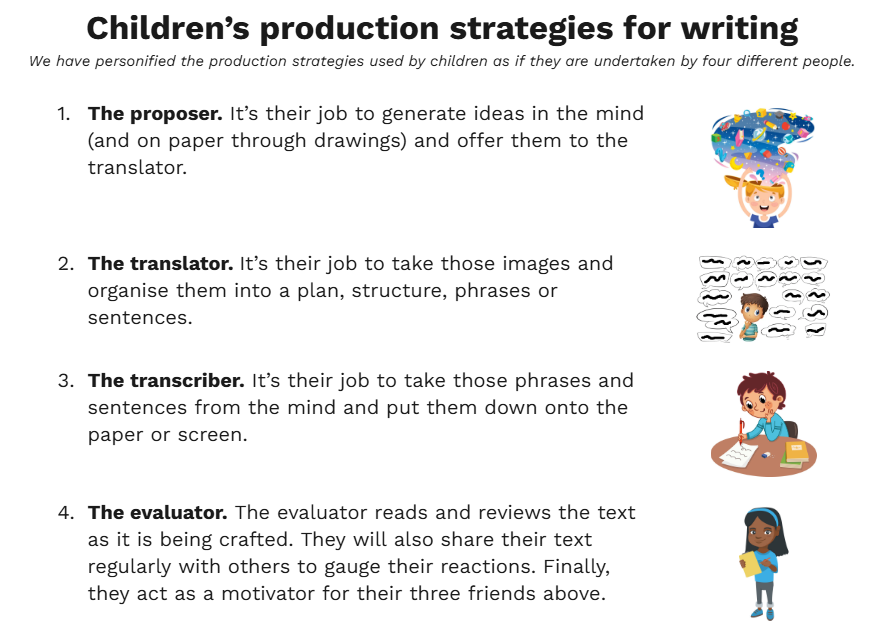


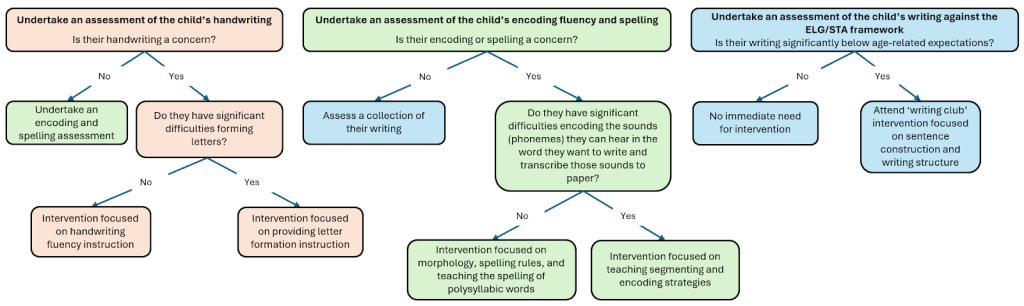



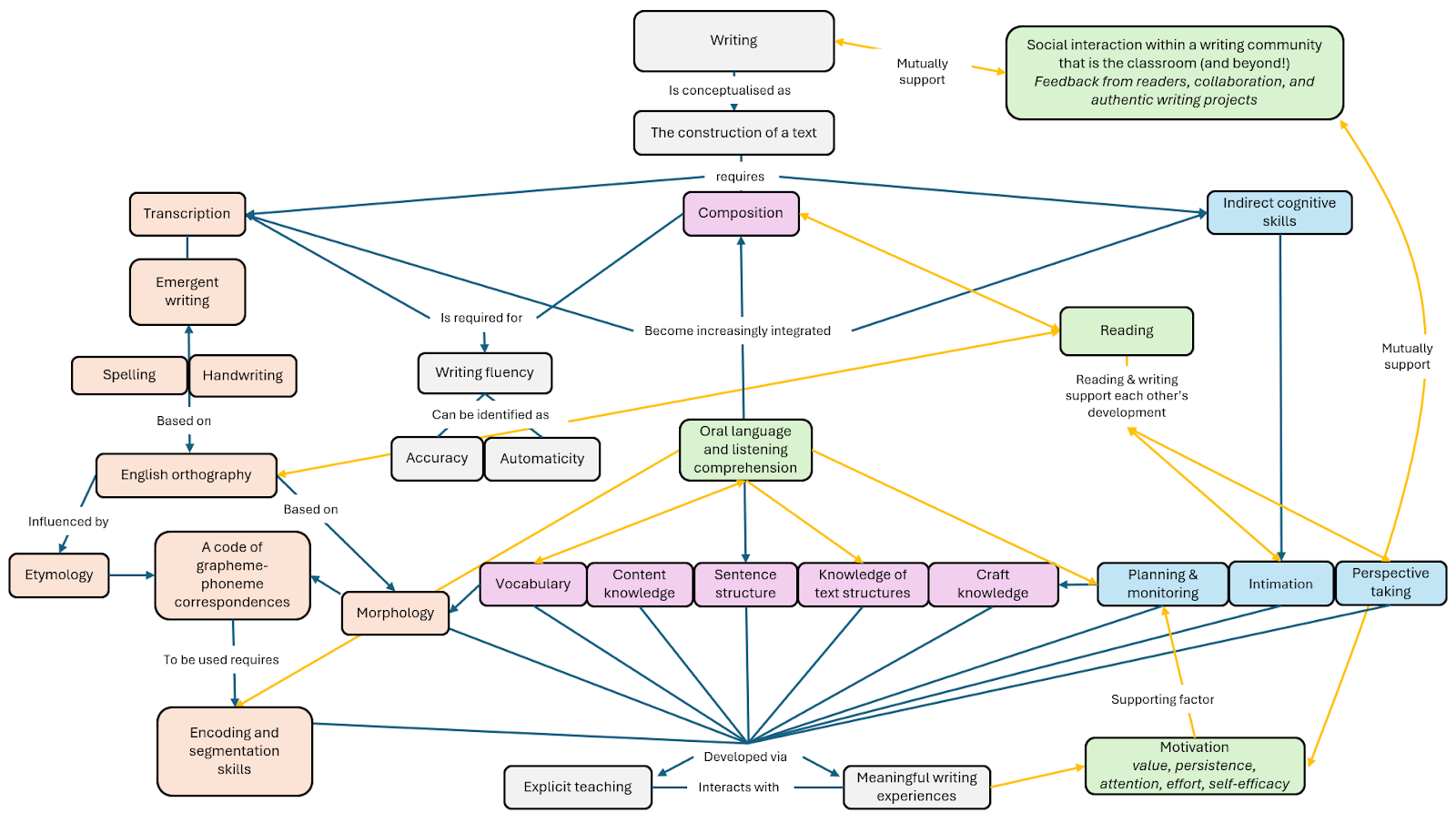
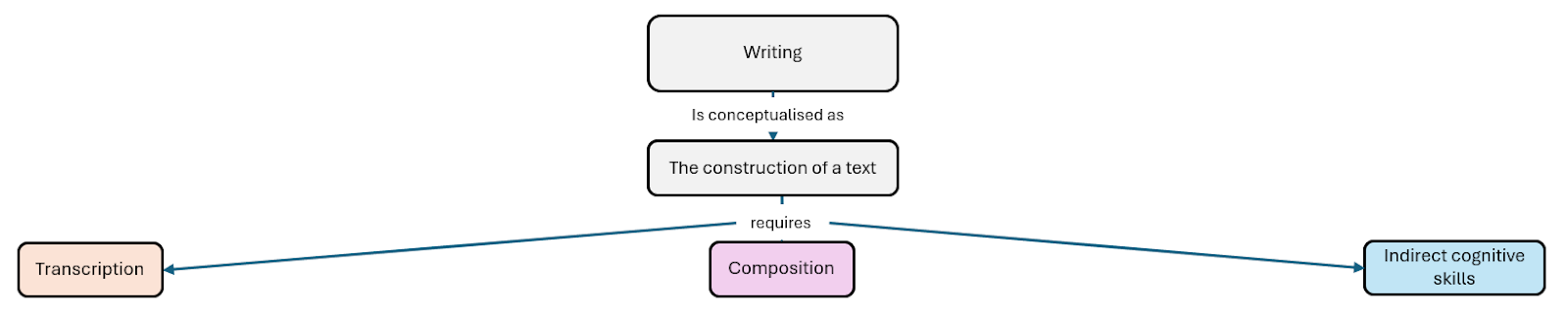
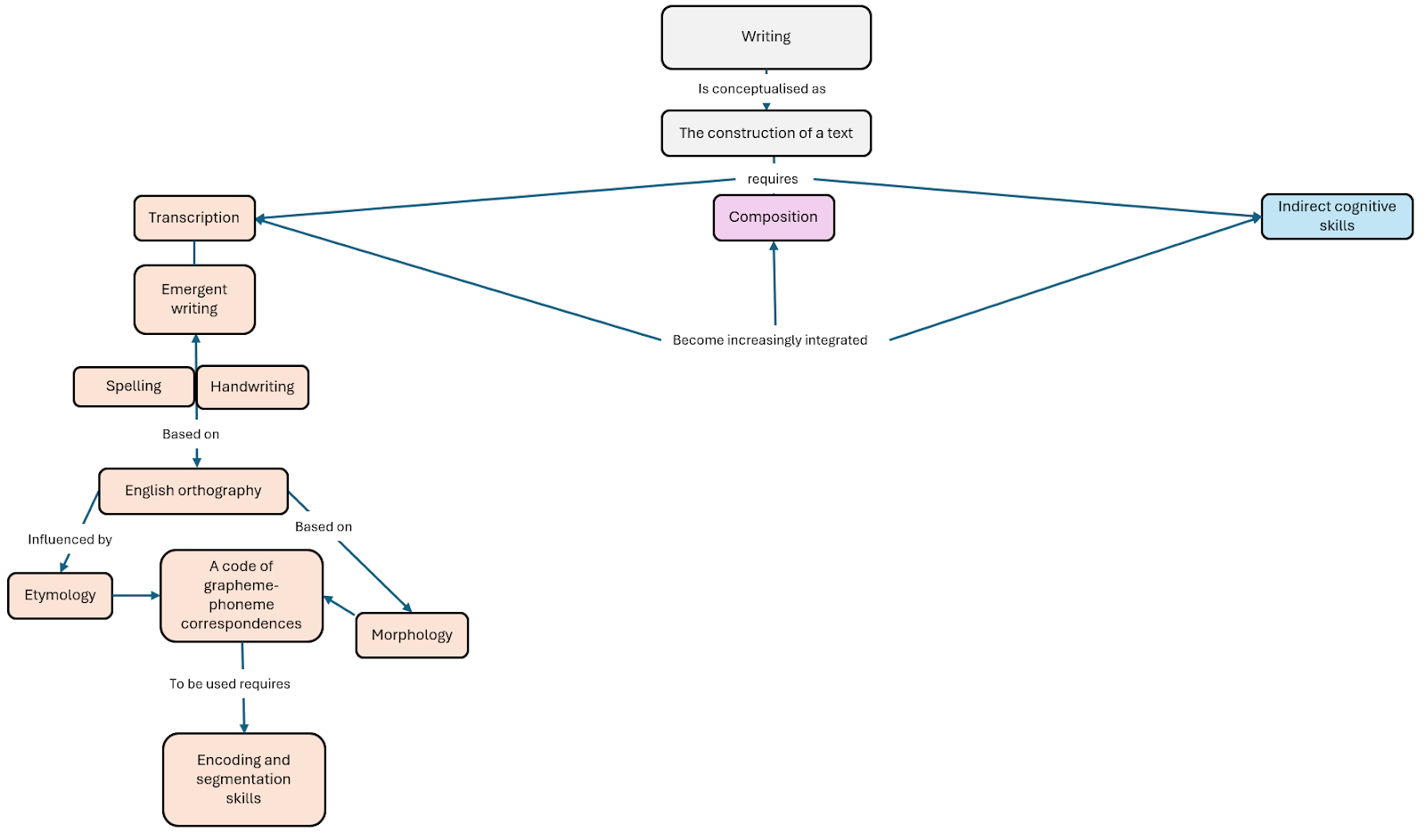
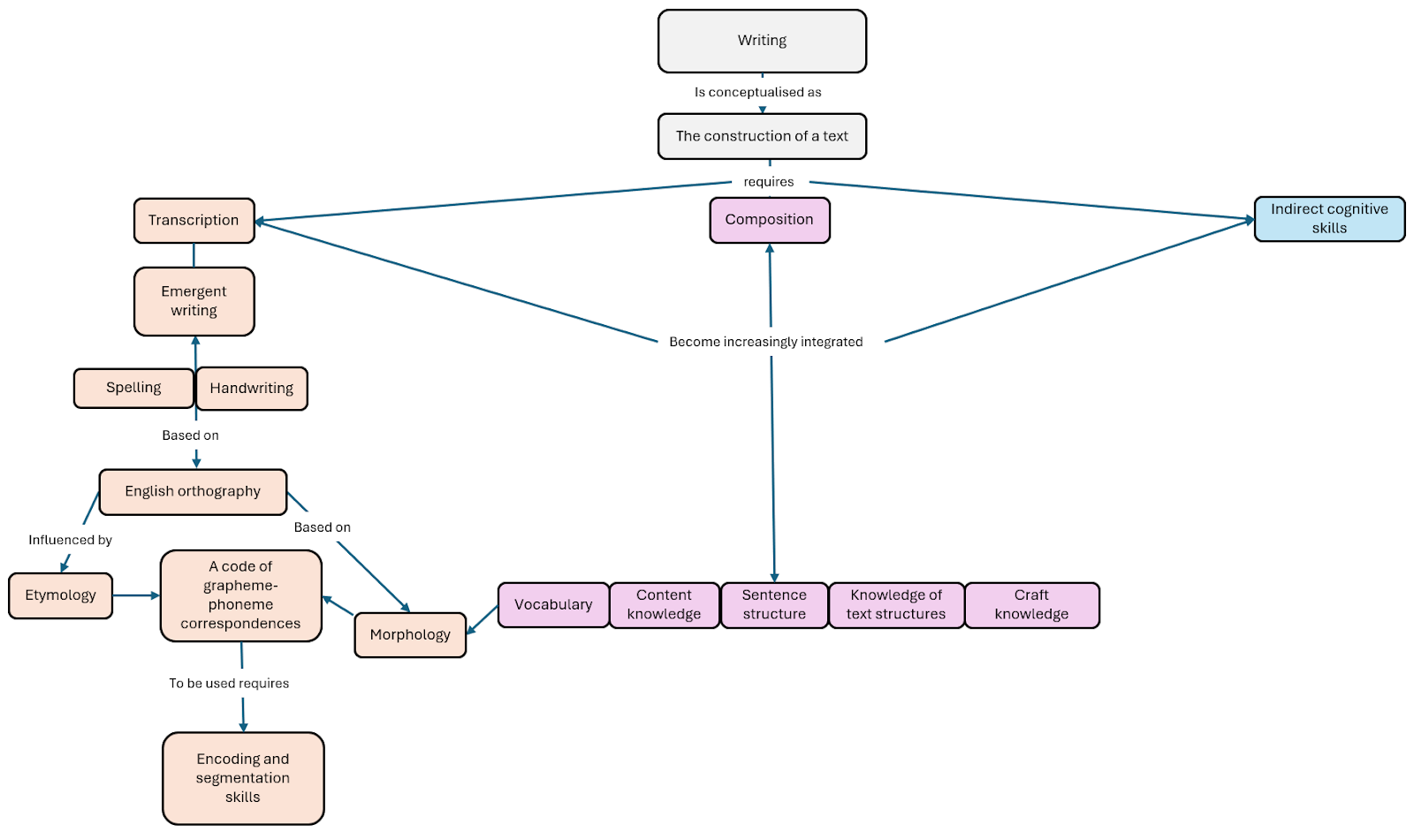

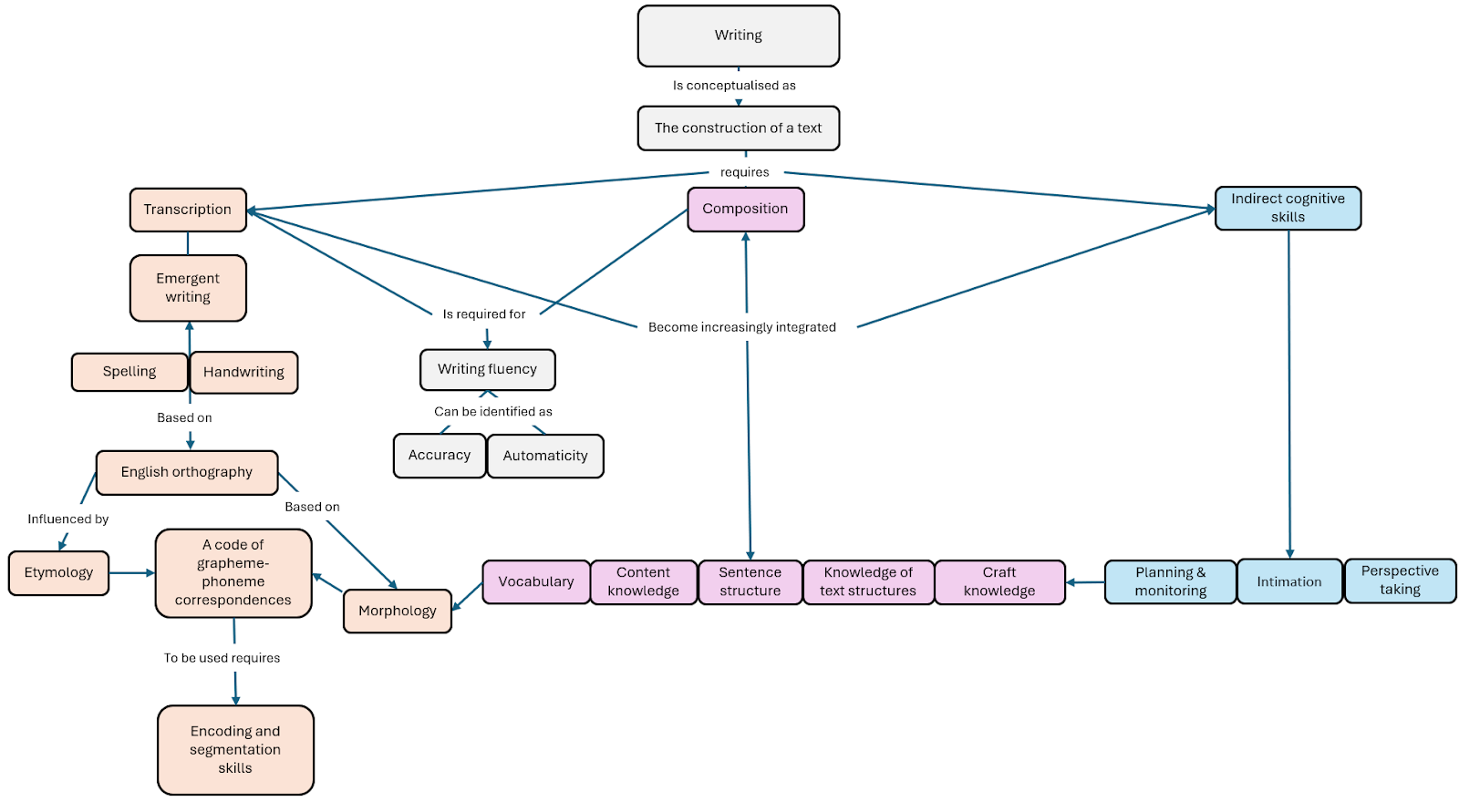
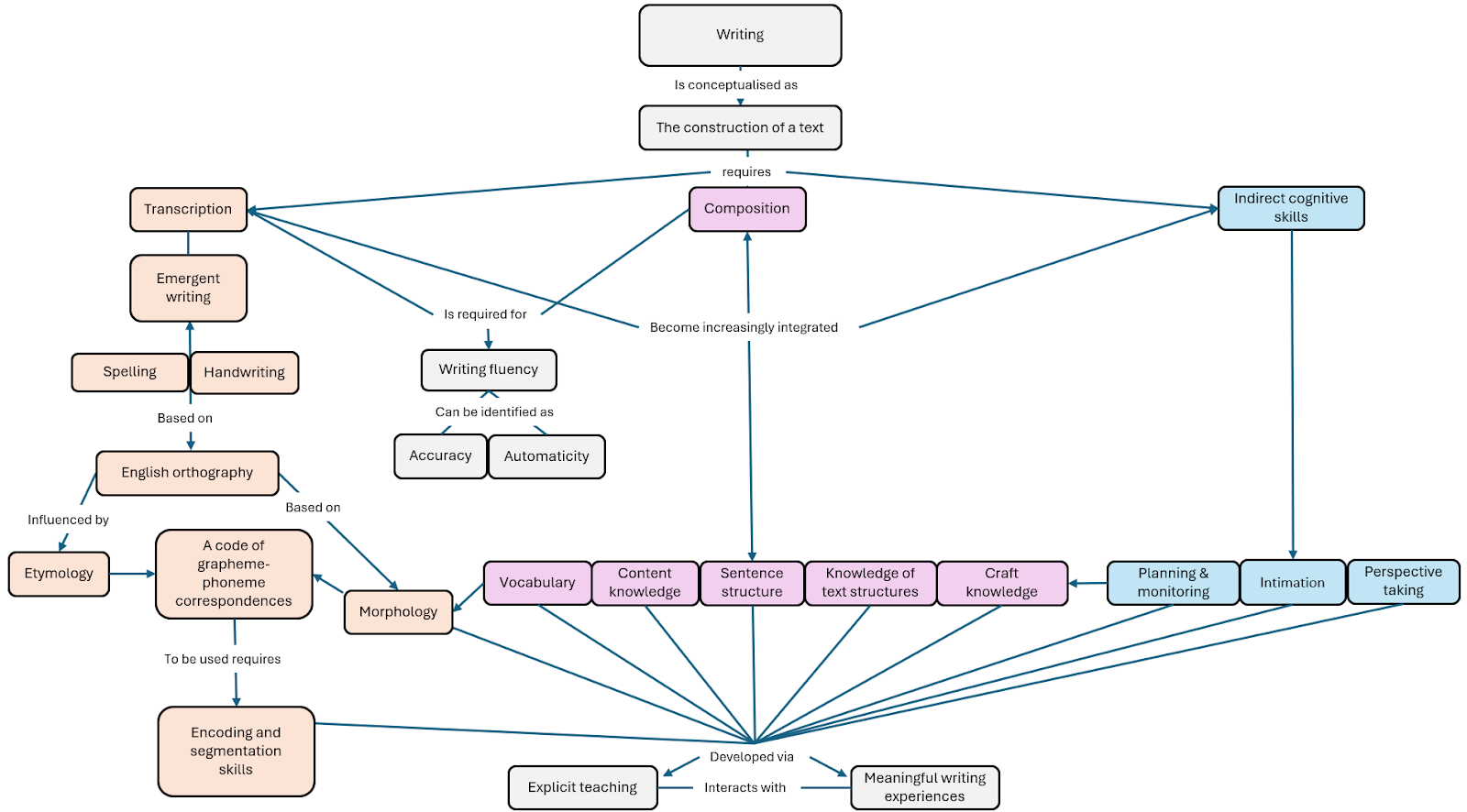

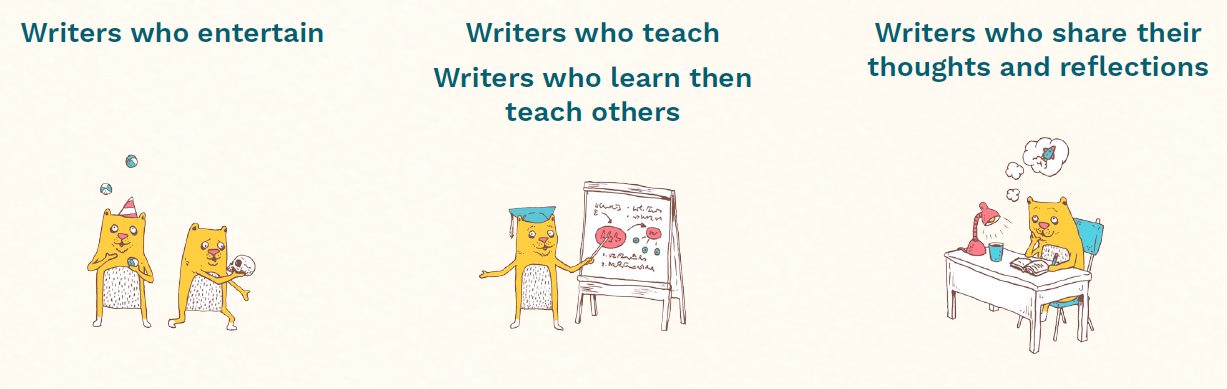


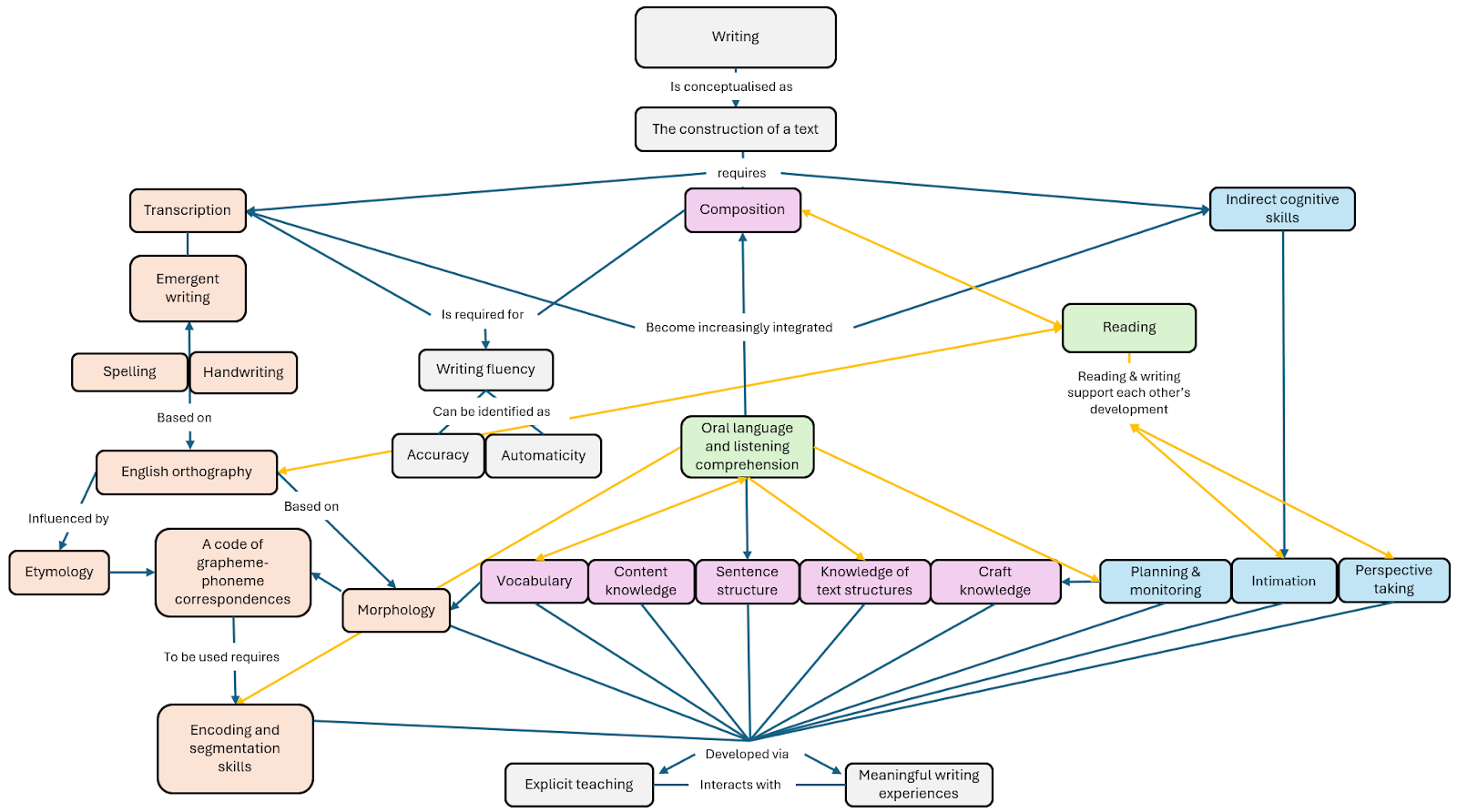

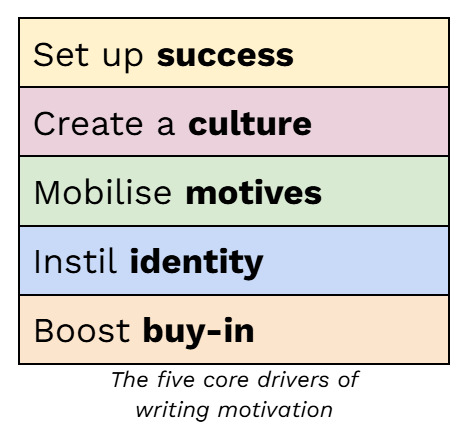


 The proposer. It’s their job to generate ideas in the mind (and on paper through drawings) and offer them to the translator.
 The translator. It’s their job to take those images and organise them into a plan, structure, phrases and sentences.
 The transcriber. It’s their job to take those phrases and sentences from the mind and put them down onto the paper or screen.
 The evaluator. The evaluator reads and reviews the text as it is being crafted. They will also share the text regularly with others to gauge their reactions. Finally, they act as a motivator.

