News

Debunking edu-myths: We must develop children’s motor skills first, and teach writing later

A well-meaning myth continues to shape early childhood classrooms: “Children need to develop fine and gross motor skills first — before we teach them how to write.” While it sounds logical, this belief delays meaningful writing instruction and misrepresents what research actually shows.

Let’s unpack why this myth persists and why it’s time to rethink it.

❌ The myth: motor skills first, writing later

You’ve probably seen this in practice: children playing with tweezers, threading beads, squeezing stress balls, all in the name of ‘preparing’ them for writing. These activities are valuable – it’s just that they are not a prerequisite for learning to write.

The idea that children must achieve certain motor milestones before writing instruction can begin is not supported by empirical evidence. In fact, delaying writing actually denies children the perfect place and opportunity for them to develop such skills.

✅ The truth: Writing drives motor skill development – not the other way around

Research shows that motor skills develop in tandem with writing – not in isolation before it. For example, in the seminal publication Already Ready, Katie Wood Ray & Matt Glover make a compelling case: children are writers from the moment they enter preschool. Their scribbles, drawings, and invented spellings are not only showcasing their writing development, they also show their motor-skills developing through writing too. 

  • Children benefit from writing early and often, even before their handwriting is neat or refined. See our article: Debunking edu-myths: ‘Emergent writing’ isn’t necessary before teaching children to write for more details on this [LINK].
  • Explicit handwriting instruction is far more effective than motor-skill exercises alone.

📚 What the research actually says

✏️ Handwriting gets better through writing, not just pegboards

It’s easy to see the logic: handwriting is a physical skill, so if a child struggles with it, they must lack the fine motor coordination required. Hence, giving them more motor practice should help, right?

This belief is widespread in both early years and SEND settings, and it’s often accompanied by a suite of activities: threading beads, using tweezers, playing with playdough, or tracing mazes. While these exercises develop children’s general motor development, there’s a crucial problem when it comes to using such practices to ‘prepare’ or improve children’s letter formation and handwriting.

Steve Graham – one of the world’s leading writing researchers – has shown that motor-skill focused programmes do not significantly improve children’s letter formation or handwriting outcomes unless paired with direct handwriting instruction. His meta-analysis concluded:

“Instructional programs designed to improve students’ motor skills were not effective. In contrast, explicit handwriting instruction was.”
— Graham et al. (2016)

Other studies add additional support to these claims (Lopez-Escribano et al. 2022; Ray 2022; Zwicker & Hadwin 2009). For instance, a systematic review of occupational therapy-based handwriting programmes (Hoy & Feder 2011) found that:

  • Interventions with fewer than 20 sessions and no direct handwriting instruction were largely ineffective.
  • The most effective programmes provided frequent, structured handwriting practice, often through meaningful writing experiences.

🤸‍♂️ So what you saying? Motor-skill development isn’t important?

This is where nuance matters. Of course, motor-skill development matters. It’s just that these supports work best when paired with handwriting instruction and meaningful writing experiences. For example, fine motor skill activities can impact children’s manual dexterity, visual perception, and visual integration (Eddy et al. 2019; Strooband et al. 2020).

🧾 What actually works? A sensible, integrated approach

If the goal is to support early writers, here’s what the evidence supports:

✅ Effective writing instruction includes:

  • Explicit teaching of letter formation and handwriting
  • Feedback on legibility and fluency
  • Opportunities for daily, meaningful writing experiences (see this article for more details LINK)

✅ Motor-skill activities can complement writing but shouldn’t replace or delay:

  • Provide activities that build core strength (e.g. crawling, wall pushes)
  • Encourage vertical writing to build shoulder stability
  • Ensure whole-body play, especially outdoors

These activities are best seen as supportive, not preparatory. Writing doesn’t wait on them – it happens alongside them.

🚀 Time to bust the myth

Here’s what needs to change:

MythFact
We need to ‘prepare’ children for writingChildren are Already Ready [LINK]
Children must develop their motor-skills firstMeaningful writing experiences are a perfect place to help children develop their motor-skills
Emergent writing doesn’t countEmergent writing is essential to children’s future writing success [LINK]
We shouldn’t teach letter formation or handwritingExplicit handwriting instruction is essential to children’s future writing success [LINK]

💬 Final thought

Children don’t need to be made ‘ready’ to write. They are already ready. They are writers the moment they have something to say through their emergent writing. The idea that they must build their motor skills before they write is an outdated and unsupported idea. 

Writing is not the reward for motor readiness – it’s the very thing that helps develop it. Children develop as writers by writing, not by waiting.

Bringing pleasure to reading lessons through writing

As teachers, we are in the profound business of cultivating lifelong readers and writers, transforming our classrooms into vibrant fields brimming with the ‘sweetest of nectar’ – good literature (Young & Ferguson 2020). Within this rich reading environment, one of the most joyous and impactful invitations we can extend to our young learners is for them to write about their reading. It is an act that nurtures a child’s intrinsic connection to a text and their blossoming identity as a writer and as a reader.

The profound connection between reading and writing is well-established, with research indicating that giving children ample time to read significantly enhances the quality of their writing, and allowing them to write in personal response to chosen texts deeply enhances their comprehension (see LINK for more on this).

The power and pleasure of personal response

At the heart of this joyful integration lies the concept of personal response. When children write about their reading in reading lessons, they don’t simply demonstrate comprehension; they give ‘something of themselves back to the text’ (Young & Ferguson 2021). This vital exchange allows them to link what they are reading to their own experiences, feelings, philosophies, cultures, and funds-of-knowledge (Young et al. 2021). 

Unlike traditional, scheme-directed writing tasks that can often lead children to merely replicate a single desired response, inviting personal written responses fosters a dynamic engagement that stretches children as readers and demands much of them as writers. It validates their unique perspective and encourages a ‘playfulness with thoughts and ideas’ that naturally leads to profitable writing (Young & Ferguson 2020).

Children’s personal responses can take many forms: they might write about why they liked a book, dwell on surprising or confusing elements, record what they learned, or reflect on what the book made them think about. This personal response, whether conscious or unconscious, often acts as a ‘trigger for a story, a poem, a piece of non-fiction or some faction’. This organic process is not only simple and elegant but ‘utterly enjoyable’ (Young & Ferguson 2020).

The different ways in which children can respond to a text. No longer do teachers (and children) need to read x30 copies of the exact same response! When we read other people’s ways of responding to a text – it deepens our comprehension of the text too. This is a major benefit of creating ‘an anthology of responses’ (Figure taken from Young & Ferguson 2020, p.94)

Embracing intertextuality

Crucially, inviting children to write about their reading introduces them to the natural and powerful concept of intertextuality (Young et al. 2021). This is the understanding that writers are influenced and inspired by everything they read, watch, play, hear and experience. Children are inherently ready to transform these textual experiences into writing. By explicitly teaching about and encouraging intertextuality, we empower children to draw from their ‘reading history and developing identities’ to create their own unique texts (Young et al. 2021).

Consider Daisy, a real Year Three child, whose story ‘Norris’ beautifully exemplifies intertextuality. She was initially moved to write because she wanted to write about a backpack (she had recently bought a new one and brought it to school). It also came from her hearing A Huge Bag of Worries as the class read-aloud. Style-wise, her story makes use of quirky, fantastical little details from Chris Riddell’s Ottoline books. She also uses some of the ‘voice’ from the Clarice Bean and Judy Moody books she loves reading in class so much. Norris’ magic rucksack had been put out in a ‘yard sale’ – a plot line she has taken from the film Toy Story. Daisy has recently been really immersed in The Worst Witch audiobooks and also watches the CBBC adaptation of it. These books use a more old-fashioned vocabulary and an ‘objective narrator voice’ with lots of speech to advance the plot, and this was the style of writing Daisy was now replicating. She also took the names Sweetpea (from Princess Poppy) and Drusilla (from The Worst Witch) for her own unkind characters. Daisy carries on telling the story of how Norris was going to retrieve her backpack. Norris and Mimosa decide to put up posters, and this gave her a chance to describe a variety of characters and places on the high street. This particular idea came from a book called The Fairy Hairdresser. This is a series of books where the first page always shows a high street inhabited by a fairy tale character waiting for a haircut. Daisy and her two younger brothers are regularly dragged down to the high street by their mum at weekends. Incidentally, Daisy’s mum is also a hairdresser. (Young & Ferguson 2020, p.92).

Practical pathways to pleasurable writing in the reading classroom

So, how can we develop this vibrant connection and invite children to write about their reading with pleasure?

  1. Cultivate a beautiful class library: Your classroom should feel like an ‘inviting library’, an additional member of the class, stocked with a wide variety of high-quality literature, including poetry, plays, magazines, newspapers, non-fiction, picture books, and, of course, children’s own published writing. Children should also be encouraged to bring books (and other favourite reading material) from home to enrich this collective resource.
  1. Prioritise reading aloud and discussion: Regularly read texts aloud to your class, making time for conversations so that children can react and discuss what’s being read. Use questions that encourage personal connection, such as Michael Rosen’s prompts: 
  1. Does this writing remind you of anything from your lives?
  2. Does it remind you of anything else you’ve seen or read?
  3. Does this remind you of anything else going on in the world? 

It’s this kind of ‘book talk’ that is a powerful springboard for writing ideas.

  1. Allow reading time to flow into writing time: Giving children ample time to read is essential, but equally powerful is allowing this reading time to directly lead into ‘personal writing time‘. This natural transition encourages children to make links and write in natural response to what they’ve read that day.
  1. Teach the art of ‘dabbling’: Introduce children to the concept of ‘dabbling’ in their writer’s notebooks while they read or listen (Young & Ferguson 2020). This involves scribbling, doodling, and quickly jotting down ideas, phrases, or images that strike them. This ‘low-stakes’ approach helps children overcome the fear of a blank page and naturally generate their own writing ideas in response to their reading. A useful technique is to create two columns: “This has given me an idea!” and “This has reminded me of something from my life!”.
  1. Encourage ‘squirreling’: Create a culture where children act like ‘squirrels’, actively searching for and ‘nesting away’ great writing from the texts they read. This could involve noting down ‘spectacular passages’, ‘interesting vocabulary’, ‘unusual ways of seeing things’, or even ‘story openers or endings’ in their writing notebooks. This practice helps them build their own ‘writing toolkit’ as they learn from the master writers they love most.
  1. Model the writer’s journey: As reader-writer-teachers, sharing your own reading-writing connections is incredibly powerful. Let children see you draw on your reading to craft your own texts, demonstrating how you borrow ‘literary, linguistic and grammatical features and vocabulary’ from the texts you love most (Young & Ferguson 2020). When a child’s writing reminds you of other authors’ work, share that connection with them; they will appreciate it.
  1. Democratise idea generation: Move away from scheme-imposed writing tasks. Instead, guide children in democratically generating a variety of writing ideas inspired by the text you’ve all read together. This empowers children to experience the ‘pleasure of planning their own creative possibilities’ (Young & Ferguson 2020).

Here, we can see a teacher and their class coming up with ‘an anthology of responses’ to their class text. No longer do teachers (and children) need to read x30 copies of the same response! When we read other people’s ways of responding to a text – it deepens our comprehension of the text. This is a major benefit of creating ‘an anthology of responses’  (Figure taken from Young & Ferguson 2020, p.97)

8. Make Idea Webs: Children really enjoy creating idea webs. The idea is simple. You take two characters, two settings and two problems from a collection of books you know and love. You then build a map around them. You draw lines and try to make connections between them to create an original writing idea. It can throw up storylines that you might never ever have thought of! The best thing to do with this lesson is to do one together as a whole class first. Then you can invite children to have a go in groups, pairs or on their own. It’s good to provide some time for children to share the ideas they generated with the rest of the class.

When children are given the time and expertise to respond to texts through their own writing, they become ‘dynamic creators of a writer and reader self-identity’ (Young & Ferguson 2021). They learn to read as writers, hearing writing ideas spring from the page and engaging in a ‘written conversation with the book they hold in their hands’ (Young & Ferguson 2020). This approach to writing in the reading classroom transforms it into a place where children ‘read and write with purpose, precision, pleasure and power’, truly joining the ‘literacy club’ (Young & Ferguson 2020). 

There is immense joy in watching children not just consume stories and information texts, but actively create them – sparked by the literature they love most in your class library.

References

  • Young, R., & Ferguson, F. (2020). Real-world writers: A handbook for teaching writing with 7-11 year olds. Routledge.
  • Young, R., & Ferguson, F. (2021). Writing for pleasure: Theory, research and practice. Routledge.
  • Young, R., Ferguson, F., Kaufman, D., Govender, N. (2021) Writing Realities Brighton: The Writing For Pleasure Centre

Further recommended reading:

  • Andersen, S. C., Christensen, M. V., Nielsen, H. S., Thomsen, M. K., Østerbye, T., & Rowe, M. L. (2018). How reading and writing support each other across a school year in primary school children. Contemporary Educational Psychology55, 129-138.
  • Bearne, E., and Watson, V. (1999). Where Texts and Children Meet. London: Routledge.
  • Benton, M., and Fox, G. (1985). Teaching Literature. Oxford: Oxford University Press.
  • Brownell, C. (2018). Creative language play(giarism). Elementary English Language Arts Classroom, 95(4), 218–228.
  • Corden, R. (2007). Developing reading–writing connections:The impact of explicit instruction of literary devices on the quality of children’s narrative writing. Journal of Research in Childhood Education, 21, 269–289.
  • Creber, P. (1990). Thinking through English. Maidenhead: Open University Press
  • Cremin, T., Mottram, M., Collins, F., Powell, S., and Safford, K. (2014). Building Communities of Engaged Readers: Reading For Pleasure. London: Routledge.
  • Cushing, I. (2018). ‘Suddenly, I am part of the poem’: Texts as worlds, reader-response and grammar in teaching poetry. English in Education, 52(1), 7–19.
  • DeCristofaro, D. (2001). Author to author: How text influences young writers, The Quarterly, 23(2), 8–12.
  • Dutro, E. (2010).What ‘hard times’ means: Mandated curricula, class-privileged assumptions, and the lives of poor children. Research in the Teaching of English, 44(3), 255–291.
  • Dyson, A.H. (1997). Writing Superheroes: Contemporary Childhood, Popular Culture, and Classroom Literacy. New York:Teachers College Press.
  • Dyson, A.H. (2013). Rewriting the Basics: Literacy Learning in Children’s Cultures. New York: Teachers College Press.
  • Fitzgerald, J., and Shanahan, T. (2000). Reading and writing relations and their development. Educational Psychologist, 35(1), 39–50.
  • Fletcher, R. (2011). Mentor Author, Mentor Texts. Portsmouth NH: Heinemann.
  • Gallagher, K. (2014). Making the most of mentor texts. Writing: A Core Skill, 71(7), 28–33.
  • Graham, S. (2020). The Sciences of Reading and Writing Must Become More Fully Integrated. Reading Research Quarterly, 55(S1), S35–S44.
  • Graham, S., and Hebert, M. (2011).Writing to read: A meta-analysis of the impact of writing and writing instruction on reading. Harvard Educational Review, 81, 710–744.
  • Graham, S., Xinghua, L., Aitken, A., Ng, C., Bartlett, B., Harris, K., and Holzapfel, J. (2018). Effectiveness of literacy programs balancing reading and writing instruction: A metaanalysis. Reading Research Quarterly, 53(3), 279–304.
  • Griffith, R. (2010). Students learn to read like writers: a framework for teachers of writing, Reading Horizons, 50(1), 49–66.
  • Hansen, J. (1987). When Writers Read. Portsmouth, NH: Heinemann.
  • Harman, R. (2013). Literary intertextuality in genre-based pedagogies: Building lexical cohesion in fifth-grade L2 writing. Journal of Second Language Writing, 22(2), 125–140.
  • Harwayne, S. (1992). Lasting Impressions. Weaving Literature into the Writing Workshop. Portsmouth, NH: Heinemann.
  • Heller, M. (1999). Reading-Writing Connections: From Theory to Practice. Mahwah, NJ: Lawrence Erlbaum Associates.
  • Hoewisch, A. (2001). ‘Do I have to have a princess in my story?’: Supporting children’s writing of fairytales. Reading and Writing Quarterly, 17, 249–277.
  • Jouhar, M. R., & Rupley, W. H. (2021). The reading–writing connection based on independent reading and writing: A systematic review. Reading & Writing Quarterly37(2), 136-156.
  • Lancia, P. (1997). Literary borrowing: The effects of literature on children’s writing. The Reading Teacher, 50(6), 470–475.
  • Lewison, M., and Heffernan, L. (2008). Rewriting writers workshop: Creating safe spaces for disruptive stories. Research in the Teaching of English, 42(4), 435–465.
  • Manak, J. (2011). The social construction of intertextuality and literary understanding: The impact of interactive read-alouds on the writing of third graders during writing workshop. Reading Research Quarterly, 46(4), 309–311.
  • Meek Spencer, M. (1988). How Texts Teach What Readers Learn. Stroud:Thimble Press.
  • Meek Spencer, M. (2000). Afterword: Transitional transformation. In Where Texts and Children Meet (pp. 198–213). London: Routledge
  • Murray, D. (1993). Read to Write (3rd Ed.). San Diego, CA: Harcourt.
  • Oatley, K. (2003). Writingandreading. In Cognitive Poetics in Practice, Gavins, J.A., and Gerard, S. (Eds.) (pp. 161–175). London: Routledge.
  • Olin-Scheller, C., & Wikström, P. (2010). Literary prosumers: Young people’s reading and writing. Education inquiry1(1), 41-56.
  • Olthouse, J. (2012). Why I write: What talented creative writers need their teachers to know. Gifted Child Today, 35(2), 117–121.
  • Pantaleo, S. (2006). Readers and writers as intertexts: Exploring the intertextualities in student writing. Australian Journal of Language and Literacy, 29(2), 163–181.
  • Pantaleo, S. (2007). The reader in the writer: Exploring elementary students’ metafictive texts. The Journal of Reading,Writing and Literacy, 2(3), 42–74.
  • Pantaleo, S. (2010). Developing narrative competence through reading and writing metafictive texts. Literacy Research and Instruction, 49(3), 264–281.
  • Parry, B., and Taylor, L. (2018). Readers in the round: Children’s holistic engagements with texts. Literacy, 52(2), 103–110.
  • Prose, F. (2006). Reading Like a Writer. New York: HarperCollins.
  • Rief, L. (2014). Read Write Teaching: Choice and Challenge in the Reading-Writing Workshop. Portsmouth, NH: Heinemann.
  • Rosen, H. (1985). Stories and Meanings. Sheffield UK: National Association of Teachers of English.
  • Rosen, H. (2017). Neither bleak house nor liberty hall: English in the curriculum. In Harold
  • Rosen Writings on Life, Language and Learning 1958–2008, Richmond, J., (Ed.) (pp. 73–90). London: UCL IOE Press.
  • Rosen, M. (1998). Did I Hear You Write? (2nd Ed.). London: Five Leaves Publications.
  • Rosen, M. (2018). Writing for Pleasure. London: Michael Rosen.
  • Rosenblatt, L. (1995). Literature as Exploration (5th Ed.). New York: Modern Language Association.
  • Rowsell, J., and Pahl, K. (2007). Sedimented identities in texts: Instances of practice. Reading Research Quarterly, 42(3), 388–404.
  • Smith, F. (1983). Reading like a writer. Language Arts, 60(5), 558–567.
  • Smith, F. (1988). Joining the Literacy Club. Portsmouth, USA: Heinemann.
  • Tierney, R., and Shanahan,T. (1991). Research on the reading-writing relationship: Interactions, transactions, and outcomes. In Handbook of Reading Research Volume II, Barr, R., Kamil, M.L., Mosenthal, P., and Pearson, P.D. (Eds.) (pp. 246–280). New York: Longman.

Debunking edu-myths: “Children choosing their own writing topics gets in the way of teaching writing effectively”

“Allowing inexperienced writers to choose their own topics can get in the way of teaching writing effectively.”

Is there any research evidence to support this view? Or is it just another edu-myth?

This is one of those slippery claims. The idea that any teacher would just leave children to choose their own writing ideas without instruction or feedback. No one would reasonably suggest that. If we support children to choose their own writing topics there is no chaos – no confusion. Through explicit idea generation instruction, and through the use of Writing Registers, there is only rigour and organisation.

🧠 The case for topic choice: Far from a hippie-free-for-all

Let’s start by being clear: giving children a say in what they write about is not the same as letting them write anything, any time, in any way. In well-designed writing curriculums, choice doesn’t mean chaos – it means authenticity (Young & Ferguson 2021). After all, generating ideas is part of a writer’s process – we have to teach it. Particularly when we consider the STA wants children’s writing to be independent. 

Research consistently shows that students are more motivated, write more fluently, and engage more deeply when they can write about topics that matter to them (Young 2024). 

When students are emotionally connected to their writing, they care more about crafting it well (Young 2025).

Children with SEND can benefit even more when given support to choose their own writing topics (Allgood 2025). The idea that giving children with SEND tightly prescribed topics makes the writing process easier for them is simply not true. In many cases, it makes writing even harder for them (see LINK for more details).

🏗️ Structure and choice should coexist

The myth assumes that offering choice and delivering high-quality instruction are incompatible. But the reality is that the most effective writing teachers do exactly this (Young & Ferguson 2021).

For example, in Writing for Pleasure schools, we use genre-based writing units that teach craft knowledge while supporting pupils to choose what they would like to write about most. 

A class might all be working on persuasive texts, but one pupil writes about banning school uniforms, another about saving hedgehogs, and another about why videogames are good for your soul! Same genre, same high-quality teaching points – just different passions and independent outcomes. 

This blend of explicit and direct instruction with genuine authorship is exactly what the most successful writing classrooms achieve (Young & Ferguson 2021).

🔄 What’s really behind this myth?

At heart, this myth seems to stem not from research evidence, but assumption.

Let’s put the myth to the test.

ClaimEvidence?
Supporting student choice harms writing quality❌ No. Research shows it boosts motivation and writing productivity when scaffolded.
Supporting student choice prevents effective teaching❌ No. Teachers can deliver explicit instruction through genre-based writing projects with individual topic choice.
Supporting student choice is too difficult for novice writers or learners with SEND❌ No. Many benefit from supported choice – not less of it.

✅ The Verdict

The idea that supporting student choice gets in the way of effective writing teaching is a myth. What really gets in the way is rigid curricula that treats writing as a formula rather than a craft (Dyson 2020). Children, even novice writers, benefit both cognitively and motivationally from being treated as authors with something to say, and from teachers who help them say it as effectively as they can.

References and further reading:

  • Boscolo, P., & Gelati, C. (2019). Writing motivation and writing development: Key issues.
  • Dockrell, J., Ricketts, J., Charman, T., & Lindsay, G. (2014). Profiles of writing difficulties in children with language and literacy difficulties.
  • Dyson, A. H. (2020). “This isn’t my real writing”: The fate of children’s agency in too-tight curricula. Theory Into Practice, 59(2), 119-127.
  • Graham, S., et al. (2012). Teaching Elementary School Students to Be Effective Writers.
  • Young, R., & Ferguson, F. (2021). Real-World Writers: A Handbook for Teaching Writing with 10- and 11-Year-Olds. London: Routledge
  • Young, R., & Ferguson, F. (2023). Supporting Children With SEND To Be Great Writers Brighton: The Writing For Pleasure Centre
  • Young, R., & Ferguson, F. (2021). Young, R. (2024) Motivating Writing Teaching Brighton: The Writing For Pleasure Centre
  • Young, R. (2025) “It’s healthy. It’s good for you”: Children’s perspectives on utilising their autonomy in the writing classroom UKLA International Conference – Liverpool – 2025

Debunking edu-myths: “The best way to teach pupils to write is by teaching them to master sentences”

It’s a seductive idea: If children can master sentence construction, the rest of writing will magically and naturally fall into place. Some advocates even suggest it’s the best way to teach writing. But is this claim really backed by research evidence?

Let’s take a closer look.

What’s the claim?

“The best way to teach pupils to write is by teaching them to master sentences.”

This is a bold assertion – one that sounds simple and efficient. But bold claims demand strong evidence.

What does the research say?

There is good and growing evidence that sentence-level instruction can significantly improve pupils’ writing, particularly for novices or struggling writers. This is why we provide schools with our eBooks:

  • Sentence-level instruction for 3-11 year olds [LINK]
  • Sentence-building intervention mini-projects [LINK]

In terms of research, we certainly have:

  • Graham & Perin’s (2007) influential meta-analysis found that sentence-level instruction was one of the most effective strategies for improving adolescent writing.
  • Myhill et al. (2012) demonstrated that teaching grammar in context, with a focus on how sentence-level choices shape meaning, can boost writing quality — especially when connected to meaningful writing projects.

So yes – helping pupils gain control over sentence construction can make a real difference, especially when it’s taught explicitly, meaningfully, and within the context of purposeful writing.

So what’s the problem?

The issue lies in the absolutism of the claim.

Firstly, not all writing involves writing sentences (Rosen 2025). Secondly, writing is a layered process. As the DfE Writing Framework cautions:

[Pupils] may be turned off writing, if teaching is focused too heavily on learning grammatical concepts, out of context and with little understanding of their potential for expressive impact.” 

Sentence-level instruction is important — but it’s just one part of the picture. As our Writing Map shows, effective writing instruction also involves:

  • Teaching pupils how to plan and organise their ideas
  • Understanding genre and audience
  • Building cohesion across paragraphs
  • Developing voice, structure, and style
  • Encouraging revision and reflection

This isn’t just opinion – it’s backed by the science of teaching writing [LINK].

Focusing solely on sentences may lead to technically correct sentence writing but their sentences will lack substance, coherence, or purpose. In other words: pupils might write neat sentences, but struggle to say anything meaningful with them [LINK].

The verdict

Partially true. Yes, sentence-level instruction is valuable. Yes, it’s supported by research. But no, it’s not the best way – at least not in isolation.

What should teachers do instead?

  • Teach sentence construction in context, as part of authentic class writing projects. As the DfE’s Writing Framework points out: “It is worth emphasising that grammar teaching will improve writing only if pupils apply what they have been taught to their writing.
  • Combine sentence-level instruction with teaching about idea generation, planning, genre, and audience.
  • Encourage pupils to think about how and why they make writing choices – not just whether they’re grammatically correct.

Sentence-level instruction is a powerful tool – but writing instruction is at its best when it treats writing as the rich, dynamic process it truly is.

Recommended further reading:

  • The components of effective sentence-level instruction [LINK]
  • Guidance on teaching at the sentence-level [LINK]
  • Sentence-level instruction: Our viewpoint [LINK]
  • Guidance on what NOT to do when teaching at the sentence-level [LINK]
  • Where’s the research on teaching at the sentence-level? [LINK]
  • Andrews, R.,Torgerson, C., Beverton, S., Locke,T., Low, G., Robinson, A., and Zhu, D. (2006). The effect of grammar teaching on writing development. British Educational Research Journal, 32(1), 39–55.
  • Fearn, L., and Farman, N. (1998). Writing Effectively: Helping Students Master the Conventions of Writing. London: Pearson.
  • Graham, S., and Perin, D. (2007). Writing Next: Effective Strategies to Improve Writing of Adolescents In Middle School & High Schools.Washington, DC:Alliance For Excellent Education.
  • Hudson, R. (2017). Grammar instruction. In Handbook of Writing Research, MacArthur, C., Graham, S., Fitzgerald, J. (Eds.) (pp. 288–300) (2nd Ed.). New York: Guildford Press.
  • Kolln, M. (1996). Rhetorical grammar: A modification lesson. English Journal, 85(7), 25–31.
  • Limpo, T., & Alves, R. (2013).Teaching planning or sentence-combining strategies: Effective SRSD interventions at different levels of written composition. Contemporary Educational Psychology, 38,328–341.
  • Myhill, D. (2018). Grammar as a meaning-making resource for improving writing (Contribution to a special issue Working on Grammar at School in L1-Education: Empirical Research across Linguistic Regions). L1-Educational Studies Language and Literature, 18, 1–21.
  • Saddler, B. (2019). Sentence combining. In Best Practices in Writing Instruction, Graham, S., MacArthur, C., and Hebert, M. (3rd Ed.) (pp. 240–261). New York: Guildford Press.
  • Weaver, C., Bush, J., Anderson, J., and Bills, P. (2006). Grammar intertwined throughout the writing process: An inch wide and a mile deep. English Teaching: Practice & Critique, 5(1), 77–101.
  • Wyse, D., and Torgerson, C. (2017). Experimental trials and ‘what works?’ In education: The case of grammar for writing. British Educational Research Journal, 43(6), 1019–1047.

What do we really mean by “I got my best writing…”?

As teachers, we’ll often describe a certain unit as producing our ‘best writing outcomes’ – but what do we really mean? Do we mean it looks impressive to outsiders? That it follows our model text perfectly? Or do we mean that it represents a child’s truest, most thoughtful, most authored work?

With growing scrutiny of writing instruction in English schools – particularly the rise of ‘elaborate dictation’ – we must ask: are children genuinely learning to write, or are they being coached to look like they can (Barrs 2019; Cremin et al. 2003; McDonald 2025)?

Superficial competency vs. genuine academic achievement 

In some classrooms today, ‘best writing’ has become a euphemism for work that is the result of extensive adult direction. This type of writing is often visually polished but intellectually hollow. Writer-teacher John Warner likens this to producing ‘writing-related simulations, formulaic responses for the purpose of passing standardised assessment’ (Warner 2025 p.5).

To illustrate this, let’s look at two examples:

Child A: The polished illusion

In Child A’s classroom, the teacher has led the class through a model text about rivers. Together, they constructed each paragraph. Students were told which adjectives to use, how to begin each sentence, and even which conjunctions to insert where. Child A has carefully followed the model, and the final piece reads fluently, with a sophisticated tone. It looks excellent in their book.

But here is Child A’s ‘competency scorecard’:

The result is a text that dupes moderators but reflects little genuine writing growth. It may even undermine the child’s belief that they can write without such heavy scaffolding (Ryan et al. 2022; Young 2025).

Child B: The authentic writer

Now consider Child B, who was given instruction and time to choose their own genuine writing topic within the parameters of a whole-class writing project. They’ve chosen to write a letter to their local football club. Because of their teacher’s instruction and feedback, the piece is cohesive and well written. Their writing shows thought, emotional honesty, and a clear sense of audience. The child revised and proof-read independently, and shared their manuscript during class discussions.

Here is Child B’s ‘competency scorecard’:

This is real writing. It is meaningful and human.

Did the child write it – or just fill in the gaps?

These examples remind us that ‘best’ should never simply mean ‘most compliant’ (Lambirth 2016). In the case of Child A, the writing appeared impressive to anyone who hadn’t witnessed the writing process. However, the child wasn’t truly composing or authoring; they were merely re-transcribing a preloaded text.

By contrast, Child B’s writing reflects authentic authorship, while also scoring well in a formal writing assessment. Their text demonstrates real learning, genuine satisfaction, and meaningful communication (Clarkson 2024; McDonald 2025; Young 2025). 

Personal competency

Too often, students who’ve been trained in mimicry come to believe that writing is about ‘pleasing the teacher or avoiding punishment’, not expressing ideas (González-Díaz et al. 2024; Lambirth 2016). They may even begin to distrust their own thoughts and ideas, defaulting to teacher input for every phrase (Ryan et al. 2022).

But when students produce something truly their own, they develop a personal sense of competency. This is where identity and confidence as a writer are born (Young 2025). Child B looked at their letter believing they had something to say – and that others wanted to hear it. This is a beautiful thing.

Social competency

Writing is a social act. When children write to be read, they make authorial choices – considering their reader, their tone, and the emotional or intellectual impact of their words (Young 2025).

Child B’s letter held meaning for its readers – so much so that they wrote back to her. In contrast, Child A’s river report didn’t mean a great deal to anyone. After all, there were 30 near-identical copies of it in the classroom.

Reclaiming the meaning of ‘best’

To reclaim ‘best writing outcomes’, we must resist the pressure to ask children to produce writing that flatters to deceive.

If we truly want students to succeed academically and not just ‘play the game of writing’ then ‘best’ must reflect:

🏆 Genuine and independent academic achievement

❤️ Personal pride and satisfaction 

🔗Social connection through authentic authorship

This does mean having the highest possible expectations. Writing in school is not just about producing ‘assessment artefacts’ – it’s about children enjoying the process of creating writing and feeling a deep sense of satisfaction and pride in producing something of the utmost quality (Young 2025).

Conclusion

In an age of elaborate dictation and ‘fake’ performative writing outcomes, we must ask: Are we producing writers, or reciters?

When we say best writing outcomes, let’s mean writing that is truly the best of them: their words, their thoughts, their academic achievement.

References and further reading

  • Barrs, M. (2019). Teaching bad writing. English in Education, 53(1), 18-31
  • Bruyère, J., Pendergrass, E. (2020) Are Your Students Writing or Authoring? Young Author’s Milieux, Early Childhood Education Journal, 48 pp.561-571
  • Clarkson, R. (2024). ‘It’s missing the heart of what writing is about’: teachers’ interpretations of writing assessment criteria. British Educational Research Journal, 50(1), 134-161.
  • Dyson, A. H. (2020). “This isn’t my real writing”: The fate of children’s agency in too-tight curricula. Theory Into Practice, 59(2), 119-127.
  • González-Díaz, V., Parr, E., & Nourie, K. (2024). Conceptualisations of ‘good’ writing in the English primary school context. Language and Education, 1-24
  • Grainger (Cremin), T., Goouch, K., Lambirth, A. (2003) Playing the game called writing, English in Education, 37(2), 4–15
  • Lambirth, A. (2016). Exploring children’s discourses of writing. English in Education, 50(3), 215-232
  • McDonald, R. (2025). Exploring teachers’ positioning of children as writers, English in Education, 1-16
  • Myhill, D., & Clarkson, R. (2021). School writing in England. In International Perspectives on Writing Curricula and Development (pp. 147-168). Routledge
  • Ryan, M., Khosronejad, M., Barton, G., Myhill, D., & Kervin, L. (2022). Reflexive writing dialogues: Elementary students’ perceptions and performances as writers during classroom experiences. Assessing writing, 51, 100592
  • Young, R. (2025) Children’s perspectives on writing competency: Academic, personal and social influences UKLA International Conference – Liverpool – 2025

The rise of ‘elaborate dictation’ and ‘writing-related simulations’ in English schools: Unethical writing teaching

In recent years, a growing concern has emerged among teachers, parents, and researchers in England: The increasing use of what could be called ‘elaborate dictation’ in classrooms. 

At first glance, elaborate dictation appears to be an effective teaching ‘hack’. It involves children copying or lightly adapting a teacher- or scheme-generated text, essentially filling in blanks within pre-structured sentences, or piecing together paragraphs composed largely of pre-determined vocabulary and syntax. These texts may appear impressive to external observers but they flatter to deceive. Beneath the surface lies a troubling question: Are students truly learning to write, compose and author – or are they merely learning to recite, regurgitate and transcribe (Cremin et al. 2003)? Writer-teacher John Warner calls this producing ‘writing-related simulations’ (Warner 2025).

What is ‘elaborate dictation’?

Unlike traditional dictation exercises, where students write down what the teacher says to practice listening and spelling, elaborate dictation is more sophisticated – and arguably more misleading. It often disguises itself as independent writing. In reality, however, the intellectual and creative effort is largely outsourced to the scheme-writer (or teacher) (Young 2025). Students may be walked through every sentence, prompted with what to say, and told exactly what to include in each paragraph.

In some classrooms, a model text is slightly adjusted and then rewritten en masse. Students essentially copy the text into their books, making only slight variations. To an outsider, the final product may appear student-authored, but the level of actual authorship is minimal (Young 2025).

Why are schools doing this?

There are several reasons behind the rise of elaborate dictation, chief among them being the pressure of accountability. In England, schools are subject to rigorous inspections and assessments by Ofsted and the STA, and they must demonstrate, one way or another, measurable progress in students’ writing. In response, some schools feel compelled to produce evidence of high-quality writing at any cost – even if that means providing, what we might call a ‘fake’ or superficial level of academic competency. All the while, other schools work hard to ensure that their children present an authentic level of academic achievement (LINK).

The ethical dilemma

At the heart of the issue is an ethical concern: children are being asked to write without ever truly authoring (Bruyère & Pendergrass 2020). They are being evaluated on pieces they did not actually produce, and these pieces are being used to judge their progress and even the school’s performance (Bars 2019; Clarkson 2024; Cremin et al. 2003).

This undermines not only the purpose of writing education but also students’ sense of achievement. Writing is fundamentally an act of thought, self-expression, and linguistic play. When that is reduced to filling in blanks and copying a polished template, students are denied the rewarding experience of sharing their own ideas and voice (Young 2025). According to Warner (2025, p.5), this happens ‘not because teachers are bad or students lack ability but because these simulations have been privileged in a system where “schooling” is divorced from “learning”‘.

Long-term consequences

The implications are serious. Students accustomed to elaborate dictation will struggle later in their lives. Their ability to structure arguments, craft narratives, and think critically through writing will be underdeveloped. Moreover, such practices can widen the gap between students from different backgrounds. Those with greater support outside of school may learn to write authentically, while others will remain dependent on regurgitating out models.

It also risks student cynicism. Children often know when they are not really writing (Dyson 2020). Repeated exposure to these practices may erode their confidence and lead them to believe they are ‘fractured writers’ incapable of original thoughts, only of parroting back what adults provide (Ryan et al. 2022).

Towards an sincere approach to writing teaching

To counter this trend, schools must reclaim the integrity of writing instruction. This means creating space for real composition and genuine academic achievement (Young 2025). It requires supporting children to conceptualise, translate and transcribe their own writing (LINK for more on this).

Of course, direct instruction, teacher modelling and scaffolding contribute significantly to the quality of writing teaching (LINK to find out more). But when support becomes so prescriptive that the child’s role is reduced to simply transcribing out the teacher’s text, the line between genuine learning and fabrication has been crossed (Young 2025).

Writing must remain an act of authorship.

Conclusion

Elaborate dictation, as practiced in some English schools, may seem like a harmless or even helpful teaching tool. But when it replaces genuine composition with coached mimicry, it does a disservice to students’ development and misrepresents their abilities to others (Barrs 2019; Myhill & Clarkson 2021). The reality is that children are cheated out of receiving a genuine writerly apprenticeship. As the education system continues to grapple with assessment pressures and performance metrics, we must ask: are we helping children find their own writing voice – or merely giving them ours to repeat?

The future of our young writers depends on your answer.

References and further reading

  • Barrs, M. (2019). Teaching bad writing. English in Education, 53(1), 18-31
  • Bruyère, J., Pendergrass, E. (2020) Are Your Students Writing or Authoring? Young Author’s Milieux, Early Childhood Education Journal, 48 pp.561-571
  • Clarkson, R. (2024). ‘It’s missing the heart of what writing is about’: teachers’ interpretations of writing assessment criteria. British Educational Research Journal, 50(1), 134-161.
  • Dyson, A. H. (2020). “This isn’t my real writing”: The fate of children’s agency in too-tight curricula. Theory Into Practice, 59(2), 119-127.
  • González-Díaz, V., Parr, E., & Nourie, K. (2024). Conceptualisations of ‘good’ writing in the English primary school context. Language and Education, 1-24
  • Grainger (Cremin), T., Goouch, K., Lambirth, A. (2003) Playing the game called writing, English in Education, 37(2), 4–15
  • Lambirth, A. (2016). Exploring children’s discourses of writing. English in Education, 50(3), 215-232
  • McDonald, R. (2025). Exploring teachers’ positioning of children as writers, English in Education, 1-16
  • Myhill, D., & Clarkson, R. (2021). School writing in England. In International Perspectives on Writing Curricula and Development (pp. 147-168). Routledge
  • Ryan, M., Khosronejad, M., Barton, G., Myhill, D., & Kervin, L. (2022). Reflexive writing dialogues: Elementary students’ perceptions and performances as writers during classroom experiences. Assessing writing, 51, 100592
  • Young, R. (2025) “It’s healthy. It’s good for you”: Children’s perspectives on utilising their autonomy in the writing classroom UKLA International Conference – Liverpool – 2025

Teaching encoding

What is encoding?

Few aspects of primary education are as widely debated or misunderstood as the teaching of phonics and its relationship with early writing. Before we proceed further, it is essential to define what is meant by encoding and its associated terminology.

At the heart of the English writing system are relationships between the sounds of spoken language and the letters used to represent them. Encoding is the process of using these relationships to translate spoken words into written form. Specifically, encoding involves breaking spoken words into their smallest units of sound, called phonemes, and representing them with individual letters or small groups of letters, called graphemes. These relationships are known as grapheme-phoneme correspondences.

Encoding is a fundamental skill in early writing. It involves segmenting phonemes within words (e.g., ‘dog’ → /d/ /o/ /g/) and then selecting and arranging graphemes to form the conventional spelling. The ability to manipulate phonemes in this way, known as phonemic awareness, is a crucial part of learning to write (Cabell et al. 2023).

The word ‘encoding’ is sometimes used interchangeably with spelling. However, encoding is best understood as the skill of constructing written words from phonemes using a knowledge of grapheme-phoneme correspondences, as opposed to memorising how whole words are spelt. 

Instruction in encoding involves teachers modelling how they are listening to the sounds in the word they wish to write while transcribing those sounds on paper. We call this writing an ‘informed spelling’. It is ‘informed’ because the youngest of writers may still be developing their knowledge of ‘the code’ and can only use what they currently know. Therefore, they may skip or substitute unknown graphemes with a squiggle, line, or letter-like shape (see LINK for more). 

When modelling encoding strategies, teachers should use the same resources they use for their phonics instruction: for example, showing children how they are referring to their sound mat to identify the letters they wish to transcribe on paper.

Why should we teach encoding? 

The argument for teaching encoding is straightforward: in order to write in English, pupils must develop an understanding of grapheme-phoneme correspondences and how to apply them when spelling words. Without this foundational knowledge, pupils would be left to rely on inefficient strategies such as rote memorisation of whole words.

Learning to write fluently requires more than just expertise in encoding, but mastering this skill is a massive and necessary step toward proficient writing. The question is not whether to teach this code but how best to do so. While some pupils may quickly master the code independently, those who struggle with writing benefit most from regular and explicit encoding instruction (Young & Ferguson 2023). With explicit instruction in encoding and lots of meaningful writing experiences, children begin to write ‘informed spellings’ automatically without conscious effort (Cabell et al. 2023; Feldgus & Cardonick 2017).

What are the limits of encoding instruction?

Encoding is an essential component of early writing, but it is not the sole factor in developing proficient writers. Encoding instruction focuses on helping pupils develop an ability to move beyond using emergent writing (see LINK for more) to beginning to spell words conventionally in such a way that other people can read and understand what it is they want to share. However, English spelling is not entirely phonetic. For example, some words contain silent letters (e.g. knight and autumn), irregular spellings (e.g. one and said), or historical letter patterns that do not conform to standard grapheme-phoneme correspondence rules (e.g. ough). Therefore, any encoding instruction should also address aspects of morphology and etymology. Pupils will need exposure to high-frequency irregular words (a common word wall/word mat) and affixes (prefixes and suffixes we typically attach to root words). For example un-help-ful.

How do pupils become more expert at spelling? 

In the early stages of writing, some words are easy to encode. For instance, if a pupil wants to spell pig, stop, in, on or fun their first attempt at encoding using their phonics knowledge will be likely to result in the conventional spelling. 

However, some words present greater challenges. Consider the word because. If a pupil has not yet learned that unstressed vowels can be difficult to hear and that -ause does not follow regular phonetic patterns, they may initially spell it as becos or becuz. Similarly, friend may be spelled as frend because the silent i does not correspond to its pronunciation. The word said is often written as sed, as pupils expect ai to produce a long a sound rather than the short e it represents in this word. Likewise, they may be spelled as thay due to the irregular ey spelling for the long a sound. Finally, enough is frequently written as enuf, as young spellers simplify the unpredictable ough pattern to match the /f/ sound. However, there is still much to celebrate with these spellings! We can see the informed ways in which children are trying to ensure their readers can decode and read their writing. This is a beautiful thing!

To develop their spelling expertise, pupils must engage in frequent meaningful writing experiences, focusing on segmenting spoken words into phonemes and linking them to their corresponding graphemes. In the EYFS-KS1, we believe this is best achieved through picturebook making projects (see LINK and LINK for more details). This practice should be supplementented by explicit spelling instruction (see LINK for more) and actively teaching children how to proof-read for their spellings at the editing stage of a class writing project (see LINK for more on this). Combine this with copious amounts of reading and pupils will gradually refine their understanding of English spelling conventions.

How should encoding be taught? 

Effective encoding instruction during writing lessons will naturally supplement a school’s chosen phonics programme. However, there are general principles that teachers should follow:

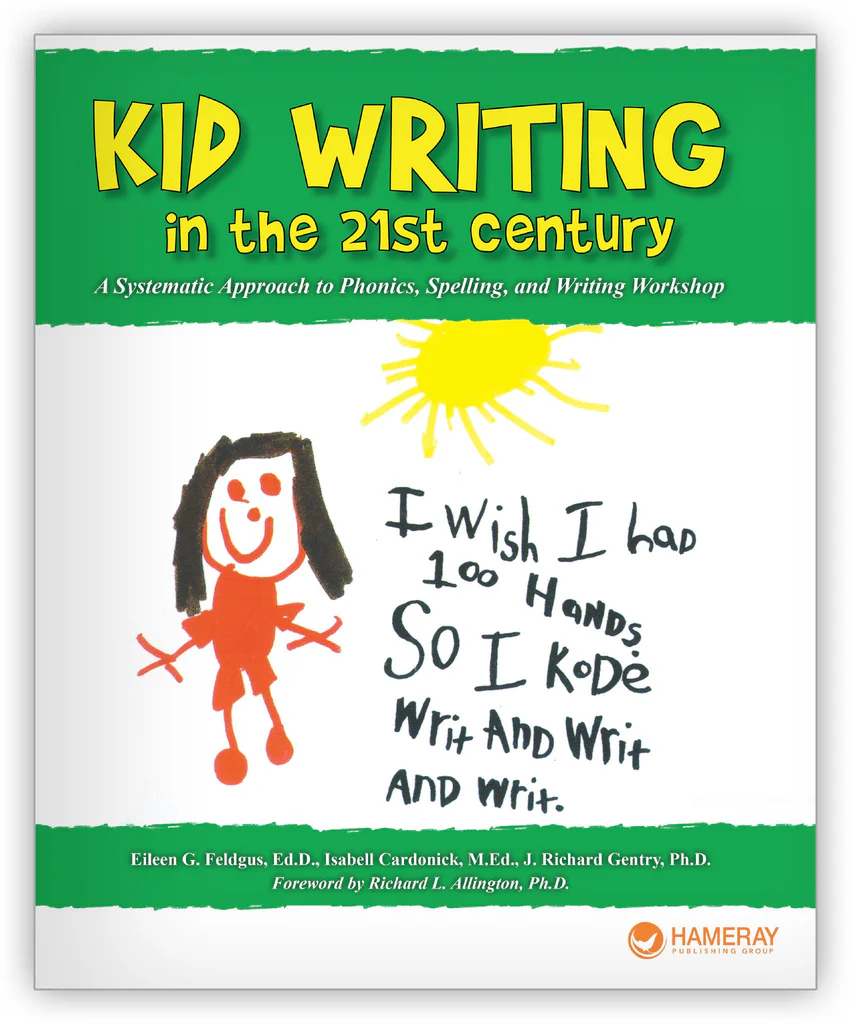
  1. Regular modelling of encoding strategies by teachers during writing lessons. See our publication: Getting Children Up & Running As Writers [LINK] as well as Kid Writing: A Systematic Approach to Phonics, Journals, and Writing Workshop by Eileen Feldgus & Isabell Cardonick for more details.
  1. Use structured routines. Consistent writing lessons and unit formats help pupils focus on their writing. Again, see our publications: Getting Children Up & Running As Writers, How To Teach Non-Fiction Writing In The EYFS and How To Teach Narrative Writing In The EYFS for more details [LINK].
  1. Ensure children are given a copious amount of meaningful writing experiences. Pupils need repeated opportunities to encode the words they want to write most to solidify their learning.
  1. Model segmenting words into phonemes. Teachers should avoid adding extra vowel sounds, such as pronouncing ‘p’ as puh instead of a crisp p.
  1. Maintain consistent terminology. Terminology used in writing lessons should align with your school’s phonics programme.
  1. Adapt to pupils’ accents. Encoding instruction should account for phonetic variations in pronunciation.
  1. Use responsive teaching. Assess pupils’ progress regularly and provide additional modelling during writing time for those who need additional support.

For school leaders, additional considerations include:

  • Providing training for all staff involved in teaching children how to encode.
  • Engaging parents in understanding how emergent writing transitions into informed spelling by way of encoding. Give parents advice on how they can support their children’s writing at home (see this link for a parent handout).
  • Organising interventions for pupils needing extra support (see our publication Supporting Children With SEND To Be Great Writers for more information LINK).

Should morphology be embedded into encoding instruction? 

Yes. When modelling their own encoding strategies, teachers should point out common spelling patterns related to morphemes, such as pluralisation (e.g. adding s) and common affixes (e.g., un- and -ing). This helps pupils understand spelling within the broader framework of English word structure.

Should children only ever write words they can fully encode?

There is no research which suggests that such an approach is desirable or necessary. Instead, children can be taught what to do when they can’t encode part of a word. For example, by drawing a line (Feldgus & Cardonick 2017). 

Here we can see the child using lines when they are unable to encode certain words they want to write. We can then see the teacher’s responsive feedback through their underwriting.

Teachers can provide responsive feedback through underwriting. Underwriting involves transcribing a child’s writing using conventional spelling. This can be done either directly under or above the child’s writing, or sometimes at the bottom of the page. When done right, it can be a simple yet powerful tool to support young writers on their journey towards becoming a successful writer.

When underwriting, teachers may write:

  • The whole sentence, phrase or choose a specific word.
  • Words that are very close to the conventional ‘adult spelling’, giving you an opportunity to celebrate how closely the child approximated the word.
  • High-frequency words that the child is likely or expected to know.
  • Words that are so far away from the conventional spelling that they are difficult to interpret.

Underwriting should always be about emphasising and celebrating what the child did know about adult writing. When done correctly, underwriting offers numerous benefits:

  • Providing a conventional model: Gives children who like it a reference for the conventional spelling which they may refer to later.
  • Responding to a specific request: Supporting children who specifically ask for help in understanding and remembering what their writing says.
  • Verbal feedback: It offers opportunities for individualised responsive instruction during verbal feedback.
  • Celebrating growth: It celebrates children’s approximations, what they did know about the ‘adult spelling’ of the word and therefore gives children confidence and a sense of achievement.

Does underwriting make children scared to write and reduce ownership? A justified concern with underwriting is that, when it is done badly, it makes children scared to write for themselves. It can also be seen as an act of graffiti on a child’s writing – a daily reminder that they can’t actually write and that someone has to come and do it for them. It’s no fun giving something like writing a try if you are only ever going to be criticised for your efforts. However, when done thoughtfully, underwriting is a teaching tool, not a correction mechanism. Best practice for underwriting includes:

  • Having the child’s consent and with them present.
  • Celebrating and building on what the child did know about the ‘adult spelling’.
  • The teacher using a pencil and small writing, usually at the bottom of the page.
  • Never underwriting before the child has made their own attempts at the word, phrase or sentence first.
  • Not doing it with every child, all the time, and on every piece of writing they produce.

Underwriting is a tool for progress and celebration. Some children enjoy seeing how their writing compares to ‘adult writing’. However, others can get really upset and feel undermined. For some, it can be the equivalent of making a lovely drawing for their teacher – only for them to get a red marker pen out and draw all over it to ‘make it correct’. If this happens day after day, some children can soon lose their motivation and confidence to write independently. With that said, if the purpose of underwriting is clearly explained, children often appreciate the thoughtful and interesting feedback it provides.

Concluding thoughts

Alongside explicit teaching, children should regularly engage in meaningful writing experiences. In the EYFS-KS1, this is best achieved through book-making (see our EYFS publications here for more details) Children should feel free to write any words they want to use in the books they are making, even if their spellings are informed but not yet conventional. Children should be supported with sound mats, word banks, high-frequency word displays, guided practice and proof-reading sessions. Over time, as pupils develop confidence and proficiency, they should be encouraged to take greater risks in spelling unfamiliar words by writing ‘temporary spellings’.

A temporary spelling is a child’s best approximation. They then put a circle around that word – knowing that they will be given proof-reading time later in the writing unit to correct it.. During proof-reading sessions, children look up the conventional spelling, cross out the temporary spelling and write the correct spelling above it. For more on delivering these kinds of proof-reading sessions, see our publication: No More: ‘My Class Can’t Edit!’ [LINK].

By the end of their second year of formal writing instruction (Year 1 in English schools), most pupils should be able to apply their phonological and morphological knowledge independently to produce informed spellings and spell many ‘phonetically predictable’ words correctly. However, encoding instruction should continue throughout primary school to support children’s ongoing spelling development and mastery of the complexities of English orthography. 

You can check your school’s spelling provision by using our provision checklist. You can download this checklist for free here.

To find out more about teaching spelling beyond Year 1, we can highly recommend the following publications:

  • Adoniou, M., (2022) Spelling it out: How words work and how to teach them Cambridge: Cambridge University Press
  • Bear, D. R., Invernizzi, M., Johnston, F., & Templeton, S. (2020) Words their way: Word study for phonics, vocabulary, and spelling USA: Pearson
  • Gentry, J. R., & Ouellette, G. (2019) Brain words: How the science of reading informs teaching USA: Stenhouse Publishers
  • Stone, L. (2021) Spelling for Life: Uncovering the simplicity and science of spelling London: Routledge
  • Westwood, P. (2014) Teaching spelling: Exploring commonsense strategies and best practices London: Routledge

References:

  • Byington, T. A., & Kim, Y. (2017). Promoting preschoolers’ emergent writing. YC Young Children, 72(5), 74-82
  • Cabell, S. Q., Neuman, S. B., & Terry, N. P. (2023). Handbook on the science of early literacy USA: Guilford Press
  • Feldgus, E. G., & Cardonick, I. (2017) Kid writing: A systematic approach to phonics, journals, and writing workshop. Wight Group/McGraw Hill 
  • Young, R., Ferguson (2019) Supporting children’s writing at home Brighton: The Writing For Pleasure Centre [LINK]
  • Young, R., Ferguson (2023a) Getting children up & running as writers Brighton: The Writing For Pleasure Centre [LINK]
  • Young, R., Ferguson (2023b) No more: ‘My class can’t edit’: A whole-school approach to developing proof-readers Brighton: The Writing For Pleasure Centre [LINK]
  • Young, R., Ferguson (2024a) How to teach non-fiction writing in the EYFS Brighton: The Writing For Pleasure Centre [LINK]
  • Young, R., Ferguson (2024b) How to teach narrative writing in the EYFS Brighton: The Writing For Pleasure Centre [LINK]

Celebrating aspects of the DfE’s Writing Framework: Championing personal writing projects

On the 8th of July 2025, the Department for Education published its non-statutory guidance document: The Writing Framework

The mission of The Writing For Pleasure Centre is to help all young people become passionate and successful writers. As a think tank dedicated to exploring what world-class writing is — and what it could be — a crucial part of our work involves influencing government policy. We were therefore delighted to be invited to contribute to this framework, and we believe there is much to celebrate.

***

The power of choice: Personal writing projects deserve a place in the classroom

In classrooms that hum with the sound of writing, something extraordinary happens when pupils are given space to work on their own passion projects. Not to tick off an objective. Not to follow a success criterion. But to say something they want to say – because they’ve chosen the topic, the form, and the audience (Young & Ferguson 2022).

Personal writing projects are not a luxury. They’re not just a ‘nice extra’ for an idle Friday afternoon. According to the DfE’s Writing Framework, they’re essential. When pupils write for enjoyment, they develop autonomy. They build fluency. They get better.

Writing for its own sake

For too long, writing in schools has been tightly prescribed. Units are planned with precision. We scaffold. We model. We assess. All of this has value – but if we’re not careful, it can send an unspoken message to pupils: writing only counts when it’s teacher-directed.

The DfE’s Writing Framework challenges this view. “It is also important,” it says, “that [pupils] are not discouraged from pursuing their own personal writing.” This means schools carving out space for writing that is self-chosen, self-driven, and self-owned.

The DfE explains how this might take the form of timetabled sessions devoted to personal writing projects. It might look like a lunchtime writing club. It is about a culture that celebrates the information texts, stories, comics, poems, and fan fiction children are creating at home and bringing into school to share with everyone.

Autonomy breeds fluency

We know that motivation matters (Young 2024). Children are more likely to practise and persist with skills they find meaningful. When pupils choose their own writing projects, they’re more invested. They return to their manuscripts willingly. They revise because they want to improve their composition. They think and live as writers.

As the Writing Framework puts it: 

“choosing to read and write for enjoyment develops autonomy and fluency, and provides further opportunities for practice.”

Valuing the writer, not just the writing

A classroom that makes space for personal writing sends a powerful message: we don’t just value the writing you produce for assessment – we value you as a writer. Your voice, your ideas, your perspective (Young 2025a).

This means honouring writing that happens beyond the lesson. When a pupil brings in a short story they wrote over the weekend, we read it. When a child shares the lyrics to a song they’ve composed, we listen. When they fill their own notebooks with serialised fiction or jokes or recipes or memories — we celebrate that.

The Writing Framework is clear: schools should “celebrate the compositions pupils produce of their own accord.” This recognition builds confidence. It shows pupils that writing isn’t just something they do – it’s something they are (Young et al. 2021).

The writing curriculum we want

Some might worry that making time for personal writing projects is a distraction from curriculum goals. But the truth is, it supports them. Pupils need structured, high-quality teaching of writing skills – but they also need opportunities to apply those skills more freely and independently. To take risks. To experiment. To play (Young & Ferguson 2022).

In fact, some of the best writing outcomes come from this blend: explicit instruction paired with space for independence. Mentor texts and modelled writing alongside moments for pupil-led creativity (Young 2025b). Purposeful practice coupled with joyful exploration.

This is the writing curriculum we want: not compliant writers, but confident writers. Not just proficient writers, but passionate ones too (Bonafede et al. 2025).

Let them write

Let’s timetable personal writing project sessions and start with a simple question: What do you want to write? And let’s celebrate the writers our pupils are becoming, not just the writing they produce on demand.

Because when we give children the choice to write for themselves, we give them the chance to fall in love with writing — not just as a school subject, but as something they can carry with them for life.

References

  • Bonafede, F., Clark, C., Picton, I., Cole, A., Young, R. (2025) Children and young people’s writing in 2025 London: National Literacy Trust
  • Young, R., (2024) Motivating writing teaching Brighton: The Writing For Pleasure Centre
  • Young, R. (2025a) Children’s perspectives on writing competency: Academic, personal and social influences UKLA International Conference – Liverpool – 2025
  • Young, R. (2025b) “It’s healthy. It’s good for you”: Children’s perspectives on utilising their autonomy in the writing classroom UKLA International Conference – Liverpool – 2025
  • Young, R., Ferguson, F. (2023) Personal writing projects Brighton: The Writing For Pleasure Centre
  • Young, R., Ferguson, F., Kaufman, D., Govender, N. (2021) Writing realities Brighton: The Writing For Pleasure Centre

Debunking edu-myths: ‘Emergent writing’ isn’t necessary before teaching children to write

“Emergent writing is not a necessary stage that children have to go through before they can be taught to write letters and words.”

This statement is often presented as a bold truth – one that encourages skipping straight to explicit instruction in letter formation and word writing. But is it actually supported by research? Or is it another edu-myth dressed up as evidence-based practice?

Let’s investigate.

❌ The myth

This claim implies that young children can – and perhaps should – bypass the early scribbles, letter-like shapes and ‘informed spellings’ commonly seen in Nursery and Reception settings. It suggests these behaviours are dispensable, even unnecessary, on the path towards early writing competence.

But this reflects a fundamental misunderstanding of how writing develops in early childhood.

✅ What the research actually says

The truth is, emergent writing is not just a ‘stage’ – it’s a critical foundation that all children (across cultures) go through towards conventional writing (Byington & Kim 2017; Ishimoto 2022). A wealth of research from developmental psychology, early childhood education, and literacy studies demonstrates that these early marks are predictive of later success in writing and reading.

📚 Key findings:

Far from being dispensable, emergent writing has been shown in a wide body of research to be foundational for later literacy success. Here’s what the evidence reveals:

🧠 1. Cognitive and linguistic foundations are built through emergent writing

  • Puranik & Lonigan (2011, 2014) show that emergent writing – like informed spelling – is a unique predictor of later writing, reading, and spelling success.
  • Hand et al. (2024) found that preschool writing predicted kindergarten and first-grade reading skills above and beyond other early literacy measures.
  • Rowe et al. (2024) demonstrate that preschoolers learn the alphabetic principle through the act of writing itself – realising that writing can represent spoken language.
  • Ouellette & Sénéchal (2017) found that informed spelling in kindergarten was a strong predictor of both reading and spelling in Grade 1.

✍️ 2. Emergent writing is not random – it’s a meaning-making tool

  • Ishimoto (2022) showed that Japanese children’s emergent writing was crucial for inscription-mediated memory, helping them internalise and revisit experiences – as well as laying groundwork for conventional writing.
  • Pinto & Incognito (2022) found that emergent writing is closely linked to visual-motor integration, a key skill for later handwriting fluency.

💬 3. Writing emerges through motivation

  • Barratt-Pugh et al. (2021) found that young children’s motivation to write is deeply tied to opportunities to use emergent writing, not drills.
  • Rowe & Neitzel (2010) demonstrated that even 2- and 3-year-olds engage in writing with intentionality, challenging the idea that they must be explicitly taught conventional adult writing from the start.
  • Rowe (2018) argues that early writing instruction too often ignores the benefits of emergent writing.

✍️ 4. Instruction that builds on emergent writing supports all learners

  • Hall et al. (2015), in a systematic review, confirmed that preschool writing instruction is most effective when it builds on children’s existing emergent writing skills.
  • Gerde et al. (2012) recommend practices that utilise children’s existing emergent writing skills to help them on the road towards producing conventional print.
  • Bingham et al. (2017) found that the best performing writing teachers support emergent writing. This support directly predicts gains in children’s future writing development.
  • Dennis & Votteler (2012) emphasises that recognising and building on emergent writing is essential for supporting diverse learners, emerging multilingual writers.

🧰 5. Effective instruction utilises, rather than skips, emergent writing

  • Rowe et al. (2022) & Quinn et al. (2016) stress the importance of responsive, scaffolded instruction – teaching that adapts to where each child is in their emergent writing journey.
  • Daffern (2024) and Critten et al. (2021) show that skills such as spelling and phonemic awareness are best developed in tandem with children’s emergent writing practices.

Together, this body of research provides compelling evidence that emergent writing is not a frivolous or optional stage – it’s a developmentally appropriate, evidence-informed foundation for lifelong writing and reading success.

🧠 Developmentally appropriate writing

It’s important to remember that children aren’t miniature adults. Before they learn to form letters accurately and spell words conventionally, they are already developing:

  • Fine motor control
  • Visual-motor integration
  • Phonological awareness
  • Concepts of print

Emergent writing helps children develop all of these. As the DfE’s Writing Framework notes:

Some children will experiment with what has been called ‘emergent writing’. They will draw and make marks, perhaps beginning to write single letters, their name or whole words as they notice print in books and the wider world. They may start to think of themselves as ‘writers’ and enjoy the feeling of conveying their ideas on paper.

Emergent writing is an important and temporary scaffold that children use while they are learning to form letters and encode the words they want to write.

⚠️ Where this myth comes from

This myth is often rooted in the misapplication of direct instruction or synthetic phonics principles. Explicit teaching of letter formation and encoding is crucial but children still need to be able to use their emergent writing while their transcriptional skills develop (see Young & Ferguson 2022). Children aren’t going to be able to write formally, like an adult, from the outset. Fortunately, even the most structured approaches to early reading and writing typically acknowledge the value of emergent writing.

🧾 Final word

To say that emergent writing isn’t necessary is to ignore what’s been observed empirically for decades. It does not reflect what the research says about the benefits of emergent writing as a temporary scaffold when working with the youngest writers, or its links to children’s ability to encode once phonics instruction begins (in earnest!).

Children’s emergent writing should be valued as a temporary scaffold as it demonstrates children’s developing understanding of conventional transcription. However, while emergent writing supports children at the earliest stages of learning to write, it is most effective when combined with explicit instruction in handwriting and encoding. Once phonics instruction is introduced, children should be weaned off their emergent writing practices as soon as possible

Let’s not throw away rich foundational gains. Children deserve the opportunity to use their emergent writing while their understanding of conventional transcription develops.

Glossary

  • Emergent writing: A temporary scaffold used by children in the earliest stages of writing development, where they create scribbles, marks, and letter-like shapes that lay the foundation for conventional writing skills. As phonics instruction begins, children are weaned off this scaffold and transition towards encoding and writing ‘informed spellings’.
  • Encoding: In early writing development, encoding refers to the process by which children use their phonics knowledge to translate spoken language into written form. This involves converting the sounds (phonemes) of speech into corresponding letters or letter patterns (graphemes).
  • Informed spellings: Sometimes mistakenly called ‘invented spellings’, are words that are often spelled as they sound, influenced by a child’s growing phonological and morphological awareness. This approach encourages children to use their developing understanding of letter-sound relationships to make informed spelling attempts, serving as a scaffold in their journey toward conventional spelling proficiency.

Recommended literature

  • Getting Children Up & Running As Writers by Ross Young & Felicity Ferguson [LINK]
  • Kid Writing: A Systematic Approach to Phonics, Journals, and Writing Workshop by Eileen Feldgus & Isabell Cardonick [LINK]
  • Already Ready: Nurturing Writers in Preschool and Kindergarten by Katie Wood Ray & Matt Glover [LINK]
  • Handbook On The Science of Early Literacy by Sonia Cabell, Susan Neuman, and Nicole Patton Terry [LINK]
  • Literacy Learning For Infants, Toddlers, & Preschoolers by Tanya Wright, Sonia Cabell, Nell Duke & Mariana Souto-Manning [LINK]
  • Understanding and Supporting Young Writers from Birth to 8 by Noella Mackenzie & Janet Scull [LINK]
  • Gnys At Wrk: A Child Learns to Write and Read by Glenda Bissex [LINK]
  • Adam’s Righting Revolutions: One Child’s Literacy Development From Infancy Through Grade One by Judith Schickedanz [LINK]
  • Before Writing by Gunther Kress [LINK]
  • Writing Begins At Home: Preparing Children For Writing Before They Go To School by Marie Clay [LINK]
  • What Changes In Writing Can I See? by Marie Clay [LINK]
  • How Very Young Children Explore Writing by Marie Clay [LINK]
  • What Did I Write? Beginning Writing Behaviour by Marie Clay [LINK]

References

  • Barratt-Pugh, C., Ruscoe, A., & Fellowes, J. (2021). Motivation to Write: Conversations with Emergent Writers. Early Childhood Education, 49, 223–234.
  • Bingham, G. E., Quinn, M. F., & Gerde, H. K. (2017). Examining early childhood teachers’ writing practices: Associations between pedagogical supports and children’s writing skills. Early Childhood Research Quarterly, 39, 35–46.
  • Byington, T. A., & Kim, Y. (2017). Promoting preschoolers’ emergent writing. YC Young Children, 72(5).
  • Critten, S., Holliman, A. J., Hughes, D. J., Wood, C., Cunnane, H., Pillinger, C., & Hilton, S. H. (2021). A longitudinal investigation of prosodic sensitivity and emergent literacy. Reading and Writing, 34(2), 371–389. [https://doi.org/10.1007/s11145-020-10077-7](https://doi.org/10.1007/s11145-020-10077-7)
  • Daffern, T. (2024). Developing spelling skills. In Understanding and Supporting Young Writers from Birth to 8 (pp. 97–123). Routledge.
  • Dennis, L., & Votteler, N. (2012). Preschool Teachers and Children’s Emergent Writing: Supporting Diverse Learners. Early Childhood Education, 41, 439–446.
  • Gerde, H. K., Bingham, G. E., & Wasik, B. A. (2012). Writing in early childhood classrooms: Guidance for best practices. Early Childhood Education Journal, 40, 351–359.
  • Hall, A. H., Simpson, A., Guo, Y., & Wang, S. (2015). Examining the effects of preschool writing instruction on emergent literacy skills: A systematic review of the literature. Literacy Research and Instruction, 54(2), 115–134.
  • Hand, E. D., Lonigan, C. J., & Puranik, C. S. (2024). Prediction of kindergarten and first-grade reading skills: Unique contributions of preschool writing and early-literacy skills. Reading and Writing, 37(1), 25–48.
  • Ishimoto, K. (2022). What are conditions for inscription-mediated memory in early childhood? Scribbling and drawing before writing. The Japanese Journal of Educational Psychology, 70(3), 276–289.
  • Ouellette, G., & Sénéchal, M. (2017). Invented Spelling in Kindergarten as a Predictor of Reading and Spelling in Grade 1: A New Pathway to Literacy, or Just the Same Road, Less Known? Developmental Psychology, 53(1), 77–88.
  • Pinto, G., & Incognito, O. (2022). The relationship between emergent drawing, emergent writing, and visual-motor integration in preschool children. Infant and Child Development, 31(2). [https://doi.org/10.1002/icd.2284](https://doi.org/10.1002/icd.2284)
  • Puranik, C. S., & Lonigan, C. J. (2011). From scribbles to scrabble: Preschool children’s developing knowledge of written language. Reading and Writing: An Interdisciplinary Journal, 24(5), 567–589.
  • Puranik, C. S., & Lonigan, C. J. (2014). Emergent writing in preschoolers: Preliminary evidence for a theoretical framework. Reading Research Quarterly, 49(4), 453–467.
  • Quinn, M. F., & Bingham, G. E. (2018). The Nature and Measurement of Children’s Early Composing. Reading Research Quarterly, 54(2), 213–235.
  • Quinn, M. F., Gerde, H. K., & Bingham, G. E. (2016). Help me where I am: Scaffolding writing in preschool classrooms. The Reading Teacher, 70, 353–357.
  • Rowe, D. W. (2018). Research & policy: The unrealized promise of emergent writing: Reimagining the way forward for early writing instruction. Language Arts, 95(4), 229–241.
  • Rowe, D. W., & Neitzel, C. (2010). Interest and agency in 2‐and 3‐year‐olds’ participation in emergent writing. Reading Research Quarterly, 45(2), 169–195.
  • Rowe, D. W., Piestrzynski, L., Hadd, A. R., & Reiter, J. W. (2024). Writing as a path to the alphabetic principle: How preschoolers learn that their own writing represents speech. Reading Research Quarterly, 59(1), 32–56.
  • Rowe, D. W., Shimizu, A. Y., & Davis, Z. G. (2022). Essential practices for engaging young children as writers: Lessons from expert early writing teachers. The Reading Teacher, 75(4), 485–494.
  • Teale, W. H., & Sulzby, E. (1986). Emergent literacy: Writing and reading. In Writing Research: Multidisciplinary Inquiries into the Nature of Writing Series. Norwood, NJ: Ablex Publishing Corporation.

Celebrating aspects of the DfE’s Writing Framework: We can finally move on from the book-based approach to writing

On the 8th of July 2025, the Department for Education published its non-statutory guidance document: The Writing Framework

The mission of The Writing For Pleasure Centre is to help all young people become passionate and successful writers. As a think tank dedicated to exploring what world-class writing is — and what it could be — a crucial part of our work involves influencing government policy. We were therefore delighted to be invited to contribute to this framework, and we believe there is much to celebrate.

***

For years, writing lessons in many classrooms have revolved around the kinds of books loved by scheme developers. Selected novels are read aloud, dissected to death, and discussed ad nauseam — and from these, children are expected to respond in ways the scheme prescribes. The problem? These responses were often far removed from the kinds of writing children were actually expected to produce for themselves. Too often they had to write for ‘pseudo-authentic’ purposes and to ‘fake’ audiences.

The DfE’s Writing Framework now wants schools to pivot away from the book-planning approach and embrace something more effective, more meaningful – and more enjoyable. Writing is no longer to be seen as a byproduct of reading, but as a discipline in its own right. It is to be taught directly, explicitly, and with purpose. And at the heart of this shift lies the concept of mentor texts (see Young & Ferguson 2023 for more details).

Writing is no longer in reading’s shadow

Schools’ writing curriculums and commercial schemes have long blurred the lines between reading and writing. But as the the framework makes clear:

Writing must be taught separately from reading. The Writing Framework

In practical terms, this means recognising that writing is a craft with its own set of skills. It needs time. It needs practice. And above all, it needs focused, expert teaching. The DfE wants pupils to ‘write every day’.

The problem with the book-based approach

Under the old model, pupils were often asked to write pieces ‘inspired by’ a single class novel — for example, a historical diary entry based on Goodnight Mister Tom, or a letter from Harry Potter to Dumbledore. However, the texts being studied didn’t actually match the type of writing children were being asked to produce. The framework highlights a simple truth: if we want children to write great short stories, we need to show them plenty of great short stories. If we want them to write newspaper articles, they need to read and explore real newspaper articles. Want them to write poems? Then immerse them in loads of wonderful poems (see Smith 1983 for more on this). The framework is finally calling for children to be exposed to MORE high-quality texts — instead of a single one.

The book-planning approach often caused teachers and children confusion too: the book didn’t reflect the structure, purpose, or style of the writing task, leaving pupils utterly unclear about what good writing looked like.

Thankfully, The framework now warns:

‘pupils are too often asked to analyse a story and then respond with their own, which pollutes the reading experience by bringing something transactional into play.’ 

What used to begin as a beautiful and authentic reading experience was quickly hijacked for arbitrary writing outcomes. It was a lose-lose situation.

Enter: Mentor texts

Instead, the framework now wants teachers to turn to mentor texts – real high-quality pieces of writing that realistically match the kind of compositions pupils are being asked to produce for themselves (see Young & Ferguson 2023 for more details).

Mentor texts, in the words of the framework, allow pupils to: ‘sit beside the author and study how the text is constructed and how it communicates.’ These texts can be written by recognised authors and writer-teachers, and they do more than simply model good writing. They help children see why writers make the choices they do. They encourage pupils to explore the effect of language. They give context – where is this text published? Who is it for? Why was it written? How can we write something like this too?

This is writing as craft, not task.

Here’s a free list of some of our favourite high-quality books that make excellent mentor texts:

  • A list of great texts which teach great writing: Mentor texts for 3-103 year olds [LINK]

High challenge, high support

The best mentor texts are aspirational. As the framework notes, they should be: ‘written above the pupils’ instructional level’ – challenging enough to stretch them, but realistic enough for the children to see what’s probable and possible. Sometimes these texts are written by teachers. Other times, they’re selected from a bank of high-quality exemplars. Either way, they give children a clear, concrete goal to aim for.

Over time, pupils learn to deconstruct these texts, notice patterns, mimic the techniques, and ultimately develop their own writing style (see Young & Ferguson 2023 for more details).

Reading and writing for enjoyment

Crucially, the framework also honours pupil autonomy: ‘writing is better for pupils who… want to write the kinds of texts they enjoy reading.’ Children are more motivated, more fluent, and more confident when writing is connected to their own interests. They may choose to write in the style of a book they’re reading at home. Or they might write a graphic novel, a recipe, a match report – genres that feel meaningful and relevant to them.

This is about more than just output. It’s about identity. By decoupling writing from the rigid novel-study approach, and giving pupils access to a variety of real models, we give them space to explore who they are as writers.

Finally catching up with other nations

The use of mentor texts in the writing classroom is common sense. It shouldn’t be controversial. It certainly isn’t in other anglophone countries like Australia, New Zealand, the USA, or Canada. Here are just a few publications from these nations which talk about the benefits of using mentor texts in the writing classroom:

  • The mentor text: using literature for writing and Knowing how texts work by Marie Quinn & Brett Healey [LINK]
  • Building young writers by Murray Gadd [LINK]
  • Mentor texts by Allison Marchetti & Rebekah O’Dell [LINK]
  • Mentor texts: Teaching writing through children’s literature by Rose Cappelli [LINK]
  • A teacher’s guide to mentor texts by Carl Anderson [LINK]
  • The writing thief: Using mentor texts to teach the craft of writing by Ruth Culham [LINK]
  • Mentor author, mentor texts by Ralph Fletcher [LINK
  • The Two Writing Teachers – [LINK]

However, we have to say that Lasting impressions: Weaving literature into the writing workshop by Shelley Harwayne is one of our all-time favourites. Alternatively, you can buy her newer book: Above and beyond the writing workshop [LINK].

The future of writing

This shift towards mentor texts and purposeful class writing projects represents a real moment of progress (see Young & Ferguson 2023 for more details). It moves us away from tired book-based schemes and transactional writing tasks, and towards a model that takes writing seriously – as an expressive, technical, and joyful process in its own right.

When we teach writing as writing – not as an afterthought to reading – we show children that their words matter. That they can write clearly, persuasively, creatively. That they can do the things writers do too.

So what about writing in reading lessons?

By the way, this doesn’t mean children can’t or shouldn’t be invited to write about their reading in reading lessons! For more on how to do this effectively, see: Literacy For Pleasure: Connect Reading And Writing and Oh, For Literature’s Sake! How To Build Reading–Writing Connections.

Research and further reading on using mentor texts 

  • Ackerman, S. (2016) Becoming Writers in a Readers’ World: Kindergarten Writing Journeys. Language Arts, 93(3), 200–212.
  • Brownell, C. (2018) Creative language play(giarism). Elementary English Language Arts Classroom, 95(4), 218–228.
  • Crawford, P., Sobolak, M., & Foster, A. (2017) Focus on Elementary: Knowing and Growing With Mentor Texts. Childhood Education, 93(1), 82–86.
  • Cremin, T., Hendry, H., Chamberlain, L., & Hulston, S. (2023) Reading and Writing for Pleasure: A Framework for Practice Executive Summary. The Open University: The Mercers’ Company.
  • Cushing, I. (2018) ‘Suddenly, I am part of the poem’: Texts as worlds, reader-response and grammar in teaching poetry. English in Education, 52(1), 7–19.
  • Deane, P., & Traga Philippakos, Z. A. (2024) Writing and Reading Connections: A before, during, and after Experience for Critical Thinkers. The Reading Teacher, 77(5), 770–780.
  • Derewianka, B. (2025) Knowing how texts work. In M. Quinn & B. Healey (Eds.), Teaching writers: From apprentice to expert (pp. 18–35). PETAA.
  • Derewianka, B., & Jones, P. (2023) Teaching language in context. London: Oxford University Press.
  • Dollins, C. A. (2020) A Critical Inquiry Approach to Mentor Texts: Learn It With EASE. The Reading Teacher, 74(2), 191–199.
  • English, R. (2021) Teaching and learning through children’s literature: Teaching through mentor texts. Practical Literacy, 26(1). ALEA.
  • Fitzgerald, J., & Shanahan, T. (2000) Reading and writing relations and their development. Educational Psychologist, 35(1), 39–50.
  • Gallagher, K. (2014) Making the most of mentor texts. Educational Leadership, 71(7), 28–33.
  • Glenn, W. (2007) Real writers as aware readers: Writing creatively as a means to develop reading skills. Journal of Adolescent & Adult Literacy, 51(1), 10–20.
  • Griffith, R. R. (2010) Students Learn to Read Like Writers: A Framework for Teachers of Writing. Reading Horizons: A Journal of Literacy and Language Arts, 50(1).
  • Hansen, J. (1987) When Writers Read. Portsmouth, NH: Heinemann.
  • Harman, R. (2013) Literary intertextuality in genre-based pedagogies: Building lexical cohesion in fifth-grade L2 writing. Journal of Second Language Writing, 22(2), 125–140.
  • Harwayne, S. (1992) Lasting Impressions: Weaving Literature into the Writing Workshop. Portsmouth, NH: Heinemann.
  • Heller, M. (1999) Reading-Writing Connections: From Theory to Practice. Mahwah, NJ: Lawrence Erlbaum Associates.
  • Hoewisch, A. (2001) “Do I have to have a princess in my story?”: Supporting children’s writing of fairytales. Reading and Writing Quarterly, 17, 249–277.
  • Kim, Y. S. G., & Zagata, E. (2024) Enhancing Reading and Writing Skills through Systematically Integrated Instruction. The Reading Teacher, 77(6), 787–799.
  • Kim, Y. S. G., Harris, K. R., Goldstone, R., Camping, A., & Graham, S. (2024) The science of teaching reading is incomplete without the science of writing: A randomized control trial of integrated teaching of reading and writing. Scientific Studies of Reading, 1–23.
  • Kim, Y.-S. G., Wolters, A., & Lee, J. won. (2023) Reading and Writing Relations Are Not Uniform: They Differ by the Linguistic Grain Size, Developmental Phase, and Measurement. Review of Educational Research, 0(0). [https://doi.org/10.3102/00346543231178830](https://doi.org/10.3102/00346543231178830)
  • Lancia, P. (1997) Literary borrowing: The effects of literature on children’s writing. The Reading Teacher, 50(6), 470–475.
  • Lewison, M., & Heffernan, L. (2008) Rewriting Writers Workshop: Creating Safe Spaces for Disruptive Stories. Research in the Teaching of English, 42(4), 435–465.
  • Lewis, C. (2000) Critical issues: Limits of identification: The personal, pleasurable, and critical in reader response. Journal of Literacy Research, 32(2), 253–266.
  • Manak, J. (2011) The social construction of intertextuality and literary understanding: The impact of interactive read-alouds on the writing of third graders during writing workshop. Reading Research Quarterly, 46(4), 309–311.
  • Martin, J. R. (2009) Genre and language learning: A social semiotic perspective. Linguistics and Education, 20(1), 10–21.
  • Martin, J. R., & Rose, D. (2007) Interacting with text: The role of dialogue in learning to read and write. Foreign Languages in China, 4(5), 66–80.
  • Martin, J. R., & Rose, D. (2009) Genre Relations: Mapping Culture. Equinox Publishing.
  • Myhill, D. A., Lines, H., & Jones, S. M. (2018) Texts that teach: Examining the efficacy of using texts as models. L1-Educational Studies in Language and Literature, 18, 1–24.
  • Nystrand, M. (1986) The structure of written communication: Studies in reciprocity between writers and readers. USA: Academic Press.
  • Opatz, M. O., & Nelson, E. T. (2022) The Evolution from Mentor Texts to Critical Mentor Text Sets. Teaching/Writing: The Journal of Writing Teacher Education, 11(2), 12.
  • Pantaleo, S. (2006) Readers and writers as intertexts: Exploring the intertextualities in student writing. Australian Journal of Language and Literacy, 29(2), 163–181.
  • Parry, B., & Taylor, L. (2018) Readers in the round: Children’s holistic engagements with texts. Literacy, 52(2), 103–110.
  • Premont, D., Young, T., Wilcox, B., Dean, D., & Morrison, T. (2017) Picture Books as Mentor Texts for 10th Grade Struggling Writers. Literacy Research and Instruction, 56(4), 290–310.
  • Purcell-Gates, V., Duke, N., & Martineau, J. (2007) Learning to read and write genre-specific text: Roles of authentic experience and explicit teaching. Reading Research Quarterly, 42(1), 8–45.
  • Quinn, M. F., & Traga Philippakos, Z. A. (2023) Building a Bridge: Writing and Reading Connections in Early Childhood. The Reading Teacher, 77(2), 260–267.
  • Rossbridge, J. (2025) The mentor text: Using literature for writing. In M. Quinn & B. Healey (Eds.), Teaching writers: From apprentice to expert (pp. 36–51). PETAA.
  • Smith, F. (1983) Reading like a writer. Language Arts, 60(5), 558–567.
  • Solsken, J., Willett, J., & Wilson-Keenan, J. (2000) Cultivating Hybrid Texts in Multicultural Classrooms: “Promise and Challenge”. National Council of Teachers of English, 179–212.
  • Ward, B., Collet, V., & Eilers, L. (2021) Using published authors as mentors to teach grammatical conventions. Research Papers in Education. [https://doi.org/10.1080/02671522.2020.1864764](https://doi.org/10.1080/02671522.2020.1864764)