Having read Christopher Such’s book Primary Reading Simplified, and specifically his chapter on conceptualising reading comprehension, we were moved to write an article about how written composition could be conceptualised too.
As teachers, our understanding of composition profoundly shapes our instructional approaches [LINK and LINK for more on this]. Misconceptions about how writing develops can lead to using unproductive and frustrating teaching methods that fail to equip pupils with the necessary skills to write effectively. In many schools, a significant portion of writing time is devoted to assigning writing rather than explicitly teaching it. At the other extreme, it’s about teaching isolated skills – such as how to answer a whole host of test-like questions about fronted adverbials or crowbarring ‘ambitious vocabulary’ into an arbitrary piece of writing. Writing may also be mainly used to check children’s understanding of their learning in the wider curriculum subjects, or of their comprehension of the text they are studying in their reading lessons.
These practices demonstrate a misconception about writing competency; they stem from the belief that strong writers are those who can employ a fixed set of technical features that can be easily identified and ticked off. However, writing is not simply the sum of its mechanical parts; rather, it is an orchestrated process that involves translating thoughts and feelings into language, structuring ideas coherently, and giving your audience what they need (see our Writing Map for more details).
Due to the nature of writing assessment in England, too many teachers, instead of using their valuable lesson time to develop pupils’ understanding of how written language works, are asking their pupils to regurgitate surface-level writing features that the STA considers to be ‘good writing’. This takes little account of teaching children how ideas can be shaped into meaningful and successful writing. The result is that pupils develop a superficial competency, without ever developing the genuine skills necessary to take a germ of an idea and see it through to successful and meaningful publication or performance.
These practices are the result of a lack of understanding of the nature of written composition.
Why are misconceptions about written composition so common?
Misconceptions about composition arise for several reasons. First, teachers and school leaders often have little time to engage in deep reflection on the nature of writing itself. Faced with the demands of external assessments, they may assume that aligning writing instruction with answering grammar test-like questions is the most logical approach. It’s jaw dropping to think that a child can answer a question about the subjunctive, passive voice or parenthesis without hesitation, but ask them what are the reasons that writers write and they will stare blankly back at you, utterly unable to answer. Second, some educational publishers respond by producing prescriptive writing resources and assessment training which reinforces superficial understandings of composition. Third, while some educational bodies have attempted to clarify what effective writing instruction entails, these messages have not always reached policymakers (and shakers) (see our attempts here). Finally, even among experts, there is no single agreed-upon rubric for what makes a particular piece of writing successful. You simply can’t standardise great writing. Writing is inherently idiosyncratic and context-dependent. This means it is notoriously difficult to make it fit into standardised frameworks. As a result, misconceptions persist, leaving teachers with ineffectual and incomplete approaches to writing instruction.
What is a better way to think about written composition?
There are two possible approaches to conceptualising writing instruction: one that prioritises formulaic skill acquisition, offering a highly-structured but ultimately ‘fake’ or superficial level of competency, and another that embraces the complexity of composition, guiding students toward deeper engagement with making and sharing meaning with others. The first approach may offer a semblance of clarity for assessment purposes, but the second leads to richer and more meaningful writing development.
To conceptualise written composition productively, we must move away from the idea that a writer’s proficiency can be reduced to a single piece of writing which ticks a whole list of grammatical features, and instead recognise that composition is a process that depends on multiple interwoven factors and the production of a body of work that is crafted over time. Writing researchers have articulated composition as encompassing a rich range of cognitive and rhetorical processes that resist reduction to a single label. These include:
- The metacognitive monitoring of one’s own composing process.
- The generation and selection of ideas.
- The management of rhetorical goals and audience considerations.
- The organisation and sequencing of content.
- The management of genre conventions.
Quality composition relies on two things:
- Fluent spelling and handwriting. Children’s writing stands or falls on their ability to transcribe their thoughts to paper (or screen) fluently (see this article for more details). If pupils struggle with encoding, spelling, letter formation and handwriting, they cannot give as much of their attention to important aspects of composition.
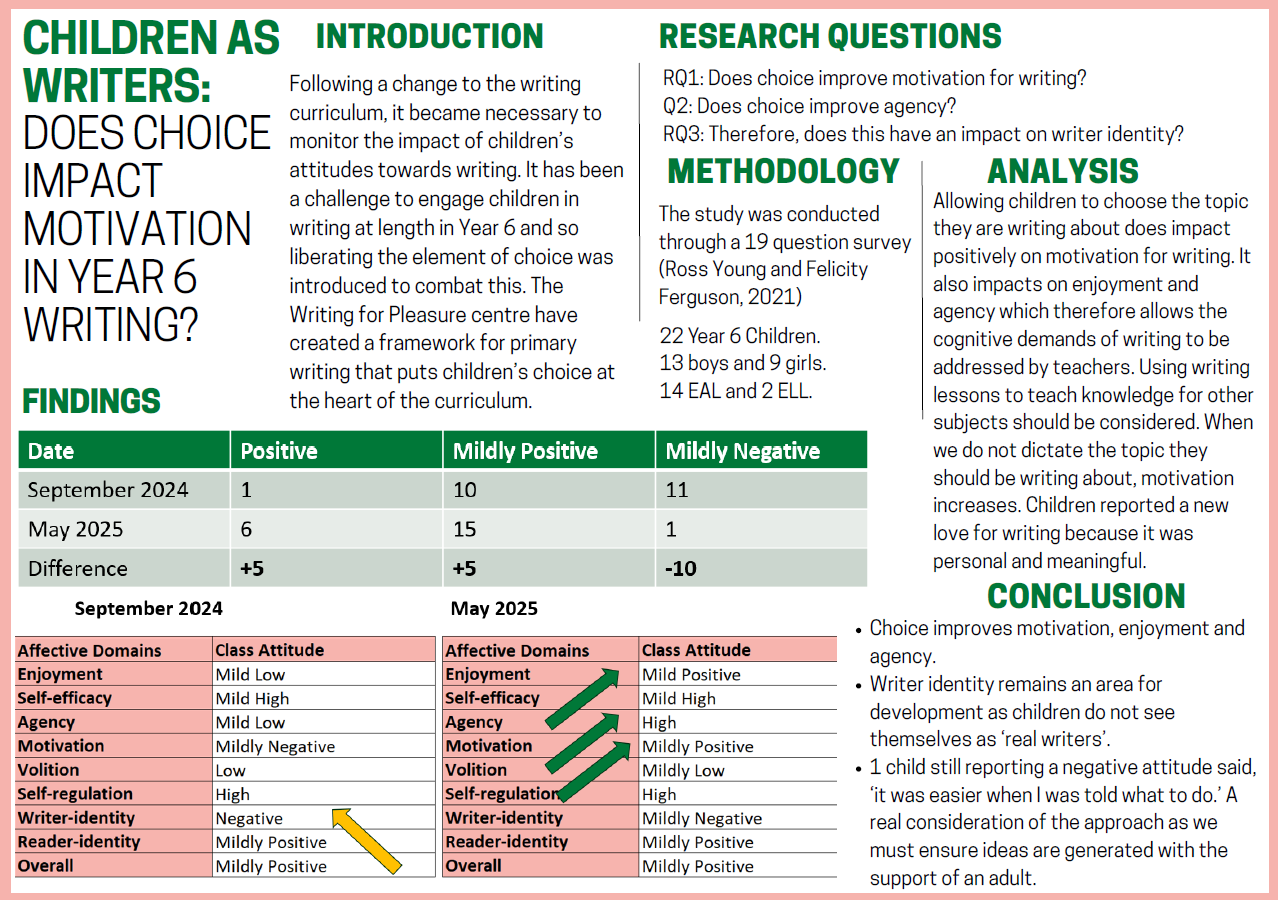
- Our understanding of why writers write. Compositional development is about understanding why writers write before investigating how they do it well. Writers write to share their ideas, what they think, what they know, and what they feel with themselves and others. Students write more effectively when they choose content they are knowledgeable about and are genuinely motivated to share (see our publication Motivating Writing Teaching for more details). They can also effectively compose if they have had regular opportunities to read, discuss and see how other writers have crafted their manuscripts for a similar purpose and audience. They can then use these insights and strategies to inform their own writing (see our publication Reading In The Writing Classroom for more details).
However, there is more to know about composition that can help us, so let’s build on the two points above.
- Composition exists on a continuum of proficiency. Students do not simply succeed or fail at writing. Rather, they progress through various levels of proficiency, continually expanding their ability to express ideas with precision, originality, flair and coherence (again, see our Writing Map).
- Writing is inherently subjective. Every writer brings unique experiences, funds-of-knowledge and stylistic preferences to their manuscripts. While certain conventions and craft moves should be explicitly taught and applied (see our Big Book Of Writing Craft Knowledge for more details), students should still be encouraged to develop their own writing ‘voice’ and use taught craft moves in a way that they believe suits their writing best. After all, a writer’s style is a magical and unique blend of structure, detail, and word choice. It is also an expression of their personal identity.
- Writing requires a lot of conscious effort, which can be supported by employing particular strategies. Skilled young writers have the willingness and the ability to engage and persist with writing and put in a lot of effort. Teachers should support their students by utilising evidence-informed practices. We will talk about this some more now…
What does this all mean for classroom teaching?
These five points have significant implications for how we teach writing in the classroom. Let’s consider what they mean in practice:
- Composition relies on fluent spelling and handwriting. Spelling and handwriting should be taught explicitly and children’s writing fluency should be developed as a matter or priority (see our Transcription Checklist and fluency article for more details). However, this explicit teaching should always be in the service of meaningful writing experiences.
- Composition relies on our understanding of why and how writers write. Writing is fundamentally about sharing your imaginative ideas, thoughts, knowledge, feelings and perspectives with an audience. Pupils write more effectively when they have a sense of purpose and a clear audience in which to share that purpose with. This is why it is crucial to provide them with rich, meaningful writing opportunities that invite them to draw on their own funds-of-knowledge and experiences. At the same time, pupils become better writers when they read and analyse mentor texts. These should be texts which realistically match the type of writing they are about to craft for themselves. Studying the craft moves, strategies and motivations of other writers also helps pupils make deliberate choices in their own writing (see our publication Reading In The Writing Classroom for more details on this).
In addition, we know writers ‘write to learn’. After all, as Joan Didion said: ‘I don’t know what I think until I write it down’. This means children should also be invited to write about their:
- Reading in reading lessons.
- Learning in the wider curriculum.
- Composition exists on a continuum of proficiency. Pupils do not simply succeed or fail at composition. Instead, they progress through different stages of proficiency, each with its own challenges and characteristics. As our Writing Map shows, the youngest of writers often begin with ‘writing-telling’ where they list ideas with little organisation or refinement. As they develop, you will see moments where they are ‘writing-transforming.’ You’ll see evidence of them crafting their writing to improve its clarity and impact. Over time, you’ll see children consciously shaping their manuscripts with their audiences’ needs at the forefront of their mind. Accepting and recognising this continuum allows teachers to identify and celebrate moments of growth while also being clear about how they can move their pupils’ writing development forward.
- Writing is ultimately subjective. While certain aspects of composition such as grammar, punctuation, and text structure should be explicitly taught, writing is also deeply personal. A strong writing curriculum should balance explicit teaching with opportunities for pupils to develop their own writing voice and style. Encouraging students to experiment independently with different writing ideas, genres, structures, and levels of formality can help them build a personal feeling of proficiency while also ensuring they meet academic expectations.
- Writing requires a lot of conscious effort, which can be supported by particular strategies. Even the most skilled writers find writing cognitively demanding. Effective composition involves juggling multiple considerations: cohesion, grammar, vocabulary, and audience engagement. Teaching writing should therefore include explicit modelling of strategies that help pupils manage this complexity. This includes explicitly teaching idea generation and planning strategies, sentence-level craft moves, revision and proof-reading techniques, and the use of literary and rhetorical devices. Providing pupils with structured opportunities to independently practise these techniques through well-planned class writing projects ensures they develop the habits of skilled and autonomous writers.
In essence, composition is developed via:
- Explicit teaching.
- Meaningful writing experiences.
These elements interact with one another. Children apply what they learn through explicit teaching when engaged in meaningful writing experiences. In turn, because they are participating in purposeful writing, they become more receptive to explicit instruction.
| Explicit teaching | Meaningful writing experiences |
| Handwriting and spelling instruction [LINK for more] Self-regulation strategy development instruction Includes: grammar, sentence-level, literary craft moves, rhetorical devices, generating ideas, planning, drafting, revising, proof-reading, publishing [LINK for more] Verbal feedback and pupil-conferencing [LINK for more] Scaffolding – including aids, modelling and guided practice [LINK for more] | Short ‘fluency’ based writing projects [LINK for more details] Reading as writers and studying mentor texts [LINK for more] Whole-class writing projects [LINK for more] Personal writing projects (both school and home) [LINK for more] Class sharing and Author’s Chair [LINK for more] |
For more on this, see our document: The Writing Map & Evidence-Based Writing Teaching [LINK].
By adopting a more nuanced understanding of written composition, teachers can develop richer, more effective writing instruction that supports genuine literacy development. In doing so, they free children from the constraints of producing superficial assessment-driven identical texts and instead cultivate their ability to think, feel, write, and communicate with depth, originality and authenticity.