News

Teaching the writing processes to children

The act of teaching writing to children has undergone significant evolution over the centuries. While writing itself is an ancient skill, explicit instruction in how to write, particularly through the lens of โ€˜the writing processes,โ€™ is a relatively recent pedagogical developmentยน. 

This article explores the history of how teachers have taught children the art and craft of writing before giving advice on how you can do it too.

Early approaches to writing instruction (1800-1960s)

In the 19th century, writing instruction in schools was largely focused on mechanics like penmanship, spelling, grammar, and transcription. Writing was more about accuracy and obedience to conventions than making and sharing meaning, creativity or individual expression.

During this period, teachers rarely emphasised the writing process. Writing was seen primarily as a product (something finished and polished in a single session) rather than as something to be moulded and crafted over time.

In the mid 20th century, educational reformers began to see the value in students expressing their own thoughts through original compositions. However, in this more student-centered model, instruction often lacked a clear structureยฒ. Children were simply asked to write but not necessarily taught how to generate ideas, plan, draft, revise, proof-read or publish their manuscripts. This gap set the stage for a more formalised approach to teaching writing.

The Dartmouth Conference and the influence of John Dixon (1960s)

A pivotal moment in the history of writing instruction came with the Dartmouth Conference of 1966 – an international gathering of British and American educators that aimed to redefine the teaching of English. The conference catalysed a shift from formalist, prescriptive models of writing to more dynamic, writer-centred approaches.

British educator and researcher John Dixon published his influential report, Growth Through English, shortly afterward. In it, he argued that writing should not be taught as a fixed body of knowledge or a set of rigid forms, but as a tool for personal growth, meaning-making, and social interaction. Dixon proposed that students develop as writers through:

  • Expressing their own experiences, thoughts, knowledge, feelings and ideas
  • Engaging in meaningful writing projects
  • Writing in a variety of genres and for different audiences
  • Reflecting on their language use

Dixon categorised language use into four broad modes – personal, poetic, transactional, and exploratory – each serving different writerly purposes. He emphasised the importance of teacher responsiveness, flexibility, and encouraging student agency.

The Dartmouth movement laid the philosophical and pedagogical foundation for what would become the process writing movement. It framed writing as a developmental act, one rooted in the lived experience of the learner โ€“ an idea that would deeply influence writer-teachers like Donald Graves in the decades that followed.

The emergence of the writing processes (1970sโ€“1980s)

The modern concept of โ€˜the writing processesโ€™ began to take shape in the 1970s and 80s. Influential researchers and educators such as Janet Emig, Linda Flower, John Hayes, Donald Graves and Donald Murray revolutionised writing instruction by promoting a process-oriented approach.

This method emphasised writing as a recursive process with several key stages:

  • Generating ideas
  • Planning
  • Drafting
  • Revising (re-seeing, re-envisioning and otherwise reshaping content)
  • Proof-reading (checking adherence to conventions, grammar, punctuation, spelling)
  • Publishing (sharing with an audience)

Through this framework, students were encouraged to view writing as a tool for thinking, feeling, and communication, rather than merely a writing performance to be judged by the end of a single lesson.

Donald Graves and the birth of process-based writing instruction

One of the most pivotal figures in the development of process-based writing instruction was Donald Graves, whose research in the 1970s-1980s fundamentally changed how teachers approached teaching writing to children.

Graves’ landmark study took place in a New Hampshire elementary school, where he conducted intensive observations of six- and seven-year-olds as they wrote. Using audio recordings, writing samples, classroom observations, and student interviews, Graves sought to understand what young writers actually did when they wrote. His findings were both surprising and transformative.

Graves discovered that even the youngest of children were capable of deep thinking, self-direction, and revision when given time, instruction, agency, and support. He found that children wrote best when they:

  • Were supported to choose their own writing topics
  • Given time to write their best pieces
  • Received consistent instruction and feedback from teachers and peers
  • Viewed themselves as real authors with something valuable to say and share

His research culminated in the seminal book Writing: Teachers & Children At Work, which laid out not just his findings but a practical vision for writing instruction. Graves argued that writing should be a daily activity, grounded in real purposes and audiences, and that teachers should serve as fellow writers and instructors โ€“ not just evaluators.

The post-process movement: A necessary rethinking

By the 1990s, scholars in composition studies began questioning the dominance of the process model in writing instruction. The so-called post-process movement did not reject the value of the writing process altogether, but it emphasised that writing is far too complex and idiosyncratic to be fully captured in a single, generalised sequence of steps. Post-process theorists argued that there is no single โ€˜correctโ€™ writing process – different writers use different processes, in different combinations, and at different times, depending on the writerly situation.

For classroom teachers, this post-process movement serves as a reminder that writing is more than a set of steps to follow. It calls for instruction that values diverse writing practices, and emphasises critical thinking about language and purpose.

Modern day

In recent years, studies have built on the foundations laid by Graves and others to offer a more contemporary, evidence-rich model of the writing process approach.

Research evidence continues to deepen our understanding of how children can be taught not only to write, but to think as writers. 

While early process models gave some structure to writing instruction, more recent research provides precise, flexible, and effective ways of helping children navigate the complexities of writingยณ.

Four of the most useful frameworks currently shaping writing pedagogy are:

  1. The rhetorical situation approachย 
  2. Childrenโ€™s production strategies for writing
  3. The writing process in the early years
  4. Ellen Counterโ€™s โ€˜Writing Houseโ€™

1. The rhetorical situation approach

A writing classroom, if it is to be authentic, must regularly pursue whatโ€™s called rhetorical purpose. This is the idea that writers write because:

  1. They have something to say
  2. They have a reason for saying it
  3. They have someone to say it to

They are moved to writeโด. 

This is at the core of what composition, rhetoric, creative writing and journalism courses all call โ€˜the rhetorical situationโ€™โต: there is a writer, there is an audience, there is a purpose, and there is a message.

A class writing project therefore begins with a class knowing they have something to say and setting themselves an authentic and purposeful writing goal through which to say it (see LINK for more details). For example: to craft persuasive letters to people in positions of authority, memoirs for loved ones, information texts for their mates, or short stories for the younger children in the school. 

Once that intention has been set, teachers and students look outward to high-quality mentor texts that resemble the kind of writing they are looking to produce for themselves. This is reading as a writer: noticing structure, studying grammatical, rhetorical and literary craft moves, analysing authorial voice, and borrowing writerly techniquesโถ.

Taken from Reading In The Writing Classroom (Young & Ferguson 2024), here are just some of the things you can look for and discuss as you read as writers:

And here are some of the writerly conversations you might have.

โ€œChildren read stories, poems and letters differently when they see these texts as things they themselves could produce.โ€ย – Frank Smith

This approach mirrors how writers actually work. While we in no way seek to diminish the importance of children developing as readers, we need to be clear that, in the writing classroom, writing should be the driver for reading. Reading should be in the service of the writersโ€™ goals.

Here is a beautiful representation of what we are talking about. On the display, we can see just some of the high-quality commercial texts children have been reading as part of their fairytale project. In addition, we can see how writer-teachers have shared their own fairytales as mentor texts too. All this rich reading has resulted in the class coming up with their own success criteria for the project: the things they believe theyโ€™ll have to do or include to write their own great fairytales too. 

In a writing classroom, the act of reading is responsive, deep, and authentic. Children and teachers study texts together because they know it helps them grow as writers. High-quality mentor texts are chosen because they match the classโ€™ writing project (you can see examples here). This is the real apprenticeship of writing. It gives students agency, craft knowledge, and a deep sense of why being a writer matters.

โ€œTo learn how to write for newspapers you must read newspapers. For magazines, browse through magazines. To write poetry, read it.โ€ย ย – Frank Smith

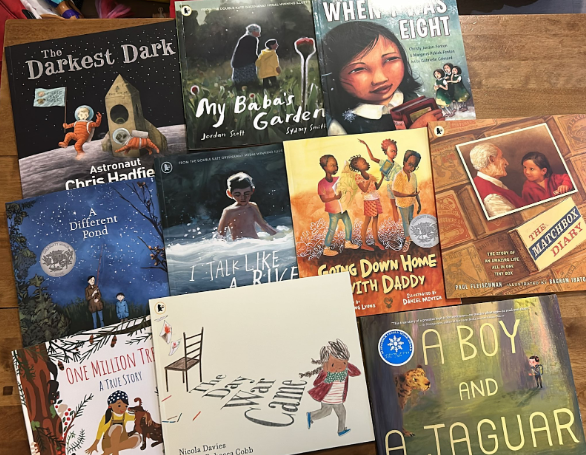
For teachers like Sam Creighton, who love reading, such an approach is a dream come true as he finally gets to expose his class to loads of his favourite high-quality texts. Here are just some of the texts he plans to share with his class as part of their memoir writing project. 

2. Childrenโ€™s production strategies for writing

As part of our work devising a conceptual framework for writing teaching, which we called The Writing Map, we described what young writers are doing as they make writing. When a child settles down to write, they will: 
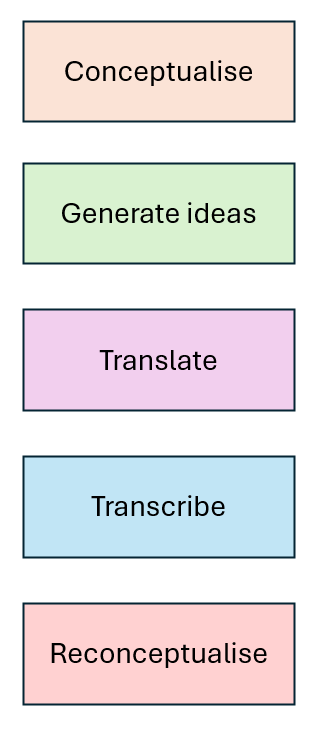
Conceptualise As youโ€™ve already read, conceptualising a piece of writing involves establishing the rhetorical situation. Consciously or subconsciously, a young writer will consider the purpose and audience for their writing. 

As teachers, we can support children with this. For example, teachers and children, together, can establish a publishing goal for a class writing project [LINK] before reading as writers [LINK].

Generate ideas Next, your young writers will generate ideas of what it is they would like to share with their reader(s). Again, as teachers, we should help and support children by teaching them idea generation techniques that writers actually use [LINK].

Translate This is where your young writers have to convert the ideas they have in their heads into possible phrases and sentences. Teachers can support this process in three ways:

  1. Ask children to draw their ideas first.
  2. Invite children to talk about (and otherwise ‘tell’) their drawings with us and their friends.
  3. Model a planning strategy that we used, before inviting children to use the same strategy for themselves [LINK].

Transcribe Transcription includes attending to letter formation, handwriting (or typing), and spelling. At this point, children must physically make their marks on paper or screen. These skills support children in getting their ideas down in a way that can be read by others, but the accuracy of spelling and handwriting will naturally be variable at this stage. What matters most is that children can record their thinking; refinements to accuracy will be revisited later during the reconceptualise phase. 

However, over time, it is important that these transcriptional skills become increasingly fluent and automatic [LINK]. This fluency develops through a balance of regular spelling and handwriting instruction alongside meaningful opportunities to write [LINK].

Reconceptualise This is actually something children are doing all the time. They will regularly stop, think, rethink, draw, redraw, share, discuss, re-read, revise, proof-read and perform their developing compositions. Teachers can support childrenโ€™s reconceptualisation processes by ensuring that they: 

  • Have regular moments during writing time to stop and share what they have crafted so far that day. For example, by giving children class sharing and Author’s Chair time [LINK].ย 
  • Provide children with explicit revision instruction and revision checklists [LINK].ย 
  • Engage in systematic and daily pupil-conferencing with their pupils [LINK].
  • Provide ample opportunities and instruction in how to proof-read their manuscripts in preparation for publication or performance [LINK].

Finally, we can personify the production strategies children use to craft text as if they were being undertaken by different people. In reality, of course, these are done by the individual writer. These people would include:
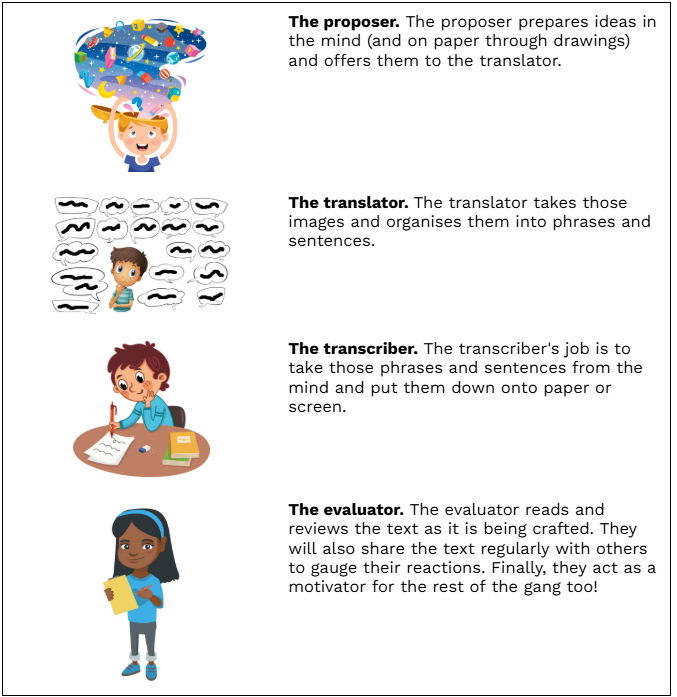
It’s important to remember that a piece of writing will move between these four people all the time. For example, the evaluator might have to go and talk to the proposer. The translator and transcriber are likely to be in back and forth conversation too.

3. The writing process in the early years

What does the writing process look like for the youngest of children? Well, having observed children writing for a number of years, weโ€™ve noticed that a developmentally appropriate writing process for the EYFS-KS1 looks a little something like this:

We talk At this stage, children are often developing their ideas and translating those ideas through spoken language. Talking helps them to clarify their thinking, play with word choices, and rehearse the structure of what it is they want to say. Children talk their texts into being. As you can see, talk is vital at all parts of a young writerโ€™s process. For example, children talk with one another before they write, as they write and after they write. These interactions occur in different ways and can include:

  • Idea explaining Children share what they plan to write about during the session with others.
  • Idea sharing Children work in pairs or small โ€˜clustersโ€™ to co-construct their own texts together.
  • Idea spreading One pupil mentions an idea to their group. Children then leapfrog on the idea and create their own texts in response too.
  • Supplementary ideas Children hear about a childโ€™s idea, like it, and incorporate it into the text they are already writing.
  • Communal text rehearsal Children say out loud what they are about to write – others listen in, comment, offer support or give feedback.
  • Personal text rehearsal Children talk to themselves about what they are about to write down. This may include encoding individual words aloud. Other children might listen in, comment, offer support or give feedback.
  • Text checking Children tell or read back what theyโ€™ve written so far and others listen in, comment, offer support or give feedback.
  • Performance Children share their texts with each other as an act of celebration and publication.

We draw Children often like to translate their ideas visually. Drawing allows them to plan and express their thoughts before writing, and it supports their understanding of chronology and narrative sequencing. It also gives them something to talk about and otherwise โ€˜tellโ€™ prior to transcribing it to paper.

We write Here, children transcribe their ideas into the written form. This may involve mark-making, early letter formation, or structured sentences depending on their stage of development. They apply their phonics knowledge, through encoding, and begin to explore spelling, punctuation, and grammar in context.

We share Children continually share their compositions with others – reading or โ€˜tellingโ€™ aloud or discussing their writing with peers and adults. This stage fosters pride, purpose, and a sense of audience, and it encourages reflection and further development of their writing skills.

This recursive process supports young writers in building both the transcriptionally and compositional aspects of writing in a meaningful and developmentally appropriate way.

4. Ellen Counterโ€™s โ€˜Writing Houseโ€™

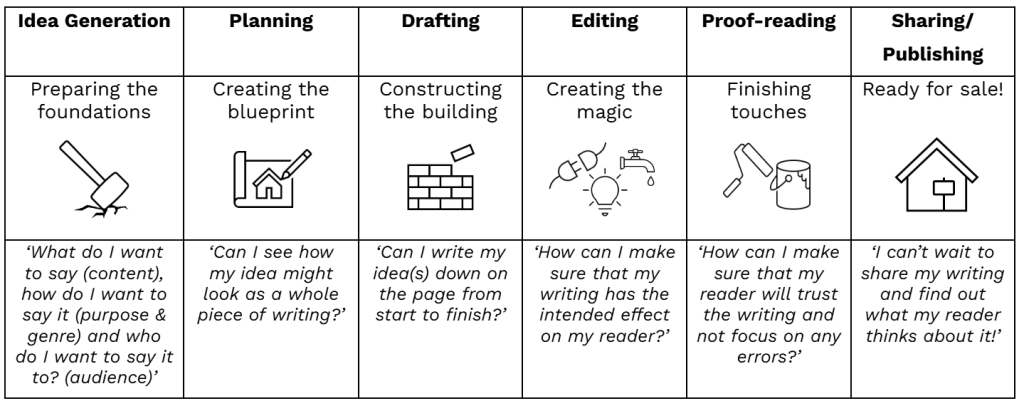
To teach writing effectively, we must encourage children to see writing as a process, while also teaching and modelling strategies that support its key stages: idea generation, planning, drafting, editing, and proofreading.

Whilst the writing process is recursive (we naturally move back and forth between stages), and although it can look different depending on what is being written and why, children need to understand that each stage of the process is distinct and requires a different kind of focus.
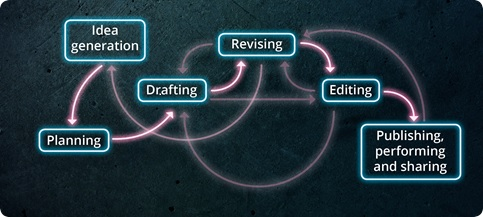
We could argue that this process is like building a house. Without time and teaching dedicated to each stage, the writing (like a house) could fall apart and not be fit for purpose. In the same way, our feedback will only be effective if we consider the stage children are at in the process and tailor our advice accordinglyโธ.

Using this model, we can extend the metaphor to guide what we focus on during writing time. It all depends on the stage. After all, you wouldnโ€™t insist on ordering paint colours before the walls have even been built. As the DfEโ€™s Writing Framework suggests, it makes little sense to focus on childrenโ€™s spelling inaccuracies when they are still working hard on getting their ideas down onto the paperโน.

Figure: A visual representation of the writing process to support shared understanding ยฉ HFL Education, used within ESSENTIALWRITING | HFL Education

The terms generate ideas, plan, draft, revise, re-read, evaluate, edit, proof-read, perform and share are all mentioned within the National Curriculum, but teacher training and writing schemes rarely equip teachers with how to explicitly teach these processes. 

For example, children are often told to proof-read or โ€˜checkโ€™ their writing without being taught how writers do this, within a clear framework of shared strategies to support themยนโฐ. 

Take the case of a Year 1 child who was thought to be falling behind in her writing because she wasnโ€™t punctuating her sentences. Interestingly, she: 

  • Could identify where a full-stop belonged when shown an unpunctuated sentence.ย 
  • Had age-appropriate knowledge of sentence structure. For instance, she could read her writing back, recognised where one idea ended, and understood that her reader would need a full-stop before the next idea began.ย 

So whatโ€™s happening here? 

The issue lies in the misconception and expectation that writing must be 100% accurate at the point of draftingยนยน. The child was only given one shot to get everything โ€˜rightโ€™, so the absence of punctuation is treated as failure. In reality, the problem is weโ€™ve overlooked how writing actually works. Like building a house, writing requires time for each stage: strategies for proof-reading need to be explicitly taught, and space for evaluating and reconceptualising is neededยนโฐ. The child wasnโ€™t failing โ€“ the approach was failing the child.

Conclusion and next steps

Planning a writing unit

In 2019, we were lucky enough to interview and observe some of the best performing writing teachers in England. We released our findings as a book in 2021. What was clear was how these teachers used the writing processes to plan their class writing units.
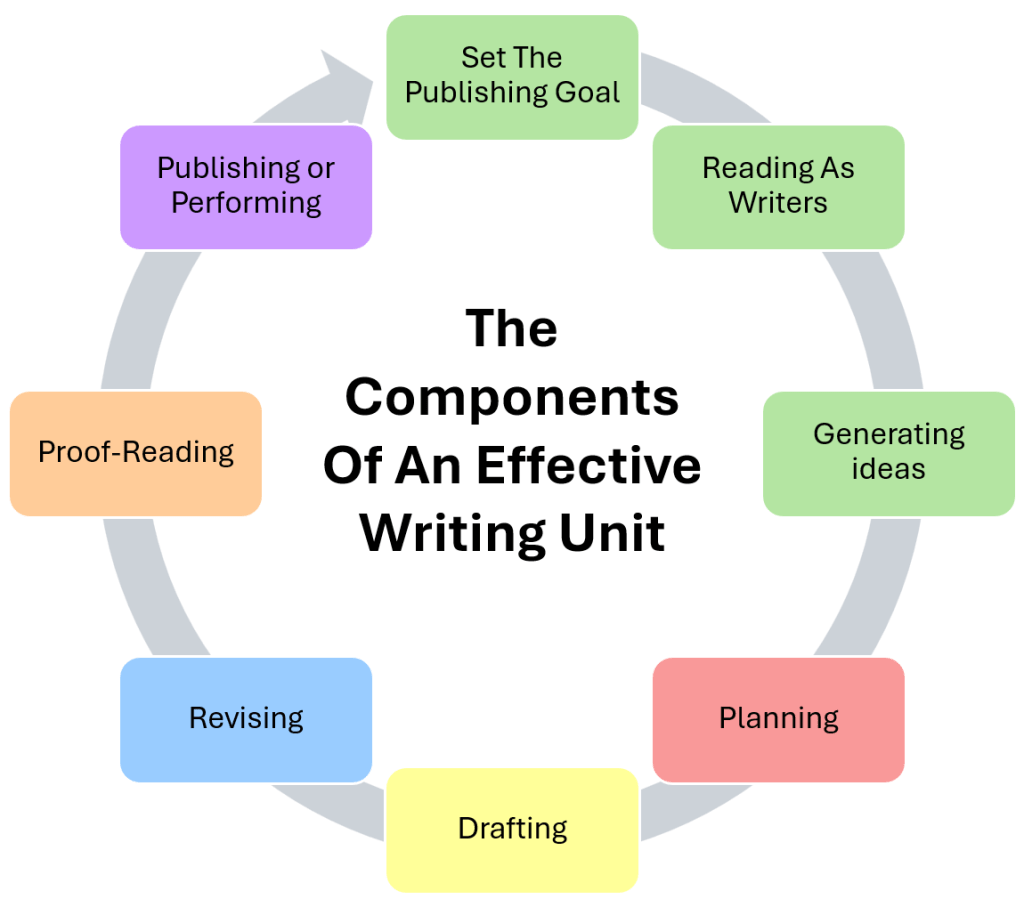
Teaching the writing processes is also a validated evidence-based practice, with a potential effect size of +1.28 (for context, anything over +0.4 is considered to be significantly effective). 

To find out more about the components of an effective writing unit, see our article.

Children also developing their own writing processes

As well as planning effective writing units, the exceptional writing teachers we observed gave their pupils time to develop their own writing process by way of personal writing projects. To find out more, see this publication. In teaching children the writing processes, we do more than guide them to craft great pieces, we hand them the tools to shape their voices, their stories, and, over time, their worlds.

By Ross Young & Ellen Counter

References

  1. How Writing Works: From the Invention of the Alphabet to the Rise of the Social Media by Dominic Wyse [LINK]
  2. โ€˜Teachersโ€™ orientations towards teaching writing and young writersโ€™ [LINK] and โ€˜Six discourses, four philosophies, one framework: A critical reading of the DfEโ€™s writing guidanceโ€™ [LINK]
  3. The science of teaching primary writing [LINK]
  4. Motivating writing teaching [LINK]
  5. The rhetorical situation [LINK]
  6. โ€˜Reading like a writerโ€™ [LINK] and โ€˜Reading in the writing classroomโ€™ [LINK]
  7. How to teaching writing [LINK]
  8. A guide to pupil-conferencing with 3-11 year olds: Powerful feedback & responsive teaching that changes writers [LINK]
  9. The DfEโ€™s Writing Framework [LINK]
  10. No more: โ€˜My pupils canโ€™t edit!โ€™ A whole-school approach to developing proof-readers [LINK]
  11. Debunking edu-myths: Writing errors form bad habits [LINK]

Two for the price of one: Developing childrenโ€™s word reading and word writing

In the complex instructional landscape of literacy, the profound connection between reading and writing is a central tenet. This article explores the specific, interdependent relationship between early reading and early writing, framing them not as separate subjects but as โ€˜two sides of the same coinโ€™. The goal of literacy instruction is, of course, comprehension and composition; however, there can be no reading comprehension without word reading, nor conventional written composition without word writing. Understanding their shared foundations and development is therefore essential for effective teaching practice.

Students’ abilities in word reading and word writing develop along a continuum, moving through distinct phases that are greatly facilitated by systematic instruction. For word reading, this progression is often conceptualised in five phases:

  1. Pre-alphabetic phase: The child approaches words as visual wholes, using clues like logos, without understanding the alphabetic principle. For example, โ€œMcDonalds!โ€
  2. Partial alphabetic phase: The child begins to use some letter-sound knowledge, often focusing on initial and final sounds.
  3. Full alphabetic phase: The child can form connections between all graphemes in a word and their corresponding phonemes.
  4. Consolidated alphabetic phase: The child starts to recognise and use consolidated letter sequence units (e.g. -ight, re-) rather than decoding letter by letter.
  5. Automaticity phase: Word reading becomes accurate, fast, and effortless, as words are recognised by sight without conscious analysis.

A similar progression occurs in word writing development, which can be understood through five stages:

1. Emergent/precommunicative: The child hasnโ€™t yet got an understanding of the systematic relationship between letters and sounds. To see the stages of emergent writing, click here.

2. Letter name: The child begins using letter-sound knowledge, but accuracy is usually limited to consonants and short vowels.

  • cat โ†’ ct (child writes the consonants, may omit vowels)
  • dog โ†’ dg
  • sun โ†’ sn
  • bat โ†’ bt

3. Within word: The child can spell most single-syllable words but struggles with more complex patterns like silent long-vowels.

  • make โ†’ mak or make (may omit the silent e)
  • home โ†’ hom
  • bike โ†’ bik
  • read โ†’ red or reed (confusion with long-vowel spelling patterns)

4. Syllables and affixes: Errors typically occur at syllable junctures or in unaccented syllables.

  • hoping โ†’ hopeing (error at the syllable juncture where the silent โ€œeโ€ should be dropped)
  • running โ†’ runing (omitting the doubled consonant at the syllable break)
  • family โ†’ famly (dropping an unaccented syllable)
  • different โ†’ diffrent (leaving out the unstressed middle syllable)

5. Derivational relations: Errors are most common with low-frequency, multisyllabic words involving derivational morphemes.

  • electricity โ†’ eletricity (dropping a syllable within a derived form)
  • responsibility โ†’ responsiblity (omitting the derivational suffix syllable)
  • biological โ†’ bioligical (confusing the placement of the derivational suffix -ical)
  • nation โ†’ natian (misapplying the derivational -ion pattern)

It is important to note that these developmental phases are not rigid, and children will move between these stages depending on the specific word they wish to write.

The shared foundations: Emergent literacy skills

The development of both word reading and word writing is contingent upon a set of foundational emergent literacy skills. These skills are drawn upon for both decoding (reading) and encoding (writing), which explains why the two abilities are so strongly correlated. The three critical skills are:

1. Phonological awareness: This is the knowledge and awareness of the sound structure of language, from larger units like syllables down to the smallest units, phonemes. This skill is essential because English is an alphabetic writing system, where symbols primarily represent speech sounds.

  • Big sounds: Children can detect or segment the larger parts of words, like the โ€˜clapsโ€™ (syllables) in a word. For example, โ€˜but-ter-flyโ€™ has three claps.
  • Rhyming parts: They can hear smaller parts, like the rhyme in a word. In โ€˜catโ€™, they can hear the โ€˜atโ€™ part.
  • Tiny sounds: They can hear the tiniest sounds (phonemes) in a word. They can hear that โ€˜catโ€™ is made of three sounds: /k/ /รฆ/ /t/

2. Orthographic awareness: This refers to the knowledge of print concepts, graphemes (the letters or groups of letters like sh or augh that represent sounds), and the permissible spelling patterns of the language. This is the skill of knowing all about letters and printed words.

  • Letter shapes and names: Children learn what each letter looks like and what it is called.
  • Letter teams: Children learn that sometimes letters work together to make one sound. For example, the letters โ€˜sโ€™ and โ€˜hโ€™ team up to make the /สƒ/ sound in ship. This combination of letters that represents one sound is called a grapheme.

3. Morphological awareness: This is the understanding of morphemes, the smallest units of meaning in words (e.g., re-, -act, -s in reacts). This awareness is particularly crucial in English, a morphophonological system where meaning-based units can override apparent phonological patterns (e.g. recognising re- and act in react prevents it from being misread as /rikt/). 

  • For example, the word โ€˜catsโ€™ has two meaning parts: โ€˜catโ€™ (the animal) and โ€˜-sโ€™ (which means more than one).
  • The word โ€˜redoโ€™ has two meaning parts: โ€˜re-โ€™ (which means do again) and โ€˜doโ€™.
  • Knowing these parts helps children read and spell big words, like โ€˜photosynthesisโ€™ or โ€˜incredibleโ€™

Principles and practices for reading and writing instruction

The shared foundation of early reading and writing has critical implications for instruction. First, because they draw on the same skills, integrated teaching has a synergistic effect: teaching writing promotes reading development, and teaching decoding promotes encoding development. Second, a student who is weak in one is very likely to be weak in the other. However, it is important to recognise they are not identical; word writing requires production and greater precision of a word’s mental representation, making it typically more difficult than the recognition task of reading.

Effective instruction is built upon several core pedagogical principles. Teachers should employ differentiated instruction based on ongoing assessment to meet childrenโ€™s varying needs and rates of learning (see here for more). It is also vital to consider students’ diverse linguistic backgrounds, recognising that foundational principles of literacy instruction are effective for all children when teachers understand and value their language experiences (see here for more). Finally, instruction should be delivered using evidence-based approaches, namely explicit and systematic teaching that provides structured modelling and scaffolding, such as the I Do, We Do, You Do model (see here for more). For example:ย 

  • I Do: First, you model exactly what to do. For example, you show children how you are using your sound mat to help you encode the words you want to write in the picturebook youโ€™re making.ย  “I want to write โ€˜catโ€™. I hear three sounds: /k/ /รฆ/ /t/. The first sound is /k/. That can be a โ€˜cโ€™ or a โ€˜kโ€™. I’ll use the โ€˜cโ€™ on my sound mat. The next sound is /รฆ/. That’s an โ€˜aโ€™. There it is on the sound mat. The last sound is /t/. That’s a โ€˜tโ€™. Let me write it: c-a-t. Yes, that’s what it looks like when I see it in books!”
  • We Do: Next, you do it together. The children use their sound mats to help them encode the words they want to write in their picturebook that day.
  • You Do: Finally, the children continue to use their sound mats when making picturebooks on their own during provision.

Hereโ€™s another example:

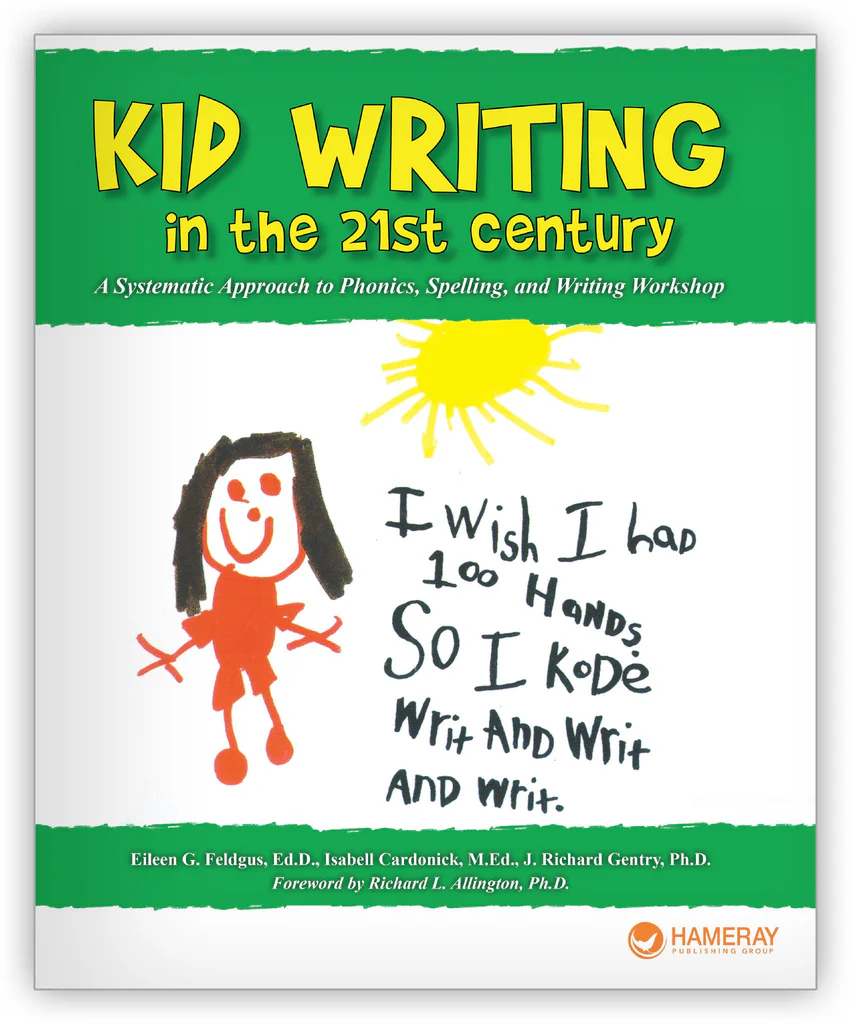
  • I Do: You show children how, when you really want to write a word, but you donโ€™t know all the grapheme-phoneme correspondences yet, you use โ€˜kid writingโ€™ as a replacement. “When I was your age, and I wanted to write a really cool word, and I didnโ€™t know all my sounds yet, I used to do this. Watch. I want to write โ€˜dinosaursโ€™. I can hear the first sound: /d/. Thatโ€™s the letter โ€˜dโ€™. Iโ€™ll write that. Next, I hear /aษช/ I donโ€™t know all the ways to spell that sound yet, so Iโ€™ll just write the letter โ€˜iโ€™. Then I hear โ€˜noโ€™ like the word โ€˜noโ€™. After that, I can hear lots of sounds, but I donโ€™t know how to write them yet, so Iโ€™ll just use โ€˜kid writingโ€™ for those. At the end, I can hear /s/. Thatโ€™s the letter โ€˜sโ€™. So my โ€˜kid writingโ€™ says: d-i-no-ใ€ฐใ€ฐ-s. Itโ€™s not the same as the adult spelling, but it shows all the sounds I do know! This way, we can still write all our wonderful ideas and share our stories.”
  • We Do: Next, you do it together. The children use their sound mats and โ€˜kid writingโ€™ to encode their more ambitious or complex vocabulary in their picturebook that day.
  • You Do: Finally, the children continue to use โ€˜kid writingโ€™ and their sound mats when making picturebooks on their own during provision.

Finally, one last example:

  • I Do: You show children how, when you want to write a tricky word that doesnโ€™t follow the usual soundโ€“letter patterns, you use the word wall to help you. “Ah, watch this! I really want to write the word โ€˜saidโ€™ in my picturebook. Hmmโ€ฆ if I try to sound it out, I might think itโ€™s s-e-d. But I know that โ€˜saidโ€™ is one of our tricky words, and itโ€™s on our word wall. Letโ€™s look. Here it is: s-a-i-d. I can copy it from the wall into my writing. Now my sentence looks just like it does in books.”
  • We Do: Next, you do it together. The children use the word wall to copy down any common tricky words in their picturebook that day.
  • You Do: Finally, the children continue to use the word wall independently to spell tricky words while they are making picturebooks during provision.

Using this routine every day can help children feel safe and confident in learning new strategies and skills.

Research-supported recommendations

Based on these principles, four key recommendations emerge for effective, integrated word reading and word writing instruction:

Teach phonological awareness and graphemeโ€“phoneme correspondences. This involves systematic instruction in manipulating sounds (e.g. blending, segmenting) and explicit teaching of letter formation. Letter instruction should focus on frequent exposure, making name-sound connections explicit, teaching visually similar letters non-sequentially, and building automaticity in both recognition and letter writing (see here for more).

Model chunking. As students progress, they must learn to process chunks larger than individual graphemes. This includes modelling (1) common rime units or phonograms (e.g. -ock, -ight, -ean), (2) syllable types:

  • Closed syllables (CVC): cat, hop, pen
  • Open syllables (CV): he, go, me
  • Vowel-consonant-e (VCe): make, bike, hope
  • Unaccented final syllables: table, pencil, cabin

and (3) morphemes (e.g., prefixes, suffixes, roots)

  • Prefixes: un- (undo, unhappy), re- (redo, rewrite)
  • Suffixes: -ful (hopeful, careful), -less (hopeless, fearless)
  • Roots: struct (construct, destruct, structure), port (transport, portable, import)

Activities like word sorts and word building are highly effective for this work.

Model decoding and encoding. Foundational skills must be explicitly applied to the acts of reading and writing. An analytic approach should be used even for irregular words, focusing on the parts that do follow predictable patterns (e.g. the sh and d in should). Teachers should view informed spelling not merely as an error, but as a valuable window into a student’s current knowledge and a crucial opportunity for them to practise applying grapheme-phoneme correspondences.

    Incorporate connected texts. Children should be regularly invited to use and apply these skills in the context of meaningful reading and writing experiences. The use of decodable and high-quality commercial texts provides beginning readers with opportunities to practise taught patterns in a supportive context. Similarly, students should be encouraged to apply their ever developing encoding knowledge in daily book-making time (see here for more), reinforcing the connection between skill acquisition and authentic communication.

      In conclusion, word reading and word writing are inextricably linked skills that are foundational to all later literacy development. By providing explicit, systematic, and integrated instruction that targets their shared underpinnings, teachers can capitalise on their relationship and build a robust foundation for students’ success in both reading and writing.

      Recommended further reading

      • Feldgus, E. G., Cardonick, I., & Gentry, J. R. (2017). Kid writing in the 21st century: A systematic approach to phonics, spelling, and writing workshop. Hameray Publishing Group
      • Kim, Y. S. G. (2022). A Tale of Two Closely Related Skills: Word Reading and Spelling Development and Instruction. In Z. A. Philippakos & S. Graham (Eds.), Writing and reading connections: Bridging research and practice. Guilford Press
      • Kim, Y. S. G. (2022) Co-Occurrence of Reading and Writing Difficulties: The Application of the Interactive Dynamic Literacy Model, Journal of Learning Disabilities, 00222194211060868
      • Ray, K. W., & Glover, M. (2008). Already ready. NH: Heinemann

      *NEW ONLINE TRAINING ANNOUNCEMENT* Improving childrenโ€™s reading AND writing: Connecting research and practice

      Improving childrenโ€™s reading AND writing: Connecting research and practice

      Four online sessions focusing on children’s reading and writing will take place in November and December from 4pm – 5pm. These sessions are designed for UK primary school teachers, primary school leaders, literacy leads and education consultants. 

      ThE sessions are designed to provide research insights to support childrenโ€™s reading and writing acquisition and development. With a focus on supporting both reading and writing skill, all those attending will have greater access and insight into contemporary research to inform their classroom practice.

      Participants will gain insight into implications for practice, a curated collection of key open access research articles and, if all four sessions are attended, a certificate of completion.

      Sessions can be booked individually for ยฃ15 each or all four sessions can be booked at a discounted price of ยฃ50.

      Sessions overview

      Session 1: Learning to read – Thursday 20 November 2025,ย 16:00-17:00pmย 

      Delivered by Professor Sarah McGeown

      This session highlights the core skills underpinning reading development, research-informed practice to support childrenโ€™s word reading, and the importance of nurturing an early love and interest in books, words, and stories. 

      Session 2: Reading motivation and engagement – Thursday 27 November 2025, 16:00-17:00pm 

      This session provides insight into the importance of reading motivation and engagement throughout primary school, research-informed principles to support reading engagement, and the reading, language, social and emotional benefits accrued from reading.

      Session 3: Learning to write – Thursday 4 December 2025, 16:00-17:00pm 

      Delivered by Ross Young

      This session explores key aspects of writing development, research-informed strategies to support children as apprentice writers, and the importance of nurturing a lifelong love of writing.

      Session 4: Writing motivation and engagement – Thursday 11 December 2025, 16:00-17:00pm 

      This session provides insight into the importance of writing motivation and engagement throughout primary school, research-informed principles to support childrenโ€™s engagement with writing, and the social, emotional, and expressive benefits gained through the experience of being a young writer.

      Biographies

      Professor Sarah McGeown is Director of the University of Edinburghโ€™s Literacy Lab. She has published widely in academic and professional journals, with research focusing on early reading acquisition and development to motivation and engagement in reading. She is an advocate for research-practice partners and closing the gap between research and practice to improve childrenโ€™s reading experiences and outcomes. 

      Ross Young is a former primary school teacher and co-founder of The Writing for Pleasure Centre. His work focuses on translating writing research into effective classroom practice, and he regularly collaborates with teachers and children in schools. He has written several books on teaching writing and leads professional development through organisations such as the UKLA. Ross is currently a PhD researcher at the University of Edinburghโ€™s Literacy Lab, studying childrenโ€™s writing lives in partnership with the National Literacy Trust. 

      Debunking the โ€˜bones arenโ€™t readyโ€™ and โ€˜motor skills firstโ€™ myths: What research says about young childrenโ€™s handwriting

      The myth

      A persistent education myth claims that young children shouldnโ€™t begin writing because ‘their bones arenโ€™t ready’ or because they first need to perfect their gross and fine motor skills. According to this argument, letter formation and handwriting instruction should wait until a childโ€™s hand bones are fully ossified or their motor coordination is deemed ‘mature enough.’

      The evidence

      1. Bone development is certainly not a barrier to basic writing movements.
      Research on hand anatomy shows that childrenโ€™s bones are still developing but ossification is not required for the basic movements involved in early writing (LINK). Even with flexible cartilage, young children are physically capable of drawing, engaging in emergent writing, and beginning letter formation.

      2. Emergent writing is developmentally appropriate and essential.
      Emergent writing includes scribbles, mock letters, and informed spellings. It is a normal, developmentally appropriate stage of writing development observed across cultures (LINK). Through emergent writing, children experiment with making meaning while learning more about conventional ‘adult writing’ and beginning explicit letter formation and handwriting instruction. Emergent writing kills dead the ‘motor skills first’ argument entirely. For more on this, I can highly recommend these two publications:

      3. Fine motor skills and handwriting develop together, not in isolation.
      Writing researchers have shown through meta-analyses that activities that only focus on gross and fine motor exercises โ€” without letter formation and handwriting instruction โ€” do not significantly improve children’s handwriting (LINK). Children can develop their motor control by actually writing, not just by cutting, beading, or doing unrelated fine motor tasks. The best place for children to develop their motor skills for writing is by writing!

      What this means for practice

      • โœ… Offer emergent writing opportunities as early as possible: Provide children with crayons, chunky pencils, regular pencils, markers, and blank picturebooks. Understand childrenโ€™s marks as being their early writing.
      • โœ… Integrate handwriting instruction gradually: Provide letter-formation instruction and meaningful writing tasks โ€” for example book-making (LINK).
      • โœ… Support motor development within context: Strengthen small-muscle control through motor skill activities, handwriting instruction and authentic writing projects, rather than relying on motor exercises alone.
      • โŒ Donโ€™t demand perfect cursive or flawless handwriting from very young children: The goal is accuracy and fluency, not adherence to a particular handwriting style.

      The bottom line

      Emergent writing + letter formation and handwriting instruction + motor skill activities + meaningful writing opportunities provide the strongest bridge to fluent handwriting and writing success.

      The ‘bones arenโ€™t ready’ and ‘motor skills first’ argument oversimplifies child development and risks delaying important writerly experiences. Rather than waiting for perfect motor skills or ossified bones, we should nurture childrenโ€™s natural curiosity and give them real reasons to write (and learn more about writing) from the very start [LINK].

      Getting Writing Right: NEW TRAINING COURSE ANNOUNCEMENT

      We’re delighted to announce that we’re collaborating with HFL Education and UK Literacy Association’s School Of The Year Elmhurst Primary School to bring you our new training: Getting Writing Right: What the Evidence Says.

      Join us for a day of learning!

      About this course

      Held at Elmhurst Primary School in London, this training will equip teachers and leaders to understand what the latest evidence and research concerning quality writing teaching is.   

      The day will consider how schools can ensure that all children make maximised progress in writing.  The essential features of writing teaching will be discussed, such as: 

      • How to set rigorous writing goals
      • How to plan a class writing project with the greater-depth standard as the standard
      • Whatโ€™s involved in delivering an effective writing lesson
      • How to deliver sentence-level and grammar instruction
      • How to connect reading and writing profitably.

      Learning Outcomes

      • Have a secure understanding of what the evidence and research says around effective writing teaching
      • Be given practical ideas and strategies for writing teaching to use in the primary classroom immediately
      • Be equipped with greater confidence and subject knowledge concerning the teaching of writing

      Additional Information

      09:30 – 15:30 – 16/10/2025

      Lunch & refreshments will be provided.

      Schools will also receive a school license (worth ยฃ54.75) for our latest eBook How To Teach Writing.

      The DfEโ€™s Writing Framework: Our Review And Implications For Practice

      On the 8h of July 2025, the Department for Education published its non-statutory guidance document entitled The Writing Framework. It purports to draw from the best available evidence about teaching writing.

      The mission of The Writing For Pleasure Centre is to help all young people become passionate and successful writers. As a think tank for exploring what world-class writing is and could be, a crucial part of our work is analysing emerging governmental policy. It is therefore important that we issue a response to what this document has to say.

      Overall conclusion
      While most of the recommendations in this policy paper are welcome, the document at times presents contradictions and remains notably incomplete.

      Our aim is not to let this review slip into unproductive criticism, but rather to offer constructive additions that we hope will add value. We therefore encourage anyone seeking to develop world-class writing instruction to engage with the research cited before making changes to their teaching practices or commercial offerings.

      Enhancing studentsโ€™ writing: The power of revision checklist sessions

      As Writing For Pleasure teachers, we are lucky enough to witness the transformative journey a pupilโ€™s writing goes on โ€“ from their initial idea to its final publication or performance. However, a crucial, yet sometimes overlooked, stage in this process is revision

      Revision is about re-seeing, re-thinking, reviewing, and otherwise re-envisioning drafted writing, offering children the privilege to splash around in their existing text and to be playful and take risks. For children to truly develop as writers, developing an effective approach to revision is paramount. This is because, at this stage in the writing process, children have the cognitive space to tackle higher-order writerly techniques.

      One impactful strategy is the use of revision checklist sessions.

      What are revision checklists?

      Revision checklists are powerful tools derived from the product goals (success criteria) you established collaboratively with your class at the beginning of a writing project. These product goals represent all the great craft moves you identified from the high-quality mentor texts you studied togetherยน. These are the things you and the class want to achieve in their compositions, often extending far beyond mere grammatical features. 

      Having been taught all these craft moves during the drafting phase, the checklist serves as a guide, prompting children to reflect on whether they have indeed incorporated these desired craft moves into their own writing.

      How they are created and look

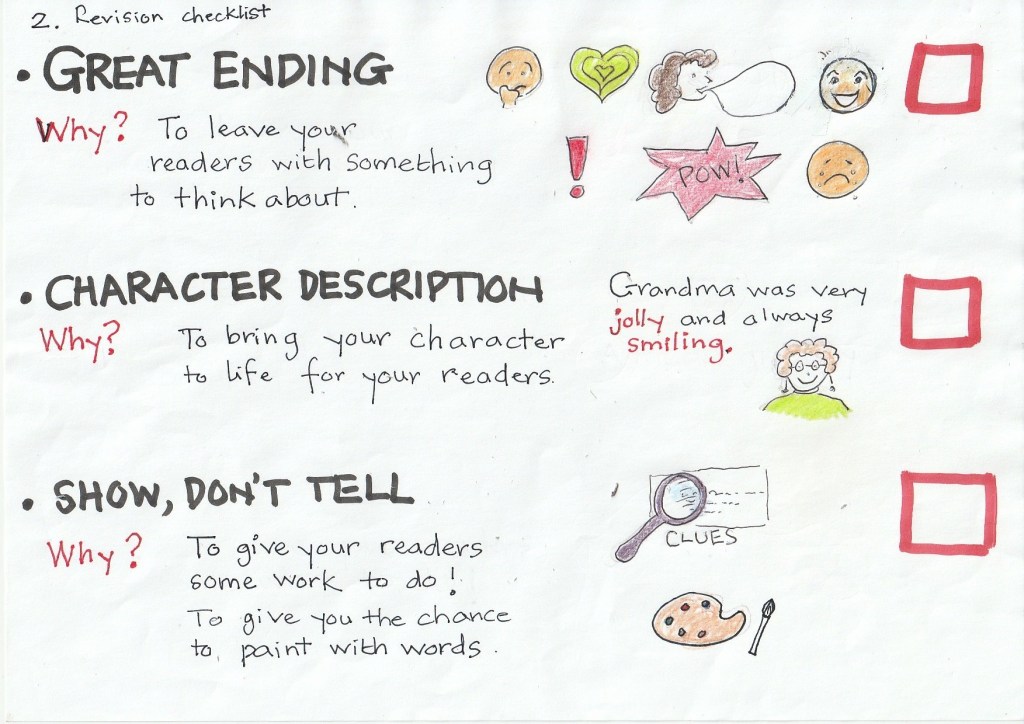
      As the name suggests, a revision checklist lists the product goals on the left-hand side. On the right, children indicate if they have used the craft move in their writing. If a craft move hasn’t been used, they can demonstrate how they could have used it on their โ€˜revision and trying things out pageโ€™. This approach ensures that revision is a proactive, reflective process rather than a punitive one.

      Hereโ€™s an example of a double-sided revision checklist for a Year Four short story project. None of the items on this checklist were a surprise to the children. All of the craft moves were modelled and taught during the drafting stage of a class writing project. 

      The benefits of revision checklist sessions

      Implementing revision checklist sessions offers numerous benefits, backed by significant research:

      • Increased academic progress: When children are given specific time to revise their compositions for quality, it can lead to a positive effect size of +0.64ยฒ. Moreover, inviting children to evaluate their writing against class-generated product goals yields a remarkable effect size of +2.03ยฒ. An effect size above +0.4 is generally considered to have a significant positive impact on children’s writing progress.
      • Improved confidence, self-concept and independence: These sessions increase children’s sense of confidence in their writing abilitiesยณ. Children also develop a feeling of competence and an ability to write well independently, reducing reliance on constant adult interventionโด. Students gain a feeling of ownership over their writing and the choices they make about its content and style.
      • Increased motivation: Children understand the โ€˜whyโ€™ behind their writing choices, leading to a deeper desire to produce high-quality writingโต.
      • Fostering a community of writers: Collaborative checklist creation and small-group instruction and discussion during these revision sessions promote a feeling of being part of a supportive writing community. Teachers finally have the time to get into deep and rich discussion with children about their writing โ€“ often about subjects that go far beyond whatโ€™s on the revision checklist itself.

      Conducting an effective revision checklist sessions

      Hereโ€™s how to introduce and run successful revision checklist session in your classroom:

      1. Collaborative checklist creation: The most effective revision checklists are those constructed in response to the product goals you identified jointly with your class when you read mentor texts at the beginning of your writing projectยน. Nothing on the checklist should be a surprise to the children at this point. All the items will have been modelled and taught to the children during the drafting stage of your class project.
      1. Teacher modelling: You can begin by showing your class how you used the revision checklist with your own writing. Explain your personal process, the decisions you made, and invite questions from the children. This makes the process tangible and relatable.
      1. Right-hand side for revision: Encourage children to draft on the left-hand side of a double page in their notebooks. This leaves the right-hand side blank for their revisions and “trying things out”. If they like a revision, they can use a star to indicate where it should be incorporated into their final manuscript. This dedicated space allows children to experiment with craft moves they haven’t yet used in their main draft. It’s a low-stakes environment for creativity and risk-taking.
      1. Small group sessions: It is highly recommended to conduct revision checklist sessions with your class in small groups over a number of days. This allows for focused, individualised instruction and feedback. While you work with a small group, the rest of the class can be engaged in their personal writing projectsโถ, ensuring continuous productive writing time.
      1. Recognising the behaviour of greater-depth writers: It’s crucial to understand that children are not obliged to include everything on the checklist! If a child experiments with a craft move on their โ€˜trying things out pageโ€™ but makes an authorial decision not to include it in their final piece, this is a sign of a greater-depth writer. This approach avoids โ€˜overwritingโ€™ and encourages genuine authorial voice and independence.
      1. Assessment: Writing produced on revision pages can (and should) still be formally assessed. This provides valuable evidence of a child’s critical thinking and engagement with the writing processโท.
      1. EYFS and KS1 adaptations: For younger children, revision can often occur spontaneously through your daily verbal feedback, using childrenโ€™s illustrations to elicit more information about their textโธ. Providing extra blank pages allows them to make significant changes to their books if needed.

      What to avoid

      To ensure your revision checklist sessions are truly effective, steer clear of these common pitfalls with success criteria:

      • Narrow focus: Do not limit revision checklists solely to grammar craft moves.
      • Completely teacher-imposed: Avoid creating lists without any input from the children.
      • Lack of context: Ensure the checklist items are linked to the lessons you taught during the drafting stage of a class project.
      • Vague goals: โ€˜Language devicesโ€™ or โ€˜good grammarโ€™ are too vague. Break these down into specific, named craft moves that children can understand and apply.
      • Separate revision from proof-reading: Remember that revision and proof-reading are two distinct cognitive processesโน. Give them their own dedicated instructional time and checklists.

      By embracing the collaborative, reflective, and empowering nature of revision checklist sessions, teachers can cultivate classrooms where young writers not only master curriculum objectives but also develop confidence, agency, and a genuine love for refining their craft.

      References

      1. Reading in the writing classroom: A guide to finding, writing and using mentor texts with your class [LINK]
      2. The enduring principles of effective writing teaching [LINK]
      3. Self-efficacy [LINK]
      4. Self-regulation [LINK]
      5. Motivating writing teaching [LINK]
      6. A guide to personal writing projects & writing clubs for 3-11 year olds [LINK]
      7. Writing development scales and assessment toolkit [LINK]
      8. How to teach narrative writing in EYFS, KS1 [LINK and LINK]; How to teach nonfiction in the EYFS, KS1 [LINK and LINK]

      No more: โ€œMy class canโ€™t editโ€ A whole-school approach to developing proof-readers [LINK]

      Why is emotion often the missing piece in our understanding of teaching writing?

      For decades, we have rightly celebrated writing as a profound intellectual pursuit. We teach our students to think critically, organise their ideas logically, and craft sophisticated arguments. Indeed, writing is often seen as the quintessential representation of thought. However, this strong emphasis on cognition, while valuable, has inadvertently created a โ€˜blind spotโ€™ in how we understand and teach writing: the role of emotion.

      As teachers, we readily acknowledge that emotions motivate our students. Yet, the prevailing belief often holds that feelings have little to do with the actual process of making writing. Drawing on insights from Alice G. Brand’s The Why of Cognition: Emotion and the Writing Processยน, this article argues that a truly complete psychology of writing must embrace affective (emotional) as well as cognitive phenomena.

      The limitations of taking a purely cognitive view

      Our respect for writing as an intellectual enterprise is understandable. We often assess childrenโ€™s writing by looking for features like: organisation, elaboration, exemplification, and critical thinking. However, the dominant cognitive models of writingยฒ, while promising to reunite writing and thinking, fall short in several crucial areas:

      ๐Ÿคท Missing the most important โ€˜Whyโ€™: While cognitive psychologists tell us that our writing choices aren’t random, they struggle to explain why we choose what we choose to write about. This fundamental question often involves our interests, values, funds-of-knowledge and identity which are deeply intertwined with emotionยณ.

      ๐Ÿคท Neglecting motivation: Teaching recommendations often only give lip-service to motivation, often subordinating it to intellect. It’s frequently tucked into corners or delicately skirted around. Yet, major research highlights the role of emotions like apathy, anxiety, frustration, engagement, persistence and commitment play in learning to writeโด.

      ๐Ÿ˜ The myth of emotional neutrality in non-fiction writing: Some erroneously link โ€˜emotional neutralityโ€™ as being a sign of quality non-fiction writing. They suggest that being aloof from your emotions, experiences and values is the hallmark of great non-fiction writing. We disagreeโต. Some of the best non-fiction involves passionate and emotional contributions from the writer.

      ๐ŸŒ‘ Methodological blind spots: Cognitive models often rely on โ€˜think-aloud protocolsโ€™ to understand studentsโ€™ writing processes. Think-aloud protocols are a research method where students verbalise their thoughts in real time while performing a writing task, so researchers can infer their underlying cognitive processes. Yet, these protocols are limited to what people can articulate and what they are asked to articulate. They tend to overlook the emotional thoughts that run through our heads. A significant amount of material โ€“ grunts, groans, squeals of delight, flashes of mental pictures, random connections, and side comments loaded with feeling are often left out.

      ๐Ÿค–โ™ฅ๏ธ Lack of emotional language and mechanical metaphors: Cognitive process models provide no language for emotion, effectively excluding it from their research and pedagogyยฒ. Instead, it’s common for cognitive psychologists to use jargon that sounds mechanical, promoting almost a robotic view of writing. Calling students monitors or operators rather than individuals or persons creates the idea that children are circuits, transistors, or else are acting like computers. Indeed, many cognitive process models are called computational models for this reason. This perspective fails to capture the rich psychological dynamics of humans; computers, unlike humans, do not grow, think, experience, learn, understand, or feel.

      ๐Ÿ—บ๏ธ๐Ÿ“ Assumed motivation and objectivity: Cognitive models of writing can lead teachers to apply the model too directly, expecting students to write in the ways the model prescribes. This assumes a kind of flat, uncomplicated objectivity (and motivation) that may not actually exist for students. As teachers, we know that some of the best writing children produce comes from those who resist or defy us, while some of the weakest writing can come from those who mindlessly obey. The implication that one writing process is superior simply because it aligns with a single cognitive model is far from the truthยฒ.

      The power of emotion in writing

      Cognitive models for writing are not โ€˜wrongโ€™; they are merely incomplete. Emotions and childrenโ€™s affective needs are not side effects but fundamental elements in learning to write. The field of writing instruction has shifted from focusing on what students produce (the product) to how they write (the process). Now it is time to fully embrace the why of writing: childrenโ€™s affective needs and motivationโถ.

      Here’s how acknowledging the role of emotion can transform our teaching:

      ๐Ÿฅณ๐Ÿ˜€๐Ÿฅฑ๐Ÿ˜ญ๐Ÿ˜ค๐Ÿ˜ก Understanding emotional cues: Help students attend not only to the intellectual but also the emotional cues of writing. What feelings arise in the space between having an idea and beginning a draft? How do studentsโ€™ affective needs shift depending on purpose, genre, audience, topic, or time constraints?

      โ™ฅ๏ธ๐Ÿง  Attending to childrenโ€™s affective needs: For students who struggle with writing, understanding and supporting childrenโ€™s affective needs at different parts of the writing process can significantly improve their writing performanceโถ. Studying how professional writers, recreational writers, and their own teachers engage emotionally with writing can also provide pupils with valuable insightsโท.

      Ultimately, while it is in cognition that writing ideas make sense, it is in emotion that this writing finds value. By integrating the whys of writing into our teaching, we can offer a more effective and affective approach to teaching writing.

      References

      1. The Why of Cognition: Emotion and the Writing Process by Alice G. Brand [LINK]
      2. The Science Of Teaching Primary Writing [LINK]
      3. Writing Realities [LINK]
      4. Motivating Writing Teaching [LINK]
      5. How To Teach Non-Fiction Writing In The EYFS [LINK], How To Teach Non-Fiction Writing In KS1 [LINK] and Real World Writers [LINK]
      6. The affective domains of writing for pleasure [LINK]
      7. Be a writer-teacher [LINK]

      Whatโ€™s good writing? Well, it depends who you ask

      Every teacher knows the challenge: ask your class what makes โ€˜good writingโ€™ and theyโ€™ll give you answers like neat handwriting, using โ€˜wowโ€™ words, or it has full-stops. Ask a staffroom full of colleagues and youโ€™ll perhaps hear a broader definition: clarity, organisation, originality, voice, emotional connection, interest, adherence to genre-specific conventions, and audience awareness.

      The truth is, there isnโ€™t one universal definition of good writing. What counts as โ€˜goodโ€™ depends on who you ask โ€” and what they value most about writing. 

      I want you to think about your own reading: when you sit down with a book at home, what is it about the authorโ€™s writing that you value most? More than anything elseโ€ฆ

      Educational theorists (and writers themselves) have long debated this, and their perspectives can help us as teachers reflect on what we value in our own classrooms.

      Here are five influential ways of thinking about โ€˜good writing.โ€™


      E.D. Hirsch โ€“ The formalist view

      For E.D. Hirsch, good writing is about correctness and adherence to the conventions of Standard Englishยน. Spelling, punctuation, grammar, and vocabulary matter most. Hirsch also links good writing to cultural literacy โ€” the shared knowledge and forms that enable effective communication across society.

      ๐Ÿ‘‰ Good writing, here, means: error-free, standardised, and conforming to agreed conventions.


      Peter Elbow โ€“ The expressionist view

      Peter Elbow sees writing primarily as a tool for self-expression and discovery. The process of freewriting, experimenting and finding a personal voice matters as much as the quality of the final outcomeยฒ. For Elbow, good writing is writing that feels authentic, fluent, and true to the writerโ€™s knowledge, feelings and experiences.

      ๐Ÿ‘‰ Good writing, here, means: authentic voice, individual style and fluency, and a sense of personal satisfaction.


      J.R. Martin & David Rose โ€“ The genre theorists

      Martin & Rose emphasise that writing is always social. A persuasive essay, a science report, and a personal narrative each have different structures and purposes โ€” and students need to be explicitly taught the typical conventions for these โ€˜genres.โ€™ In their view, good writing is writing that does its job in context: a good discussion essay looks different from a good story because each piece serves a different functionยณ.

      ๐Ÿ‘‰ Good writing, here, means: matching structure and language to the text type and purpose.


      Aristotle โ€“ The mimetic tradition

      The roots of the mimetic tradition go back to Aristotle, who described art and literature as mimesis โ€” complete accuracy to reality. From this perspective, writing is good when it convincingly represents the world: vivid description, believable characters, accurate accounts. Whether in fiction or non-fiction, good writing reflects truth in human experienceโด.

      ๐Ÿ‘‰ Good writing, here, means: representing the world clearly, vividly, and sincerely.


      Martin Nystrand โ€“ The audience-focused view

      Martin Nystrand highlights writing as a conversation between writer and reader. A text isnโ€™t โ€˜goodโ€™ on its own โ€” it becomes good if it connects with its audience. That means anticipating readersโ€™ expectations, engaging their interest, and communicating effectively.

      ๐Ÿ‘‰ Good writing, here, means: audience-centred communication โ€” readable and responsive to the readersโ€™ needs.


      Why this matters for teaching

      Each perspective suggests a different classroom focus:

      • Formalist: teach โ€˜rulesโ€™, correctness, and shared conventions.
      • Expressionist: encourage the development of voice, flair and personal satisfaction.
      • Genre theory: explicitly teach text types and purposes.
      • Mimetic: develop vivid, accurate, realistic writing.
      • Audience-focused: build audience awareness and adaptability.

      No single view has all the answers. The kind of writing we value depends on our goals and the context. A history essay, a science report, and a private poem each demand different things โ€” but all can be โ€˜good writingโ€™ in their own terms.

      For teachers, the challenge and opportunity is to help students navigate these varied expectations โ€” focusing on transcriptional conventions, textual features, voice, accuracy, purpose and audience. Ultimately, good writing isnโ€™t one fixed standard: itโ€™s about making choices that fit the purpose, context, and reader.

      References

      1. The Philosophy of Composition by E. D. Hirsch Jr [LINK] for a critique see Telling Writing by Ken Macrorie [LINK]ย 
      2. Writing Without Teachers by Peter Elbow [LINK] for a critique see Writing With Teachers by David Bartholomae [LINK]
      3. Genre Relations by J.R Martin & David Rose [LINK] for a critique see Policing the Text: Structuralism’s Stranglehold on Australian Language and Literacy Pedagogy by Megan Watkins [LINK]
      4. Richard Fulkerson’s Four Philosophies of Composition [LINK]
      5. The Structure of Written Communication: Studies in Reciprocity between Writers and Readers by Martin Nystrand [LINK] for a critique see Text & Talk by David R. Olson [LINK]

      Understanding whatโ€™s at โ€˜the heartโ€™ of the writing process

      As writing teachers, we spend much of our time honing students’ cognitive skills. We see writing as a deeply intellectual act, a direct reflection of a student’s thoughts. However, a study by Brand & Powellยน, urges us to expand our view beyond pure cognition and consider the profound and often overlooked role of emotion in writing. After all, writing is about thinking and feeling.

      For too long, research into writing has either sidestepped emotions or focused solely on their disruptive potential (like writer’s block or anxiety). This study, however, investigated the full spectrum of emotions โ€“ positive and negative โ€“ experienced by novice adult writers during the writing process. The findings offer vital insights that can reshape how we understand and support our students.

      The study at a glance

      • Who: The study involved 87 novice writers, primarily undergraduate English and psychology students.
      • What: Researchers used the Brand Emotions Scale For Writersยฒ to measure students’ emotional states. Emotions were categorised into three clusters:ย 
      • Positive = adventurous, happy, inspired, satisfied, relieved
      • Negative passive = ashamed, bored, confused, depressed, shy
      • Negative active = afraid, angry, anxious, frustrated
      • How: Students completed the scale immediately before and after a required writing assignment (class essays) and some self-sponsored writing (initiated on their own).
      • Goal: To describe changes in emotions during writing and identify factors influencing studentsโ€™ emotional intensity and change, such as writing skill and whether the writing was required or self-initiated.

      Key findings and what they might mean for the writing classroom

      The study revealed several crucial points about how emotions shift and interact with the writing process:

      โฌ†๏ธ๐Ÿ˜ƒ Writing generally improves positive emotions: A significant finding was that positive emotions increased notably during writing sessions. Specifically, feelings like inspiration, satisfaction, and relief showed the most significant increases. Concurrently, negative passive feelings (like boredom and confusion) significantly decreased during writing.

      This suggests that the act of writing can be an emotionally rewarding experience, leading to feelings of personal accomplishment. We can lean into this, highlighting the sense of satisfaction students can feel upon the completion of a class writing project.

      ๐Ÿ˜€๐Ÿ˜  Skill and self-perception play distinct roles: Students deemed โ€˜unskilledโ€™ by their teachers initially felt much less positive before writing than their skilled counterparts. However, after writing, their positive feelings intensified to match the level of skilled writers, resulting in a greater overall positive emotional change for the unskilled group. Writers who perceived themselves as less skilled consistently reported significantly higher negative passive emotions (e.g., more boredom and confusion) than those who rated themselves as skilled. 

      The fact that less skilled writers experience a greater increase in positive emotions during writing is powerful. This offers an opportunity to acknowledge their effort and growth, reinforcing that the process of making writing can be emotionally beneficial and rewarding.

      Therefore, a focus on self-efficacy, or studentsโ€™ belief in their own ability, is crucial. If a student thinks they were simply born a โ€˜bad writerโ€™ and that there is nothing they can do, they are more likely to suffer emotionally. However, strategies that build confidence and address studentsโ€™ self-perception can directly improve their emotional experience and engagementยณ.

      ๐Ÿ˜ก๐Ÿ˜ฐโค๏ธ The nuance of negative active emotions: The study found that โ€˜negative active emotionsโ€™ (such as anger, anxiety, and frustration) tended to stay relatively constant or only decreased slightly during writing. These emotions resisted change, regardless of writing skill or whether the writing was self-initiated or required.

      Perhaps surprisingly, students reported higher negative active emotions when engaged in self-sponsored writing compared to required school writing. This means anxiety isn’t always about incompetence. We shouldnโ€™t automatically equate anxiety or frustration with a lack of skill. Skilled writers might experience these emotions due to having high expectations for themselves.

      The finding that self-selected topics can lead to more anger, anxiety, or frustration feels counter-intuitive but is important. It might indicate that students feel more freedom to express strong emotions when writing for themselves, or that the responsibility of undertaking their own writing (that they personally value) creates a different kind of pressure – because they care more about it! They are passionate about doing well. This means offering choice isn’t a magic bullet for emotional ease but it does shift the emotional landscape. It means students might care more about their writing doing well. 

      Implications for teaching

      This research highlights that emotions are not merely peripheral to writing; they are central to the experience and often to the writing product itself.

      Acknowledge the emotional journey. Talk to students about how they feel when they write. You should also talk about how you feel when you writeโด. Help them recognise that shifts in emotions are a normal part of the process โ€“ the satisfaction in finishing, the thrill of a new idea, the frustration of a writerโ€™s block.

      Understanding the rich tapestry of emotions involved in writing moves us beyond a purely cognitive model and allows for a more holistic approach to teaching writing. By supporting not just the minds, but also the hearts of our young writers, we can help them navigate the complex, challenging, and ultimately pleasurable journey of putting thoughts and feelings onto paper.

      References:

      1. Emotions and the Writing Process: A Description of Apprentice Writers by Alice G. Brand and Jack L. Powell [LINK]
      2. The Development of an Emotions Scale for Writers by Jack L. Powell and Alice G. Brand [LINK]
      3. Self-efficacy [LINK]
      4. Be a writer-teacher [LINK]