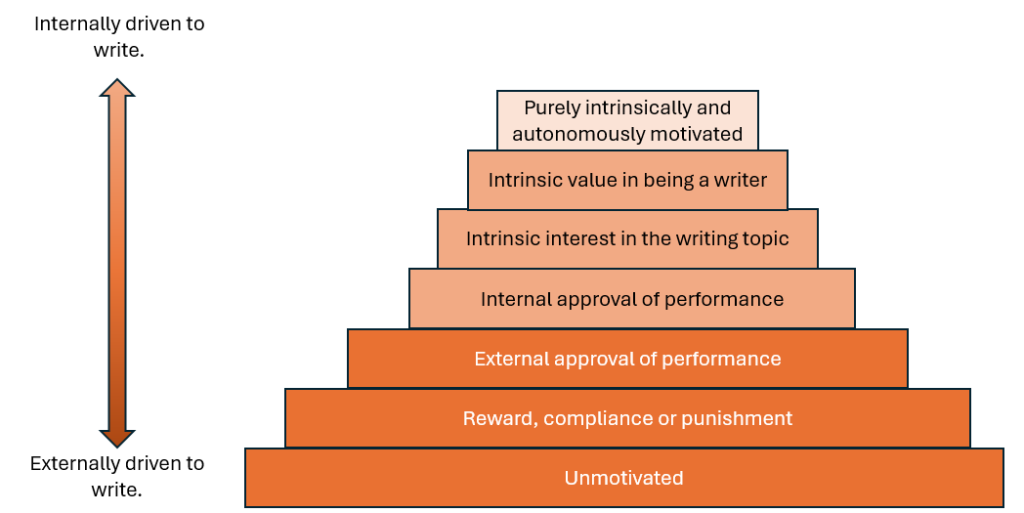
This article outlines how to support children with their early word writing.
Specific literacy skills for supporting early word writing
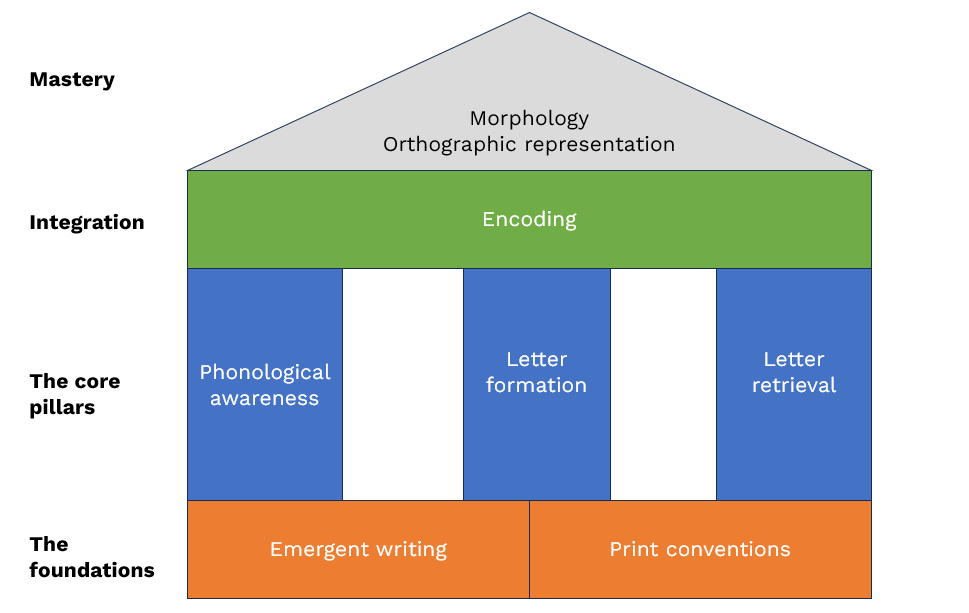
Successful word writing is a complex task requiring the integrated effort of several literacy skills (Feldgus et al. 2017; Treiman & Kessler 2014; Zhang et al. 2025). These include:
Specific literacy skills for supporting early word writing
Emergent writing
This is the most foundational stage and encompasses all of a child’s attempts at writing before they know about phoneme-grapheme correspondence.
It includes scribbling, drawing, making letter-like shapes and writing strings of letters that aren’t necessarily mapped to corresponding sounds (Byington & Kim 2017; Pinto, G., & Incognito 2022).
Children lean on their emergent writing practices while they continue to learn more about conventional ‘adult’ writing (Feldgus et al. 2017; Young & Ferguson 2024a).
Correlation with word writing is strong because it indicates a child has already engaged in exploring the functional purpose of writing (Gerde et al. 2012).
Watching someone write often grabs young children’s attention. Children like to imitate the actions of adults. If a young child sees you writing, they will want to participate and copy you. If children regularly spend time in the company of others writing, they will ‘write’ alongside them. As a result, they can learn to engage with writing long before they can form letters. This gives them valuable early experiences with being a writer.
Print conventions
Understanding that in the English writing system writing typically moves left-to-right, top-to-bottom and spaces are used to separate words.
Essential for readability; should be modelled during reading and writing experiences (Cabell et al. 2007; Dunsmuir & Blatchford 2004).
Letter formation
Knowing how to correctly form individual letters (graphemes).
Crucial. Slow or poor formation consumes working memory and can negatively impact a child’s composing (Puranik & Al Otaiba 2012; Reutzel et al. 2019; Santangelo & Graham 2016).
Letter retrieval
The automaticity of selecting the correct letter shape(s) (grapheme) for a specific sound (phoneme). Also known as automaticity of phoneme-grapheme correspondence.
This is the primary skill for phonetic spelling. The automaticity of retrieving the correct letter pattern (grapheme) for a sound is the strongest immediate predictor of early writing success (Caravolas et al. 2001; Malpique et al. 2020; Puranik & Al Otaiba 2012).
Phonological awareness
The ability to isolate and hear the individual sounds (phonemes) within a spoken word. This is critical for children to translate the sounds they can hear into words on the page.
The ability to break spoken words into individual sounds dictates whether a child can attempt phonetic spelling (Cabell et al. 2022). Inviting children to write can develop their phonological awareness (Vernon & Ferreiro 1999; Zhang et al. 2017).
Encoding
The integrated act of segmenting a word, selecting the correct letter(s) for each sound, and sequencing them to write an informed or otherwise conventionally spelt word (Feldgus et al. 2017; Young & Ferguson 2024a).
This is the output measure itself. If children are successfully encoding words, the above required sub-skills are well integrated and working well (Feldgus et al. 2017; Puranik & Al Otaiba 2012; Treiman & Kessler 2014).
Morphology
The ability to understand and manipulate morphemes (the smallest units of meaning in a word, such as prefixes, suffixes, and root words).
Provides powerful knowledge for spelling longer and more complex words (e.g. un- help -ful), reducing reliance on encoding individual sounds.
Accelerates spelling progress in later stages (Devonshire & Fluck 2010; McCutchen & Stull 2015; Nunes et al. 2003; Wolter et al. 2009).
Orthographic representation
The ability to store and retrieve specific letter sequences from memory (lexical knowledge). This involves recalling a word’s conventional spelling (especially important for irregular words).
Crucial for moving from phonetic spelling (kat for cat, sed for said) to full conventional spelling (Treiman & Kessler 2014).
Cognitive and perpetual skills for early word writing
These seven underlying cognitive and perpetual capacities are the fuel that drive children towards successful word writing.

Cognitive and perpetual skills for early word writing
| Cognitive/perceptual focus | Importance to early word writing |
| Working memory | Arguably the most critical cognitive skill. Working memory holds the spoken word, the segmented sounds, and the sequence of letters being transcribed in the mind (Berninger et al. 2010; Kellogg 2001; Leidershnaider 2025; Hooper et al. 2011; Zhang et al. 2017). |
| Oral language and vocabulary | A child must know the words that best represent what it is they want to say. Strong oral language, particularly at the full discourse level, is a powerful predictor of overall writing quality (Cabell et al. 2022; Kim & Schatschneider 2017; Puranik & Lonigan 2012; Seoane et al. 2025). |
| Motor skills | Directly impacts the fluency of word writing. When graphomotor speed is slow, it creates a bottleneck, diverting working memory away from composing (Leidershnaider 2025; Hooper et al. 2011; Puranik & Al Otaiba 2012). |
| Metacognitive skills | Refers to functions like planning, self-monitoring, and checking (Balade et al. 2025; Limpo & Olive 2021). |
| Processing speed | The efficiency of converting sounds to letters and physically producing them (Afonso et al. 2020). |
| Attention and focus | Sustained concentration is necessary for word writing (Kim & Schatschneider 2017). |
| Long-term memory | The broad category that stores all knowledge (vocabulary, letter forms, orthographic representations). Its function is obviously embedded within the other skills listed (Caravolas et al. 2001). |
Engagement with early word writing
As Donald Graves (1983, p.1) famously announced: Children want to write. They want to write from their very first day of school. Keeping that motivation alive is essential as children who are motivated to write are more likely to: put in increased effort, persist for longer, show more enthusiasm, give writing more of their attention and be more willing to seek help from others.

This engagement requires: (1) explicit modelling and instruction in the skills required to be successful and (2) regular meaningful, motivating and pleasurable writing experiences.
Word writing progression
Students’ abilities in word writing develop along a continuum, moving through distinct phases that are greatly facilitated by systematic instruction and meaningful writing experiences. For word writing, this progression is often conceptualised in five phases:
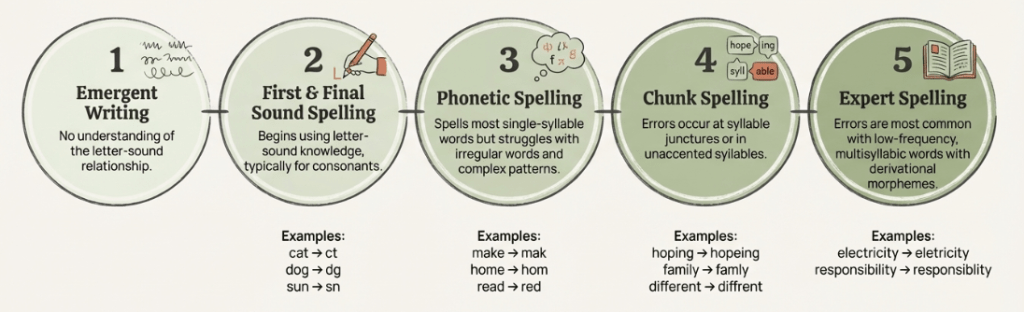
1. Emergent writing
The child hasn’t yet got an understanding of the systematic relationship between letters and sounds. To see the specific stages of emergent writing, click here.
2. First and final sound spelling
The child begins using their letter-sound knowledge but accuracy is usually limited to consonants and short vowels.
- cat → ct (child writes the consonants, may omit vowels)
- dog → dg
- sun → sn
- bat → bt
3. Phonetic spelling
The child can spell most single-syllable words but struggles with irregular words and more complex patterns like silent long-vowels.
- make → mak or make (may omit the silent e)
- home → hom
- bike → bik
- read → red or reed (confusion with long-vowel spelling patterns)
4. Chunk spelling
Errors typically occur at syllable junctures or in unaccented syllables.
- hoping → hopeing (error at the syllable juncture where the silent “e” should be dropped)
- running → runing (omitting the doubled consonant at the syllable break)
- family → famly (dropping an unaccented syllable)
- different → diffrent (leaving out the unstressed middle syllable)
5. Expert spelling
Errors are most common with low-frequency, multisyllabic words involving derivational morphemes.
- electricity → eletricity (dropping a syllable within a derived form)
- responsibility → responsiblity (omitting the derivational suffix syllable)
- biological → bioligical (confusing the placement of the derivational suffix -ical)
- nation → natian (misapplying the derivational -ion pattern)
It is important to note that these developmental phases are not rigid and children will move between these stages depending on the specific word they wish to write.
Approaches to early writing
The main approaches to early writing include: writing readiness, naturalistic, reading first and communicative (Young & Ferguson 2024b). Each approach profoundly shapes how you teach young writers. Teachers should adjust how much each approach influences their practice based on what they believe their class needs most.
1. Writing readiness stresses early transcription skills. It helps children who struggle with the foundational skills of writing. However, taken to its extreme, it can deny children meaningful writing experiences. Children can begin to see writing as nothing more than transcriptional drills which serve no purpose (Young & Ferguson 2025a). At its worst, it creates passive and disengaged writers.
2. Naturalistic stresses freedom, self direction and self-expression. It values emergent writing, individual pacing, and children’s own volition to write (Edelsky 1990). Taken to its extreme, it can avoid providing explicit instruction, leave some children without the experiences or support they need, and can be in conflict with modern-day curriculum requirements.
3. Reading first erroneously delays the teaching of writing in favour of teaching early reading. Research does not support such an approach. Writing instruction and experiences boost children’s reading development. Reading and writing are mutually beneficial (Graham & Hebert 2011; Kim 2022a, 2022b; Vernon & Ferreiro 1999).
4. Communicative stresses providing explicit instruction alongside writing for real purposes and audiences (Young & Ferguson 2025b). Daily opportunities to engage in meaningful writing is seen as essential. It balances explicit teacher modelling and instruction with opportunities for meaning making and meaning sharing. It looks to create a community of writers with the focus on successfully communicating with readers.
We view a communicative approach as the best starting point for early writing. This is because it brings together (1) systematic synthetic phonics, (2) letter formation/handwriting instruction, (3) spelling instruction (4) explicit teacher modelling and writing instruction, and (5) daily opportunities to engage in meaningful writing experiences.
Research-supported recommendations
Six key recommendations emerge from research for effective word writing:
1. Teach phonological awareness
This involves systematic instruction in manipulating sounds (e.g. blending, segmenting). This comprehensive sequence reflects a consensus among structured synthetic phonics programs, all of which prioritise a systematic introduction to phoneme-grapheme relationships.
2. Teach letter formation
Explicitly model and teach letter formation (see here for more). Handwriting instruction should focus on: frequent exposure, making name-sound connections, teaching visually similar letters non-sequentially, and building automaticity in both letter recognition and letter writing. Here is a recommended order of teaching:

3. Model encoding strategies and encourage children to write their own informed ‘sound spellings’
Teachers should regularly model how to encode words to paper. An analytic approach should be used for irregular words. Teachers should focus children’s attention on the parts of a word that do follow predictable patterns (e.g. the sh and d in should) (McGeown et al. 2013). Informed ‘sound spellings’ let children represent the sounds they hear, even if the spelling is unconventional or incomplete. It is not an error but a sign of their developing phonological awareness and a crucial practice ground for encoding (Ouellette & Sénéchal 2008; Treiman 2017).
4. Model chunking
As students progress, they must learn to process chunks larger than individual graphemes. This includes modelling:
(1) common rime units or phonograms (e.g. -ock, -ight, -ean),
(2) syllable types:
- Closed syllables (CVC): cat, hop, pen
- Open syllables (CV): he, go, me
- Vowel-consonant-e (VCe): make, bike, hope
- Unaccented final syllables: table, pencil, cabin
(3) morphemes (e.g., prefixes, suffixes, roots)
- Prefixes: un- (undo, unhappy), re- (redo, rewrite)
- Suffixes: -ful (hopeful, careful), -less (hopeless, fearless)
- Roots: struct (construct, destruct, structure), port (transport, portable, import)
Activities like word sorts and word building are highly effective for this type of learning.
5. Encourage children to use ‘kid writing’ for the phoneme- grapheme correspondence they don’t yet know and utilise ‘underwriting’
When children encounter a grapheme-phoneme correspondent they haven’t learnt yet, they should be encouraged to use a simple line or squiggle as a placeholder. This is sometimes called using your ‘kid writing’ (Feldgus et al. 2017). Kid writing is a powerful assessment tool as it quite literally shows you the gaps in children’s understanding of word writing.

Underwriting is the practice of transcribing a child’s kid writing or informed spelling into conventional adult spelling. This is typically done under or at the bottom of their original writing. When implemented correctly, it is a powerful teaching tool and feedback mechanism (Ouellette & Sénéchal 2008; Puranik & Lonigan 2014).
Best practice involves ensuring it is done with the child’s consent and presence, celebrating what the child already knew about the word they wanted to write (e.g. underlining their correct sounds), and providing a conventional spelling model for their reference. It offers valuable opportunities for individualised responsive instruction and should be used selectively, never before the child has made their own attempt so as to avoid undermining their confidence and intrinsic motivation to write independently (Treiman & Kessler 2014). For more, see this article.
6. Provide meaningful writing experiences
Children should be regularly invited to use and apply their word writing skills in the context of meaningful writing experiences. Students should be encouraged to apply their ever developing encoding knowledge in daily book-making/writing time (see here for more), reinforcing the connection between skill acquisition and authentic communication.
References and further reading
- Afonso, O., Martínez-García, C., Cuetos, F., & Suarez-Coalla, P. (2020). The development of handwriting speed and its relationship with graphic speed and spelling. Cognitive Development, 56, 100965.
- Balade, J., Rodríguez, C., & Jiménez, J. E. (2025). Developmental Trajectories of Transcription and Oral Language Skills in Kindergarten Students: The Influence of Executive Functions and Home Literacy Practices. Journal of Intelligence, 13(12), 163.
- Berninger V. W., Abbott R.D., Swanson H. L., Lovitt, D., Trivedi, P., Lin, S. J., Gould, L., Youngstrom, M., Shimada, S., Amtmann. D. (2010). Relationship of word-and sentence-level working memory to reading and writing in second, fourth, and sixth grade. Lang Speech Hear Serv Sch, 41(2), 179-93.
- Byington, T. A., & Kim, Y. (2017). Promoting preschoolers’ emergent writing. YC Young Children, 72(5), 74-82.
- Cabell, S. Q., McGinty, A. S., & Justice, L. M. (2007). Assessing print knowledge In Assessment in emergent literacy (pp. 327-376).
- Cabell, S. Q., Gerde, H. K., Hwang, H., Bowles, R., Skibbe, L., Piasta, S. B., & Justice, L. M. (2022). Rate of growth of preschool-age children’s oral language and decoding skills predicts beginning writing ability. Early Education and Development, 33(7), 1198-1221.
- Caravolas, M., Hulme, C., & Snowling, M. J. (2001). The foundations of spelling ability: Evidence from a 3-year longitudinal study. Journal of Memory and Language, 45(1), 740–754.
- Devonshire, V., & Fluck, M. (2010). Spelling development: Fine-tuning strategy-use and capitalising on connections between words. Learning and Instruction, 20, 361–371.
- Dunsmuir, S., & Blatchford, P. (2004). Predictors of writing competence in 4‐to 7‐year‐old children. British journal of educational psychology, 74(3), 461-483.
- Edelsky, C. (1990). Whose agenda is this anyway? A response to McKenna, Robinson, and Miller. Educational Researcher, 19(8), 7-11.
- Feldgus, E. G., Cardonick, I., & Gentry, J. R. (2017). Kid writing in the 21st century: A systematic approach to phonics, spelling, and writing workshop. Hameray Publishing Group.
- Gerde, H. K., Bingham, G. E., & Wasik, B. A. (2012). Writing in early childhood classrooms: Guidance for best practices. Early childhood education journal, 40(6), 351-359.
- Graham, S., & Hebert, M. (2011). Writing to read: A meta-analysis of the effects of writing instruction on reading comprehension and reading skills. Review of Educational Research, 81(2), 189–211.
- Graves, D. H. (1983). Writing: Teachers and children at work. Heinemann.
- Hofslundsengen, H., Gustafsson, J. E., & Hagtvet, B. E. (2019). Contributions of the home literacy environment and underlying language skills to preschool invented writing. Scandinavian Journal of Educational Research, 63(5), 653-669.
- Hooper, S. R., Costa, L. J., McBee, M., Anderson, K. L., Yerby, D. C., Knuth, S. B., & Childress, A. (2011). Concurrent and longitudinal neuropsychological contributors to written language expression in first and second grade students. Reading and Writing, 24(2), 221-252.
- Kaderavek, J. N., Cabell, S. Q., & Justice, L. M. (2009). Early writing and spelling development. Emergent literacy and language development: Promoting learning in early childhood, 104-152.
- Kellogg, R. T. (2001) Competition for working memory among writing processes, American Journal of Psychology, 114(2), 175–191
- Kim, Y.-S., Otaiba, S. A., Puranik, C., Folsom, J. S., Greulich, L., & Wagner, R. K. (2011). Componential skills of beginning writing: An exploratory study. Learning and Individual Differences, 21(5), 517–525.
- Kim, Y. S., Al Otaiba, S., Folsom, J. S., Greulich, L., & Puranik, C. (2014). Evaluating the dimensionality of first-grade written composition. Journal of Speech, Language, and Hearing Research, 57(1), 199-211.
- Kim, Y. S. G., & Schatschneider, C. (2017). Expanding the developmental models of writing: A direct and indirect effects model of developmental writing (DIEW). Journal of educational psychology, 109(1), 35.
- Kim, Y. S. G. (2022a). A Tale of Two Closely Related Skills: Word Reading and Spelling Development and Instruction. In Z. A. Philippakos & S. Graham (Eds.), Writing and reading connections: Bridging research and practice. Guilford Press
- Kim, Y. S. G. (2022b) Co-Occurrence of Reading and Writing Difficulties: The Application of the Interactive Dynamic Literacy Model, Journal of Learning Disabilities, 00222194211060868
- Lacina, J., Roberts, S. K., & Crawford, P. A. (2025). Celebrating Pathways to Joyful and Meaningful Writing with Young Children. Early Childhood Education Journal, 1-6.
- Leidershnaider, L. (2025). Investigating the Relationship Between Cognitive Load and Writing Task Complexity in Grades 4-6 School-Aged Children (Master’s thesis, University of Toronto (Canada)).
- Limpo, T., & Olive, T. (Eds.). (2021). Executive functions and writing (Vol. 19). Oxford University Press.
- Machón, A. (2023). Drawings by Children Between 3 and 4 Years of Age: Developmental Study of the Period of Form and Graphic-Symbolic Representation. In The Routledge International Handbook of Research on Writing (pp. 20-35). Routledge.
- Malpique, A. A., Pino-Pasternak, D., & Roberto, M. S. (2020). Writing and reading performance in Year 1 Australian classrooms: Associations with handwriting automaticity and writing instruction. Reading and Writing, 33(3), 783-805.
- McCutchen, D., & Stull, S. (2015). Morphological awareness and children’s writing: accuracy, error, and invention. Reading and writing, 28(2), 271-289.
- McGeown, S. et al. (2013a). Individual differences in children’s reading and spelling strategies and the skills supporting strategy use. Learning and Individual Differences, 28, 75-81. https://doi.org/10.1016/j.lindif.2013.09.013
- McGeown, S. et al. (2013b). Towards an understanding of how children read and spell irregular words: the role of nonword and orthographic processing skills. Journal of Research in Reading. https://doi.org/10.1111/jrir.12007
- Nunes, T., Bryant, P., & Olsson, J. (2003). Learning morphological and phonological spelling rules: An intervention study. Scientific Studies of Reading, 7, 289–307. doi:10.1207/S1532799XSSR0703_6
- Ouellette, G., & Sénéchal, M. (2008). Pathways to literacy: A study of invented spelling and its role in learning to read. Child development, 79(4), 899-913.
- Pinto, G., & Incognito, O. (2022). The relationship between emergent drawing, emergent writing, and visual‐motor integration in preschool children. Infant and Child Development, 31(2), e2284.
- Pollo, T. C., Kessler, B., & Treiman, R. (2009). Statistical patterns in children’s early writing. Journal of experimental child psychology, 104(4), 410-426.
- Puranik, C. S., & AlOtaiba, S. (2012). Examining the contribution of handwriting and spelling to written expression in kindergarten children. Reading and writing, 25(7), 1523-1546.
- Puranik, C. S., & Lonigan, C. J. (2012). Early writing deficits in preschoolers with oral language difficulties. Journal of Learning Disabilities, 45(2), 179-190.
- Puranik, C. S., & Lonigan, C. J. (2014). Emergent writing in preschoolers: Preliminary evidence for a theoretical framework. Reading research quarterly, 49(4), 453-467.
- Reutzel, P., Mohr, K. A., & Jones, C. D. (2019). Exploring the relationship between letter recognition and handwriting in early literacy development. Journal of Early Childhood Literacy, 19(3), 349-374.
- Rose, J. (2006). Independent review of the teaching of early reading. Department for Education and Skills.
- Rowe, D. W. (2023). Writing in early childhood. In The Routledge international handbook of research on writing (pp. 187-205). Routledge.
- Santangelo, T., & Graham, S. (2016). A comprehensive meta-analysis of handwriting instruction. Educational psychology review, 28(2), 225-265.
- Seoane, R. C., Wang, J., Cao, Y., & Kim, Y. S. G. (2025). Unpacking the Relation Between Oral Language and Written Composition: A Meta-Analysis. Review of Educational Research, 00346543251320359.
- Thomas, L. J., Gerde, H. K., Piasta, S. B., Logan, J. A., Bailet, L. L., & Zettler-Greeley, C. M. (2020). The early writing skills of children identified as at-risk for literacy difficulties. Early Childhood Research Quarterly, 51, 392-402.
- Treiman, R., & Kessler, B. (2014). How children learn to write words. Oxford University Press.
- Vernon, S., & Ferreiro, E. (1999). Writing development: A neglected variable in the consideration of phonological awareness. Harvard Educational Review, 69(4), 395-416.
- Wolter, J. A., Wood, A., & D’zatko, K. W. (2009). The influence of morphological awareness on the literacy development of first-grade children. Language, Speech, and Hearing Services in Schools, 40(3), 286-298.
- Young, R., Ferguson, F. (2024a) Getting children up and running as writers Brighton: The Writing For Pleasure Centre
- Young, R., Ferguson, F. (2024b) The different perspectives you can take on teaching early writing.[https://writing4pleasure.com/2024/03/15/the-different-perspectives-you-can-take-on-teaching-early-writing/]
- Young, R., Ferguson, F. (2025a) The research on developing children’s transcription and compositional skills. https://writing4pleasure.com/the-research-on-developing-childrens-transcription-and-compositional-skills/%5D
- Young, R., Ferguson, F. (2025b) How to teach writing in the EYFS [https://writing4pleasure.com/how-to-teach-writing-in-the-eyfs/]
- Zhao, Y., Gerde, H. K., Shu, L., & Gagne, J. R. (2025). Evidence-based instructional support for early writing in preschool and kindergarten: a scoping review. Reading and Writing, 1-27.
- Zhang, C., Bingham, G. E., & Quinn, M. F. (2017). The associations among preschool children’s growth in early reading, executive function, and invented spelling skills. Reading and Writing, 30(8), 1705-1728.
- Zhang, C., & Bingham, G. E. (2019). Promoting high-leverage writing instruction through an early childhood classroom daily routine (WPI): A professional development model of early writing skills. Early Childhood Research Quarterly, 49, 138-151.
- Zhang, X. Y., Bingham, G. E., Branum‐Martin, L., Gerde, H. K., & Bowles, R. P. (2025). Assessing Early Writing in Preschool: Attention to Early Writing Tasks and Component Skills. Reading Research Quarterly, 60(4), e70051.
Further recommended reading
The power of emergent writing
- How can you teach children to write before they know their letters? [LINK]
- Debunking edu-myths: ‘Emergent writing’ isn’t necessary before teaching children to write [LINK]
- Debunking the ‘bones aren’t ready’ and ‘motor skills first’ myths: What research says about young children’s handwriting [LINK]
- Promoting preschoolers’ emergent writing [LINK]
Living the writer’s life: A daily routine for writing in the EYFS
- How to teach writing in the EYFS [LINK]
- Developing motivated and successful writers in the EYFS [LINK]
- Research-based writing practices specific to the EYFS [LINK]
- What are children doing as they produce writing? [LINK]
“This when we ‘play’ writing…” The pleasure of book-making
- “This is when we play writing!”: Writing and play in the EYFS [LINK]
- Drawing first, writing after: A winning strategy for early writers [LINK]
- Teaching children how to plan their writing in the EYFS and KS1 [LINK]
“Miss, do you like my adult writing?” Teaching encoding strategies
- Encoding and ‘informed spellings’ [LINK]
- Teaching encoding [LINK]
- Underwriting: Should teachers do it? [LINK]
- Early alphabet instruction [LINK]
- Early spelling development [LINK]
Writing words, phrases and sentences
- Two for the price of one: Developing children’s word reading and word writing [LINK]
- Transcription and oral language are key to children’s early writing development [LINK]
- Developing children’s talk for writing [LINK]
- What is writing fluency? [LINK]
- How do we develop writing fluency? [LINK]
- Building up to extended writing projects [LINK]
- The Writing For Pleasure Centre’s sentence-building mini-projects [LINK]
Recommended publications
- Already Ready: Nurturing Writers in Preschool and Kindergarten by Katie Wood Ray & Matt Glover [LINK]
- Kid Writing: A Systematic Approach to Phonics, Journals, and Writing Workshop by Eileen Feldgus & Isabell Cardonick [LINK]
- How Children Learn To Write Words by Rebecca Treiman & Brett Kessler [LINK]
- Never Too Early To Write by Bea Johnson [LINK]
- A Teacher’s Guide to Getting Started with Beginning Writers by Katie Wood Ray & Lisa Cleaveland [LINK]
- What Changes In Writing Can I See? by Marie Clay [LINK]
- What Did I Write? by Marie Clay [LINK]
- Handbook On The Science of Early Literacy by Sonia Cabell, Susan Neuman, and Nicole Patton Terry [LINK]
- Children’s Reading And Spelling: Beyond The First Steps by Terezinha Nunes and Peter Bryant [LINK]
- Literacy Learning For Infants, Toddlers, & Preschoolers by Tanya Wright, Sonia Cabell, Nell Duke & Mariana Souto-Manning [LINK]
- Understanding and Supporting Young Writers from Birth to 8 by Noella Mackenzie & Janet Scull [LINK]
- Writing Begins At Home: Preparing Children For Writing Before They Go To School by Marie Clay [LINK]
- How Very Young Children Explore Writing by Marie Clay [LINK]
- Gnys At Wrk: A Child Learns to Write and Read by Glenda Bissex [LINK]
- Adam’s Righting Revolutions: One Child’s Literacy Development From Infancy Through Grade One by Judith Schickedanz [LINK]
- Family Literacy: Young Children Learning To Read & Write by Denny Taylor [LINK]
- Children’s Language: Connecting Reading, Writing & Talk by Judith Wells Lindfors [LINK]
- Before Writing by Gunther Kress [LINK]