Children as Writers: Does choice impact motivation in Year 6 writing? by Alice Bidder

By Alice Bidder – Hartland International School

How many times have you needed to write a diary from the perspective of an evacuee or a non-chronological report on the Vikings in your life? Most probably, never. However, how often do we need to write a letter to bring about change or engage in writing that explains a process or discusses difficult issues? 

This action research project aims to measure the impact of choice on writing motivation in Year 6. 

Background of the problem

At Hartland, we felt we needed to remodel our writing curriculum to give the children a clear purpose for writing. Too often we were receiving 26 copies of the same narrative that had been “innovated” from a model text. It lacked creativity and children were not motivated to write. Therefore, we began the journey to improve attitudes to writing through Ross Young and Felicity Ferguson’s Writing for Pleasure framework. 

It has long been a challenge to have children write at length in Year 6 and so introducing the element of choice was introduced to combat this. The Writing for Pleasure centre has created a framework for primary writing that puts supporting children’s choices at the heart of the curriculum. New to the role of English lead for the academic year 2024-25, it was a school-wide priority to give both students and teachers alike the opportunity to make changes to their attitudes towards writing.

Literature review

The National Literacy Trust: Children and young people’s writing in 2024, reported on worrying statistics for the state of children’s motivation for writing. In a survey of 76,131 children and young people, fewer than 3 in 10 children (28.7%) reported that they choose to write in their free time. Furthermore, 44.0% of children and young people aged 8 to 18 struggled with deciding what to write, and 1 in 3 (36.8%) admitted that they only wrote when they had to. This further highlights the need to consider curriculum choices when delivering writing lessons to pupils. As teachers, we have a duty to inspire children’s writing ideas and provide support with this process when needed.

In the academic year 2023/24, 72% of children met the standard for writing in teacher assessments (DfE 2025). This is a decline of 6% since before the pandemic in 2020. Additionally, students achieving greater depth remained at 13%. Another decrease, down from 20% before the pandemic. These statistics demonstrate the rapid decline in outcomes for writing in the United Kingdom. Curriculum design over the last decade has been catered towards ‘cross-curricular learning’. Often, history and geography content is taught through English lessons and so writing instruction can be secondary to exploring texts that are didactic to the curriculum topics (Young & Ferguson 2021).

Methodology

The action research approach to measure the impact of choice in writing was necessary as it is important to review practice regularly and make changes to achieve maximum impact. It is also important to reflect and review each action research cycle to understand what methods are not providing impact and so should be revised before the next cycle. 

In this research, this took the form of a new writing project every 6-8 weeks. At each milestone, outcomes for writing were assessed and where students had been successful, their writing choices were analysed to depict why this was. The study aimed to answer three questions: 

  1. Does supporting children’s writing choices impact their writing motivation?
  2. Does supporting children’s writing choices impact their writing enjoyment?
  3. Does supporting children’s writing choices impact their identities as writers?

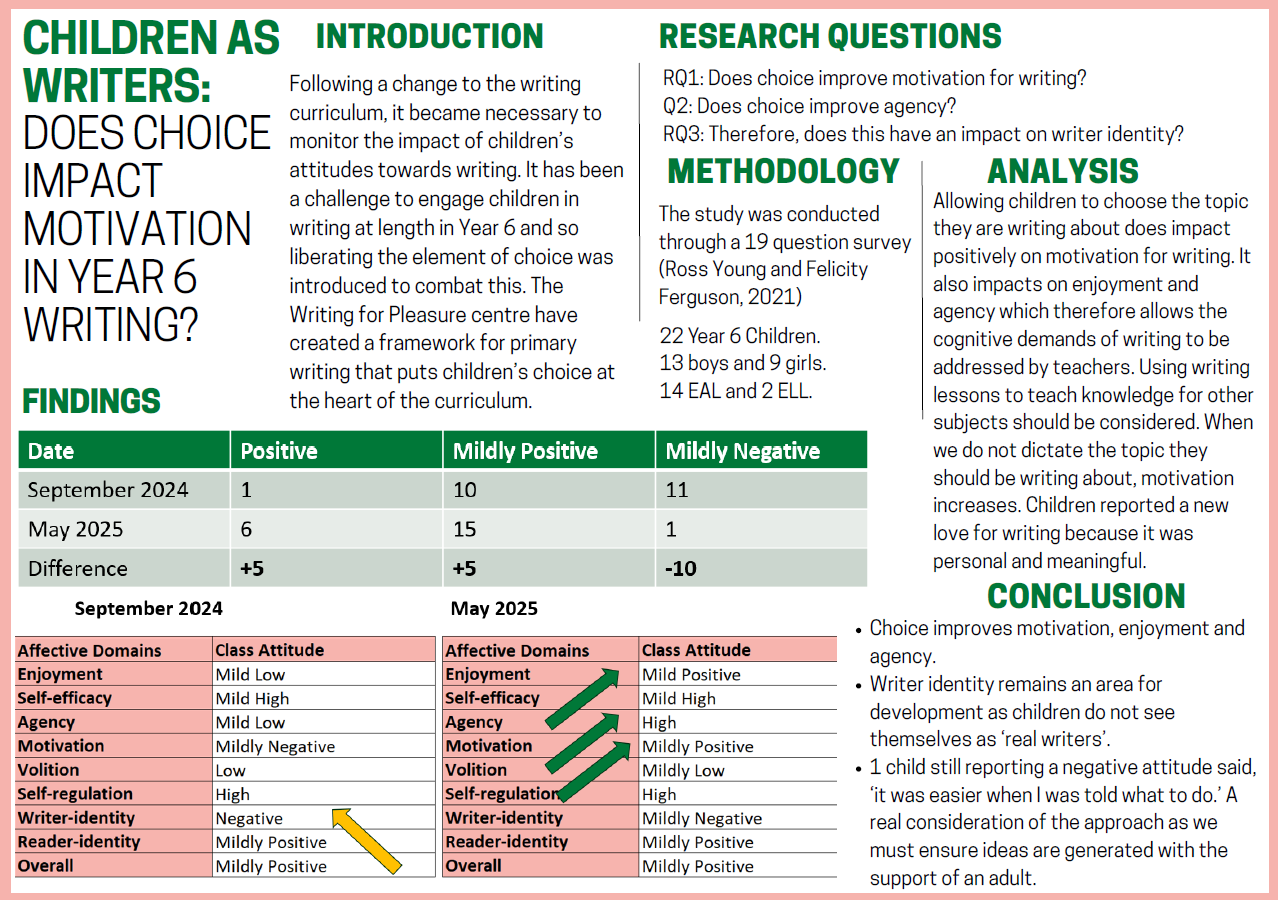
The research began with a Children As Writers survey. All children completed the survey of 19 questions, each written to measure one of the affective domains of writing (Table 1). This was then reviewed in May 2025 with a final measure of the affective domains (Table 2). Student interviews were conducted in May 2025 to further understand a small percentage of the outcomes.

  • Participants: The sample included 22 students. 13 boys and 9 girls from a Year 6 class in an International, British Curriculum school in Dubai.
  • Data Collection: 22 students completed a survey in September 2024 and then repeated the same survey in May 2025. 1 student interview was conducted in May 2025.

Data analysis

In September 2024, children, as a collective, reported ‘mild low’ enjoyment, ‘mildly negative’ motivation and ‘mild low’ agency (Table 1). This showed that children did not have a positive outlook on writing, were not motivated to write and felt that they did not have ownership over their writing. As Year 6 children, aged 10-11, attitudes towards writing are often challenging to change as they have spent six years at primary school and have the most experience with the subject. Therefore, the results of the survey were not surprising at this stage.

Table 1: Outcomes of the ‘Children As Writers’ survey in September 2024.

The aim of the survey was to focus on enjoyment, motivation and writer-identity. This is because motivation in particular is linked to increased persistence, attention and effort (Young 2024). These behaviours are also related to how children manage the cognitive load of writing (Young & Ferguson 2023). 

Attainment outcomes in writing for the class suggest that 79% are meeting the expected standard and 71% achieving above the standard. Whilst this is significantly above outcomes reported in the United Kingdom, the assessment framework used was not the same criteria. The Knowledge and Human Development Association (KHDA) is the governing body for Dubai and the assessment framework used reflects the demands of the country. 

However, it is possible to compare the 79% meeting the standard as a reflection of the success of the writing curriculum as this is above the 72% meeting the standard in the United Kingdom. Although the aim of the study was not to measure attainment in writing, it is interesting to note the outcomes do not drop when supporting pupils to choose their own writing ideas.

When the survey was replicated in May 2025, results showed a positive increase in all the affective domains. Significantly, enjoyment and motivation. Whilst the domain of writer-identity has increased from ‘negative’ it remains ‘mildly negative’ from student’s final responses. When questioned about this, children reported ‘real writers are published authors, not children’. Therefore, this will continue as a priority next academic year. 

Teachers should strive to work on children’s opinion of themselves as writers and engage with them as ‘real’ authors to demonstrate that the writing process is the same for them as it is for recreational or professional adult writers.

Table 2: Outcomes of the ‘Children As Writers’ survey in May 2025.

On an individual basis, the survey also reported an overall attitude to writing based on a five level scale: negative, mild negative, mild positive, positive and very positive. In the initial survey, 1 student had a positive attitude towards writing. 10 were mildly positive and 11 were mildly negative. This culminated in a 50% negative outlook and 50% positive. After a year of using the ‘Writing for Pleasure’ framework and giving children choice in their writing lessons, 6 children reported a positive attitude (23% increase), 15 were mildly positive (23% increase) and 1 remained mildly negative (45% decrease).

Table 3: Individual outcomes of the survey with differences shown.

Results

  • Research question 1: Does supporting student choice improve children’s motivation to write?

Yes, in the context of the children in the sample.

  • Research question 2: Does supporting student choice improve children’s writing enjoyment? 

Yes, in the context of the children in the sample.

  • Research question 3: Does supporting student choice improve children’s writer-identities?

Not to a positive level, yet.

Discussion and reflection

When comparing the findings of the study to the literature available, it can be said that supporting children to make their own writing choices improves their motivation, enjoyment and agency as young writers. This is an issue that is being felt in the international school systems as well as in the United Kingdom. A simple change in teacher practice should be to involve children in the idea generation stage of a class writing project. If children are being dictated to about the topic they must write about, we cannot hope for improved motivation for writing both in and outside of the classroom (Young & Ferguson 2021). Teachers should reflect on how weighted their English curriculums are towards other subjects as opposed to explicitly focusing on the teaching of writing. For example, are their writing curriculums simply a supplement for their reading or wider-curriculum subjects (history/geography)? If they want to improve the attitudes of their students and their writing outcomes, they might need to think again. 

On a personal level, my practice has improved as I have reflected on each writing cycle to continually take children’s voices into account when planning a unit. Explicitly modelling and teaching children idea generation strategies as part of the sequence has improved in each iteration. I have also had time to reflect on the successful pieces of writing as well as asked children what I could have done differently. When planning lessons to support children with coming up with their own ideas, I started quite open and free as I thought this would be the best approach. However, when I was met with a sea of blank faces and a chorus of ‘I don’t know’, I knew that idea generation techniques have to be explicitly taught and modelled if we are going to support pupils. We developed lessons from Young and Ferguson’s materials to teach the ‘I am an expert’ and ‘Let’s have an ideas party’ techniques. 

It was important to engage with the advice with the authors of the framework that stated, ‘giving children choice doesn’t mean you can’t give advice or direction’ (Young & Ferguson 2025). This statement is further supported by additional advice for staff: ‘teachers can be direct and tell children to choose something else – as long as they can explain to the child why’. This highlights the important role that the teacher has at this stage in the writing process to ensure that children’s ideas will be fruitful and beneficial to their progress as a writer. We must provide children with the confidence that their ideas matter and other people will be interested in reading their writing.

The introduction of ‘faction’ (a blend of facts and fiction) has also been an important element to our lessons and curriculum. This teaches children that writing lessons are not always about regurgitating facts and curriculum content but about teaching them the skills to become great writers. It does not matter if ‘the facts’ in their faction writing are true. The beauty of faction is that children get to invent their own facts whilst focusing on the objectives of the writing curriculum and developing their authorial voice.

All teachers at Hartland have followed this approach for the academic year. This will continue indefinitely as we feel, across the school, children’s motivation has greatly improved. Next year, teachers in all year groups will carry out the Children As Writers survey with their classes at the beginning and end of the year. In its initial phase, this will give teachers an understanding of their classes’ current attitude and give them clear next steps on which domains need to be addressed.

Conclusion

In conclusion, choice has an impact on motivation and enjoyment of writing. Teachers should reflect on their current writing curriculum and aim to involve children in the process. Their ideas should be at the heart of their writing during writing lessons and teachers should focus on explicitly teaching writing skills rather than delivering content for other subjects. Writing lessons must be carefully planned and student choice should not be interpreted as providing a lack of direction.

Debunking edu-myths: Pupils should write about the wider-curriculum subjects in writing lessons

“Writing about what they’ve learned in other subjects means pupils have a strong knowledge pool from which to draw.”

This idea – that writing lessons should be used as vehicles for cross-curricular learning – seems appealing. It suggests efficiency, curriculum integration, and meaningful outcomes. But it risks misunderstanding how writing and learning actually work.

Let’s examine what the research really says.

❌ Myth: Pupils write best when they write about other curriculum topics in writing lessons

This myth assumes that knowledge from other subjects is readily available in children’s long-term memory for them to draw on – that it’s rich, secure, and deeply understood. But research from cognitive science shows that writing is a demanding task that draws heavily on children’s working memory (Young & Ferguson 2022). Let’s face it. Despite our best efforts, pupils rarely have deep and fluent access to subject knowledge from the wider-curriculum. As a result, they routinely struggle – not due to weak writing skills, but because they’re trying to generate content they barely remember.

The reality is that attempting to write about recently taught material can result in cognitive overload. It unnecessarily increases the mental effort children require, leaving them with less capacity to focus on the very writing skills we’re asking them to apply.

✅ What the evidence actually says:

🧠 1. Children write best when they are supported to draw on secure, long-term knowledge.

Cognitive load theory and writing research (Young & Ferguson 2022) show that the most fluent and effective writing happens when pupils can retrieve content without effort. In practice, this means drawing on their own funds-of-knowledge (Young et al. 2023): their lived experiences, personal interests, cultural understandings, family life and hobbies – knowledge already stored and reinforced in their long-term memory.

These reservoirs of knowledge are not only more accessible, but also more valued and meaningful. This means there is both a cognitive and motivational benefit to children choosing their own writing topics to write about (within the parameters of a class writing project) (Young 2024). Writing from a place of familiarity allows children to focus all their attention on writing – sentence construction, voice, and authorial intent – rather than being distracted by wrestling with unfamiliar (and perhaps uninspiring) content.

  • Langer et al. (1984): Highlights the strong and consistent relationship between secure content knowledge and the overall quality of student’s writing.
  • McCutchen (1986): Children produce better quality texts on topics they know well and are motivated by.
  • Benton et al. (1995): Higher levels of knowledge and topic interest generally results in improved writing performance. Writing on topics of their own choosing can be particularly beneficial for less-experienced writers.
  • Kellogg (2001): Children who know their subject well are better able to focus their attention on the quality of their writing.
  • Olinghouse et al. (2015): Children’s level of topic knowledge consistently predicts the overall quality of their story, persuasive, and informative writing.
  • Cremin et al. (2005): Authentic writing flourishes when children are treated as authors, with space to choose what they wish to write about.
  • Graham & Perin (2007): Choice in writing tasks is positively linked to motivation and quality of writing, particularly for struggling or reluctant writers.
  • Graham et al. (2019): Students who possess more knowledge about their writing topic are more likely to produce better quality writing.
  • Bonafede et al. (2025): Pupils who enjoy writing often cite choosing their own writing topics and personal relevance as key motivators.

Young et al. (in press): Pupils with low motivation and confidence in writing regularly report that they wished they had more opportunities to choose what they wrote about within the parameters and structure of whole-class writing projects.

🧾 2. Writing helps children consolidate new knowledge – but timing matters.

However, this where nuance is required. There’s good evidence to suggest that writing supports children’s learning in lessons like history, science, and geography, particularly when it takes the form of summarising, elaboration, or self-explanation (Bangert-Drowns et al. 2004; Fiorella & Mayer 2015). This is the foundation of disciplinary literacy (Shanahan & Shanahan 2008).

This kind of writing is most effective when it occurs in subject lessons and only after pupils have acquired the relevant knowledge. Asking them to write before their understanding is secure can inhibit writing quality and subject learning.

✍️ 3. Writing lessons should focus on teaching writing.

Research highlights the importance of writing lessons focusing explicitly on teaching writing – structure, style, purpose, grammar, and audience (see our Writing Map for more details).

These skills are best taught when cognitive load is reduced and children are able to fully focus on developing their writing. This happens most reliably when pupils are writing about what they already know well. This is especially true for English language learners (Young & Ferguson 2024) and children with special educational needs and disabilities (Young & Ferguson 2023).

💡 So what should we do instead?

Rather than crowbarring wider curriculum content into writing lessons, we should:

  • Explicitly teach children idea generation strategies that model to them how they can find topics from their own secure knowledge base – their experiences, interests, and secure understanding. Of course, if a student shows a particular interest or aptitude for what they are learning in the wider-curriculum, they can decide to write on that subject!
  • Use writing in wider-curriculum subjects as a tool for learning.
  • Recognise that explicitly teaching writing and writing for learning both matter.

🧨 Final thought

It might sound efficient to use writing lessons to ‘double up’ on curriculum content. But the research says otherwise. If we want children to become confident, capable writers, we must teach them how to write from knowledge that is already fully embedded – not with knowledge they are already grappling with to acquire.

🔗 Key References and further reading:

  • Bangert-Drowns, R. L., Hurley, M. M., & Wilkinson, B. (2004). The effects of school-based writing-to-learn interventions on academic achievement: A meta-analysis. Review of educational research, 74(1), 29-58.
  • Benton, S. L., Corkill, A. J., Sharp, J. M., Downey, R. G., Khramtsova, I. (1995) Knowledge, interest, and narrative writing, Journal of Educational Psychology, 87, 66-79
  • Bonafede, F., Clark, C., Picton, I., Cole, A. Young, R. (2025). Children and Young People’s Writing in 2025. National Literacy Trust.
  • Cremin, T., Goouch, K., & Lambirth, A. (2005). Creativity and writing: Developing voice and verve in the classroom. Routledge.
  • Fiorella, L., & Mayer, R. E. (2015). Learning as a generative activity: Eight learning strategies that promote understanding. Cambridge University Press
  • Graham, S., Perin, D. (2007) Writing Next: Effective Strategies to Improve Writing of Adolescents in Middle School & High Schools.Washington, DC:Alliance for Excellent Education
  • Graham, S., Harris, K. R., Fishman, E., Houston, J., Wijekumar, K., Lei, P. W., & Ray, A. B. (2019). Writing skills, knowledge, motivation, and strategic behavior predict students’ persuasive writing performance in the context of robust writing instruction. The Elementary School Journal, 119(3), 487-510.
  • Kellogg, R.T. (2001) Competition for working memory among writing processes, American Journal of Psychology, 114(2), 175–191
  • Langer, J. A. (1984) The effects of available information on responses to school writing tasks, Research in the Teaching of English, 18, 27–44
  • McCutchen, D. (1986) Domain knowledge and linguistic knowledge in the development of writing ability, Journal of Memory and Language, 25(4), 431–444
  • Moll, L., Amanti, C., Neff, D., & Gonzalez, N. (2006). Funds of knowledge for teaching: Using a qualitative approach to connect homes and classrooms. In Funds of knowledge (pp. 71-87). Routledge.
  • Olinghouse, N., Graham, S., Gillespie R. (2015) The Relationship of Discourse and Topic Knowledge to Fifth Graders’ Writing Performance, Journal of Educational Psychology, 107. 10.1037/a0037549
  • Shanahan, T., & Shanahan, C. (2008). Teaching Disciplinary Literacy to Adolescents: Rethinking Content-Area Literacy. Harvard Educational Review.
  • Young, R., Ferguson, F. (2021) Thinking through writing: Writing across the curriculum In Real-World Writers: A Handbook for Teaching Writing with 7-11 Year Olds London: Routledge
  • Young, R., Ferguson, F., Kaufman, D., Govender, N. (2023) Writing Realities Brighton: The Writing For Pleasure Centre
  • Young, R., Ramdarshan Bold, M., Clark, C., McGeown, S. (in press) “It’s healthy. It’s good for you”: Children’s perspectives on utilising their autonomy in the writing classroom” Literacy

How Writing For Pleasure transformed our grammar teaching – and our SATS results by Justin Gisby-Clark

This year, our Year 6 pupils achieved something we are incredibly proud of: 81% met the expected standard in the SPaG (Spelling, Punctuation and Grammar) SATs, and 26% reached the greater depth standard with many only one or two marks away from either threshold. While we are pleased with these results, we are even more proud of how we achieved them. Many factors contribute to pupil success, but we strongly believe that a key influence has been our consistent and thoughtful adoption of the Writing For Pleasure approach this year — particularly the way we’ve embedded grammar mini-lessons within it.

We’ve long known that grammar, when taught in isolation, can feel disconnected from the creative and purposeful act of writing. Children may become skilled at identifying clauses in a test or labelling a fronted adverbial, but struggle to apply these craft moves meaningfully in their own writing. That was the gap we wanted to bridge — and Writing For Pleasure offered exactly the pedagogical shift we needed.

What changed?

Rather than teaching grammar as a stand-alone subject, we wove grammar mini-lessons into our daily writing practice in the form of teaching one focus craft move a day (Young & Ferguson 2022). These were short, focused sessions, often just 10 minutes, drawn directly from what our pupils needed in that moment — either based on our observations of their writing, the product goals (success criteria) they had set for themselves, or the genre and form they were exploring.

These mini-lessons were always contextualised. For example, rather than just explaining what relative clauses are, we looked at how published writers use them to add precision or detail.

Pupils were then simply invited to use them in their own writing that day. Because they understood the why, not just the how, grammar began to feel like a powerful writer’s tool rather than a hurdle to overcome.

Shifting ownership

One of the most powerful outcomes has been a shift in pupil ownership. Our learners began to see themselves as writers who make real authorial choices — not just trying to tick boxes (Myhill 2021; Young 2025). As a result, their use of grammar became more sophisticated, purposeful, and embedded.

We saw pupils experimenting with sentence types, playing with punctuation for effect, and revisiting grammar points not because they were told to, but because they wanted their writing to be clearer, more persuasive, or more engaging. It wasn’t unusual to hear conversations like, “I changed that to a passive because it keeps me at a distance from my reader and I sound more formal,” or “I used a dash here to break up the tension.”

The results speak for themselves

While we always focus first on writing for meaning and purpose, we’ve been thrilled to see how this approach has also delivered measurable results. Our SATs data shows a significant improvement:

  • 81% of our Year 6 pupils met the expected standard in SPaG, a significant increase compared to previous years.
  • 26% reached the greater depth standard, demonstrating a deeper understanding and application of grammar knowledge.

Just as importantly, the children themselves feel more confident and empowered as writers. They approach grammar not as a checklist but as a toolkit, and that shift in mindset has been invaluable.

Looking ahead

We plan to continue deepening this approach across the school, ensuring all pupils —regardless of age or experience — benefit from grammar teaching that is meaningful, responsive, and rooted in real writing (Myhill 2021; Young & Ferguson 2022). We’ve learned that when grammar is taught with purpose and joy, children not only achieve more — they become more as writers.

By Justin Gisby-Clark

English Lead & Year Six Teacher – Kingsnorth CEP & English Hub

Debunking edu-myths: “In Reception and Year One, composition is less relevant”

This line of thinking is common in the early years of education, and it’s easy to understand why. Young children are just beginning to learn the mechanics of writing – forming letters, spelling simple words, and stringing together sentences. But the claim that composition is ‘less relevant’ in Reception and Year One doesn’t stand up to what research, good practice, and cognitive science tell us. In fact, it’s an edu-myth that may be quietly undermining young writers’ confidence and development.

🧱 Where the myth comes from

This myth likely stems from a well-meaning desire to ensure children master the foundational skills of transcription (handwriting, spelling, and punctuation) before moving on to the supposed ‘harder stuff’ of idea generation. Teachers are often under pressure to produce neat, accurate writing, which can make transcription feel like the only priority in early writing instruction.

But here’s the thing, as our Writing Map shows: composition and transcription are not either/or. They’re both part of the intertwined writing process, especially for our youngest writers.

🧠 What the research says

Far from being ‘less relevant,’ the writing process – including ideation, planning, oral rehearsal, and revision – is not only appropriate for Reception and Year One but crucial for developing confident, capable young writers.

1. Young children are composing long before transcription is fluent

Research shows that children engage in complex compositional thinking even before they can write conventionally.

  • Rohloff et al. (2024) found that young children make deliberate transformations of ideas between talk and writing, showing that composition is an active cognitive process from the outset.

  • McIntyre et al. (2025) confirm that ideation (not just transcription) drives quality in both oral and written story retellings, even in early writers.
  • Ray & Glover (2008) show that young children are already writers engaged in authentic composition from the very beginning of their schooling.

2. Emergent writing and informed spellings foster composition

Children who are encouraged to use emergent writing and informed spellings demonstrate stronger motivation and writing outcomes (see LINK for more on this).

  • Schrodt et al. (2024) show that informed spelling instruction boosts both literacy achievement and writing motivation.

  • Rodríguez et al. (2024) and Puranik et al. (2024) emphasise that oral language and transcription skills work together to shape the productivity and quality of young children’s writing – suggesting that composition cannot be divorced from either.

3. Composition and transcription develop best together

While transcription is foundational, it doesn’t need to be fully mastered before composition should be developed. In fact, integrating both yields the best outcomes.

  • Graham et al. (2018) found that targeted handwriting and spelling instruction supports struggling writers, but must be paired with meaningful writing experiences.

  • Berninger et al. (2002) demonstrated that teaching spelling and composition in tandem (not separately) leads to better writing outcomes.

  • Harris et al. (2023) show that children as young as Year One can develop transcription skills while also learning to plan, write, and revise informational texts through meaningful writing experiences.

4. Children benefit from explicit writing instruction early on

There’s strong evidence that explicit, process-based writing instruction in the early years enhances both writing quality and engagement.

  • Hall et al. (2015) found that preschoolers benefit from writing instruction that includes idea development, audience awareness, and text structure.

  • Farrow et al. (2024) highlight strategies to develop composition in early years settings, showing that young children are capable of rich, expressive writing when supported appropriately.

5. Writing development is driven by multiple, interacting skills

Writing isn’t linear. It’s built through the integration of language, cognitive, and transcriptional processes.

  • Kim & Schatschneider (2017) and Kim (2020, 2024) demonstrate that composition is the central outcome of writing development – shaped by a network of contributing factors including oral language, topic knowledge, working memory, and transcription skills. This model makes clear that supporting composition means nurturing all these interrelated domains from the earliest stages.

  • Seoane et al. (2025) reinforce this by showing, through a large-scale meta-analysis, that oral language plays a direct and lasting role in shaping young children’s written composition – influencing both the quality and coherence of what they are able to express in writing from the earliest years.

✅ The truth?

In Reception and Year One, transcription is crucial but the writing process for composition is just as relevant.

Children thrive when they are given chances to think, talk, draw, and write their ideas. A centralist approach, where transcription and composition develop hand-in-hand, is not only possible, it’s what research tells us is most effective.

📝 Try This in the classroom:

  • Storytelling and information-sharing before writing: Let children talk through and share their ideas with teachers and friends before writing.
  • Drawing as planning: Use drawing as a form of planning to help children organise and translate their ideas to paper.
  • Shared and guided writing: Model how writers plan, draft, revise – even with simple sentences.
  • Celebrate meaning: Respond first to what children are saying in their writing before correcting sentence-construction, spelling or handwriting.

Final word

Dismissing composition as ‘less relevant’ in the early years risks turning writing into a purely technical exercise. If we want children to see themselves as writers, creators of meaning, storytellers, information sharers and thinkers – then we must value the full writing process from the very beginning. Young children are capable of more than we think. Let’s make sure we’re not the ones holding them back.

References

  • Berninger, V. W., Vaughan, K., Abbott, R. D., Begay, K., Coleman, K. B., Curtin, G., Hawkins, J. M., & Graham, S. (2002). Teaching spelling and composition alone and together: Implications for the simple view of writing. Journal of Educational Psychology, 94(2), 291–304. [https://doi.org/10.1037/0022-0663.94.2.291](https://doi.org/10.1037/0022-0663.94.2.291)
  • Farrow, J., Wasik, B. A., Hindman, A. H., & Farrow, M. J. (2024). Translating Ideas into Language: High-Impact Strategies to Nurture Children′s Creative Composing in Early Childhood Classrooms. Early Childhood Education Journal, 1-16.
  • Graham, S., Harris, K. R., & Adkins, M. (2018). The impact of supplemental handwriting and spelling instruction with first grade students who do not acquire transcription skills as rapidly as peers: A randomized control trial. Reading and Writing, 31(6), 1273-1294.
  • Hall, A. H., Simpson, A., Guo, Y., & Wang, S. (2015). Examining the effects of preschool writing instruction on emergent literacy skills: A systematic review of the literature. Literacy Research and Instruction, 54(2), 115-134.
  • Harris, K. R., Kim, Y. S., Yim, S., Camping, A., & Graham, S. (2023). Yes, they can: Developing transcription skills and oral language in tandem with SRSD instruction on close reading of science text to write informative essays at grades 1 and 2. Contemporary Educational Psychology, 73, 102150.
  • Kim, Y. S. G. (2020). Structural relations of language and cognitive skills, and topic knowledge to written composition: A test of the direct and indirect effects model of writing. British Journal of Educational Psychology, 90(4), 910-932.
  • Kim, Y. S. G. (2024). Writing fluency: Its relations with language, cognitive, and transcription skills, and writing quality using longitudinal data from kindergarten to grade 2. Journal of Educational Psychology, 116(4), 590.
  • Kim, Y. S. G., & Schatschneider, C. (2017). Expanding the developmental models of writing: A direct and indirect effects model of developmental writing (DIEW). Journal of Educational Psychology, 109(1), 35.
  • Kim, Y. S. G., Yang, D., Reyes, M., & Connor, C. (2021). Writing instruction improves students’ writing skills differentially depending on focal instruction and children: A meta-analysis for primary grade students. Educational Research Review, 34, 100408.
  • McIntyre, A., Scott, A., McNeill, B., & Gillon, G. (2025). Comparing young children’s oral and written story retelling: the role of ideation and transcription. Speech, Language and Hearing, 28(1), 2357450.
  • Puranik, C., Duncan, M., & Guo, Y. (2024). Unpacking the relations of transcription and oral language to written composition in kindergarten children. Early Childhood Research Quarterly, 67, 227-238.
  • Rodríguez, C., Jiménez, J. E., & Balade, J. (2024). The impact of oral language and transcription skills on early writing production in kindergarteners: Productivity and quality. Early Childhood Education Journal, 1-11.
  • Rohloff, R., Ridley, J., Quinn, M. F., & Zhang, X. (2024). Young Children’s Composing Processes: Idea Transformations in Verbalizations from Pre-Writing to Post-Writing. Early Childhood Education Journal, 1-11.
  • Rowe, D. W. (2018). Research & policy: The unrealized promise of emergent writing: Reimagining the way forward for early writing instruction. Language Arts, 95(4), 229-241.
  • Schrodt, K., FitzPatrick, E., Lee, S., McKeown, D., McColloch, A., & Evert, K. (2024). The Effects of Invented Spelling Instruction on Literacy Achievement and Writing Motivation. Education Sciences, 14(9), 1020.
  • Seoane, R. C., Wang, J., Cao, Y., & Kim, Y. S. G. (2025). Unpacking the Relation Between Oral Language and Written Composition: A Meta-Analysis. Review of Educational Research, 00346543251320359.

Debunking edu-myths: We must develop children’s motor skills first, and teach writing later

A well-meaning myth continues to shape early childhood classrooms: “Children need to develop fine and gross motor skills first — before we teach them how to write.” While it sounds logical, this belief delays meaningful writing instruction and misrepresents what research actually shows.

Let’s unpack why this myth persists and why it’s time to rethink it.

❌ The myth: motor skills first, writing later

You’ve probably seen this in practice: children playing with tweezers, threading beads, squeezing stress balls, all in the name of ‘preparing’ them for writing. These activities are valuable – it’s just that they are not a prerequisite for learning to write.

The idea that children must achieve certain motor milestones before writing instruction can begin is not supported by empirical evidence. In fact, delaying writing actually denies children the perfect place and opportunity for them to develop such skills.

✅ The truth: Writing drives motor skill development – not the other way around

Research shows that motor skills develop in tandem with writing – not in isolation before it. For example, in the seminal publication Already Ready, Katie Wood Ray & Matt Glover make a compelling case: children are writers from the moment they enter preschool. Their scribbles, drawings, and invented spellings are not only showcasing their writing development, they also show their motor-skills developing through writing too. 

  • Children benefit from writing early and often, even before their handwriting is neat or refined. See our article: Debunking edu-myths: ‘Emergent writing’ isn’t necessary before teaching children to write for more details on this [LINK].
  • Explicit handwriting instruction is far more effective than motor-skill exercises alone.

📚 What the research actually says

✏️ Handwriting gets better through writing, not just pegboards

It’s easy to see the logic: handwriting is a physical skill, so if a child struggles with it, they must lack the fine motor coordination required. Hence, giving them more motor practice should help, right?

This belief is widespread in both early years and SEND settings, and it’s often accompanied by a suite of activities: threading beads, using tweezers, playing with playdough, or tracing mazes. While these exercises develop children’s general motor development, there’s a crucial problem when it comes to using such practices to ‘prepare’ or improve children’s letter formation and handwriting.

Steve Graham – one of the world’s leading writing researchers – has shown that motor-skill focused programmes do not significantly improve children’s letter formation or handwriting outcomes unless paired with direct handwriting instruction. His meta-analysis concluded:

“Instructional programs designed to improve students’ motor skills were not effective. In contrast, explicit handwriting instruction was.”
— Graham et al. (2016)

Other studies add additional support to these claims (Lopez-Escribano et al. 2022; Ray 2022; Zwicker & Hadwin 2009). For instance, a systematic review of occupational therapy-based handwriting programmes (Hoy & Feder 2011) found that:

  • Interventions with fewer than 20 sessions and no direct handwriting instruction were largely ineffective.
  • The most effective programmes provided frequent, structured handwriting practice, often through meaningful writing experiences.

🤸‍♂️ So what you saying? Motor-skill development isn’t important?

This is where nuance matters. Of course, motor-skill development matters. It’s just that these supports work best when paired with handwriting instruction and meaningful writing experiences. For example, fine motor skill activities can impact children’s manual dexterity, visual perception, and visual integration (Eddy et al. 2019; Strooband et al. 2020).

🧾 What actually works? A sensible, integrated approach

If the goal is to support early writers, here’s what the evidence supports:

✅ Effective writing instruction includes:

  • Explicit teaching of letter formation and handwriting
  • Feedback on legibility and fluency
  • Opportunities for daily, meaningful writing experiences (see this article for more details LINK)

✅ Motor-skill activities can complement writing but shouldn’t replace or delay:

  • Provide activities that build core strength (e.g. crawling, wall pushes)
  • Encourage vertical writing to build shoulder stability
  • Ensure whole-body play, especially outdoors

These activities are best seen as supportive, not preparatory. Writing doesn’t wait on them – it happens alongside them.

🚀 Time to bust the myth

Here’s what needs to change:

MythFact
We need to ‘prepare’ children for writingChildren are Already Ready [LINK]
Children must develop their motor-skills firstMeaningful writing experiences are a perfect place to help children develop their motor-skills
Emergent writing doesn’t countEmergent writing is essential to children’s future writing success [LINK]
We shouldn’t teach letter formation or handwritingExplicit handwriting instruction is essential to children’s future writing success [LINK]

💬 Final thought

Children don’t need to be made ‘ready’ to write. They are already ready. They are writers the moment they have something to say through their emergent writing. The idea that they must build their motor skills before they write is an outdated and unsupported idea. 

Writing is not the reward for motor readiness – it’s the very thing that helps develop it. Children develop as writers by writing, not by waiting.

Bringing pleasure to reading lessons through writing

As teachers, we are in the profound business of cultivating lifelong readers and writers, transforming our classrooms into vibrant fields brimming with the ‘sweetest of nectar’ – good literature (Young & Ferguson 2020). Within this rich reading environment, one of the most joyous and impactful invitations we can extend to our young learners is for them to write about their reading. It is an act that nurtures a child’s intrinsic connection to a text and their blossoming identity as a writer and as a reader.

The profound connection between reading and writing is well-established, with research indicating that giving children ample time to read significantly enhances the quality of their writing, and allowing them to write in personal response to chosen texts deeply enhances their comprehension (see LINK for more on this).

The power and pleasure of personal response

At the heart of this joyful integration lies the concept of personal response. When children write about their reading in reading lessons, they don’t simply demonstrate comprehension; they give ‘something of themselves back to the text’ (Young & Ferguson 2021). This vital exchange allows them to link what they are reading to their own experiences, feelings, philosophies, cultures, and funds-of-knowledge (Young et al. 2021). 

Unlike traditional, scheme-directed writing tasks that can often lead children to merely replicate a single desired response, inviting personal written responses fosters a dynamic engagement that stretches children as readers and demands much of them as writers. It validates their unique perspective and encourages a ‘playfulness with thoughts and ideas’ that naturally leads to profitable writing (Young & Ferguson 2020).

Children’s personal responses can take many forms: they might write about why they liked a book, dwell on surprising or confusing elements, record what they learned, or reflect on what the book made them think about. This personal response, whether conscious or unconscious, often acts as a ‘trigger for a story, a poem, a piece of non-fiction or some faction’. This organic process is not only simple and elegant but ‘utterly enjoyable’ (Young & Ferguson 2020).

The different ways in which children can respond to a text. No longer do teachers (and children) need to read x30 copies of the exact same response! When we read other people’s ways of responding to a text – it deepens our comprehension of the text too. This is a major benefit of creating ‘an anthology of responses’ (Figure taken from Young & Ferguson 2020, p.94)

Embracing intertextuality

Crucially, inviting children to write about their reading introduces them to the natural and powerful concept of intertextuality (Young et al. 2021). This is the understanding that writers are influenced and inspired by everything they read, watch, play, hear and experience. Children are inherently ready to transform these textual experiences into writing. By explicitly teaching about and encouraging intertextuality, we empower children to draw from their ‘reading history and developing identities’ to create their own unique texts (Young et al. 2021).

Consider Daisy, a real Year Three child, whose story ‘Norris’ beautifully exemplifies intertextuality. She was initially moved to write because she wanted to write about a backpack (she had recently bought a new one and brought it to school). It also came from her hearing A Huge Bag of Worries as the class read-aloud. Style-wise, her story makes use of quirky, fantastical little details from Chris Riddell’s Ottoline books. She also uses some of the ‘voice’ from the Clarice Bean and Judy Moody books she loves reading in class so much. Norris’ magic rucksack had been put out in a ‘yard sale’ – a plot line she has taken from the film Toy Story. Daisy has recently been really immersed in The Worst Witch audiobooks and also watches the CBBC adaptation of it. These books use a more old-fashioned vocabulary and an ‘objective narrator voice’ with lots of speech to advance the plot, and this was the style of writing Daisy was now replicating. She also took the names Sweetpea (from Princess Poppy) and Drusilla (from The Worst Witch) for her own unkind characters. Daisy carries on telling the story of how Norris was going to retrieve her backpack. Norris and Mimosa decide to put up posters, and this gave her a chance to describe a variety of characters and places on the high street. This particular idea came from a book called The Fairy Hairdresser. This is a series of books where the first page always shows a high street inhabited by a fairy tale character waiting for a haircut. Daisy and her two younger brothers are regularly dragged down to the high street by their mum at weekends. Incidentally, Daisy’s mum is also a hairdresser. (Young & Ferguson 2020, p.92).

Practical pathways to pleasurable writing in the reading classroom

So, how can we develop this vibrant connection and invite children to write about their reading with pleasure?

  1. Cultivate a beautiful class library: Your classroom should feel like an ‘inviting library’, an additional member of the class, stocked with a wide variety of high-quality literature, including poetry, plays, magazines, newspapers, non-fiction, picture books, and, of course, children’s own published writing. Children should also be encouraged to bring books (and other favourite reading material) from home to enrich this collective resource.
  1. Prioritise reading aloud and discussion: Regularly read texts aloud to your class, making time for conversations so that children can react and discuss what’s being read. Use questions that encourage personal connection, such as Michael Rosen’s prompts: 
  1. Does this writing remind you of anything from your lives?
  2. Does it remind you of anything else you’ve seen or read?
  3. Does this remind you of anything else going on in the world? 

It’s this kind of ‘book talk’ that is a powerful springboard for writing ideas.

  1. Allow reading time to flow into writing time: Giving children ample time to read is essential, but equally powerful is allowing this reading time to directly lead into ‘personal writing time‘. This natural transition encourages children to make links and write in natural response to what they’ve read that day.
  1. Teach the art of ‘dabbling’: Introduce children to the concept of ‘dabbling’ in their writer’s notebooks while they read or listen (Young & Ferguson 2020). This involves scribbling, doodling, and quickly jotting down ideas, phrases, or images that strike them. This ‘low-stakes’ approach helps children overcome the fear of a blank page and naturally generate their own writing ideas in response to their reading. A useful technique is to create two columns: “This has given me an idea!” and “This has reminded me of something from my life!”.
  1. Encourage ‘squirreling’: Create a culture where children act like ‘squirrels’, actively searching for and ‘nesting away’ great writing from the texts they read. This could involve noting down ‘spectacular passages’, ‘interesting vocabulary’, ‘unusual ways of seeing things’, or even ‘story openers or endings’ in their writing notebooks. This practice helps them build their own ‘writing toolkit’ as they learn from the master writers they love most.
  1. Model the writer’s journey: As reader-writer-teachers, sharing your own reading-writing connections is incredibly powerful. Let children see you draw on your reading to craft your own texts, demonstrating how you borrow ‘literary, linguistic and grammatical features and vocabulary’ from the texts you love most (Young & Ferguson 2020). When a child’s writing reminds you of other authors’ work, share that connection with them; they will appreciate it.
  1. Democratise idea generation: Move away from scheme-imposed writing tasks. Instead, guide children in democratically generating a variety of writing ideas inspired by the text you’ve all read together. This empowers children to experience the ‘pleasure of planning their own creative possibilities’ (Young & Ferguson 2020).

Here, we can see a teacher and their class coming up with ‘an anthology of responses’ to their class text. No longer do teachers (and children) need to read x30 copies of the same response! When we read other people’s ways of responding to a text – it deepens our comprehension of the text. This is a major benefit of creating ‘an anthology of responses’  (Figure taken from Young & Ferguson 2020, p.97)

8. Make Idea Webs: Children really enjoy creating idea webs. The idea is simple. You take two characters, two settings and two problems from a collection of books you know and love. You then build a map around them. You draw lines and try to make connections between them to create an original writing idea. It can throw up storylines that you might never ever have thought of! The best thing to do with this lesson is to do one together as a whole class first. Then you can invite children to have a go in groups, pairs or on their own. It’s good to provide some time for children to share the ideas they generated with the rest of the class.

When children are given the time and expertise to respond to texts through their own writing, they become ‘dynamic creators of a writer and reader self-identity’ (Young & Ferguson 2021). They learn to read as writers, hearing writing ideas spring from the page and engaging in a ‘written conversation with the book they hold in their hands’ (Young & Ferguson 2020). This approach to writing in the reading classroom transforms it into a place where children ‘read and write with purpose, precision, pleasure and power’, truly joining the ‘literacy club’ (Young & Ferguson 2020). 

There is immense joy in watching children not just consume stories and information texts, but actively create them – sparked by the literature they love most in your class library.

References

  • Young, R., & Ferguson, F. (2020). Real-world writers: A handbook for teaching writing with 7-11 year olds. Routledge.
  • Young, R., & Ferguson, F. (2021). Writing for pleasure: Theory, research and practice. Routledge.
  • Young, R., Ferguson, F., Kaufman, D., Govender, N. (2021) Writing Realities Brighton: The Writing For Pleasure Centre

Further recommended reading:

  • Andersen, S. C., Christensen, M. V., Nielsen, H. S., Thomsen, M. K., Østerbye, T., & Rowe, M. L. (2018). How reading and writing support each other across a school year in primary school children. Contemporary Educational Psychology55, 129-138.
  • Bearne, E., and Watson, V. (1999). Where Texts and Children Meet. London: Routledge.
  • Benton, M., and Fox, G. (1985). Teaching Literature. Oxford: Oxford University Press.
  • Brownell, C. (2018). Creative language play(giarism). Elementary English Language Arts Classroom, 95(4), 218–228.
  • Corden, R. (2007). Developing reading–writing connections:The impact of explicit instruction of literary devices on the quality of children’s narrative writing. Journal of Research in Childhood Education, 21, 269–289.
  • Creber, P. (1990). Thinking through English. Maidenhead: Open University Press
  • Cremin, T., Mottram, M., Collins, F., Powell, S., and Safford, K. (2014). Building Communities of Engaged Readers: Reading For Pleasure. London: Routledge.
  • Cushing, I. (2018). ‘Suddenly, I am part of the poem’: Texts as worlds, reader-response and grammar in teaching poetry. English in Education, 52(1), 7–19.
  • DeCristofaro, D. (2001). Author to author: How text influences young writers, The Quarterly, 23(2), 8–12.
  • Dutro, E. (2010).What ‘hard times’ means: Mandated curricula, class-privileged assumptions, and the lives of poor children. Research in the Teaching of English, 44(3), 255–291.
  • Dyson, A.H. (1997). Writing Superheroes: Contemporary Childhood, Popular Culture, and Classroom Literacy. New York:Teachers College Press.
  • Dyson, A.H. (2013). Rewriting the Basics: Literacy Learning in Children’s Cultures. New York: Teachers College Press.
  • Fitzgerald, J., and Shanahan, T. (2000). Reading and writing relations and their development. Educational Psychologist, 35(1), 39–50.
  • Fletcher, R. (2011). Mentor Author, Mentor Texts. Portsmouth NH: Heinemann.
  • Gallagher, K. (2014). Making the most of mentor texts. Writing: A Core Skill, 71(7), 28–33.
  • Graham, S. (2020). The Sciences of Reading and Writing Must Become More Fully Integrated. Reading Research Quarterly, 55(S1), S35–S44.
  • Graham, S., and Hebert, M. (2011).Writing to read: A meta-analysis of the impact of writing and writing instruction on reading. Harvard Educational Review, 81, 710–744.
  • Graham, S., Xinghua, L., Aitken, A., Ng, C., Bartlett, B., Harris, K., and Holzapfel, J. (2018). Effectiveness of literacy programs balancing reading and writing instruction: A metaanalysis. Reading Research Quarterly, 53(3), 279–304.
  • Griffith, R. (2010). Students learn to read like writers: a framework for teachers of writing, Reading Horizons, 50(1), 49–66.
  • Hansen, J. (1987). When Writers Read. Portsmouth, NH: Heinemann.
  • Harman, R. (2013). Literary intertextuality in genre-based pedagogies: Building lexical cohesion in fifth-grade L2 writing. Journal of Second Language Writing, 22(2), 125–140.
  • Harwayne, S. (1992). Lasting Impressions. Weaving Literature into the Writing Workshop. Portsmouth, NH: Heinemann.
  • Heller, M. (1999). Reading-Writing Connections: From Theory to Practice. Mahwah, NJ: Lawrence Erlbaum Associates.
  • Hoewisch, A. (2001). ‘Do I have to have a princess in my story?’: Supporting children’s writing of fairytales. Reading and Writing Quarterly, 17, 249–277.
  • Jouhar, M. R., & Rupley, W. H. (2021). The reading–writing connection based on independent reading and writing: A systematic review. Reading & Writing Quarterly37(2), 136-156.
  • Lancia, P. (1997). Literary borrowing: The effects of literature on children’s writing. The Reading Teacher, 50(6), 470–475.
  • Lewison, M., and Heffernan, L. (2008). Rewriting writers workshop: Creating safe spaces for disruptive stories. Research in the Teaching of English, 42(4), 435–465.
  • Manak, J. (2011). The social construction of intertextuality and literary understanding: The impact of interactive read-alouds on the writing of third graders during writing workshop. Reading Research Quarterly, 46(4), 309–311.
  • Meek Spencer, M. (1988). How Texts Teach What Readers Learn. Stroud:Thimble Press.
  • Meek Spencer, M. (2000). Afterword: Transitional transformation. In Where Texts and Children Meet (pp. 198–213). London: Routledge
  • Murray, D. (1993). Read to Write (3rd Ed.). San Diego, CA: Harcourt.
  • Oatley, K. (2003). Writingandreading. In Cognitive Poetics in Practice, Gavins, J.A., and Gerard, S. (Eds.) (pp. 161–175). London: Routledge.
  • Olin-Scheller, C., & Wikström, P. (2010). Literary prosumers: Young people’s reading and writing. Education inquiry1(1), 41-56.
  • Olthouse, J. (2012). Why I write: What talented creative writers need their teachers to know. Gifted Child Today, 35(2), 117–121.
  • Pantaleo, S. (2006). Readers and writers as intertexts: Exploring the intertextualities in student writing. Australian Journal of Language and Literacy, 29(2), 163–181.
  • Pantaleo, S. (2007). The reader in the writer: Exploring elementary students’ metafictive texts. The Journal of Reading,Writing and Literacy, 2(3), 42–74.
  • Pantaleo, S. (2010). Developing narrative competence through reading and writing metafictive texts. Literacy Research and Instruction, 49(3), 264–281.
  • Parry, B., and Taylor, L. (2018). Readers in the round: Children’s holistic engagements with texts. Literacy, 52(2), 103–110.
  • Prose, F. (2006). Reading Like a Writer. New York: HarperCollins.
  • Rief, L. (2014). Read Write Teaching: Choice and Challenge in the Reading-Writing Workshop. Portsmouth, NH: Heinemann.
  • Rosen, H. (1985). Stories and Meanings. Sheffield UK: National Association of Teachers of English.
  • Rosen, H. (2017). Neither bleak house nor liberty hall: English in the curriculum. In Harold
  • Rosen Writings on Life, Language and Learning 1958–2008, Richmond, J., (Ed.) (pp. 73–90). London: UCL IOE Press.
  • Rosen, M. (1998). Did I Hear You Write? (2nd Ed.). London: Five Leaves Publications.
  • Rosen, M. (2018). Writing for Pleasure. London: Michael Rosen.
  • Rosenblatt, L. (1995). Literature as Exploration (5th Ed.). New York: Modern Language Association.
  • Rowsell, J., and Pahl, K. (2007). Sedimented identities in texts: Instances of practice. Reading Research Quarterly, 42(3), 388–404.
  • Smith, F. (1983). Reading like a writer. Language Arts, 60(5), 558–567.
  • Smith, F. (1988). Joining the Literacy Club. Portsmouth, USA: Heinemann.
  • Tierney, R., and Shanahan,T. (1991). Research on the reading-writing relationship: Interactions, transactions, and outcomes. In Handbook of Reading Research Volume II, Barr, R., Kamil, M.L., Mosenthal, P., and Pearson, P.D. (Eds.) (pp. 246–280). New York: Longman.

Debunking edu-myths: “Children choosing their own writing topics gets in the way of teaching writing effectively”

“Allowing inexperienced writers to choose their own topics can get in the way of teaching writing effectively.”

Is there any research evidence to support this view? Or is it just another edu-myth?

This is one of those slippery claims. The idea that any teacher would just leave children to choose their own writing ideas without instruction or feedback. No one would reasonably suggest that. If we support children to choose their own writing topics there is no chaos – no confusion. Through explicit idea generation instruction, and through the use of Writing Registers, there is only rigour and organisation.

🧠 The case for topic choice: Far from a hippie-free-for-all

Let’s start by being clear: giving children a say in what they write about is not the same as letting them write anything, any time, in any way. In well-designed writing curriculums, choice doesn’t mean chaos – it means authenticity (Young & Ferguson 2021). After all, generating ideas is part of a writer’s process – we have to teach it. Particularly when we consider the STA wants children’s writing to be independent. 

Research consistently shows that students are more motivated, write more fluently, and engage more deeply when they can write about topics that matter to them (Young 2024). 

When students are emotionally connected to their writing, they care more about crafting it well (Young 2025).

Children with SEND can benefit even more when given support to choose their own writing topics (Allgood 2025). The idea that giving children with SEND tightly prescribed topics makes the writing process easier for them is simply not true. In many cases, it makes writing even harder for them (see LINK for more details).

🏗️ Structure and choice should coexist

The myth assumes that offering choice and delivering high-quality instruction are incompatible. But the reality is that the most effective writing teachers do exactly this (Young & Ferguson 2021).

For example, in Writing for Pleasure schools, we use genre-based writing units that teach craft knowledge while supporting pupils to choose what they would like to write about most. 

A class might all be working on persuasive texts, but one pupil writes about banning school uniforms, another about saving hedgehogs, and another about why videogames are good for your soul! Same genre, same high-quality teaching points – just different passions and independent outcomes. 

This blend of explicit and direct instruction with genuine authorship is exactly what the most successful writing classrooms achieve (Young & Ferguson 2021).

🔄 What’s really behind this myth?

At heart, this myth seems to stem not from research evidence, but assumption.

Let’s put the myth to the test.

ClaimEvidence?
Supporting student choice harms writing quality❌ No. Research shows it boosts motivation and writing productivity when scaffolded.
Supporting student choice prevents effective teaching❌ No. Teachers can deliver explicit instruction through genre-based writing projects with individual topic choice.
Supporting student choice is too difficult for novice writers or learners with SEND❌ No. Many benefit from supported choice – not less of it.

✅ The Verdict

The idea that supporting student choice gets in the way of effective writing teaching is a myth. What really gets in the way is rigid curricula that treats writing as a formula rather than a craft (Dyson 2020). Children, even novice writers, benefit both cognitively and motivationally from being treated as authors with something to say, and from teachers who help them say it as effectively as they can.

References and further reading:

  • Boscolo, P., & Gelati, C. (2019). Writing motivation and writing development: Key issues.
  • Dockrell, J., Ricketts, J., Charman, T., & Lindsay, G. (2014). Profiles of writing difficulties in children with language and literacy difficulties.
  • Dyson, A. H. (2020). “This isn’t my real writing”: The fate of children’s agency in too-tight curricula. Theory Into Practice, 59(2), 119-127.
  • Graham, S., et al. (2012). Teaching Elementary School Students to Be Effective Writers.
  • Young, R., & Ferguson, F. (2021). Real-World Writers: A Handbook for Teaching Writing with 10- and 11-Year-Olds. London: Routledge
  • Young, R., & Ferguson, F. (2023). Supporting Children With SEND To Be Great Writers Brighton: The Writing For Pleasure Centre
  • Young, R., & Ferguson, F. (2021). Young, R. (2024) Motivating Writing Teaching Brighton: The Writing For Pleasure Centre
  • Young, R. (2025) “It’s healthy. It’s good for you”: Children’s perspectives on utilising their autonomy in the writing classroom UKLA International Conference – Liverpool – 2025

Debunking edu-myths: “The best way to teach pupils to write is by teaching them to master sentences”

It’s a seductive idea: If children can master sentence construction, the rest of writing will magically and naturally fall into place. Some advocates even suggest it’s the best way to teach writing. But is this claim really backed by research evidence?

Let’s take a closer look.

What’s the claim?

“The best way to teach pupils to write is by teaching them to master sentences.”

This is a bold assertion – one that sounds simple and efficient. But bold claims demand strong evidence.

What does the research say?

There is good and growing evidence that sentence-level instruction can significantly improve pupils’ writing, particularly for novices or struggling writers. This is why we provide schools with our eBooks:

  • Sentence-level instruction for 3-11 year olds [LINK]
  • Sentence-building intervention mini-projects [LINK]

In terms of research, we certainly have:

  • Graham & Perin’s (2007) influential meta-analysis found that sentence-level instruction was one of the most effective strategies for improving adolescent writing.
  • Myhill et al. (2012) demonstrated that teaching grammar in context, with a focus on how sentence-level choices shape meaning, can boost writing quality — especially when connected to meaningful writing projects.

So yes – helping pupils gain control over sentence construction can make a real difference, especially when it’s taught explicitly, meaningfully, and within the context of purposeful writing.

So what’s the problem?

The issue lies in the absolutism of the claim.

Firstly, not all writing involves writing sentences (Rosen 2025). Secondly, writing is a layered process. As the DfE Writing Framework cautions:

[Pupils] may be turned off writing, if teaching is focused too heavily on learning grammatical concepts, out of context and with little understanding of their potential for expressive impact.” 

Sentence-level instruction is important — but it’s just one part of the picture. As our Writing Map shows, effective writing instruction also involves:

  • Teaching pupils how to plan and organise their ideas
  • Understanding genre and audience
  • Building cohesion across paragraphs
  • Developing voice, structure, and style
  • Encouraging revision and reflection

This isn’t just opinion – it’s backed by the science of teaching writing [LINK].

Focusing solely on sentences may lead to technically correct sentence writing but their sentences will lack substance, coherence, or purpose. In other words: pupils might write neat sentences, but struggle to say anything meaningful with them [LINK].

The verdict

Partially true. Yes, sentence-level instruction is valuable. Yes, it’s supported by research. But no, it’s not the best way – at least not in isolation.

What should teachers do instead?

  • Teach sentence construction in context, as part of authentic class writing projects. As the DfE’s Writing Framework points out: “It is worth emphasising that grammar teaching will improve writing only if pupils apply what they have been taught to their writing.
  • Combine sentence-level instruction with teaching about idea generation, planning, genre, and audience.
  • Encourage pupils to think about how and why they make writing choices – not just whether they’re grammatically correct.

Sentence-level instruction is a powerful tool – but writing instruction is at its best when it treats writing as the rich, dynamic process it truly is.

Recommended further reading:

  • The components of effective sentence-level instruction [LINK]
  • Guidance on teaching at the sentence-level [LINK]
  • Sentence-level instruction: Our viewpoint [LINK]
  • Guidance on what NOT to do when teaching at the sentence-level [LINK]
  • Where’s the research on teaching at the sentence-level? [LINK]
  • Andrews, R.,Torgerson, C., Beverton, S., Locke,T., Low, G., Robinson, A., and Zhu, D. (2006). The effect of grammar teaching on writing development. British Educational Research Journal, 32(1), 39–55.
  • Fearn, L., and Farman, N. (1998). Writing Effectively: Helping Students Master the Conventions of Writing. London: Pearson.
  • Graham, S., and Perin, D. (2007). Writing Next: Effective Strategies to Improve Writing of Adolescents In Middle School & High Schools.Washington, DC:Alliance For Excellent Education.
  • Hudson, R. (2017). Grammar instruction. In Handbook of Writing Research, MacArthur, C., Graham, S., Fitzgerald, J. (Eds.) (pp. 288–300) (2nd Ed.). New York: Guildford Press.
  • Kolln, M. (1996). Rhetorical grammar: A modification lesson. English Journal, 85(7), 25–31.
  • Limpo, T., & Alves, R. (2013).Teaching planning or sentence-combining strategies: Effective SRSD interventions at different levels of written composition. Contemporary Educational Psychology, 38,328–341.
  • Myhill, D. (2018). Grammar as a meaning-making resource for improving writing (Contribution to a special issue Working on Grammar at School in L1-Education: Empirical Research across Linguistic Regions). L1-Educational Studies Language and Literature, 18, 1–21.
  • Saddler, B. (2019). Sentence combining. In Best Practices in Writing Instruction, Graham, S., MacArthur, C., and Hebert, M. (3rd Ed.) (pp. 240–261). New York: Guildford Press.
  • Weaver, C., Bush, J., Anderson, J., and Bills, P. (2006). Grammar intertwined throughout the writing process: An inch wide and a mile deep. English Teaching: Practice & Critique, 5(1), 77–101.
  • Wyse, D., and Torgerson, C. (2017). Experimental trials and ‘what works?’ In education: The case of grammar for writing. British Educational Research Journal, 43(6), 1019–1047.

What do we really mean by “I got my best writing…”?

As teachers, we’ll often describe a certain unit as producing our ‘best writing outcomes’ – but what do we really mean? Do we mean it looks impressive to outsiders? That it follows our model text perfectly? Or do we mean that it represents a child’s truest, most thoughtful, most authored work?

With growing scrutiny of writing instruction in English schools – particularly the rise of ‘elaborate dictation’ – we must ask: are children genuinely learning to write, or are they being coached to look like they can (Barrs 2019; Cremin et al. 2003; McDonald 2025)?

Superficial competency vs. genuine academic achievement 

In some classrooms today, ‘best writing’ has become a euphemism for work that is the result of extensive adult direction. This type of writing is often visually polished but intellectually hollow. Writer-teacher John Warner likens this to producing ‘writing-related simulations, formulaic responses for the purpose of passing standardised assessment’ (Warner 2025 p.5).

To illustrate this, let’s look at two examples:

Child A: The polished illusion

In Child A’s classroom, the teacher has led the class through a model text about rivers. Together, they constructed each paragraph. Students were told which adjectives to use, how to begin each sentence, and even which conjunctions to insert where. Child A has carefully followed the model, and the final piece reads fluently, with a sophisticated tone. It looks excellent in their book.

But here is Child A’s ‘competency scorecard’:

The result is a text that dupes moderators but reflects little genuine writing growth. It may even undermine the child’s belief that they can write without such heavy scaffolding (Ryan et al. 2022; Young 2025).

Child B: The authentic writer

Now consider Child B, who was given instruction and time to choose their own genuine writing topic within the parameters of a whole-class writing project. They’ve chosen to write a letter to their local football club. Because of their teacher’s instruction and feedback, the piece is cohesive and well written. Their writing shows thought, emotional honesty, and a clear sense of audience. The child revised and proof-read independently, and shared their manuscript during class discussions.

Here is Child B’s ‘competency scorecard’:

This is real writing. It is meaningful and human.

Did the child write it – or just fill in the gaps?

These examples remind us that ‘best’ should never simply mean ‘most compliant’ (Lambirth 2016). In the case of Child A, the writing appeared impressive to anyone who hadn’t witnessed the writing process. However, the child wasn’t truly composing or authoring; they were merely re-transcribing a preloaded text.

By contrast, Child B’s writing reflects authentic authorship, while also scoring well in a formal writing assessment. Their text demonstrates real learning, genuine satisfaction, and meaningful communication (Clarkson 2024; McDonald 2025; Young 2025). 

Personal competency

Too often, students who’ve been trained in mimicry come to believe that writing is about ‘pleasing the teacher or avoiding punishment’, not expressing ideas (González-Díaz et al. 2024; Lambirth 2016). They may even begin to distrust their own thoughts and ideas, defaulting to teacher input for every phrase (Ryan et al. 2022).

But when students produce something truly their own, they develop a personal sense of competency. This is where identity and confidence as a writer are born (Young 2025). Child B looked at their letter believing they had something to say – and that others wanted to hear it. This is a beautiful thing.

Social competency

Writing is a social act. When children write to be read, they make authorial choices – considering their reader, their tone, and the emotional or intellectual impact of their words (Young 2025).

Child B’s letter held meaning for its readers – so much so that they wrote back to her. In contrast, Child A’s river report didn’t mean a great deal to anyone. After all, there were 30 near-identical copies of it in the classroom.

Reclaiming the meaning of ‘best’

To reclaim ‘best writing outcomes’, we must resist the pressure to ask children to produce writing that flatters to deceive.

If we truly want students to succeed academically and not just ‘play the game of writing’ then ‘best’ must reflect:

🏆 Genuine and independent academic achievement

❤️ Personal pride and satisfaction 

🔗Social connection through authentic authorship

This does mean having the highest possible expectations. Writing in school is not just about producing ‘assessment artefacts’ – it’s about children enjoying the process of creating writing and feeling a deep sense of satisfaction and pride in producing something of the utmost quality (Young 2025).

Conclusion

In an age of elaborate dictation and ‘fake’ performative writing outcomes, we must ask: Are we producing writers, or reciters?

When we say best writing outcomes, let’s mean writing that is truly the best of them: their words, their thoughts, their academic achievement.

References and further reading

  • Barrs, M. (2019). Teaching bad writing. English in Education, 53(1), 18-31
  • Bruyère, J., Pendergrass, E. (2020) Are Your Students Writing or Authoring? Young Author’s Milieux, Early Childhood Education Journal, 48 pp.561-571
  • Clarkson, R. (2024). ‘It’s missing the heart of what writing is about’: teachers’ interpretations of writing assessment criteria. British Educational Research Journal, 50(1), 134-161.
  • Dyson, A. H. (2020). “This isn’t my real writing”: The fate of children’s agency in too-tight curricula. Theory Into Practice, 59(2), 119-127.
  • González-Díaz, V., Parr, E., & Nourie, K. (2024). Conceptualisations of ‘good’ writing in the English primary school context. Language and Education, 1-24
  • Grainger (Cremin), T., Goouch, K., Lambirth, A. (2003) Playing the game called writing, English in Education, 37(2), 4–15
  • Lambirth, A. (2016). Exploring children’s discourses of writing. English in Education, 50(3), 215-232
  • McDonald, R. (2025). Exploring teachers’ positioning of children as writers, English in Education, 1-16
  • Myhill, D., & Clarkson, R. (2021). School writing in England. In International Perspectives on Writing Curricula and Development (pp. 147-168). Routledge
  • Ryan, M., Khosronejad, M., Barton, G., Myhill, D., & Kervin, L. (2022). Reflexive writing dialogues: Elementary students’ perceptions and performances as writers during classroom experiences. Assessing writing, 51, 100592
  • Young, R. (2025) Children’s perspectives on writing competency: Academic, personal and social influences UKLA International Conference – Liverpool – 2025

The rise of ‘elaborate dictation’ and ‘writing-related simulations’ in English schools: Unethical writing teaching

In recent years, a growing concern has emerged among teachers, parents, and researchers in England: The increasing use of what could be called ‘elaborate dictation’ in classrooms. 

At first glance, elaborate dictation appears to be an effective teaching ‘hack’. It involves children copying or lightly adapting a teacher- or scheme-generated text, essentially filling in blanks within pre-structured sentences, or piecing together paragraphs composed largely of pre-determined vocabulary and syntax. These texts may appear impressive to external observers but they flatter to deceive. Beneath the surface lies a troubling question: Are students truly learning to write, compose and author – or are they merely learning to recite, regurgitate and transcribe (Cremin et al. 2003)? Writer-teacher John Warner calls this producing ‘writing-related simulations’ (Warner 2025).

What is ‘elaborate dictation’?

Unlike traditional dictation exercises, where students write down what the teacher says to practice listening and spelling, elaborate dictation is more sophisticated – and arguably more misleading. It often disguises itself as independent writing. In reality, however, the intellectual and creative effort is largely outsourced to the scheme-writer (or teacher) (Young 2025). Students may be walked through every sentence, prompted with what to say, and told exactly what to include in each paragraph.

In some classrooms, a model text is slightly adjusted and then rewritten en masse. Students essentially copy the text into their books, making only slight variations. To an outsider, the final product may appear student-authored, but the level of actual authorship is minimal (Young 2025).

Why are schools doing this?

There are several reasons behind the rise of elaborate dictation, chief among them being the pressure of accountability. In England, schools are subject to rigorous inspections and assessments by Ofsted and the STA, and they must demonstrate, one way or another, measurable progress in students’ writing. In response, some schools feel compelled to produce evidence of high-quality writing at any cost – even if that means providing, what we might call a ‘fake’ or superficial level of academic competency. All the while, other schools work hard to ensure that their children present an authentic level of academic achievement (LINK).

The ethical dilemma

At the heart of the issue is an ethical concern: children are being asked to write without ever truly authoring (Bruyère & Pendergrass 2020). They are being evaluated on pieces they did not actually produce, and these pieces are being used to judge their progress and even the school’s performance (Bars 2019; Clarkson 2024; Cremin et al. 2003).

This undermines not only the purpose of writing education but also students’ sense of achievement. Writing is fundamentally an act of thought, self-expression, and linguistic play. When that is reduced to filling in blanks and copying a polished template, students are denied the rewarding experience of sharing their own ideas and voice (Young 2025). According to Warner (2025, p.5), this happens ‘not because teachers are bad or students lack ability but because these simulations have been privileged in a system where “schooling” is divorced from “learning”‘.

Long-term consequences

The implications are serious. Students accustomed to elaborate dictation will struggle later in their lives. Their ability to structure arguments, craft narratives, and think critically through writing will be underdeveloped. Moreover, such practices can widen the gap between students from different backgrounds. Those with greater support outside of school may learn to write authentically, while others will remain dependent on regurgitating out models.

It also risks student cynicism. Children often know when they are not really writing (Dyson 2020). Repeated exposure to these practices may erode their confidence and lead them to believe they are ‘fractured writers’ incapable of original thoughts, only of parroting back what adults provide (Ryan et al. 2022).

Towards an sincere approach to writing teaching

To counter this trend, schools must reclaim the integrity of writing instruction. This means creating space for real composition and genuine academic achievement (Young 2025). It requires supporting children to conceptualise, translate and transcribe their own writing (LINK for more on this).

Of course, direct instruction, teacher modelling and scaffolding contribute significantly to the quality of writing teaching (LINK to find out more). But when support becomes so prescriptive that the child’s role is reduced to simply transcribing out the teacher’s text, the line between genuine learning and fabrication has been crossed (Young 2025).

Writing must remain an act of authorship.

Conclusion

Elaborate dictation, as practiced in some English schools, may seem like a harmless or even helpful teaching tool. But when it replaces genuine composition with coached mimicry, it does a disservice to students’ development and misrepresents their abilities to others (Barrs 2019; Myhill & Clarkson 2021). The reality is that children are cheated out of receiving a genuine writerly apprenticeship. As the education system continues to grapple with assessment pressures and performance metrics, we must ask: are we helping children find their own writing voice – or merely giving them ours to repeat?

The future of our young writers depends on your answer.

References and further reading

  • Barrs, M. (2019). Teaching bad writing. English in Education, 53(1), 18-31
  • Bruyère, J., Pendergrass, E. (2020) Are Your Students Writing or Authoring? Young Author’s Milieux, Early Childhood Education Journal, 48 pp.561-571
  • Clarkson, R. (2024). ‘It’s missing the heart of what writing is about’: teachers’ interpretations of writing assessment criteria. British Educational Research Journal, 50(1), 134-161.
  • Dyson, A. H. (2020). “This isn’t my real writing”: The fate of children’s agency in too-tight curricula. Theory Into Practice, 59(2), 119-127.
  • González-Díaz, V., Parr, E., & Nourie, K. (2024). Conceptualisations of ‘good’ writing in the English primary school context. Language and Education, 1-24
  • Grainger (Cremin), T., Goouch, K., Lambirth, A. (2003) Playing the game called writing, English in Education, 37(2), 4–15
  • Lambirth, A. (2016). Exploring children’s discourses of writing. English in Education, 50(3), 215-232
  • McDonald, R. (2025). Exploring teachers’ positioning of children as writers, English in Education, 1-16
  • Myhill, D., & Clarkson, R. (2021). School writing in England. In International Perspectives on Writing Curricula and Development (pp. 147-168). Routledge
  • Ryan, M., Khosronejad, M., Barton, G., Myhill, D., & Kervin, L. (2022). Reflexive writing dialogues: Elementary students’ perceptions and performances as writers during classroom experiences. Assessing writing, 51, 100592
  • Young, R. (2025) “It’s healthy. It’s good for you”: Children’s perspectives on utilising their autonomy in the writing classroom UKLA International Conference – Liverpool – 2025