Improving children’s reading AND writing: Connecting research and practice
Four online sessions focusing on children’s reading and writing will take place in November and December from 4pm – 5pm. These sessions are designed for UK primary school teachers, primary school leaders, literacy leads and education consultants.
ThE sessions are designed to provide research insights to support children’s reading and writing acquisition and development. With a focus on supporting both reading and writing skill, all those attending will have greater access and insight into contemporary research to inform their classroom practice.
Participants will gain insight into implications for practice, a curated collection of key open access research articles and, if all four sessions are attended, a certificate of completion.
Sessions can be booked individually for £15 each or all four sessions can be booked at a discounted price of £50.
Sessions overview
Session 1: Learning to read – Thursday 20 November 2025, 16:00-17:00pm
Delivered by Professor Sarah McGeown
This session highlights the core skills underpinning reading development, research-informed practice to support children’s word reading, and the importance of nurturing an early love and interest in books, words, and stories.
Session 2: Reading motivation and engagement – Thursday 27 November 2025,16:00-17:00pm
This session provides insight into the importance of reading motivation and engagement throughout primary school, research-informed principles to support reading engagement, and the reading, language, social and emotional benefits accrued from reading.
Session 3: Learning to write – Thursday 4 December 2025,16:00-17:00pm
Delivered by Ross Young
This session explores key aspects of writing development, research-informed strategies to support children as apprentice writers, and the importance of nurturing a lifelong love of writing.
Session 4: Writing motivation and engagement – Thursday 11 December 2025,16:00-17:00pm
This session provides insight into the importance of writing motivation and engagement throughout primary school, research-informed principles to support children’s engagement with writing, and the social, emotional, and expressive benefits gained through the experience of being a young writer.
Biographies
Professor Sarah McGeown is Director of the University of Edinburgh’s Literacy Lab. She has published widely in academic and professional journals, with research focusing on early reading acquisition and development to motivation and engagement in reading. She is an advocate for research-practice partners and closing the gap between research and practice to improve children’s reading experiences and outcomes.
Ross Young is a former primary school teacher and co-founder of The Writing for Pleasure Centre. His work focuses on translating writing research into effective classroom practice, and he regularly collaborates with teachers and children in schools. He has written several books on teaching writing and leads professional development through organisations such as the UKLA. Ross is currently a PhD researcher at the University of Edinburgh’s Literacy Lab, studying children’s writing lives in partnership with the National Literacy Trust.
The UKLA annual student and teacher online conference (2025) explores the notion of the teaching of writing for pleasure. Through the conference delegates will, through three expert-led sessions, develop their subject knowledge and gain practical strategies and lesson ideas to teach writing for pleasure confidently in the classroom. There will be a particular focus on writing for pleasure with SEND pupils.
Designed for both student teachers and teachers, this conference will prove to be invaluable professional development.
Through the day there will be interactive sessions from:
Ross Young – founder of the Writing for Pleasure Centre The 14 Principles which underpin Writing for Pleasure
Billy Allgood – SENCO @ Gallions Primary School The benefits of writing for pleasure for SEND pupils
Felicity Ferguson – founder of the Writing for Pleasure Centre How to develop yourself as an excellent teacher of writing in whatever context you find yourself in.
In this essential new eBook, The Power Of Scaffolds: Utilising Posters & Other Tools In The Writing Classroom, Felicity Ferguson, Tobias Hayden & Ross Young provide practical strategies designed to give children the tools they need to write successfully, independently, and fluently.
Writing is inherently hard, and our job as teachers is to make it easier for young writers. While excellent instruction is key, children must retain and recall the content of writing lessons over time to develop their independence.
This book champions the use of simple, effective scaffolds (primarily posters and handouts) to overcome this obstacle. A writing poster is a large visual illustration of instruction about writing or being a writer, displayed for children, teachers, and teaching assistants to reference for as long as it is useful. These tools are applicable for all ages, from EYFS to Year 6.
Making and using posters is an excellent way to scaffold the writing process. The advice and clear examples within this book show how these scaffolds can:
Support instruction at every stage of the writing process.
Help you teach responsively.
Act as a ‘surrogate teacher’ when you are not immediately available.
Make it easier for children to remember and apply what they have learned.
Encourage true independence in writing.
SRSD: The research behind the scaffolds
A good poster is a vital component of Self-Regulating Strategy Development Instruction (SRSD). While the name sounds complex, SRSD simply means teaching children strategies that enable them to become independent writers by actively using what you have taught them. Research confirms that SRSD instruction is one of the most validated and effective practices a writing teacher can employ, yielding benefits for all children, particularly those with Special Educational Needs (SEND).
By creating and displaying thoughtfully constructed posters, you are reinforcing the quality instruction you are delivering in real-time.
Practical strategies: What you will learn
This lavishly illustrated book invites you to draw inspiration from posters made by teachers and used in real classrooms. It provides practical guidance on creating both temporary and permanent posters tailored to your classroom needs.
Key areas covered include:
Qualities of a good Poster: You will learn that effective posters should be large, simple, clear, visually appealing, and focus on only one thing. They should utilise catchy titles and visual symbols to support retention.
Teaching with two posters: The book advises creating two posters to support each lesson. Poster 1 (selling your craft move) should advertise the benefits and function of the writing technique or strategy you are teaching that day, while Poster 2 (modelling the craft move) shows how the teacher has used the move in their own writing.
Reinforcing subject knowledge: The process of creating effective posters requires you to analyse the structure and function of the craft move you are teaching, which reinforces (and can add to) your own writing subject knowledge.
Organised display: To avoid a cluttered classroom, the book guides you in placing and grouping posters according to the writing process or craft area, suggesting areas like The Ideas Cupboard or Functional Grammar Corner.
Comprehensive coverage: The book provides examples of posters for all aspects of the National Curriculum (and beyond). We cover a wide range of writing stages and needs, including posters to support bookmaking (EYFS/KS1), generating ideas, grammar craft moves, sentence-level strategies, spelling, proofreading, and literary and rhetorical craft moves.
Maximising impact: Revision checklists
Crucially, the book also demonstrates how these scaffolds feed into other high-impact strategies, particularly revision checklist sessions.
Revision is about re-seeing and re-thinking drafted writing, allowing children the space to tackle higher-order writerly techniques. Revision checklists are powerful tools derived from the product goals (success criteria) established with the class. When children evaluate their writing against collaboratively generated product goals, research shows a remarkable positive effect on writing progress.
The book shows you how to turn your posters into revision checklists, ensuring your pupils are already familiar with the examples and instruction contained within them. By providing dedicated time and instruction for revision you can develop a community of writers, increase children’s academic progress, and boost their confidence.
Invest in your practice
This book is informed by ongoing work with classroom teachers and early years educators, grounded in scientific research. If you want effective ways to help all young writers retain and apply instruction independently, this eBook is for you!
At its core, our position is simple: AI cannot write¹. This is because AI cannot think, feel or draw on personal experiences. To write involves thinking, feeling and sharing meaning. All large language models do is generate syntax based on patterns in data². It’s a simulation of language use without understanding. This carries implications for writers, teachers, and students.
Why AI generated syntax is not writing
No thought, no consciousness, no experience. AI models lack lives. They do not think, feel, wonder, doubt, or imagine. They have no personal histories to draw on, no hopes, no fears, no embodied existence. Human writing grows out of lived experiences, emotion, sensory detail, uncertainty, revision, reflection and thought. These are things language models do not possess.
Pattern without understanding. What language models do is statistical pattern-matching. They generate sequences of words based on probabilities from large datasets. It does not shape and make meaning. It carries no intention nor does it understand rhetorical nuance in the way a human does. It is a fake. A phoney.
No agency, no intentionality As writers, we make choices: what to emphasise, what moral stance to take, which metaphor to extend and where to leave ambiguity. These choices are part of the writing process and the author’s voice. AI has no intentions. It cannot choose in the service of meaning beyond what its available data suggests.
Lack of authentic revision, struggle, and joy The writing process is messy. We draft, we abandon, we rewrite, we confront frustration, failure, joy and discovery. But it is precisely this process that makes writing – writing. Out of the difficulty, pleasure and satisfaction comes growth. Writers experience satisfaction and pleasure in shaping a sentence that sings, surprising themselves with an idea, finding just the right word for the occasion and sharing their developing manuscript with others³. Writing is relational too. It connects us to peers, mentors, readers and communities. AI knows nothing of this. It does not struggle but neither does it take delight. It does not revise with care nor does it feel the pride of authorship. It simply produces syntax based on data patterns. The writer’s journey, both its frustrations and its thrills, is entirely absent.
Teachers who outsource their own writing
We must be clear: Teachers who turn to AI to produce ‘mentor texts’ abdicate their responsibility as genuine writer-teachers.
Teachers of writing need to write themselves⁸. Without fully engaging in writing, they are unable to authentically teach writing. Without undertaking a class writing project for themselves, they are in no position to appreciate where their students might need particular instruction or support. They also leave themselves unable to model the idea generating, planning, decision-making, risk-taking, revising, proof-reading, publishing and performing that writing requires³.
When a colleague lets AI generate syntax, they stand at the front of their class without the vital expertise and experiences required to be an effective teacher of that writing. AI cannot explain why a sentence was shaped a certain way, how a certain metaphor came about or why an idea was discarded and then brought back. Also, what message does this send? That writing is simply a product to produce on demand, not a process. All that is learnt in the crafting of writing can be replaced with automation. A writer’s joy, struggle and growth is unnecessary. These are the wrong messages entirely. It is a betrayal of what it means to model the writer’s life for students⁴.
The call for “AI-proof” writing projects
If AI is going to saturate our cultural landscape, then teachers, scheme writers and assessment designers must respond by rethinking the kinds of writing projects they set. The future lies in writing projects that AI cannot possibly reproduce. These are writing projects that demand students to draw deeply on their own:
funds-of-knowledge (the personal expertise they accumulate from home, community and experience)
funds-of-identity (their lived histories, values, passions and perspectives)
funds-of-language (the registers, dialects and linguistic repertoires that make their writing voice distinct)
personal responses (insights, reflections, memories, emotions only they can access)
Such writing insists on authenticity. It asks students to inhabit the page with part of themselves: their thoughts, ideas, voice, experiences and their ways of seeing the world⁵. AI will never be able to replicate this kind of writing because AI has no self to draw from. Teachers, therefore, must design writing projects that insist on meaning over language patterns, originality over generic templates and humanity over writing simulations². That is a necessary pedagogical shift.
When students turn to AI
If students (and teachers) are regularly using AI as a replacement for their own authorship, we must ask ourselves a serious question: Is there enough personal value in the class writing projects we’ve designed?
Students reach for shortcuts when writing tasks feel meaningless, disconnected, or overly formulaic⁷. The solution is not to tighten surveillance but to design projects that genuinely matter to young writers. Again, these will be projects that invite them to draw on their own experiences, funds-of-knowledge, and sense of identity⁵. When students are invested in a piece of writing, when it feels like it is theirs, they are far less likely to want an algorithm to do it for them⁶.
AI cannot assess what matters most
Teachers should resist using AI to assess children’s writing. While AI can provide surface-level feedback on grammar, spelling, or sentence variety, it will never be able to evaluate the aspects of writing we value most: meaning, voice, originality, authenticity, and the emotional and intellectual impact of a piece.
Some argue that AI can handle assessing the transcriptional aspects of a student’s writing rather efficiently, supposedly freeing teachers up to focus more on higher-order concerns like voice and meaning. We are not convinced. As we know only too well, what becomes important in assessment arrangements is what becomes important in our teaching. To delegate assessment to AI is to miss the very point of what reading and assessing students’ writing is all about.
What this means in practice
AI as a tool, not an author. We regard AI as a compositional assistant like a grammar or spell-checker. For students who experience writing as anxiety or paralysis, AI may reduce their fear of the blank page, allowing them to experiment more freely or approach revision with greater confidence⁷. While AI can offer suggestions, alternative phrasing, or surface-level support, the human writer must, within this cognitive partnership, remain in authorial control: steering, revising, choosing, and rejecting. The final text must remain authored.
Teachers should ask students to compare their own writing with AI-generated outputs and critique the differences. In this way, AI can function as a mirror, helping students notice what is inauthentic about a machine’s syntax and clarify what is distinctive and special about their own writing.
Transparency, fairness, digital literacy and ethical use of AI If teachers use AI, they must be transparent about how and why they have done so. Students deserve to know whether a text has been wholly human-written or partially generated by an algorithm. Anything less risks creating a double standard, with teachers relying on tools that students are forbidden to use. By openly sharing drafts, prompt entries, and AI-generated inputs, teachers model honesty and fairness, allowing students to make informed choices about their own AI-related writing practices. What matters most is integrity: students should experience an authentic apprenticeship in writing, not a concealed dependence on technology.
Pedagogical clarity: In writing classrooms, AI should never replace teacher modelling, meaning-making, voice, invention, idea generation, planning techniques, or the teaching of revision and proofreading strategies.
Our hope and ambition
Children and young people believe in the pleasure and satisfaction of human authorship⁷. It’s our view that students want to say something with originality, see the world in unique ways, connect with their readers emotionally and intellectually, and most importantly, surprise and develop themselves as authors. We want students and teachers to stay in contact with the craft of writing and not hand it over to machinery.
We must aim to consider large language models critically and transparently. We mustn’t lose sight of what being a writer-teacher is and what it means to teach and model writing⁸. In every instance, the human author must remain the agent, the thinker, the feeler, the asker of questions, the entertainer, the painter of words, the sharer of knowledge, insight, experience and personal expertise.
Warner, J. (2025). More than words: How to think about writing in the age of AI. Hachette UK.
Sharples, M., & y Pérez, R. P. (2022). Story machines: How computers have become creative writers. London: Routledge.
Young, R., & Ferguson, F. (2021). Writing for pleasure: Theory, research and practice. Routledge.
Kaufman, D. (2002). Living a literate life, revisited. English Journal, 91(6), 51-57.
Young, R., Ferguson, F., Kaufman, D., & Govender, N. (2022). Writing realities. Brighton: The Writing For Pleasure Centre.
Young, R., Ramdarshan‐Bold, M., Clark, C., & McGeown, S. (2025). ‘It’s healthy. It’s good for you’: Children’s perspectives on utilising their autonomy in the writing classroom. Literacy
Picton, I., Clark, C., & Bonafede, F. (2025). Young People’s Use of Generative AI to Support Literacy in 2025. National Literacy Trust.
Smith, J., & Wrigley, S. (2015). Introducing teachers’ writing groups: Exploring the theory and practice. Routledge.
Further recommended reading:
‘The dangers of using AI to grade: Nobody learns, nobody gains’ by Marc Watkins [LINK]
Sharples, M. (2022). Automated essay writing: An AIED opinion. International journal of artificial intelligence in education, 32(4), 1119-1126.
On the 7th of October 2025, the National Literacy Trust published findings from its newest survey entitled: Children & Young People’s Writing In School in 2025. It gathered views from around 15,000 children and young people aged 8-18 from 90 schools across the UK. The report examines their views on writing and on the writing instruction they receive. By listening to the voices of young writers, the study looks to better understand the disconnect between curriculum requirements, governmental policy and writing as a personal and socially meaningful practice.
***
As teachers, we work hard to equip children and young people with the essential skills they need to thrive in the broadest sense. Writing is one of the most fundamental of these skills, crucial not just for academic success but for self-expression, social connection and future career prospects. Yet, the National Literacy Trust’s latest data paints a worrying picture of a deepening crisis in writing attainment and motivation across England.
In 2025, around 30% of 11-year-olds in England left primary school unable to write at the minimum expected standard. This attainment gap is concerning as is the motivational landscape. Only around 30-40% of students actually enjoy writing at school.
In addition:
Gender: More girls (44%) than boys (34%) enjoy writing at school.
Age: Enjoyment drops significantly with age. 50% of children aged 8-11 enjoy writing but this goes down to around 30% among 14-16-year-olds, suggesting a significant dip during mid-adolescence. Interestingly, enjoyment then increases slightly amongst 16-18 year olds to just under 40%. Of course, none of this is anything to celebrate.
Socioeconomic status: Children and young people receiving Free School Meals (FSMs) report enjoying writing more (41%) than their non-FSM peers (37%).
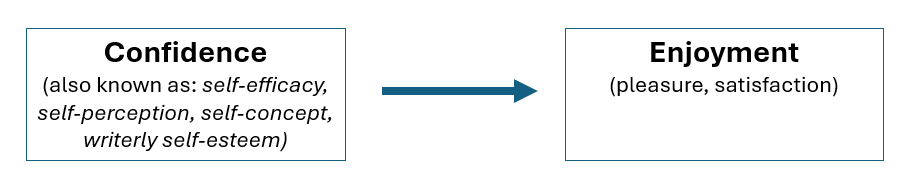
1. The relationship between confidence and enjoyment
The link between confidence and enjoyment is critical for classroom practice. Nearly 90% of students who enjoy writing at school consider themselves to be accomplished writers.
It’s very difficult to write with enjoyment if you feel you’re not very good at it. Confidence is one of the biggest predictors of children’s writing achievement¹. So, what practices have a track record for improving children’s writerly confidence²?
Study mentor texts [LINK] With students, study and discuss texts that actually realistically match the type of writing they are being asked to write for themselves. This provides them with examples to emulate and learn from. This builds up their writerly confidence.
Establish success criteria together [LINK] While reading mentor texts, collaborate with students to identify the techniques necessary for crafting their own high-quality texts. Make a commitment to teach these techniques, developing a sense of ownership and confidence among your students.
Model craft moves [LINK] Demonstrate how to use a craft move before inviting students to do the very same in the context of their own writing. Modelling provides clarity and confidence, helping students grasp concepts more effectively.
Set process goals [LINK] Encourage students to focus on a specific goal during writing time. By breaking down the writing process into small manageable chunks, students can see themselves making progress every day and this breeds confidence.
Support children to choose their own writing topics [LINK] There are cognitive and motivational benefits to supporting children to choose their own writing ideas within the parameters of a class writing project. Being able to draw on a topic stored in their long-term memory (and one they are highly motivated to write about) fills them with writerly confidence.
Teach the writing processes [LINK] Design class writing projects that encompass all stages of the writing process, from generating ideas to publishing. Allocate time for instruction on each stage. This establishes a sense of daily progress, reassurance and success.
Provide verbal feedback [LINK] Provide students with personalised feedback on their writing, both from their teacher and their peers. Effective verbal feedback reinforces successes and nudges students to apply constructive feedback quickly and confidently.
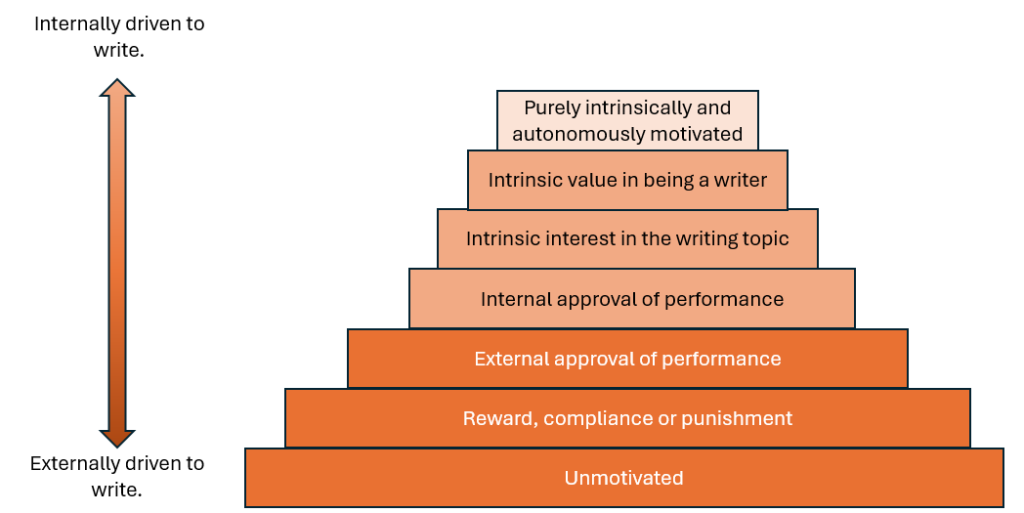
2. Redefining purpose: Intrinsic and external expectations
When the NLT asked students why they are moved to write, their answers revealed what they perceive the purpose of writing at school to be. Their reasons for writing were often shaped by external expectations and pressures. Indeed, 40% of children and young people admitted they wrote solely out of compliance or to avoid punishment. Some students did share other motivations. For example:
To achieve good marks (37%).
To secure better job opportunities (27%).
To express their creativity (35%)
To explore ideas (34%)
To reflect on and deal with their emotions (24%)
To better understand new learning (24%)
It can be useful to consider why children are motivated to write at school. Research consistently shows that students who write for external, teacher-controlled reasons tend to demonstrate poorer writing performance. In contrast, intrinsic motivation is linked with better outcomes³. However, it is important to recognise that extrinsically motivated young writers can also thrive, particularly when external rewards or recognition align with their personal goals and interests anyway⁴.
It’s very difficult to write at your best if you’re not motivated. Pupils who are motivated to write are more likely to: put in more effort, persist for longer, pay more attention, show more enthusiasm and work harder to solve their own writing problems⁵. It’s therefore important that we nurture the ‘will’ to develop the ‘skill’. A drop in motivation is a serious threat to student engagement.
Embrace intrinsic value: Writing in school should be framed as a personally and socially profound activity, one that helps students make and share meaning, develop their ideas and understanding, cultivate their artistry and imagination, and articulate their thoughts, funds-of-knowledge, opinions, and feelings. By doing so, they can achieve exceptional academic outcomes.
Not either/or: Students who view themselves as good writers are motivated by academic goals, intrinsic factors like self-expression and making social connections with others through writing.
3. Teaching the writing processes: Confidence gaps and strategy use
A common misconception is to assume that students are either confident and competent writers or they’re not. In reality, their confidence can be subject to change depending on what aspect of the writing process they currently find themselves in. For example:
Pupils are most confident in generating writing ideas (73%)
Students are not confident to proof-read (50%)
Students also lack confidence in sharing, performing and publishing their writing (43%)
Pupils lack confidence in revising (53%)
It’s very difficult to produce your most meaningful and academically successful writing if you don’t have the strategies to do so. Children who know the writing processes, and have internalised strategies and techniques for negotiating them successfully, produce better writing⁷.
Teach planning techniques [LINK] Students appreciate being taught how to use a variety of intuitive planning strategies.
Plan revision sessions into your class writing projects [LINK] Students showed an overwhelming preference for experimenting and revising their writing but only after they’ve drafted.
Explicitly model how proof-readers edit [LINK] Model an aspect of proof-reading in your own writing before inviting pupils to do the same during that day’s writing time.
Establishing a publishing goal for class writing projects with your class [LINK] Children appreciate being invited to consider whom they want to share or perform their writing to, and how they wish to publish it, as part of a class writing project.
Utilising self-regulation strategies in the face of difficulty
When students get stuck, their most common response is to stop and think (43%), or to ask for help (24%). However, only a minority (16%) of students reported independently trying different things out when stuck, demonstrating a lack of self-regulation. The link between enjoyment, confidence, and self-regulation is profound⁷.
More of those who enjoyed writing persevered and tried new strategies (20%) and fewer gave up (3%) compared with those who didn’t enjoy writing (13% gave up).
Those who rated themselves as good writers were more inclined to pause and reflect or try out a new strategy.
It’s very difficult to enjoy or succeed at writing if you feel like you always need assistance. Developing children’s self-regulation skills is probably the most effective thing a teacher of writing can do in their classroom⁷. So, what does this mean?
Get your writing instruction right [LINK]. Self-Regulated Strategy Development (SRSD) is by far the most thoroughly researched and consistently effective approach to teaching writing. It explicitly teaches students evidence-based strategies for generating ideas, planning, drafting, revising, and proof-reading, while also developing their ability to monitor and manage their own writing process. SRSD blends cognitive strategy instruction with self-regulation techniques, helping children not just to know what good writing involves, but how to do it for themselves. Studies show that SRSD benefits struggling and proficient writers alike, improving both the quality and quantity of their writing. However, despite its strong evidence base and adaptability across ages, genres, and abilities, SRSD remains virtually absent from most UK classrooms. Few teachers encounter it in their initial training, and fewer still receive professional development in how to implement it. As a result, one of the most effective tools for improving writing outcomes (and for giving children the confidence to see themselves as independent writers) remains unused in the very places where it is needed most.
4. The social and emotional landscape: Anxiety and dependence
The social and emotional environment of the writing classroom profoundly shapes student engagement⁵. At present, writing evokes considerable apprehension and anxiety in pupils.
Worrying about correctness at the wrong time: One in three students worries about their grammar, punctuation and spelling while they are drafting.
Avoidance: Three in ten avoid experimentation for fear it might go wrong. A quarter of pupils felt discouraged from writing altogether due to their teacher potentially identifying mistakes.
Widespread fear: While anxiety was highest among poor writers, fear was widespread even amongst those who rated themselves as good writers.
Anxiety is the enemy of good writing. Students are often afraid of making errors while drafting, worrying that these mistakes will be seen as unacceptable or as evidence of poor writing. This has serious consequences: children who experience writing anxiety typically produce less, do only the minimum required, and avoid taking creative risks⁵.
It’s difficult to enjoy or produce your best writing in a climate of fear. Research suggests that the culture of writing in some schools places excessive emphasis on accuracy at the wrong stage of the writing process⁸. It may be that colleagues would benefit from CPD in how to plan a writing unit [LINK] and how to deliver sympathetic and useful feedback to pupils [LINK].
5. A klaxon call for collaboratively-controlled writing projects
A call for structure, guidance and instruction: Nearly half of the students surveyed expressed a preference for clear, structured guidance from their teachers on how to craft a great piece of writing.
Desire for some authorial control: Simultaneously, autonomy was a massive motivator. Half of students said they would write more, and with greater frequency, if given trust and guidance to choose their own writing topics within the parameters of class writing projects.
This is not a rejection of structure. Students appreciate structure and reassuringly consistent routines¹⁸. Rather, it is a call for scaffolding that empowers them to exercise their own authorial agency.
Implement collaboratively-controlled writing projects: Teachers should design class writing projects which are collaboratively-controlled by teachers and pupils together³.
Support students to find value: Most students recognised the value of writing. However, over half of those who rated themselves as poor writers believed that ‘schooled writing’ lacked meaning or an authentic purpose. We must consistently provide purposeful and authentic class writing projects⁹.
6. Igniting the desire to write: The catalysts for engagement
Understanding what moves students to write most is both affective and effective practice⁵. Having authorial control was the strongest motivator:
Choice over writing topic: Students cited being supported to choose what they wanted to write about as their greatest cognitive and motivational driver¹⁰.
Choice over style and form: 30% wanted to decide on the form or style of their writing.
Personal expression: 28% want permission to express their own thoughts, funds-of-knowledge and opinions through their writing.
Utilising intertextuality: 27% want permission to riff off their favourite authors to produce their own writing¹¹.
Perhaps understandably, only 16% saw value in being given a writing prompt. This is probably because it represents what’s called ‘an empty choice’¹².
The desire for some authorial control is linked to engagement: those who enjoy writing are much more likely to be motivated by creative freedom and personal expression.When given the support to choose their own topics and forms, students express overwhelming preferences for class projects that are exciting, personally meaningful, and allows for exploration:
Topics: Preferences are varied, including writing about horror, history¹³, mysteries, sport¹⁴, adventure and murder cases. Students also want to share, through writing, their own funds-of-knowledge and cultural passions¹⁵. They also desire opportunities to write about real-world issues that matter to them personally¹⁶.
Genres: Fiction and poetry dominate, with genres such as fantasy, detective fiction, lyrics, and script writing repeatedly mentioned. There is also notable enthusiasm for writing intended for performance and for forms inspired by visual media, such as comics and manga [LINK]. Students would also value learning how to write personal narratives, such as memoirs [LINK].
Conclusion
The findings from this report compel us to rethink not just how we teach writing, but why¹⁷. We see a clear tension: students value writing yet many feel increasingly anxious and disengaged when writing at school. Writing is most meaningful when students can relate it to their own lives and interact with others as authors. After all, writing is about making and sharing meaning⁵.
With this in mind, the most powerful catalysts for pupil engagement lie in helping students find intrinsic value in their writing: personal relevance, emotional resonance, authorial control, and social interaction with readers. By embracing teaching practices that combine explicit instruction, modelling, and guidance with opportunities for choice and supportive writing processes, we can move beyond writing as formalism and unlock its full potential as both a critical learning tool and a powerful form of self-expression.
Discussion essays [LINK], persuasive letters [LINK], advocacy journalism [LINK], community activism [LINK] and social/political poetry [LINK].
‘Teachers’ orientations towards teaching writing and young writers’ [LINK] and ‘Six discourses, four philosophies, one framework: A critical reading of the DfE’s writing guidance’ [LINK]
The act of teaching writing to children has undergone significant evolution over the centuries. While writing itself is an ancient skill, explicit instruction in how to write, particularly through the lens of ‘the writing processes,’ is a relatively recent pedagogical development¹.
This article explores the history of how teachers have taught children the art and craft of writing before giving advice on how you can do it too.
Early approaches to writing instruction (1800-1960s)
In the 19th century, writing instruction in schools was largely focused on mechanics like penmanship, spelling, grammar, and transcription. Writing was more about accuracy and obedience to conventions than making and sharing meaning, creativity or individual expression.
During this period, teachers rarely emphasised the writing process. Writing was seen primarily as a product (something finished and polished in a single session) rather than as something to be moulded and crafted over time.
In the mid 20th century, educational reformers began to see the value in students expressing their own thoughts through original compositions. However, in this more student-centered model, instruction often lacked a clear structure². Children were simply asked to write but not necessarily taught how to generate ideas, plan, draft, revise, proof-read or publish their manuscripts. This gap set the stage for a more formalised approach to teaching writing.
The Dartmouth Conference and the influence of John Dixon (1960s)
A pivotal moment in the history of writing instruction came with the Dartmouth Conference of 1966 – an international gathering of British and American educators that aimed to redefine the teaching of English. The conference catalysed a shift from formalist, prescriptive models of writing to more dynamic, writer-centred approaches.
British educator and researcher John Dixon published his influential report, Growth Through English, shortly afterward. In it, he argued that writing should not be taught as a fixed body of knowledge or a set of rigid forms, but as a tool for personal growth, meaning-making, and social interaction. Dixon proposed that students develop as writers through:
Expressing their own experiences, thoughts, knowledge, feelings and ideas
Engaging in meaningful writing projects
Writing in a variety of genres and for different audiences
Reflecting on their language use
Dixon categorised language use into four broad modes – personal, poetic, transactional, and exploratory – each serving different writerly purposes. He emphasised the importance of teacher responsiveness, flexibility, and encouraging student agency.
The Dartmouth movement laid the philosophical and pedagogical foundation for what would become the process writing movement. It framed writing as a developmental act, one rooted in the lived experience of the learner – an idea that would deeply influence writer-teachers like Donald Graves in the decades that followed.
The emergence of the writing processes (1970s–1980s)
The modern concept of ‘the writing processes’ began to take shape in the 1970s and 80s. Influential researchers and educators such as Janet Emig, Linda Flower, John Hayes, Donald Graves and Donald Murray revolutionised writing instruction by promoting a process-oriented approach.
This method emphasised writing as a recursive process with several key stages:
Generating ideas
Planning
Drafting
Revising (re-seeing, re-envisioning and otherwise reshaping content)
Proof-reading (checking adherence to conventions, grammar, punctuation, spelling)
Publishing (sharing with an audience)
Through this framework, students were encouraged to view writing as a tool for thinking, feeling, and communication, rather than merely a writing performance to be judged by the end of a single lesson.
Donald Graves and the birth of process-based writing instruction
One of the most pivotal figures in the development of process-based writing instruction was Donald Graves, whose research in the 1970s-1980s fundamentally changed how teachers approached teaching writing to children.
Graves’ landmark study took place in a New Hampshire elementary school, where he conducted intensive observations of six- and seven-year-olds as they wrote. Using audio recordings, writing samples, classroom observations, and student interviews, Graves sought to understand what young writers actually did when they wrote. His findings were both surprising and transformative.
Graves discovered that even the youngest of children were capable of deep thinking, self-direction, and revision when given time, instruction, agency, and support. He found that children wrote best when they:
Were supported to choose their own writing topics
Given time to write their best pieces
Received consistent instruction and feedback from teachers and peers
Viewed themselves as real authors with something valuable to say and share
His research culminated in the seminal book Writing: Teachers & Children At Work, which laid out not just his findings but a practical vision for writing instruction. Graves argued that writing should be a daily activity, grounded in real purposes and audiences, and that teachers should serve as fellow writers and instructors – not just evaluators.
The post-process movement: A necessary rethinking
By the 1990s, scholars in composition studies began questioning the dominance of the process model in writing instruction. The so-called post-process movement did not reject the value of the writing process altogether, but it emphasised that writing is far too complex and idiosyncratic to be fully captured in a single, generalised sequence of steps. Post-process theorists argued that there is no single ‘correct’ writing process – different writers use different processes, in different combinations, and at different times, depending on the writerly situation.
For classroom teachers, this post-process movement serves as a reminder that writing is more than a set of steps to follow. It calls for instruction that values diverse writing practices, and emphasises critical thinking about language and purpose.
Modern day
In recent years, studies have built on the foundations laid by Graves and others to offer a more contemporary, evidence-rich model of the writing process approach.
Research evidence continues to deepen our understanding of how children can be taught not only to write, but to think as writers.
While early process models gave some structure to writing instruction, more recent research provides precise, flexible, and effective ways of helping children navigate the complexities of writing³.
Four of the most useful frameworks currently shaping writing pedagogy are:
The rhetorical situation approach
Children’s production strategies for writing
The writing process in the early years
Ellen Counter’s ‘Writing House’
1. The rhetorical situation approach
A writing classroom, if it is to be authentic, must regularly pursue what’s called rhetorical purpose. This is the idea that writers write because:
They have something to say
They have a reason for saying it
They have someone to say it to
They are moved to write⁴.
This is at the core of what composition, rhetoric, creative writing and journalism courses all call ‘the rhetorical situation’⁵: there is a writer, there is an audience, there is a purpose, and there is a message.
A class writing project therefore begins with a class knowing they have something to say and setting themselves an authentic and purposeful writing goal through which to say it (see LINK for more details). For example: to craft persuasive letters to people in positions of authority, memoirs for loved ones, information texts for their mates, or short stories for the younger children in the school.
Once that intention has been set, teachers and students look outward to high-quality mentor texts that resemble the kind of writing they are looking to produce for themselves. This is reading as a writer: noticing structure, studying grammatical, rhetorical and literary craft moves, analysing authorial voice, and borrowing writerly techniques⁶.
Taken from Reading In The Writing Classroom (Young & Ferguson 2024), here are just some of the things you can look for and discuss as you read as writers:
And here are some of the writerly conversations you might have.
“Children read stories, poems and letters differently when they see these texts as things they themselves could produce.” – Frank Smith
This approach mirrors how writers actually work. While we in no way seek to diminish the importance of children developing as readers, we need to be clear that, in the writing classroom, writing should be the driver for reading. Reading should be in the service of the writers’ goals.
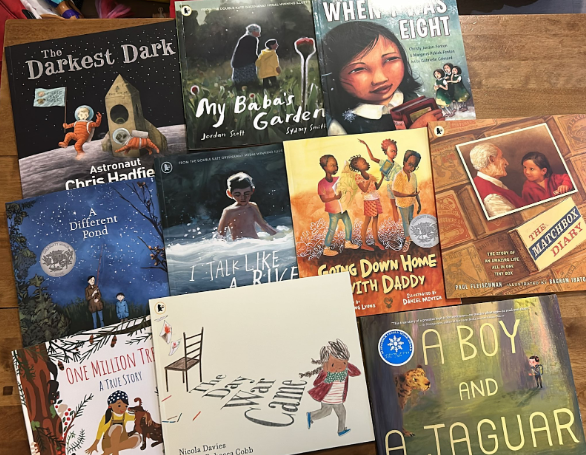
Here is a beautiful representation of what we are talking about. On the display, we can see just some of the high-quality commercial texts children have been reading as part of their fairytale project. In addition, we can see how writer-teachers have shared their own fairytales as mentor texts too. All this rich reading has resulted in the class coming up with their own success criteria for the project: the things they believe they’ll have to do or include to write their own great fairytales too.
In a writing classroom, the act of reading is responsive, deep, and authentic. Children and teachers study texts together because they know it helps them grow as writers. High-quality mentor texts are chosen because they match the class’ writing project (you can see exampleshere). This is the real apprenticeship of writing. It gives students agency, craft knowledge, and a deep sense of why being a writer matters.
“To learn how to write for newspapers you must read newspapers. For magazines, browse through magazines. To write poetry, read it.” – Frank Smith
For teachers like Sam Creighton, who love reading, such an approach is a dream come true as he finally gets to expose his class to loads of his favourite high-quality texts. Here are just some of the texts he plans to share with his class as part of their memoir writing project.
2. Children’s production strategies for writing
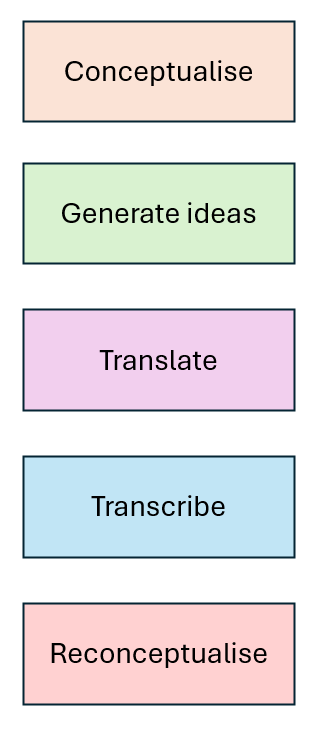
As part of our work devising a conceptual framework for writing teaching, which we called The Writing Map, we described what young writers are doing as they make writing. When a child settles down to write, they will:
Conceptualise As you’ve already read, conceptualising a piece of writing involves establishing the rhetorical situation. Consciously or subconsciously, a young writer will consider the purpose and audience for their writing.
As teachers, we can support children with this. For example, teachers and children, together, can establish a publishing goal for a class writing project [LINK] before reading as writers [LINK].
Generate ideas Next, your young writers will generate ideas of what it is they would like to share with their reader(s). Again, as teachers, we should help and support children by teaching them idea generation techniques that writers actually use [LINK].
Translate This is where your young writers have to convert the ideas they have in their heads into possible phrases and sentences. Teachers can support this process in three ways:
Ask children to draw their ideas first.
Invite children to talk about (and otherwise ‘tell’) their drawings with us and their friends.
Model a planning strategy that we used, before inviting children to use the same strategy for themselves [LINK].
Transcribe Transcription includes attending to letter formation, handwriting (or typing), and spelling. At this point, children must physically make their marks on paper or screen. These skills support children in getting their ideas down in a way that can be read by others, but the accuracy of spelling and handwriting will naturally be variable at this stage. What matters most is that children can record their thinking; refinements to accuracy will be revisited later during the reconceptualise phase.
However, over time, it is important that these transcriptional skills become increasingly fluent and automatic [LINK]. This fluency develops through a balance of regular spelling and handwriting instruction alongside meaningful opportunities to write [LINK].
Reconceptualise This is actually something children are doing all the time. They will regularly stop, think, rethink, draw, redraw, share, discuss, re-read, revise, proof-read and perform their developing compositions. Teachers can support children’s reconceptualisation processes by ensuring that they:
Have regular moments during writing time to stop and share what they have crafted so far that day. For example, by giving children class sharing and Author’s Chair time [LINK].
Provide children with explicit revision instruction and revision checklists [LINK].
Engage in systematic and daily pupil-conferencing with their pupils [LINK].
Provide ample opportunities and instruction in how to proof-read their manuscripts in preparation for publication or performance [LINK].
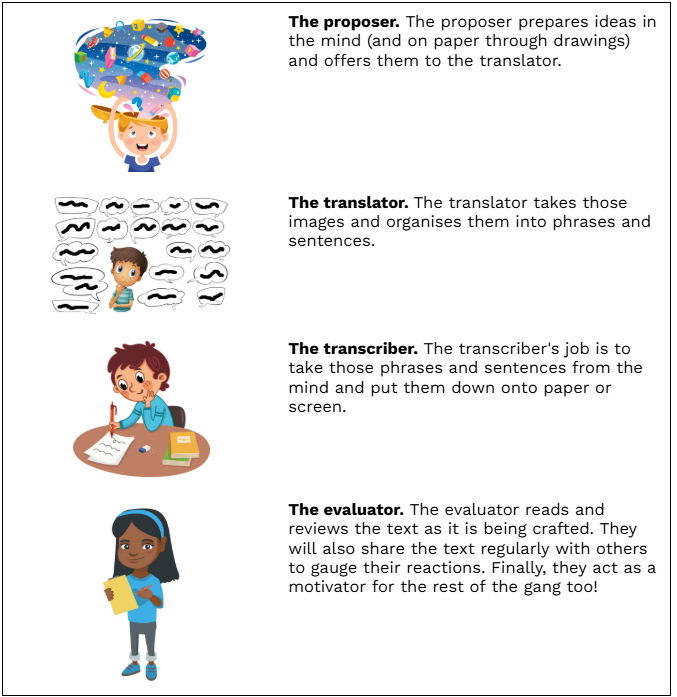
Finally, we can personify the production strategies children use to craft text as if they were being undertaken by different people. In reality, of course, these are done by the individual writer. These people would include:
It’s important to remember that a piece of writing will move between these four people all the time. For example, the evaluator might have to go and talk to the proposer. The translator and transcriber are likely to be in back and forth conversation too.
3. The writing process in the early years
What does the writing process look like for the youngest of children? Well, having observed children writing for a number of years, we’ve noticed that a developmentally appropriate writing process for the EYFS-KS1 looks a little something like this:
We talk At this stage, children are often developing their ideas and translating those ideas through spoken language. Talking helps them to clarify their thinking, play with word choices, and rehearse the structure of what it is they want to say. Children talk their texts into being. As you can see, talk is vital at all parts of a young writer’s process. For example, children talk with one another before they write, as they write and after they write. These interactions occur in different ways and can include:
Idea explaining Children share what they plan to write about during the session with others.
Idea sharing Children work in pairs or small ‘clusters’ to co-construct their own texts together.
Idea spreading One pupil mentions an idea to their group. Children then leapfrog on the idea and create their own texts in response too.
Supplementary ideas Children hear about a child’s idea, like it, and incorporate it into the text they are already writing.
Communal text rehearsal Children say out loud what they are about to write – others listen in, comment, offer support or give feedback.
Personal text rehearsal Children talk to themselves about what they are about to write down. This may include encoding individual words aloud. Other children might listen in, comment, offer support or give feedback.
Text checking Children tell or read back what they’ve written so far and others listen in, comment, offer support or give feedback.
Performance Children share their texts with each other as an act of celebration and publication.
We draw Children often like to translate their ideas visually. Drawing allows them to plan and express their thoughts before writing, and it supports their understanding of chronology and narrative sequencing. It also gives them something to talk about and otherwise ‘tell’ prior to transcribing it to paper.
We write Here, children transcribe their ideas into the written form. This may involve mark-making, early letter formation, or structured sentences depending on their stage of development. They apply their phonics knowledge, through encoding, and begin to explore spelling, punctuation, and grammar in context.
We share Children continually share their compositions with others – reading or ‘telling’ aloud or discussing their writing with peers and adults. This stage fosters pride, purpose, and a sense of audience, and it encourages reflection and further development of their writing skills.
This recursive process supports young writers in building both the transcriptionally and compositional aspects of writing in a meaningful and developmentally appropriate way.
4. Ellen Counter’s ‘Writing House’
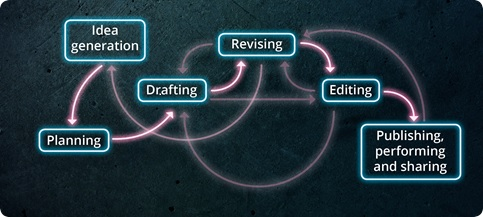
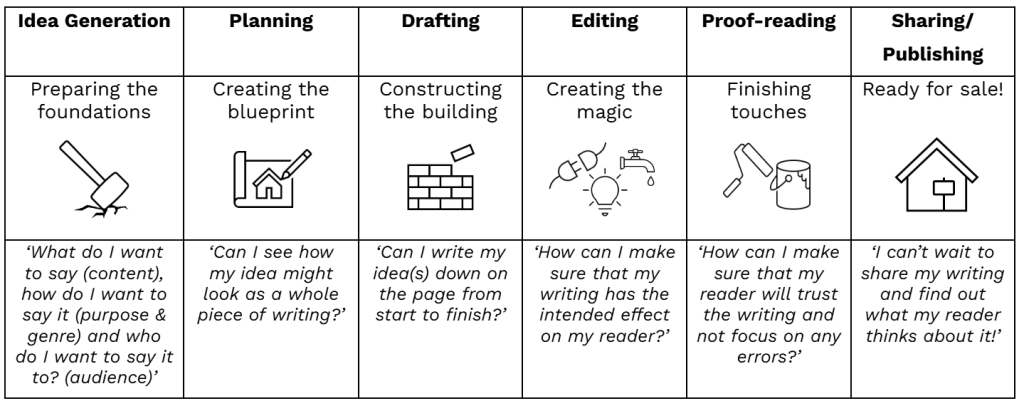
To teach writing effectively, we must encourage children to see writing as a process, while also teaching and modelling strategies that support its key stages: idea generation, planning, drafting, editing, and proofreading.
Whilst the writing process is recursive (we naturally move back and forth between stages), and although it can look different depending on what is being written and why, children need to understand that each stage of the process is distinct and requires a different kind of focus.
We could argue that this process is like building a house. Without time and teaching dedicated to each stage, the writing (like a house) could fall apart and not be fit for purpose. In the same way, our feedback will only be effective if we consider the stage children are at in the process and tailor our advice accordingly⁸.
Using this model, we can extend the metaphor to guide what we focus on during writing time. It all depends on the stage. After all, you wouldn’t insist on ordering paint colours before the walls have even been built. As the DfE’s Writing Framework suggests, it makes little sense to focus on children’s spelling inaccuracies when they are still working hard on getting their ideas down onto the paper⁹.
The terms generate ideas, plan, draft, revise, re-read, evaluate, edit, proof-read, perform and share are all mentioned within the National Curriculum, but teacher training and writing schemes rarely equip teachers with how to explicitly teach these processes.
For example, children are often told to proof-read or ‘check’ their writing without being taught how writers do this, within a clear framework of shared strategies to support them¹⁰.
Take the case of a Year 1 child who was thought to be falling behind in her writing because she wasn’t punctuating her sentences. Interestingly, she:
Could identify where a full-stop belonged when shown an unpunctuated sentence.
Had age-appropriate knowledge of sentence structure. For instance, she could read her writing back, recognised where one idea ended, and understood that her reader would need a full-stop before the next idea began.
So what’s happening here?
The issue lies in the misconception and expectation that writing must be 100% accurate at the point of drafting¹¹. The child was only given one shot to get everything ‘right’, so the absence of punctuation is treated as failure. In reality, the problem is we’ve overlooked how writing actually works. Like building a house, writing requires time for each stage: strategies for proof-reading need to be explicitly taught, and space for evaluating and reconceptualising is needed¹⁰. The child wasn’t failing – the approach was failing the child.
Conclusion and next steps
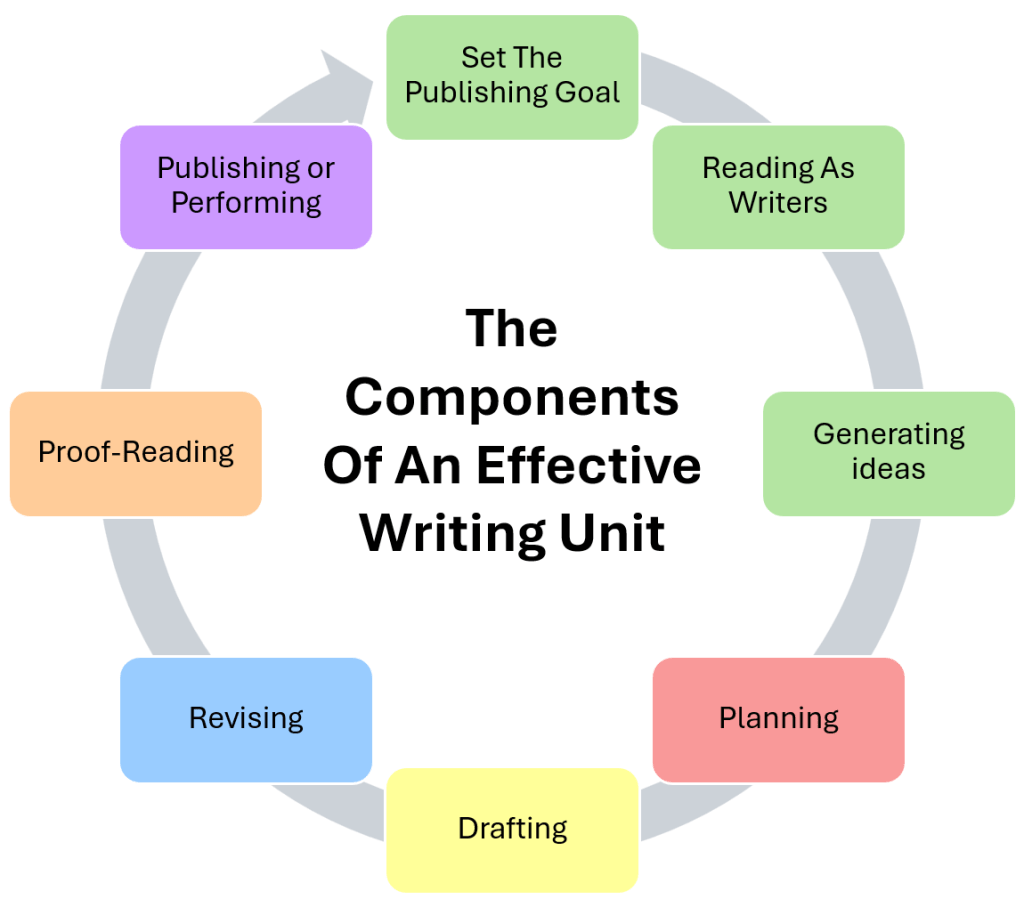
Planning a writing unit
In 2019, we were lucky enough to interview and observe some of the best performing writing teachers in England. We released our findings as a book in 2021. What was clear was how these teachers used the writing processes to plan their class writing units.
Teaching the writing processes is also a validated evidence-based practice, with a potential effect size of +1.28 (for context, anything over +0.4 is considered to be significantly effective).
To find out more about the components of an effective writing unit, see our article.
Children also developing their own writing processes
As well as planning effective writing units, the exceptional writing teachers we observed gave their pupils time to develop their own writing process by way of personal writing projects. To find out more, see this publication. In teaching children the writing processes, we do more than guide them to craft great pieces, we hand them the tools to shape their voices, their stories, and, over time, their worlds.
How Writing Works: From the Invention of the Alphabet to the Rise of the Social Media by Dominic Wyse [LINK]
‘Teachers’ orientations towards teaching writing and young writers’ [LINK] and ‘Six discourses, four philosophies, one framework: A critical reading of the DfE’s writing guidance’ [LINK]
In the complex instructional landscape of literacy, the profound connection between reading and writing is a central tenet. This article explores the specific, interdependent relationship between early reading and early writing, framing them not as separate subjects but as ‘two sides of the same coin’. The goal of literacy instruction is, of course, comprehension and composition; however, there can be no reading comprehension without word reading, nor conventional written composition without word writing. Understanding their shared foundations and development is therefore essential for effective teaching practice.
Students’ abilities in word reading and word writing develop along a continuum, moving through distinct phases that are greatly facilitated by systematic instruction. For word reading, this progression is often conceptualised in five phases:
Pre-alphabetic phase: The child approaches words as visual wholes, using clues like logos, without understanding the alphabetic principle. For example, “McDonalds!”
Partial alphabetic phase: The child begins to use some letter-sound knowledge, often focusing on initial and final sounds.
Full alphabetic phase: The child can form connections between all graphemes in a word and their corresponding phonemes.
Consolidated alphabetic phase: The child starts to recognise and use consolidated letter sequence units (e.g. -ight, re-) rather than decoding letter by letter.
Automaticity phase: Word reading becomes accurate, fast, and effortless, as words are recognised by sight without conscious analysis.
A similar progression occurs in word writing development, which can be understood through five stages:
1. Emergent/precommunicative: The child hasn’t yet got an understanding of the systematic relationship between letters and sounds. To see the stages of emergent writing, click here.
2. Letter name: The child begins using letter-sound knowledge, but accuracy is usually limited to consonants and short vowels.
cat → ct (child writes the consonants, may omit vowels)
dog → dg
sun → sn
bat → bt
3. Within word: The child can spell most single-syllable words but struggles with more complex patterns like silent long-vowels.
make → mak or make (may omit the silent e)
home → hom
bike → bik
read → red or reed (confusion with long-vowel spelling patterns)
4. Syllables and affixes: Errors typically occur at syllable junctures or in unaccented syllables.
hoping → hopeing (error at the syllable juncture where the silent “e” should be dropped)
running → runing (omitting the doubled consonant at the syllable break)
family → famly (dropping an unaccented syllable)
different → diffrent (leaving out the unstressed middle syllable)
5. Derivational relations: Errors are most common with low-frequency, multisyllabic words involving derivational morphemes.
electricity → eletricity (dropping a syllable within a derived form)
responsibility → responsiblity (omitting the derivational suffix syllable)
biological → bioligical (confusing the placement of the derivational suffix -ical)
nation → natian (misapplying the derivational -ion pattern)
It is important to note that these developmental phases are not rigid, and children will move between these stages depending on the specific word they wish to write.
The shared foundations: Emergent literacy skills
The development of both word reading and word writing is contingent upon a set of foundational emergent literacy skills. These skills are drawn upon for both decoding (reading) and encoding (writing), which explains why the two abilities are so strongly correlated. The three critical skills are:
1. Phonological awareness: This is the knowledge and awareness of the sound structure of language, from larger units like syllables down to the smallest units, phonemes. This skill is essential because English is an alphabetic writing system, where symbols primarily represent speech sounds.
Big sounds: Children can detect or segment the larger parts of words, like the ‘claps’ (syllables) in a word. For example, ‘but-ter-fly’ has three claps.
Rhyming parts: They can hear smaller parts, like the rhyme in a word. In ‘cat’, they can hear the ‘at’ part.
Tiny sounds: They can hear the tiniest sounds (phonemes) in a word. They can hear that ‘cat’ is made of three sounds: /k/ /æ/ /t/
2. Orthographic awareness: This refers to the knowledge of print concepts, graphemes (the letters or groups of letters like sh or augh that represent sounds), and the permissible spelling patterns of the language. This is the skill of knowing all about letters and printed words.
Letter shapes and names: Children learn what each letter looks like and what it is called.
Letter teams: Children learn that sometimes letters work together to make one sound. For example, the letters ‘s’ and ‘h’ team up to make the /ʃ/ sound in ship. This combination of letters that represents one sound is called a grapheme.
3. Morphological awareness: This is the understanding of morphemes, the smallest units of meaning in words (e.g., re-, -act, -s in reacts). This awareness is particularly crucial in English, a morphophonological system where meaning-based units can override apparent phonological patterns (e.g. recognising re- and act in react prevents it from being misread as /rikt/).
For example, the word ‘cats’ has two meaning parts: ‘cat’ (the animal) and ‘-s’ (which means more than one).
The word ‘redo’ has two meaning parts: ‘re-’ (which means do again) and ‘do’.
Knowing these parts helps children read and spell big words, like ‘photosynthesis’ or ‘incredible’
Principles and practices for reading and writing instruction
The shared foundation of early reading and writing has critical implications for instruction. First, because they draw on the same skills, integrated teaching has a synergistic effect: teaching writing promotes reading development, and teaching decoding promotes encoding development. Second, a student who is weak in one is very likely to be weak in the other. However, it is important to recognise they are not identical; word writing requires production and greater precision of a word’s mental representation, making it typically more difficult than the recognition task of reading.
Effective instruction is built upon several core pedagogical principles. Teachers should employ differentiated instruction based on ongoing assessment to meet children’s varying needs and rates of learning (see here for more). It is also vital to consider students’ diverse linguistic backgrounds, recognising that foundational principles of literacy instruction are effective for all children when teachers understand and value their language experiences (see here for more). Finally, instruction should be delivered using evidence-based approaches, namely explicit and systematic teaching that provides structured modelling and scaffolding, such as the I Do, We Do, You Do model (see here for more). For example:
I Do: First, you model exactly what to do. For example, you show children how you are using your sound mat to help you encode the words you want to write in the picturebook you’re making. “I want to write ‘cat’. I hear three sounds: /k/ /æ/ /t/. The first sound is /k/. That can be a ‘c’ or a ‘k’. I’ll use the ‘c’ on my sound mat. The next sound is /æ/. That’s an ‘a’. There it is on the sound mat. The last sound is /t/. That’s a ‘t’. Let me write it: c-a-t. Yes, that’s what it looks like when I see it in books!”
We Do: Next, you do it together. The children use their sound mats to help them encode the words they want to write in their picturebook that day.
You Do: Finally, the children continue to use their sound mats when making picturebooks on their own during provision.
Here’s another example:
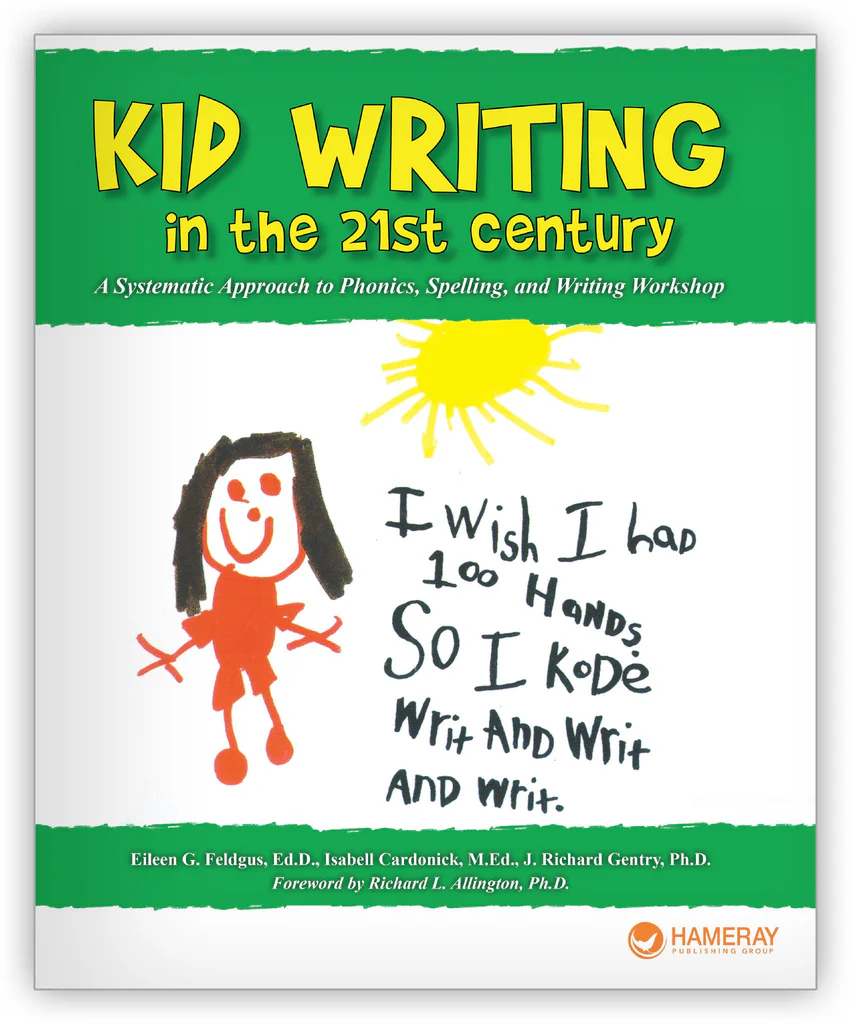
I Do: You show children how, when you really want to write a word, but you don’t know all the grapheme-phoneme correspondences yet, you use ‘kid writing’ as a replacement. “When I was your age, and I wanted to write a really cool word, and I didn’t know all my sounds yet, I used to do this. Watch. I want to write ‘dinosaurs’. I can hear the first sound: /d/. That’s the letter ‘d’. I’ll write that. Next, I hear /aɪ/ I don’t know all the ways to spell that sound yet, so I’ll just write the letter ‘i’. Then I hear ‘no’ like the word ‘no’. After that, I can hear lots of sounds, but I don’t know how to write them yet, so I’ll just use ‘kid writing’ for those. At the end, I can hear /s/. That’s the letter ‘s’. So my ‘kid writing’ says: d-i-no-〰〰-s. It’s not the same as the adult spelling, but it shows all the sounds I do know! This way, we can still write all our wonderful ideas and share our stories.”
We Do: Next, you do it together. The children use their sound mats and ‘kid writing’ to encode their more ambitious or complex vocabulary in their picturebook that day.
You Do: Finally, the children continue to use ‘kid writing’ and their sound mats when making picturebooks on their own during provision.
Finally, one last example:
I Do: You show children how, when you want to write a tricky word that doesn’t follow the usual sound–letter patterns, you use the word wall to help you. “Ah, watch this! I really want to write the word ‘said’ in my picturebook. Hmm… if I try to sound it out, I might think it’s s-e-d. But I know that ‘said’ is one of our tricky words, and it’s on our word wall. Let’s look. Here it is: s-a-i-d. I can copy it from the wall into my writing. Now my sentence looks just like it does in books.”
We Do: Next, you do it together. The children use the word wall to copy down any common tricky words in their picturebook that day.
You Do: Finally, the children continue to use the word wall independently to spell tricky words while they are making picturebooks during provision.
Using this routine every day can help children feel safe and confident in learning new strategies and skills.
Research-supported recommendations
Based on these principles, four key recommendations emerge for effective, integrated word reading and word writing instruction:
Teach phonological awareness and grapheme–phoneme correspondences. This involves systematic instruction in manipulating sounds (e.g. blending, segmenting) and explicit teaching of letter formation. Letter instruction should focus on frequent exposure, making name-sound connections explicit, teaching visually similar letters non-sequentially, and building automaticity in both recognition and letter writing (see here for more).
Model chunking. As students progress, they must learn to process chunks larger than individual graphemes. This includes modelling (1) common rime units or phonograms (e.g. -ock, -ight, -ean), (2) syllable types:
Closed syllables (CVC): cat, hop, pen
Open syllables (CV): he, go, me
Vowel-consonant-e (VCe): make, bike, hope
Unaccented final syllables: table, pencil, cabin
and (3) morphemes (e.g., prefixes, suffixes, roots)
Roots: struct (construct, destruct, structure), port (transport, portable, import)
Activities like word sorts and word building are highly effective for this work.
Model decoding and encoding. Foundational skills must be explicitly applied to the acts of reading and writing. An analytic approach should be used even for irregular words, focusing on the parts that do follow predictable patterns (e.g. the sh and d in should). Teachers should view informed spelling not merely as an error, but as a valuable window into a student’s current knowledge and a crucial opportunity for them to practise applying grapheme-phoneme correspondences.
Incorporate connected texts. Children should be regularly invited to use and apply these skills in the context of meaningful reading and writing experiences. The use of decodable and high-quality commercial texts provides beginning readers with opportunities to practise taught patterns in a supportive context. Similarly, students should be encouraged to apply their ever developing encoding knowledge in daily book-making time (see here for more), reinforcing the connection between skill acquisition and authentic communication.
In conclusion, word reading and word writing are inextricably linked skills that are foundational to all later literacy development. By providing explicit, systematic, and integrated instruction that targets their shared underpinnings, teachers can capitalise on their relationship and build a robust foundation for students’ success in both reading and writing.
Recommended further reading
Feldgus, E. G., Cardonick, I., & Gentry, J. R. (2017). Kid writing in the 21st century: A systematic approach to phonics, spelling, and writing workshop. Hameray Publishing Group
Kim, Y. S. G. (2022). A Tale of Two Closely Related Skills: Word Reading and Spelling Development and Instruction. In Z. A. Philippakos & S. Graham (Eds.), Writing and reading connections: Bridging research and practice. Guilford Press
Kim, Y. S. G. (2022) Co-Occurrence of Reading and Writing Difficulties: The Application of the Interactive Dynamic Literacy Model, Journal of Learning Disabilities, 00222194211060868
Ray, K. W., & Glover, M. (2008). Already ready. NH: Heinemann
Improving children’s reading AND writing: Connecting research and practice
Four online sessions focusing on children’s reading and writing will take place in November and December from 4pm – 5pm. These sessions are designed for UK primary school teachers, primary school leaders, literacy leads and education consultants.
ThE sessions are designed to provide research insights to support children’s reading and writing acquisition and development. With a focus on supporting both reading and writing skill, all those attending will have greater access and insight into contemporary research to inform their classroom practice.
Participants will gain insight into implications for practice, a curated collection of key open access research articles and, if all four sessions are attended, a certificate of completion.
Sessions can be booked individually for £15 each or all four sessions can be booked at a discounted price of £50.
Sessions overview
Session 1: Learning to read – Thursday 20 November 2025, 16:00-17:00pm
Delivered by Professor Sarah McGeown
This session highlights the core skills underpinning reading development, research-informed practice to support children’s word reading, and the importance of nurturing an early love and interest in books, words, and stories.
Session 2: Reading motivation and engagement – Thursday 27 November 2025,16:00-17:00pm
This session provides insight into the importance of reading motivation and engagement throughout primary school, research-informed principles to support reading engagement, and the reading, language, social and emotional benefits accrued from reading.
Session 3: Learning to write – Thursday 4 December 2025,16:00-17:00pm
Delivered by Ross Young
This session explores key aspects of writing development, research-informed strategies to support children as apprentice writers, and the importance of nurturing a lifelong love of writing.
Session 4: Writing motivation and engagement – Thursday 11 December 2025,16:00-17:00pm
This session provides insight into the importance of writing motivation and engagement throughout primary school, research-informed principles to support children’s engagement with writing, and the social, emotional, and expressive benefits gained through the experience of being a young writer.
Biographies
Professor Sarah McGeown is Director of the University of Edinburgh’s Literacy Lab. She has published widely in academic and professional journals, with research focusing on early reading acquisition and development to motivation and engagement in reading. She is an advocate for research-practice partners and closing the gap between research and practice to improve children’s reading experiences and outcomes.
Ross Young is a former primary school teacher and co-founder of The Writing for Pleasure Centre. His work focuses on translating writing research into effective classroom practice, and he regularly collaborates with teachers and children in schools. He has written several books on teaching writing and leads professional development through organisations such as the UKLA. Ross is currently a PhD researcher at the University of Edinburgh’s Literacy Lab, studying children’s writing lives in partnership with the National Literacy Trust.
A persistent education myth claims that young children shouldn’t begin writing because ‘their bones aren’t ready’ or because they first need to perfect their gross and fine motor skills. According to this argument, letter formation and handwriting instruction should wait until a child’s hand bones are fully ossified or their motor coordination is deemed ‘mature enough.’
The evidence
1. Bone development is certainly not a barrier to basic writing movements. Research on hand anatomy shows that children’s bones are still developing but ossification is not required for the basic movements involved in early writing (LINK). Even with flexible cartilage, young children are physically capable of drawing, engaging in emergent writing, and beginning letter formation.
2. Emergent writing is developmentally appropriate and essential. Emergent writing includes scribbles, mock letters, and informed spellings. It is a normal, developmentally appropriate stage of writing development observed across cultures (LINK). Through emergent writing, children experiment with making meaning while learning more about conventional ‘adult writing’ and beginning explicit letter formation and handwriting instruction. Emergent writing kills dead the ‘motor skills first’ argument entirely. For more on this, I can highly recommend these two publications:
3. Fine motor skills and handwriting develop together, not in isolation. Writing researchers have shown through meta-analyses that activities that only focus on gross and fine motor exercises — without letter formation and handwriting instruction — do not significantly improve children’s handwriting (LINK). Children can develop their motor control by actually writing, not just by cutting, beading, or doing unrelated fine motor tasks. The best place for children to develop their motor skills for writing is by writing!
What this means for practice
✅ Offer emergent writing opportunities as early as possible: Provide children with crayons, chunky pencils, regular pencils, markers, and blank picturebooks. Understand children’s marks as being their early writing.
✅ Integrate handwriting instruction gradually: Provide letter-formation instruction and meaningful writing tasks — for example book-making (LINK).
✅ Support motor development within context: Strengthen small-muscle control through motor skill activities, handwriting instruction and authentic writing projects, rather than relying on motor exercises alone.
❌ Don’t demand perfect cursive or flawless handwriting from very young children: The goal is accuracy and fluency, not adherence to a particular handwriting style.
The bottom line
Emergent writing + letter formation and handwriting instruction + motor skill activities + meaningful writing opportunities provide the strongest bridge to fluent handwriting and writing success.
The ‘bones aren’t ready’ and ‘motor skills first’ argument oversimplifies child development and risks delaying important writerly experiences. Rather than waiting for perfect motor skills or ossified bones, we should nurture children’s natural curiosity and give them real reasons to write (and learn more about writing) from the very start [LINK].
We’re delighted to announce that we’re collaborating with HFL Education and UK Literacy Association’s School Of The Year Elmhurst Primary School to bring you our new training: Getting Writing Right: What the Evidence Says.
Join us for a day of learning!
About this course
Held at Elmhurst Primary School in London, this training will equip teachers and leaders to understand what the latest evidence and research concerning quality writing teaching is.
The day will consider how schools can ensure that all children make maximised progress in writing. The essential features of writing teaching will be discussed, such as:
How to set rigorous writing goals
How to plan a class writing project with the greater-depth standard as the standard
What’s involved in delivering an effective writing lesson
How to deliver sentence-level and grammar instruction
How to connect reading and writing profitably.
Learning Outcomes
Have a secure understanding of what the evidence and research says around effective writing teaching
Be given practical ideas and strategies for writing teaching to use in the primary classroom immediately
Be equipped with greater confidence and subject knowledge concerning the teaching of writing
Additional Information
09:30 – 15:30 – 16/10/2025
Lunch & refreshments will be provided.
Schools will also receive a school license (worth £54.75) for our latest eBook How To Teach Writing.