News

Debunking edu-myths: Children must master sentence-level accuracy before they can write whole texts

  • The idea that children need extensive, isolated sentence practice is an edu-myth.
  • It’s a common misconception that extensive out-of-context sentence drills will make children better writers.
  • Extensive sentence practice is only beneficial when it’s embedded in real writing. Isolated drills typically have little to no positive impact –  and can even be detrimental.

The Writing Revolution (TWR), also known as the Hochman Method, has gained significant traction in some schools, particularly for its structured sentence-level focus. It promises to improve student writing by explicitly teaching students to write grammatically correct, complex sentences before moving on to writing whole texts. TWR resonates strongly with some teachers by offering an oversimplified solution to what is otherwise the complexity of teaching writing.

However, research into writing development consistently emphasises the importance of giving children frequent opportunities to write independently. Instructional approaches that limit these opportunities may ultimately restrict students’ ability to develop as confident, independent writers.

Though popular, TWR currently lacks the level of rigorous, independent research typically required to classify it as evidence-based.

While evaluations (like those from Metis Associates) have reported promising results, TWR currently lacks:

  • Peer-reviewed studies with control groups
  • Randomised controlled trials (RCTs)
  • Independent, large-scale validation

Despite this, some teachers find it valuable, while others would caution that it can lead to overly formulaic writing that may not be considered independently produced.

So while TWR offers a narrowly focused approach, what does the research currently say about sentence-level writing instruction? Let’s walk through evidence-based practices that are well-supported and actionable in the classroom.

What the research currently supports: Sentence instruction and student application

Explicit sentence instruction

Research is clear. Children benefit when we explicitly teach them how to build and combine sentences using conjunctions like and, but, because, and other more sophisticated structures over time.

  • Sentence combining — the practice of showing children how to turn short, choppy sentences into compound and complex ones — is one of the most consistently effective strategies a writing teacher can use.
  • Meta-analyses report strong effect sizes for sentence-level instruction, with measurable improvements in writing fluency and syntactic maturity (Young & Ferguson 2021).
  • Explicitly teaching how conjunctions function within sentences gives students the building blocks they need to write with control and variety (see our Sentence-Level Curriculum for more details).

Application in children’s own writing: The critical step

Here’s where the most important research insight comes in: Students must apply their new sentence-level skills to their own writing. Research consistently shows that without explicit opportunities to apply sentence-level craft moves in their own meaningful writing, children rarely transfer these skills independently.

What doesn’t work: Isolated drills

Research cautions against relying on disconnected sentence-level exercises and worksheets. In fact, such practice has been identified by Graham & Perin (2007) as one of the few instructional practices a teacher can use that will have a significant negative impact on their students’ writing development.

Children don’t need extensive out-of-context practice. Instead, they need carefully scaffolded instruction that is consistently and regularly applied in their own meaningful writing.

As our Writing Map shows, when sentence instruction is divorced from meaningful writing experiences, students may improve on practice drills but they very often fail to carry those skills into their independent writing.

Ofsted’s Curriculum Research Review also stresses that sentence-level instruction should be embedded in authentic, contextual writing projects and not taught as isolated grammar exercises.

What about SRSD instruction?

Self-Regulated Strategy Development (SRSD) is a research powerhouse in writing instruction. 

SRSD is a structured, evidence-based approach that teaches students strategies for generating ideas, planning, drafting, revising and proof-reading their compositions. See this article for more details.

It is the most rigorously validated and consistently effective instructional approach for improving student writing. It’s been continually trialled and studied and shows consistently large effects on student writing outcomes (Young & Ferguson 2021).

If you’re looking for a well-evidenced model for teaching at the sentence level, SRSD is a great option.

Practical instructional sequence for teachers

Here’s a framework for evidence-based writing instruction that you can trust:

  1. Explicit teaching and modelling: Model a sentence-level craft move to your class.
  2. Guided practice: Ask children to practice using the craft move on their ‘trying things out page’.
  3. Application to own writing:
    • Ask children to use the craft move in their own writing that day. 
    • Reiterate how children can use the craft move in their future writing too. 
    • Expect to see children using the craft move in their personal writing projects.
  1. Celebration and review:
    • Ask children who have used the craft move in particularly innovative or sophisticated ways to share their manuscript with the rest of the class.
    • Hold ‘revision checklist sessions‘ with small groups of children to review their use of taught craft moves.

Key takeaways

✅ Sentence-level instruction, when explicitly taught and applied to students’ own writing, is strongly supported by research.

✅ The critical step is transfer: students must use the sentence-level craft move in their own writing.

✅ Avoid isolated drills – explicit sentence-level instruction should be connected to meaningful writing experiences.

✅ Instructional frameworks like SRSD provide a more thorough routine to teacher instruction that integrates sentence-level work within the broader writing process.

Final thoughts

Sentence-level instruction is powerful, but it is only effective when connected to meaningful writing experiences. Teachers can feel confident investing time in explicit sentence work – so long as students are also given many real opportunities to write, revise, and make independent choices as writers.

📘 Key meta-analyses and reviews

  1. Graham, S. & Perin, D. (2007). A meta-analysis of writing instruction for adolescent students. Journal of Educational Psychology, 99, 445–476.
    • Demonstrates strong effect sizes for sentence-level instruction and warns against the use of extensive disconnected practice exercises and worksheets.
  2. Andrews, R., Torgerson, C., Beverton, S., et al. (2006). The effect of grammar teaching on writing development. British Educational Research Journal, 32(2), 233–253.
    • Reviews grammar instruction practices and their impact on student writing.
  3. Ofsted’s (2021). Curriculum Research Review: English.
    • Highlights the importance of explicit sentence-level instruction within a writing process framework.

🛠 Teaching sentence-level craft moves

  1. Graham, S. (2006). Strategy instruction and the teaching of writing: A meta-analysis. In C. MacArthur, S. Graham & J. Fitzgerald (Eds.), Handbook of Writing Research.
    • Offers foundational evidence for sentence-level instruction.

🧠 Self-regulated strategy development instruction

  1. Harris, K. R., & Graham, S. (2005). Writing better: Teaching writing process and self-regulation to students with learning problems. Baltimore, MD: Brookes.
    • A definitive guide to SRSD implementation and its evidence base.
  2. Graham, S., Harris, K. R., & Mason, L. (2006). Self-Regulated Strategy Development in writing instruction.
    • Explores SRSD steps, self-regulation integration, and efficacy for diverse learners.
  3. Graham, S., McKeown, D., Kiuhara, S., & Harris, K. R. (2012). A meta-analysis of writing instruction for students in the elementary grades. Journal of Educational Psychology, 104(4), 879–896
  • Reports effect sizes up to 1.17 versus about 0.59 for other methods.

🗣 Isolated vs. embedded instruction

  1. Graham & Perin (2007). Explicitly identify disconnected grammar and drill practices as among the few writing approaches with significant negative impact.
  2. Ofsted (2021) states that sentence-level teaching must be embedded within meaningful writing experiences.

✍️ Additional tools & resources

You can download these eBooks at: writing4pleasure.com/resources

Further reading and free CPD

  • The components of effective sentence-level instruction [LINK]
  • Guidance on teaching at the sentence-level [LINK]
  • Sentence-level instruction: Our viewpoint [LINK]
  • Guidance on what NOT to do when teaching at the sentence-level [LINK]
  • Where’s the research on teaching at the sentence-level? [LINK]

Debunking edu-myths: Writing errors form bad habits

One persistent belief in writing education is that if children are allowed to write with errors – whether in spelling or punctuation – they will form bad habits that are difficult to break later. As a result, some teachers may feel compelled to restrict opportunities for children to write independently, or else correct every single mistake as soon as it appears. This is called the ‘earning your right to write’ orientation towards writing teaching (Young & Ferguson 2021). However, contemporary research strongly challenges this notion. The reality is that writing exists on a continuum of proficiency. Errors play a crucial role in learning but not in habit formation. 

In this article, we will unpack the research that debunks this common edu-myth and explore why allowing space for children to write independently can actually strengthen their writing skills over time.

Writing development exists on a continuum of proficiency

Students do not simply succeed or fail at writing. Rather, they progress through various levels of proficiency, continually expanding their ability to express ideas with precision, originality, flair and coherence (see Visualising The Science Of Writing: The Writing Map Explained for more details).

Informed spellings support children’s reading and writing 

Children’s writing abilities develop in stages, from emergent scribbles to phonetic spelling, and eventually to conventional forms. This staged progression is well-documented in the work of Gentry (2004), who outlined five developmental stages of spelling: precommunicative, semiphonetic, phonetic, transitional, and conventional. Errors at each stage reflect the child’s current understanding of the language system and should be seen as milestones of growth rather than signs of ingrained bad habits.

Research has consistently shown that using ‘informed spelling’ — where children approximate the spelling of words based on their phonological knowledge — actually enhances children’s reading and writing development. Ouellette & Sénéchal (2008) found that children who used informed spelling significantly improved their later reading and conventional spelling skills. Far from cementing errors, this process promotes deeper engagement with phoneme-grapheme relationships and encourages phonological awareness, which is foundational for proficient reading and writing (again, see Visualising The Science Of Writing: The Writing Map Explained for more details).

Punctuation errors are part of writing growth

Just as spelling errors are developmental, so too are punctuation errors. Myhill (2012) emphasises that punctuation is not an isolated skill but is learned contextually as children continue to understand its communicative purpose. Early punctuation errors — such as missing full stops, inconsistent capitalisation, or ‘creative’ use of commas — are common, particularly in children’s early drafts or in their less formal writing. These errors disappear with explicit writing teaching, increased writing experiences and exposure to written language conventions through reading (again, see Visualising The Science Of Writing: The Writing Map Explained for more details).

Research by Dockrell et al. (2015) shows that punctuation accuracy improves over time with instruction. Early errors do not form rigid habits; they are part of the trial-and-error process that builds mastery.

The risks of over-correction

Avoid overcorrection that disrupts fluency, overly rigid marking, or error fixation during drafting stages. Over-emphasising accuracy too early in a children’s writing process can be counterproductive. Myhill et al. (2013) and Young & Ferguson (2021) argue that focusing on correctness from the outset of a child’s writing process can undermine student confidence, reduce their willingness to take creative risks, and result in children writing the bare minimum to get by. Essentially, children learn that it is better to draft error-free writing than to craft good writing. As a result, children miss out on opportunities to develop their writing fluency – so fundamental to their future writing success. Constant correction and limiting children’s opportunities to write independently inhibits children’s attempts to build fluency and stamina (again, see Visualising The Science Of Writing: The Writing Map Explained for more details).

Writing habits are flexible, not fixed

The notion that early errors become permanently ingrained is not supported by the evidence. Ehri’s (1997) research on orthographic learning shows that children’s spelling patterns evolve as they build automaticity with word forms. Writing habits are malleable and responsive to effective instruction, feedback, and exposure to meaningful reading and writing experiences. The key is not to eliminate errors prematurely but to continually guide students toward conventional forms over time.

Conclusion

Teachers should feel confident in allowing children opportunities to write independently, knowing that early errors in spelling, grammar, and punctuation are not indicators of long-term bad habits. These errors are actually valuable windows into what a child can actually do when writing on their own and offer teachers valuable opportunities for targeted and responsive teaching.

Top tips

  • Just as we provide children with opportunities to read independently, it is advantageous to offer children some opportunities to write independently too – safe in the knowledge that children won’t develop bad habits (see our book A Guide To Personal Writing Projects for more details). 
  • Provide daily verbal feedback during the proof-reading stage. Provide general written feedback once children have proof-read for themselves. Give children a proof-reading session to attend to your written feedback (see our book No More: My Class Can’t Edit for more details).
  • Encourage children to write ‘informed spellings’ when drafting (see this article for more details). 
  • Develop children’s writing fluency as a matter of priority (see this article for more details). 

References

  • Dockrell, J. E., Connelly, V., Walter, K., & Critten, S. (2015). Predicting the quality of composition and written language bursts from oral language, spelling, and handwriting skills in children with and without specific language impairment. Written Communication, 32(3), 306–329. https://doi.org/10.1177/0741088315591315

Highlights how punctuation and writing accuracy develop over time with instruction, even for students with language difficulties

  • Ehri, L. C. (1997). Learning to read and learning to spell are one and the same, almost. In C. A. Perfetti, L. Rieben, & M. Fayol (Eds.), Learning to spell: Research, theory, and practice across languages (pp. 237–269). Lawrence Erlbaum Associates.

Demonstrates that spelling habits are flexible and evolve as children develop automaticity with written words.

  • Gentry, J. R. (1982). An analysis of developmental spelling in GNYS AT WRK. The Reading Teacher, 36(2), 192–200.

Introduces the developmental stages of spelling, showing that errors reflect stages of development rather than bad habits.

  • Myhill, D. (2012). The ordeal of deliberate choice: Metalinguistic development in secondary writers. In V. Berninger (Ed.), Past, present, and future contributions of cognitive writing research to cognitive psychology (pp. 247–274). Psychology Press.

Emphasises that punctuation is learnt contextually and improves over time in the context of explicit instruction and meaningful writing experiences.

  • Myhill, D., Jones, S., & Watson, A. (2013). Grammar matters: How teachers’ grammatical knowledge impacts on the teaching of writing. Teaching and Teacher Education, 36, 77–91. https://doi.org/10.1016/j.tate.2013.07.005

Warns against overcorrecting and shows that an excessive focus on accuracy at the wrong time in a child’s writing process can undermine their confidence and risk-taking.

Finds that using ‘informed spellings’ actually supports children’s reading and spelling development, rather than harming it.

  • Young, R., Ferguson, F. (2021). Writing for pleasure: Theory, research & practice London: Routledge

Outlines the ‘earning your right to write’ myth and advocates for a centralist approach to writing development. Suggests that transcriptional accuracy should be held in the highest regard – so much so that it ought to be explicitly taught through handwriting, spelling, and proofreading lessons.

NEW TRAINING COURSE ANNOUNCEMENT

We’re delighted to announce that we’re collaborating with HFL Education and UK Literacy Association’s School Of The Year Elmhurst Primary School to bring you our new training: Getting Writing Right: What the Evidence Says.

Join us for a day of learning!

About this course

Held at Elmhurst Primary School in London, this training will equip teachers and leaders to understand what the latest evidence and research concerning quality writing teaching is.   

The day will consider how schools can ensure that all children make maximised progress in writing.  The essential features of writing teaching will be discussed, such as: 

  • How to set rigorous writing goals
  • How to plan a class writing project with the greater-depth standard as the standard
  • What’s involved in delivering an effective writing lesson
  • How to deliver sentence-level and grammar instruction
  • How to connect reading and writing profitably.

Learning Outcomes

  • Have a secure understanding of what the evidence and research says around effective writing teaching
  • Be given practical ideas and strategies for writing teaching to use in the primary classroom immediately
  • Be equipped with greater confidence and subject knowledge concerning the teaching of writing

Additional Information

09:30 – 15:30 – 16/10/2025

Lunch & refreshments will be provided.

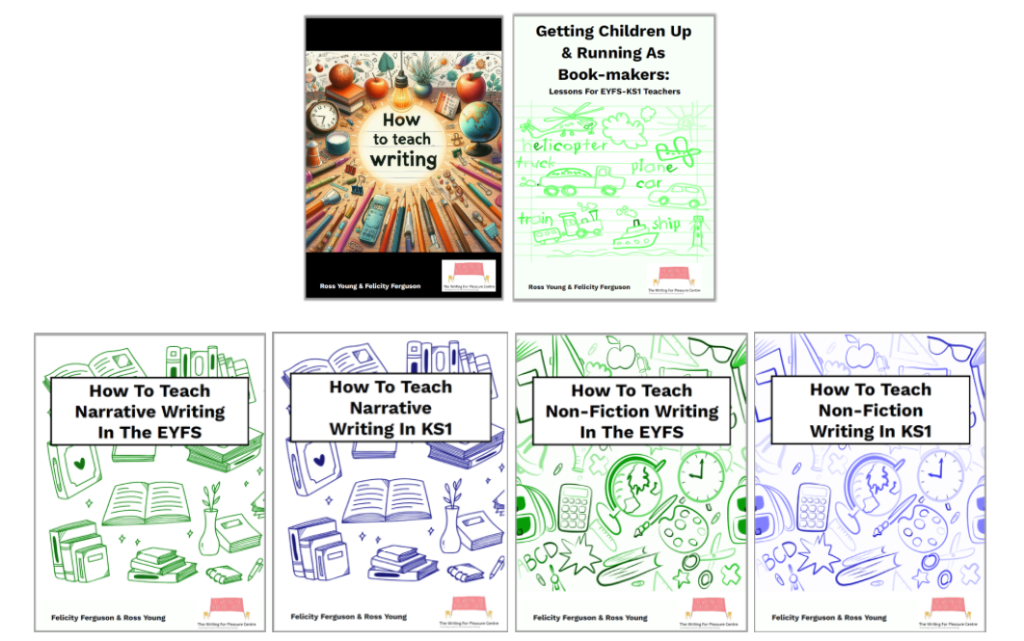
Schools will also receive a school license (worth £54.75) to our latest eBook How To Teach Writing.

Teaching young children to write: The case for ditching extended writing

Why less can be more in early writing instruction

In the early stages of learning to write, particularly in Reception and Key Stage One, it can be tempting to push for ‘extended writing’ as a sign of progress. 

Extended writing, often characterised by multi-paragraph pieces, is undoubtedly important later in schooling. However, compelling evidence suggests that asking very young children to produce overly long texts can actually undermine their writing development.

At the same time, this does not mean we should abandon writing at the whole-text level. In fact, composing complete texts, however short, is essential. 

The key is finding the right balance: prioritising quality, purpose, and coherence in children’s writing over sheer quantity for quantity’s sake.

Why extended writing isn’t the goal (Yet)

Children in Reception and Year One are often still developing their transcription skills: letter formation, handwriting fluency, encoding, and early spelling. Until these transcriptional foundations are secure, children won’t be able to compose their best texts. When transcription is effortful, children’s cognitive resources are disproportionately consumed by forming letters and encoding words, leaving them with limited capacity for composing at length

Writing is an inherently complex process that draws on multiple skills simultaneously. According to The Science Of Writing, children’s working memory can quickly become overwhelmed if they are expected to juggle handwriting, spelling, grammar, punctuation, and idea generation over extended pieces. This cognitive overload can lead to frustration, poor writing quality, and even writing avoidance (see Motivating Writing Teaching for more on this).

Why whole-text writing still matters

Text-level understanding from the start

Crucially, not expecting extended writing in Reception and Year One does not mean avoiding text-level work. Research stresses that writing should involve an awareness of purpose, audience, and composing at a text level. For example, writing 4-8 sentences as part of a picturebook project constitutes writing a whole text. See these articles for more on the book-making approach: 

  • Early writing development and our book-making approach [LINK]
  • Getting children up and running as writers [LINK]
  • How to teach writing in the EYFS [LINK]
  • How to teach writing in KS1 [LINK]

Whole-text teaching helps children learn to compose sentences with coherence, to sequence their ideas, and to consider how sentences work together to create a collective meaning.

The power of composing short texts

Research shows that composing short texts is one of the most effective things a teacher of early writing can do (LINK). Writing a handful of well-structured linked sentences:

  • Allows meaningful discussion about beginnings, endings, sequencing, text structures and cohesion.
  • Acts as a bridge between sentence-level grammar and producing longer compositions later on.
  • Encourages children to plan, compose, revise and proof-read on a manageable scale.
  • Ensures children are developing their oral language skills at the discourse level.

Our own guidance, along with that of the EEF, Ofsted and the DfE, advocates for starting with ‘short but complete writing opportunities’ that help children practise writing for a purpose and in context. This is in opposition to focusing solely on isolated sentences or disconnected grammar exercises.

  • Building up to extended writing projects [LINK]
  • Our sentence-level curriculum [LINK]

Short texts: What the research says

Our Writing Development Map shows how composition and transcription become increasingly integrated. Proficiency in both follows a gradual developmental trajectory, where these components become more and more interconnected and automated over time. Composition and transcription rely on one another for their development. Therefore, writing short texts allows children to successfully develop their composing skills while their transcription skills are developing too.

Practical implications for teachers

  1. Use mentor texts which realistically match the amount and type of writing you want the children to produce for themselves. For example:
  1. Model one aspect of writing each day, through the principles of self-regulation strategy development instruction, to show children how short but complete texts are structured.
  1. Focus on quality, not quantity: Emphasise short, purposeful and coherent writing projects in the EYFS and KS1.
  2. Use a developmentally appropriate writing process, such as the book-making approach, which includes scaffolds like drawing for planning and oral rehearsal to help children organise, translate, and transcribe their ideas fluently and happily.
  1. Show children how to revise and proof-read even the shortest pieces of writing.

For more details, consider reading the following publications. Alternatively, you can download our EYFS-KS1 units plans and programme of study. Remember, these publications and unit plans are FREE for members. To become a member, follow this link.

Conclusion

The expectation that young children should produce multi-paragraph writing in Reception and early KS1 is not supported by the evidence. Instead, research strongly supports a developmentally appropriate approach that focuses on transcriptional fluency while still teaching children to compose whole, meaningful texts on a manageable scale.

Making short picturebooks and chapter books across EYFS-KS1 is not a compromise or a ‘lesser form of writing’. They are vital, evidence-informed stepping stones to becoming confident and capable writers.

Enhancing your writing teaching: Insights from a metacognitive model

Original article: LINK | By Douglas J. Hacker 

***

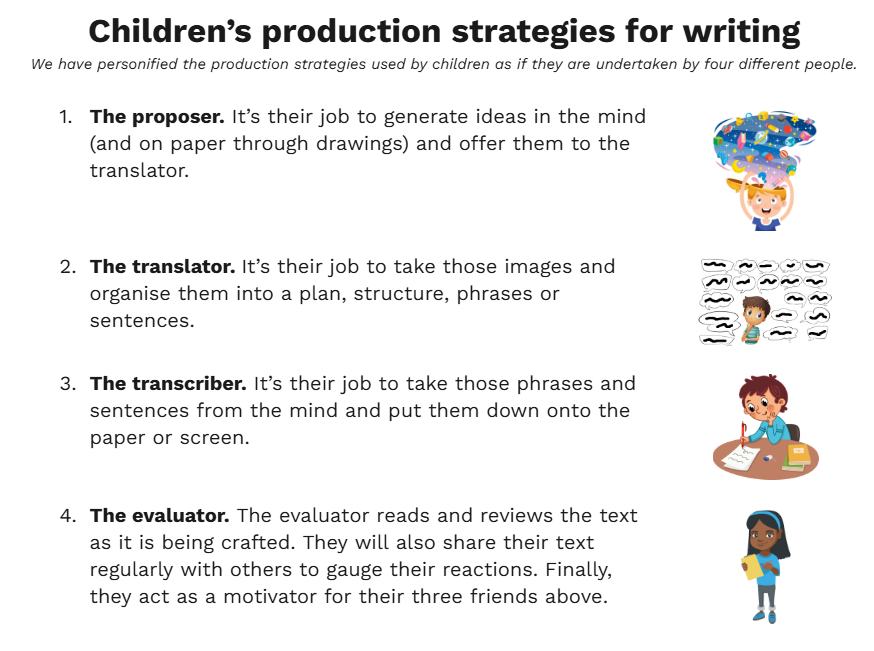
When children are in the writing classroom, their brains are like a busy workshop. They are builders and project managers who are crafting texts. An important part of crafting these texts is thinking. Here’s what children are up to while they are writing:

Level 1: The doing

  • Their brain gets to work coming up with writing ideas. They are thinking about what they want to write about and are planning it out.
  • They then translate these ideas into thoughts, words, phrases and sentences in their mind before transcribing them to paper (or screen).
  • They also look at what they’ve written and read it back to themselves.

We can call this ‘the doing.’ They are the production strategies children use as they are writing. Here’s a nice explanation taken from our publication The Science Of Teaching Primary Writing:

Level 2: The thinking

The thinking part of their writing process is acting like a project manager. It looks at what the “doing” part is doing. It thinks about the words they’ve written and the ideas they’ve shared.

They ask themselves questions like: Does this make sense?, Is that the right word? and Will the person reading this understand me?

Based on this thinking, they tell the “doing” part what to do next. They might say: Change that word!, Add more details here!, Rub out that sentence!, or Let’s try planning a bit more…!

When we write, our brains are always doing this merry dance between the doing and the thinking. This goes on and on until we feel like our writing is finished. Children as young as three start doing this kind of thinking and doing while writing (see here for examples).

Scribbles and drawings are where they start. When they are starting out, children will make scribbles, letter-like shapes and drawings (see here for examples). They are already trying to translate their thoughts into marks. Learning that a written mark can stand in for a spoken word is a massive and profound step in children’s thinking about language.

Writing helps children look closely at words. When they write, children are translating their thoughts into words. Writing lets children see these words. This helps them notice how words are built, how sentences go together, and how they need to use different words and sentences depending on who they are writing for (This is called perspective taking and you can read more about it here). Writing helps children think about language itself.

Thinking about their writing helps children improve. The more children practice considering their ideas, turning those ideas into sentences, transcribing those sentences to paper, and revising them, the more fluent they become. As our Writing Map shows, writing fluency is a key factor in children’s writing success.

Implications for classroom practice

According to our Writing Map, when teachers embrace this metacognitive model for writing, they equip their students with the tools to produce high-quality texts. For example:

1. Explicitly teach children the writing processes: Planning class writing projects so that children work through the full writing process can help them develop a deeper understanding of both writing and what it means to be a writer. This helps them become better writers and thinkers. 

  • Here is a developmentally-appropriate writing process for children in the EYFS-KS1. 
  • Here is one for children in KS2.

2. Teach monitoring strategies: Encourage children to actively monitor their writing. This involves teaching strategies such as:

  • Reading mentor texts [LINK
  • Regularly rereading and retelling your writing with teachers and friends [LINK]
  • Formally reviewing their writing through revision checklist sessions [LINK]. 

3. Teach control strategies: Equip children with strategies that writers use to control their writing, including techniques for: 

  • Generating ideas [LINK]
  • Planning [LINK
  • Translating thoughts into drawings before turning them into sentences [LINK]
  • Drafting fluently [LINK]
  • Proof-reading [LINK]

4. Encourage reflection and verbalisation: Provide regular opportunities for students to talk about their writing through ego-centric speech [LINK], verbal feedback [LINK], class sharing and Author’s Chair [LINK]. 

5. Acknowledge and develop children’s metalinguistic and metapragmatic awareness: By teaching both grammar and at the sentence-level in a functional and purposeful way, children are well positioned to discuss the different effects grammatical craft moves have on their writing (See these two links for more – here and here). 

Through functional grammar teaching, children’s awareness of language structure (metalinguistics) and awareness of how language is used effectively in different social contexts and for different purposes (metapragmatics) develops in sophisticated ways. These forms of awareness are strongly linked to improvements in children’s writing quality.

6. Build on children’s early writing development: Recognise that children’s early mark-making and drawings are important developmental milestones. It helps children associate marks with meaning and develops their graphomotor skills. Understanding this developmental shift from “first-order representation” (marks directly portray objects) to “second-order representation” (marks represent spoken words) is profound (see link for more).

7. Don’t delay writing instruction: Learning to write should productively run alongside learning to read. By writing, children create a model for representing speech (words, phrases, sentences) that they can then ‘read’ or ‘tell’. This ‘penny drop’ moment can often be the gateway children need to truly engage with reading. It gives them a new kind of intrinsic motivation — as they read aloud words born of their own thoughts and see how others respond. In doing so, they begin to understand the purpose of reading: they have created something worth reading. And now, they read others’ writing in new ways.

How to keep students motivated to proofread: Practical strategies for the classroom

Proofreading is a critical skill that helps students refine their writing and become more independent writers. However, convincing students to engage deeply in proofreading can sometimes be a challenge. Often, they see it as tedious or irrelevant, leading to disengagement. At the end of the day, they are children. In many ways, they have a wonderful naivety and lack of prejudice when it comes to people’s transcriptional accuracy. They just don’t seem to care about keeping to conventions as much as us adults seem to! However, by drawing on motivational psychology (see our eBook Motivating Writing Teaching for more details), teachers can develop a classroom environment where proofreading becomes a meaningful and motivating part of the writer’s process.

Here’s how you can apply these theories to keep your students motivated when asking them to proofread their writing.

1. Help students see the value of proofreading

Students are more motivated when they see a task as valuable. Many students think proofreading is just about nitpicking grammar, but you can reframe it as an opportunity to strengthen their voice and make their writing more impactful for their readers.

Practical tips: 

  • Connect with real audiences: Let students know their writing will be shared beyond the classroom walls — that is going to be published for real. Make sure they know that the proof-reading they are doing therefore matters. You can do this by setting a high-value publishing goal with or for your class at the beginning of a class writing project. 
  • Develop peer expertise: Encourage students to become ‘proofreading experts’ in specific areas (e.g. the capitalisation captain, the vocabulary use vixen or the spelling superhero) to build their sense of mastery and writer-identity. These proof-reading experts could be called upon by their peers to help catch a few extra proof-reads! I know of some teachers who give children different hats to indicate their expertise. Extrinsic rewards can be given out to these experts for helping their peers too.

2. Build expectancy for success: Boost their confidence

Students need to believe they will be successful each day. When proofreading feels overwhelming or overly technical, their motivation plummets. Focus on growing their sense of daily proficiency.

Practical tips:

  • Model just one proofreading strategy explicitly: Provide clear, step-by-step methods for checking a specific aspect of their manuscript (e.g. using the CUPS method).
  • Start small: Let students focus on finding one type of error at a time to build success and reduce cognitive overload. As children become better proof-readers, they can slowly be asked to do more within a single session.
  • Praise effort and improvement: Acknowledge and celebrate every proof-read they find! For example, ask students to count the number of proof-reads they make and reward the winner(s) as being the best proof-readers in town! You should also celebrate the student(s) who have the least number of proof-reads to find (because they write extremely accurately as they draft). Don’t be afraid to use extrinsic motivators and rewards at the proof-reading stage.
  • Provide scaffolds: Use checklists, modelled examples, and posters to help guide students (see our eBook: No More: My Class Can’t Edit! for more details).

3. Lower the ‘cognitive cost’: Make proofreading feel quick and like no sweat.

If students believe proof-reading is too time-consuming, boring, or likely to end in failure, they’ll see the ‘cognitive cost’ as too high. You can minimise these barriers.

Practical tips:

  • Break proofreading into bite-sized tasks. There are lots of ways to do this. For example, proofread for just one CUPS item or proof-read just one paragraph a day.
  • Make it social: Let children proofread together – and let them see how many proof-reads they can find together. Gamification can work well here. For example, you could introduce a leaderboard. However, it’s important that you celebrate the teams that had the least number of proof-reads to find and the team who found the most.
  • You might not like this suggestion – but I’m afraid it’s true. Some of the writing we make needs to be more correct than other pieces. That’s a reality. Maybe for some writing projects, you don’t need to put as much instructional focus into transcriptional accuracy. Instead, you might want to focus on developing other areas of children’s writing proficiency. There are lots of ways to organise writing units with different focuses. Take a look at this article for more details: The Components Of An Effective Writing Unit.
  • Give timely, supportive verbal feedback: When students see you’re noticing their efforts and not just their mistakes, the emotional ‘cost’ of proof-reading decreases rapidly. Below is an excerpt taken from our eBook: Pupil-Conferencing In The Writing Classroom.

***

Teachers and assistant teachers can sometimes focus on children’s transcriptional errors too early in their writing process. Be reassured that children will be given an opportunity to attend to these things in dedicated proof-reading sessions (Young & Ferguson 2023c). We can also be tempted to fix children’s writing on their behalf. However, this is inappropriate and counterproductive. When we do this, we create dependent writers – and we are in the business of developing independent writers.

The moment you get that famous red pen out and do the cognitive work on the children’s behalf, you are disempowering them. We recommend that teachers and assistant teachers roughly point out where some transcriptional errors may be found within a child’s manuscript, and then ask the child to find and correct them for themselves. For example:

  • Wow, you found so many edits! I can see you have three more to find though.
  • Whoa 35 edits. You’re one of the best proof-readers around. You do still have some spellings in your last paragraph to sort out though please.
  • Ah, you’ve still got a few capitalisation issues in your first paragraph – you better go find them and sort them out.
  • You’ve done a really good job at proof-reading this so far. However, you’ve got a few spellings that need sorting out on this page – maybe proof-read it with Callum and see if you can get them sorted.

Always celebrate the conventions children are using appropriately before talking with them about a convention they may be overlooking. Ensure that your conferences always start with what the child is doing, using phrases such as:

Opening phrases for proof-reading conferences:

  • I can see that you’re a writer who knows to…
  • Wow, look at all those…
  • I really love how you’ve used … that’s really going to help your reader out.
  • These are fantastic. You’re really thinking about your reader.
  • Would you look at that? This is great! Why did you use…
  • I can tell you’re a great proof-reader, look at how you’ve…
  • Whoa, you must have made about 20 proof-reads on this! That’s amazing. You’re the best proof-reader I know.

Next, comes the teaching part of the editing conference. Here are some great openers you can use:

Teaching phrases for proof-reading conferences:

  • Did you have a reason for deciding … [to put a semi-colon here?]
  • Tell me about your choice to… [use commas around this extra bit of information.]
  • I noticed that you… Explain what you’re thinking. [I’ve noticed the book you’re making hasn’t got a title – is there a reason for that?]
  • Show me where you’ve tried to help your reader understand your writing [Bringing conventions back to their purpose – to help our readers]
  • Let me show you how I help my readers understand my writing so you can do it too… [Sometimes, children need an additional example beyond the whole-class mini-lesson]

Let’s look in the book you’re reading to see how the writer has done it [Let’s look at how the author used the conventions for speech punctuation]

As you will see, framing your teaching comments like this is a sympathetic way of drawing children’s attention to errors or omissions, clearing up possible misunderstandings, and getting them to re-think and talk about the function of conventions.

***

Final thoughts

When you use motivational theory to inform your teaching practice, you can design proofreading activities that:

  • Feel valuable and worthwhile
  • Build students’ feelings of confidence and competence
  • Are low in emotional and cognitive ‘cost’
  • Support children’s need for social connection

By doing this, proofreading stops being just a correction task – it becomes part of a rich writing process where students take ownership, feel proud of their growth, and understand why their writing matters.

The Writing For Pleasure Centre’s Sentence-Level Curriculum

For many teachers, the prospect of teaching writing can feel daunting. Research indicates that many of us feel ill-prepared to teach writing, often replicating the ineffective methods we experienced ourselves as children. This challenge extends specifically to teaching about sentences, leaving many unsure where to begin. Yet, effective sentence construction is vital for clear and meaningful written expression. Struggles with sentence construction can significantly impact children’s writing, consuming their working memory, hindering fluency, and affecting clarity and coherence.

Recognising this widespread issue, The Writing For Pleasure Centre was founded as a think tank and action research community dedicated to helping all young people become passionate and successful writers. Through extensive research, including meta-analyses and case studies, we have developed a pedagogy based on what the science and research evidence indicates is the most effective practice. This approach, known as The Writing For Pleasure approach, can be considered a synonym for world-class writing teaching.

A cornerstone of this approach is sentence-level instruction. Teaching at the sentence level is essential because it supports core writing processes like planning, drafting, and revising, and helps free up working memory for higher-level concerns like purpose and audience. Limited sentence skills can hinder children’s writing fluency, making it difficult for children to translate ideas into text quickly and often leading to writing that is judged negatively (see our Writing Map for more details).

To address these challenges, we offer our Sentence-Level Curriculum. This comprehensive curriculum draws on our extensive research base. It provides teachers with the confidence and tools needed to teach about sentences in a way that helps children write their most successful and meaningful pieces.

The curriculum organises sentence-level instruction into three categories reflecting what children are trying to achieve in their writing:

  • Focused sentences: Lessons that help children concentrate on the most important parts of their writing – nouns and verbs – forming the basis of well-focused sentences.

  • Balanced sentences: Instruction to help children make connections between their thoughts and ideas, sharing reasoning, providing contrasts, establishing conditions, and discussing alternatives.

  • Developed sentences: Lessons focused on pushing the reader’s thinking, understanding, and imaginings, elaborating on meaning using artistic flair, rhetorical techniques and poetic devices.

Our Sentence-Level Curriculum incorporates writing-study lessons, which involve sharing powerful ‘how to’ knowledge and inviting children to apply it during writing time. These mini-lessons are short, explicit, and direct, teaching one concept before inviting application. The approach recommends a consistent routine of mini-lesson, writing time, and class sharing.

The other key component of the curriculum is the use of sentence-building mini-projects. These are not rote exercises but short, playful and purposeful ways for children to explore writing by experimenting, taking risks, and discovering new ways of shaping ideas. The projects are designed to build children’s skills quickly but incrementally, starting with simple sentences and progressing towards a full repertoire of understanding.

These short projects are based on three evidence-informed principles:

  1. Teaching students what sentences are and expanding their awareness of syntactic possibilities.
  2. Focusing on sentence formation and revision to gradually reduce cognitive load.
  3. Improving children’s writing fluency.

The projects encourage children to see the function of different punctuation and sentence types and how manipulating syntax helps them discover different ways of expressing ideas. They allow children to focus on crafting small, manageable pieces of text within the broader process of ‘making’ real writing.

Specific mini-projects cover a range of sentence and grammar concepts suitable for different age ranges, from the EYFS to Year 6 (3-11 year olds). For example:

  • Understanding what a sentence is
  • Using end punctuation (full stops, question marks, exclamation marks)
  • Connecting ideas with coordinating conjunctions
  • Adding detail with adjectives and expanded noun phrases
  • Making verbs more precise with adverbs
  • Using pronouns to avoid repetition
  • Crafting complex sentences with subordinating conjunctions
  • Using the passive voice
  • Understanding the subjunctive mood
  • Adding extra information with parenthesis
  • Connecting related sentences with semicolons
  • Introducing explanations or lists with colons

Our sentence curriculum emphasises the use of mentor texts to show children what can be done with sentences and how they can apply these techniques in their own writing. Teachers are encouraged to model techniques from their own writing and from other published examples. The projects also use drawing to help children – especially those who struggle most – focus on expressing their ideas clearly and to visualise how different sentence constructions affect the style and meaning of what they want to say.

Ultimately, The Writing For Pleasure Centre’s Sentence-Level Curriculum is designed to help children gain control over sentence construction and punctuation, leading to increased confidence and the ability to write with greater originality and style. By focusing on the function of sentence elements and engaging children in playful experimentation and thoughtful revision, this curriculum lays the foundation for more fluent, expressive, and successful writing.

*NEW BOOK* Unlock the power of sentences with The Writing For Pleasure Centre’s Sentence-Building Mini-Projects!

Are you a teacher looking for effective ways to help your students master sentence construction and punctuation? Do you hear yourself thinking, “They don’t know what a sentence is!” or “They don’t know what end punctuation is!”? The Writing For Pleasure Centre offers a solution designed specifically for young writers of all needs and abilities.

Sentence-Building Mini-Projects, developed by experienced writer-teachers Ross Young and Felicity Ferguson, are more than just exercises – they are a playful, purposeful, and powerful way for you and your pupils to explore writing. Grounded in extensive research and classroom practice, this programme provides direct instruction at the sentence-level through structured yet engaging projects.

The core of the programme involves short book-making projects. These projects offer a unique advantage by allowing children to focus on crafting manageable pieces of text within the broader process of creating real writing. They are not rote exercises or worksheets. Instead, they closely mirror real writing by asking students to revise and enhance sentences they have composed themselves. The projects are also infinitely repeatable, providing practice whenever needed.

What makes these projects so effective?

  • Functional understanding: Children learn the function of different pieces of punctuation and sentence types, rather than just memorising terms. For example, they learn how end punctuation signals the end of a thought and how a sentence should be read, or how coordinating conjunctions let them add more information.
  • Practical application: The projects promote a better understanding of capitalisation and punctuation through practical application, making grammar instruction far more meaningful.
  • Experimentation and discovery: Each project invites children to experiment, take risks, and discover new ways of shaping their ideas.
  • Incremental skill building: Projects are sequenced carefully, helping young writers build their sentence-level skills incrementally, moving from simple sentences towards a full repertoire of understanding. This means there are projects suitable for various age ranges, from the EYFS through to Year 6.
  • Focus on meaning and audience: Students are helped to consider how sentence structure impacts their readers and gain a greater appreciation for constructing unique writing styles. They learn to make each word count towards the meaning they wish to convey.
  • Drawing integration: Drawing is an important part of the process. By developing content through pictures, the projects reduce cognitive load, allowing young writers, especially those with difficulties, to focus on expression. Drawing also helps children see how their sentence-level decisions impact the meaning of their illustrations, making grammatical patterns visible and instruction more useful and exciting.
  • Building confidence and fluency: As young writers gain control over sentence construction and punctuation, they gain confidence and begin to write with greater originality and style. This also enhances their reading fluency and comprehension by familiarising them with complex sentence patterns.
  • Supports revision skills: The projects help children transform their sentences for meaning, not just make superficial changes.

The mini-projects cover a wide range of sentence-level concepts, including:

  • Understanding what a sentence is
  • Using end punctuation
  • Adding information with coordinating conjunctions
  • Using adjectives and adverbs
  • Understanding apostrophes for possession
  • Using commas and semi-colons for lists
  • Applying capital letters
  • Using prepositional phrases
  • Adding extra information with subordinating conjunctions
  • Choosing precise nouns and verbs
  • Punctuating direct speech with speech marks and speaker tags
  • Understanding the usefulness of pronouns
  • Exploring modal verbs
  • Adding ‘bonus’ information with relative clauses and parenthesis
  • Understanding the passive voice
  • Using the subjunctive mood
  • Preventing ambiguity with hyphens
  • Connecting related sentences with semi-colons
  • Using colons for ‘drumrolls’ and explanations
  • Constructing complex multi-clause sentences
  • Understanding tense
  • Writing in different perspectives (1st, 2nd, 3rd person)

By integrating these projects into your teaching, you can provide your students with the tools and understanding they need to become more proficient, confident, and expressive writers. Each project includes planning guidance, exemplar texts, and subject knowledge to help you seamlessly integrate sentence-level teaching into your existing curriculum.

Explore The Writing For Pleasure Centre’s Sentence-Building Mini-Projects and help your students write happily and fluently!

Individual license – £10.95

School/Institution license – £54.75

or FREE for members

*BIG NEWS* We have updated our KS2 writing units for 2025. What’s new?

At The Writing For Pleasure Centre, we offer a supportive and empowering model of writing instruction which we believe is unmatched by other commercial programmes. Our approach gives teachers:

  • Expertly-crafted scripted lessons and units
  • Additional lessons so that teachers can build their own custom units based on their students’ most pressing writerly needs
  • eBooks to help develop teachers’ independence
  • Personalised email support through our CPD programme

Our goal is, as always, to help teachers become successful, confident and independent writer-teachers. 

 Units that model excellence

Each unit has been crafted by an experienced writer-teacher who knows how to embed the principles of effective writing instruction. Our units:

  • Provide immediate structure, resources and clarity for busy teachers
  • Supply rich model texts and sequenced lessons
  • Include grammar and sentence-level lessons
  • Reduce teachers’ planning time while developing the quality of their instruction

Built-in flexibility: Plan with confidence

Each unit includes a suite of additional lessons so teachers can:

  • Adapt the units quickly to reflect their pupils’ most pressing and immediate writerly needs
  • Build their own units with expert scaffolding
  • Be responsive to classroom dynamics while maintaining fidelity to the principles of best practice school-wide.

This means every unit can be treated as a starting point, not just a script – allowing teachers who wish to teach responsively the joy and satisfaction of doing so.

Literature that builds independence

Our embedded CPD articles help teachers:

  • Understand the pedagogy behind great writing teaching
  • Grow their subject, pedagogical and curriculum knowledge
  • Eventually plan their very own writing units from scratch with total confidence

Unlike other commercial providers, we don’t want teachers to feel they have to rely on our scripted units forever. We want them to become independent curriculum designers who get to teach writing with expertise and pleasure.

CPD that connects and supports

A truly unique feature of our programme is our CPD with personalised feedback. When schools join our professional development offer, they can:

  • Email us their unit plans
  • Receive quick, supportive feedback, ideas, and encouragement on a personal level
  • Gain reassurance and insight from experienced mentors

This kind of close, ongoing support helps teachers refine their practice, grow in confidence, and feel part of a wider writing community.

In summary

Our updated units provide:

  • Expertly written example units and scripted lessons
  • Rich model texts and sequenced lessons
  • Grammar and sentence-level lessons
  • Additional lessons so teachers can adapt and build their own units
  • Literature so teachers can learn to plan their own units independently if they want to
  • CPD with personalised and ongoing support and feedback

We believe teachers ultimately deserve real in-depth support – not just scripts.

We believe children deserve to write with purpose, pleasure, and pride.

Let’s create classrooms and schools where everyone writes with joy and satisfaction!

What now?

If you’re already a member, simply log in. We have updated all the planning links in the Class Writing Project section of the members’ area. Go check them out and get downloading!

    • Teachers and schools can purchase any of our EYFS-KS2 writing units from our website for £5.95 [LINK].
      • Teachers can purchase an individual licence to our website for £28.50 a year. This gives them access to all our eBooks, unit plans and resources [LINK].
      • Schools can purchase a whole-school licence to our website for £400 a year. This gives everyone access to our eBooks, programme of study, assessment guidance, CPD materials, units plans and resources. If you’re a smaller school, get in touch as we may be able to provide you with a discount [LINK].

      ***

        If you want to get in touch, you can use our contact form or email us: hello@writing4pleasure.com

        Ross Young & Felicity Ferguson

        Balancing scripted lessons with teacher autonomy: How Writing For Pleasure Centre units work

        Great writing instruction thrives on both structure and responsiveness. At The Writing For Pleasure Centre, we believe that children flourish as writers when their teachers are supported to be confident, successful and reflective writer-teachers. That’s why our approach offers more than just our pre-planned units and scripted lessons. We provide expertly designed units but we also give teachers the tools and knowledge they need to eventually plan their own.

        Unlike many other commercial schemes, our goal isn’t to make teachers dependent on our materials. Instead, we eventually want to empower them to design their own writing units for their classes. However, we want to ensure that their units are grounded in the principles of effective writing teaching and are responsive to the unique needs of their pupils at that time. 

        Expertly written units and lessons that model excellence

        We refuse to naively ignore the pressures, demands and time-constraints faced by teachers. We are also very much aware of the fact that teachers rarely receive adequate training on how to teach writing while on their initial teacher education courses. We know that pre-service and early career teachers are often left frustrated and disappointed. This is why we offer scripted writing units and lessons.

        Our units serve as powerful models of practice. They’ve been crafted by experienced writing teachers and researchers who understand what excellent writing instruction looks like at each stage of a child’s development. For busy teachers, or those new to teaching writing, our scripted units offer clarity, confidence, and high-quality instruction without the burden or anxiety of planning a writing unit on your own from scratch. They’re an ideal starting point for delivering coherent and consistent writing projects across a whole school.

        A unique feature: Additional lessons for teacher-led planning

        What sets our units apart from other commercial providers is that every writing unit we provide includes a wealth of additional lesson ideas which teachers can draw on to ‘build their own unit’ if they choose to. These lessons are like Lego bricks. Teachers can easily decide to include them or move them around. This is a deliberate and powerful design choice. We recognise that teachers know their pupils best – not us – and that they may want to tailor our units around a particular aspect of writing.

        Rather than locking teachers into a fixed sequence, we offer them the flexibility to be responsive to what they think their class actually needs instruction in most! Our additional lessons allow teachers to remix, expand, and otherwise shape our units in ways that suit their classroom context – while still maintaining high standards and whole-school fidelity to evidence-informed practice.

        A unique feature: Email support

        A truly unique feature of our CPD training is our offer to teachers to email us their unit plans so that they can receive quick assistance, feedback and encouragement. Teachers are able to gain reassurance and insight from experienced mentors. This kind of personal and ongoing support helps teachers refine their practice, grow in confidence, and feel part of a wider writing teaching community. They don’t have to plan alone.

        A unique feature: Literature that builds independence

        Our third unique offering is our collection of eBooks and research summaries which support teachers in understanding the principles behind effective pedagogy so they can develop the confidence to plan their own units from scratch. This is always our long-term aim: that teachers engage deeply with pedagogy, see how our scripted units reflect best-practice in action, and then use that knowledge to become independent curriculum designers.

        This isn’t about just handing over scripts to teachers and being done with it. It’s about their professional growth. Teachers are not technicians – they are thinkers, writers, and professionals. Our eBooks are designed to help them embrace that role fully.

        Conclusion: From holding your hand to self-sufficiency

        By offering high-quality scripted units, and also the tools for self-directed planning, we believe we provide something unique: support without dependency. We meet teachers where they are – whether they want to follow a fully scripted unit, adapt one using our additional lessons, or create their own from the start.  We walk with them on their journey towards greater confidence and professional autonomy.

        This is how we help develop not only better writing outcomes for children, but also more empowered, knowledgeable, and fulfilled teachers of writing.

        What now?

        1. Teachers and schools can purchase any of our EYFS-KS2 writing units from our website at a unit price of £5.95 [LINK].
        1. Teachers can purchase an individual licence to our website for £28.50 a year. This gives them access to all our eBooks, unit plans and resources [LINK].
        1. Schools can purchase a whole-school licence to our website for £400 a year. This gives everyone access to our eBooks, programme of study, assessment guidance, CPD materials, units plans and resources. If you’re a smaller school, contact us, as we may be able to provide you with a discount [LINK].

        If you want to get in touch, you can use our contact form or email us: hello@writing4pleasure.com

        Ross Young & Felicity Ferguson