Book Review: The Responsive Writing Teacher by Melanie Meehan & Kelsey Sorum

The Responsive Writing Teacher, Grades K-5 : A Hands-on Guide to Child- Centered, Equitable Instruction by Corter, Kelsey Marie (9781071840641) |  BrownsBfS

The Responsive Writing Teacher: A Hands-on Guide To Child-Centered, Equitable Instruction

By Melanie Meehan & Kelsey Sorum

In The Responsive Writing Teacher, Melanie Meehan (an elementary writing coordinator and educational blogger at the magnificent Two Writing Teachers) and Kelsey Sorum (a kindergarten teacher) provide a broad perspective of what it means to be a young writer and what it means to teach them as a writer-teacher. What excites me most about this title is how it drills down into perhaps the most important aspect of all teaching, but particularly writing, that of responsive teaching.

As we do with all our write-ups, I will review the book using the 14 principles of world-class writing teaching (Young & Ferguson 2021).

  1. Build A Community Of Writers

‘An important element of culturally responsive teaching is that students see diverse representation within the classroom environment and its resources. What message will students see about themselves and the world when they look around?’ (p.95)

The authors explain early on that there are a number of ways in which we can be responsive to the needs of our young writers. These include:

  • Academic – ensuring new skills and content match students’ abilities and goals
  • Linguistic– ensuring language(s) used in instruction and in the classroom environment are accessible and inclusive of home languages
  • Cultural  – ensuring a diverse representation of authorship and within the content of texts
  • Socio-emotional – ensuring a safe and supportive environment for taking risks and overcoming challenges in the writing process

For Meehan & Sorum, building up children’s writer-identities forms a major part of building a loving and safe community of writers. They share a number of practical ways in which teachers can support and invite children’s funds of knowledge and funds of identity into the classroom including:

  • Producing ‘identity webs’
  • Inviting children to interview one another
  • Writing ‘I am…’ poems
  • Producing multilingual books
  • Creating writing posters and resources which authentically reflect traditionally underrepresented learners
  • Inviting children to co-construct the posters and resources that are used in the classroom
  • Selecting mentor texts which reflect children’s funds of knowledge and identities including multilingual texts
  • Participating in class writing projects and writing alongside learners
  1. Treat Every Child As A Writer

As the title suggests, this book’s biggest strength is its focus on responsive teaching. Meehan & Sorum provide a treasure-trove of advice on ensuring your writing classroom is as equitable as possible for all apprentice writers. In particular, they offer tools and resources for ensuring English language learners have equal access to writing and being a writer.

  1. Read, Share, Talk & Think About Writing

‘Students often have great insight into what makes things challenging for them.’ (p.20)

What’s striking about the authors’ practice is how they bring children into the conversation about what they need to learn most and how they then teach the children how they can do it for themselves. For too long, asking children what they need instruction in has almost been seen as cheating. However, Meehan & Sorum powerfully and convincingly show how teachers can invite their learners to read, share, talk and think about writing with them. This includes advice on how to undertake student-driven planning, goal-setting and assessment.

  1. Pursue Authentic & Purposeful Class Writing Projects

‘Adapting writing [projects] so that they align with students’ interests contributes to a stimulating writing environment and positively affects the quality of student writing.’ (p.40)

Throughout the book,  Meehan & Sorum show how you can move from predetermined units to writing projects that are authentic and purposeful. For example, in chapter two, the authors share valuable questions teachers should ask themselves when teaching a class writing project.

Before a project:

  • What will the class do?
  • How can they do it?
  • What strategies can help?

During a project:

  • What are the class not doing yet?
  • What might be getting in the way?
  • What strategies might help?

After a project:

  • Where can the class go from here?
  • What aspect of this work is particularly engaging for them or can be expanded upon?
  1. Pursue Personal Writing Projects

While the authors share examples of how we, as writer-teachers, should pursue our own personal writing projects, they don’t consider within this particular title how such time could be made for children to do the same.

  1. Teach The Writing Processes

‘Knowing how writers write is as valuable as knowing what they can write’ (p.18)

Meehan & Sorum provide really valuable tools for collecting information about the writing processes and writing behaviours of your class. As we know, teaching young writers about the writing processes is one of the most effective practices a writer-teacher can employ. The authors also make the case that to teach about the writing process, teachers must consider and perhaps even diagram their own writing processes.

  1. Teach Mini-Lessons

‘Responsive plans are made from a place of knowing. No curriculum writer, no plan maker knows the writers in a classroom like the teacher does. A responsive writing teacher crafts instruction that aligns with students’ developing skills.’(p.49)

Throughout the book, the authors share what must be one of the most important questions we can ask our apprentice writers: What helps you learn? The authors then share what you can do with the answers. In addition, they show very practically how you can use your own writing to teach high-quality and responsive mini-lessons.

  1. Be Reassuringly Consistent

It’s exciting to see Meehan & Sorum advocate for the reassuringly consistent routine of a contemporary writing workshop approach. Through such an approach, they explain how students are provided with high-quality instruction. They are then afforded significant amounts of time for writing and given the opportunity to talk and share their developing compositions with others. Finally, they acknowledge the powerful relationship between reading and writing.

  1. Balance Composition & Transcription

While it’s insinuated through their mention of revision and editing checklists and their discussion around the explicit teaching of the writing processes, the authors don’t go into much detail about how teachers can ensure a balance is kept between teaching about the compositional aspects of writing and how teachers can get students to focus on transcriptional accuracy. I suspect teachers would like to know more about how this is achieved by the authors in their classrooms.

  1. Set Writing Goals

One of the things that always impresses me about American writer-teachers is their ability to see their classroom as a ‘third teacher’. And so it is with Meehan & Sorum who provide a whole chapter on how ‘charts,’ posters and working walls can bring an accessibility to teachers’ writing instruction. Through different types of charts, the authors show how they can not only set children challenging and achievable writing goals but also show them how to achieve these goals successfully. They suggest the following types of charts:

  • Genre charts – share the typical features of a certain text-type.
  • Process charts – detailing the processes writers go through during writing time.
  • Strategy charts – show how you can use and apply a certain skill or literary technique.
  • Reference charts – a visual reminder of something the children will need to do time and again.
  • Checklists – help children keep track of their progress towards set goals.
  • Goal-setting charts – help learners know how to achieve a certain writing goal.
  1. Pupil-Conference: Meet Children Where They Are

While no specific advice is given on how to conduct pupil-conferences, I would argue there are already plenty of texts out there that do that brilliantly. Instead, this text shares a vision in which all aspects of writing teaching are open for ‘conference’ and discussion.

  1. Be A Writer-Teacher

‘Demonstration texts that are intentional and explicit keep students at the forefront – representing, engaging, inspiring, and inviting young writers in.’ (p.143)

Both authors strongly advocate for the writer in ‘writer-teacher’. They make a compelling argument that teachers who write grow (p.144):

They suggest that teachers mirror and participate in class writing projects throughout the year as well as immerse themselves in their own volitional writing projects for the benefit of both themselves and also for the children they serve.

  1. Literacy For Pleasure: Connect Reading & Writing

‘Mentor texts provide students with inspiration and examples of writing elements specific to each genre. Making thoughtful choices about the texts for each unique class of writers is paramount, considering the content, language, and representation within the text and in the authorship. Such decisions can increase the connection children make with texts and authors; the connection children make with each genre; and the connection children make with themselves, as growing writers.’ (p.113)

 Meehan & Sorum ask two important questions when it comes to the reading/writing connection:

  1. Who are the writer-teachers students need to see and learn from?
  2. Whose stories do students need to hear?

There is also an important distinction made between using a mentor text and using mentor texts. The authors rightly suggest that children should see a variety of mentor texts from a variety of authors (including their writer-teacher and the texts of other students) and that these texts should match the sorts of things children are trying to achieve within a class writing project.

  1. Interconnection Of The Principles

In conclusion, Meehan & Sorum provide teachers with much to think about in terms of equitable and responsive writing teaching. By reflecting on the wisdom shared within these pages, teachers would be perfectly placed to create a passionate, supportive and loving community of writers who write with pleasure, purpose and power.

Review by Ross Young. Ross runs The Writing For Pleasure Centre and helps convene the United Kingdom Literacy Association’s Teaching Writing special interest group.

References:

  • Young, R., Ferguson, F., (2021) Writing For Pleasure: theory, research and practice London: Routledge

The research on handwriting

We get asked from time to time what our opinion is on handwriting. We don’t really hold a strong personal opinion on the matter but rather look at the position taken by current research. With this in mind, we have set up this page to share links to relevant research that people may find interesting reading.

Having read the research ourselves, we conclude that we would want children to feel they can write quickly and happily and to feel confident that others can read their writing too.

Articles:

  • The unrealised promise of emergent writing: Reimagining the way forward for early writing instruction [LINK]
  • Early alphabet instruction [LINK]
  • Want to improve children’s writing? Don’t neglect their handwriting [LINK]
  • The links between handwriting and composing for Y6 children [LINK]

Research specific to the early years:

  • Jones, C. (2014) Effects of writing instruction on kindergarten students’ writing achievement: an experimental study. The journal of Educational research, 108 (1), 35–44 [LINK]
  • Rowe, D. (2018) The Unrealized Promise of Emergent Writing: Reimagining the Way Forward for Early Writing Instruction Language Arts 95(4) pp.229-241 [LINK]
  • Graham, S., Harris, K., Adkins, M. (2018) The impact of supplemental handwriting and spelling instruction with first grade students who do not acquire transcription skills as rapidly as peers: a randomized control trial Read Writ 31:1273-1294 [LINK]
  • López-Escribano, C., Martín-Babarro, J., Pérez-López, R. (2022) Promoting Handwriting Fluency for Preschool and Elementary-Age Students: Meta-Analysis and Meta-Synthesis of Research From 2000 to 2020, Frontiers in Psychology, 13, 841573 [LINK]
  • Malpique, A., Pino-Pasternak, D., Valcan, D. (2017). Handwriting automaticity and writing instruction in Australian kindergarten: An exploratory study Reading & Writing 30(8) 1789-1812 [LINK]
  • Malpique, A., Pino-Pasternak, D., Roberto, M. (2020) Writing and reading performance in Year 1 Australian classrooms: associations with handwriting automaticity and writing instruction Reading & Writing 33 pp.783-805 [LINK]
  • Puranik, C., AlOtaiba, S. (2012) Examining the contribution of handwriting and spelling to written expression in kindergarten children Read Writ 25:1523-1546 [LINK]

General handwriting research:

  • Alves, R., Limpo, T., Salas, N., and Joshi, R. (2019). Handwriting and spelling. In Best Practices in Writing Instruction, Graham, S., MacArthur, C., and Hebert, M. (Eds.) (3rd Ed.) (pp.211–240). New York: Guilford Press.
  • Barnett, A. L., & Prunty, M. (2021). Handwriting difficulties in developmental coordination disorder (DCD). Current Developmental Disorders Reports8, 6-14.
  • Berninger, V.W., and Amtmann, D. (2003). Preventing written expression disabilities through early and continuing assessment and intervention for handwriting and/or spelling problems: Research into practice. In Handbook of Learning Disabilities, Swanson, H.L., Harris, K.R., and Graham, S. (Eds.) (pp. 345–363). New York: Guilford Press.
  • Graham, S. (1992). Issues in handwriting instruction. Focus on exceptional children25(2) [LINK]
  • Graham, S., Harris, K. R., & Fink, B. (2000) Is handwriting causally related to learning to write? Treatment of handwriting problems in beginning writers. Journal of educational psychology92(4), 620 [LINK]
  • Graham, S. (2009). Want to improve children’s writing?: Don’t neglect their handwriting. American Educator, 33, 20–40. [LINK]
  • Limpo, T., Alves, R. A., & Connelly, V. (2018). Testing the effectiveness of handwriting interventions: introduction to the special issue. Reading and Writing31, 1249-1253. [LINK]
  • López-Escribano, C., Martín-Babarro, J., Pérez-López, R. (2022) Promoting Handwriting Fluency for Preschool and Elementary-Age Students: Meta-Analysis and Meta-Synthesis of Research From 2000 to 2020, Frontiers in Psychology, 13, 841573 [LINK]
  • Medwell, J., and Wray, D. (2007). Handwriting: What do we know and what do we need to know? Literacy, 41(1), 10–16. [LINK]
  • Medwell, J., Strand, S., & Wray, D. (2007). The role of handwriting in composing for Y2 children. Journal of Reading Writing and Literacy, 2(1), 18–36. [LINK]
  • Medwell, J., Strand, S., & Wray, D. (2009). The links between handwriting and composing for Y6 children. Cambridge journal of education39(3), 329-344. [LINK]
  • Ozmen, E. R., & Atbasi, Z. (2016). Identifying Interventions for Improving Letter Formation: A Brief Experimental Analysis of Students with Intellectual Disabilities. International Electronic Journal of Elementary Education9(1), 197-209.
  • Ray, K., Dally, K., Rowlandson, L., Tam, K. I., & Lane, A. E. (2022). The relationship of handwriting ability and literacy in kindergarten: a systematic review. Reading and Writing35(5), 1119-1155.
  • Santangelo, T., Graham, S. (2016) A Comprehensive Meta-analysis of Handwriting Instruction Educational Psychology Review 28:225-265 [LINK]
  • Skar, G. B., Lei, P. W., Graham, S., Aasen, A. J., Johansen, M. B., Kvistad, A. H. (2022) Handwriting fluency and the quality of primary grade students’ writing, Reading and Writing, 35(2), 509-538 [LINK]
Be reassuringly consistent

This chapter begins with a discussion of the importance of teaching the essential writing skills children require if they are to produce successful texts. This includes reflecting on the simple view of writing and what cognitive writing research has contributed to this area. The authors consider the cognitive load, metacognition, and demands on working memory involved when pupils compose and transcribe texts. They then explore what research and case studies into effective practice have been able to offer teachers in terms of successful and powerful writing instruction. The discussion includes developing children’s handwriting, typing, spelling, and editing (proof-reading) abilities. The chapter concludes with examples of effective practice from the classrooms of high-performing Writing For Pleasure teachers.

DOWNLOAD CHAPTER

The rights (and responsibilities) of the child writer

Daniel Pennac, in his book The Rights Of The Reader, created 10 rights for child readers. In 2011, The National Writing Project produced its own ten rights for writers which includes the following:

  1. The right not to share.
  2. The right to change things and cross things out.
  3. The right to write anywhere.
  4. The right to a trusted audience.
  5. The right to get lost in your writing and not know where you’re going.
  6. The right to throw things away.
  7. The right to take time to think.
  8. The right to borrow from other writers.
  9. The right to experiment and break rules.
  10. The right to work electronically, draw or use a pen and paper.

Jeni Smith helped write these rights and you can listen to her talk in the video below:

Using the poster as a springboard, I asked the children in my class what their rights and responsibilities were in the writing classroom. Below, you can see what they came up with.

I have since placed them into a number of different categories which I find really interesting. The categories include: the role of the teacher, home writing, reader in the writer, what to write, how to write, sharing writing and ‘getting your writing reader-ready’.

The Rights Of The Child Writer

The role of the teacher:

Home writing:

Reader in the writer:

What to write:

  • The right to write about the things you care about and express yourself.
  • The right to generate ideas in lots of different ways.
  • The right to write in many different genres,
  • The right to write Inspired by…poems.
  • The right to write a poem that doesn’t rhyme.
  • The right to write memoir.
  • The right to write a gift for someone.

How to write:

  • The right to use ‘planning grids’ or else get your ideas together.
  • The right to move around the writing process – to write your own way.
  • The right to make mistakes, cross things out and change your mind.
  • The right to abandon personal writing projects.
  • The right to take time to think, to be unsure and to write freely.
  • The right to get lost in our writing and not know where you’re going.
  • The right to experiment and take risks.

Sharing writing:

  • The right to be shy.
  • The right to give and receive ‘author talks’ from your peers.
  • The right to a supportive audience.

Getting your writing ‘reader ready’:

My question now is – what would the rights be in your class?

Further reading:

I really love reading about writer-teacher Timothy Lensmire’s practice. He discusses his desire to create a writing community which allows for personal ownership and individual exploration of writing topics whilst at the same time promoting a sense of public participation and responsibility towards others. If that interests you too, I can recommend these two books:

  • Lensmire, T. (1994) When Children Write: Critical Re-visions of the Writing Workshop New York: Teachers’ College Press
  • Lensmire, T. (2000) Powerful writing, responsible teaching New York: Teachers’ College Press

*NEW* The UKLA’s Teachers’ Writing Group

The teachers’ writing group is particularly welcoming to anyone who wants to develop as a writer-teacher, but for whatever reason feels nervous or unsure on how to start.

There has been a call from members in recent surveys for the UKLA to establish a Teachers’ Writing Group. We are pleased to announce that one is now being established. The group guarantees to be a friendly, inclusive and supportive group and is open to anybody who works in education. It is particularly welcoming to anyone who wants to develop as a writer-teacher but for whatever reason feels nervous or unsure on how to start. The group will meet online once every half-term and is for all UKLA members.

The meetings will be in the evening and will last an hour and a half. They will follow a simple routine of: be together, write together and share together. 

Be together

Meetings will start with an informal chat and the sharing of a writing prompt (for those who might like to use one). Alternatively, members can use the writing time as an opportunity to continue working on their own existing writing project. Finally, some members might want to use the time as an opportunity to participate in some free-writing or what we call ‘dabbling’.

Write together

We will then have writing time. People can stay on the video call. They can turn off their camera and microphones, or they can leave their computer all together and write in a place that suits them best. A time will be given for when everyone should return to the meeting. If people want to write with others, we can set up breakout rooms. 

Share together

Finally, the meeting will end with some sharing time. This is an opportunity for those who would like to talk about how their writing is coming along, seek advice from others, or simply read some of what they’ve been crafting. Members don’t need to share if they don’t want to.

Benefits of joining our group:

  • Meet other like-minded and sympathetic teachers.
  • Give yourself some time to write for pleasure.
  • Give yourself some accountability for working on your existing writing projects.
  • Learn some idea generation techniques.
  • An opportunity to craft mentor texts for your learners.
  • A chance to talk about the teaching of writing.

The group will be run by Ross Young and Felicity Ferguson who are the convenors of The UKLA’s Teaching Writing SIG and the founders of The Writing For Pleasure Centre. If you’re interested in joining, please contact them at: writing4pleasure.com/contact

Writing is one of the best ways to teach reading…

My friend and colleague Doug Kaufman recently turned to me and said that ‘You know, writing might be one of the best ways to teach reading’. I’ve been thinking about this a lot and I think he’s right. Who better to deeply understand and appreciate a chef’s cooking than a fellow chef?

What is it writers do when they read?

  • Because writers know that to craft texts is to share meaning, they know to look out for potential meanings being shared with them by the author.
  • Because writers know the powerful reasons they are moved to write, they can speculate and understand the reasons why the author of the text they read may have been moved too. 
  • Because writers hear the personal responses people have to their work, they know that they can share responses to their reading.
  • Because writers use things they’ve read, seen and experienced to help craft texts, they know that what they are reading will have drawn on these things too and they can make connections.
  • Because writers craft writing in response to what’s going on in the world, they can better understand that the texts they read might be in response to these life events too. 
  • Because writers use techniques to keep their readers guessing, they are better able to make logical, plausible or inventive suggestions as to what could happen in the book they are reading. 
  • Because writers are asked questions about their texts, they understand that they can ask questions of the texts they read. 
  • Because writers are asked to clarify what it is they are meaning to say, they understand that they can ask for clarification as readers. 
  • Because writers have to summarise, and because they hear their peers and others summarise their work, they can summarise the writing of others too.
  • Because writers are continually thinking about and discussing their compositions with others, they understand that they can ‘think aloud’ in response to the texts they are reading. 
  • Because writers use literary techniques to help people visualise their ideas, they are able to visualise what they have read.
  • Because writers understand that manuscripts are artefacts and ‘gifts’ that they craft to be shared and responded to by others, they understand that they can write in response to the rich artefacts and ‘gifts’ shared with them.
  • Encoding text means practising phonics for reading.

Further reading

  • Ahmed, Y., Kent, S. C., & Keller-Margulis, M. (2023). Reading-to-Writing Mediation model of higher-order literacy. Frontiers in Psychology, 14.
  • Fitzgerald, J., & Shanahan, T. (2000). Reading and writing relations and their development. Educational Psychologist, 35, 39–50.
  • Graham S. (2020a) Reading and Writing Connections: A Commentary. In: Alves R., Limpo T., Joshi R. (eds) Reading-Writing Connections. Literacy Studies (Perspectives from Cognitive Neurosciences, Linguistics, Psychology and Education), vol 19. Springer, Cham.
  • Graham, S. (2020b). The Sciences of Reading and Writing Must Become More Fully Integrated. Reading Research Quarterly, 55(S1), S35– S44.
  • Graham, S., & Hebert, M. (2011). Writing-to-read: A meta-analysis of the impact of writing and writing instruction on reading. Harvard Educational Review, 81, 710–744.
  • Graham, S., Liu, K., Aitken, A., Ng, C., Bartlett, B., Harris, K. R., & Holzapel, J. (2018a). Balancing reading and writing instruction: A meta-analysis. Reading Research Quarterly, 53, 279–304.
  • Graham, S., Liu, K., Bartlett, B., Ng, C., Harris, K. R., Aitken, A., Barkel, A., Kavanaugh, C., & Talukdar, J. (2018b). Reading for writing: A meta-analysis of the impact of reading and reading instruction on writing. Review of Educational Research, 88, 243–284.
  • Graham, S., Kiuhara, S., and MacKay, M. (2020). The effects of writing on learning in science, social studies, and mathematics: A meta-analysis. Review of Educational Research, 90(2), 179–226
  • Kim, Y.-S. G., Wolters, A., & Lee, J. won. (2023). Reading and Writing Relations Are Not Uniform: They Differ by the Linguistic Grain Size, Developmental Phase, and Measurement, Review of Educational Research, 0(0). https://doi.org/10.3102/00346543231178830
  • Mayer, K.. (2007). Emerging knowledge about emergent writing YC Young Children 62 pp.34-40
  • Proctor, P., Daley, S., Xu, Y., Graham, S., Li, Z., Hall, T. (2020) Shared Knowledge between Reading and Writing among Middle School Adolescent Readers The Elementary School Journal 120:3, 507-527
  • Quinn, M. F., & Traga Philippakos, Z. A. Building a Bridge: Writing and Reading Connections in Early Childhood. The Reading Teacher.

NAAE Writing For Pleasure event on the 24th of April.

This event is being hosted by the National Association of Advisers. Join Ross Young and Felicity Ferguson as they focus on their latest book which looks to explore what writing for pleasure means.

About this Event

Ross Young Felicity Ferguson are the founders of The Writing For Pleasure Centre and authors of Writing For Pleasure: Theory, Research and Practice. They are national representatives for The United Kingdom Literacy Association and the conveners of their international Teaching Writing Special Interest Group. The mission of The Writing For Pleasure Centre is to help all young people become passionate and successful writers.

This event is free for NAAE members. Non members are welcome to attend this event by purchasing a ticket (£5).

The talk will focus on their latest book which looks to explore what writing for pleasure means, and how it can be realised as a much-needed pedagogy whose aim is to develop children, young people, and their teachers as extraordinary and life-long writers. The approach described is grounded in what global research has long been telling us are the most effective ways of teaching writing and contains a description of the authors’ own research project into what exceptional teachers of writing do that makes the difference.

In the book, Young & Ferguson describe ways of building communities of committed and successful writers who write with purpose, power, and pleasure, and they underline the importance of the affective aspects of writing teaching, including promoting in apprentice writers a sense of self-efficacy, agency, self-regulation, volition, motivation, and writer-identity. They define and discuss 14 research-informed principles which constitute a Writing for Pleasure pedagogy and show how they are applied by teachers in classroom practice. Case studies of outstanding teachers across the globe further illustrate what world-class writing teaching is.

Their ground-breaking text is considered essential reading for anyone who is concerned about the current status and nature of writing teaching in schools. The rich Writing for Pleasure pedagogy presented by the authors is seen as a radical new conception of what it means to teach young writers effectively today.

Our Second Teachers’ Writing Group by Sam Creighton

Image

By Sam Creighton @sam_creighton

Context

‘Alone we can do so little, together we can do so much.’ – Helen Keller

When it comes to teaching, it can be tempting to look for a method to follow, a checklist to work through, but we all know that this approach never manages to capture the special quality that is apparent in classrooms where both pupils and teachers really seem to just ‘get it’. This is absolutely true for the teaching of writing, perhaps even more so than for any other pedagogical area. 

In our first teacher-writer group meeting, we eight staff at Elmhurst Primary School discussed the different approaches that can be taken to teaching writing and assessed their strengths and weaknesses through the lens of our own experiences. We were buoyed by the fact that a lot of the practices marked out as effective in Young & Ferguson’s Writing for Pleasure: Research, Theory and Practice (2021)  were already apparent in many or all of our classrooms. Yet, despite this, a lot of us felt that we weren’t quite ‘there’ in establishing a writing for pleasure culture in the same way we had embedded a very strong reading for pleasure ethos.

After reflection and discussion, we came to realise that the missing ingredient was encouraging and fostering communities of writers on sub-class, class, year group, whole school and community levels. We might be starting to teach the act of writing well, but we were not yet consistently creating the environments to bring it to life. So, it was with this deficit in mind that the group – our ranks now swelled to ten members – met for the second time.

Session

Like the first session, the second was a great success, facilitating enjoyment and both individual and group reflection. In this article, I will briefly explain the structure of the meeting and then summarise the discussion that unfolded. My hope is that it can act as a guide – or even just a dim spark of inspiration – for other schools looking to establish their own teacher-writer groups.

The session took place on Zoom on an evening after school. It lasted one hour and followed a rough timetable of:

1)    Discussion – 15 minutes

2)    Writing time – 30 minutes

3)    Sharing/reflection – 15 minutes

Ahead of the meeting, we shared (with permission) the eleventh chapter of Young & Ferguson’s book (2021). The chapter looks at the importance of writing communities and ways that they can be organically developed. We framed our opening discussion roughly around the reflection questions found at the end of the chapter:

1) The texts children write reflect the environment in which they are crafted. What do your children’s texts say about the writing environment in your classroom? 

2) From both a writer and a teacher’s perspective, do you know how a writing workshop works? Have you attended a writer-teacher group? Do you attend writing institutes or retreats? Do you know how writers socialise and write when they attend these events? Does this reflect how your classroom works and how it feels?

3) Does your writing classroom run like a well-oiled machine? Have children internalised the rituals, routines, rights, and responsibilities of the classroom?

4) If someone walks into your classroom, would they think this is a place where writers work? How would they know? What would they feel, hear, and see to help them realise this is a community where writers learn and work alongside each other every day?

5) Do you and the children in your class describe yourselves as published authors and writers?

6) Do the practices, behaviours and beliefs of your classroom mirror those of writers outside of school?

7) Do you allow the outside community into the classroom writing community? Does children’s home writing come into school? Do you have other recreational or professional writers from a range of disciplines visit and work in your classroom?

8) Does your children’s published writing ever bring them extra opportunities or responses from outside school?

9) Could your school invite a local writer to be a ‘writer in residence’?

This was followed by a writing activity that aimed to draw on our memories of the Elmhurst Primary School community and our place in it. It is actually an activity that is used for idea generation in one of our year six projects, in which they write leaving speeches. First, each person had a minute or two to note down as many different emotions as they could think of – no restrictions or guidance was placed on this. People then had five minutes to think of Elmhurst-based memories when they had felt any of these emotions and to jot down a word or phrase next to the relevant feeling to act as a memory prompt – they could do this for as many or as few emotions as they wanted. We then split into pairs in breakout rooms for 5 minutes, to discuss similarities, differences or general reflections on these memories. There were some really interesting observations, including from one pair who had chosen the exact same three emotions as each other to focus on!

We then had twenty minutes to choose one or more of our memories and write whatever we wanted in response. Not everyone decided to share their compositions – it was made clear at the start that there was no compulsion to – but three people did, up from just one last time, showing members are becoming more confident and comfortable. We closed with a further period of discussion and reflection on how we found the writing and where to go from there.

Reflection

As fun and liberating as the period of writing was, just like last time, it was the opening and finishing discussions that held the most value. Here is a summary of what we discussed, along with questions I think it’s worthwhile every teacher pondering.

1) We all feel relatively confident in the instructional element of teaching writing but it’s the establishment of organic and vibrant communities that can be more of a struggle. One senior leader noted she has seen these communities existing in our school (which is great!) but that they are not everywhere yet, which is what we want to move towards. What community-building techniques can we learn from those classrooms where they are established? What are we doing in our own classrooms that is worth sharing more widely?

2) Another teacher spoke about how we have a very well embedded reading community across our school, but the writing does not yet have this same entrenched feel. How did we get to this point with RfP and can we learn from that experience to the benefit of the push towards WfP? What are the similarities and difference between a reading community and a writing community?

3) One member made the important point that some teachers feel they have benefitted greatly from training, support and ideas around how to build reading cultures but that, as a school, we haven’t yet had the same wealth of resources and energy directed towards writing communities. Do we feel there are areas in which we need support? How can we get this support? Do we have areas of strength that we could use to support others?

4) A SLT member made an interesting point that many of our children are writers, but don’t see themselves as such. Being a writer is, clearly, about more than just the capability of writing, but what is a writerly identity? Do we identify as writers ourselves and, whatever the answer, how can we use this reflection to support our children and empower them to see themselves as writers?

5) This is in real contrast to how our children definitely do see themselves as readers. Why do most of our children find it easier to ‘be’ readers than writers? It was suggested that writing requires a vulnerability that reading doesn’t – how can we create communities where children feel safe enough to be this open?

6) There was an interesting difference with children in the support group (children who are not able to access the year group’s curriculum with the main class, so are in a smaller class that studies exactly the same content but with more scaffolding and perhaps a slower pace). These children have struggled to read over lockdown but have flourished as writers.  One possible answer as to why this is the case is that perhaps writing has a lower entry level than reading – everyone can access writing to some degree but not everyone can read independently. Do we all realise this and give our most vulnerable children enough opportunity and space to write? How can we instil this group’s enthusiasm for writing in our other pupils?

7) It seemed like one of the key factors behind this group’s burgeoning community of writers is that the teacher is a real writing role-model. She spoke to the children about her own writing and shared her ideas with them, which often inspired their own. This builds on our last meeting about being teacher-writers, are we writing every day? Are we not just calling ourselves, but acting as writers in front of our children? 

8) There were some really interesting points made about how the tools we are using for writing makes a big difference. One person said that having plain paper is much easier to start writing on than lined because you have freedom of form (you can draw a speech bubble, sketch, write in the corner etc). Equally, another teacher made a great point about how personal writing notebooks that could be taken home could be really useful and give children a safe space for trying out ideas. Some of the members have had success with these in the past. What resources are we providing children with for writing? What messages are these resources conveying about what/how they are meant to write? Are these resources seen as their property or the school’s?

9) It was interesting how one member could not get back into the right frame of mind to write after being interrupted, even though she had lots of ideas initially. Are we keeping interruptions to a minimum in our children’s writing time? Are we only stopping the whole class if it’s really urgent or are we doing it too much and disrupting their flow needlessly?

10) Another small but important point was how some members talked about how poetry is their go-to form of writing, which is very different from others who felt more comfortable with first-person prose. Are we allowing children freedom (when possible) to choose the form and format of their writing? What could be the benefits of this? Could there be any downsides if they always choose the same one or two?

The teachers all gave very positive feedback about the meeting and said they are enthused to put some of the ideas and strategies into action. We have a third session scheduled for after the Easter break and I hope it will be as rewarding as these first two.​

You can read Sam’s write up from his school’s first writer-teacher meeting here.

Developing A Sincere Writing Curriculum In KS1

Developing A Sincere Writing Curriculum In KS1

The Writing For Pleasure Centre and Louise Birchall

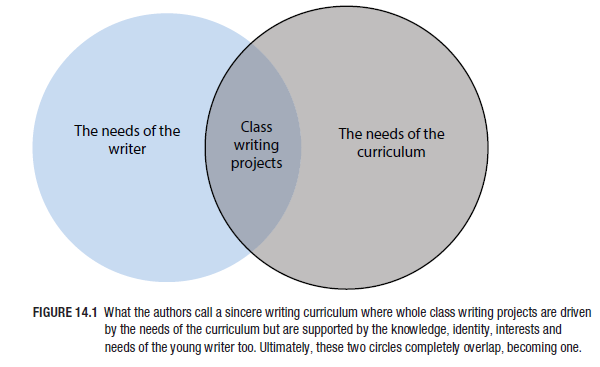
When you walk into Louise’s writing classroom, you soon realise that children always have something they want to say and share with you. This means they always have things they want to write about too. All writers, but particularly the youngest ones, write best when someone shows them how they can use topics they really care about, and things from their everyday lives, to craft meaningful and successful texts. This is what we explain as nurturing writers by inviting them to use their existing funds of knowledge and funds of identity (Young & Ferguson 2020, 2021).

Funds of knowledge and funds of identity can include children coming together and using any of the following to help them generate ideas for their own texts:

  • Their out-of-school learning experiences, talents, passions, hobbies and interests.
  • The computer games they play, the things they watch on TV (and online), the things they read, and other things from their popular cultures.
  • Objects and other artefacts from home.

One of the reasons Louise teaches writing so well is because she has a genuine fascination and wonder for the knowledge and identities her five year old writers bring into the writing classroom. The children have an almost unbounded need to express these things with others through writing. At five, it’s already part of who they are. This is because Louise’s class writing projects guide children into applying curriculum objectives by allowing them ample room to appropriate and use literacy from their childhood worlds (Dyson 2010).

Louise has created what we term as a sincere writing curriculum. Her writing classroom invites children to write about the things they’re moved to write about most (Young & Ferguson 2020). This allows her to focus on the needs of the curriculum and to teach her learners all the things that will help them craft their best texts. Louise knows that when children have agency over their writing topics, and are motivated for them to do well, they are far more willing to engage with and apply the curriculum objectives (Young & Ferguson 2021).

(Young & Ferguson 2021 p113)

Classroom writing has a long research history that validates writing as a process and places the writer at the center of the writing experience
– Marva Capello (2006).

Louise: Developing a sincere writing curriculum isn’t something you can do in advance. Getting started requires patience and a fair amount of watching, listening and asking. As a writer-teacher, you need to be ready and willing to adapt to children’s sometimes spontaneous inspirations. Spending time building strong relationships with the children in your class will encourage them to feel secure about sharing their knowledge and identity with you and others. We make lots of lists. We make lists of things we find funny, interesting and curious. We write lists of things we like and engage with most. We write lists of questions we want answers to. Over time, these lists build and build and they can become your writing curriculum. A curriculum developed alongside the children. This sort of collaboration leads to more meaningful outcomes and children who have confidence in their own voice and writer-identities.

Tips to developing a sincere writing curriculum:

– Provide time for children to talk about what they might like to write about. Write these up as lists on flipchart paper. Listen carefully to everything the children talk about (Lamme et al. 2002). Show and tell is just one really valuable resource for getting to know what is important to each child.

– Watch what children choose to pick up and read. Source similar types of texts and place them in the classroom library. Alternatively, invite children to create their own texts to put into the class library. 

– Explain that in class writing projects, they can create the same kind books they love to read.

– Encourage children to ask questions and invite them to contribute to what class writing projects could involve (James 2020). 

– Over time, build your classroom as a community of writers. Involve children in decisions about how the classroom should be organised and what they need from you to craft the best texts they can.

– Creating a writing centre means children know they are free to help themselves to writing equipment outside of writing workshop time (UKLA 2021).

– Value the things children value.

References:

  • Capello, M., (2006) Voice and identity development in writing workshop Language Arts 83(6) pp.482-491
  • Dyson, A.H. (2010) Writing childhoods under construction: Re-visioning ‘copying’ in early childhood Journal of Early Childhood Literacy 10(1), pp.7–31
  • James, S., (2020) Let’s make a ‘Guess Who?’ book! Writing character descriptions in Year Two [LINK]
  • Lamme, L. L., Fu, D., Johnson, J., & Savage, D. (2002). Helping kindergarten children move towards independence. Early Childhood Education Journal, 30(2), 73-79
  • UKLA (2021) Literacy in Early Education Leicester: UKLA
  • Young, R., Ferguson, F. (2020) Real-World Writers: A handbook for teaching writing with 7-11 year olds London: Routledge 
  • Young, R., Ferguson, F. (2021) Writing For Pleasure: theory, research and practice London: Routledge

Teaching grammar: our viewpoint

Should we teach grammar?

The debate about whether or not we should teach grammar is actually a pretty absurd one. The moment you engage in conversation with learners about writing, being a writer and their specific compositions, you will be talking about and teaching grammar. We teach grammar without even realising.

This is because you are bound to talk about and give instruction in things like: 

  • Phonology – the interesting relationship between their spoken sounds and their written spellings.
  • Morphology – words and their word choices.
  • Syntax – the way they’ve chosen to arrange their words and phrases.
  • Semantics – the meaning(s) they are trying to share with others.
  • Pragmatics – the context and organisation of their writing.
  • Semiotics – their use of signs and symbols.
  • Metafunctions – the decisions they are taking and making.
  • Field – the content of what they are sharing.
  • Tenor – the relationship between them and their readers.
  • Mode – the technologies they are using and the choices they are making over how to present their writing.
  • Genres – the style, voice and conventions they’ve chosen to use or subvert.

Hopefully, this list shows you that grammar is more than the naming of parts or the adherence to conventions of punctuation. Grammar is a beautiful thing.

For us, this means you can teach about grammar as much as you like as long as your instruction is orientated towards helping learners craft more meaningful and successful texts (Young & Ferguson 2020, 2021a). Grammar ultimately is about developing children’s style and voice (Young & Ferguson 2021b).

Should we use linguistics to help us teach writing?

Now, if we are in agreement that it’s impossible to separate grammar from the teaching of writing, we can discuss whether it’s necessary for children to receive lessons in linguistics. Linguistics is the study of language and its structures and includes the study of grammar. When we study language, we can discuss and learn about things like:

  • Sociolinguistics – the social factors that might influence the writing we craft.
  • Dialectology – the influence dialect and geography can have on our writing.
  • Psycholinguistics – the relationship between ourselves and our writing.
  • Comparative linguistics – the similarities and differences between languages.
  • Structural linguistics – the structures and systems of language people use.

Again you can and should study language in a writing classroom. Part of good writing teaching is studying how other writers use language successfully and meaningfully (Young & Ferguson 2021a). Children should be invited to study your writing as a writer-teacher, they can discuss each other’s writing and they should study the manuscripts of recreational and professional writers.

Is the PAG test appropriate for assessing children’s ability to be writers?

So, hopefully, we’ve agreed that the study of language can help in our efforts to develop children as writers. So now the question really becomes about whether young writers need to be able to name and identify parts of language in a PAG test; something that represents only a tiny fragment of what is involved in the study of language. The answer is quite obviously no. The National Curriculum has given primary schools the responsibility to develop children’s writing and them as writers. While we’ve shown that the study of language can be helpful when teaching writing, linguistics actually has its own separate and very specialised fields of study. By all means assess children’s writing and their development as writers, but drop the need to assess their ability to be in some way ‘structural linguists’ by the age of 11.

Concluding thoughts 

As we have shown, children are naturally studying grammar in the writing classroom whenever they read, share, talk about and discuss their own writing and the writing of others. Grammar is the study of how a language makes sense, and we cannot help but learn about and teach it in writing lessons, unless of course we are content for children’s writing to fail in its intention – to share meaning.

  • Giving names to things, and having a shared language in which to talk about writing can be pretty useful. But we don’t need to test children’s abilities to remember those names in a writing classroom.
  • Our view of grammar teaching is that it should combine the dimensions of structure and use. Structure is concerned with syntax (sentence construction) and this will be part of many writing discussions. In this context, we are not against the use of grammatical terminology, but we see it simply as a metalanguage which can assist in conversations about writing. ‘Use’ means considering what we want to mean (semantics), how we achieve clarity and how we achieve the effect we want to have (pragmatics). If we want children to write successful and meaningful texts, we should ensure that semantics and pragmatics are driving the writing, helped by an understanding of context and syntax.
  • We see grammar as a set of choices we can make when we craft writing. The grammatical choices we decide on are conditioned by both semantics and pragmatics. For example, in the context of writing in a particular genre, we ask children to think about ‘field’ (the content of what they want to share), ‘tenor’ (the relationship between them and their readers), and ‘mode’ (how they wish to present their writing). These considerations help them focus on the choices they will make to achieve meaning, clarity and effect, and to be clear about the reasons for their choices.
  • We recognise that grammar is ultimately teaching about style and voice. The cumulative effect of all the choices children can make when they write is to create style, whether it be (for example) a formal or conversational style, a personal or unique voice, a style associated with writing in a particular professional field (a historian or a scientist maybe), or a style related to a specific genre (poetic, narrative, expository).
  • We believe that we should not impose particular choices, but make children aware that there are possibilities and invite them to use them. Tell them these are things that can be done with language rather than what must be done. We believe that the feeling of confidence that comes from making their own choices adds to children’s sense of competence, independence and personal responsibility when writing.
  • We believe that assessment should reflect the way we teach. In a Writing for Pleasure approach (Young & Ferguson 2021a), therefore, we should be evaluating children as writers, and making grammar in its widest sense an essential part of such assessment. Our viewpoint on the grammar component of the current system of PAG testing is as follows: its conception of grammar is too narrow, with an unjustifiable and pointless emphasis on testing children’s ability to identify and name parts; it is prescriptive, and does not admit the possibility of stylistic variation; it allows no freedom for children to show a sense of personal creativity, and it impacts negatively on the way writing is taught in the curriculum, in the form of ‘teaching to the test.’
  • Lastly, we want grammar study to be enjoyable, thought-provoking, purposeful, and to arouse curiosity and interest in all of us. We want it to be dynamic rather than static and for children to see its personal relevance to the ways in which they want to share their meaning with others.

References:

Our First Teachers’ Writing Group by Sam Creighton

Image

By Sam Creighton @sam_creighton

Context

‘Those who do not understand the past are condemned to repeat it.’ – George Santayana

Our approach to writing – the way we think about it, the way we do it (or whether we do it at all) and, crucially, how we teach it – is a product of our own writing apprenticeships. The way our parents, our teachers and our peers exposed us to the written word cannot help but influence the way we expose our pupils to it. It is therefore vital that, as reflective practitioners, we take the time to understand these influences and how they manifest themselves in our pedagogies.

It was towards this end that eight teachers, including classroom practitioners and senior leaders, from Elmhurst Primary settled down in front of Zoom one Wednesday evening for the first meeting of the school’s Teacher-Writer Group (TWG).

All the research confirms that one of the most important aspects of teaching writing effectively is for teachers to speak from a position of understanding and experience. In short, for them to be writers themselves. Therefore, the TWG aims to help us develop our own writerly identities and consider how they do, can and should influence our teaching of writing.

Session

The first meeting was a genuine pleasure and a resounding success. In this article I lay out a summary of the structure we followed and the issues we discussed in the hope it can be of use to other schools who wish to set up their own staff groups.

The hour-long meeting followed a rough timetable of:

  • Discussion – 15 minutes
  • Writing time – 30 minutes
  • Sharing/reflection – 15 minutes

Ahead of the meeting, we shared (with permission) the first chapter of Ross Young and Felicity Ferguson’s brilliant new book, Writing for Pleasure: Theory, Research, Practice, which evaluates different styles and approaches to writing teaching. We framed our opening discussion roughly around the reflection questions found at the end of the chapter:

  1. Did you enjoy learning to write? Why? Why not?
  2. How many teachers can you attribute this to?
  3. Do you think you are a good writer now? Why? Why not?
  4. How does your experience with writing affect your view of how writing should be taught?
  5. Which teacher orientation would you have wanted to be taught by most?
  6. Which orientation(s) do you feel best represent(s) your personal theory of writing teaching?

We then moved onto a writing activity (shamelessly taken from the National Writing Project’s bank of prompts) which flowed well from this discussion. First, each person had a few minutes to jot down up to five moments when writing has been important in their life (the definitions of both writing and important were left deliberately vague). We then split into breakout rooms for five minutes to discuss these moments. It was lovely that all four pairs came back having found interesting areas of overlap.

We then had twenty-five minutes to choose one or more of our memories and write whatever we wanted. Not everyone decided to share their work – it was made clear at the start that there was no compulsion to – but of the pieces that were, we had one poem that was a rallying cry around the importance of the Writing For Pleasure pedagogy (you can read it at the bottom of the article) and another that was a rewritten version of the eulogy the person gave at their grandmother’s funeral, which genuinely beautiful. We closed with a further period of discussion and reflection on how we found the writing and where to go from there.

Reflection

As freeing as the period of writing was, it was the bookending discussions where the magic really happened. I was astonished at the range of topics we covered and how insightful the points made were. Below is a summary of what we discussed, along with questions I think it’s worthwhile every teacher pondering.

1) Writing can be a powerful tool for children to find their voices, free their imaginations and pursue their potentials. This came from the memory of one teacher who recalled a particular essay at the start of secondary school that they credit with igniting their passion for education and putting them on the path they have followed for the rest of their life. How can we give our children the necessary time, space, freedom and support required for this?

2) On the flip side, failing to provide children with this can have life-long consequences. It’s our duty to teach our them how to find their voices and how to make them powerful. I think the poem (below) is an inspiring rallying cry around this – I’d quite like to put it up by my desk! How well are we doing this now and how can we make sure it is always a priority?

3 ) As one teacher found as a child – and still now – writing doesn’t feel like a chore when it has the right balance of structure and personal ownership (they keep a daily journal on every holiday they take, which is a good example of this). Is this balance correct with the writing being done in our classrooms?

4) Two teachers both spoke of feeling ashamed as children when personal writing was discovered and/or criticised by adults because of the content. Are we unfairly expecting our children to always have us as their teachers in mind as their audience? We don’t have to like what the writing is about for it to be good writing.

5) One teacher made the important point about feedback on writing being daunting and unpleasant, especially when being handed back a piece covered in red pen. Another has also always remembered one throwaway comment about needing to ‘write more in future’. How are we giving feedback to children, is it in a hierarchical superior-inferior power relationship or is it more as fellow writers within a writing community? Are we the only people giving feedback or are we allowing children to meaningfully give it to each other?

6) How are we celebrating writing? One teacher still has a piece of work that was on display in primary school, this shows how meaningful that recognition was to her. Are we helping (all of) our children feel such joy and pride in their work?

7) Two teachers both talked about the cathartic experience of writing and how it helps deal with emotional times. Are we letting children tap into their own feelings and experiences in their writing or are we (even unintentionally) erecting a barrier between out-of-school experiences and in-school writing?

8) One teacher found her way into writing trough arts and crafts and has now used that link productively in her own teaching. Are we (a) giving children multiple avenues through which to engage with writing? and (b) reflecting on how our own experiences as writers can inform our pedagogy?

9) We almost all have next to no memories of learning to write and those we do have are largely negative. Why is this? How can we make sure our classrooms contain writing experiences and communities that are positively memorable?

10) One teacher talked about how short and arbitrary time limits set on writing tasks stifled her creativity as a child. Professional writers never (or rarely) write like this, so why are we asking our kids to? Are they ever able to start, set aside and return to writing like professionals? Could this be where personal projects fit in?

All of the teachers have since said how much they enjoyed the meeting and that left feeling enthused to get back into the classroom. We have a second session scheduled for after half-term and I for one cannot wait for it.

A poem composed by one of the teachers during the writing time

I wish I was taught how to become a life-long writer.

Maybe then it would feel more natural?

I wish I was taught to believe in myself.

Maybe then I’d view myself as a real writer?

I wish I was taught that my experiences matter.

Maybe then I’d be in a constant state of composition?

It’s never too late though,

I can begin right now.

And give my children the self-belief, the sense of community and the power to make a difference that I never knew I was missing.