I wrote this for my younger brother’s class because I really wanted them to know all about our cat.
Emma
This blogpost is about a Year 4 child called Emma (pseudonym) and her information text journey.
This is Emma’s ‘speedy book’ which she wrote to use as plan for her more extended information text.
What I liked about using a ‘speedy book’ to plan is that I was able to jot down ideas, but it was almost like publishing because people from the younger classes got to read it.
Emma
Emma planned her information text using a planning strategy called ‘speedy books’. These are small A5 picture books which the children write for younger readers but also to help them organise their thoughts for their more extended pieces. Emma used her speedy book to help her write her final information text. She worked on her piece over the course of about six writing sessions before publishing it (see below).
As you can see, Emma extended and elaborated on what she wrote in her ‘speedy book’ You can also see how the speedy book helped keep her piece focused and cohesive.
How did she work?
As always, we examined mentor texts during our genre-study week. Inspired by one of the texts she found in the KS1 Genre-Booklet Information And Me Books, Emma decided to base her particular information text on her own cat.
Below is a snapshot of some other aspects of Emma’s journey through the writing process encompassing: idea generation, drafting, revising and editing. On these pages, she demonstrates strong feelings of: self-efficacy, agency and self-regulation as she manages her composition. I keep a record of every pupil conference, so I know I didn’t confer with her during this particular project. This is heartening as it indicates her confidence levels were high enough to take her idea all the way through to publication independently. This is great evidence for her writing portfolio.
This collection of photos shows: her original intentions for the piece (her publishing goal), how she used the product goals, where she got her idea from (This is what I do…), the drafting of paragraphs based on the pages in her ‘speedy book’ and the revisions she made on her ‘trying things out’ page.
What information did she add in?
As we read the final published version, we can see that there is a good deal of personal information about the relationship Emma has with her cat. In revealing this to her readers, she also allows us to infer that this might be true about cats’ behaviour in general (sleeping on her bed all night, waiting for her on the stairs to get home, hating water, enjoying playing outside with the other cats, going missing for a few days etc.). We learn more about cats from reading this piece than we did before but we also learn more about Emma too.
On her final page, she decides to share information more explicitly with her reader by sharing a list of items you would need to take care of a cat, and a second list of all the cat breeds that she knows.
Personally, I really enjoyed this style of non-fiction writing with the blend between the more generic and objective information about a topic and the bond that the author has with their chosen subject. As a class teacher, it also enables me to know my children as well as playing a key role in strengthening the writing community as we learn more from each other and about each other’s lives.
What else did I enjoy about this piece?
I really like the poem Emma included at the end of her text (see below). I’m pretty sure she is referencing Puss In Boots from Shrek based on the description, but I really like the way she just alludes to this and doesn’t name him. Instead, she prefers to refer to him as ‘that’ cat. I like to think the spelling of perfect as ‘purfect’ is a deliberate pun although on her ‘trying things out’ page it is circled as a temporary spelling. However, as she took this piece through the editing process, it is perfectly possible that she found the correct spelling then decided to keep it. I’ll have to ask her.
Phoenix is a cat
She’s not like that cat
She doesn’t wear boots
She doesn’t have a sword or a hat
But that’s OK
She’s purfect the way she is.
I love the vibrancy and celebratory nature of the front cover. Who wouldn’t want to grab it from the shelf and read it? I appreciate the presence of the purple mouse toy which was referenced on page 4. There is further attention to detail with the pumpkins playing the role of the dots on the letter ‘i’ in the words Kitty and Pumpkin. The pattern on the word Kitty is like the fur of her calico cat even down to the distribution of the grey and orange fur (25% coverage) and the white fur (75% coverage). A sublime detail.
Publishing is such an important process for so many reasons, but what I especially like about it is the opportunity it creates for children to be illustrators. It actually opens up a whole new world of potential mini-lessons, especially when making mini-books, and allows children to incorporate their own observations to influence the design decisions they make. Illustrations are part of writing and are another tool we can use to help us share our meaning with our readers.
My favourite thing about this project was that we got to make a ‘speedy book’ first even though it was hard not to add in too much information!
Emma
Final thoughts
It is interesting that Emma already had a lot to say and was almost restricting herself during the planning process. Perhaps this aided her in the organisation and structure of her text and provided a framework for her when she did let her full draft pour out in the next session. What I think is important is that children now have an additional planning strategy in their repertoires and can use it independently when they see fit. And in doing so, they know that they will be producing two books for the price of one.
After a couple of drafting sessions where children have been using their ‘speedy books‘ as plans to write more about their topics, today we began revising.
We concentrated on looking at different ways you might begin a non-fiction text with a mini-lesson titled Intriguing introductions.
One boy’s ‘speedy book’ about The Norris Nuts
As always, I try out the mini-lessons I am going to teach in my own writing journal so I can talk through how I did with the class. Yesterday, I taught a mini-lesson called Write a bit, share a bit and this seemed to improve the overall fluency of the children’s drafting.
The first four paragraphs I drafted in advance, but the final one I decided to do with the children, encouraging them to ask me a few questions to prompt me. When you write something and then share it with an audience, they almost automatically enquire about what you have written, and the kinds of questions they ask often nudge you to think of things that you wouldn’t necesssarily have included under your own steam.
My draft of Soft Play With My Girl (working title)
One boy’s draft of The Norris Nuts
Once you have got your words down then, for me, the fun starts. You get to play around with what you’ve got, add things in, take things out, think about how you want your audience to react, paint with words etc.
Revision is the process when I see the most gains in writing quality, and where I can really focus my teaching on the product goals (either through whole class mini-lessons, or small group/one-to-one pupil conferencing) which were established during our genre-study week.
I picked five typical non-fiction introductions and gave them a whirl
Coming up with ways to start your non-fiction pieces off with a bang is a lot of fun and the children found this lesson really useful. It stimulated a lot of talk and sharing. In fact, today we had a first-timer in our ‘author’s chair’ because he was so happy with what he had produced.
One boy had a go at a couple of openings for his The Norris Nuts information text. He used his ‘trying things out page’.
A class poster showing children a range of options for writing non-fiction introductions.
I must confess that I didn’t know what The Norris Nuts was, but I do now! And that surely is the point of an information text. Coming up, we have a few more sessions allocated for revision before we look to ‘tidy up our pieces’ in preparation for our publishing party.
Today, during the third session of our class project (information texts), we experimented with a planning technique called ‘speedy books’. Having chosen our favourite ideas yesterday, we spent today’s thirty minutes of writing time turning them into mini-books, but with a difference: these were aimed at an EYFS audience.
What was the purpose of planning in this way?
1. To support the organisation and structure of our main texts.
2. To enable children to have the opportunity to plan with simplicity and with a genuine audience in mind.
3. To create an actual text that could be read and enjoyed.
Why not just use a box-up grid, or any other recognised planning technique?
Well, there are many legitimate and useful planning techniques out there, many of which are made available in a Writing for Pleasure classroom. But, since writing can be an idiosyncratic process, the more children know about the different ways that writers plan, the more options they have each time they think about creating a text.
For instance, I always teach children about different drafting approaches one of which is to be a ‘discoverer’ (children write a first draft and then this becomes their plan to write a second draft). And this is essentially what we were doing today; however, I think what separates today’s technique from the others is that in using it the children were creating a complete and authentic text which could be enjoyed by a real audience, and their ‘plan’ now exists as a book in its own right. We will see next week how it supports the drafting of their longer compositions.
How was it taught?
I shared my example with the children (see below) and we discussed it in relation to some simple product goals. It was left up on display, while a few others from The Writing for Pleasure Centre’s EYFS class projects were placed on the children’s tables to act as mentor texts – I often find that, even for a simple text like this one, I need to see examples while I am writing to remind myself exactly what I am aiming for.
Soft Play With My Girl
I created a template with boxes and lines, a decorative spine and a date stamp on a blank front cover. I limited it to five pages. The emphasis was on speed, so I wanted to ensure the format was already taken care of so the children could focus on their text. You could just as easily staple together some blanks pages of A4, but I wanted it to feel a bit special.
There were some brief product goals on the back cover of each mini-book to help to produce a successful example
What did the children create?
Things In The Computer
My Day In The Mosque
Spiders Are Real
Southend!
Were they successful?
These speedy books are peppered with… information! It is clear that children were writing from a position of strength and were able to focus on what they wanted to say on each page. And each of those pages says something new. The books also contain a good deal of subject specific vocabulary and, crucially, they are entirely original in conception reflecting children’s writing realities. Finally, they represent a valuable starting point for a longer draft thus fulfilling the purpose of a plan.
What happened during author’s chair time?
I found that today, perhaps because of the clarity provided by the simplicity of the speedy books, more children were able to participate in the discussion. Also, the comments (likes, suggested changes and questions) were drawing out more information from the author which automatically contributed to the beginning of the revision process. I could see how starting from this low floor would enable everyone to build up their text.
Wasn’t this a waste of time for the more experienced writers though?
Apparently not. I had thought that some children might be put off by the EYFS-nature of the process. However, the feedback was that the mini-lesson was overwhelmingly ‘very useful’ (24 out of 26 writers) with only two children evaluating it as ‘quite useful’.
Taking the temperature of the room to see how useful each day’s instruction was forms an important part of my Writing for Pleasure classroom
What will happen in session four?
On Monday, we will have our speedy books out on our tables to act as our plan as we begin drafting into our class project books.
What will happen to the speedy books at the end of the class project?
They will be given to the EYFS classes to read and enjoy. Some will be given to younger siblings at home. I already have some in my bag for the weekend to take home and read to my daughter!
Classroom display showing the number of sessions available until the publication deadline
Today was session two in our class project and we were generating ideas using a technique called Thinking ‘faction’. This is where you use your knowledge of fictional worlds, settings, characters and events and use them as inspiration for a piece of information writing. This was the first time I have taught this mini-lesson. As usual, I had a go at it in advance, so I could talk it through with the children before inviting them to try it out for themselves. I surprised myself at the ease with which my ideas flowed.
My ideas span interests from my childhood, my teenage years, adulthood and some recent experiences shared with my daughter
To give some structure, I created a sheet divided up into sections: things from films, things from books, things from TV, things from games/YouTube etc. I set myself a finish line of twenty ideas and it took me about ten minutes to generate fourteen ideas. I explained to the children that this would be a great opportunity to do lots of talking (talk for writing is extremely important throughout the writing process) while we were doing it and that I would be joining in with them to cross my finish line during today’s writing time.
This child has assigned both a knowledge score and an interest score to his two favourite ideas to help him decide which one to write about
What struck me at the end of this session was just how many ideas we had generated as a class. Twenty-eight children, each with at least ten ideas on their pages, had generated many hundreds of ideas in less than twenty minutes. Who says children won’t have anything to write about? Not me.
Tomorrow in session three: Planning using ‘speedy’ books
A writing station should support children’s independence as writers by giving them the tools they might need to solve their own writing problems. Self-regulation (knowing what to do and how to do it) is an important affective need to attend to in every writing community and supporting its development requires careful consideration.
What is in our writing station?
A mini-lesson archive – This provides the opportunity for children to revisit any previous instruction. Currently, it is organised into eight craft areas: Being Writers, Generating Ideas, Organisation and Structure, Fluency, Clarity and Accuracy, Developing, Word Choices and Spellings.
2. A section related to goal setting – This contains: to-do lists, writing calendars, mini-lesson evaluation sheets and a selection of class project genre-booklets (these contain mentor texts and suggestions for how to navigate the writing process).
3. An area for publishing materials – At the moment, we have: line guides (narrow and wide), blank mini-books, blank speedy books, publishing menus, some stamped self-addressed envelopes (for sending out bits of writing so you can receive something in return) and publishing templates.
4. A place for revising and editing resources – Here we store: one-thousand word dictionaries, openings and endings examples and a variety of useful checklists.
5. Some pockets for idea generation – At present, we have: some ideas hearts, topic suggestion sheets, narrative arc examples and writing wheels.
How is it used?
Some children visit it all the time; others seldom do so. Why? Well, it probably depends on their particular need, and possibly their level of experience as a writer too. I often see children using it who are already successfully negotiating the writing process and know just what resource they are looking for. At other times, it functions as a supporting act to a pupil conference I might be conducting where I need to refer to something there. In this case, I always take the pupil with me to find the resource so they can remember where to find it again and become more familiar with the whole station. Frequently, children use it to teach each other which is a really pleasant aspect of being in a writing community.
Final thoughts
As a rule, I tend not to put a resource into the writing station until I have used it as part of a mini-lesson. I also conduct a mini-lesson at the start of the year about how we will use the writing station. Like the class library, this is an area of the classroom which children enjoy taking care of. They also specialise in organising it and appreciate having their suggestions about its contents valued. You will find that there are certain items which are mainstays of this area, while others might emerge during the year based on pupil need, or sometimes demand! Why not build your own and share it too?
Our class library holds a treasured place in our writing community. Creating one works well if you teach our Being Writers mini-lesson called Doing What Bookshops Do at the beginning of the first term and should be self-sustaining throughout the year. This helps develop children’s affective behaviours. For example: motivation, writer-identity, volition and agency.
It has several other important functions. Below are ten that come to mind:
Simply, it acts as a publishing goal (a place where writers can publish their writing for others to read) while supporting children’s understanding of some of the real reasons they may be moved to write.
It can help writers to understand large categories in writing (narrative: story and memoir, persuasion and opinion and non-fiction) as well as sub-divisions (genres like mystery stories, poetry or match reports).
As it belongs to the community, it can be shaped the way you wish, so it enables children to experiment with genre either by hybridising, or by creating micro-divisions which meet their writing interests (E.g. sword-fighting stories, poems about animals, or funny school tales).
It connects reading and writing by giving children an additional option when reading for pleasure. Many children choose to read each other’s, or their own writing during this time.
It increases the range and volume of potential mentor texts for future study during a class project.
Physically, it sits at the centre of the reading area demonstrating its importance, and its status is further raised because it makes available a plethora of options when reading aloud to the class.
Making it portable helps when you want to read for pleasure away from the classroom, or even if you want to loan your whole library to another class.
It is a great place into which to publish your own writing, or that of other writer-teachers.
It creates an additional area of the classroom which requires organisation and management helping to develop children’s sense of responsibility and authentic ownership over their learning environment.
It has the potential, in a mature and developed writing community, to act as an originator of fresh class project ideas, and may spawn its own mini-lessons as you navigate how best to use it.
Can anything be published into the class library? Ultimately, yes, but you will want to teach some other Being Writers mini-lessons relating to publishing expectations in order to strive for quality. These may look different depending on level of experience, however, the principles remain the same.
Writerly knowledge is all the things writers know about writing and being a writer. But what is it they know, and why might it be important for our students to know this stuff too?
In our book Writing For Pleasure: theory, research and practice, we consider what a knowledge-rich writing curriculum would include. We believe it’s important that pupils know the craft knowledge involved in creating texts, including:
Process knowledge, knowledge about the processes, procedures, strategies, and techniques writers employ as they go through their writing process, generating ideas, planning, drafting, revising, editing, publishing, and performing.
Genre knowledge, the typical textual, linguistic, literary and grammatical features genres employ to be at their most meaningful and successful.
Goal knowledge, how writers set themselves goals and manage their writing deadlines.
Knowledge about their reader, how writers will meditate on the purpose for their writing, gather information about and consider their future readership.
Knowledge about a writerly environment, how writers live and work with others, and the conditions which are conducive to writing productively and happily.
Transcriptional knowledge, including spelling and punctuation conventions and keyboard and handwriting skills.
Knowledge of how writers use their reading, including how they read to enhance their craft knowledge and search for content material.
Knowledge of technology and other modalities.
Knowledge of the affective domains considered by writers as they craft and publish texts. These include giving attention to their confidence, motivation, desire, competence and their personal and collective responsibilities.
A knowledge-based writing curriculum is essential because, without such knowledge, it’s hard for us to answer the following sorts of important questions:
If I gave my class two hours of writing time, would they know what to do with it?
Do I think students in my school would know how to generate a seed of an idea and see it through to publication or performance successfully?
Are my students going to know enough to be able to live the writer’s life after they leave my school?
In a knowledge-rich writing classroom, you’d expect positive answers to these questions. For example, students would know how to manage their writing process. They would have ready strategies to help them find an idea they were moved to write about. They would also know how to generate this ‘seed of an idea’ and see it through to successful performance or publication. They would know how important it is to consider the purpose(s) their writing is to serve, who their audience will be and therefore what this audience’s expectations might include. They would know which genre(s) would best support their intentions and what the typical features and conventions of those genres are (importantly, they would know that they can play with or break these conventions too). They would know how to manage their time by setting themselves process goals (things they want to get done) and product goals (strategies or techniques they want to employ in their writing to make it as meaningful and as successful as it can be).
Notably, they would know what to do when they don’t know what to do. They would know how to use their writing environment productively to solve their writing problems – including where they can access resources, and how to use them. They would also know how to lean on their writer-teacher, friends and peers for support.
They would know what sort of transcriptional conventions their readership would expect to see and would ensure their writing was as accurate as they could make it before publication. They would know how to use technology to help them in their writing process (for example: how to research for writing material, how technology can help them attend to their spellings or word choices, including using Google, online thesauruses and electronic spell checkers). They would also know how to use technology to support their publishing choices, for example through word processing, presentations, blogs and video or audio recordings.
They would know how to manage themselves. They would keep in mind why they were moved to write their piece in the first place. Even when the writing was hard, they would remember that there is a gratification to be had in that struggle. They would remember that, actually, writing is an intoxicating and satisfying way of life. They would use proven strategies to keep themselves motivated. They would also know what their personal and collective responsibilities to the class are as a community of writers living, writing and working together.
Finally, and most importantly, they would know how to successfully live a writer’s life after leaving school. If they wanted or needed to, they could live the writer’s life for economic reasons (knowing how to write with authority, daring and originality is great currency). They could decide to live the writer’s life for political or civic reasons – sharing their knowledge and opinions with clarity and imagination. I also hope they would write for personal reasons – as an act of reflection or record keeping. Finally, I would want them to know how to write for reasons of pure pleasure and recreation – feeling a sense of joy and accomplishment in sharing their artistry, identity and knowledge with others in ways that are profound and confident.
We share how Writing For Pleasure schools try to develop this knowledge in our new publication:
Language, quite simply, is a window through which we can reach out and touch each other’s minds. Anyone can reach through it… It is the most intimate act we can ever perform. We must be sure, always, to keep that window open – Gerry Altmann
Early talk
In a previous blog-post, we looked at how important talk is for children’s writing development. This article continues the conversation by looking at what the research says about how we can develop it. First, let’s define what we mean and then consider how much speech and language learning takes place before children enter formal schooling.
Talking
The ability to express one’s own thoughts and feelings.
Reciting
Repeating aloud a text from memory.
Writing
The activity or occupation of composing text for publication.
Dictating
The transcription of someone else’s spoken text.
Developing children’s language
The development of children’s own communication using speech and/or writing.
Age
Typical language milestones
Eighteen months old
At eighteen months old, children already have a vocabulary of around fifty words.
Two years old
By two years old, most children produce utterances of two words. These utterances are crafted by the child and are not the parroting back of an adult model. Speech and thought come together by the age of two.
Two and a half
Can utter sentences of three words.
Between three and four years olds
Begin speaking in full sentences. Children can say an infinite number of original sentences – sentences that they’ve never said or heard before.
Five years old
Children are able to use language with a capacity close to that of an adult. For example they use language for the following purposes: to persuade, influence or command others; to share and understand information; to tell stories (both real and imagined) and use language imaginatively and playfully. Children can typically say and write sentences of around five words.
From seven years old
Children usually acquire a full and accurate knowledge of their first language.
Taken from Halliday 1969; Bancroft 1995; Latham 2002)
As you can see, every single child brings a great deal of language learning into the classroom on their very first day of school. However, this learning can often be underestimated or overlooked by many who work in education (Avineri et al. 2015; Sperry et al. 2019; Burnett et al. 2020; Bergelson et al. 2022). Research also shows that children are most likely to succeed in schools that use and value this existing knowledge and build on it (Johnson 2015; McQuillan 2019).
Developing children’s talk for writing
If you can help your students regard their inner [or outer] speech as something they can in some edited form transcribe any time to paper, they will take a giant step toward becoming fluent writers – Moffett & Wagner (1992)
Children’s development as talkers relies on ‘a conversational context’. Children’s language develops when they are given the cognitive responsibility to use it. Ultimately, children must be the ones to construct their own speech and writing. Otherwise, they learn little (Latham 2002; Timperley & Parr 2009; Chuy et al. 2011; Avineri et al. 2015; Allal 2019). The acquisition of language is a dynamic and creative process, not the passive reciting and copying of someone else’s model.
Here we see the Nursery children in Marcela Vasques’ class being invited to ‘talk their books into being’ by having an Ideas Party. This is talk into writing.
Children’s talk and writing should be developed concurrently. Children must engage in egocentric talk, talking aloud to themselves as they write. They also need to write alongside and in happy dialogue with their teacher and peers. This means it’s necessary for children to play a daily and active role in their own talk and writing construction. They should also learn about speech and text construction from being ‘overhearers’ to their peers’ talk, help and instruction. In addition, children can engage in what we call parallel writing and co-operative writing, where they participate daily in the kind of activities listed below:
Children talk with one another before they write, as they write and after they write. These interactions occur in different ways and can include:
Idea explaining Children share what they plan to write about during the session with others. Idea sharing Children work in pairs or small ‘clusters’ to co-construct their own texts together. Idea spreading One pupil mentions an idea to their group. Children then leapfrog on the idea and create their own texts in response too. Supplementary ideas Children hear about a child’s idea, like it, and incorporate it into the text they are already writing. Communal text rehearsal Children say out loud what they are about to write – others listen in, comment, offer support or give feedback. Personal text rehearsal Children talk to themselves about what they are about to write down. This may include encoding individual words aloud. Other children might listen in, comment, offer support or give feedback. Text checking Children tell or read back what they’ve written so far and others listen in, comment, offer support or give feedback. Performance Children share their texts with each other as an act of celebration and publication.
(Young & Ferguson in press)
Instruction and being a writer-teacher
Despite what we might think, young children pay close attention to the conventions of adult talk and writing. Teachers should therefore engage in ways that are explained in the table above during daily writing time too. This is best done through systematic and daily pupil-conferencing. See our guide to pupil-conferencing with 3-11 year olds for more details.
Develop children’s talk for writing through explicit instruction, not through recite for writing activities
The problem with a lot of writing programs is that there isn’t enough talk nor is there enough writing taking place each day. Talk involves creating something for others to understand. Writing also involves creating something for others to understand. To develop writers, we must develop talkers. This is because what children learn by speaking, they use as a resource for writing (Harste 2012). The Writing For Pleasure Centre’s recent publication Big Book Of Writing Mini-Lessons For 3-11 Year Olds provides lessons to help teachers do just that. It’s about teaching children the strategies of talk for writing and inviting them to use those strategies during that day’s writing time. For example:
Tell it if you can’t read it
How to write in collaboration
How to share your writing with a friend
How to respond to your friend’s writing
Collecting language – speech
Can I copy you?
Leapfrogging using a friend’s idea
Talk about your topic…
Tell your story…
Go from sounds to letters
Talk to yourself
Pencil microphone – say it then write it
Whisper your sentence, hold it, and keep it
Think, say, write
Make a page – share a page
Write a little – share a little
Well, what do you want to say next?
Go back and wake your writing up!
Give your writing a tickle
These strategies then become internalised and children apply them with automaticity.
Talk to support children’s encoding
Back to egocentric talk, it takes a lot of working memory for children to take the phonemes of their speech and present them as graphemes of written language; otherwise called encoding. Encoding, fluency and automaticity in writing can only really come if children are ‘talking aloud to themselves’ and writing meaningfully and for a sustained period every day. Until that happens, children are relying on their working memory which leaves them with little space to consider the more complex compositional and transcriptional aspects of writing. As a result, their academic progress suffers (Louden et al. 2005; Herste 2012; Graham et al. 2012; Ouellette & Sénéchal 2017; Rowe 2018). We want encoding to be stored in their long-term memory as quickly as possible. This is another reason why children simply must talk and write every single day.
Talking, cognition and writing
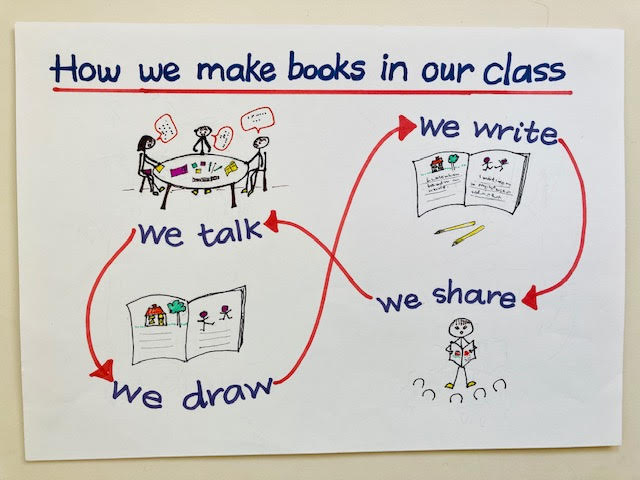
In terms of cognitive development, if children aren’t speaking enough, then they aren’t really thinking enough. This is because much of their thinking is inextricably linked with speaking (Latham 2002). Therefore, growth in talk, writing and cognition can either be facilitated and enhanced or limited and deprived by the sorts of writing programs we choose to use in our classrooms. If children aren’t speaking enough, their progress is likely to be limited. The way in which cognition, talk and writing are enhanced is by having children engage in genuine language use – genuine talk before, during and after writing. We see this quite clearly in the typical writers’ process for children in the EYFS:
An example of the writing processes for an EYFS classroom.
In summary, the best writing classrooms are ones where children and their teacher are talking and writing with one another every day. Children talk before, during and after writing and the teacher talks before, during and after writing too. Teachers do this by delivering valuable daily writing instruction (Young et al. 2021), providing individualised instruction through pupil-conferencing (Ferguson & Young 2021) and by role-modelling writers’ talk by being a writer-teacher amongst their pupils as they write (Young & Ferguson 2021).
References:
Allal, L. (2019) Assessment and the co-regulation of learning in the classroom Assessment in Education: Principles, Policy & Practice 27:4, 332-349 DOI: 10.1080/0969594X.2019.1609411
Avineri, N., Johnson, E., Brice-Heath, S., McCarty, T., Ochs, E., Kremer-Sadlik, T., Blum, S., Zentella, A.C., Rosa, J., Flores, N., Alim, H.S. and Paris, D. (2015), Invited Forum: Bridging the “Language Gap” Journal of Linguistic Anthropology, 25: 66-86
Bancroft, D. (1995) Language development In Lee & Das Gupta Children’s Cognitive and Language Development London: Wiley
Bergelson, E., Soderstrom, M., Schwarz, I. C., Rowland, C., Ramirez-Esparza, N., Hamrick, L., … & Cristia, A. (2022). Everyday language input and production in 1001 children from 6 continents.
Biber, D. (2023). Writing and speaking. In The Routledge International Handbook of Research on Writing (pp. 124-138). Routledge.
Burnett C, Merchant G, Neumann MM (2020) Closing the gap? Overcoming limitations in sociomaterial accounts of early literacy Journal of Early Childhood Literacy 20(1):111-133
Chuy, M., Scardamalia, M., and Bereiter, C. (2011). Development of ideational writing through knowledge building:Theoretical and empirical bases. In Handbook of Writing: A Mosaic of New Perspectives, Grigorenko, E., Mambrino, E., and Preiss, D. (Eds.) (pp. 175–190). New York: Psychology Press
Ferguson, F., Young, R. (2021) Pupil-conferencing With 3-11 Year Olds: Powerful Feedback & Responsive Teaching That Changes Writers [www.writing4pleasure.com/a-guide-to-pupil-conferencing-with-3-11-year-olds]
Graham, S., Bollinger, A., Booth Olson, C., D’Aoust, C., MacArthur, C., McCutchen, D., Olinghouse, N. (2012) Teaching elementary school students to be effective writers: A practice guide (NCEE 2012–4058). Washington, DC: National Center for Education Evaluation and Regional Assistance, Institute of Education Sciences, U.S. Department of Education
Halliday, M.A.K. (1969) Relevant Models of Language In Williams The State of Language Birmingham: University of Birmingham School of Education
Harste, J.C. (2012) Reading-writing connection. In C. A. Chapelle (Ed.) The encyclopedia of applied linguistics (pp.1-8) Oxford: Wiley
Horowitz, R. (2023). Transforming speech into writing: Constructing a voice and identity in academic world writing. In The Routledge International Handbook of Research on Writing (pp. 105-123). Routledge.
Johnson, E. (2015) Debunking the “language gap” Journal for Multicultural Education 9(1) pp.42-50
Latham, D. (2002) How children learn to write: Supporting and developing children’s writing in schools London: Paul Chapman
Louden, W., Rohl, M., Barrat-Pugh, C., Brown, C., Cairney, T., Elderfield, J., House, H., Meiers, M., Rivaland, J., & Rowe, K. J. (2005). In teachers’ hands: Effective literacy teaching practices in the early years of schooling. Australian Journal of Language and Literacy, 28, 173-252.
McQuillan, J. L. (2019) The Inefficiency of Vocabulary Instruction International Electronic Journal of Elementary Education, 11(4), pp. 309–318
Moffett, J., Wagner, B. J. (1992) Student-centered language arts, K-12 Portsmouth, NH: Heinemann
Ouellette, G., Sénéchal, M. (2017) Invented Spelling in Kindergarten as a Predictor of Reading and Spelling in Grade 1: A New Pathway to Literacy, or Just the Same Road, Less Known? Developmental Psychology 53(1) pp.77-88
Rodríguez, C., Jiménez, J. E., & Balade, J. (2024). The Impact of Oral Language and Transcription Skills on Early Writing Production in Kindergarteners: Productivity and Quality. Early Childhood Education Journal, 1-11 [LINK]
Rowe, D. (2018) The Unrealized Promise of Emergent Writing: Reimagining the Way Forward for Early Writing Instruction Language Arts 95(4) pp.229-241
Sperry, D.E., Sperry, L.L., Miller, P.J. (2019) Reexamining the Verbal Environments of Children From Different Socioeconomic Backgrounds Child Development, 90: 1303-1318
Timperley, H., Parr, J. (2009) What is this lesson about? Instructional processes and student understandings in writing classrooms The Curriculum Journal, 20(1), 43–60
Young, R., Ferguson, F. (2021) Writing For Pleasure: Theory, research and practice London: Routledge
Young, R., Ferguson, F., Hayden, T., Vasques, M. (2021) The Writing For Pleasure Centre’s Big Book Of Mini-Lessons [www.writing4pleasure.com/the-writing-for-pleasure-centres-big-book-of-mini-lessons]
Young, R., Ferguson, F. (in press) Real-World Writers: Teaching writing with 3-7 year olds
How important is the role of talk in children’s writing development? Case studies of the best performing writing teachers would argue that it is transformative (Pressley et al. 1997; Medwell et al. 1998; Langer 2001; Gadd & Parr 2017; Young 2019). A child’s writing and their language development mutually benefit when they are invited to craft writing amongst their teacher and peers every single day. Indeed, engaging in daily and meaningful talk and writing is one of the best ways to develop children’s language (Mercer et al. 1999; Rojas-Drummond et al. 2008; Green et al. 2008; Parr et al. 2009; Fisher et al. 2010; Dix 2016; Reedy & Bearne 2021).
Encouraging children to talk and collaborate together during writing time is an evidence-based research recommendation (Graham et al. 2012; Grossman et al. 2013; De Smedt & Van Keer 2014) and an opportunity to talk as they write improves children’s final written outcomes (McQuitty 2014). For example, children who talk as they write go on to write richer and more sophisticated texts (Wiseman 2003; Vass et al. 2008). This may be because talk gives children more working memory for writing (Latham 2002; Cremin & Myhill 2012; Young & Ferguson 2021) or because talk between children assists them in deciding what to say and how to encode it (Davidson 2007; Whittick 2020).
A classroom rich in talk, where children are encouraged to tell others about events in their own lives, the knowledge they bring into school, and the imaginative ideas their minds conjure up is the foundation of any high-quality writing program (Lamme et al. 2002; Tolentino 2013; Daniels 2014; Rowe 2018; Young & Ferguson 2020, 2021). Your class can have more stories and ideas for writing than you’ll ever know what to do with as long as you’re willing to give time for talking and sharing. Children regularly rely on talk for guidance, a model, expertise, assistance, and instruction (Wohlwend 2008; Kissel 2009). This isn’t a negative thing as it shows children’s commitment to being independent through what’s called co-regulation (Young & Ferguson 2021).
Children talk their texts into being. Talk is vital at all parts of a young writer’s process. Firstly, talking with peers helps children generate ideas for what it is they want to write about. Talk also supports pupils to plan what it is they want to write down. It helps them draft fluently, to revise, and to proofread with a readership in mind. Finally, talk is an opportunity to publish or perform for others (Young & Ferguson 2021).
Children talk with one another before they write, as they write and after they write. These interactions occur in different ways and can include:
Idea explaining Children share what they plan to write about during the session with others. Idea sharing Children work in pairs or small ‘clusters’ to co-construct their own texts together. Idea spreading One pupil mentions an idea to their group. Children then leapfrog on the idea and create their own texts in response too. Supplementary ideas Children hear about a child’s idea, like it, and incorporate it into the text they are already writing. Communal text rehearsal Children say out loud what they are about to write – others listen in, comment, offer support or give feedback. Personal text rehearsal Children talk to themselves about what they are about to write down. This may include encoding individual words aloud. Other children might listen in, comment, offer support or give feedback. Text checking Children tell or read back what they’ve written so far and others listen in, comment, offer support or give feedback. Performance Children share their texts with each other as an act of celebration and publication.
(Young & Ferguson in press)
Through our own talk with pupils during writing time, we teach children how to respond to other’s writing, ask questions, and how to give advice and instruction. Children begin to copy us. By hearing and participating in pupil-conferences, children become sociable and knowledgeable writer-teachers too (Ferguson & Young 2021).
This article looks to highlight the importance of talk in writing. Children can write all the words they can say. However, if we put words in children’s mouths, they end up not as writers but reciters. Duplicators of someone else’s voice. If we want to develop children’s language and writing alongside each other, we must give them time to talk and write together everyday. We must keep in mind that dictating and reciting texts isn’t talking or writing. Dictation and recitation are practices associated with a presentational-skills (Young & Ferguson 2021) or ‘writing readiness’ (Young 2021) ideology towards early writing development. Both of which are fundamentally flawed.
Neither scientific research nor the case studies of the best performing writing teachers recommend the slavish and repetitive learning of a text. It’s not in children’s best interests to spend their time engaged in long-winded ‘barking out of a text’. Instead, we must put talk and language development where it belongs – at the heart of the writing process.
References
Cremin,T., and Myhill, D. (2012) Creating Communities of Writers London: Routledge.
Daniels, K., (2014) Cultural agents creating texts: a collaborative space adventure Literacy 48(2) pp.103-111
Davidson, C. (2007). Independent writing in current approaches to writing instruction: What have we overlooked? English Teaching: Practice and Critique, 6, 11–24
De Smedt, F., and Van Keer, H. (2014). A research synthesis on effective writing instruction in primary education. Procedia Social and Behavioral Sciences, 112, 693–701.
Ferguson, F., Young, R. (2021) Pupil-conferencing With 3-11 Year Olds: Powerful Feedback & Responsive Teaching That Changes Writers [https://writing4pleasure.com/a-guide-to-pupil-conferencing-with-3-11-year-olds/]
Fisher, R., Myhill, D., Jones, S., and Larkin, S. (2010) Using Talk to Support Writing. London: Sage.
Gadd, M., and Parr, J. (2017). Practices of effective writing teachers. Reading & Writing 30(6), 1551–1574.
Graham, S., Bollinger, A., Booth Olson, C., D’Aoust, C., MacArthur, C., McCutchen, D., Olinghouse, N. (2012) Teaching elementary school students to be effective writers: A practice guide (NCEE 2012–4058). Washington, DC: National Center for Education Evaluation and Regional Assistance, Institute of Education Sciences, U.S. Department of Education
Green, J., Yeager, B., and Castanheira, M. (2008). Talking texts into being: On the social construction of everyday life and academic knowledge in the classroom. In Exploring Talk in School: Inspired by the Work of Douglas Barnes, Mercer, N., and Hodgkinson, S. (Eds.) (pp. 115–130). London: Sage.
Grossman, P.L., Loeb, S., Cohen, J., and Wyckoff, J. (2013). Measure for measure:The relationship between measures of instructional practice in middle school English language arts and teachers’ value-added scores. American Journal of Education, 119(3), 445–470.
Kissel, B. (2009) Beyond the Page: Peers Influence Pre-Kindergarten Writing through Image, Movement, and Talk, Childhood Education 85:3 pp.160-166
Langer, J.A. (2001). Beating the odds:Teaching middle and high school students to read and write well. American Educational Research Journal, 38(4), 837–880.
Lamme, L., Fu, D., Johnson, J., Savage, D. (2002). Helping kindergarten children move towards independence. Early Childhood Education Journal, 30(2), 73-79.
Latham, D. (2002) How children learn to write: Supporting and developing children’s writing in schools London: Paul Chapman
McQuitty, V. (2014) Process-oriented writing instruction in elementary classrooms: Evidence of effective practices from the research literature. Writing & Pedagogy, 6(3), 467–495
Medwell, J., Wray, D., Poulson, L., and Fox, R. (1998). Effective Teachers of Literacy. A Report Commissioned by the UK Teacher Training Agency.
Mercer, N.,Wegerif, R., and Dawes, L. (1999). Children’s talk and the development of reasoning in the classroom. British Educational Research Journal, 25, 95–111.
Parr, J., Jesson, J., and McNaughton, S. (2009). Agency and platform:The relationships between talk and writing. In The SAGE Handbook of Writing Development. London: Sage.
Pressley, M.,Yokoi, L., Rankin, J.,Wharton-McDonald, R., and Mistretta, J. (1997). A survey of the instructional practices of grade 5 teachers nominated as effective in promoting literacy. Scientific Studies of Reading, 1(2), 145–160.
Reedy, D., Bearne, E. (2021) Talk for teaching and learning: the dialogic classroom Leicester: UKLA
Rojas-Drummond, S.M.,Albarr’an, C.D., and Littleton, K.S. (2008). Collaboration, creativity and the co-construction of oral and written texts. Thinking Skills and Creativity, 3(3), 177–191.
Rowe, D. (2008) The Social Construction of Intentionality: Two-Year-Olds’ and Adults’ Participation at a Preschool Writing Center Research in the Teaching of English 42(4) pp.387-434
Tolentino, E. (2013) “Put an explanation point to make it louder”: Uncovering Emergent Writing Revelations through Talk Language Arts 91(1) 10-22
Vass, E., Littleton, K., Miell, D., Jones, A. (2008) The discourse of collaborative creative writing: Peer collaboration as a context for mutual inspiration Thinking Skills and Creativity pp.192-202
Whittick, L. (2020) Write a little – share a little [Online].Available: [https://writing4pleasure.com/write-a-little-share-a-little/]
Wiseman, A. (2003) Collaboration, Initiation, and Rejection: The Social Construction of Stories in a Kindergarten Class The Reading Teacher 56(8) pp.802-810
Wohlwend, K. (2008) From “What Did I Write?” to “Is this Right?”: Intention, Convention, and Accountability in Early Literacy, The New Educator, 4:1, 43-63
Young, R. (2019). What is it ‘Writing For Pleasure’ teachers do that makes the difference? The University Of Sussex:The Goldsmiths’ Company [Online] Available: http://www.writing4pleasure.com.
Young, R., Ferguson, F. (2020) Real-World Writers: A Handbook For Teaching Writing With 7-11 Year Olds London: Routledge
Young, R., Ferguson, F. (2021) Writing For Pleasure: Theory, Research & Practice London: Routledge
Young, R., Ferguson, F. (in press) Real-World Writers: A Handbook For Teaching Writing With 3-7 Year Olds
Cremin,T., and Myhill, D. (2012) Creating Communities of Writers London: Routledge.
Daniels, K., (2014) Cultural agents creating texts: a collaborative space adventure Literacy 48(2) pp.103-111
Davidson, C. (2007). Independent writing in current approaches to writing instruction: What have we overlooked? English Teaching: Practice and Critique, 6, 11–24
De Smedt, F., and Van Keer, H. (2014). A research synthesis on effective writing instruction in primary education. Procedia Social and Behavioral Sciences, 112, 693–701.
Ferguson, F., Young, R. (2021) Pupil-conferencing With 3-11 Year Olds: Powerful Feedback & Responsive Teaching That Changes Writers [https://writing4pleasure.com/a-guide-to-pupil-conferencing-with-3-11-year-olds/]
Fisher, R., Myhill, D., Jones, S., and Larkin, S. (2010) Using Talk to Support Writing. London: Sage.
Gadd, M., and Parr, J. (2017). Practices of effective writing teachers. Reading & Writing 30(6), 1551–1574.
Graham, S., Bollinger, A., Booth Olson, C., D’Aoust, C., MacArthur, C., McCutchen, D., Olinghouse, N. (2012) Teaching elementary school students to be effective writers: A practice guide (NCEE 2012–4058). Washington, DC: National Center for Education Evaluation and Regional Assistance, Institute of Education Sciences, U.S. Department of Education
Green, J., Yeager, B., and Castanheira, M. (2008). Talking texts into being: On the social construction of everyday life and academic knowledge in the classroom. In Exploring Talk in School: Inspired by the Work of Douglas Barnes, Mercer, N., and Hodgkinson, S. (Eds.) (pp. 115–130). London: Sage.
Grossman, P.L., Loeb, S., Cohen, J., and Wyckoff, J. (2013). Measure for measure:The relationship between measures of instructional practice in middle school English language arts and teachers’ value-added scores. American Journal of Education, 119(3), 445–470.
Kissel, B. (2009) Beyond the Page: Peers Influence Pre-Kindergarten Writing through Image, Movement, and Talk, Childhood Education 85:3 pp.160-166
Langer, J.A. (2001). Beating the odds:Teaching middle and high school students to read and write well. American Educational Research Journal, 38(4), 837–880.
Lamme, L., Fu, D., Johnson, J., Savage, D. (2002). Helping kindergarten children move towards independence. Early Childhood Education Journal, 30(2), 73-79.
Latham, D. (2002) How children learn to write: Supporting and developing children’s writing in schools London: Paul Chapman
McQuitty, V. (2014) Process-oriented writing instruction in elementary classrooms: Evidence of effective practices from the research literature. Writing & Pedagogy, 6(3), 467–495
Medwell, J., Wray, D., Poulson, L., and Fox, R. (1998). Effective Teachers of Literacy. A Report Commissioned by the UK Teacher Training Agency.
Mercer, N.,Wegerif, R., and Dawes, L. (1999). Children’s talk and the development of reasoning in the classroom. British Educational Research Journal, 25, 95–111.
Parr, J., Jesson, J., and McNaughton, S. (2009). Agency and platform:The relationships between talk and writing. In The SAGE Handbook of Writing Development. London: Sage.
Pressley, M.,Yokoi, L., Rankin, J.,Wharton-McDonald, R., and Mistretta, J. (1997). A survey of the instructional practices of grade 5 teachers nominated as effective in promoting literacy. Scientific Studies of Reading, 1(2), 145–160.
Reedy, D., Bearne, E. (2021) Talk for teaching and learning: the dialogic classroom Leicester: UKLA
Rojas-Drummond, S.M.,Albarr’an, C.D., and Littleton, K.S. (2008). Collaboration, creativity and the co-construction of oral and written texts. Thinking Skills and Creativity, 3(3), 177–191.
Rowe, D. (2008) The Social Construction of Intentionality: Two-Year-Olds’ and Adults’ Participation at a Preschool Writing Center Research in the Teaching of English 42(4) pp.387-434
Tolentino, E. (2013) “Put an explanation point to make it louder”: Uncovering Emergent Writing Revelations through Talk Language Arts 91(1) 10-22
Vass, E., Littleton, K., Miell, D., Jones, A. (2008) The discourse of collaborative creative writing: Peer collaboration as a context for mutual inspiration Thinking Skills and Creativity pp.192-202
Whittick, L. (2020) Write a little – share a little [Online].Available: [https://writing4pleasure.com/write-a-little-share-a-little/]
Wiseman, A. (2003) Collaboration, Initiation, and Rejection: The Social Construction of Stories in a Kindergarten Class The Reading Teacher 56(8) pp.802-810
Wohlwend, K. (2008) From “What Did I Write?” to “Is this Right?”: Intention, Convention, and Accountability in Early Literacy, The New Educator, 4:1, 43-63
Young, R. (2019). What is it ‘Writing For Pleasure’ teachers do that makes the difference? The University Of Sussex:The Goldsmiths’ Company [Online] Available: http://www.writing4pleasure.com.
Young, R., Ferguson, F. (2020) Real-World Writers: A Handbook For Teaching Writing With 7-11 Year Olds London: Routledge
Young, R., Ferguson, F. (2021) Writing For Pleasure: Theory, Research & Practice London: Routledge
Young, R., Ferguson, F. (in press) Real-World Writers: A Handbook For Teaching Writing With 3-7 Year Olds