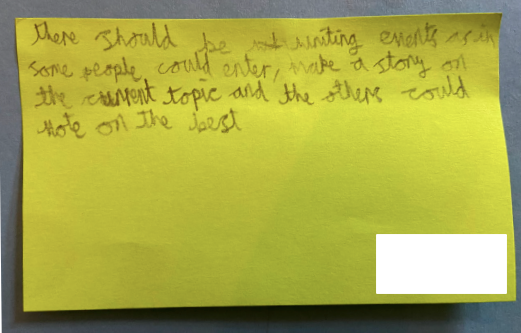
If we think that children don’t have anything to write about, we are doing them a huge disservice. Given the time to think, question, dismiss, select and elaborate upon their own ideas, we find that all children have something that they want to say and – very importantly – be motivated to write about. Children try to persuade adults to do things all the time. After all, we (the adults) are the gatekeepers – the withholders of time, knowledge, information, choice (the list could go on). Being persuasive is an important life skill. We all need to persuade others at different points in our lives and for various reasons. In order to get our point across succinctly, without being rude, and know enough facts about the subject to argue our case, we need to be clear and knowledgeable about what we want to say and how to say it. When we really want something, we are ready to commit the thought and energy it takes to work out how to get it.
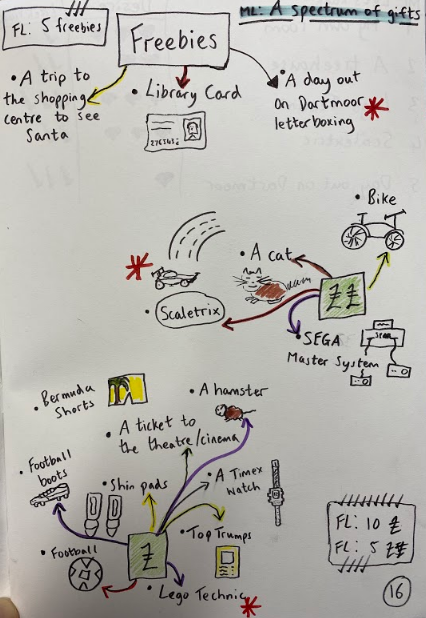
When asked what the children wanted to say in order to improve their own lives as a form of personal gain (The Writing For Pleasure Centre 2022), their ideas were plentiful. Here is a small selection:
Asking for more Chromebooks to be available for children to use in Year 4
Asking to change the school menu to include healthier options
To request a signed copy of a book from favourite author
To request a family pet
To request that Sainsbury’s stop using unnecessary plastic packaging in their supermarkets
To ask their grandparents to quit smoking
To request that Laser Quest to make their equipment less heavy to carry
To ask for the local incinerator to stop burning rubbish
To ask a game company for some free samples
To ask the local council to do more about dog mess in the local park
To ask the Headteacher for swimming lessons missed because of lockdown
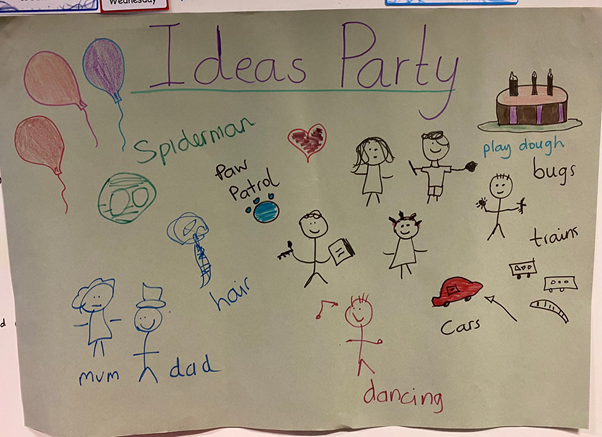
An example of one child’s ‘Ideas Party’
The children were given the time to discuss and think about these ideas deeply, and consider whether they knew enough or needed longer to research and find out more facts. They could reflect upon whether the subject matter really meant enough to them to be able to write as persuasively as possible. There were no pseudo-audiences or ‘fake’ content in our writing classrooms – we could allow ourselves to understand that when it comes to genuine, impactful writing to make real-life change, we need to write from the heart and to an authentic reader.
While a lot of children knew what they wanted, they didn’t necessarily know the appropriate audience for that letter; they didn’t know who actually had the power to make the change that they wanted to see. Speaking to the children about who could actually help with their cause was a process which to some extent demystified the workings of the world for them; they saw that real adults make decisions about how things work, and those things aren’t inevitable but can be changed, even if that change might seem unlikely or outlandish. Such an understanding encourages children to have opinions, to be critical, to imagine changes, to use their voice, as they can see that all of those things can be put to purpose.
The anecdotes mini-lesson (Young et al. 2021) was probably one of the most transformational in this project, partly because the idea was so alien to the children. Encouraging children to include their own personal feelings and anecdotes as part of their persuasion was a new idea to most of them, and something our classes really ran with. So many of them had assumed that what they thought and their own experiences wouldn’t be listened to by adults. We wanted to make clear to the children how they can use their age to their advantage, that their opinions and experiences might be valued because of their age, rather than in spite of it. Telling children that their experiences matter, and that events in their own lives might change someone else’s perspective, inspired them. Lots of the children could think of moving stories that utilised emotion and sympathy to persuade their audience, but possibly even more importantly, it was a key step in showing children that their personal voice could be meaningful and powerful.
Letting children choose why they were writing persuasively and who to, giving them a genuine purpose and audience, led to the children taking a rigorous and critical approach to their writing. When the children had decided who they were going to persuade, just asking them, “Do you think saying that is going to persuade them?” became a really powerful teaching point. Throughout the writing process, children applied that question to their own and other children’s drafts, and the children held themselves and each other to increasingly high standards. Persuasion is a life skill that to some extent or other, children will have already acquired, and it’s a skill that requires a huge amount of empathy. Asking the children to think from their persuadee’s perspective enables them to consider their audience in a new way. It’s not just, “will your audience be entertained by this?” but “can you make your audience agree with you?”, a question which requires a perhaps more rigorous kind of scrutiny. In persuasive writing, thinking about your audience is of the utmost importance, and the children’s research extended from the topic of their persuasive letter to who they were persuading, as they began to see not just their own role in the writing process, but the significance of who they were writing for.
Once we all finished the letters, we learnt how to address the envelopes and post them correctly. We posted them in the hope of our messages to be read, understood and responded to by a genuine reader.
After a week, one child came to class very excited, telling everyone that his dad received his letter in the post that morning. He announced that his dad had cried – proud tears after having received such a touching letter from his son. He said that his father had been persuaded to give him a hamster. “I couldn’t believe it! It worked!” the child said. His expression said everything. He told the whole class that he had tried several times before to persuade his family to buy a pet and in different ways (using the celebrations of birthdays, Christmas, Summer holidays, etc) but it hadn’t worked until the morning his letter arrived. The power of writing was becoming evident for the whole class to see.
A few days later, the school office called looking for a child to collect a letter addressed to her. The letter came, as the child said, in a “very sophisticated envelope” from Sainsbury’s. She read it aloud, initially in disbelief that it could be authentic. Another child said: “Yes, it is real! They hear you and they have responded!” She started believing it when she realised there was a serial number to track the response online.
The same day a grandparent asked for a few minutes to speak after school. Emotionally, she said that she had received a letter from her grandson. The letter was about the impact smoking has on our health and he was asking her to stop. She had been considering stopping smoking for several years but because of the letter, she made a final decision – she was quitting.
The impact of this project has been tangible. As we wait to hear back from more of our recipients, looking forward to turning the envelopes over in our hands and poring over the contents, the belief is building in our classrooms that writing is a powerful and worthwhile pursuit. We can’t wait for the next Writing for Pleasure project to begin.
Near the beginning of my year five’s fiction class writing project (The Writing For Pleasure Centre 2022), I taught a lesson which aimed to help children find their own writing idea for a story project – and get excited about their writing. We’ve tried several idea generation lessons (Young et al. 2021) in the past and the children have loved exploring and sharing their ideas, adding to them at the planning stage and revising their drafted texts to create richer narratives.
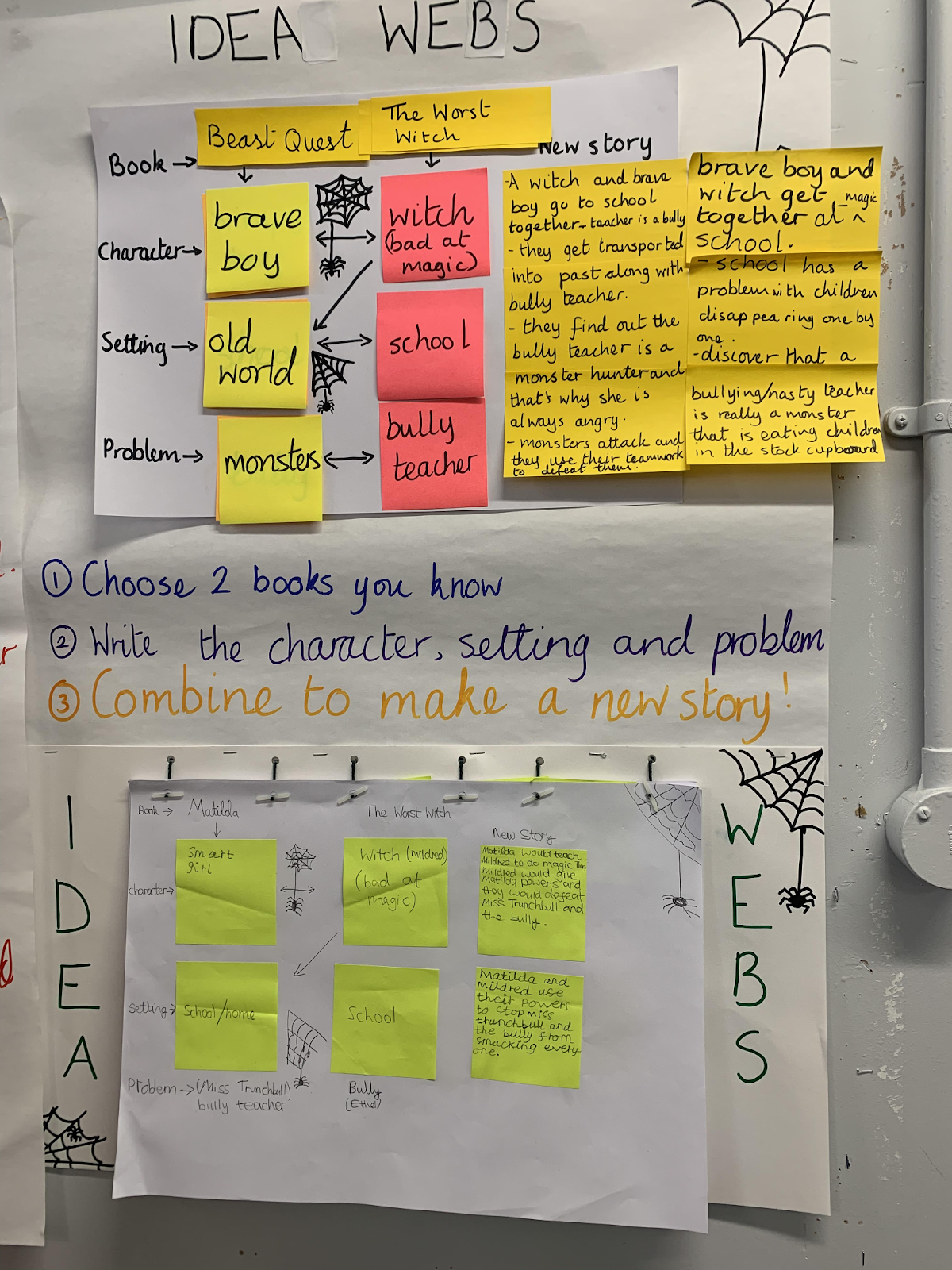
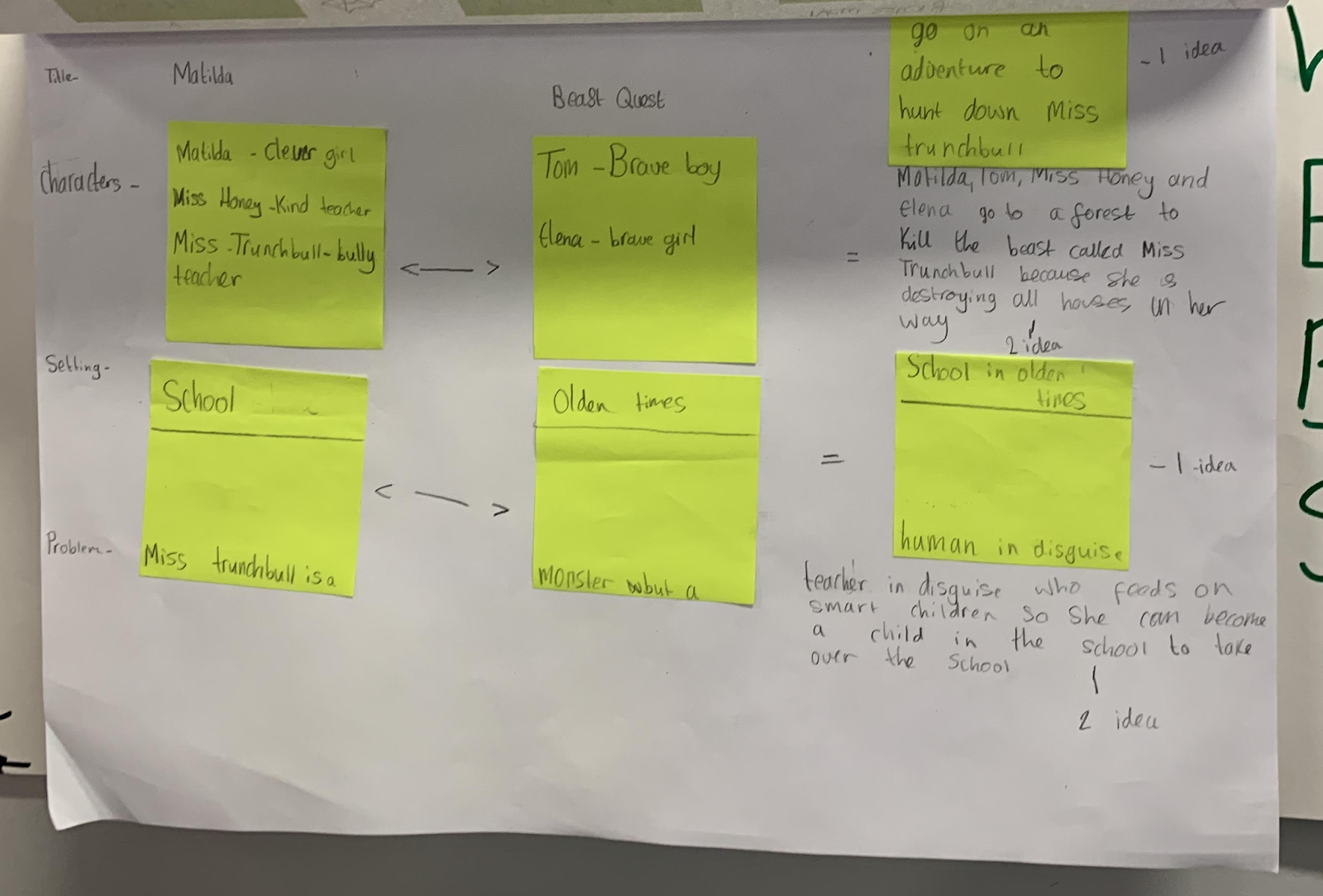
Today we tried out a new technique together – Idea Webs, which we took from the Writing For Pleasure Centre’s Big Book of Mini Lessons. This technique involves children in a simple process of looking at two of their favourite books and writing down on post-it notes one character, one setting and one problem from each book. They are then invited to create a new story, inspired by their notes. I tried it out for myself, and, as I found my own story ideas, I realised that the technique was both straightforward and fun.
Here we see writer-teacher Ateqa’s Idea Web which is displayed as a model. What’s wonderful about this poster is how Ateqa has made publicly available children’s Idea Webs for others to read and feel inspired by.
As I introduced the Idea Web techniques and created a shared class version with the children, it was obvious that they were excited to contribute their ideas. We didn’t record them all, but the children knew they would be making their own web soon enough. After I finished modelling the mini-lesson (12 minutes), the children immediately set to work, loving the idea of using their favourite books and characters to generate new ideas. They worked in pairs (brilliant for each choosing their own book) using an A3 sheet and some sticky notes. We were so excited at all the amazing buzz we had created around idea generation. The children took their characters, settings and problems and created rich outlines for whole new stories. These included hilariously mixed-up characters such as wimpy wizards and genius witches, and all kinds of bizarre settings and problems. I genuinely felt that professional writers would have given a fortune to be a fly on the classroom wall that day as the amazing ideas and story outlines milled about.
At the end of the session, the children started to firm up their ideas ready for me to take the Writing Register in the following lesson. A Writing Register is a place where I record every child’s name and a working title for their chosen story idea (Young & Kettle 2022). Once we had created the register and started the planning process, I felt like I couldn’t part with these amazing ideas, so I gathered them up and stuck them under my model ready for children in need of inspiration for their Personal Writing Projects throughout the year (Young & Ferguson 2021).
This lesson was not at all what I expected; it created magic in my classroom and excitement around writing. I will definitely be using these Idea Webs in my future fiction projects.
The best way to have a good idea is to have lots of ideas– Linus Pauling
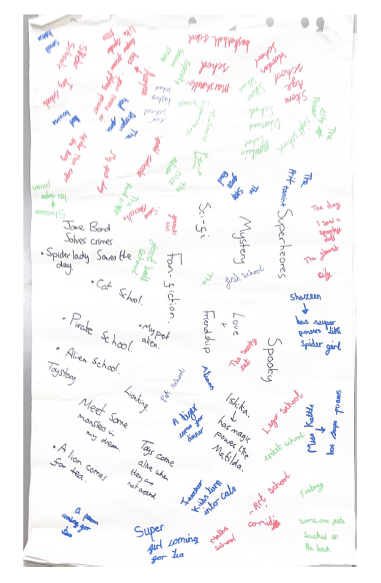
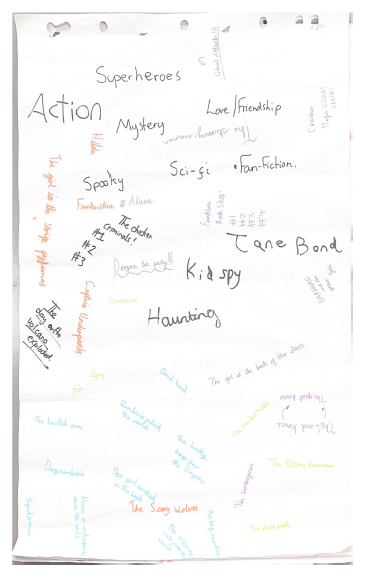
Idea Parties are a fantastic way for all children, regardless of age (EYFS-KS2), to generate ideas together for a class project (Young et al. 2021). It works across all genres. Generating ideas is one of my favourite things about teaching young writers. Children have a wonderful ability to come up with unique and original ideas in a way that I can’t. When you give children some flipchart paper and invite them to come up with ideas for the class writing project, it’s like a creative bomb goes off. This is especially true with children who have had a long apprenticeship in the principles of a Writing For Pleasure approach (Young & Ferguson 2020, 2021). One of the best things about Idea Parties is the social way in which children work together to come up with lots of writing ideas. It’s often other people’s ideas that spark off your own ideas too.
Here is an example of an Ideas Party we had in a Year Four classroom. The children had already been introduced to their latest class writing project: Short Stories. They’ve already looked at a variety of mentor texts and they’ve decided on their product goals (success criteria) for the project. Now was the day to start thinking about what they wanted their short stories to be about.
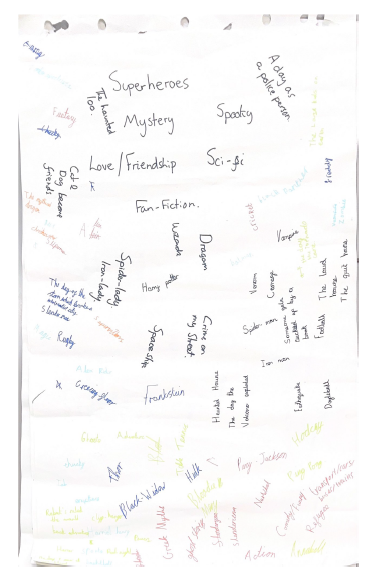
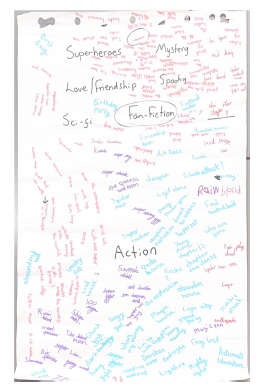
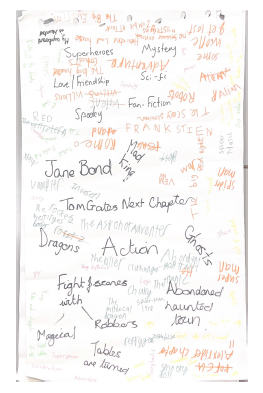
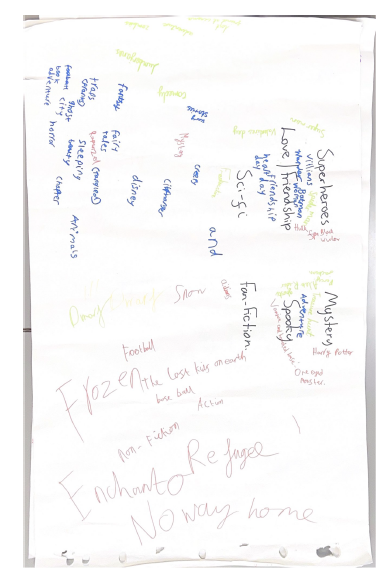
Prior to the lesson, Ms Kettle and I put some flipchart paper out on each desk and wrote some story ‘themes’ we thought the children might enjoy thinking about. These were: superheroes, mystery, sci-fi, love and friendship, fan-fiction, and spooky. In their groups, the children spent around twenty minutes coming up with as many story ideas as they could. As teachers, we also spent time at each desk coming up with ideas with the children too. It was really fun and by the end we had hundreds of ideas. More than we could ever write about for the project.
Their teacher, Ms Kettle, was amazed by just how successful this writing strategy was. She noted how little the children needed prompting to get their ideas flowing and once they got started it was hard for her to get them to stop (no bad thing!).
Next, we asked the children to choose their absolute favourite idea. This would be the story idea they would pursue for the class writing project. For children who found it hard to choose because they had so many ideas, we simply told them to write all the other ideas they liked into the back of their personal writing project books (Young & Ferguson 2021). They could then work on these other great stories in their free time and at home.
The last thing we needed to do that day was take our Writing Register. Taking a Writing Register has lots of benefits.
By starting with your most confident writers, you give other children time to listen to what their peers have chosen to write about.
The writing register naturally makes children consider a working title for their piece. In the process of coming up with their title, they have to find a general focus for their idea.
Taking a register allows you to hear what each child is going to write about and provides you with an opportunity to clarify any uncertainties or difficulties they might have with it.
You can show the writing register to your class next year. This is another way of helping children come up with their own writing ideas.
It creates an excitement and buzz in the classroom.
It holds children accountable.
Ms Kettle noted how having an Ideas Party flowed so naturally into taking the Writing Register. Asking the children to give their story a working title really got them to narrow in on the focus of their narrative. Below is the final writing register for the Short Stories project. Going forward, Ms Kettle can’t imagine planning a writing project without including a little Ideas Party!
Discussion is an exchange of knowledge – Robert Quillen
Children discuss things all the time. They weigh things up and consider things in their heads. They hear each other out – they challenge each other’s thinking from time to time and they try to justify their thoughts with some kind of explanation. Our students are happy to challenge what they’ve heard but are still open to changing their own opinions too. We have built this up by having debating as a central plank of our curriculum offering, weaving it throughout all subjects, while also teaching discrete debating lessons and running extra-curricular clubs for KS1 and KS2.
In the world of social media, globalisation and political polarisation, it’s our view that discussion is an important life and academic skill that we want our pupils to be exposed to, and we want them to know how to use it for themselves. With this in mind, we set up a Discussion Class Writing Project with our Year Six classes. Children were invited to bring their own identities, cultural capital, thoughts, opinions and knowledge into the writing classroom. The idea was simple: children should write on a topic they are motivated to discuss with the rest of their class. We’ve noted that when children write on subjects they are already knowledgeable about, and motivated by, they have more cognitive space to focus on what matters: the quality of their writing.
After studying and discussing a number of high-quality mentor texts, we taught the children an idea generation technique from The Writing For Pleasure Centre’s Big Book Of Writing Mini-Lessons.
I’m An Expert In
This is MY idea, I thought. No one knows it like I do. And it’s okay if it’s different, and weird, and maybe a little crazy… I cared for it. I fed it good food. I worked with it, I played with it. But most of all, I gave it my attention -Kobi Yamada in ‘What To Do With An Idea’
Children love to teach each other things. There’s nothing like the feeling of confidence and pride in yourself that comes with being able to tell others about something you feel you are an expert in, especially if they don’t know much about the topic but would really like to learn something. You don’t have to know everything about your subject, but you do need to know enough to write with a bit of authority and passion. Being an expert obviously helps with most types of non-fiction writing, including instructions, explanation, information and also discussion, where you need to be able to give some kind of factual evidence for and against different points of view.
Having children write about their own funds of knowledge is one of my favourite things to do in the writing classroom. The idea that you are the class expert on something can bring a new sense of confidence to children who previously may have had little. Every child is an expert in something. You can give them these two headings to write in their notebook:
1. Things I can do. 2. Things I know a lot about.
Start this mini-lesson with everyone writing a list of things they think they might be a bit of an expert in. It could include anything, from supercars or unicorns, to making friendship bracelets, collecting crisp packets or doing Taekwondo – anything goes as long as children’s writing shares their expertise, shows their passion and rouses their reader’s curiosity and interest.
Taken from The Writing For Pleasure Centre’s Big Book Of Mini-Lessons (p.116)
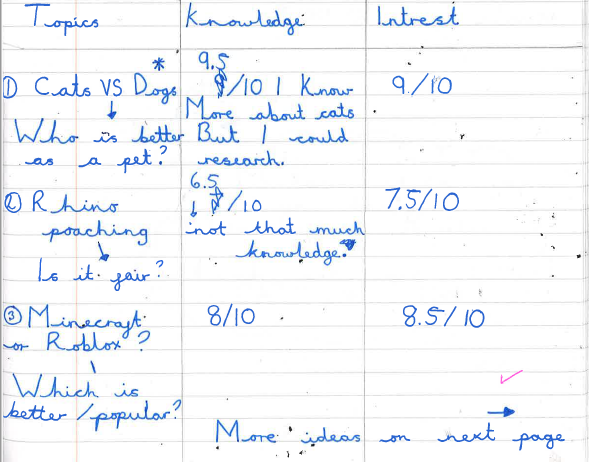
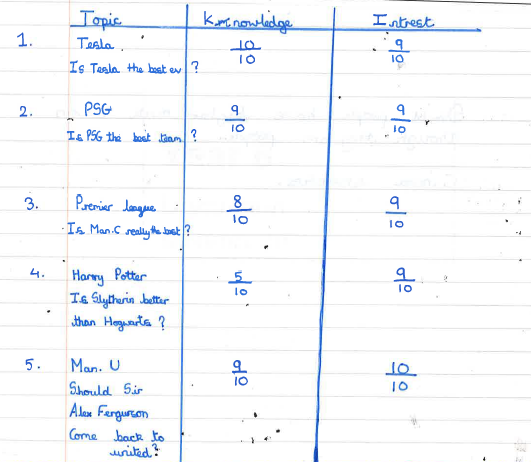
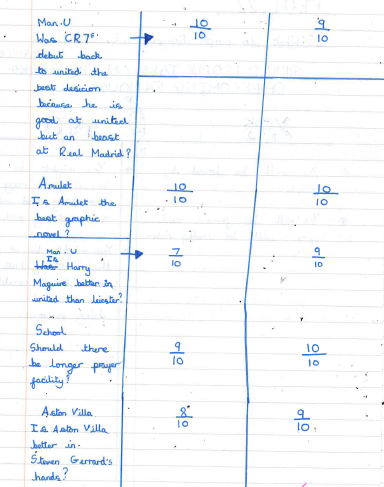
Below, you can see how children weighed up the different ideas they generated. Sometimes our first ideas aren’t the best. They were asked to consider their knowledge-level and interest-level for each of the early ideas they came up with. They also spoke to their friends about their lists before making a final decision on what it was they were going to write about.
As is tradition, once everyone had identified what they would like to write about, we took a Writing Register. Here it is:
Name
Working Title
Madiha
Is hockey too dangerous for primary schools?
Samairah
Should video games be banned?
Yahya
Is the Rise of Skywalker the worst Star Wars film?
Aroosh
Should playtime be longer?
Rumaysah
Is drawing better than painting?
Nadirah
Should you buy a kitten?
Het
Should fast food restaurants be banned?
Harvi
Should play and lunch at school be cancelled?
Hajaar
Should school be banned?
Mehnaz
Should healthcare be free in every country?
Aaisha
Should the death penalty be legal?
Mishall
Should the death penalty be legal?
Najat
Should we continue space exploration?
Minhaz
Is Brazil better than England at football?
Nivi
Are graphic novels ‘real reading’?
Aairah
Is Maths better than English?
Shlok
Are comics better than chapter books?
Kyan
Is climate change the biggest threat to the world?
Yusma
Should you have to learn English if you live in London?
Krithika
Are aliens real?
Humaiyra
Should the death penalty be legal?
Haniyah
Should the Covid vaccine be compulsory?
Umar
Should the death penalty be legal?
Zoeya
Which pet is better – cats or dogs?
Zainab
Should mangas have age restrictions in libraries?
Zain
Do aliens exist?
Zanna
Apple or Samsung?
Haroon
Which is the better team? Liverpool FC or Man City FC?
Aadam
Should vaccines be compulsory?
Tasnin
Should hospital workers be paid more than footballers?
Adam
Should Mustangs (horses) be used by humans?
Tasvinder
Can we do more to stop sea pollution?
Gabriel
Should we have one global currency?
Shaheem
Is the rise of retro gaming having a negative impact on the industry?
Hamdan
Are aliens real?
Jasleen
Are mermaids real?
Amen
Is Tony Stark the best marvel character?
Fowjia
Should hospital workers be paid more?
Sadek
Who is the best Spiderman?
Isha
Is Neymar the greatest footballer of all time?
Shuayb
Fame: Is it worth it?
Muntaha
Are VR headsets a good idea?
Zaina
Are movies better than books?
Muhammed
Should cooking be on the primary curriculum?
Awaid
Should firearms be banned across the world?
Zara
Should school time be reduced?
Aisha
Should pupils have a half day on Fridays?
Keyaan
Should we have to pay the ULEZ charge?
Sumaiyah
Should social media be banned?
Muhibul
Are footballers paid too much?
Ayaan
Are footballers paid too much?
Nafis
Should Lego be banned?
Jawad
Should Lego be banned?
Dhairi
Should electronics have a daily three hour limit for usage?
Sneha
Should meat consumption be banned in the UK?
Nabiha
Should the production of plastic be banned?
Khadijah
Is school uniform necessary?
Ahmad
What should we be exploring more: Ocean or space?
Amara
Should school uniforms be free?
Affan
Should medical care be freely available across the world?
Druvi
Can we be doing more to protect green spaces?
Rumaithah
Can we be doing more to protect green spaces?
Abdurrahman
Should the Covid-19 vaccine be made compulsory?
Dhanvi
Should animal testing be banned?
Ismaeel
Is it time to make the summer holidays shorter?
Hamza
Should the FIFA World Cup be every four years?
Azam
Should commercial flights be banned?
Fatima
Do we need homework?
Zahira
In the future, should we live on Mars?
Tanya
Should animal testing be banned?
As you can see, the children came up with a variety of genuinely interesting and thought-provoking topics that hopefully you’d be interested to read and discuss yourself!
Over the next few weeks, we worked hard on these ideas and crafted them into very respectable final texts. You will be able to read them all here very soon.
We think this project is an excellent example of the Writing Realities (Young et al. 2022) principles being realised in the classroom. Firstly, we can see how children were invited to use their existing funds of knowledge. And because each child was discussing their own idea, they were also able to learn from one another and so contributed to the class’ community knowledge. This is something that isn’t really possible when children all have to write on a subject predetermined by their teacher or a scheme writer. Children learnt that they could teach others, entertain them, share their own personal reflections on a topic, engage in lively debate, and, importantly, share their opinions on subjects that matter to them most. During this project, children got to know each other a lot better and learnt about what is important to their classmates. This created an empathy and sensitivity we’ve not felt in our writing classrooms before.
By Sam Creighton, Inka Vann & Andrew Sheppard
Young, R., Ferguson, F., Kaufman, D., Govender, N. (2022) Writing Realities [www.writing4pleasure.com]
Two powerful aspects of a Writing for Pleasure pedagogy are:
Having authentic audiences for writing;
Empowering children with the volition to control their own writing process.
These come perfectly together in the practice of the writing workshop collectively deciding on the purpose and outcome of a class project.
This short post will explain the process and impact of one such decision within my year six classroom and look at how and why it might be replicated by other practitioners.
What had the children written in this project?
The class, a group of 24 year six children, had written what is called ‘Flash Fiction‘. The children understood this as a short, impactful piece of narrative writing that focusses on a single moment (perhaps from a larger story). They were allowed – even encouraged – to leave some aspects of their stories unexplained, focusing on crafting their chosen moment rather than the wider narrative that it (perhaps) fitted into. The genre or topic for their stories was generated by them.
What did they choose as their publishing goal (and how)?
In the first lesson of any new writing project, I like to discuss and define the genre of writing we will be producing and its purpose. A key part of this is choosing a final outcome or audience that the writing is intended for. This lends real purpose to the writing; it is being crafted for a reason beyond teacher assessment.
To select this ultimate aim, the children spend time consulting the ‘Publishing Menu’ (a list of possible outcomes) provided by The Writing For Pleasure Centre. The class then suggests four or five options which are then voted on.
This was our second class project of the year, so the children had some experience of this process already (for our first project – Social And Political Poetry – we sold anthologies to parents to raise money for Amnesty International). For Flash-Fiction, the children voted overwhelmingly to send their stories to writing ‘experts’ – which they took to mean authors, editors, publishers and world-class writing teachers.
This is where the power of Twitter came to the fore. I put out a tweet explaining the situation and asking for volunteers and was immediately flooded with generous offers of involvement. I quickly amassed a list long enough to allow all children to get feedback from such distinguished figures as Jennifer Killick (author of numerous books including the Alex Sparrow and Crater Lake series), Philippa R Francis (editor at the Golden Egg Academy) and real world-leaders of writing education such as Ross Young, Felicity Ferguson, Jonnny Walker, Ben Harris and Marcela Vasques.
What was the impact of the feedback on the children?
In a word: excitement. The feedback arrived in stages and I gave it out as soon as it dropped into my inbox (making, I admit, a rather theatrical show of each one). This meant that some children got their critique before others. The absolute joy with which the kids poured over the feedback was wonderful to see, as was how those who were yet to receive theirs would ask whether it had arrived multiple times a day. It was also clearly more than a passing infatuation as I have noticed children getting their messages out again and again to read over even days later. I have also seen them swapping and discussing each other’s feedback, leading to fantastically reflective discussions about writing and being writers. We are just starting our next class project, so it’s too early to say whether the feedback is being brought into their subsequent writing, although it does seem to be trickling in to their Personal Writing Projects.
Evidence and examples
Included with this post is a copy of two of the stories along with the feedback they received. Also, below are some short reflections from three of the children about how they found the process and whether it was useful to their development as a writer:
‘I felt excited because I wanted to get feedback on my work to see what I need to improve on. I felt happy reading through what they sent me because it was good feedback and told me how to make things better. I found the feedback really useful because now I know that I should write some moments fast and some moments slow and go into the details. I think I will use the advice in the future.’
‘I felt happy to send my work off because I knew I could use that feedback to develop my skills and improve what I had written. I felt happy to get the feedback because I could change what was wrong and persevere. I will definitely use the advice in the future because I know that to develop my writing, I need to make some moments more specific.’
‘I felt really excited to send my work to an expert because I wanted to know what they would say. When I received the feedback I was really happy because it sounded like they liked my work. I did find it useful because I now know to try and describe my characters more.’
Some children responded that the feedback was not useful but when asked about this they were able to reflect that it was because the responses they received were only positive and they were keen to also have areas of development highlighted for them. I think this shows that they have internalised a very positive and developmental mindset.
The Village Pond by Humaiyra, aged 11:
Feedback for Humaiyra from Jennifer Killick, author of Crater Lake and Alex Sparrow series, Lottie and the Junkers and the upcoming Dread Wood:
I was so impressed with this story! Humaiyra does a brilliant job of creating an atmosphere through her clever use of description – definitely a future horror author. It contains so many classic horror elements and is genuinely chilling. Something I think Humaiyra could do to strengthen it even more is give the reader a better idea of the characters by adding a few additional details. We know they’re cousins and that Humaiyra is reluctant to go to the pond, but she changes her mind very easily – why is that? Are they older than her and often encourage her to do things that might get her into trouble? Or is she naturally a person who follows others to make them happy? I’d love to understand a little more about their relationship. There are some gorgeous details that really draw the reader in, like when the characters sink their feet into the pond and I’d love for those to be expanded just a little more. What does the pond feel like around their feet? Does the mud squelch? Does it smell? Overall I think this is a brilliant piece of writing – atmospheric, chilling and with some excellent details that paint the scene for the reader. Humaiyra definitely has a talent for horror.
A Fiery Imagination by Nivi, aged 10:
Feedback for Nivi from Philippa R. Francis, developmental editor at the Golden Egg Academy:
Your title is a clever play on words and hints teasingly at what is to come. You set the scene with a sense of calm and reflection from your first-person narrator. This helps establish the dragon as an imaginary, though frightening, creature.
The next few paragraphs include realistic and convincing dialogue with a rather irritating brother. Your use of sounds: shout, thud,bang helps the reader experience the annoyance directly and you convey the narrator’s physical and emotional response well. Such a neat sleight of hand that this seems all so normal and then the main character looks through the window!
Your diction (choice of words) is specific and creates concrete images: for example, smoke drifting down, drenched and shattered. My personal favourite is the simile like deadly snowflakes. That moment where something red and wet wraps around the main character is also effective because you leave it to the reader to work out it’s the dragon’s tongue. That really increases the ick factor!
You have created a sense of increasing peril in the last two paragraphs and the whole piece ends with the reader wondering how the main character could have survived to tell their tale. I wonder if using the present tense throughout the whole piece might increase the feeling of danger? Whatever you decide, it’s a cracking piece of writing and I would encourage you to keep practising your skills with enthusiasm, Nivi.
Next steps
It was not only the children who benefitted from the process, I also found the feedback valuable. A fresh pair of eyes over the children’s manuscripts and the areas of development these experts identified really helped inform my understanding of the writing community I’m lucky enough to be a part of and to think about what future Mini-Lessons might be needed. For example, a repeated theme in the expert responses was the need for children to Slow Down… key moments more, so this is something I will revisit as a mini-lesson.
On a more individual level, I want to Pupil-Conference with each child to make sure that they both understand their feedback and know how to implement it in the future.
The purpose of a writing study week is to think in depth about what other writers have done in their own pieces of writing and to tease out the things we want to try and emulate in our own compositions (Hayden 2021). Today, I shared my short story (with a setting focus), Trouble At Granny’s, with my class of Year 4 writers and we read it, thought about it and discussed it.
I invited them to identify five mini-lessons which they thought I might have tried out in my story and which they wanted me to teach them more about. And if they could, I asked them to come up with a title for each one. Here’s an example:
Having read Trouble At Granny’s, two children worked together to identify mini-lesson ideas and came up with some possible titles for each one.
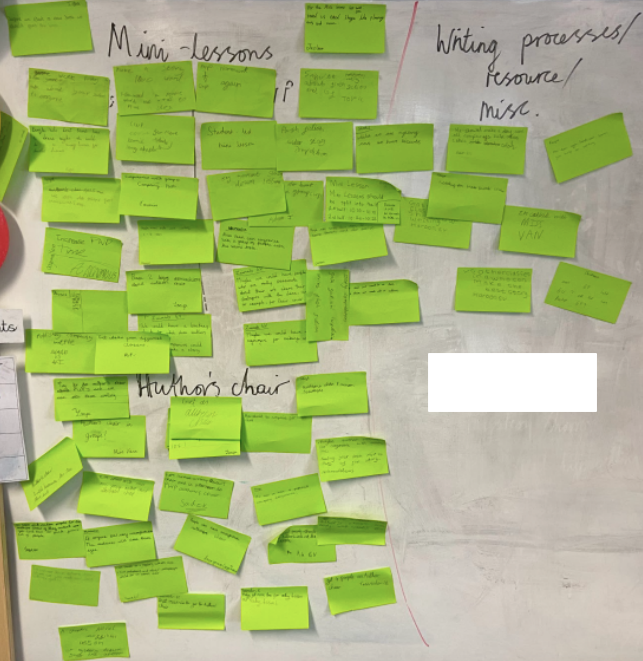
They came up with some great ideas and we have begun collating them. These will form the basis of our product goals (success criteria, toolkit, ingredients – whatever you like to call them).
A class poster collating the children’s ideas about what we could try out when we are writing our own short stories
Choosing which stories to study during a genre-study week can be tricky. I always like to include several of my own examples for a number of reasons.
Having the writer in the room for the children to probe is a great way to deal with children’s questions about how the text was composed from a position of authentic writerly knowledge.
It shows children that you have tried to write the type of text you are asking them to develop themselves.
It supports my own development as a writer-teacher as scrutinising my own composition with a class of critics helps me to see potential revisions.
One of my own stories which the children read, discussed and used as a source for potential mini-lessons
What this session showed me was that rather than going through the motions of identifying the same old features time after time, perhaps children enjoy the challenge of really linking their study of texts to some of the instruction they might want to receive. After all, having an influence over the design of some mini-lessons can be a powerful way to help develop children’s perceptions of themselves as writer-teachers (in their own unique way) (Hayden 2021).
What do I mean by that? Well, two girls in my class have just set up a poetry lunchtime club for other children in the school where they want to pass on their writerly knowledge, strategies and tips. This is a classic example of children being motivated by the type of pedagogical environment in which they are being nurtured. They want to deliver to other children the type of writing instruction they receive from me in class.
There really is no reason why we can’t widen the role children play in influencing our day-to-day teaching decisions. We all benefit when we know more about what our young writers need and respond accordingly (Hayden 2021).
On the 26h of November 2021, the Education Endowment Foundation published its revised guidance report entitled ‘Improving Literacy In KS2’. It purports to be updated with the latest research and provides guidance for schools to help them deliver evidence-informed literacy provision that improves outcomes for all.
The mission of The Writing For Pleasure Centre is to help all young people become passionate and successful writers. As a think tank for exploring what world-class writing teaching is and could be, a crucial part of our work is analysing emerging guidance reports such as the one provided by the Education Endowment Foundation. It is therefore important that we issue a review of what this document has to say.
What we concluded from our review of the document
The recommendations made in the EEF’s report are timely and generally welcome. However, we at The Writing For Pleasure Centre believe we can provide more detail, guidance and examples for teachers and schools. We urge anyone interested in developing world-class writing teaching to read the cited research at the end of this review before making any changes to their writing teaching or commercial offerings. The EEF’s report supports many of the research recommendations related to the 14 principles of world-class writing teaching (Young & Ferguson 2021a). For example, there were recommendations related to the following principles:
Build a community of writers.
Read, share, think and talk about writing.
Pursue purposeful and authentic writing projects.
Be reassuringly consistent.
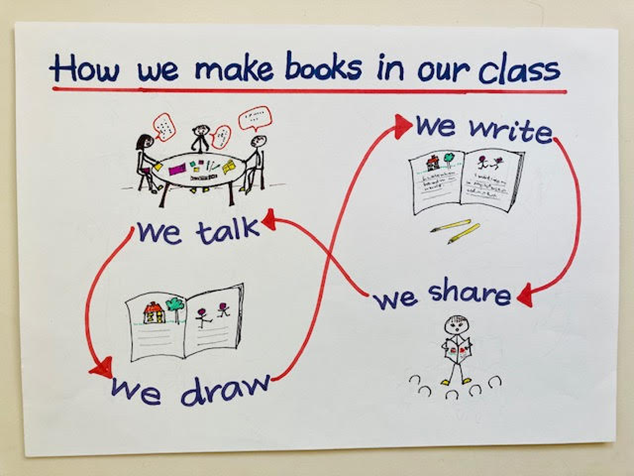
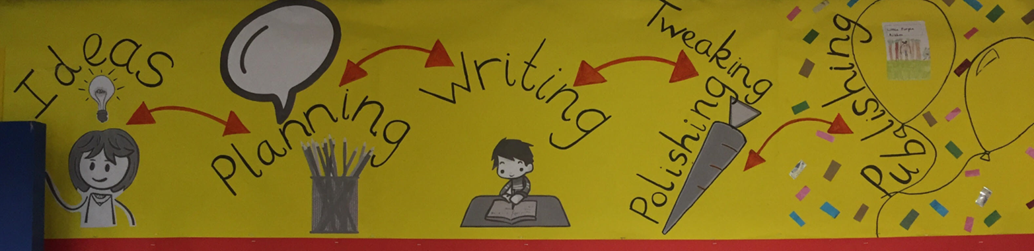
Teach the writing processes.
Set writing goals.
Teach mini-lessons.
Balance composition and transcription.
Be a writer-teacher.
Pupil conference: meet children where they are.
Connect reading and writing.
We will reflect on these in more detail.
Teach writing composition strategies through modelling and supported practice
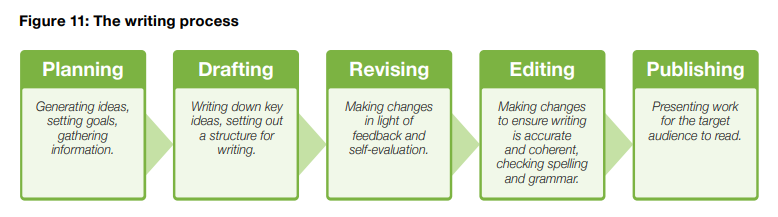
To develop pupils’ ability to write… it can be helpful to think of writing as a task made up of five stages: planning, drafting, revising, editing, and publishing. Children can be taught, through modelling and scaffolding, strategies which support them to undertake each of these stages of the writing process EEF p.28
(EEF’s Improving Literacy In KS2. p.31)
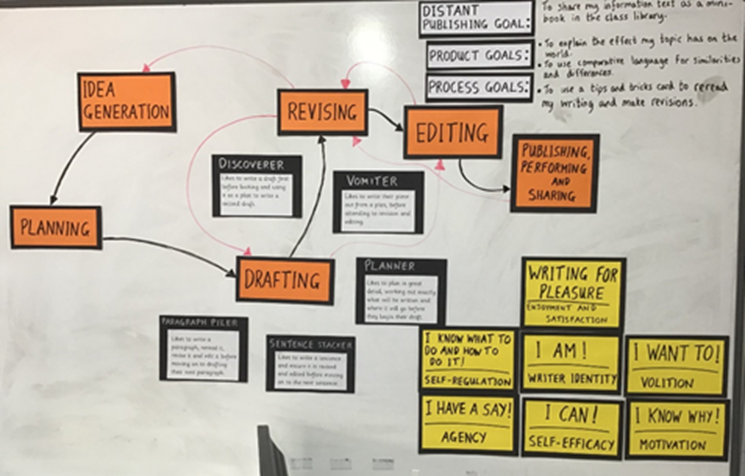
We are pleased to see the EEF highlight one of the key principles of world-class writing teaching: teach the writing processes. However, as we know, writing is not the linear process the EEF’s illustration might, perhaps inadvertently, suggest. Firstly, it is better to use the term writing processes. This is because there isn’t a single writing process. Each writer’s approach to the process of writing is different and they will use these processes in different ways and in different combinations. We can see that in the different writing habits that are discussed with children in Writing For Pleasure schools:
The writing habits below come from our book Real-World Writers. Writing habits are our own way of doing things. You might be an Adventurer, who likes to draft first then use it as a plan for a second draft. Perhaps you’re a Planner, writing a tight plan to precede your draft.
Many people are Vomiters, quickly drafting from a plan and attending later to revising and editing. Others are Paragraph Pilers, only drafting the next paragraph when they have revised and edited the one before. And there are Sentence Stackers, who perfect a sentence before moving on to the next. I have always identified myself as a dedicated Sentence Stacker, whereas my writing partner is a confirmed Vomiter. It’s totally amazing that we get our writing done together without too much pain. You can have great conversations with children about what kind of a writer they think they are, and they love giving themselves a writerly label and seeing how their friends identify themselves too.
Of course children can and will chop and change their writing habits depending on the type of writing they are doing or indeed the type of mood they find themselves in on that particular day.
The purpose of this type of lesson is to tell children that they can experiment with different writing habits, and to invite them to try one out in their writing today. Point out that this will help them find their own preferred one in time. Show them examples from your own notebook where you have tried some different ones out, perhaps according to the type of writing you were doing.
The process of producing writing can also be different depending on age and experience. For example the process of writing can look like this in The EYFS:
When teaching the writing processes is combined with two other key principles, namely: teach daily mini-lessons and be a writer-teacher, we see powerful instruction in our writing classrooms. For example, in our Writing For Pleasure schools, we see teachers explicitly teach and model a single writing strategy or technique before inviting children to use it for themselves during that day’s writing time. This happens every single day.
If we boil down our approach to teaching the craft of writing, it is as simple as:
Teach, then Invite
Teach. Provide explicit and direct instruction to your class on an aspect of writing you feel they need a better understanding of.
Invite. Invite children to try it out during that day’s writing time.
For more information on teaching grammar, sentence-level instruction, and other craft knowledge, please see the following mini-books:
The WfP Centre’s BIG BOOK of writing mini-lessons: Lessons that teach powerful craft knowledge for 3-11 year olds [LINK]
The WfP Centre’s grammar mini-lessons for 5-11 year olds [LINK]
The WfP Centre’s sentence-level instruction for 3-11 year olds [LINK]
Setting process goals
Ms Howarth may want to consider how to make… writing less daunting for her class. This could be done by initially focusing on one element of the writing process in each session, for example, planning or drafting, with shorter, regular sessions over which the children can complete their [writing project]. Breaking a [project] down in this way and teaching pupils strategies for approaching each stage of the writing [project] will also allow children to have time to reflect on and understand the writing process[es]. EEF p.28
Here we can see another principle of world-class writing teaching being suggested by the EEF: the setting of a process goal (also known as a writing deadline), the thing children need to get done in that particular writing session. Here are some examples of what process goals can sound like in Writing For Pleasure classrooms:
Today, our goal is to fill out our planning grids.
Today, our process goal is to let the last few people finish their planning grids.
Today, our goal is to write our second section.
Today, our goal is to write about your third topic.
Today, our process goal is to write our endings.
Today, our process goal is to write our introductions.
Today, our goal is to write one of our sections.
Today, our process goal is to write our conclusion.
Today, our goal is to think about our character description.
Today, our goal is to try out writing some suspense into our pieces.
Today, our process goal is to finish our drafts if we can.
Today, our goal is for the last few children to finish their drafts.
Today our goal is to check our writing against our revision checklist.
Today, our process goal is for the last few children to finish revising their pieces.
Today, our process goal is to check for capitalisation.
Today, our goal is to check for our use of vocabulary.
Today, our process goal is to check our punctuation.
Today, our goal is to check our spellings.
Today, our goal is for the last few children to have time to check their spellings.
Obviously, once children have a secure understanding of the writing processes and the strategies they can use to negotiate their way through these processes, teachers can begin to set more open-ended writing deadlines (process goals). For example:
Today is our first writing day. You have 14 writing sessions in total. Use your time wisely!
What do you want to get done today? Make sure you’ve set yourself a process goal.
What do you want to get done today? Remember, we’ve got 8 more writing sessions left before our publication deadline.
Can I check where everyone is at? Who is drafting? Who is revising? Who is proof-reading? Who has handed in their manuscript?
We’ve only got a few more days left before our publishing deadline. You need to make sure your manuscripts are nearly ready.
We’ve got a couple of days left. You need to make sure you’re proof-reading now. These manuscripts need to be ‘reader ready’.
This is our last day. I need all your final manuscripts in. They must be full proof-read. If they’re not, you better work with some friends to get them sorted.
OK, I can see that despite our best efforts, loads of us aren’t quite ready yet. I’m therefore going to extend our final deadline by a few days. This is to give you all the very best chance of producing your best pieces. For those who are finished, please enjoy a few more days of personal project time.
Whilst many teachers appreciate how this kind of instruction can help children navigate their way through a writing project successfully, many rightly bemoan the fact that children will finish what they are required to do at different times. That’s why we highly recommend that, once children have finished what they’ve been requested to do as part of the class writing project for that day, they know they can continue working on their personal writing projects (Young & Ferguson 2020). This ensures that all children are engaging in meaningful and productive writing practice throughout the whole writing session, what we call being in a ‘constant state of composition’ (Young & Ferguson 2021a). For more information on how to set up personal writing projects in your classroom, please see our dedicated mini-book on the subject.
What happened to generating ideas as its own distinct writing process?
One aspect of the EEF’s guidance that was disappointing was to see that the most important writing process fails to receive the attention it deserves: generating ideas. Idea generation is a process which happens before writers begin planning, and indeed is a process which informs how one decides to plan. Too often we see teachers or scheme writers taking cognitive and emotional responsibility for this part of the writing process and as a result children fail to receive a complete writerly apprenticeship (Young & Ferguson 2021a).
Teachers or scheme writers who formulate writing ideas on children’s behalf are making a serious instructional mistake (Young & Ferguson 2021a). One of the problems is that children don’t have equal access to writing topics. For example, when teachers or scheme writers choose topics for writing derived from their own personal interests and cultures, they are only ever helping children who are most ‘like them’. Writing on a topic chosen by someone else also makes the task of writing more cognitively difficult (Stein 1983; Heller 1999). In contrast, when children are allowed to choose and access a topic they are familiar with and emotionally connected to, their writing performance improves and they produce higher quality texts (Bruning & Horn 2000; Kellogg 2001, 2008; Graham 2006; Purcell-Gates et al. 2007; Flint & Fisher 2014; Behizadeh 2014, 2018; Fletcher 2016; Young 2019; Harmey 2020). If teachers are interested in teaching their students strategies and techniques for generating their own ideas within the parameters of a variety of written genres, consider looking at our BIG Book Of Mini-Lessons: Lessons That Teach Powerful Craft Knowledge For 3-11 Year Olds which includes over 70 such techniques.
Let’s have an ideas party
The best way to have a good idea is to have lots of ideas – Linus Pauling
Generating ideas is one of my favourite things about teaching young writers. Children have a wonderful ability to come up with unique and original ideas in a way that I can’t. When you gather children onto the carpet with some flipchart paper next to you, write ‘things we can write about’ at the top and then invite them to come up with ideas for the class writing project, it’s like a creative bomb goes off. This is especially true with children who have had a long apprenticeship with the principles of a contemporary writing workshop approach (Young & Ferguson 2020, 2021a). The best thing about generating ideas in a social way with others is that often other people’s ideas spark your own ideas off too. You can pin these lists up around the room so children can refer to them over many days if they want to. With the youngest of children, you may want to draw diagrams of the things they suggest, as opposed to writing it down.
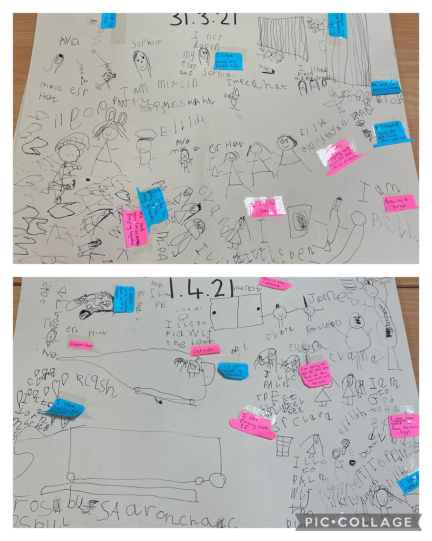
Here we see the Nursery children in Marcela Vasques’ class being invited to have an Ideas Party.
An example of what an Ideas Party can look like in KS1
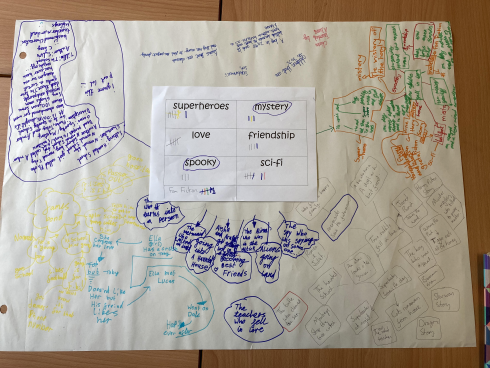
An example of what an Ideas Party can look like in KS2. Here the teacher asked the children to come up with a variety of short story ideas for each of the themes in the middle of the paper. The children worked together to ensure they had ideas evenly spread across the different themes by keeping a tally chart. After around twenty minutes, the class had generated around 200+ story ideas.
Teach writing composition strategies through modelling and supported practice: Balance composition and transcription
It is important to promote the basic skills of writing (handwriting, typing, spelling and sentence construction) — skills that need to become increasingly automatic so that pupils can concentrate on writing composition. EEF p.30
This is good advice. However, you rarely hear these two components of advice being reversed. For example, if we teach children (through repeated, daily, meaningful practice) about composition, they have more cognitive energy to focus on skills like transcription. Indeed a daily, meaningful and sustained period in which to write is one of the best ways of ensuring automaticity of not only transcriptional skill but also compositional competence (Dahl & Freppon 1995; Hall 2019; Roitsch et al. 2021; Young & Ferguson 2021a).
Developing handwriting accuracy and fluency
It’s well known that early writers should focus their efforts on ‘automaticity’ and fluency of handwriting rather than on the adherence to any particular style (Graham et al. 2012; Santangelo & Graham 2016). The main aim at this age is for children to write quickly, accurately and effortlessly. The fact is children who write with automaticity go on to perform very well in their later years and produce higher-quality pieces (Puranik & AlOtaiba 2012; Malpique et al. 2017, 2020). We are therefore pleased to see the EEF’s guidance supporting this position.
Developing compositional fluency
Although accurate spelling, grammar, and handwriting are important, at this stage [planning, drafting] they are not the main focus. EEF p.33
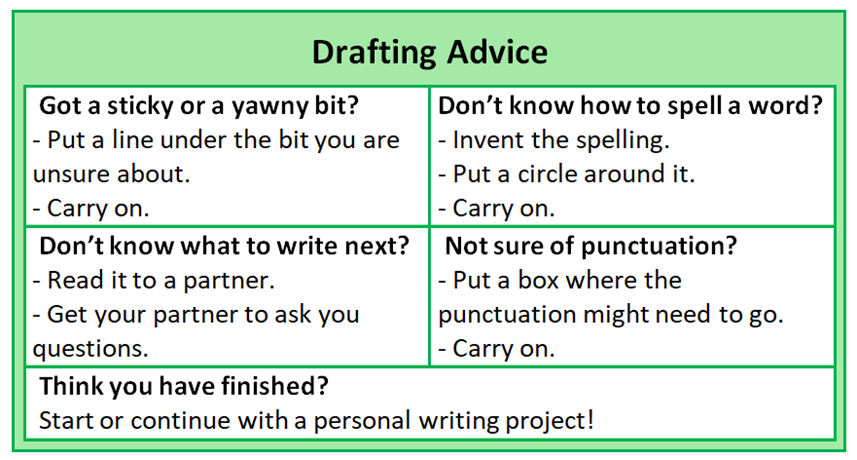
Many Writing For Pleasure classrooms will help children to focus on their composition whilst drafting and will also support children’s writing fluency by giving them the drafting advice below. Getting children to draft quickly, fluently and happily is essential to their writing success. It’s while drafting that children discover, perhaps for the first time, what it is exactly they want to say. This is no easy task and we can often make this process even harder by inundating children with additional burdens. While meaning well, we are directing children to focus on the wrong things at the wrong time. Children simply must be allowed to draft freely. They can attend to additional demands like success criteria when they are revising and transcriptional accuracy when they are proof-reading.
Drafting advice
(Taken from Real-World Writers Young & Ferguson 2020)
It’s a good idea to give this drafting advice at the beginning of the year. It’s also useful to share it across a whole school, and a poster on the working wall is helpful. For this lesson, it’s good to show children a piece of your own writing where you’ve applied the advice. Let them ask you questions about your writing process too. Over time, you’ll find children beginning to develop their own idiosyncratic ways of drafting.
Developing children’s ability to attend to and correct their spellings
Writing ‘Sp’ beside spellings pupils are unsure about and then checking spellings using a dictionary. EEF p.30
Our Writing For Pleasure schools take proof-reading extremely seriously. The expectation is that children are to prepare their manuscripts for genuine publication beyond just teacher evaluation. As a result, they are explicitly taught how to proof-read and are given multiple sessions to get their manuscripts ‘reader ready’ prior to publication (Young & Ferguson 2020). Part of proof-reading is obviously attending to your spellings.
Children are taught to circle any ‘temporary spellings’ (also known as unsure spellings, invented spellings or ‘sound spellings’) when drafting (Young et al. 2021). This reminds them to look up the conventional spelling when it comes time to proof-read. However, dictionaries are probably one of the worst places to go if you are trying to look up a spelling you don’t know, since their main function is to supply definitions for words. Instead, we recommend children use:
Word walls (a list of common words children should know how to spell are up on the wall).
Common word lists (x10, x100, x1000).
Their friends.
The book they are reading.
Electronic devices (such as computers or tablets) which include speech facilities like Siri or Google.
Electronic spell checkers.
Phonic dictionaries like ACE.
Teach writing composition strategies through modelling and supported practice: Set writing goals
[Use] checklists to support…writing and monitor progress towards goals. Over time, pupils can be prompted to develop their own checklists before starting to write, instead of using checklists provided by their teacher. It is important that pupils learn to modify their writing according to the audience for whom they are writing, which includes selecting an appropriate form or genre. Pupils need to learn the features and conventions of different genres. Exposure to a rich range of genres and identification of key features can support this. EEF p.30-31
It’s really great to see ‘setting goals’ and ‘genre study’ being mentioned in the report. However, this could do with a little more unpacking. Firstly, we know that goal setting can be one of the most effective practices for teachers to employ in their writing classrooms (Young & Ferguson 2021a). Goal setting includes:
Establishing a publishing goal for a class writing project. Who is going to receive the writing at the project’s end (beyond teacher evaluation).
Product goals. These are things you might need to do or include to write ‘the best piece in the whole entire world’.
Process goals. These are process deadlines: things you need to get done on the road to final publication or performance.
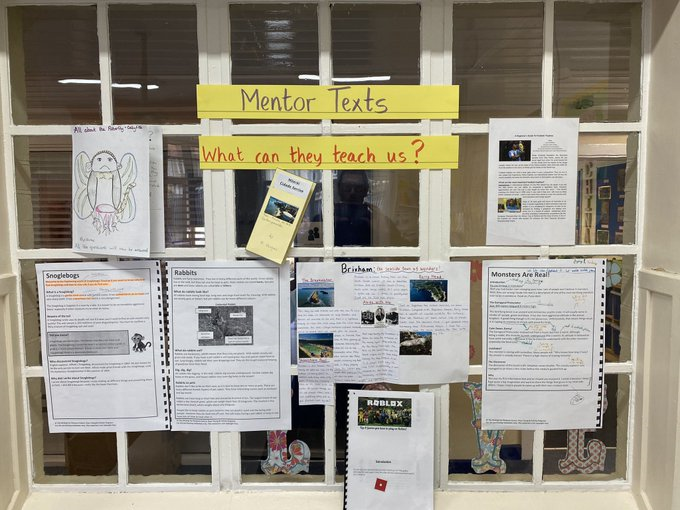
Here we can see the variety of mentor texts which have been discussed and studied as part of an information text class writing project. The class have studied other children’s successful texts from previous years, commercially published texts which match the kind of writing the children are expected to make, and their teacher’s own exemplar text.
Genre-study is a significantly effective teaching practice (Graham and Perin 2007; Purcell-Gates et al. 2007; Rose 2008; Graham et al. 2012 Olinghouse et al. 2015; Koster et al. 2015; Young & Ferguson 2021a). Writers learn about writing by studying the texts of their heroes. These can be called mentor texts. If I asked you to write a film review and you’d never written one before, I suspect your first thought would be to read a few. The same is true in our writing classrooms. We want teachers and children to study the kind of writing they are about to embark on in their class writing project. These texts need to match the kind of writing you’re expecting children to make themselves. If children are writing short information texts, read short information texts. If you’re writing poetry, read poetry. As you’re discussing and studying these mentor texts, you need to make a list of ‘product goals’ (Young & Ferguson 2020, 2021a, 2021g). These are the things you’re going to try and do to write ‘the best texts in the whole entire world ever…’
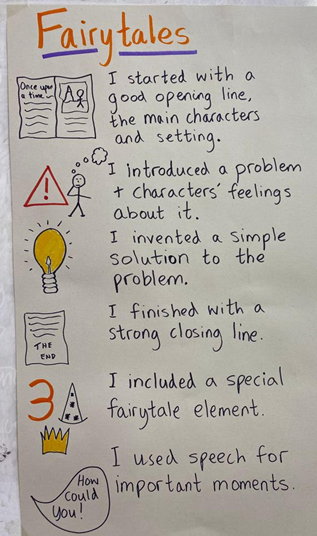
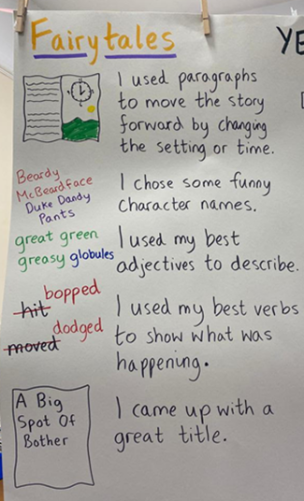
For example:
Here we can see a list of product goals children and their teacher have identified whilst discussing and studying a variety of fairytale mentor texts. These will inform the teacher’s future writing lessons.
Teach writing composition strategies through modelling and supported practice: Pursue purposeful and authentic writing projects
It’s great to see the EEF acknowledge that writing is a cognitively demanding activity which requires children to engage in daily practice which is meaningful, motivating and engaging; writing that is orientated towards writing for purpose and genuine audiences.‘Consideration of purpose and audience can support effective writing. Like adults, children may benefit from having a reason to write and someone to write for’ (p.31).
Being moved to write The EEF suggests that there are four purposes for writing: to describe, to narrate, to inform and to persuade. Readers might find it interesting to know that our curriculum and resources are developed around the idea that there are six common reasons we are moved to write. These include:
One way to get the children to reflect on their own writing and ideas is to ask them to think about: Why do writers write? They can then also reflect on why they write, what they like writing about and the purpose behind their writing and other writers’ writing. You can create a poster for your class or the children can create and generate ideas in their books. When I taught this lesson, it was good to have the display that the children had created because we kept referring to it, during conferencing and other writing lessons. They knew and could readily tell me why they were writing, with a definite increase in confidence and motivation.
We want writing in classrooms to match (as closely as possible) the reasons people are moved to write out in the world. This is what purposeful and authentic writing is all about. Class writing projects should therefore be written for an audience beyond just teacher evaluation. Children’s writing should find its way into people’s hands, into their ears and across their screens. We make this recommendation not only for its affective and motivational benefits but also because it helps children write higher-quality texts (Boscolo & Gelati 2019; Bruning & Horn 2000; Gadd & Parr 2016; Hickey 2003; Young & Ferguson 2021a). However, teachers can often struggle to plan authentic writing projects. This is why we provide a host of example projects on our website for teachers to download and use. Teachers could also consider how they can adapt their existing projects to make them more authentic. For example:
Less authentic
could become
More authentic
Writing x30 pseudo-authentic letters to a collection of chairs which have left the classroom, asking them to return Or Writing x30 pseudo-authentic letters as an evacuee in World War 2
could become
Writing a letter to someone you admire. [LINK]Writing a letter to the editor of a local newspaper about an issue of concern. [LINK]Writing a letter to someone in the family or community with a little power or influence, making a request for change. [LINK]
Writing x30 pseudo-authentic newspaper articles about the discovery of Tutankhamun’s tomb Or Write x30 pseudo reports about a spaceship landing in the playground
could become
Writing a class newspaper full of different articles, opinion pieces and features.Writing advocacy journalism articles about local charities. [LINK]
Writing x30 pseudo diary entries as the Iron Man
could become
Writing a personal memoir to share with family and friends. [LINK]
Writing x30 copies of pseudo instructions for a robot to make a jam sandwich
could become
Writing some instructions on how to do something you’re really good at so you can teach others. [LINK]
Writing x30 copies of Queen Victoria’s biography
could become
Writing x30 different biographies of people in your families or the local community. [LINK]
Each child turning a video they’ve watched into a playscript they never get to perform
could become
x30 short sketches which could be swapped with other classes. Children could then be invited to perform them for one another.
Writing x30 copies of the same story idea for teacher evaluation
could become
Writing x30 different stories as an anthology to go in the waiting room of the local doctor’s surgery. [LINK]Writing x30 different picture books for the class libraries in KS1. [LINK]
Writing x30 pseudo information texts about a made-up animal
could become
x30 different information texts on something they are knowledgeable and passionate about. These information texts could be put together to create a class encyclopaedia of knowledge. [LINK]
Writing x30 reports of the same science experiment
could become
Writing a variety of reports in response to different scientific inquiries and questions children wanted to find an answer to. [LINK]
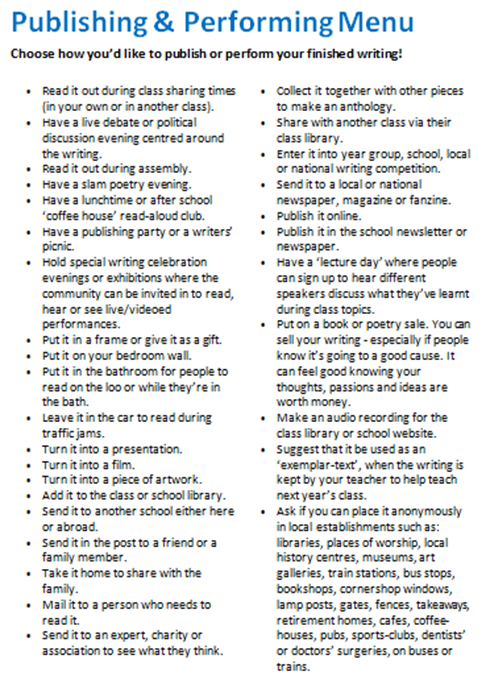
Alternatively, a class (teacher and pupils together) can identify a genuine purpose and audience for any class writing project themselves by using our Publishing And Performance Menu.
Choose something delicious from the publishing menu
Publishing is like stuffing a note into a bottle and hurling it into the sea. Some bottles drown, some come safe to land, where the notes are read and then possibly cherished, or else misinterpreted, or else understood all too well by those who hate the message – Margaret Atwood
At the beginning of a new class writing project, I always give out what I call my ‘publishing menu’. It’s a place where children can see all the different options for where our writing could go when we publish at the end of the project. We talk about the menu options. We discuss their pros and cons. This kind of discussion inevitably leads to us talking about the possible audience for our writing too.
By the end of this lesson, we will have chosen from the menu where our writing will end up. This publishing menu can be found in any of our class writing project resources. However, I can highly recommend making your own – and ask your class what they think could go on the menu too. Children have great ideas about where their writing can end up.
Finally, the EEF rightly points out that ‘combining reading and writing instruction can support children’s development in both’ (p.31). However, we need to be careful. This is what we currently know, from educational research and from case-studies of exceptional writing teachers, about the interconnections between writing and reading in the classroom:
When young writers read, ideas for writing occur.
Children learn much about the craft of writing and develop an ‘inner ear’ for language if they are given regular, sustained and wide opportunities to read.
Children who read and listen to high-quality texts include more literary features and write better texts.
Children who read poetry include more imagery and other poetic devices in their own writing.
Young writers often develop strong affective bonds with the things they have read and use aspects of these texts in their own writing.
Children who write in response to the texts they have read significantly enhance their comprehension of those texts.
Children having ample time to read is fundamental to their writing development.
Developing children’s language capabilities: Pupil-conferencing
Pupil-conferencing is one of the principles of world-class writing teaching (Young & Ferguson 2021a). We therefore welcome the EEF’s recommendation that schools ‘design a school feedback policy that prioritises and exemplifies the principles of effective feedback’ (p.34). This is because it gives pupils and teachers an opportunity to engage in quality talk. We see aspects of good pupil-conferencing shared in the EEF’s report too. For example:
Teachers can increase the quantity and quality of classroom talk by:
– asking open questions, such as questions that require pupils to explain, reason, or argue; – probing with follow-up questions that require pupils to expand on their answers; – building on pupils’ responses to move the dialogue forward; – encouraging pupils to ask their own questions; – ensuring every pupil has opportunities to articulate their ideas and be listened to. EEF p.13
Developing children’s language capabilities: Read, share, think and talk about writing
We know that writing and being a writer is a personal and intensely social undertaking which is both cognitive and emotive. One of the principles of world-class writing teaching is to ensure that children read, share, think and talk about their writing. We ensure that children learn that they can articulate and develop their ideas with their peers prior to writing them down.
You can read about how Writing For Pleasure teachers have created a classroom culture that encourages dialogue by reading the examples of practice below:
You can read about how Benjamin Harris incorporates opportunities for dialogue into daily writing sessions through the Author’s Chair [LINK].
You can read and listen to how writer-teacher Sadie Phillips taught her children to peer-conference [LINK].
You can read about how Tobias Hayden talks with his class about what writing instruction they feel they need most [LINK].
You can also read our article about how to develop children’s talk for writing [LINK].
Developing children’s language capabilities: Expanding pupils’ vocabulary
Explicitly teaching and modelling strategies writers use to consider their word choices is an important part of receiving a well-rounded writerly apprenticeship. There are a number of mini-lesson designed to help establish good habits when it comes to considering vocabulary in the Word Choices section of our BIG book of mini-lessons. For example:
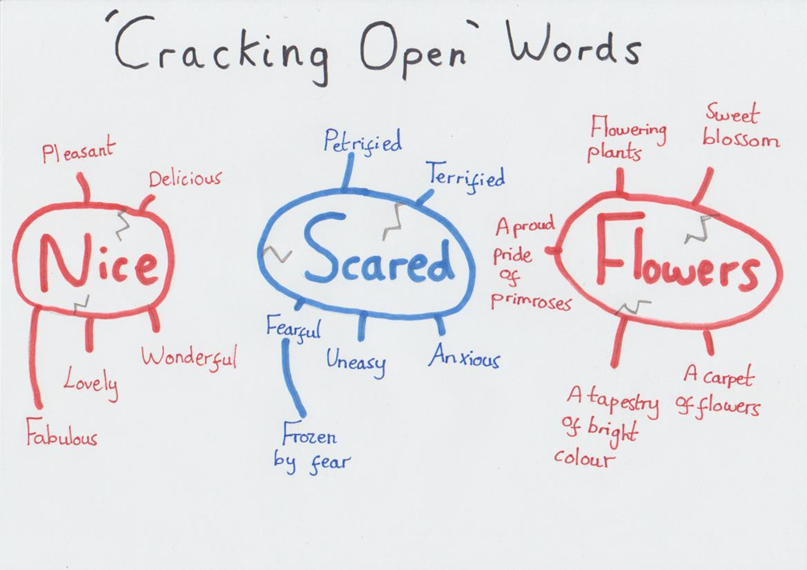
‘Cracking open’ boring words
We all do it. In our excitement to get our thoughts down, we will write the words that come to mind immediately. This is fine and is a good way of drafting fluently. However, it is always worth revising your draft afterwards to notice just how often you may be using the same words. Sometimes I use my Roget’s Thesaurus of English Words & Phrases to help me, but online thesauruses are excellent too. Otherwise, I will ‘crack open’ the word by drawing a circle around it and writing alternatives.
The best thing to do with this lesson is to show children how you have used this technique yourself in your writer’s notebook. You can explain how you went about it and answer any of the children’s questions. You can then invite your young writers to have a go for themselves in their own writing that day. This lesson is most effective when the majority of your class are revising their pieces. Taken from Young et al. 2021
Teaching spelling and recognising types of spelling error
We recognise the EEF’s frustrations at the lack of high quality evidence about how to teach spelling, but agree that the evidence we do have points towards spelling being actively taught rather than simply tested (Adoniou 2014; Alves et al. 2019; Young & Ferguson 2022).
Harold Rosen once famously said to Donald Graves that any idiot can tell a genius they’ve made a spelling mistake (Graves 1983 p.188). We are sure there are many who have experienced ridicule or been made to feel unintelligent simply because they were unable to spell conventionally. Unfortunately, these negative views still persist in society and have serious long-term consequences for an individual’s confidence and desire to write.
Ways in which teachers can improve children’s spelling include:
Prolific opportunities to write.
Prolific opportunities and time to read.
Explicit instruction in how to proof-read.
Explicit spelling instruction. It is suggested that children be exposed to a balanced approach to instruction which includes teaching phonology, morphology, orthography and etymology in combination and at the earliest of stages.
At The Writing For Pleasure Centre we’ve recognised the need to take sentence-level instruction seriously and to teach children about sentences in a way that helps them write what they mean. We know that formal grammar instruction has always had a negative impact on children’s writing development (Kolln 1996; Fearn & Farnan 1998; Andrews et al. 2006; Weaver et al. 2006; Wyse & Torgerson 2017; Hudson 2017; Myhill 2018; Young & Ferguson 2021). However, like the EEF, the types of sentence-combining instruction suggested within the pages of our Sentence-Level Instruction Mini-Book are far more promising (Keen 2004; Graham & Perin 2007; Limpo & Alves 2013; Saddler 2019; Walter et al. 2021; Young & Ferguson 2020). We believe work around sentences should be in the service of developing children’s style as writers. We describe sentence-level instruction, and by extension instruction on style, as being about helping children:
Share their writing voice and identity.
Achieve the purpose they have for their writing.
Write with clarity and simplicity.
Develop, elaborate on and embellish their initial ideas.
Our mini-book breaks this instruction down into three categories:
Focused sentences
Balanced sentences
Developed sentences
Target teaching and support by accurately assessing pupil needs
Formative assessment can be integrated into classroom teaching strategies to help ensure that pupil needs are identified and teaching is appropriately targeted. Formative assessment involves eliciting evidence of learning from pupils on an ongoing basis and adapting teaching to meet pupils’ needs. EEF p.39
The Writing For Pleasure Centre’s Writing Development Scales And Assessment Toolkit is written predominantly to support our affiliate schools who pursue the principles of Writing For Pleasure. Assessment is at its most powerful, and most useful, when it is aligned to a school’s curriculum and what teachers and students are doing in class every single day. However, we believe any school can use this material if they appreciate the need for children to:
Receive direct and explicit instruction in the craft of writing every day (Young et al. 2021; Young & Ferguson 2021d; Young & Ferguson 2021e).
Be given an opportunity to write meaningfully and for a sustained period every day (Young & Ferguson 2020, 2022).
Receive additional responsive teaching through daily pupil conferencing (Ferguson & Young 2021).
Develop their artistry, narrative, opinion and non-fiction writing over time (Young & Ferguson 2020, 2022).
We also need to look at the principles of assessment. For example, our toolkit is as much about assessment-based responsive instruction as it is about assessment itself. Assessment isn’t about data. Data has never helped a child write better. Assessment is about obtaining valuable information to make your teaching more effective and efficient. Assessment-based instruction is about:
Children finding out what makes a piece of writing successful and meaningful.
Children being involved in setting writing goals for class projects.
Teachers providing daily writing lessons that are responsive to what their class needs instruction in most (Young et al. 2021; Young & Ferguson 2021d; Young & Ferguson 2021e).
Teachers providing individualised feedback, through pupil-conferencing, that is responsive to what their pupils need instruction in most (Ferguson & Young 2021).
Children crafting their writing because they have an emotional investment in it being the best it can be (Young & Ferguson 2021a).
What next?
Is there a moral purpose to teaching writing? At The Writing For Pleasure Centre, we believe children should know how to successfully live a writer’s life after leaving school. We want them to write well for educational purposes (to pass exams and to share what they know with skill and precision). We also hope they would know how to live the writer’s life for economic reasons (the ability to write with authority, daring and originality is great currency). We hope they could live the writer’s life for political or civic reasons – sharing their knowledge and opinions with clarity and imagination. We also hope they would write for personal reasons – as an act of reflection or recording. Finally, we would want them to know how to write for reasons of pure pleasure and recreation – feeling a sense of joy and accomplishment in sharing their artistry, identity and knowledge with others in ways that are profound and confident.
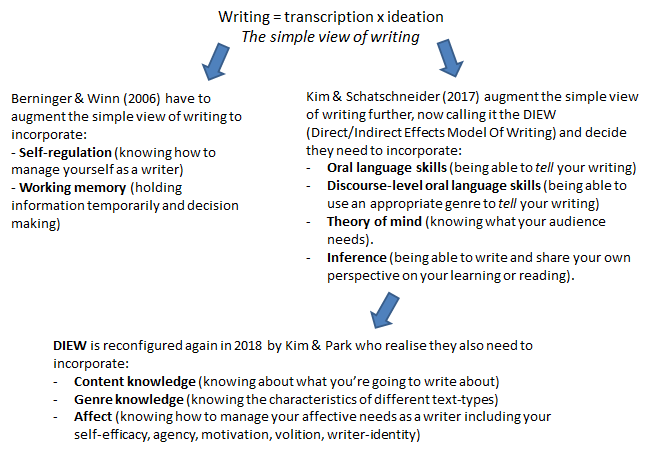
The thing that’s disappointing about the EEF’s guidance report is its lack of a clear vision of what writing is and what being a writer should mean. As we have said, writing and being a writer is personal and intensely social, and is both a cognitive and emotive undertaking (Young & Ferguson 2021a). However, the EEF’s report draws heavily on a theoretical framework which fails to fully appreciate this. The model used to influence the report was originally called The Simple View Of Writing. This view of writing is now outdated and has required repeated revisions in recent years. Academics have recently noted how The Simple View Of Writing leaves out major aspects of how children develop as writers.
The simple view originally suggested that writing is made up of only two components: ideation and transcription (Juel, Griffith, & Gough 1986; Berninger et al. 2003) and later a third component of ‘executive function’ was added in 2006 (Beringer & Winn 2006). One problem with this framework is that it treats writing as a simple marriage between transcription and ideation, when really it involves numerous highly interconnected components. Another issue is that interpretations of this theoretical framework regularly result in flawed pedagogical recommendations being suggested and adopted by policy-makers, commercial providers and teachers, namely in the form of a ‘presentational skills’ orientation towards writing teaching (Young & Ferguson 2021a). Thankfully, we don’t believe this is the case with the EEF’s report. Finally, despite The Simple View Of Writing influencing policy and practice for many decades, we still see profound underachievement in writing across England where it has been highly influential. This underachievement is rightly recognised as a major issue in Professor Francis’ forward to the EEF’s report. As we’ve said, the Simple View Of Writing cited in the EEF’s report has since been revised and its limitations highlighted. Below, we provide references to the latest thinking around The Simple View Of Writing for people’s interest. However, whilst these revisions are making the framework better all the time, they are, in our view, still limiting and incomplete.
Kim, Y., Schatschneider, C. (2017) Expanding the developmental models of writing: A direct and indirect effects model of developmental writing (DIEW) Journal of Educational Psychology 109(1) 35-50
Kim, Y,. & Park, S. (2019) Unpacking pathways using the direct and indirect effects model of writing (DIEW) and the contributions of higher order cognitive skills to writing Reading and Writing: An Interdisciplinary Journal, 32, pp.1319–1343
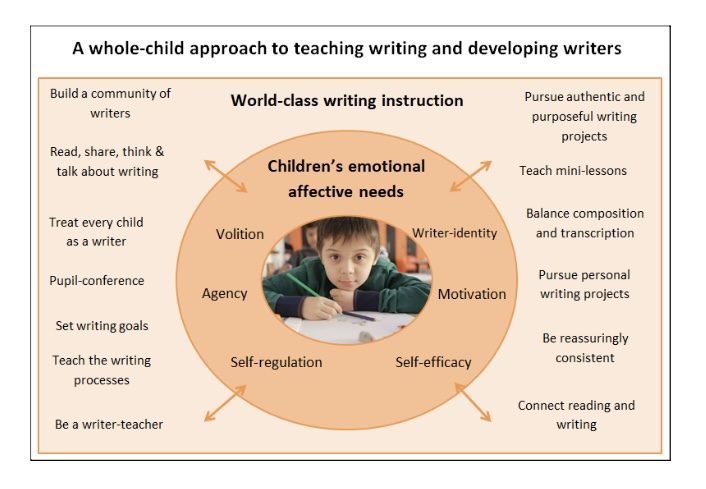
This isn’t just a problem for the EEF. The Writing For Pleasure Centre is also in the process of trying to devise an alternative conceptual framework which can better encapsulate what it means to develop children’s writing and themselves as writers. There is no doubt teachers and commercial providers need an alternative framework which can fully acknowledge the complex social, cognitive and emotive nature of writing and being a writer, alongside pedagogical and instructional recommendations that centre around helping children write the most accomplished texts that they can. Our early work suggests a need for us to move towards a ‘whole-child’ approach. Please note that our use of the phrase ‘whole-child’ shouldn’t be confused with a child-centered or naturalistic approach to writing teaching. As we’ve already discussed in previous writing, this would not be our recommendation (Young & Ferguson 2021a).
A whole-child approach to teaching writing and developing writers. Adapted from Young & Ferguson (2021a)
Ross Young & Felicity Ferguson
References
Adoniou, M. (2014).What should teachers know about spelling Literacy, 48(3), 144–153.
Alves, R., Limpo, T., Salas, N., and Joshi, R. (2019). Handwriting and spelling. In Best Practices in Writing Instruction, Graham, S., MacArthur, C., and Hebert, M. (Eds.) (3rd Ed.) (pp.211–240). New York: Guilford Press.
Andrews, R.,Torgerson, C., Beverton, S., Locke,T., Low, G., Robinson, A., and Zhu, D. (2006). The effect of grammar teaching on writing development. British Educational Research Journal, 32(1), 39–55.
Behizadeh, N. (2014). Xavier’s take on authentic writing: Structuring choices for expression and impact. Journal of Adolescent & Adult Literacy, 58(4), 289–298.
Behizadeh, N. (2018). Aiming for authenticity: Successes and struggles of an attempt to increase authenticity in writing. Journal of Adolescent & Adult Literacy, 62(4), 411–419.
Berninger, V., Amtmann, D. (2003) Preventing written expression disabilities through early and continuing assessment and intervention for handwriting and/or spelling problems: Research into practice. In: Swanson, H.Harris, K., Graham, S., Eds. Handbook of Learning Disabilities New York: The Guilford Press (p.323-344)
Berninger, VW., Winn, WD. (2006) Implications of advancements in brain research and technology for writing development, writing instruction, and educational evolution. In: MacArthur, C.Graham, S., Fitzgerald, J., editors. Handbook of writing research New York: Guilford (p.96-114)
Boscolo, P., and Gelati, C. (2019). Motivating Writers. In Best Practices in Writing Instruction, Graham, S., MacArthur, C., and Hebert, M. (Eds.) (3rd Ed.) (pp. 51–78). New York:The Guilford Press.
Bruning, R., and Horn, C. (2000). Developing motivation to write. Educational Psychologist, 35(1), 25–37.
Dahl, K., Freppon, P. (1995) A Comparison of Innercity Children’s Interpretations of Reading and Writing Instruction in the Early Grades in Skills-Based and Whole Language Classrooms Reading Research Quarterly 30(1) pp.50-74
Fearn, L., and Farman, N. (1998). Writing Effectively: Helping Students Master the Conventions of Writing. London: Pearson.
Ferguson, F., Young, R. (2021) A Guide To Pupil-Conferencing With 3-11 Year Olds: Powerful Feedback & Responsive Teaching That Changes Writers Brighton: The Writing For Pleasure Centre
Fletcher, A. (2016). Exceeding expectations: Scaffolding agentic engagement through assessment as learning. Educational Research, 58(4), 400–419.
Flint, A.S., and Fisher,T. (2014).Writing their worlds:Young english language learners navigate writing workshop. In Writing & Pedagogy, 6(3), 1756–5839.
Gadd, M., and Parr, J. (2016). It’s all about Baxter:Task orientation in the effective teaching of writing. Literacy, 50(2), 93–99.
Graham, S. (2006). Strategy instruction and the teaching of writing:A meta-analysis. In Handbook of Writing Research, McArthur, C., Graham, S., and Fitzgerald, J. (Eds.) (pp. 187–207). New York: Guilford Press.
Graham, S., and Perin, D. (2007). Writing Next: Effective Strategies to Improve Writing of Adolescents In Middle School & High Schools.Washington, DC:Alliance For Excellent Education
Graham, S., Bollinger, A., Booth Olson, C., D’Aoust, C., MacArthur, C., McCutchen, D., Olinghouse, N. (2012) Teaching elementary school students to be effective writers: A practice guide (NCEE 2012–4058). Washington, DC: National Center for Education Evaluation and Regional Assistance, Institute of Education Sciences, U.S. Department of Education
Harmey, S. (2020). Co-constructing writing: handing over the reins to young authors. Education 3-13, 3–11.
Heller, M. (1999). Reading-Writing Connections: From Theory to Practice. Mahwah, NJ: Lawrence Erlbaum Associates.
Hickey, D.T. (2003). Engaged participation versus marginal nonparticipation: A stridently sociocultural approach to achievement motivation. The Elementary School Journal, 103(4), 401–429.
Hudson, R. (2017). Grammar instruction. In Handbook of Writing Research, MacArthur, C., Graham, S., Fitzgerald, J. (Eds.) (pp. 288–300) (2nd Ed.). New York: Guildford Press.
Juel C, Griffith PL, Gough PB. (1986) Acquisition of literacy: A longitudinal study of children in first and second grade Journal of Educational Psychology (78) pp.243–255.
Kellogg, R. T. (2001). Competition for working memory among writing processes. American Journal of Psychology, 114(2), 175–191.
Kellogg, R. T. (2008). Training writing skills: A cognitive developmental perspective. Journal of Writing Research 1(1), 1–26.
Kolln, M. (1996). Rhetorical grammar: A modification lesson. English Journal, 85(7), 25–31.
Koster, M.,Tribushinina, E., De Jong, P.F., and Van de Bergh, B. (2015).Teaching children to write: A meta-analysis of writing intervention research. Journal of Writing Research, 7(2), 249–274.
Limpo,T., & Alves, R. (2013).Teaching planning or sentence-combining strategies: Effective SRSD interventions at different levels of written composition. Contemporary Educational Psychology, 38,328–341.
Malpique, A., Pino-Pasternak, D., Valcan, D. (2017). Handwriting automaticity and writing instruction in Australian kindergarten: An exploratory study Reading & Writing 30(8) 1789-1812
Malpique, A., Pino-Pasternak, D., Roberto, M. (2020) Writing and reading performance in Year 1 Australian classrooms: associations with handwriting automaticity and writing instruction Reading & Writing 33 pp.783-805
Myhill, D. (2018). Grammar as a meaning-making resource for improving writing (Contribution to a special issue Working on Grammar at School in L1-Education: Empirical Research across Linguistic Regions). L1-Educational Studies Language and Literature, 18, 1–21.
Olinghouse, N., Graham, S., and Gillespie, A. (2015). The relationship of discourse and topic knowledge to fifth graders’ writing performance. Journal of Educational Psychology, 107(2), 391–406.
Puranik, C., AlOtaiba, S. (2012) Examining the contribution of handwriting and spelling to written expression in kindergarten children Read Writ 25:1523-1546
Purcell-Gates,V., Duke, N., and Martineau, J. (2007). Learning to read and write genre-specific text: Roles of authentic experience and explicit teaching. Reading Research Quarterly, 42(1), 8–45.
Roitsch, J., Gumpert, M., Springle, A., Raymer, A. (2021) Writing Instruction for Students with Learning Disabilities: Quality Appraisal of Systematic Reviews and Meta-Analyses, Reading & Writing Quarterly, 37:1, 32-44
Rose, D. (2008).Writing as linguistic mastery:The development of genre-based literacy pedagogy. In Handbook of Writing Development, Myhill, D., Beard, R., Nystrand, M., and Riley, J. (Eds.) (pp. 151–166). London: Sage
Saddler, B. (2019). Sentence combining. In Best Practices in Writing Instruction, Graham, S., MacArthur, C., and Hebert, M. (3rd Ed.) (pp. 240–261). New York: Guildford Press.
Santangelo, T., Graham, S. (2016) A Comprehensive Meta-analysis of Handwriting Instruction Educational Psychology Review 28:225-265
Stein, N. (1983). On the goals, functions, and knowledge of reading and writing. Contemporary Educational Psychology, 8(3),261–292.
Walter, K., Dockrell, J., Connelly, V. (2021) A sentence-combining intervention for struggling writers: response to intervention. Read Writ 34, 1825–1850
Weaver, C., Bush, J., Anderson, J., and Bills, P. (2006). Grammar intertwined throughout the writing process: An inch wide and a mile deep. English Teaching: Practice & Critique, 5(1), 77–101.
Wyse, D., and Torgerson, C. (2017). Experimental trials and ‘what works?’ In education:The case of grammar for writing. British Educational Research Journal, 43(6), 1019–1047.
Young, R., Ferguson, F. (2020) Real-World Writers London: Routledge
Young, R., Ferguson, F. (2021a) Writing For Pleasure London: Routledge
Young, R., Ferguson, F. (2021b) A Quick Guide To Teaching Writing In The EYFS Brighton: The Writing For Pleasure Centre
Young, R., Ferguson, F. (2021c) A Quick Guide To Teaching Writing In KS1 Brighton: The Writing For Pleasure Centre
Young, R., Ferguson, F. (2021d) Grammar Mini-Lessons For 5-11 Year Olds Brighton: The Writing For Pleasure Centre
Young, R., Ferguson, F. (2021e) Sentence-Level Instruction: Lessons That Help Children Find Their Style & Voice For 3-11 Year Olds Brighton: The Writing For Pleasure Centre
Young, R., Ferguson, F. (2021f) A Guide To Personal Writing Projects & Writing Clubs For 3-11 Year Olds Brighton: The Writing For Pleasure Centre
Young, R., Ferguson, F. (2021g) Writing Development & Assessment Toolkit For 3-11 Year Olds Brighton: The Writing For Pleasure Centre
Young, R., Ferguson, F., Hayden, T., Vasques, M. (2021) The Big Book Of Mini-Lessons: Lessons That Teach Powerful Craft Knowledge For 3-11 Year Olds Brighton: The Writing For Pleasure Centre
I invited children to consider things they would like to persuade someone to gift them (a thing, their time or an experience). Careful consideration was given to costs with our focus being on things that are ‘freebies’ as opposed to expensive unattainable items. The design of the lesson was interesting and emerged through a whole class discussion. Children had indicated that they favoured a mini-lesson in this area so we invented it together! I think it worked well, and really forced them to consider the nature of the potential requests they were making.
At the end of the session, I taught the children a technique for helping them to choose the one final idea they wished to take forward called, Let’s rank! We discussed the criteria we wanted to use to simply evaluate each idea and came up with desire (how much we really wanted the change, experience or gift we listed) and likelihood (how likely we were to have our request granted). Pupils collated their favourite ideas from across the two Generating Ideas mini-lessons (Make a change! and Spectrum of a gift) into ‘A top-five list‘. Having done that, we assigned a number of hearts for desire and a number of ticks for likelihood (a maximum of three for each) to help establish which idea should be taken forward.
We’ve given ourselves the weekend to mull over our shortlist and on Monday each of us will make our final choice and begin planning/drafting our letters.
Having spent several days studying the genre and coming up with our product goals (see below), today it was time to start generating some ideas for our letters.
What a range of change!
In this session, using a mini-lesson idea (Make a Change!) from The Big Book Of Writing Mini-lessons, the children generated scores of unique ideas. Here are some of my favourites:
Ideas for changes at home
Have my own TV in my bedroom
Change my bedtime to 8.45pm so I can watch Tracy Beaker: The Next Step
Get a bigger dining table
Be responsible for taking care of the strawberries
Go shopping on my own
Get my own bedroom
Have some of my own TV time
More storage in the house
Visit our house in Peterborough
Go to bed earlier (7pm)
Get more responsibility for jobs around the house (hoovering)
Get rid of the bunk beds
Ideas for changes at school
Have juice in our water bottles
Change the end of the school day to 2.45pm
Be able to choose our desserts
Do more coding lessons
Have a class pet
Get more playground equipment
Play Roblox on the school computers
Watch cartoons while eating our lunch
Have more PE lessons
Change the lunch menu more often
Enter more competitions like the British Library superhero comic one
Come to school by myself
How useful did the children find this mini-lesson?
There were quite mixed reviews for this lesson in terms of its usefulness. Some children found this lesson ‘very useful‘, but several found it to be ‘only a little bit useful‘ or ‘not at all useful‘. The reasons given are insightful. For instance, one girl thought that there were just not many things that she wanted to change at home or school. I should point out though that she still had six of her own ideas for the writing project.
When asked what she wanted a mini-lesson in next, she said, “I don’t know!” This can happen in any writing classroom. I will probably conference with her tomorrow to dig deeper into what she needs. I often ask the children their opinions on the instruction I’m giving them. This way, I can build up a more accurate picture of the collective and individual needs of my pupils.
When we invite children to generate ideas of their own, they develop as writers in profound ways. Missing out this part of the writing process means that children are only ever writing about someone else’s idea. In doing so, we risk alienating children from writing. Far better to give them the strategies and techniques that can support the formulation of their own ideas in a socially sympathetic community of writers. I look forward to seeing which unique idea they each choose to take forward for their persuasive letter.
Why invite your class to make requests and suggestions about their writing lessons? When children are invited to actively participate in how their writing classroom is run, it can improve both their motivation and their writer identity. We know that for children to get the most out of their writing lessons, they need to feel like they have some agency and ownership over what they write and how they write it (Young & Ferguson 2021).
Considering themselves as writers
Last week, I asked my class to think about how they can ‘help me to help them’ by making suggestions and requests for writing lessons. We talked about how the suggestions they make benefit both them and I as fellow writers, as I can build mini lessons, author’s chair sessions and our writing station around their writerly needs.
Spending time considering what might be an appropriate request was important in guiding the class to make manageable suggestions; I didn’t want them to make impractical requests that would potentially need to be denied. In this case, we agreed that all suggestions should be polite, fair, and specific.
This meant that they had already considered what the purpose of an author’s chair session really was and could now think more critically about how they thought that time could be most profitably used. It was interesting to see how, independently of each other, many pupils wanted very similar things from our author’s chair sessions!
The most popular suggestions were:
For me to participate in an Author’s Chair session, so that they could learn more about how to receive feedback from others.
The girl who suggested this said that it would be ‘good to hear what you say when people give you advice.’
For us to have special guests during Author’s Chair, so a wider range of feedback can be heard.
To hold an Author’s Chair session with new audiences – e.g. other classes or year groups.
For us to ensure that Author’s Chair sessions are fair. Some children felt we needed to ensure that a wider range of participants joined in.
This allowed me as a writer-teacher to reflect on my class’ writerly needs. Now that they are building their confidence as writers, they evidently want to share their writing with wider audiences. This was great news.
Suggestions for lessons
Children needed a little more prompting when suggesting mini-lessons to me. I think they are so used to it being me who decides what they need instruction in most. Generally speaking though, their requests fell into two categories:
Mini-lessons on particular writing processes they struggle with. Interestingly, planning seemed to be the most popular request and, incidentally, this is the stage of our Class Writing Project that many of them are currently at!
Mini-lessons related to our current Class Writing Project, Flash Fiction. I could see that they had internalised our product goals for this project, as some of the requests related specifically to how to achieve these.
One boy had recognised from our product goal list that the key moment of our Flash Fiction stories needed to be ‘slowed down’ – he also shared with me that this was something he recognised needing to do in his writing more generally.
From these particular requests, I could tell that my class had developed a strong sense of what our next mini lessons should be in relation to where we were at with our Flash Fiction pieces. However, as well as receiving these more pertinent suggestions, some children made requests that were quite general or not well articulated, revealing their relative inexperience as reflective writers.
Other suggestions
Many children were enthusiastic about the idea of writing competitions, again, informing me that they would like to widen the audiences of their writing.
A few students suggested that we undertake ‘group conferences’, where I work with a small group of them who have a similar need.
Finally, pupils who have developed their own smaller publishing houses for personal projects were keen for opportunities to collaborate with one another.
Moving forward
This mini-lesson allowed me to develop a much greater understanding of my class as writers and what they see as important in writing sessions, namely: the option of sharing their developing pieces with wider audiences regularly and mini-lessons that attend to their most pressing writing needs.
In terms of understanding individual writers, this mini-lesson also gave me the opportunity to see which children were not well-versed in articulating their needs and understanding the bigger picture of our writing projects.