How Important Is Talk For Writing?


Writing floats on a sea of talk – James Britton

How important is the role of talk in childrenโ€™s writing development? Case studies of the best performing writing teachers would argue that it is transformative (Pressley et al. 1997; Medwell et al. 1998; Langer 2001; Gadd & Parr 2017; Young 2019). A childโ€™s writing and their language development mutually benefit when they are invited to craft writing amongst their teacher and peers every single day. Indeed, engaging in daily and meaningful talk and writing is one of the best ways to develop childrenโ€™s language (Mercer et al. 1999; Rojas-Drummond et al. 2008; Green et al. 2008; Parr et al. 2009; Fisher et al. 2010; Dix 2016; Reedy & Bearne 2021).

Encouraging children to talk and collaborate together during writing time is an evidence-based research recommendation (Graham et al. 2012; Grossman et al. 2013; De Smedt & Van Keer 2014) and an opportunity to talk as they write improves childrenโ€™s final written outcomes (McQuitty 2014). For example, children who talk as they write go on to write richer and more sophisticated texts (Wiseman 2003; Vass et al. 2008). This may be because talk gives children more working memory for writing (Latham 2002; Cremin & Myhill 2012; Young & Ferguson 2021) or because talk between children assists them in deciding what to say and how to encode it (Davidson 2007; Whittick 2020).

A classroom rich in talk, where children are encouraged to tell others about events in their own lives, the knowledge they bring into school, and the imaginative ideas their minds conjure up is the foundation of any high-quality writing program (Lamme et al. 2002; Tolentino 2013; Daniels 2014; Rowe 2018; Young & Ferguson 2020, 2021). Your class can have more stories and ideas for writing than youโ€™ll ever know what to do with as long as youโ€™re willing to give time for talking and sharing. Children regularly rely on talk for guidance, a model, expertise, assistance, and instruction (Wohlwend 2008; Kissel 2009). This isnโ€™t a negative thing as it shows childrenโ€™s commitment to being independent through whatโ€™s called co-regulation (Young & Ferguson 2021).

Children talk their texts into being. Talk is vital at all parts of a young writerโ€™s process. Firstly, talking with peers helps children generate ideas for what it is they want to write about. Talk also supports pupils to plan what it is they want to write down. It helps them draft fluently, to revise, and to proofread with a readership in mind. Finally, talk is an opportunity to publish or perform for others (Young & Ferguson 2021).

Children talk with one another before they write, as they write and after they write. These interactions occur in different ways and can include:

Idea explaining Children share what they plan to write about during the session with others.
Idea sharing Children work in pairs or small โ€˜clustersโ€™ to co-construct their own texts together.
Idea spreading One pupil mentions an idea to their group. Children then leapfrog on the idea and create their own texts in response too.
Supplementary ideas Children hear about a childโ€™s idea, like it, and incorporate it into the text they are already writing.
Communal text rehearsal Children say out loud what they are about to write – others listen in, comment, offer support or give feedback.
Personal text rehearsal Children talk to themselves about what they are about to write down. This may include encoding individual words aloud. Other children might listen in, comment, offer support or give feedback.
Text checking Children tell or read back what theyโ€™ve written so far and others listen in, comment, offer support or give feedback.
Performance Children share their texts with each other as an act of celebration and publication. 

(Young & Ferguson in press)

Through our own talk with pupils during writing time, we teach children how to respond to otherโ€™s writing, ask questions, and how to give advice and instruction. Children begin to copy us. By hearing and participating in pupil-conferences, children become sociable and knowledgeable writer-teachers too (Ferguson & Young 2021).

This article looks to highlight the importance of talk in writing. Children can write all the words they can say. However, if we put words in childrenโ€™s mouths, they end up not as writers but reciters. Duplicators of someone elseโ€™s voice. If we want to develop childrenโ€™s language and writing alongside each other, we must give them time to talk and write together everyday. We must keep in mind that dictating and reciting texts isnโ€™t talking or writing. Dictation and recitation are practices associated with a presentational-skills (Young & Ferguson 2021) or โ€˜writing readinessโ€™ (Young 2021) ideology towards early writing development. Both of which are fundamentally flawed.

Neither scientific research nor the case studies of the best performing writing teachers recommend the slavish and repetitive learning of a text. Itโ€™s not in childrenโ€™s best interests to spend their time engaged in long-winded โ€˜barking out of a textโ€™. Instead, we must put talk and language development where it belongs – at the heart of the writing process.

References

  • Cremin,T., and Myhill, D. (2012) Creating Communities of Writers London: Routledge.
  • Daniels, K., (2014) Cultural agents creating texts: a collaborative space adventure Literacy 48(2) pp.103-111
  • Davidson, C. (2007). Independent writing in current approaches to writing instruction: What have we overlooked? English Teaching: Practice and Critique, 6, 11โ€“24
  • De Smedt, F., and Van Keer, H. (2014). A research synthesis on effective writing instruction in primary education. Procedia Social and Behavioral Sciences, 112, 693โ€“701.
  • Dix, S. (2016).Teaching writing:A multilayered participatory scaffolding practice. Literacy, 50(1), 23โ€“31.
  • Ferguson, F., Young, R. (2021) Pupil-conferencing With 3-11 Year Olds: Powerful Feedback & Responsive Teaching That Changes Writers [https://writing4pleasure.com/a-guide-to-pupil-conferencing-with-3-11-year-olds/]
  • Fisher, R., Myhill, D., Jones, S., and Larkin, S. (2010) Using Talk to Support Writing. London: Sage.
  • Gadd, M., and Parr, J. (2017). Practices of effective writing teachers. Reading & Writing 30(6), 1551โ€“1574.
  • Graham, S., Bollinger, A., Booth Olson, C., Dโ€™Aoust, C., MacArthur, C., McCutchen, D., Olinghouse, N. (2012) Teaching elementary school students to be effective writers: A practiceย  guide (NCEE 2012โ€“4058). Washington, DC: National Center for Education Evaluation and Regional Assistance, Institute of Education Sciences, U.S. Department of Education
  • Green, J., Yeager, B., and Castanheira, M. (2008). Talking texts into being: On the social construction of everyday life and academic knowledge in the classroom. In Exploring Talk in School: Inspired by the Work of Douglas Barnes, Mercer, N., and Hodgkinson, S. (Eds.) (pp. 115โ€“130). London: Sage.
  • Grossman, P.L., Loeb, S., Cohen, J., and Wyckoff, J. (2013). Measure for measure:The relationship between measures of instructional practice in middle school English language arts and teachersโ€™ value-added scores. American Journal of Education, 119(3), 445โ€“470.
  • Kissel, B. (2009) Beyond the Page: Peers Influence Pre-Kindergarten Writing through Image, Movement, and Talk, Childhood Education 85:3 pp.160-166
  • Langer, J.A. (2001). Beating the odds:Teaching middle and high school students to read and write well. American Educational Research Journal, 38(4), 837โ€“880.
  • Lamme, L., Fu, D., Johnson, J., Savage, D. (2002). Helping kindergarten children move towards independence. Early Childhood Education Journal, 30(2), 73-79.
  • Latham, D. (2002) How children learn to write: Supporting and developing childrenโ€™s writing in schools London: Paul Chapman
  • McQuitty, V. (2014) Process-oriented writing instruction in elementary classrooms: Evidence of effective practices from the research literature. Writing & Pedagogy, 6(3), 467โ€“495
  • Medwell, J., Wray, D., Poulson, L., and Fox, R. (1998). Effective Teachers of Literacy. A Report Commissioned by the UK Teacher Training Agency.
  • Mercer, N.,Wegerif, R., and Dawes, L. (1999). Children’s talk and the development of reasoning in the classroom. British Educational Research Journal, 25, 95โ€“111.
  • Parr, J., Jesson, J., and McNaughton, S. (2009). Agency and platform:The relationships between talk and writing. In The SAGE Handbook of Writing Development. London: Sage.
  • Pressley, M.,Yokoi, L., Rankin, J.,Wharton-McDonald, R., and Mistretta, J. (1997). A survey of the instructional practices of grade 5 teachers nominated as effective in promoting literacy. Scientific Studies of Reading, 1(2), 145โ€“160.
  • Reedy, D., Bearne, E. (2021) Talk for teaching and learning: the dialogic classroom Leicester: UKLA
  • Rojas-Drummond, S.M.,Albarrโ€™an, C.D., and Littleton, K.S. (2008). Collaboration, creativity and the co-construction of oral and written texts. Thinking Skills and Creativity, 3(3), 177โ€“191.
  • Rowe, D. (2008) The Social Construction of Intentionality: Two-Year-Olds’ and Adults’ Participation at a Preschool Writing Center Research in the Teaching of English 42(4) pp.387-434
  • Tolentino, E. (2013) “Put an explanation point to make it louder”: Uncovering Emergent Writing Revelations through Talk Language Arts 91(1) 10-22
  • Vass, E., Littleton, K., Miell, D., Jones, A. (2008) The discourse of collaborative creative writing: Peer collaboration as a context for mutual inspiration Thinking Skills and Creativity pp.192-202
  • Whittick, L. (2020) Write a little – share a little [Online].Available: [https://writing4pleasure.com/write-a-little-share-a-little/]
  • Wiseman, A. (2003) Collaboration, Initiation, and Rejection: The Social Construction of Stories in a Kindergarten Class The Reading Teacher 56(8) pp.802-810
  • Wohlwend, K. (2008) From โ€œWhat Did I Write?โ€ to โ€œIs this Right?โ€: Intention, Convention, and Accountability in Early Literacy, The New Educator, 4:1, 43-63
  • Young, R. (2019). What is it โ€˜Writing For Pleasureโ€™ teachers do that makes the difference? The University Of Sussex:The Goldsmithsโ€™ Company [Online] Available: http://www.writing4pleasure.com.
  • Young, R., Ferguson, F. (2020) Real-World Writers: A Handbook For Teaching Writing With 7-11 Year Olds London: Routledge
  • Young, R., Ferguson, F. (2021) Writing For Pleasure: Theory, Research & Practice London: Routledge
  • Young, R., Ferguson, F. (in press) Real-World Writers: A Handbook For Teaching Writing With 3-7 Year Olds
  • Cremin,T., and Myhill, D. (2012) Creating Communities of Writers London: Routledge.
  • Daniels, K., (2014) Cultural agents creating texts: a collaborative space adventure Literacy 48(2) pp.103-111
  • Davidson, C. (2007). Independent writing in current approaches to writing instruction: What have we overlooked? English Teaching: Practice and Critique, 6, 11โ€“24
  • De Smedt, F., and Van Keer, H. (2014). A research synthesis on effective writing instruction in primary education. Procedia Social and Behavioral Sciences, 112, 693โ€“701.
  • Dix, S. (2016).Teaching writing:A multilayered participatory scaffolding practice. Literacy, 50(1), 23โ€“31.
  • Ferguson, F., Young, R. (2021) Pupil-conferencing With 3-11 Year Olds: Powerful Feedback & Responsive Teaching That Changes Writers [https://writing4pleasure.com/a-guide-to-pupil-conferencing-with-3-11-year-olds/]
  • Fisher, R., Myhill, D., Jones, S., and Larkin, S. (2010) Using Talk to Support Writing. London: Sage.
  • Gadd, M., and Parr, J. (2017). Practices of effective writing teachers. Reading & Writing 30(6), 1551โ€“1574.
  • Graham, S., Bollinger, A., Booth Olson, C., Dโ€™Aoust, C., MacArthur, C., McCutchen, D., Olinghouse, N. (2012) Teaching elementary school students to be effective writers: A practiceย  guide (NCEE 2012โ€“4058). Washington, DC: National Center for Education Evaluation and Regional Assistance, Institute of Education Sciences, U.S. Department of Education
  • Green, J., Yeager, B., and Castanheira, M. (2008). Talking texts into being: On the social construction of everyday life and academic knowledge in the classroom. In Exploring Talk in School: Inspired by the Work of Douglas Barnes, Mercer, N., and Hodgkinson, S. (Eds.) (pp. 115โ€“130). London: Sage.
  • Grossman, P.L., Loeb, S., Cohen, J., and Wyckoff, J. (2013). Measure for measure:The relationship between measures of instructional practice in middle school English language arts and teachersโ€™ value-added scores. American Journal of Education, 119(3), 445โ€“470.
  • Kissel, B. (2009) Beyond the Page: Peers Influence Pre-Kindergarten Writing through Image, Movement, and Talk, Childhood Education 85:3 pp.160-166
  • Langer, J.A. (2001). Beating the odds:Teaching middle and high school students to read and write well. American Educational Research Journal, 38(4), 837โ€“880.
  • Lamme, L., Fu, D., Johnson, J., Savage, D. (2002). Helping kindergarten children move towards independence. Early Childhood Education Journal, 30(2), 73-79.
  • Latham, D. (2002) How children learn to write: Supporting and developing childrenโ€™s writing in schools London: Paul Chapman
  • McQuitty, V. (2014) Process-oriented writing instruction in elementary classrooms: Evidence of effective practices from the research literature. Writing & Pedagogy, 6(3), 467โ€“495
  • Medwell, J., Wray, D., Poulson, L., and Fox, R. (1998). Effective Teachers of Literacy. A Report Commissioned by the UK Teacher Training Agency.
  • Mercer, N.,Wegerif, R., and Dawes, L. (1999). Children’s talk and the development of reasoning in the classroom. British Educational Research Journal, 25, 95โ€“111.
  • Parr, J., Jesson, J., and McNaughton, S. (2009). Agency and platform:The relationships between talk and writing. In The SAGE Handbook of Writing Development. London: Sage.
  • Pressley, M.,Yokoi, L., Rankin, J.,Wharton-McDonald, R., and Mistretta, J. (1997). A survey of the instructional practices of grade 5 teachers nominated as effective in promoting literacy. Scientific Studies of Reading, 1(2), 145โ€“160.
  • Reedy, D., Bearne, E. (2021) Talk for teaching and learning: the dialogic classroom Leicester: UKLA
  • Rojas-Drummond, S.M.,Albarrโ€™an, C.D., and Littleton, K.S. (2008). Collaboration, creativity and the co-construction of oral and written texts. Thinking Skills and Creativity, 3(3), 177โ€“191.
  • Rowe, D. (2008) The Social Construction of Intentionality: Two-Year-Olds’ and Adults’ Participation at a Preschool Writing Center Research in the Teaching of English 42(4) pp.387-434
  • Tolentino, E. (2013) “Put an explanation point to make it louder”: Uncovering Emergent Writing Revelations through Talk Language Arts 91(1) 10-22
  • Vass, E., Littleton, K., Miell, D., Jones, A. (2008) The discourse of collaborative creative writing: Peer collaboration as a context for mutual inspiration Thinking Skills and Creativity pp.192-202
  • Whittick, L. (2020) Write a little – share a little [Online].Available: [https://writing4pleasure.com/write-a-little-share-a-little/]
  • Wiseman, A. (2003) Collaboration, Initiation, and Rejection: The Social Construction of Stories in a Kindergarten Class The Reading Teacher 56(8) pp.802-810
  • Wohlwend, K. (2008) From โ€œWhat Did I Write?โ€ to โ€œIs this Right?โ€: Intention, Convention, and Accountability in Early Literacy, The New Educator, 4:1, 43-63
  • Young, R. (2019). What is it โ€˜Writing For Pleasureโ€™ teachers do that makes the difference? The University Of Sussex:The Goldsmithsโ€™ Company [Online] Available: http://www.writing4pleasure.com.
  • Young, R., Ferguson, F. (2020) Real-World Writers: A Handbook For Teaching Writing With 7-11 Year Olds London: Routledge
  • Young, R., Ferguson, F. (2021) Writing For Pleasure: Theory, Research & Practice London: Routledge
  • Young, R., Ferguson, F. (in press) Real-World Writers: A Handbook For Teaching Writing With 3-7 Year Olds

What do world-class writing teachers do that makes the difference? Seminar presentation UKLA National Conference 2021

What do world-class writing teachers do that makes the difference? Seminar presentation UKLA National Conference 2021

A good place to start talking about Writing For Pleasure is to explain what it actually is. Itโ€™s a phrase and an idea which is open to several different (and quite dissimilar) interpretations, but for us at least it has a very specific meaning. Weโ€™ve obviously written our book about it, called Writing for pleasure: theory research and practice, which explains what it means for us and how it can be realized as what we believe to be a much-needed pedagogy, a pedagogy which we also call โ€˜Writing for Pleasureโ€™.

In our definition, a Writing For Pleasure pedagogy is nothing less than world-class writing teaching. We can say that becauseโ€ฆ When children are taught using world-class writing practices, we know they write for pleasure to a high degree.

So, how do we define world-class writing teaching?ย  When world -class writing teaching is happening, teachers and children together develop strong writer-identities in the classroom. When itโ€™s happening, children feel confident and competent. Itโ€™s happening when children have a strong desire and urge to write. Itโ€™s happening when children feel they have personal control over their writing, and when children are deeply motivated to share their words and so work hard to craft meaningful and successful texts. World-class writing teaching is essentially the kind of teaching in which childrenโ€™s affective needs are being met, when their emotions and feelings are seen as crucially important to their development as writers. When this happens, children go on to achieve exceptionally well academically.

So what gave us the impetus to take up the idea of writing for pleasure, and ultimately write the book?

We know from research carried out in the UK by the National Literacy Trust that, for many years now, there has been a decline in childrenโ€™s enjoyment of writing, and in their motivation to write both in and out of school, with many children expressing indifference to or even an active dislike of writing. In fact, in 2020, the NLT reported that childrenโ€™s enjoyment of writing was at its lowest since records began.

In addition, evidence has shown that too many students in England have been underachieving in writing.. As recently as 2019, for example, it was reported that only one in five children was achieving above the basic level in writing. So we feel confident in concluding that there is a significant link between lack of enjoyment and underachievement in writing.

From our own and othersโ€™ research, we have established that there are more specific connections to be made between childrenโ€™s enjoyment, their achievement and their affective needs, with affective needs at the centre.

It seems that, for a long time, little attention has been paid by educators to the feelings, emotions and attitudes of young apprentice writers. And thereโ€™s no doubt that this negatively impacts on their enjoyment of writing. Children do not develop or see themselves as writers when their affective needs have not been met, and this in turn has a negative influence on their writing achievement. We see this as a really pernicious cycle of cause and effect, and so we were moved to write our book in the hope of taking the first step towards turning this tide of unhappiness and underachievement.ย 

In 2016, when we were still classroom teachers, we started to question our own writing teaching. In the course of our careers we had tried quite a few of the major approaches to writing teaching in our classroom. Weโ€™d tried: The presentational skills approach, The literature-based approach, The genre approach and what is rather appealingly called The naturalistic/romantic approach. Each had its strengths and weaknesses. We decided to focus on the strengths of each orientation and to work to minimize their weaknesses. In the process of doing this we felt we had created a whole new pedagogy. A Writing For pleasure pedagogy. Incidentally, if you want to know more about these various approaches, we describe them all in the first chapter of the book. We think youโ€™d find it very interesting reading, and are sure you would recognize many aspects there of the way in which you were taught writing yourselves.

In the early days, we wrote what we called a Writing for Pleasure Manifesto in which we defined these two types of pleasure. We especially like the second one – Writing for pleasure, the type of pleasure that comes after the act of writing. Knowing youโ€™ll get a response from your audience and that your writing will be put to work – sharing your memories, knowledge, ideas, thoughts, artistry or opinions with others. There can also be pleasure in hearing the meanings others might take from your text. Pleasure can also come from hearing your own writing voice, from knowing you said what you meant to say or from achieving what you meant your reader to feel. Writing for pleasure therefore gives children a sense of empowerment and the feeling that writing has enriched their lives and the lives of others.

So, initially, our main focus was on children writing as pleasure and writing for pleasure. This was because we had read that when children enjoy writing, they are seven times more likely to write above the expected standard than those who donโ€™t. We had also read that children who donโ€™t enjoy writing are eight times more likely to write below the expected standard. So writing for, as and with pleasure seemed massively important.ย 

What we wanted then, of course, was for the children in our class to write for and with enjoyment, and for the satisfaction and pride that comes from producing something significant, successful and meaningful. We also wanted to see if, at the same time, we could achieve exceptional academic progress. We were able to show that, indeed, when children wrote as and for pleasure, their academic performance did improve remarkably.

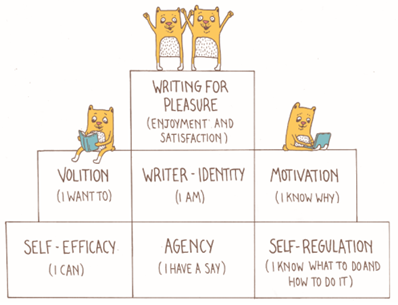
Over time, we deepened our understanding of childrenโ€™s โ€˜affective needsโ€™ and got a better handle on what enjoyment and satisfaction actually mean in the context of a writing classroom. Through our own action-research and from our reading of the research of others, we noted that the following affective domains were repeatedly mentioned as part of the most effective practices. Namely: self-efficacy, self-regulation, agency, motivation, volition and writer-identity. We continued to investigate and use writing practices which had a consistent reputation for attending to these needs, and began to write about it online. Gradually, other teachers began to reveal themselves as Writing For Pleasure teachers too. In 2019, we were given a grant to investigate what these other Writing For Pleasure teachers were doing in their classrooms that was making the difference (the difference being: having a track record of securing exceptional academic progress, with the children loving being writers). The study confirmed that the most exceptional teachers focused their instruction on addressing and developing childrenโ€™s affective needs and these teachers used the most effective writing practices to do it. And finally, we became totally convinced -and remain totally convinced- that, if there isnโ€™t a rich combination of both rigorous instruction in the craft of writing and attention to childrenโ€™s affective needs, children will never become the confident and competent writers we want them to be.ย 

For example, children who are not confident canโ€™t write for pleasure. Children who donโ€™t know what to do or how to do it, canโ€™t write for pleasure. Children who come into school everyday not knowing why they are doing the writing they are doing – canโ€™t write for pleasure. Children who have no ownership or personability over their writing canโ€™t write for pleasure. Children who have no desire to put pen to paper or fingers to keyboard canโ€™t write for pleasure. Finally, children who donโ€™t see themselves as writers simply arenโ€™t writing for pleasure. They are writing for something else and Iโ€™ll leave you to decide what they are writing for…ย ย 

As part of our work, we looked at many research studies, meta-analyses and case studies which described effective writing teaching. These 14 principles of world-class writing teaching emerged from that work.They are what drives a Writing for Pleasure pedagogy, and are what we saw Writing For Pleasure teachers use in their classrooms.The theory, research and practice which underpin each one is given its own dedicated chapter in our book.

What weโ€™ve done in the book is:

  • Begin with an overview and critical reflection of all the major approaches to teaching writing and how aspects of all them inform a Writing For Pleasure pedagogy.
  • Then focus on each of the affective domains and their relationship to effective practice. 
  • Then introduce the enduring principles of world-class writing teaching, and give a detailed exploration of each principle.

 And finally, we have set out an extensive action plan for world-class writing teaching which we want to see gain ground in the UK, but which is as yet a long way from being realised.

We feel that our achievement has been to be the first in the UK to systematically draw together what so much research has been telling us for a long time about the most effective writing teaching practices, and to then use that research to develop the idea of Writing For Pleasure, and to show how, as a pedagogy, it can transform classroom practice in the most positive ways.

As I said at the beginning of this talk, the theory of Writing for Pleasure embodies everything we currently know about what constitutes world-class writing teaching. We donโ€™t know it all yet, and so The Writing For Pleasure Centre will continue to read, observe, investigate, learn and write about it, always with a view to refining and improving our understanding. In the meantime, itโ€™s our great hope that, through dissemination of the principles and practices of Writing for Pleasure, as many children as possible will come to receive world- class teaching and grow as a generation of extraordinary writers. This, after all, is what they deserve.

I thought Iโ€™d end by quoting a short passage from the preface to our book because it encapsulates our most profound beliefs about teaching both the writer and the writing, and also about the human relationships that are a part of doing just that.

Writing For Pleasure is a robust and rigorous pedagogy. It does not advocate for a โ€˜creative writingโ€™ approach, though it encourages children to write creatively. It does not call for a return to a โ€˜growthโ€™, โ€˜naturalisticโ€™, or โ€˜romanticโ€™ conception of writing, though it does want children to grow as writers. It wants children to learn about linguistic and literary features, grammar, and punctuation, but in such a way as to help them craft meaningful and successful texts. It wants children to write in an environment of collective responsibility but also to be able to develop their own individual voice. Finally, it wants children to learn the behaviours, dispositions, knowledge, skills, and techniques of writers, to write with purpose, power, precision, and pleasure, and to write for life. And running beneath it like an underground stream is the conviction that we as teachers should be helping children to see writing not as being directed solely towards a set of efficient outcomes, but as an enterprise in which they can and should express their values, ideals, and aspirations.

ย So, I hope Iโ€™ve shown you what writing for pleasure means in the deepest sense, thatโ€™s to say in our sense, and that youโ€™ll see why as practitioners we simply cannot afford to ignore all its implications for our teaching.

What can we learn from Writing for Pleasure teachers? Primary Matters

For NATE: Primary Matters

Authors Ross Young and Felicity Ferguson share their compelling research, equipping teachers with the knowledge to reshape their teaching of writing in transformative ways and help children become empowered writers who write with purpose, power, precision and pleasure.

What Is It Writing For Pleasure Teachers Do That Makes The Difference? (Young 2019) was a one-year research project funded by The Goldsmithsโ€™ Company and supported by The University Of Sussex which investigated how Writing For Pleasure teachers secured outstanding academic achievement from their pupils whilst also attending to childrenโ€™s affective needs (positive dispositions and feelings towards writing and being writers). This research comes at a time when we are seeing profound underachievement in writing coupled with an increase in young peopleโ€™s indifference to or dislike of writing (Young & Ferguson 2021). It was a requirement that the practices of the teachers participating in the research should be based on what studies tell us are the most effective writing teaching, associated with high levels of pupil motivation, confidence, agency, independence, desire, writer identity, enjoyment, satisfaction and pleasure. Teachers were also required to provide evidence and a track record of exceptional academic progress among their pupils.

From a rich literature review, we were able to identify the fourteen enduring and interconnected principles of world-class writing teaching. These practices have, for a long time, been associated with high levels of student achievement and feelings of pleasure in being a young writer. The literature review was based on:

  • Extensive research into the most effective writing instruction including meta-analyses of multiple studies.
  • Existing case studies of what the best performing teachers of writing do that makes the difference.
  • Research summaries from reputable literacy charities and associations.

So what can we learn from these teachers? Below we share what it was they were doing in their classrooms that was making the difference, including: the creation of a social environment and a positive culture for developing as a writer; high-quality teaching to produce authentic, confident, and independent writers; teachers writing, teaching, and giving feedback as writers, and teachers connecting writing with reading.

The 14 Principles Of World-Class Writing Teaching

  1. Build a community of writers
  2. Treat every child as a writer
  3. Read, share, think and talk about writing
  4. Pursue authentic and purposeful writing projects
  5. Teach the writing processes
  6. Set writing goals
  7. Be reassuringly consistent
  8. Pursue personal writing projects
  9. Balance composition and transcription
  10. Teach daily mini-lessons
  11. Be a writer-teacher
  12. Pupil-conference: meeting children where they are
  13. Literacy for pleasure: connect reading and writing
  14. Interconnect the principles
    (Young & Ferguson 2021)

Create a community of writers

  • Children saw their teachers as extraordinarily positive, caring, strict, fun, calm and interested in their lives and development as writers.
  • Their classrooms felt like a rich mixture of a creative writersโ€™ workshop but also had the sharp focus of a professional publishing house (Young & Ferguson 2020).
  • The teachers supported and encouraged children to bring and use their own โ€˜funds of knowledgeโ€™ into their writing projects, meaning that children could write from a position of strength (Young & Birchill 2021).
  • Classrooms were a shared and democratic space.
  • The children talked of feeling confident and knowing that their teachers wanted them to try their best, take their time and to focus specifically on making their written pieces the highest quality they could be for their future readership.

Treat every child as a writer

  • The teachers held high achievement expectations for all their writers.
  • All children felt like independent writers who were achieving writing goals with regularity. They were praised for the goals they achieved in the writing lesson.
  • The teachers ensured that all their writers remained part of the writing community.

Read, share, think and talk about writing

  • Children were given ample opportunity to share and discuss with others (including their writer-teacher) their own and othersโ€™ writing in order to give and receive constructive criticism, writerly advice and celebrate
    achievement.
  • Writing was seen as a social act, and dialogic talk was important at all stages of the writing process.
  • Children were encouraged to talk about the content of their writing, their writing processes, and to share any techniques or strategies they thought were working particularly well for them.
  • Whilst talk was an integral part of any writing time, so was maintaining a low level of noise to avoid disturbing fellow writers (Whittick 2020).

Purposeful & Authentic Writing Projects

  • Teachers and children together considered the purpose and future audiences for their class writing projects. Because children were given the opportunity to generate their own ideas and had a strong sense of a real reader and a clear distant goal for the writing to be published, the projects were seen as meaningful (The Writing For Pleasure Centre 2021).
  • Agency played an important role within class writing projects. Children were encouraged to either generate their own individual ideas, share and work on ideas in โ€˜clustersโ€™ or, as a whole class, generate an idea that they could all pursue together (Young & Ferguson 2020).
  • It was striking that these teachers were regularly refocusing the children on considering the future readership and publication of their piece throughout their projects (James 2020).
  • Class writing projects were worked on over a number of weeks.

Teach the writing processes

  • Teachers gave direct instruction in strategies for engaging in the different components of the writing process (how to generate an idea, plan, draft, revise, edit, publish). They scaffolded childrenโ€™s understanding of these processes through demonstration, resources, displays, discussion, sharing self-written exemplars and also techniques children had used themselves.
  • Children were made to feel very knowledgeable about the writing process and confident in navigating it on their own. One way in which the teachers showed commitment to helping their children achieve independence was to allow them to develop and use a writing process which suited them best and to write at a pace which enabled them to produce their best writing (Hayden 2020).
  • The children were able to use the writing processes recursively and were not tied to a linear model.

Set writing goals

  • To maintain childrenโ€™s commitment and motivation during a class writing project, teachers ensured that their classes understood the โ€˜distant goalโ€™ for the project, that is to say, its audience and purpose (Hayden & Vasques 2020).
  • The class, as a community, also had a say in setting the โ€˜product goalsโ€™ for their project. This took place in the form of discussions as to what they would have to do, and what it was writers did, to ensure their writing was successful and meaningful in the context of the projectโ€™s aims (Young & Ferguson 2020).
  • The teachers would often share a piece of their own writing, in keeping with the project, to initiate a discussion about writing decisions. The children then used the outcomes of these discussions as an aid to setting product goals for their own writing. The product goals were similar to success criteria, but importantly they also included more overarching goals linked directly to purpose and audience (Ferguson 2020).
  • Product goals were put on display and were repeatedly referred to by the children and the teachers throughout their class writing projects.
  • The teachers set loose โ€˜process goalsโ€™ for writing time to help the class generally stay on track, without forcing children to keep to a certain pace or writing process.

Be reassuringly consistent

  • The teachers showed excellent classroom organisation and behaviour management. There was strong emphasis on routines, promoting self-regulation, expectations and focused collaborative learning among the children.
  • Teachers had a clear routine of mini-lesson (10 to 20 minutes), writing
    time (30-40 minutes) and class sharing/authorโ€™s chair (10-15 minutes)
    (Young & Ferguson 2020).
  • The mini lessons were a short direct instruction on an aspect of writing which was likely to be useful to the children during that dayโ€™s writing. The teachers taught from their own craft, regularly sharing their writing โ€˜tips, tricks and secretsโ€™; alternatively, they would share examples from literature taken from the class library (The Writing For Pleasure Centre 2020).
  • In the class-sharing / authorโ€™s chair session, children would share their developing pieces and discuss with their peers the writing goals they had achieved that day (Harris 2020).

Pursue personal writing projects

  • The teachers understood how essential it is that children are given time to write for a sustained period every day and to work on both class and personal writing projects (Vasques 2020; Hayden & Vasques 2021).

  • Children were given at least one timetabled hour a week to engage in personal writing projects. However, the teachers also encouraged children to pursue personal writing in little pockets of time throughout the week.
  • Children transferred knowledge and skills learnt in class writing projects and used them expertly and successfully in their personal ones.
  • The teachers set up routines where personal writing project books went to and fro between school and home every day. This meant that children could be in a constant state of composition.

Balance composition and transcription

  • The teachers focused on giving direct instruction in the โ€˜generalitiesโ€™ of good writing. They taught writing lessons which would help that day but which would serve children in future writing projects too.
  • They ensured that they taught the right lessons at the right time, with the emphasis on composition at the beginning of a writing project and more focus on teaching good transcriptional techniques and strategies later.
  • The teachers had high expectations for transcriptional accuracy, spelling and handwriting and wanted the children to take pride in their final written products. They encouraged children to concentrate on composing their piece (or part of their piece) before giving full attention to making it transcriptionally accurate.
  • They allocated specific time for children to focus on revising their pieces prior to editing them. Thus, revision and editing had separate and specific status.
  • They also asked children to regularly stop, re-read and share their work with their peers. By re-reading, the children had an opportunity to revise and edit their developing pieces as they were progressing (Whittick 2020).
  • There was a good balance between discussing what the content of the childrenโ€™s writing projects might be, how the writing could be organised to be successful, and the explicit teaching of different writing processes.
  • The teachers were very aware that, if grammar was to be understood in a meaningful way, it must be taught functionally and applied and examined in the context of real composition (The Writing For Pleasure Centre 2020).

Teach daily mini-lessons

  • Children learned numerous strategies and techniques that they could employ independently. They were taught strategies for managing every part of the writing process and they knew how to use them across all class and personal writing projects.
  • Self-regulation strategies and resources were introduced carefully and given dedicated instructional time. In mini-lessons, the teachers would illustrate the benefit of a writing strategy or resource with personal reference to their own experience as a writer, before modelling and encouraging the children to use it that day if possible. The strategies and techniques were offered in the spirit of a fellow writer sharing their own writerly knowledge and their โ€˜tricksโ€™ (Hayden 2020).
  • These teachers made use of their working walls for โ€˜advertisingโ€™ and sharing self-regulation strategies.

Be a writer-teacher

  • Teachers wrote for pleasure in their own lives outside the classroom. They used their literate lives as an education tool in the classroom (Bean 2020).
  • The teachers regularly wrote and shared their writing with their class. They would also share their own finished pieces in relation to the projects they were asking the children to engage in, and would take advice from the children on compositions they were in the process of developing.
  • The teachers would readily share the tricks, tips and โ€˜secretโ€™ strategies that they habitually employed in their own writing and would invite children to give them a try too.

Pupil conference: meet children where they are

  • The teachers believed that a rich response to childrenโ€™s writing was crucial. Whilst they used both written and verbal feedback, they particularly emphasised the usefulness of โ€˜liveโ€™ verbal feedback, which they felt was immediate, relevant and allowed the child to reflect on and attend to learning points raised while still actually engaged in their writing (Young & Ferguson 2020).
  • Conferences were short, friendly, supportive and incredibly positive. The children looked forward to these โ€˜conversationsโ€™ because they knew they would receive genuine praise for and celebration of the writing goals they were achieving and also good advice as to how they could improve their developing compositions further.
  • The teachers were able to undertake pupil-conferencing in a systematic way and were successful because their children and classrooms were settled, focused, highly organised and self-regulating. Behavioural expectations were also made very clear.

Literacy for pleasure: connect reading and writing

  • The teachers looked to build a community of readers and writers concurrently.
  • They taught using a reading for pleasure pedagogy (Cremin et al 2014).
  • They had print-rich classrooms which included stories, non-fiction, poetry, newspapers, magazines and the childrenโ€™s own published texts.
  • The teachers read aloud every day to their classes with pleasure and enthusiasm, including poetry, picture books, chapter books, non-fiction texts and sometimes their own writing.
  • The teachers encouraged children to make links between what they were reading, their own lives and potential writing ideas. They discussed authorsโ€™ themes and analysed their craft, understanding and encouraging the use of intertextuality, and writing in personal response to texts read (Young & Ferguson 2020).
  • They understood that volitional reading can lead to volitional writing, ensuring that during independent reading time children could also write in their personal writing project books if they felt an urge to do so (Taylor & Clarke 2021).
  • Children collected words, phrases and other good examples of a writerโ€™s craft in the hope that they might come in useful at a later date.

Conclusion
What we have learned from these Writing For Pleasure teachers is that, through an intellectual and practical commitment to the fourteen principles of world-class writing teaching, it is possible to transform classroom practice in the most significant and positive ways. Children are empowered not only to achieve exceptionally well academically, but also to grow as writers who write with purpose, power, precision and pleasure.

References:

  • Cremin, T., Mottram, M., Collins, F., Powell, S., Safford, K., (2014) Building Communities Of Engaged Readers: Reading For Pleasure London: Routledge
  • Taylor, L., Clarke, P., (2021) We read, we write: reconsidering reading-writing relationships in primary school children Literacy 55(1) pp.14-24
  • Young, R., Ferguson, F. (2021) Writing For Pleasure: theory, research and practice London: Routledge
  • Young, R., Ferguson, F. (2020) Real-World Writers: a handbook for teaching writing with 7-11 year olds London: Routledge

Celebrating the Spread by Theresa Gooda

unsplash-image-wnkE42AFNZg.jpg

This was originally posted at: https://www.nationalwritingproject.uk/blog-main/helping-the-spread


South Downs NWP Convenor and secondary English teacher, Theresa Gooda, shares her experience of writing as part of the UKLA Teachersโ€™ Writing Group.


As we pass โ€˜Freedom Dayโ€™ and the heightened messages about โ€˜stopping the spreadโ€™, it has been wonderful to welcome a different sort of spread: the proliferation of teachersโ€™ writing groups. It is heartening, in these troubled times, to know that the practice of teachers writing, the opportunity for personal reflection about writing, and the possibility of changing practice through regular dialogic conversations with colleagues about writing, continues to spread.  Because we know, of course, that voice (in writing as well as speech) is โ€˜createdโ€™, both unconsciously but also deliberately constructed, in dialogue with other voices (Bakhtin, 1986).

As well as being privileged to lead the South Downs NWP group, and recently been invited to be part of the wonderful UEA NWP group, I have also lately participated in a new venture at UKLA: their Teachersโ€™ Writing Group, run by Ross Young at Writing 4 Pleasure. They share similar principles with NWP about being part of a community that promotes research-informed writing teaching, and about the importance of being a writing teacher generally.ย 

Like much of our lockdown and post-lockdown life, meetings are remote, via Zoom. In the first meeting, in early June, participants were invited to experiment with dabbling as an idea generation technique alongside the reading of a childrenโ€™s book. 

In Julyโ€™s meeting, the work of writer-teacher Peter Elbow was championed, and in particular the value of free writing. 

Mostly though, the group achieved that joyful, valuable thing we all need: of carving out space and time to write. Iโ€™m already looking forward to Augustโ€™s meeting.

The DfEโ€™s Reading Framework: Our Review And Implications For Teaching Writing


On the 10th of July 2021, the Department for Education published its non-statutory guidance document entitled โ€˜The reading framework: Teaching the foundations of literacyโ€™. It purports to provide guidance for schools to meet existing expectations for teaching early reading and writing (p.78).

The mission of The Writing For Pleasure Centre is to help all young people become passionate and successful writers. As a think tank for exploring what world-class writing is and could be, a crucial part of our work is analysing emerging governmental policy. It is therefore important that we issue a response to what this document has to say.

Overall conclusion

If commercial scheme writers and schools pursue the recommendations made in this policy paper in any kind of serious way, we run the very real risk of developing the most reluctant, listless and unmotivated writers for a generation. While some of the recommendations within the policy paper are welcome, it remains grossly incomplete. We therefore urge anyone interested in developing world-class writing teaching to read the cited research within this review before making any changes to their writing teaching or commercial offerings.

The โ€˜Writing Readinessโ€™ Ideology

This policy paper defies research recommendations. Not a single research paper relating to early writing development is cited. Therefore, we can only conclude that the DfE has decided to promote an ideological position of โ€˜writing readinessโ€™ rather than pursue an evidence-based and research-informed position.

Writing readiness is also referred to in research and literature as: a presentational skills ideology (Young & Ferguson 2021), a worksheet curriculum (Dahl & Freppon 1995), the fragmented and discontinuous approach (Dunsmuir & Blatchford 2004), mechanics-orientated teaching, didactic-only instruction, the bottom-up perspective, code-based teaching (Quinn & Bingham 2018), drill-and-skill-to-kill-the-will, piecemeal, sequenced and scripted, recite for writing, writing as a cognitive only matter (Johnston 2019), the transcribing speech orientation (Lancaster 2007), the component skills perspective (Harmey & Wilkinson 2019), formula writing (VanNess et al. 2013), the write โ€˜correctlyโ€™ like an adult perspective (Daniels 2014), the artificial approach (Thomas 2005), the systematic procedures perspective (Bruyรจre & Pendergrass 2020), the exercise approach (Hรฅland et al. 2019), the โ€˜only conventional writing is real writingโ€™ perspective (Bradford & Wyse 2020) or the โ€˜additive-cumulativeโ€™ view of writing (Tolchinsky 2017).

We know that children who donโ€™t master the basic skills of writing early into their educational journey can go on to underperform and even experience school failure (Berninger et al. 2002; Abbott et al. 2010; Young & Ferguson 2021). With this in mind, advocates of a โ€˜writing readinessโ€™ ideology erroneously take the view that we must therefore focus on getting children to transcribe conventionally first before they are allowed to begin making and sharing meaning through writing. However, this is a serious instructional mistake (Snyders 2014; Rowe 2018). This perspective is ineffective in achieving its own aims and is most often suggested by those who are unaware of current research and best practice (Hall et al. 2015). The problem with such an approach is not so much what it includes but rather what it decides to leave out (Young & Ferguson 2021).

Advocates for this approach typically hold the view that for children to learn how to write, they must first be told that they canโ€™t (Roser et al. 2014). They fail to see that children want to write from the very first day they attend school (Graves 1983), that ninety percent of children come to school on the first day believing they can write (Calkins 1994), and that actually children are โ€˜already readyโ€™ to write (Ray & Glover 2008; Ackerman 2016; Bradford & Wyse 2020). Despite this, a โ€˜writing-readinessโ€™ ideology asks teachers to position their pupils as โ€˜transcribers and dictatorsโ€™ who must practise specific transcriptional skills until near mastery, before earning their right to write.

Limitations:

  • Firstly, the withholding of meaningful writing opportunities until basic skills have been mastered defies research recommendations (Gerde et al. 2012; Graham et al. 2012).
  • Policymakers shouldnโ€™t confuse spelling and handwriting development with writing development. Spelling represents only a fraction of what we must develop in the youngest of writers (Tolchinsky 2017). Through a โ€˜writing-readinessโ€™ orientation, children learn only about transcribing. They can only learn about writing and authoring from instruction about writing and being a writer and through repeated daily meaningful practice. Slavishly copying out isolated letters and sentences is not writing (Ferreiro 1982).
  • According to both Johnston (2019) and Young & Ferguson (2021), policymakers are right to give their attention and focus to the cognitive dimensions of learning to write, but their limitations lie in their failure to see or care that this cognitive development is also emotionally and affectively loaded and therefore needs to be embedded in motivating, social and meaningful practice.
  • Expertise in composition and transcription influence each other and support each otherโ€™s acquisition. Therefore, to somehow ban meaning making until full transcription is achieved is tremendously harmful and counter-productive.
  • This policy document is essentially asking children to prepare for an apprenticeship that never feels like it is going to come. For example, Hรฅland et al. (2019 p.70) notes that โ€˜it is unclear whether students understand for what purpose they are exercisingโ€™. As a result, children quickly become uninterested in writing.
  • According to Mackenzie & Veresov (2013), a โ€˜writing readinessโ€™ perspective can disrupt childrenโ€™s natural text construction process by underestimating or denying the significance of drawing as part of childrenโ€™s writing process. Indeed, this policy paper holds no value in childrenโ€™s drawings contributing to their writing development.
  • If children are allowed the opportunity to share meaning, itโ€™s suggested that teachers step in and write the message on that childโ€™s behalf by getting the child to dictate what it was they wanted to say. As a result, children donโ€™t learn how they could write without a teacher present. Indeed, under this conception, teachers are being asked to assume all cognitive responsibility for the writing activities that take place in the classroom, leaving children passive and actually learning very little.
  • This policy paper supports linear planning and a one-size fits all teaching practice. However, according Boyle & Charles (2010), good early writing teaching involves responsive teaching and a great deal of individualised instruction.
  • The recommendations in this policy document will train a generation of children to be dependent rather than independent writers. For example, according to Jacobson (2010 p.2), โ€˜story starters or writing prompts, fill-in-the-blank sentences or waiting until January to begin writing (โ€œwhen the students know their lettersโ€) are just a few of the ways we communicate to students that they are not capable of writing and thinking on their ownโ€™โ€™.

The importance of talk and play 

We are pleased that the policy paper acknowledges the importance of high expectations, rigorous routines, and clear organisation. For example, teachers with the most engaged and best performing pupils are also superb classroom managers (Wharton-McDonald et al. 1998). There are few disciplinary encounters because the students are so engaged with their writing. Children know what to do and how to do it. They also know what to do when they don’t know what to do (Young & Ferguson 2021).

However, the document wrongly suggests that a โ€˜noisyโ€™ classroom is an unproductive one. Talk and play are essential to developing children as writers if they regularly occur in calm, rigorous and well organised learning environments. The document fails to see that writing develops in an active, dynamic and highly social way. Children only understand what writing is, what it is for, and what it means to be a writer, if they write in a social and cultural context that matches what writers actually do (Lamme et al. 2002; Kissel 2009; Kissel et al. 2011; Tolentino 2013). For example, empirical evidence shows that talking and playing while writing can initiate ideas, promote revising and encourage more cohesive, logical and structured texts; elaborate plots; action; dialogue and descriptive settings (McQuitty 2014). In addition, when children write together, they engage in more sophisticated writerly behaviours, write longer pieces and write in a wider variety of genres (McQuitty 2014).

Where are the writing centres?

Itโ€™s such a shame that there is nothing mentioned about writing across the day or the use of writing centres despite the fact that they are both essential to childrenโ€™s writing development (Mayer 2007; Rowe 2008; Tolentino 2013; Quinn et al. 2016; Bingham et al. 2017, 2018; Bollinger & Myers 2020).

Letter formation and handwriting 

Learning to form letters and spell words requires considerable effort and attention. Schools, therefore, should consider the advantages to children of delaying the teaching of joined handwriting. Nearly all the headteachers in the schools Ofsted visited for its โ€˜Bold beginningsโ€™ survey did not teach a cursive or pre-cursive script in Reception. They told inspectors that they believed: 

โ€ฆ it slowed down childrenโ€™s writing, at a point when they already found manual dexterity tricky and the muscles in their shoulders, arms and hands were still developing.

(The Reading Framework p.49)

Itโ€™s well known that early writers should focus their efforts on โ€˜automaticityโ€™ and fluency of handwriting rather than on the adherence to any particular style (Graham et al. 2012; Santangelo & Graham 2016). The main aim at this age is for children to write quickly, accurately and effortlessly. The fact is children who write with automaticity go on to perform very well in their later years and produce higher-quality pieces (Puranik & AlOtaiba 2012; Malpique et al. 2017, 2020). We are therefore pleased to see the policy paper support this position.

We are also pleased that the policy paper highlights the importance of letter formation and handwriting instruction as being absolutely essential, that it needs to occur daily, and that it is best practised in connection with daily phonics instruction (Rowe 2018; Graham et al. 2018). However, what the document ignores is how important it is that teachers invite children to use all that theyโ€™ve learnt about letter formation during a daily โ€˜writing workshop timeโ€™ and/or through their daily play in the writing centre. 

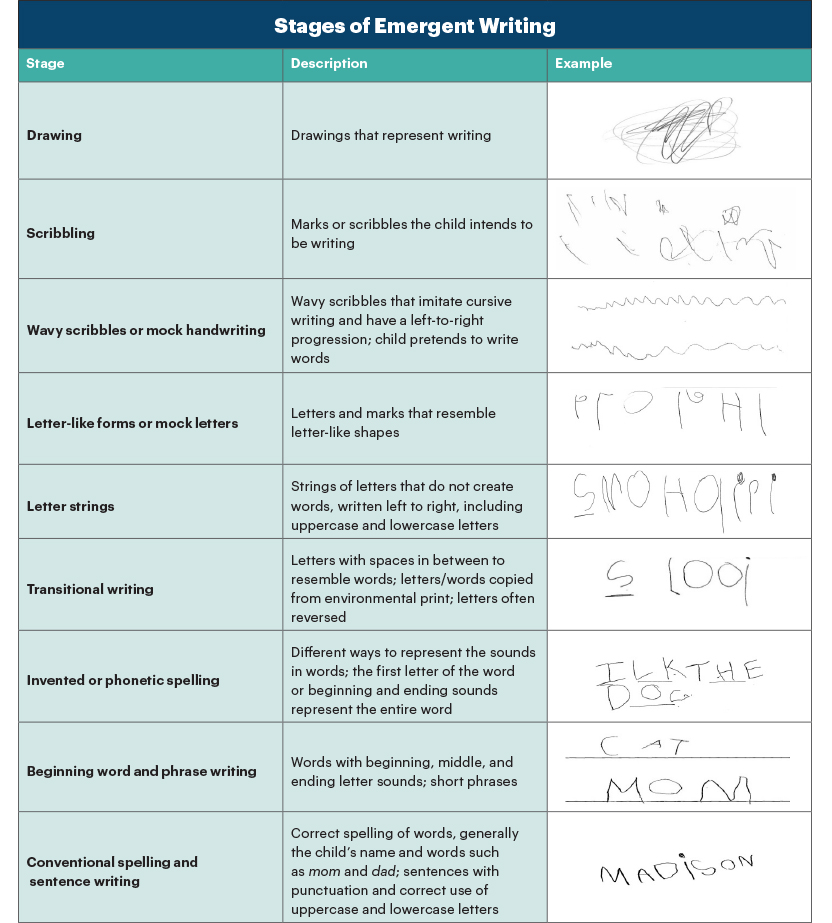
The document also fails to mention how childrenโ€™s letter formation develops through a recursive process of: drawings and scribbles; linear scribbles and mock handwriting and letter-like symbols. This then progresses to: random but real letter strings; letters that represent key sounds learnt; spaces that indicate separation between words; โ€˜sound spellingsโ€™ using phonics knowledge before finally spelling words conventionally.

(Byington & Kim 2017)

Confusion around spelling

Again, we praise the document for highlighting the importance of teaching children to encode during daily phonics instruction. We want children to learn how others can begin to understand the texts they make when they are not around to tell or explain them to their readers.

โ€˜Teachers should encourage correct spellingโ€™ (p.50). A strange and developmentally inappropriate  suggestion especially when you consider the reportโ€™s own recommendation that teachers should praise childrenโ€™s attempts at spelling in โ€˜phonetically-plausible waysโ€™ (also known as using their โ€˜sound-spellingsโ€™ or โ€˜invented spellingsโ€™). Indeed, children who receive phonics instruction orientated towards producing โ€˜sound spellingsโ€™ outperform children who donโ€™t on a whole variety of writing and reading measures (Gerade et al. 2012; Rowe 2018). However, rather confusingly, the paper then suggests that teachers shouldnโ€™t model โ€˜sound spellingsโ€™ despite the fact that children are being asked to adopt the strategy for themselves when writing independently. In summary, teachers arenโ€™t to model a strategy that the policy document wants children to use.

The importance of drawing 

Alongside talking and oral rehearsal, drawing is young childrenโ€™s most appropriate planning technique. Itโ€™s important to give time to drawing because, that when children are encouraged to draw as part of their writing process, they create more meaningful texts and with deeper complexity than they would without drawing (Horn & Giacobbe 2007; Christianakis 2011; Hui 2011; Mackenzie 2011; Mackenzie & Veresov 2013; Olshansky 2014).

The document doesnโ€™t appreciate the early signs, marks, symbols and drawings children put down on screen or paper as being writing (a way of making and sharing meaning). People did not create a transcriptional system first and then decide to share meaning with it afterwards (Lancaster 2007; Wyse 2017). Under this guidance, children will unfortunately learn that if you are to write you must essentially write conventionally and like an adult or not at all.

Whatโ€™s it all for?

โ€˜Let us be clear. If children do not learn and internalise the essential transcriptional skills involved in crafting writing – spelling, handwriting, and punctuation – then their attempts to share meaning with others may be compromised or even fruitless…Therefore, [any] call to teach fundamental writing skills is always welcome. However, it is not intended that transcriptional skills be taught in isolation, away from the craft of meaning making and sharing (Young & Ferguson 2021 p.177). 

We support the paperโ€™s focus on teaching encoding (spelling) and letter formation/handwriting through the context of high-quality and dedicated phonics instruction. However, the suggestion that โ€˜extra time to write is unnecessaryโ€™ and that being given time to write only results in cognitive overload and damage to motivation goes against everything we know about developing young writers. For example, the document neglects to see how instruction in letter formation, handwriting and encoding (spelling) should, as far as children are concerned, serve their daily sustained and meaningful opportunity for writing. It’s only from this meaning-sharing orientation that children want to learn more about how to form letters and encode words so they can better share their meanings (Louden et al. 2005; Wohlwend 2008; Hui 2011; Herste 2012; Graham et al. 2012; Dennis & Votteler 2013; Ouellette & Sรฉnรฉchal 2017).

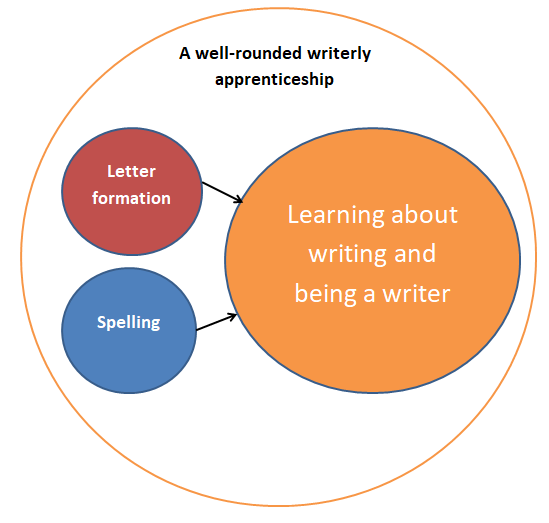
The document essentially provides no guidance on how to develop the orange circle in the figure below:

Instruction in letter formation (handwriting) and spelling during phonics sessions should be there to serve childrenโ€™s daily opportunities to make and share meaning through writing.

Itโ€™s critical that teachers promote and give instruction in all three of the above components. These three dimensions need to develop alongside one another in order for children to understand the world of being a writer. Despite the fact that the report acknowledges the importance of composition (p.50), the paper focuses exclusively on letter formation and childrenโ€™s ability to spell and spends no time discussing how to teach children to be writers and how to teach compositional techniques, procedures and strategies. According to research and the case studies of the best performing teachers, this is a grave error (Poulson et al. 2001; Pressley et al. 2001; Block et al. 2002; Louden et al. 2005; Jones et al. 2010; Graham et al. 2012; Dombey 2013; Kent et al. 2014; Puranik & Lonigan 2014; Hall et al. 2015). 

When children are invited to compose meaningful texts every day, their opportunities to practise letter formation and spelling are naturally supported within an authentic context. Teachers who teach writing through a contemporary and rigorous โ€˜writing workshop approachโ€™ have children who perform just as well in the โ€˜basic skillsโ€™ of letter formation and spelling as those teachers who make these components their sole instructional priority (Dahl & Freppon 1995; Hall 2019; Roitsch et al. 2021). This is because children are encouraged to use what they learn about letters, words and sentences, to create and share meaning. They acquire meaningful knowledge about transcription (spelling, letter formation, handwriting), when they are invited to use it meaningfully rather than through exercises, skills and worksheets. When children enact the processes that real writers do (but in a developmentally appropriate way), they produce writing products which can meet the needs of the curriculum (Wiseman 2003; Harmey & Wilkinson 2019; Managhan 2020; Barratt-Pugh et al. 2021). 

It is this balance between explicit and direct instruction and meaningful practice which makes for world-class writing teaching.

Ross Young & Felicity Ferguson

References

  • Abbott, R. D., Berninger, V. W., & Fayol, M. (2010) Longitudinal relationships of levels of language in writing and between writing and reading in grades 1 to 7. Journal of Educational Psychology, 102, 281-298
  • Ackerman, S. (2016) Becoming Writers in a Readers’ World: Kindergarten Writing Journeys Language Arts 93(3) pp.200-212
  • Barratt-Pugh, C., Ruscoe, A., Fellowes, J. (2021) Motivation to Write: Conversations with Emergent Writers Early Childhood Educ J 49, 223โ€“234
  • Berninger, V., & Richards, T. (2002) Brain literacy for educators and psychologists New York, NY: Academic Press
  • Bingham, G. E., Quinn, M. F., & Gerde, H. K. (2017) Examining early childhood teachersโ€™ writing practices: Associations between pedagogical supports and childrenโ€™s writing skills Early Childhood Research Quarterly, 39 pp.35โ€“46
  • Bingham, G., Quinn, M., McRoy, K., Zhang, X., Gerde, H. (2018) Integrating Writing into the Early Childhood Curriculum: A Frame for Intentional and Meaningful Writing Experiences Early Childhood Education Journal 46 pp.601-611
  • Bollinger, C., Myers, J. (2020) Young Childrenโ€™s Writing in Playโ€‘Based Classrooms Early Childhood Education Journal 48:233-242
  • Boyle, B & Charles, M. (2010) Using socio-dramatic play to support a beginning writer: โ€˜Daniel, the doctor and the bleeding ballโ€™, International Journal of Early Years Education, 18:3, 213-225
  • Block, C.C., Oakar, M. and Hurt, N. (2002), The expertise of literacy teachers: A continuum from preschool to Grade 5. Reading Research Quarterly, 37: 178-206
  • Bradford, H., Wyse, D. (2020): Two-year-old and three-year-old childrenโ€™s writing: the contradictions of childrenโ€™s and adultsโ€™ conceptualisations, Early Years, DOI:10.1080/09575146.2020.1736519
  • Bruyรจre, J., Pendergrass, E. (2020) Are Your Students Writing or Authoring? Young Authorโ€™s Milieux Early Childhood Education Journal 48 pp.561-571
  • Calkins, L. (1994) The art of teaching writing Portsmouth, NH: Heinemann
  • Christianakis, M. (2011) Children’s Text Development: Drawing, Pictures, and Writing Research in the Teaching of English 46(1) pp.22-54
  • Dahl, K., Freppon, P. (1995) A Comparison of Innercity Children’s Interpretations of Reading and Writing Instruction in the Early Grades in Skills-Based and Whole Language Classrooms Reading Research Quarterly 30(1) pp.50-74
  • Daniels, K., (2014) Cultural agents creating texts: a collaborative space adventure Literacy 48(2) pp.103-111
  • Dennis, L., Votteler, N. (2012) Preschool Teachers and Childrenโ€™s Emergent Writing: Supporting Diverse Learners Early Childhood Education 41: 439-446
  • Dombey, H. (2013) What we know about teaching writing Preschool & Primary Education, 1, 22-40
  • Dunsmuir, S., Blatchford, P. (2004) Predictors of writing competence in 4- to 7-year old children British Journal of Educational Psychology 74 pp.461-483
  • Gerde, H.K., Bingham, G.E., Wasik, B.A. (2012) Writing in Early Childhood Classrooms: Guidance for Best Practices. Early Childhood Education Journal 40, pp.351โ€“359
  • Graham, S., Bollinger, A., Booth Olson, C., Dโ€™Aoust, C., MacArthur, C., McCutchen, D., Olinghouse, N. (2012) Teaching elementary school students to be effective writers: A practice  guide (NCEE 2012โ€“4058). Washington, DC: National Center for Education Evaluation and Regional Assistance, Institute of Education Sciences, U.S. Department of Education
  • Graham, S., Harris, K., Adkins, M. (2018) The impact of supplemental handwriting and spelling instruction with first grade students who do not acquire transcription skills as rapidly as peers: a randomized control trial Read Writ 31:1273-1294
  • Graves, D. (1983) Writing: teachers and children at work Portsmouth, NH: Heinemann
  • Hรฅland, A., Frafjord Hoem, T., Margaret McTigue, E. (2019) Writing in First Grade: The Quantity and Quality of Practices in Norwegian Classrooms Early Childhood Education Journal 47:63โ€“74
  • Hall, A., Simpson, A., Guo, Y., Wang, S. (2015) Examining the Effects of Preschool Writing Instruction on Emergent Literacy Skills: A Systematic Review of the Literature, Literacy Research and Instruction, 54:2, 115-134
  • Hall, A., (2019a) Every Child is a Writer: Understanding the Importance of Writing in Early Childhood Institute for Child Success [Online: https://www.instituteforchildsuccess.org/publication/every-child-is-a-writer-understanding-the-importance-of-writing-in-early-childhood-writing/%5D
  • Harmey, S., Wilkinson, I. (2019) A Critical Review of the Logics of Inquiry in Studies of Early Writing Development Journal of Writing Research 11(1) pp.41-78
  • Harste, J.C. (2012) Reading-writing connection. In C. A. Chapelle (Ed.) The encyclopedia of applied linguistics (pp.1-8) Oxford: Wiley
  • Horn, M., Giacobbe, M., (2007) Talking, Drawing, Writing: Lessons for Our Youngest Writers New York: Stenhouse
  • Hui, W.Y. (2011) The Writing behind Drawing: Lessons learned from my Kindergarten Class Journal of Classroom Research in Literacy 4(3)
  • Jacobson, J. (2010) No more โ€˜Iโ€™m done!โ€™ Fostering independent writers in the primary grades Portland: Maine: Stenhouse
  • Jones, C., Reutzel, R., Fargo, J. (2010) Comparing Two Methods of Writing Instruction: Effects on Kindergarten Students’ Reading Skills The Journal of Educational Research 103(5) pp.327-341
  • Johnston, P. (2019) Talking Children Into Literacy: Once More, With Feeling Literacy Research: Theory, Method, and Practice 68(1) pp.64-85
  • Kent, S., Wanzek, J., Petscher, Y., Al Otaiba, S., Kim, YS. (2014) Writing fluency and quality in kindergarten and first grade: The role of attention, reading, transcription, and oral language Reading & Writing 1:27(7) pp.1163-1188
  • Kissel, B. (2009) Beyond the Page: Peers Influence Pre-Kindergarten Writing through Image, Movement, and Talk, Childhood Education 85:3 pp.160-166
  • Kissel, B., Hansen, J., Tower, H., Lawrence, J. (2011) The influential interactions of pre-kindergarten writers Journal of Early Childhood Literacy, 11(4), pp.425โ€“452
  • Lamme, L., Fu, D., Johnson, J., Savage, D. (2002). Helping kindergarten children move towards independence. Early Childhood Education Journal, 30(2), 73-79.
  • Lancaster, L. (2007) Representing the ways of the world: How children under three start to use syntax in graphic signs Journal of Early Childhood Literacy 7(2) pp.123-154
  • Louden, W., Rohl, M., Barrat-Pugh, C., Brown, C., Cairney, T., Elderfield, J., House, H., Meiers, M., Rivaland, J., & Rowe, K. J. (2005). In teachersโ€™ hands: Effective literacy teaching practices in the early years of schooling. Australian Journal of Language and Literacy, 28, 173-252.
  • Mackenzie, N. (2011). From drawing to writing: What happens when you shift teaching priorities in the first six months of school? Australian Journal of Language and Literacy, 34: 322โ€“340
  • Mackenzie, N., Veresov, N. (2013) How Drawing can Support Writing Acquisition: Text Construction in Early Writing from a Vygotskian Perspective Australasian Journal of Early Childhood, 38(4) pp.22โ€“29
  • Malpique, A., Pino-Pasternak, D., Valcan, D. (2017). Handwriting automaticity and writing instruction in Australian kindergarten: An exploratory study Reading & Writing 30(8) 1789-1812
  • Malpique, A., Pino-Pasternak, D., Roberto, M. (2020) Writing and reading performance in Year 1 Australian classrooms: associations with handwriting automaticity and writing instruction Reading & Writing 33 pp.783-805
  • Managhan, E. (2020). Effective Practices to Balance Literacy Instruction in Early Childhood Learning to Teach, 9(1). Retrieved from https://openjournals.utoledo.edu/index.php/learningtoteach/article/view/375
  • Mayer, K.. (2007). Emerging knowledge about emergent writing YC Young Children 62 pp.34-40
  • McQuitty, V. (2014) Process-oriented writing instruction in elementary classrooms: Evidence of effective practices from the research literature. Writing & Pedagogy, 6(3), 467โ€“495
  • Olshansky, B. (2014) Time for a Paradigm Shift: Recognizing the Critical Role of Pictures Within Literacy Learning. Occasional Paper Series (31) Retrieved from https://educate.bankstreet.edu/occasional-paper-series/vol2014/iss31/10
  • Ouellette, G., Sรฉnรฉchal, M. (2017) Invented Spelling in Kindergarten as a Predictor of Reading and Spelling in Grade 1: A New Pathway to Literacy, or Just the Same Road, Less Known? Developmental Psychology 53(1) pp.77-88
  • Poulson, L., Avramidis, E., Fox, R., Medwell, J., Wray, D. (2001) The theoretical beliefs of effective teachers of literacy in primary schools: an exploratory study of orientations to reading and writing Research Papers in Education 16(3) pp.271-292
  • Pressley, M., Wharton-Mcdonald, R., Allington, R., Block, C. C., Morrow, L., Tracey, D., Baker, K., Brooks, G., Cronin, J., Nelson, E., & Woo, D. (2001). A study of effective first grade literacy instruction. Scientific Studies of Reading, 5, 35-58
  • Puranik, C., AlOtaiba, S. (2012) Examining the contribution of handwriting and spelling to written expression in kindergarten children Read Writ 25:1523-1546
  • Puranik, C., Lonigan, C. (2014) Emergent Writing in Preschoolers: Preliminary Evidence for a Theoretical Framework Reading Research Quarterly 49(4) pp.453-467
  • Quinn, M. F., Gerde, H. K., & Bingham, G. E. (2016). Help me where I am: Scaffolding writing in preschool classrooms The Reading Teacher, 70, 353โ€“357
  • Quinn, M. F., Bingham, G. E. (2018) The Nature and Measurement of Childrenโ€™s Early Composing Reading Research Quarterly 54(2) pp.213โ€“235
  • Ray, K., Glover, M. (2008) Already ready: nurturing writers in preschool and kindergarten Portsmouth NH: Heinemann
  • Roitsch, J., Gumpert, M., Springle, A., Raymer, A. (2021) Writing Instruction for Students with Learning Disabilities: Quality Appraisal of Systematic Reviews and Meta-Analyses, Reading & Writing Quarterly, 37:1, 32-44
  • Roser, N., Hoffman, J., Wetzel, M., Price-Dennis, D., Peterson, K., Chamberlain, K. (2014) Pull Up a Chair and Listen to Them Write: Preservice Teachers Learn From Beginning Writers, Journal of Early Childhood Teacher Education, 35:2, 150-167
  • Rowe, D. (2008) The Social Construction of Intentionality: Two-Year-Olds’ and Adults’ Participation at a Preschool Writing Center Research in the Teaching of English 42(4) pp.387-434
  • Rowe, D. (2018) The Unrealized Promise of Emergent Writing: Reimagining the Way Forward for Early Writing Instruction Language Arts 95(4) pp.229-241
  • Santangelo, T., Graham, S. (2016) A Comprehensive Meta-analysis of Handwriting Instruction Educational Psychology Review 28:225-265 
  • Thomas, P., (2005) Fostering composing pre-K and beyond – avoiding the artificial nature of writing and teaching Journal of teaching writing 22(1) pp.64-82
  • Tolchinsky, L. (2017). From text to language and back: The emergence of written language. In C. MacArthur, S. Graham, & J. Fitgerald (Eds.) Handbook of writing research New York, NY: Guilford
  • Tolentino, E. (2013) “Put an explanation point to make it louder”: Uncovering Emergent Writing Revelations through Talk Language Arts 91(1) 10-22
  • VanNess, A., Murnen, T., Bertelsen, C. (2013) Let Me Tell You a Secret: Kindergartners Can Write! International Literacy Association 66(7) pp.574-585
  • Wharton-McDonald, R., Pressley, M., & Hampston, J. (1998). Outstanding literacy instruction in first grade: Teacher practices and student achievement. Elementary School Journal, 99, 101โ€“128.
  • Wiseman, A. (2003) Collaboration, Initiation, and Rejection: The Social Construction of Stories in a Kindergarten Class The Reading Teacher 56(8) pp.802-810
  • Wohlwend, K. (2008a) From โ€œWhat Did I Write?โ€ to โ€œIs this Right?โ€: Intention, Convention, and Accountability in Early Literacy, The New Educator, 4:1, 43-63
  • Young, R., Ferguson, F. (2021) Writing For Pleasure: Theory, research and practice London: Routledge

Reluctant Writers: Where Do We Start? By Ellen Counter

@EllenCounter

Whenever I walk into a classroom, or if Iโ€™m teaching a writing lesson, the first questions I tend to ask myself are โ€œwhereโ€™s the enjoyment here?โ€ and then โ€œwhereโ€™s the purposeful writing?โ€ And if I donโ€™t see it or feel it then I know something probably needs to change. First and foremost, if a child doesnโ€™t want to write and/or feels that they arenโ€™t very good at it – thatโ€™s usually the biggest hurdle to their development as a writer. As a teacher, itโ€™s our job to listen – and I mean really listen – to our children and, before we do anything else, find out how they feel about writing and about themselves as writers. And in doing so, we need to ask ourselves the same question.

Between 2009-2010 I had the privilege of working with Teresa Cremin, who was working with a group of teachers in Newham as part of a UKLA โ€˜Teachers as Writersโ€™ project1. During our first session, she asked us to create โ€˜writing riversโ€™ – thinking about our range of experiences of writing from the earliest point in our lives up to adulthood. And in doing so, to consider how we felt about that writing and why. I quickly realised that, in contrast to my childhood, I no longer wrote for enjoyment or pleasure. I wrote for purely functional purposes – to send an email or create lists of tasks. No feedback, no creativity, no joy. And what message about writing was I giving to my pupils? Well, here I came to the depressing, embarrassing realisation that I too was sucking the joy from their writing lives. When I met Teresa, I was teaching in year 5 and in my second year of teaching. At the time, my school used a literacy scheme which followed a formulaic pattern of looking at an extract or passage of text, answering questions about it, teaching an element of grammar or punctuation (out of context) and then asking the children to write the same genre with the same content or context, using aforementioned grammar/ punctuation (and often in just a day or two).  I was the gatekeeper who decided what they would write about, how and when2 โ€“ and there was never any choice or discussion about this.  At this point I should probably add that I am an English Literature graduate, and I just accepted that this was the way the subject was taught at school. Not once had I really questioned it, but at the same time I knew that the children didnโ€™t really enjoy their English lessons – and I didnโ€™t enjoy teaching them.

In fact, judging from their answers to a writing survey, over half (56%) of my pupils did not feel positively about writing at all. One child, weโ€™ll call him Jason, was refreshingly honest in his responses

I could feel his โ€œOh god do we have toโ€ in the way he sat in his seat every day; the way he came into the classroom, looking at his feet and barely saying โ€œHelloโ€. I could feel it from the way he scowled at other children whenever they asked him what book he was reading; the way he rolled his eyes when he was asked to pull in his chair. Jason was described to me on numerous occasions as โ€˜lazyโ€™ and โ€˜rudeโ€™. Most teachers seemed to have dismissed him as a child who couldnโ€™t be bothered, and by the time he arrived in year 5, Jason was falling far behind his peers. Highly unlikely to get the required level 4 by the time of SATs, his needs were no longer a priority, and he knew it. Looking back at his handwriting, it seems to say that he was trapped by a lack of fluency – unable to join his letters and write freely; he was stuck. He would often spend ages writing the date or a learning objective and barely get around to writing anything else before the lesson ended. His โ€œOh god do we have toโ€ reflected exactly how Jason felt every single day. I admired his honesty hugely, and Jasonโ€™s admission has stayed with me ever since. Because in the ten years since then, all too often in the children I have met and taught, these struggles with writing go hand-in-hand with similar struggles in communication, behaviour, self-expression and self-esteem. It makes sense really – if you think you canโ€™t write, does that mean youโ€™ve got nothing to say? And if youโ€™ve got nothing to say, what worth do you have?

After analysing the childrenโ€™s feedback from their writing surveys, I decided to implement Teresaโ€™s suggestions with gusto – clearly something had to change and it was going to start with me. We had talked about teachers writing alongside the children, writing the same thing we had asked the children to write. At first Iโ€™ll admit I felt very sceptical – and anxious – about this concept. Surely the children would all be talking and not know what to do if I sat down and wrote alongside them? Surely theyโ€™d need me to help them when they were writing? I couldnโ€™t believe what actually happened when I announced that, from now on, I would go on the same writing journey as them. At the time, we were writing our own narratives based on a hazardous journey, such as that of Michael from โ€˜Kensukeโ€™s Kingdomโ€™. I was also going to write an opening to my story. A silent respect followed an initially surprised reaction – they were far more quiet than usual and stayed that way for the rest of the lesson. They occasionally looked up to watch me as I chewed my pen, referred to the thesaurus, asked a child next to me to read a sentence to check it made sense to them. To my surprise, I found out that as long as they knew what resources they had at their disposal, they were quieter, more focused than usual and produced some wonderful writing. As well as doing my own writing, I would spend longer talking to the children, having in-depth conversations with children about how it felt to write, the process of writing and giving advice using tips and tricks that I had been relying on in my own writing process. We talked about how their writing made me feel as I read it, and whether that was their intention or not. I suddenly understood how it felt to feel that same frustration and vulnerability when staring at an empty page and the words donโ€™t come. I would share that vulnerability by talking aloud as I wrote in front of the class – circling words that โ€˜didnโ€™t feel rightโ€™ or underlining parts that felt boring or needed reworking. That day started a process that I have tried to stick to ever since. In my classroom, we all write – we are a community of writers, all working towards a common goal of publishing something we are proud of.

The next step was to focus on the writing process of the children. The time it was taking for Jason to meticulously write the date and LO before getting down to any writing was bothering me. What was the purpose of that anyway? Teresa wanted us to introduce writing โ€˜journalsโ€™ with the children. They could write whatever they wanted to in the journals; it wouldnโ€™t be marked and they could share their writing only if they wanted to. Again, this felt like a risk. There were no rules about the journals, other than if you chose to draw or doodle you had to write about it in some way. I wondered to myself: What if a child didnโ€™t choose to write at all? What if they had nothing to write about?3 As it turned out, as long as I kept the profile of the journals in the highest esteem, and they were given time to generate their ideas and we used them every day, this was never a problem. The excitement about the notion that they didnโ€™t have to write the date, or cross out with a ruler, and they could draw on the front cover and doodle in the margins – in fact wherever they liked – was incredible. Never before had the children been provided with autonomy over their work in this way, or been provided with this level of trust. I also felt a little upset about their reaction – how sad that my pupils were so excited about a doodle and not having to write a date. What had it come to when I kept being asked: โ€œBut are you sure, Miss? We donโ€™t have to underline the LO?โ€; โ€œWonโ€™t I get in trouble if I draw?โ€ and โ€œCan I really use a pen now?โ€ or โ€œCan we really write about what we want?โ€ with a mixture of disbelief, excitement and anxiety.

In case you need any reassurance about the drawing element – the childrenโ€™s drawings were an essential part of their writing. They provided a counterpart to their ideas and a process with which to visualise what they wanted to say and inform their word choices4. We would talk about their drawings and use them to consider impact on audience, the pictures we wanted our reader to see when they read our words. Jason took to his journal like a duck to water. He loved it. So much so, that when it came to โ€˜sharing timeโ€™5 he started to jump at the opportunity to share what he had written. I began to see a change in him on the day when he wanted us to read part of a setting description he was writing for a story based on a desert island (our reading of โ€˜Kensukeโ€™s Kingdomโ€™ was filtering into his own writing decisions). As he read his work, we all stopped at a phrase he had written and were unanimous in our praise. I still remember it now:

As I stepped into the soft, settling sandโ€ฆ

โ€œWowโ€, I said, โ€œJason – youโ€™re a writer.โ€ His reaction will never leave me. I donโ€™t think Iโ€™d seen him smile like that before. Days after that, we could see the other children borrowing his phrase and it cropped up in some of their poetry after discussing alliteration – all referring to โ€˜Jasonโ€™s trickโ€™. Jason began to start offering advice to other children; he wanted another journal to take home with him. He started writing stories with his mum.

After the year (and the โ€˜teachers as writersโ€™) project had ended, I asked the children to complete the same survey. I was shocked by the change in their responses.  You may remember that 56% of my pupils had felt negatively about writing.  This had dropped to 12%, as now 88% of the children had a positive reaction to the thought of writing.  Before we started the project, 74% of the class did not or rarely wrote anything at home.  This had reduced to 16%, as 84% were now continuing their writing at home or creating their own writing projects6.  Jasonโ€™s responses were some that stood out the most:

I often wonder now about how Jason is getting on. Does he still write? Does he think heโ€™s a good person? Is he happy? When I was delivering some training about writing for pleasure recently, I started talking about him and cried. Heโ€™ll never know what an impact heโ€™s had on me; but his words will stay with me forever.

***

1 This project formed part of the UKLA โ€˜Ideas in Practiceโ€™ book, Teaching Writing Effectively:  Reviewing Practice, published in 2011.

2 Harold and Connie Rosen wrote in The Language of Primary School Children (1973), p.92:  โ€œThe question of children using written language for their own purposesand of maintaining confidence in their own โ€˜voicesโ€™ is one that presents itself not only in the introductory stages but all through primary school.โ€  I had not thought about this before the โ€˜Teachers as Writersโ€™ project. 

3 I have heard this a lot – the assumption that children have no ideas and nothing to write about. Iโ€™m ashamed to admit I thought the same. I would now argue that if a child says they have nothing to write about, itโ€™s because the idea that they have a choice in what to write is such an alien concept by.  By the time theyโ€™re in KS2, they truly believe they can only write something based on the content or context their teacher has provided for them. I can assure you – give a child the time to generate their own ideas and build back the trust that we, as adults and educators, value what they have to say and will listen to them, and they will have enough ideas to keep them writing into adulthood.

4 More information about childrenโ€™s writing journals can be found in the UKLA Minibook (35) Childrenโ€™s Writing Journals by Lynda Graham and Annette Johnson.  As they state:  โ€œ..the drawings children include in their journals are the visual counterpart to the written choices they are making.  For children, illustration is a natural expression of their literacy, a means to communicate and transform their ideas and insights.โ€  (2012) p. 16.

5 Sharing time is vital to the success of writing for pleasure (see Ross Young & Felicity Fergusonโ€™s Real-World Writers pp. 71-72).  It gives children the opportunity to see each otherโ€™s work and provide feedback, based on the intention of impact on reader (from the writer) and whether this has been successful or not. A visualiser is key here too – seeing the writing is as important as hearing it. Sometimes we can spend ages debating whether a particular verb has the right effect or not – this is where the magic happens.

6 According to Clark, C. and Teravainen, A. (2017) in Writing for Enjoyment and Its Link to Wider Writing, (London: National Literacy Trust) children who write at home are seven times more likely to write above the expected writing standard.


The Wrong Way to Teach Grammar By Michelle Navarre Cleary

I recently came across this article by Michelle Navarre Cleary and I just had to share it. I think it’s brilliantly written with astute remarks made throughout. These include:

‘…We knowย that grammar instruction that works includes teaching students strategies for revising and editing, providing targeted lessons on problems that Students immediately apply to their own writing, and having students play with sentences like Legos, combining basic sentences into more complex ones…’

‘…Students are victims of the mistaken belief that grammar lessons must come before writing, rather than grammar being something that is best learned through writing…’

‘…Once students get ideas they care about onto the page, they are ready for instructionโ€”including grammar instruction…’

‘…If 30 years later, you or your child is still being taught grammar independent of actually writing, it is well past time to demand writing instruction that is grounded in research rather than nostalgia…’

I can highly recommend reading the whole article. You might also enjoy reading our view on grammar teaching and you might be interested in our ebook: Grammar Mini-Lesson For 5-11 Year Olds

Teachers’ Talk Radio Interview

Teachers Talk Radio

Ross Young recently spoke with Meera Chudasama at Teachers’ Talk Radio about all things Writing For Pleasure pedagogy. He was joined by his colleague Year Four writer-teacher Tobias Hayden.

They spoke about what a Writing For Pleasure classroom looks and feels like and what the research says about world-class writing teaching.

You can listen to the interview at the link here.

Are you for real? Bringing purpose and authenticity into the writing classroomย 

For Teach Reading & Writing Magazine

Writing for a purpose means writing for real. Itโ€™s reasonable to assume that every act of writing undertaken out in the world is underpinned by a reason to write it, by the writerโ€™s impulse to make their mark on the world with some kind of purpose and intention. Yet although we know from research that, if writing is done in school for a real purpose, childrenโ€™s pleasure in writing is increased, and that writing for and with pleasure means they write better texts, it appears that we often donโ€™t think of bringing authentic purposes  into the writing classroom.

The whole issue of what could make writing authentic in school, including what a real purpose and audience for writing would look like, is well worth thinking about. Research studies on the subject express a broad but compelling consensus of opinion, agreeing that, to be authentic, a writing project must connect both with childrenโ€™s own lives and with how and why writing is undertaken in the world outside the school gates. If these factors are missing from the practices of writing teachers, writing cannot be taught in an authentic way. And when it isnโ€™t taught in an authentic way, when teaching isnโ€™t informed by what writers in the wider world do and the processes they go through, and when children are not encouraged to bring their own funds of knowledge into the writing classroom, the result is that in school they are rarely given the chance to write authentically.

The serious barrier to children having the opportunity to write with genuine purpose and for a genuine audience is that decisions about the genre, the topic, the purpose and the audience for a writing project are almost always made by the teacher, who then assigns the project to the children to complete. Projects are often harnessed, in what seems to be quite an arbitrary way in terms of the teaching of writing, to a current topic or to the particular class novel under study. Teacher-chosen audiences and purposes are typically artificial and manufactured, having little or no connection to purposes and audiences in the real world, which means- bizarrely- that children are effectively being asked to pretend at writing. This may happen particularly in a literature-based approach to writing teaching: for example, children might be asked to write a letter to a book character, or a newspaper article about a dragonโ€™s egg appearing in the playground or about the day the chairs all left the classroom and how they had to be persuaded by letter to return. Such projects may seem seductively attractive  and motivating on the surface, but they will have only a short-lived effect on childrenโ€™s development as writers. You could say itโ€™s rather like experiencing a sugar rush – high energy, but only for a brief space of time. And, in the context of assigning a writing โ€˜taskโ€™ attached to a topic, teachers inevitably find themselves receiving thirty very similar versions of, for example, a biography of Queen Victoria, or the much-favoured newspaper article about the opening of Tutankhamunโ€™s tomb, written for no purpose other than to have children repeat the given information, and with no defined audience beyond themselves and therefore no reason to be published. Hence the inauthenticity of so many writing projects.

However, we can avoid this scenario because, in actual fact, itโ€™s easy to create authentic and motivating projects with a real purpose and audience by the simple expedient of setting a genre as a parameter for writing, discussing who they are going to write it for, and then giving children agency over their own writing topic. If children have been taught idea generation techniques, they can learn about the conventions of the genre for the class writing project and then go on to choose what they want to write about, using their own funds of knowledge and identifying their own genuine purposes and audiences. To give some simple examples: write an information text, but choose a subject you know a lot about and which you think others would be interested to learn about too. Write a persuasive letter to someone in the community who might have the power to act on your request. Or, in a narrative genre, generate your own playful or imaginative idea and write it as a story, poem or as a piece of โ€˜factionโ€™, with the aim of entertaining readers and showing your artistry by painting with words. These reasons to write do, of course, mirror real-world writing purposes, and the writing that springs from them is as authentic as the writing that takes place in the world outside school.ย 

In summary, writing in school can be undertaken with genuine purpose if it matches the reasons why writers write in the outside world; if the topic is chosen by the child and is therefore relevant to their own lives; if it can be published and put to work in the world as entertainment, as a record, as an opinion or an attempt to influence, as a reflection or as an explanation about something. It will have an authentic outcome only if it has a real envisioned audience, whether that audience is close or distant, known or unknown, but is certainly not Dumbledore, a collection of chairs, or Paddington Bear, and is not the teacher whose own purpose is primarily to read the writing for evaluation or assessment.

If genre is taught well in class writing projects and children are allowed to write authentically, finding their own reasons for writing and using the genre for their own purposes and in their own way, they will be experiencing a sincere curriculum which simultaneously attends to their emotional needs as young writers and fulfils official objectives. They will also be part of a process which not only helps them write better texts but gives them the opportunity to write for real, with purpose, power and pleasure.

Sidebar

If authenticity means not pretending, then we should remember to:

  • Give children a say in deciding on the purpose and audience for a writing project in a particular genre. As a class, have an โ€˜ideas partyโ€™ – collect ideas on flipchart paper for what they would like to write about and to whom, and then collaboratively agree on both.
  • Alternatively, set a genre as the parameter and then give children individual agency over the writing topic. Teach idea generation techniques to help them find their own topic and then take a โ€˜writing registerโ€™.
  • Let children use their own funds of knowledge and identity in their writing in school. They need to write their own worlds and express who they are.ย 
  • Give children the chance to find reasons to be moved to write, and be who they want to be in their piece – maybe entertainers, biographers, poets, storytellers, teachers or advisers. Show them how they can mix elements of different genres together to do this.
  • Ensure that the mentor texts you provide include authentic and legitimate examples from the world outside school.
  • Make discussions about publishing possibilities an initial and important part of a class writing project.

By Felicity Ferguson. Felicity helps run The Writing For Pleasure Centre. Their aim is to help all young people become passionate and successful writers.

NATE: What can we learn from Writing for Pleasure teachers?ย for Primary Matters magazine

Authors Ross Young and Felicity Ferguson share their compelling research, equipping teachers with the knowledge to reshape their teaching of writing in transformative ways and help children become empowered writers who write with purpose, power, precision and pleasure.

What Is It Writing For Pleasure Teachers Do That Makes The Difference? (Young 2019) was a one-year research project funded by The Goldsmithsโ€™ Company and supported by The University Of Sussex which investigated how Writing For Pleasure teachers secured outstanding academic achievement from their pupils whilst also attending to childrenโ€™s affective needs (positive dispositions and feelings towards writing and being writers). This research comes at a time when we are seeing profound underachievement in writing
coupled with an increase in young peopleโ€™s indifference to or dislike of writing (Young & Ferguson 2021).

It was a requirement that the practices of the teachers participating in the research should be based on what studies tell us are the most effective writing teaching, associated with high levels of pupil motivation, confidence, agency, independence, desire, writer-identity, enjoyment, satisfaction and pleasure. Teachers were also required to provide evidence and a track record of exceptional academic progress among their pupils.

From a rich literature review, we were able to identify the fourteen enduring and interconnected principles of world-class writing teaching. These practices have, for a long time, been associated with high levels of student achievement and feelings of pleasure in being a young writer. The literature review was based on:

  • Extensive research into the most effective writing instruction including meta-analyses of multiple studies.
  • Existing case studies of what the best performing teachers of writing do that makes the difference.
  • Research summaries from reputable literacy charities and associations.
The 14 Principles Of World-Class Writing Teaching
– Build a community of writers
– Treat every child as a writer
– Read, share, think and talk about writing
– Pursue authentic and purposeful writing projects
– Teach the writing processes
– Set writing goals
– Be reassuringly consistent
– Pursue personal writing projects
– Balance composition and transcriptionย 
– Teach daily mini-lessons
– Be a writer-teacher
– Pupil-conference
– Connect reading and writing
– Interconnect the principles

(Young & Ferguson 2021)

So what can we learn from these teachers? Below we share what it was they were doing in their classrooms that was making the difference, including: the creation of a social environment and a positive culture for developing as a writer; high-quality teaching to produce authentic, confident, and independent writers; teachers writing, teaching, and giving feedback as writers, and teachers connecting writing with reading.

Create A Community Of Writers

  • Children saw their teachers as extraordinarily positive, caring, strict, fun, calm and interested in their lives and development as writers.ย 
  • Their classrooms felt like a rich mixture of creative writersโ€™ workshop but also had the sharp focus of a professional publishing house (Young & Ferguson 2020).ย 
  • The teachers supported and encouraged children to bring and use their own โ€˜funds of knowledgeโ€™ into their writing projects, meaning that children could write from a position of strength (Young & Birchill 2021).
  • Classrooms were a shared and democratic space.ย 
  • The children talked of feeling confident and knowing that their teachers wanted them to try their best, take their time and to focus specifically on making their written pieces the highest quality they could be for their future readership.

Treat Every Child As A Writer

  • The teachers held high achievement expectations for all their writers.
  • All children felt like independent writers who were achieving writing goals with regularity. They were praised for the goals they achieved in the writing lesson.
  • The teachers ensured that all their writers remained part of the writing community.

Read, Share, Think And Talk About Writing

  • Children were given ample opportunity to share and discuss with others (including their writer-teacher) their own and othersโ€™ writing in order to give and receive constructive criticism, writerly advice and celebrate achievement.
  • Writing was seen as a social act, and dialogic talk was important at all stages of the writing process. 
  • Children were encouraged to talk about the content of their writing, their writing processes, and to share any techniques or strategies they thought were working particularly well for them. 
  • Whilst talk was an integral part of any writing time, so was maintaining a low level of noise to avoid disturbing fellow writers (Whittick 2020).

Purposeful & Authentic Writing Projects

  • Teachers and children together considered the purpose and future audiences for their class writing projects. Because children were given the opportunity to generate their own ideas and had a strong sense of a real reader and a clear distant goal for the writing to be published, the projects were seen as meaningful (The Writing For Pleasure Centre 2021).
  • Agency played an important role within class writing projects. Children were encouraged to either generate their own individual ideas, share and work on ideas in โ€˜clustersโ€™ or, as a whole class, generate an idea that they could all pursue together (Young & Ferguson 2020).
  • It was striking that these teachers were regularly refocusing the children on considering the future readership and publication of their piece throughout their projects (James 2020).ย 
  • Class writing projects were worked on over a number of weeks.

The affective needs of young writers as identified by Young & Ferguson (2021)

Teach The Writing Processes

  • Teachers gave direct instruction in strategies for engaging in the different components of the writing process (how to generate an idea, plan, draft, revise, edit, publish). They scaffolded childrenโ€™s understanding of these processes through demonstration, resources, displays, discussion, sharing self-written exemplars and also techniques children had used themselves.
  • Children were made to feel very knowledgeable about the writing process and confident in navigating it on their own. One way in which the teachers showed commitment to helping their children achieve independence was to allow them to develop and use a writing process which suited them best and to write at a pace which enabled them to produce their best writing (Hayden 2020).
  • The children were able to use the writing processes recursively and were not tied to a linear model.

Set Writing Goals

  • To maintain childrenโ€™s commitment and motivation during a class writing project, teachers ensured that their classes understood the โ€˜distant goalโ€™ for the project, that is to say, its audience and purpose (Hayden & Vasques 2020).
  • The class, as a community, also had a say in setting the โ€˜product goalsโ€™ for their project. This took place in the form of discussions as to what they would have to do, and what it was writers did, to ensure their writing was successful and meaningful in the context of the projectโ€™s aims (Young & Ferguson 2020).
  • The teachers would often share a piece of their own writing, in keeping with the project, to initiate a discussion about writing decisions. The children then used the outcomes of these discussions as an aid to setting product goals for their own writing. The product goals were similar to success criteria, but importantly they also included more overarching goals linked directly to purpose and audience (Ferguson 2020).
  • Product goals were put on display and were repeatedly referred to by the children and the teachers throughout their class writing projects.
  • The teachers set loose โ€˜process goalsโ€™ for writing time to help the class generally stay on track, without forcing children to keep to a certain pace or writing process.

Be Reassuringly Consistent

  • The teachers showed excellent classroom organisation and behaviour management. There was strong emphasis on routines, promoting self-regulation, expectations and focused collaborative learning among the children.
  • Teachers had a clear routine of mini-lesson (10 to 20 minutes), writing time (30-40 minutes) and class sharing/authorโ€™s chair (10-15 minutes) (Young & Ferguson 2020).
  • The mini lessons were a short direct instruction on an aspect of writing which was likely to be useful to the children during that dayโ€™s writing. The teachers taught from their own craft, regularlyย  sharing their writing โ€˜tips, tricks and secretsโ€™; alternatively, they would share examples from literature taken from the class library (The Writing For Pleasure Centre 2020).
  • In the class-sharing / authorโ€™s chair session, children would share their developing pieces and discuss with their peers the writing goals they had achieved that day (Harris 2020).ย ย ย 

Pursue Personal Writing Projects

  • The teachers understood how essential it is that children are given time to write for a sustained period every day and to work on both class and personal writing projects (Vasques 2020; Hayden & Vasques 2021). 
  • Children were given at least one timetabled hour a week to engage in personal writing projects.  However, the teachers also encouraged children to pursue personal writing in little pockets of time throughout the week. 
  • Children transferred knowledge and skills learnt in class writing projects and used them expertly and successfully in their personal ones.
  • The teachers set up routines where personal writing project books went to and fro between school and home every day. This meant that children could be in a constant state of composition.

Balance Composition And Transcription

  • The teachers focused on giving direct instruction in the โ€˜generalitiesโ€™ of good writing. They taught writing lessons which would help that day but which would serve children in future writing projects too.ย 
  • They ensured that they taught the right lessons at the right time, with the emphasis on composition at the beginning of a writing project and more focus on teaching good transcriptional techniques and strategies later.
  • The teachers had high expectations for transcriptional accuracy, spelling and handwriting and wanted the children to take pride in their final written products. They encouraged children to concentrate on composing their piece (or part of their piece) before giving full attention to making it transcriptionally accurate.
  • They allocated specific time for children to focus on revising their pieces prior to editing them. Thus, revision and editing had separate and specific status.
  • They also asked children to regularly stop, re-read and share their work with their peers. By re-reading, the children had an opportunity to revise and edit their developing pieces as they were progressing (Whittick 2020).
  • There was a good balance between discussing what the content of the childrenโ€™s writing projects might be, how the writing could be organised to be successful, and the explicit teaching of different writing processes.
  • The teachers were very aware that, if grammar was to be understood in a meaningful way, it must be taught functionally and applied and examined in the context of real composition (The Writing For Pleasure Centre 2020).ย 

Teach Daily Mini-Lessons

  • Children learned numerous strategies and techniques that they could employ independently. They were taught strategies for managing every part of the writing process and they knew how to use them across all class and personal writing projects.
  • Self-regulation strategies and resources were introduced carefully and given dedicated instructional time. In mini-lessons, the teachers would illustrate the benefit of a writing strategy or resource with personal reference to their own experience as a writer, before modelling and encouraging the children to use it that day if possible. The strategies and techniques were offered in the spirit of a fellow writer sharing their own writerly knowledge and their โ€˜tricksโ€™ (Hayden 2020).
  • These teachers made use of their working walls for โ€˜advertisingโ€™ and sharing self-regulation strategies.

Be A Writer-Teacher

  • Teachers wrote for pleasure in their own lives outside the classroom. They used their literate lives as an education tool in the classroom (Bean 2020).
  • The teachers regularly wrote and shared their writing with their class. They would also share their own finished pieces in relation to the projects they were asking the children to engage in, and would take advice from the children on compositions they were in the process of developing.
  • The teachers would readily share the tricks, tips and โ€˜secretโ€™ strategies that they habitually employed in their own writing and would invite children to give them a try too.

Pupil Conference: Meet Children Where They Are

  • The teachers believed that a rich response to childrenโ€™s writing was crucial. Whilst they used both written and verbal feedback, they particularly emphasised the usefulness of โ€˜liveโ€™ verbal feedback, which they felt was immediate, relevant and allowed the child to reflect on and attend to learning points raised while still actually engaged in their writing (Young & Ferguson 2020).ย 
  • Conferences were short, friendly, supportive and incredibly positive. The children looked forward to these โ€˜conversationsโ€™ because they knew they would receive genuine praise for and celebration of the writing goals they were achieving and also good advice as to how they could improve their developing compositions further.
  • The teachers were able to undertake pupil-conferencing in a systematic way and were successful because their children and classrooms were settled, focused, highly-organised and self-regulating. Behavioural expectations were also made very clear.

Literacy For Pleasure: Connect Reading And Writing

  • The teachers looked to build a community of readers and writers concurrently.ย 
  • They taught using a reading for pleasure pedagogy (Cremin et al 2014).
  • They had print-rich classrooms which included stories, non-fiction, poetry, newspapers, magazines and the childrenโ€™s own published texts.ย 
  • The teachers read aloud every day to their classes with pleasure and enthusiasm, including poetry, picture books, chapter books, non-fiction texts and sometimes their own writing.ย 
  • The teachers encouraged children to make links between what they were reading, their own lives and potential writing ideas. They discussed authorsโ€™ themes and analysed their craft, understanding and encouraging the use of intertextuality, and writing in personal response to texts read (Young & Ferguson 2020).
  • They understood that volitional reading can lead to volitional writing, ensuring that during independent reading time children could also write in their personal writing project books if they felt an urge to do so (Taylor & Clarke 2021).ย 
  • Children collected words, phrases and other good examples of a writerโ€™s craft in the hope that they might come in useful at a later date.

Conclusion

What we have learned from these Writing For Pleasure teachers is that, through an intellectual and practical commitment to the fourteen principles of world-class writing teaching, it is possible to transform classroom practice in the most significant and positive ways. Children are empowered not only to achieve exceptionally well academically, but also to grow as writers who write with purpose, power, precision and pleasure.

I feel like if I never wrote โ€“ life would be a bit boring wouldnโ€™t it – having loads of thoughts but never being able to show it.ย – Year 4 Child