
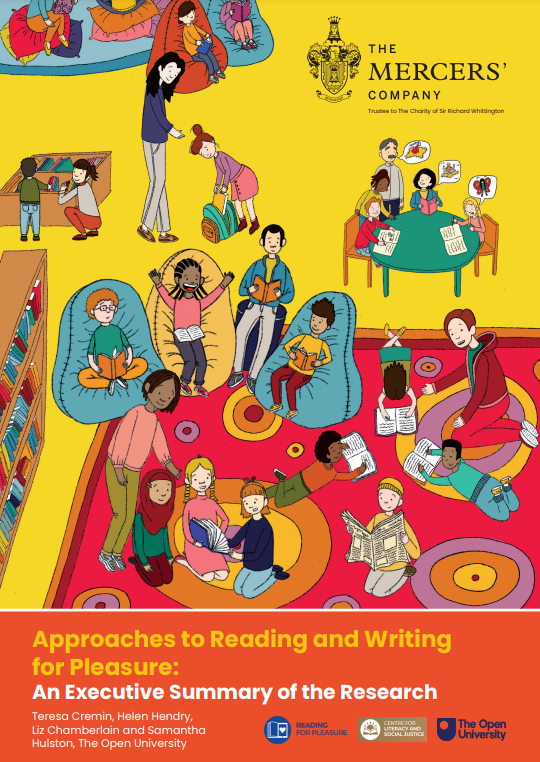
The OU team’s work was commissioned by the Mercers’ Company as part of its Young People and Education Programme ‘Literacy Special Initiative on Reading and Writing for Pleasure’ (2020-2023). The OU team reviewed the extant peer reviewed research literature, from 2000-2023 for young people aged 5-13 years. Their Executive Summary is here (LINK).
By Teresa Cremin, Helen Hendry, Liz Chamberlain and Samantha Hulston
Introduction
This Open University research builds on our own work at The Writing For Pleasure Centre (Young 2019; Young & Ferguson 2020, 2021, 2024; Young et al. 2023) by looking into effective approaches which motivate young writers. On a personal level, we’re delighted to see how this study supports the insights we’ve observed in Writing For Pleasure schools over the past five years [LINK].
A growing body of research has highlighted the profound benefits of nurturing a love for reading and writing in young people [LINK, LINK and LINK]. Engaging with literature and expressing oneself through writing not only enhances children’s academic performance but also contributes towards their social and emotional development [LINK]. Studies consistently demonstrate that avid readers benefit from improved comprehension, enriched vocabulary, and better learning outcomes, while those who write regularly enjoy increased self-efficacy and overall wellbeing [LINK].
Despite these clear advantages, recent surveys reveal a troubling decline in young people’s enjoyment of reading and writing. According to the Progress in International Reading Literacy Study (PIRLS), fewer than half of ten-year-olds express a fondness for reading, with a significant minority indicating outright dislike (Mullis et al., 2023). Similarly, only about one-third of 8 to 18-year-olds enjoy writing in their spare time (Clark et al., 2023). These trends are particularly pronounced among boys and those from economically underserved backgrounds.
Given these challenges, it is imperative for educators, parents, and policymakers to implement evidence-based strategies to rekindle young people’s interest in writing [LINK and LINK]. The practices mentioned throughout this article could help us reverse the decline in children’s writing enthusiasm (and outcomes) and instead foster a lifelong love for writing and being a writer [LINK].
Writer identities
This Open University research discusses how children’s experiences with writing in and out of school affects their identities as writers and their self-expression. It emphasises that writing is not just a skill but also a social activity that contributes to the construction and performance of identity [LINK]. Positive experiences with writing, including encouragement and support, foster a stronger writer-identity, which in turn can lead to greater motivation, perseverance, and success in writing [LINK].
Teacher interactions play a significant role in shaping children’s perceptions of themselves as writers [LINK]. Teachers’ views on writing, whether they see it as a creative pursuit or a set of technical skills, influence how they interact with their students and provide feedback [LINK and LINK]. These interactions can either support or hinder the development of a positive writer-identity [LINK]. For instance, if teachers (or scheme-writers) hold narrow views of what it means to be a writer, students who don’t fit that mold may develop negative attitudes towards writing [LINK].
Furthermore, the use of ability groupings in schools can impact children’s writer-identities. Those placed in so-called ‘lower ability groups’ often have a weaker sense of writerly confidence, leading them to avoid taking risks in writing. This can create a cycle where children who feel less capable as writers engage less with writing, further diminishing their confidence, experience and ability.
Research indicates that with proper encouragement, children can develop a growth-mindset about their writing competencies and identities, which can enhance their confidence and willingness to engage in writing [LINK]. Social interactions, particularly with peers, also play a significant role in shaping writer identities [LINK]. Collaborative writing experiences, where students can discuss their writing choices and challenges, help them reflect on their compositions, build a positive sense of self as writers, and recognise the value of their peers as fellow writers [LINK].
In summary, the construction of positive writer-identities is crucial for children’s success in writing, and these identities are heavily influenced by their experiences and interactions, particularly in school settings [LINK].
Component, agentic, and social writers
Cremin and her colleagues highlight the importance of developing autonomy, competence, and relatedness in young writers. Their research highlights that children who experience a sense of agency in their writing are more intrinsically motivated to write [LINK]. Writerly autonomy allows children to make choices about various aspects of their writing, such as content, process, and audience. However, at present, popular writing schemes often constrain this autonomy. Providing regular opportunities for children to write in a supportive environment can help them exercise their authorial agency [LINK].
Importantly, the research highlights the reciprocal relationship between autonomy and competency in writing. As children feel more autonomous, they tend to write more, which in turn improves their competence and reinforces their confidence [LINK]. Conversely, children with lower confidence are more likely to avoid writing. A child’s writerly confidence is often influenced by feedback from trusted sources such as their writer-teacher, peers, and professional writers. Therefore, creating supportive writing environment that offers constructive feedback and reassurance is essential for fostering a sense of competence in young writers [LINK and LINK].
Additionally, engaging in real-world writing projects and focusing on the audience who will receive their writing can enhance children’s sense of competency too [LINK]. Writing not only serves as a means of self-expression but also as a way to connect with others. The motivation to create connections with readers is a key aspect of writing [LINK].
Reading for pleasure and writing for pleasure connected
Existing research points to a mutual reinforcement between reading for pleasure and engaging in writing. Positive reading experiences often inspire children to replicate the joy and insight gained from reading by undertaking writing for themselves [LINK, LINK, LINK, LINK, LINK and LINK].
The broader a child’s reading repertoire, the more diverse their writing styles tend to be, with increased confidence and competence in writing often linked to their preferences as readers. This connection is facilitated by identifying and adopting textual features during reading that can be employed in their writing, which in turn enhances their awareness of authorial choices and fuels their motivation to write [LINK].
The research also emphasises the value young people place on agency in their writing, enjoying the autonomy to choose content, form, structure and the direction of their writing. This sense of authorial freedom is a significant motivator, fostering creativity and self-expression [LINK]. However, when children are generating their own writing ideas within the parameters of a class writing project, they benefit from support, instruction and feedback from their friends and their writer-teacher [LINK]. Giving children autonomy does not mean teacher apathy [LINK].
When children have limited control over their writing, it can lead to negative responses, including disengagement and anxiety. On the other hand, opportunities to engage in purposeful, real-world writing projects, where the value and relevance of writing to their lives is clear, can significantly enhance their motivation [LINK and LINK].
Children who see writing as a tool for personal expression and social connection are more likely to develop an intrinsic desire to write [LINK]. With this in mind, the importance of teachers getting to know their students is emphasised, as understanding their funds-of-knowledge, funds-of-identity, and funds-of-language can help children align class writing projects to topics that resonate with them [LINK].
Outside of school, young people often engage in various forms of personal and purposeful writing, such as social media posts and fanfiction, which draw on their cultural experiences and interests. However, this writing is not always recognised or valued in the classroom, which can diminish students’ pleasure in and desire to write in school settings [LINK].
Setting time aside for writing
The researchers underscore the importance of explicit and dedicated time for teaching writing in schools. Existing studies suggest that allowing time for students to explore and innovate in their writing is crucial for developing their competence and motivation as writers [LINK]. However, just increasing the amount of time children get to write without provide direct instruction will minimise its effectiveness [LINK and LINK].
Research highlights the benefits of offering children opportunities to choose when and how they write. In the early years, this would certainly include giving children access to writing tables, writing journals, blank picturebooks and ‘personal writing project’ time [LINK and LINK]. These practices support the idea that when children have agency in their writing, they are more likely to engage with it purposefully and with enthusiasm [LINK].
Some children also choose to write outside of school, making time to write at home or in online spaces where they can engage at their own pace [LINK and LINK]. These environments foster volitional engagement in writing, allowing young people to pursue writing on their own terms and in ways that are personally meaningful to them. The flexibility and autonomy provided by these contexts are important for nurturing a lasting interest in writing.
Social interactions around writing
The research study also emphasises the role of interaction and peer collaboration in supporting young writers and highlights how talk can positively influence children’s writing development. Here’s a breakdown of the key points:
- Role of talk and collaboration: Interaction among peers and with writer-teachers is crucial in helping young writers generate ideas, collaborate, reflect on their compositions, and respond to the writing of others [LINK and LINK]. Research shows that talk is instrumental in these processes, assisting students in testing ideas and considering their writer identities [LINK]. It also contributes to their engagement and motivation by creating a supportive environment where they can discuss and develop their writing.
- Impact of oral storytelling: Participating in oral storytelling and enacting their own stories can inspire them to write with greater authorial agency and intentionality [LINK and LINK].
- Motivational aspects of collaboration: Peer collaboration, such as co-production and peer-assisted writing, is shown to foster a sense of connection and relatedness among students. These collaborative activities are linked to increased writing motivation and engagement [LINK]. Informal interactions around writing, driven by students’ social relationships, can also encourage more frequent and meaningful writing [LINK].
- Learner-led interactions: The most effective interactions are often those that are learner-led rather than teacher-led. When teachers show genuine interest in students’ writing, respect their authorial agency, and provide constructive feedback, students are more likely to take control of their writing process [LINK]. This approach supports children’s independence and enhances their confidence.
Teachers as writing role models
Finally, the researchers explore the significant role of writing role models (both teachers and professional writers) in shaping students’ experiences and attitudes towards writing.
- Investment in writing: Teachers who actively engage in writing alongside their students can foster positive attitudes towards writing and make the process more enjoyable [LINK]. Sharing their own writing experiences, including their successes and challenges, can be particularly motivating for students [LINK].
- Teacher confidence and identity: Even teachers who may not feel confident as writers will have a positive impact on their students by adopting a visible and developing writer identity of their own This allows them to connect with their students as a fellow (albeit older and more experienced) apprentice writer. A teachers’ own histories and confidence will influence their teaching practices, which can range from seeing writing as a skills-based activity or as a more communicative pursuit [LINK, LINK and LINK].
- Impact of teacher experience: Teachers who have extended opportunities to write and reflect on their experiences often develop greater self-confidence, which can lead to positive changes in their teaching practices too [LINK].
- Personal and social spaces: Some teachers aim to create a shared writing culture where students can confidently navigate between personal and social writing spaces. This approach helps students see writing as a socially supported and personally purposeful activity [LINK].
- Supportive communities: Writing communities that are inclusive and offer substantial support can enhance students’ sense of autonomy and motivation [LINK]. Such communities also help students manage the opportunities of becoming authors.
- Publication and audience engagement: In connected writing communities, students’ writing is often published and shared through various means (performances, readings, debates, anthologies, and digital resources). Focused attention on the audience for their writing can further motivate students [LINK and LINK].
Conclusion
This Open University research underscores the multifaceted nature of writing as it intersects with children’s identities and self-expression across various contexts (home, school, and beyond). The findings reveal that writing is more than a skill – it is a social activity deeply intertwined with how children perceive themselves as writers and their motivation to engage in writing [LINK, LINK, LINK and LINK].
In summary, fostering positive writer-identities requires a communicative approach that integrates supportive teacher interactions, opportunities for autonomy, and meaningful social engagement [LINK and LINK]. By creating environments that recognise and nurture these elements, educators can significantly enhance students’ motivation and success in writing [LINK and LINK]. This is a beautiful thing.