
How our book-making approach frees up working memory, enabling children to write with confidence by developing and organising their ideas before they have to manage transcription.
Watch any young writer sit down to transcribe a sentence and you can often see the strain. They are trying to remember what they want to say, find the words to express it, hold the sounds in their mind, and form their letters correctly, all at the same time.
This happens when schools, schemes, teachers or even so-called experts or consultants insist on asking children to deal with composition and transcription at the same time. The science of writing has, for a long time, understood that writing is not one skill but several, working together under the limits of a child’s working memory (LINK). When all of these demands land on a child simultaneously, something has to give, and it is usually the quality and ambition of the writing itself.
Our book-making pedagogy offers a more developmentally appropriate approach. Rather than asking children to generate ideas, plan, translate and transcribe all at once, we separate out these demands and sequence them carefully. Composition comes first. Transcription follows. The result is a more rigorous and systematic writing instruction. It is writing instruction that respects how much a young writer can actually hold in their mind at once.
Settling the thinking before the transcribing begins
Through our book-making approach, children spend real time on composition before they are asked to transcribe a single word. They generate ideas through ‘Idea Parties’ and use talk and drawings to decide what their book will be about. They then sequence their ideas onto the pages of their book by putting an illustration on each page. They then use these illustrations to orally rehearse the sentence(s) they want to transcribe to paper.
By the time a child picks up their pencil, the composing element is largely done. They are now in a position to focus on transcribing their ideas to paper. By settling their compositions first, book-making removes the competition in working memory.
For young writers, drawing and talking supports the compositional work of writing.
Drawing functions as an early and genuine form of text construction. When children draw, they take their ideas out of their minds and organise them onto paper, freeing up their working memory (LINK). Their illustrations become a stable reference point that they can return to and orally rehearse. They no longer need to hold this information in their mind. Freeing them up to focus on transcription.
Oral rehearsal does similar work at the sentence-level. Children build their sentence(s) aloud before they write them, and can adjust its structure and meaning through teacher and peer feedback (LINK). When it’s time to transcribe, the sentence already exists. They are not searching for content and a sentence structure at the same moment. Working memory is free to focus on transcription.
How our book-making approach develops through the year groups
The examples below show how we can adjust our transcription expectations as children’s writing fluency develops (in earnest). As children’s fluency increases, we can increase the amount of thinking they are to transcribe in one sitting.
LEVEL ONE (Nursery – Reception): A mixture of emergent writing, single words or short phrases on each page
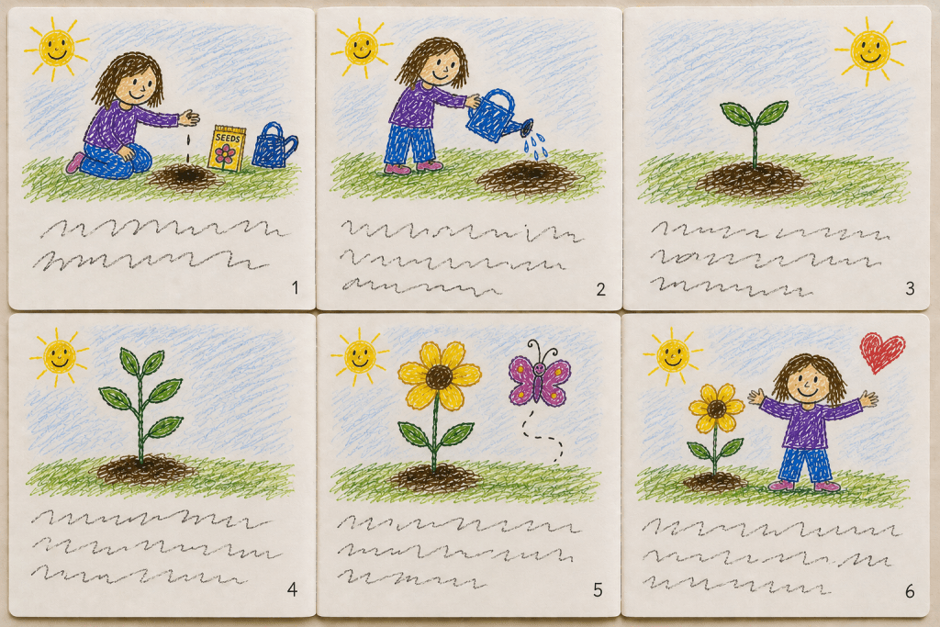
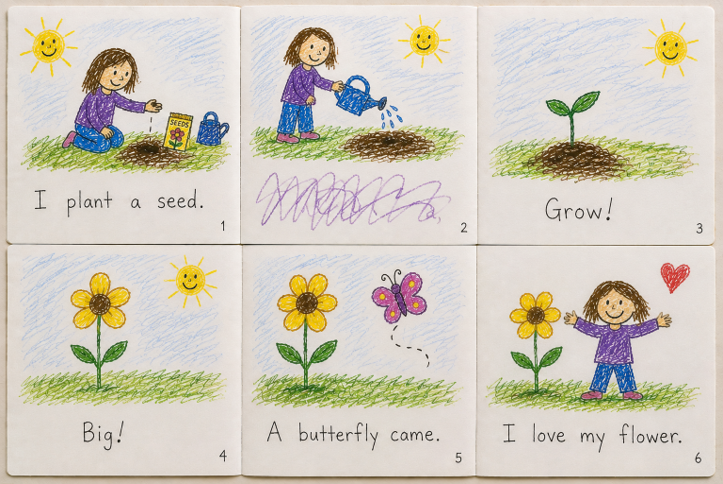
At Nursery and at the start of Reception, most children will use emergent writing or kid writing, as a temporary scaffold, to create their texts. However, once phonics, handwriting and spelling instruction is introduced, they’ll transition quickly onto writing single words or short phrases.
LEVEL TWO (Reception – Year One): A single sentence per page
At level two, a child can be expected to commit to a single sentence to each page of their picturebook (sometimes they’ll just be having such a great day they’ll want to do more). The cognitive demand of transcription is kept low so that a child who is still building their handwriting and spelling automaticity can create a whole text and feel the success and satisfaction that comes with that.
Our expectation is that children in Reception/Year One would learn to craft books like this. By the way, for children new to English, LEVEL ONE or LEVEL TWO is a really great place to start (LINK)
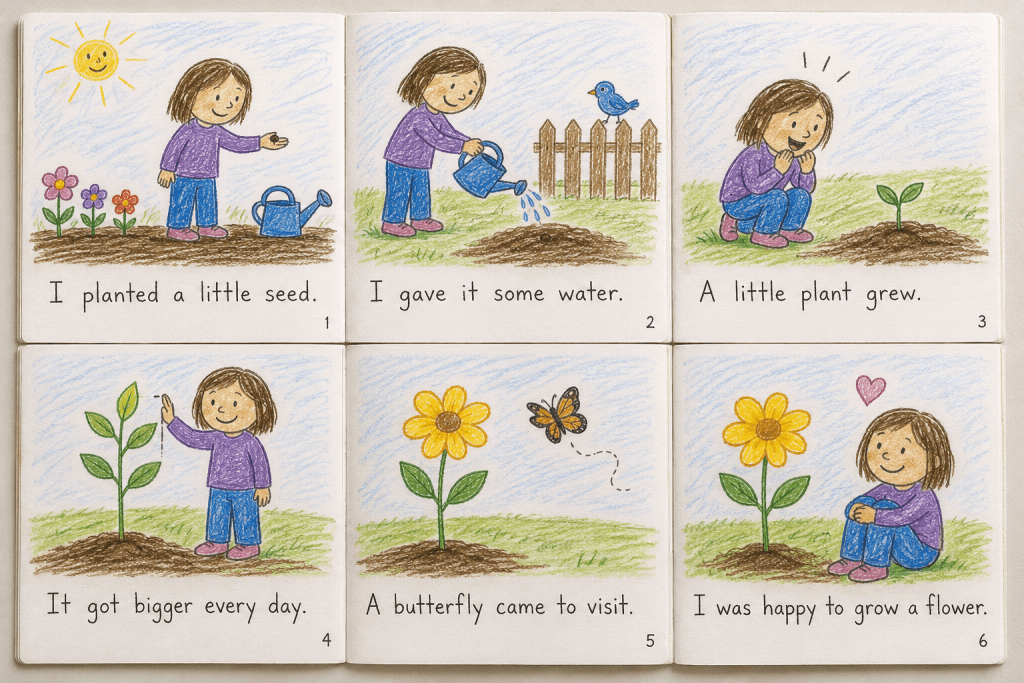
LEVEL THREE (Year One – Year Two): Multiple sentences per page
This is a small step up in transcriptional load. When children are ready, they can be asked to transcribe more of the content they have already settled on through their talk, drawing and oral rehearsals. Often, you’ll know that they’re ready because, despite asking only for a single sentence, they’ll ignore you and want to write multiple sentences on each page anyway! We find this is typical in year one and into year two.
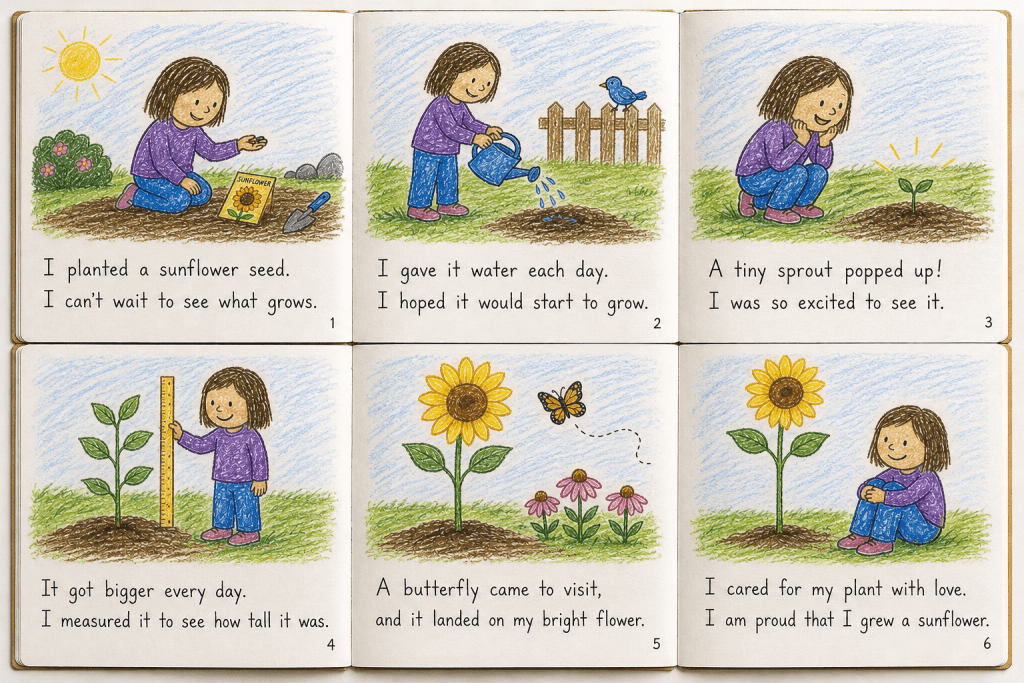
LEVEL FOUR (Year Two – Year Three Onwards): A paragraph per page
At LEVEL FOUR, each page becomes a short paragraph of three or four sentences. This is a substantial increase in transcriptional output. Critically, though, the approach remains reassuringly consistent. The expectation is that children draft a page a day.
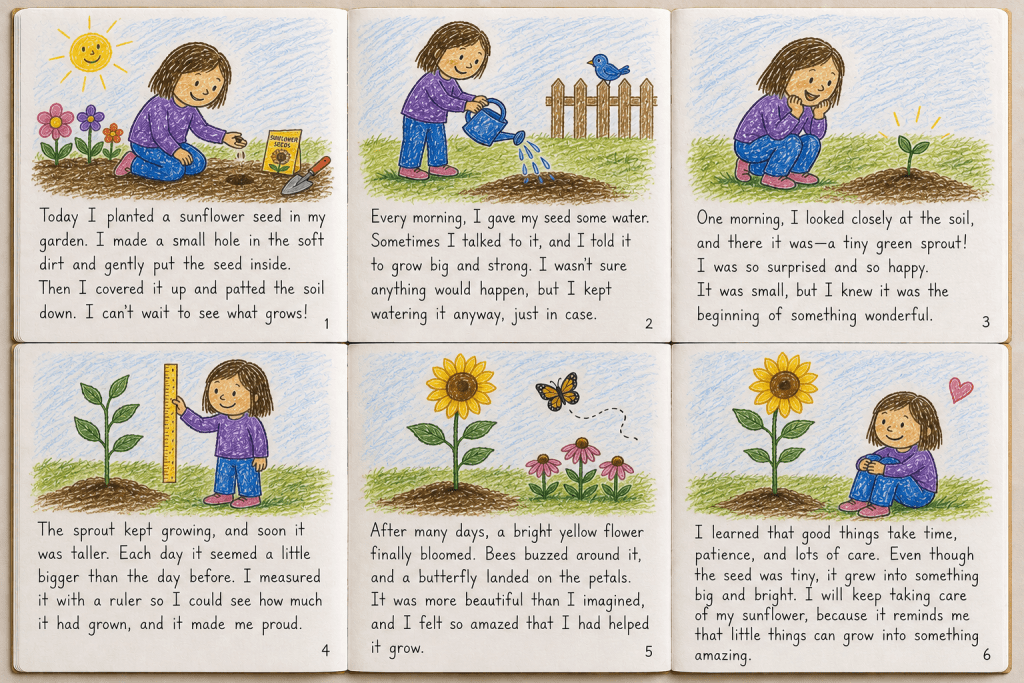
Seen side by side, the four levels make the composition-first argument visible. What changes is the transcriptional demand the teacher asks the child to manage in a single sitting. A teacher can move a class, a group, or an individual child between these levels at any time. Adaptive teaching becomes a matter of adjusting children’s transcriptional load, not redesigning the entire writing task!
Transcription becomes a manageable task
Book-making treats transcription as the final stage, made easier by everything that’s come before it.
Once children’s compositions are settled, children’s attention can go towards forming letters, encoding words and using punctuation (LINK).
This is still demanding work! But children are no longer being asked to simultaneously invent content, plan it all in their mind and then transcribe it to paper in one sitting. Our approach creates room for transcription and composition to improve. We see transcriptional fluency increase, feelings of pride and success increase, and final outcomes become longer and more controlled. This is because transcription is no longer competing with composition for the same limited attention.
This is at the heart of the book-making approach. Strong transcription is not the precondition for good composition. It is something composition-first teaching makes possible.
Book-making should not replace explicit transcription teaching.
Book-making sessions work best when they sit alongside regular, explicit and well-taught handwriting and spelling lessons. These lessons need to be timetabled in their own right [LINK].
Handwriting and spelling require their own short, regular, explicit sessions, separate from book-making time, where letter formation, spelling patterns, and orthographic knowledge can be taught directly and practised deliberately. Importantly, what children learn in these sessions does not stay contained within them. Instead, they use and apply all that rich learning straight into their books.
Seen this way, these two kinds of lessons are feeding the same outcome from two directions.
- Explicit transcription teaching builds the automaticity and fluency that book-making sessions depend on.
- Book-making sessions give the real and motivating context in which children actually want to improve their transcriptional skills!
Writing for a reason changes how children behave as writers
Importantly, book-making doesn’t produce isolated sentences. It produces short but complete texts. Books that can be told, read, shared, revisited and enjoyed by others. That sense of audience and purpose changes how children engage with writing.
Studies of authenticity in children’s writing find that pupils consistently prefer, and invest more effort in, writing that serves a genuine communicative purpose for a real audience beyond the classroom. We know that they pay more attention, put in more effort, persist for longer, show greater enthusiasm, seek support from others rather than give up, write more independently and are less likely to allow themselves to be distracted (LINK, LINK)
They care about whether their meaning comes across. They also start to see themselves as authors, with control over different kinds of texts, rather than as pupils completing an exercise. Writer identity, understood as a pupil’s sense of themselves as someone who is a genuine writer, is also associated with stronger engagement, positive dispositions towards writing and exceptional academic progress (LINK).
This approach isn’t just practice. It is publication. That distinction matters to how seriously children take their own writing.
What this looks like for the teacher
None of this happens by accident. Teachers model how to make a book, from the initial idea to the illustrations. They demonstrate oral rehearsal of sentences, guide children to sequence their pages, and support them as they refine and orally rehearse what they want to transcribe to paper.
This level of quality instruction is what allows children to enter the transcribing stage with confidence rather than uncertainty.
Top tips:
- In addition to book-making sessions, deliver short, regular, explicit handwriting and spelling lessons. These should be timetabled in their own right [LINK].
- Before transcribing, children should talk, draw and orally rehearse their ideas [LINK, LINK, LINK, LINK and LINK].
- Children should be asked to transcribe at whatever level of sentence demand is most appropriate.
- After transcribing, children should ‘tell’ or otherwise read back their writing to their teacher or friends. This way, they can check if their meaning was clear and well understood.
To end
By settling composition first, through talk, drawing, and oral rehearsal, you ensure that when children turn their attention to transcription, they are writing language they already own rather than trying to invent and write it at the same time.
It’s this ordering that allows young writers to produce manuscripts that are longer, more controlled, more successful and more genuinely their own. It’s also an awful lot of fun!