
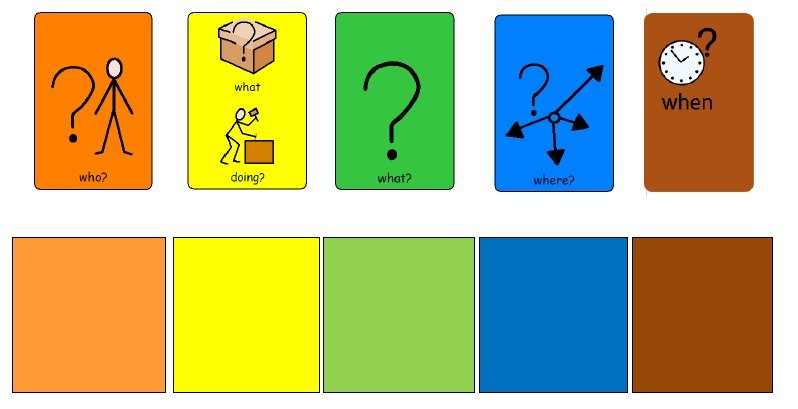
Orange who cards, yellow doing cards, green what cards and blue where cards line the working wall. Sentence strips sit on tables. Children sort picture symbols into coloured boxes and read back ‘The boy is kicking the ball in the park.’
Children transcribe these sentences and teachers see progress on the strip in front of them.
But there is a problem hiding in that ‘progress’. Children are just getting better at Colourful Semantics. That is not the same thing as getting better at writing. This article explains why this matters, what the evidence does and does not say, and what might be better evidence-informed alternatives.
Where Colourful Semantics came from and what the evidence says
Colourful Semantics was not designed as a writing pedagogy. Alison Bryan (1997) developed it as a speech and language therapy for children with expressive language difficulties, often what we would now call developmental language disorder. It colour-codes the thematic roles in spoken sentences so children can see and assemble its parts.
The evidence for it, even in clinical settings, is thin:
- Bolderson et al. (2011) worked with six children aged 5–6 with expressive difficulties, twice weekly for eight weeks. Their spoken sentences improved but there was no control group. This means the gains could reflect repeated testing or ordinary development anyway.
- Hettiarachchi (2016, 2019) studied groups of 30 children in Sri Lanka. Children with intellectual disabilities and children who are deaf or hard of hearing. Both studies found gains in spoken language. However, neither had a control group.
- Christopoulou et al. (2021) Is a randomised controlled trial with 40 autistic preschoolers in Cyprus. Adding Colourful Semantics to a wider oral language communication intervention significantly improved children’s spoken grammar and vocabulary.
- Papakyritsis et al. (2024) worked with a single child with Down syndrome. Eight weeks after treatment, the child was still producing ‘full’ spoken sentences for nearly half the target pictures without the colour coding.
It’s worth noting that, in our review of best practice for supporting children with SEND as writers, Colourful Semantics never appeared as a recommended practice. For more on this, see our publication: Supporting Children With SEND To Be Great Writers: A Guide For Teachers And SENCOS [LINK].
There is some evidence that Colourful Semantics can support oral language development, particularly for children with significant language and learning needs. What is almost entirely missing, however, is evidence about writing. Only a very small number of studies have directly examined written outcomes. For example, Kee and Tay (2017) reported substantial improvements in sentence-writing scores among 31 Malaysian Year 4 pupils following a four-week intervention. However, there was no control group, and the pre- and post-tests involved very similar tasks. More recently, Barter and Marley (2025) reported improvements in the written sentence construction of six Year 1 bilingual pupils following an intervention. This was a small practitioner research project rather than a controlled study. Neither provides convincing evidence that Colourful Semantics improves children’s ability to write independently, transfer sentence knowledge to unfamiliar contexts or develop as writers more broadly.
This is an evidence gap and not proof of failure. My central point would be this: we have very little evidence that Colourful Semantics improves writing beyond the specific sentence-construction activities in which children have been intensively trained. However, we do have evidence of what can work for children with SEND [LINK].
Getting better at the task, not at writing
The central problem is transfer. When children practise a specific task, they get better at that task. Whether the gains carry over to something different is a separate question, and the answer is usually ‘far less than we hoped’. For more on this, see our article on ‘precision teaching’ [LINK].
A Colourful Semantics session is a very particular intervention task. The teacher supplies a picture. The child is cued by a fixed sequence of questions: who, doing, what, where. The answers slot into the coloured boxes. Success in this intervention means a complete, correctly ordered clause about someone else’s picture. This is not the same as learning to write.
Composing a piece of writing asks for something quite different. First, children should be given plenty of opportunity to think about what they want to say, to whom and why. Then, they need plenty of time to plan their ideas before drafting. Next, they need strategies that help them hold an idea in mind, find the words to express it, and shape sentences that connect with those that came before. For more on this, see our article on the science of early writing and our book-making approach [LINK].
It is entirely possible for a child to move up the Colourful Semantics stages while their independent writing barely changes. We see this in classrooms. Children who can produce ‘The girl is eating an apple in the kitchen’ on demand, yet whose own writing remains a list of disconnected and effortful sentences.
There is also a second risk. When the coloured frame becomes the model of ‘a good sentence’, children may well learn to write to the frame. Every sentence becomes who–doing–what–where. Their writing might get longer, but it is bad writing. It’s unnatural and robotic: The boy is going to the park. The boy is playing on the swings. The boy is eating an ice cream at the park. Each sentence is technically complete, but nothing connects one sentence to the next. Nothing varies, and nothing sounds like a real person telling a reader something. Young writers don’t build sentences by filling in slots. They choose what to put first and what to leave out. They decide when a short sentence will land better and how one idea leads into the next. Colourful Semantics teaches none of this. Adding a blue ‘where’ and a purple ‘describing word’ is rewarded whether or not the reader actually needs it. Over time, children learn that writing means completing a pattern rather than saying what you really mean (LINK for more on this).
What the wider grammar research tells us
Writing starts with meaning not with naming sentence parts. At times, you get the feeling that Colourful Semantics is more interested in developing children as ‘structural linguists’ than as writers (LINK and LINK for more on this).
Children write well when they have something they want to say and someone they want to say it to. Colourful Semantics, by design, removes both. The content comes from a picture card. The audience is the adult checking their strip for correctness alone.
Colourful Semantics is, at heart, decontextualised grammar work. We have decades of research on what that kind of teaching does for children’s writing.
- Andrews et al. (2006) reviewed the evidence for teaching formal grammar to 5–16-year-olds. They found no good evidence that it improved the quality or accuracy of pupils’ writing.
- Graham and Perin (2007) found that traditional grammar instruction had a negative average effect on pupils’ writing quality.
- Myhill et al. (2012) found that grammar instruction can help, but only when it is taught in the context of making real composition.
So what should teachers do?
Use Colourful Semantics where it was designed to be used. For a child with an identified expressive language difficulty, working with a speech and language therapist, it may be a sensible oral language support. That is a targeted intervention for a few children. It is certainly not a writing intervention or whole-class writing programme.
Don’t judge it by the strip. If you do use it, measure success in children’s own independent writing, not in their Colourful Semantics work. If their strips improve but their own writing doesn’t, the intervention isn’t working.
Take the scaffold away. Any scaffold should be designed to disappear. A child who still needs cue cards to write a sentence after a term is a child we need to rethink our approach for.
Sentence development is best undertaken inside real writing. That looks like:
- Children writing about things they know and care about, for real readers.
- Plenty of talk, drawing and planning before writing so their ideas are well rehearsed (‘think it, say it, draw it, write it’).
- Short, focused mini-lessons on sentence-level craft moves linked to the piece children are writing now.
- Teachers modelling their own sentence choices in their own writing.
- High-quality verbal feedback where a teacher helps a child say more about their idea rather than prompting them through a fixed sequence.
The goal is children who can say what they mean to someone who wants to read it.
Identifying and addressing children’s writing needs
Assign children to the intervention they need most and make sure that intervention matches what you want children to do in whole-class writing lessons.
A child’s difficulties with sentences rarely have just one cause. Before choosing an intervention, assess what is actually getting in the way. It might be handwriting, spelling and encoding, oral language, or sentence construction and cohesion. Deal with the most basic barrier first: a child who still finds forming letters effortful is unlikely to benefit from sentence work until that is addressed.
A sentence-level intervention should also look like the writing children do in class. That means having ideas of their own, rehearsing them aloud, drafting and revising, but with more time, a smaller group, and additional instruction, modelling and responsive feedback from a writer-teacher. Book-making, writing club and focus groups all work this way. Evaluate the intervention with the same kind of assessment that identified the need. Then judge it by the child’s independent writing in whole-class lessons. If the intervention and the classroom ask children to do different things, the gains are unlikely to carry over. For more on this, see our guide to interventions (LINK).
Two alternatives worth trying
If you want sentence teaching that carries into children’s own writing, two resources from The Writing For Pleasure Centre are ideal for you..
- Sentence-Level Instruction: Lessons That Help Children Find Their Style & Voice for 3–11 Year Olds (LINK). These short lessons are organised by what children are trying to achieve: focused, balanced and developed sentence lessons. Each lesson follows a simple pattern of ‘teach, then invite’. The teacher names a sentence-level craft move and shows it in their own writing and in mentor texts. Children then try it in the piece they are writing that day.
- Sentence-Building Mini-Projects (LINK). These are short book-making projects, each centred on one sentence-level craft move, from conjunctions and relative clauses to parenthesis and the passive. On the surface, a picture and a sentence on each page may sound just like Colourful Semantics. The difference is fundamental. Children write about things they want to say and draw their own pictures. They revise sentences they composed themselves and think about what each sentence-level change does for their reader. The projects are short and repeatable. They can be used with a whole-class or as an intervention with specific pupils.
References and further reading
- Andrews, R., Torgerson, C., Beverton, S., Freeman, A., Locke, T., Low, G., Robinson, A. and Zhu, D. (2006) The effect of grammar teaching on writing development. British Educational Research Journal, 32(1), 39–55. https://doi.org/10.1080/01411920500401997
- Barter, L., & Marley, B. (2025). Colourful Semantics in action: Supporting Year 1 bilingual writers. NALDIC. https://naldic.org.uk/colourful-semantics/
- Bolderson, S., Dosanjh, C., Milligan, C., Pring, T. and Chiat, S. (2011) Colourful Semantics: a clinical investigation. Child Language Teaching and Therapy, 27(3), 344–353. https://doi.org/10.1177/0265659011412248
- Bryan, A. (1997) Colourful Semantics: thematic role therapy. In S. Chiat, J. Law and J. Marshall (eds) Language Disorders in Children and Adults: Psycholinguistic Approaches to Therapy. London: Whurr, 143–161.
- Christopoulou, M., Voniati, L., Drosos, K. and Armostis, S. (2021) Colorful semantics in Cypriot-Greek-speaking children with autism spectrum disorder. Folia Phoniatrica et Logopaedica, 73(3).
- Graham, S. and Perin, D. (2007) Writing Next: Effective Strategies to Improve Writing of Adolescents in Middle and High Schools. Washington, DC: Alliance for Excellent Education.
- Hettiarachchi, S. (2016) The effectiveness of Colourful Semantics on narrative skills in children with intellectual disabilities in Sri Lanka. Journal of Intellectual Disabilities, 20(1), 18–33.
- Hettiarachchi, S. and Ranaweera, M. (2019) The effectiveness of using the ‘Colourful Semantics’ approach to support language development with children who are deaf or hard-of-hearing. Deafness & Education International, 21(4), 157–173. https://doi.org/10.1080/14643154.2019.1573473
- Kee, L. L. and Tay, J. Y. (2017) The use of colorful semantics to improve sentence construction in writing sentences among Year Four pupils. Journal of English Education, 2(1).
- Law, J., Lee, W., Roulstone, S., Wren, Y., Zeng, B. and Lindsay, G. (2012) ‘What Works’: Interventions for Children and Young People with Speech, Language and Communication Needs. London: Department for Education.
- Myhill, D., Jones, S., Lines, H. and Watson, A. (2012) Re-thinking grammar: the impact of embedded grammar teaching on students’ writing and students’ metalinguistic understanding. Research Papers in Education, 27(2), 139–166. https://doi.org/10.1080/02671522.2011.637640
- Myhill, D., Jones, S., Watson, A. and Lines, H. (2013) Playful explicitness with grammar: a pedagogy for writing. Literacy, 47(2), 103–111. https://doi.org/10.1111/j.1741-4369.2012.00674.x
- Papakyritsis, I., Daskalaki, K. and Nerantzini, M. (2024) The effectiveness of a sentence-building treatment protocol based on Colorful Semantics. Journal of Monolingual and Bilingual Speech, 6(2), 169–197.
- PenCRU (2018) What’s the Evidence? Is Colourful Semantics an effective therapy for improving language development in children with Autism Spectrum Disorder? Peninsula Cerebra Research Unit, University of Exeter.
- Young, R. and Ferguson, F. (2023) Sentence-Level Instruction: Lessons That Help Children Find Their Style & Voice for 3–11 Year Olds. 2nd edn. Brighton: The Writing For Pleasure Centre.
- Young, R., Ferguson, F. (2025) Sentence-Building Mini-Projects. Brighton: The Writing For Pleasure Centre.