
We recommend reading the PDF version of this article as the formatting is much better [LINK].
Last year, we shared our Writing Map [LINK], a writing equivalent of Christopher Such’s reading map [LINK]. It’s something we use in our professional development. However, colleagues working in Nursery and Reception have been asking us a very reasonable question: What does the science of writing look like before children can write conventionally?
This article is our answer. The Emergent Writing Development Model zooms in on the very beginning of the writing map. It sets out what the youngest of writers are developing, what conditions let that development happen, and how the visible products of their writing typically change over time.
We think it’s important that early years teachers and school leaders have a secure understanding of how young children become writers. Early writing pedagogy is an area where folk wisdom, inherited habits and well-meaning caution have too often filled the space where research evidence should be (Young & Ferguson 2027). A shared model gives us a shared language and a shared set of expectations.
You can see the model below. Let’s take a look at it, step by step.

Conceptualising emergent writing
At the centre of the model sits a single definition: emergent writing is purposeful communication through the increasingly sophisticated use of marks, letters, words and conventions.
Every element of the model exists to support that core act of meaning-making and meaning-sharing.
Emergent writing is not a preparatory stage before ‘real’ writing begins. It is real writing in the sense that matters developmentally. Children use scribbles, drawings, letter-like shapes, strings of letters and ‘informed spellings’ to represent their meaning.
The difficulty for teachers is that emergent writing does not develop in a neat, single straight line. It doesn’t develop one domain at a time, nor at a matched pace across domains. A child’s growing understanding that writing carries meaning, their oral language, their ability to segment spoken words into sounds, their transcription skills, their sense of themselves as ‘a person who writes’, and the responses they get from their readers are all developing at the same time and shaping one another.
The model therefore separates three questions that are too often collapsed into one:
- What develops? → the eight domains.
- What supports this development? → the four conditions.
- What does it look like on the page? → the trajectory.
Each domain has a direct, two-way relationship with the centre. Development in a domain improves a child’s communication, and meaningful communication gives each domain a reason to develop. The domains also influence their neighbours, which is why the model is drawn as a ring rather than as a ladder.
The eight domains
1. Ideas and purpose – Why I am writing this
Ideas and purpose is the child’s sense of why they are making marks at all. Long before children can write conventionally, they use writing for recognisably distinct purposes: to express something personal, tell someone about an event, entertain, record something they want to remember, or imitate the writing they’ve seen adults do. What they choose to write is heavily shaped by their interests, play and experiences.
When early years teachers support children’s composing, their pupils end the year with stronger name-writing and spelling skills (Young & Ferguson, 2027).
2. Oral language and thinking – What I can say and think
Before a child can compose a written sentence, they draw on the vocabulary, sentence structures, narrative know-how and background knowledge of their spoken language. Oral language predicts the quality of children’s writing throughout the early years (Young & Ferguson, 2027). There is no point at which a child has ‘enough’ vocabulary to begin writing. Instead, oral language keeps feeding writing and writing keeps feeding oral language development.
Talking through what you are about to write (oral rehearsal) is one of the most powerful supports available to an emergent writer (Young & Ferguson, 2027). It lets thinking and language happen ahead of, and separately from, the physically demanding act of transcription.
3. Phonological and alphabet Knowledge – What I know about sounds and letters
Phonological awareness (noticing and manipulating rhyme, syllables and individual sounds) and alphabet knowledge (letter names and the sounds they represent) give a child the knowledge they need for producing informed, and eventually conventional, spelling.
- Encoding = segmenting a spoken word into sounds and matching those sounds to letters.
- Informed spelling = the observable product of a child attempting to encode before conventional spelling is secure.
- ‘Kid writing’ = a strategy in which children write the sounds they know and leave a line for the sounds they don’t know – yet (Feldgus et al. 2017).
A phonetically plausible spelling is not an error to be stamped out. It is highly informative. The quality of children’s informed spelling in the early years predicts their later reading and spelling skills (Ouellette & Sénéchal 2008, 2017) and children who are supported to encode make gains in spelling, word reading and writing motivation (Young & Ferguson, 2027).
4. Transcription skills – How I form my writing
Transcription is the physical act of getting language onto the page: letter formation, recognisable words and the gradual use of spaces and punctuation.
Letter writing develops gradually. Explicit handwriting instruction works. However, motor-skills-only programmes do not (Santangelo & Graham 2016).
5. Concepts of print – What I know about how writing works
Concepts about print are the conventions that govern written language as a system: that print carries meaning, how books are organised, directionality, that words are separated by spaces, and that different text types look and work differently (Young & Ferguson, 2027).
Alongside name writing and letter knowledge, print knowledge at school entry is among the strongest predictors of later writing attainment (Dunsmuir & Blatchford, 2004). Children build these concepts most securely by using print for a purpose (Young & Ferguson, 2027).
6. Drawing – How I support my writing
Drawing is a powerful support for children’s writing. They use it to plan and clarify their ideas before committing it to text. It is part of the composing process – not decoration.
When Mackenzie (2011) asked teachers to make drawing central to writing for the first six months of schooling, children produced texts that were more complex than those they produced through words alone. Drawing also takes the child’s plan out of working memory and puts it onto the page, where it can be seen and returned to.
7. Social interaction and Ffeedback – What I know about writing with others
For a young child, writing is rarely a solitary act. Shared writing, conversations about what a piece says, responsive feedback, and the modelling of teachers and more experienced peers all move a child’s writing beyond what they could produce alone. Children influence one another’s writing through image, movement and talk. The richest writing often happens in teacher- and peer-mediated circumstances (Young & Ferguson, 2027).
8. Motivation and identity – Why I want to write
Motivation and identity is the child’s relationship with writing: their interest and enjoyment, their sense of themselves as someone who writes, their perceived competence and their sense of agency over what and how they write.
A child can be transcriptionally and compositionally competent and still be minimally engaged, and as a result underperform. Conversely, a highly motivated child can write beyond what is ever predicted. Teacher assessment of children’s attitudes to writing is strongly associated with writing competence at age seven (Dunsmuir & Blatchford, 2004). Children in the early years can make distinct judgments about the value of writing, their self-concept as writers and their enjoyment of it (Mata, 2011).
The conditions that support development
These conditions determine the extent to which a child’s developing skills, knowledge and motivation get expressed, practised and extended.
A child can have considerable phonological and transcriptional knowledge and still write very little if the conditions around them don’t invite it.
Conversely, a child may have lots of opportunities to write made available to them in their environment, but may not have received the necessary instruction and support to develop the skills needed to produce their best writing.
| Condition | What it involves |
| Environment | Print-rich spaces, ready access to varied writing materials, and protected time to write and to revisit earlier writing. Emergent writers often return to a piece across several sessions. One-off writing episodes under-represent what children can do. |
| Culture & Community | The value that caregivers, peers, teachers and the wider community visibly place on children’s writing; the rich cultural and linguistic funds of knowledge children already bring to Nursery or school; and real-life purposes for writing at home, school and in the community. |
| Autonomy & Choice | Children’s agency over their writing topics and their decision-making power over their writing. |
| Teacher Role | Intentional teaching, instruction, modelling, scaffolding, close observation and feedback. |
Why does this matter? Because the evidence suggests these conditions are frequently absent. Many preschoolers experience as little as one minute of writing a day (Campbell et al., 2019). Writing in play areas is high-quality when it happens, but it is surprisingly rare (Quinn et al., 2022). Moreover, it is the quality of teachers’ instruction, modelling and interactions that predicts children’s writing growth (Guo et al., 2012).
The developmental trajectory of children’s writing

- Mark making – scribbles with no stable sound-symbol relationship, but already an intentional and communicative activity.
- Emergent scribbling – more controlled scribbles whose meaning is closely tied to the child’s accompanying talk and drawing.
- Letter-like forms and conventional letters – some marks become recognisable as letters or letter-like shapes.
- Informed spelling and word writing – letters begin to represent sounds systematically.
- Early conventional writing – spelling becomes more accurate, sentences are written and print conventions are applied more consistently.
We’ve drawn this as a strip. However, there are two important cautions:
- The phases overlap. Children frequently show features of more than one phase at once, particularly across different types of writing project. Development is often step-like, with rapid gains followed by plateaus of consolidation. It can be like the tide on the shore: great strides forward, then a retreat to what they know (Harmey & Wilkinson, 2019).
- The trajectory describes the page, not the child. A child capable of sophisticated oral composition may still be producing emergent scribbles because their transcription hasn’t caught up yet. A child with accurate transcription may still produce very little if they haven’t had the time and support to develop their drawings and ideas. To understand what’s really going on, you have to look across all the domains.
Teachers wanting a finer-grained tool will find Papadopoulos’s (2026) writing development rubric a useful complement to the five phases, as it helps locate exactly which domain, or which part of a domain, is holding a child’s writing back.
Once children begin encoding, our five-phases of spelling development takes over:
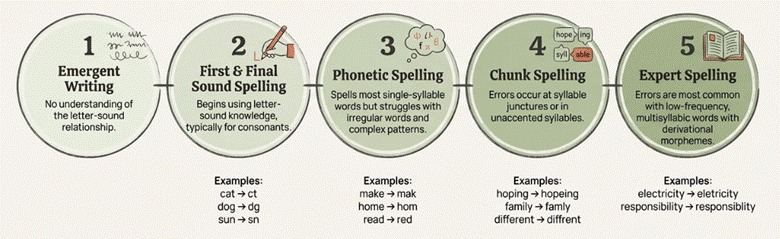
(Young & Ferguson, 2027)
What now?
While we offer one-off professional development sessions to schools and MATs, and recognise their value in strengthening schools’ conceptual understanding of writing and help them identify areas for improvement, we believe long-term and sustained support is essential for translating this knowledge into effective classroom practice. Most schools we work with ultimately seek more than just theoretical guidance – they want to implement a reassuringly consistent approach to writing teaching that they can adopt, adapt, and use as a foundation for change. In these cases, we typically introduce the theoretical foundations of writing instruction before guiding schools through our Writing For Pleasure approach that balances four key priorities:
- Checking the school’s provision for explicitly teaching encoding, handwriting and spelling.
- Developing children’s writing fluency in the EYFS and KS1.
- Providing opportunities for students to craft purposeful and authentic writing.
- Engaging students and teachers in discussions about writing to deepen their understanding of the craft.
To achieve these priorities, we introduce three core writing structures:
- Short ‘book-making’ projects: Focused intervention projects which build automaticity and accuracy in encoding and support sentence construction and cohesion.
- Reading as writers: Analytical and reflective discussions of mentor texts that help students establish ambitious goals for their writing.
- Class writing projects: Opportunities for students to generate ideas, plan, draft, revise, proof-read and publish extended pieces of writing.
These structures are not anything complex. They simply make practical the principles of world-class writing teaching [LINK for more on this]. They support teachers while allowing them flexibility for adaptation and ongoing improvement.
Our support also extends far beyond writing lessons. We help schools tackle challenges such as assessment, supporting children with specific writing difficulties, helping English language learners, and fostering a school-wide culture of writer-teachers. The majority of our work with schools can be summarised as follows:
- Providing constructive feedback on schools’ current approach to writing instruction and their writing curriculum, either through online discussions or in-person consultancy.
- Helping classroom teachers and school leaders develop a deeper understanding of writing development so they can make evidence-informed instructional decisions that feel right for their school.
- Outlining our Writing For Pleasure approach so that schools can adopt, adapt, or use it as a foundation for further development.
Finally, we work hard to provide free or very affordable alternatives to our consultancy work. We believe passionately in ensuring that high-quality professional development is accessible to as many teachers as possible.
- Anyone can send us a message via email, Twitter, Facebook or Blue Sky with any questions, and we’ll do our best to answer them.
- We hear from many schools who have used our website to drive their own CPD. You can access all our free CPD materials here.
- Individual teachers can purchase our eBook How To Teach Writing for £5.95. Schools can purchase a licence for all their staff to gain access for £54.75 [LINK].
- Teachers can purchase an individual licence to our website for £28.50 a year. This gives them access to all our eBooks, unit plans and resources [LINK].
- Schools can purchase a whole-school licence to our website for £400 a year. This gives everyone access to our eBooks, programme of study, assessment guidance, CPD materials, units plans and resources. If you’re a smaller school, get in touch as we may be able to provide you with a discount [LINK].
If you want to get in touch, you can use our contact form or email us: hello@writing4pleasure.com
Ross Young & Felicity Ferguson
References and further reading
- Adams, A. M., Soto-Calvo, E., Francis, H. N., Patel, H., Hartley, C., Giofrè, D., & Simmons, F. R. (2021) Characteristics of the preschool home literacy environment which predict writing skills at school. Reading and Writing, 34(9), 2203-2225.
- Bingham, G. E., Quinn, M. F., & Gerde, H. K. (2017) Examining early childhood teachers’ writing practices: Associations between pedagogical supports and children’s writing skills. Early Childhood Research Quarterly, 39, 35-46.
- Bissex, G. (1980) Gnys at Wrk: A Child Learns to Write and Read. Cambridge, MA: Harvard University Press.
- Cabell, S. Q., Gerde, H. K., Hwang, H., Bowles, R., Skibbe, L., Piasta, S. B., & Justice, L. M. (2022) Rate of growth of preschool-age children’s oral language and decoding skills predicts beginning writing ability. Early Education and Development, 33(7), 1198-1221.
- Campbell, K., Chen, Y. J., Shenoy, S., & Cunningham, A. E. (2019) Preschool children’s early writing: Repeated measures reveal growing but variable trajectories. Reading and Writing, 32(4), 939-961.
- Clay, M. M. (1966) Emergent Reading Behaviour [Unpublished doctoral thesis]. University of Auckland.
- Clay, M. M. (1975) What Did I Write? Beginning Writing Behaviour. Auckland: Heinemann.
- Clay, M. M. (2010) How Very Young Children Explore Writing. Portsmouth, NH: Heinemann.
- Dunsmuir, S., & Blatchford, P. (2004) Predictors of writing competence in 4- to 7-year-old children. British Journal of Educational Psychology, 74(3), 461-483.
- Dyson, A. H. (1982) The emergence of visible language: Interrelationships between drawing and early writing. Visible Language, 16(4), 360-381.
- Dyson, A. H. (1989) Multiple Worlds of Child Writers: Friends Learning to Write. New York: Teachers College Press.
- Feldgus, E. G., Cardonick, I., & Gentry, J. R. (2017) Kid Writing in the 21st Century. Hameray Publishing.
- Ferreiro, E., & Teberosky, A. (1982) Literacy Before Schooling. Exeter, NH: Heinemann.
- Guo, Y., Justice, L. M., Kaderavek, J. N., & McGinty, A. (2012) The literacy environment of preschool classrooms: Contributions to children’s emergent literacy growth. Journal of Research in Reading, 35(3), 308-327.
- Harmey, S. J., & Wilkinson, I. A. (2019). A critical review of the logics of inquiry in studies of early writing development. Journal of Writing Research, 11(1), 41-78.
- Kissel, B. (2009) Beyond the page: Peers influence pre-kindergarten writing through image, movement, and talk. Childhood Education, 85(3), 160-166.
- Mackenzie, N. (2011) From drawing to writing: What happens when you shift teaching priorities in the first six months of school? Australian Journal of Language and Literacy, 34(3), 322-340.
- Mata, L. (2011) Motivation for reading and writing in kindergarten children. Reading Psychology, 32(3), 272-299.
- McCutchen, D. (1996) A capacity theory of writing: Working memory in composition. Educational Psychology Review, 8(3), 299-325.
- Ouellette, G., & Sénéchal, M. (2008) Pathways to literacy: A study of invented spelling and its role in learning to read. Child Development, 79(4), 899-913.
- Ouellette, G., & Sénéchal, M. (2017) Invented spelling in kindergarten as a predictor of reading and spelling in Grade 1: A new pathway to literacy, or just the same road, less known? Developmental Psychology, 53(1), 77-88.
- Papadopoulos, I. (2026) Emergent writing in early childhood: Developmental patterns in drawing, scribbling, and letter-like forms. International Journal of Early Childhood, 1-18.
- Puranik, C. S., Petscher, Y., & Lonigan, C. J. (2013) Dimensionality and reliability of letter writing in 3- to 5-year-old preschool children. Learning and Individual Differences, 28, 133-141.
- Quinn, M. F., Gerde, H. K., & Bingham, G. E. (2022) Who, what, and where: Classroom contexts for preschool writing experiences. Early Education and Development, 33(8), 1439-1460.
- Read, C. (1971) Pre-school children’s knowledge of English phonology. Harvard Educational Review, 41(1), 1-34.
- Rodríguez, C., Jiménez, J. E., & Balade, J. (2024) The impact of oral language and transcription skills on early writing production in kindergarteners: Productivity and quality. Early Childhood Education Journal.
- Rowe, D. W., & Neitzel, C. (2010) Interest and agency in 2- and 3-year-olds’ participation in emergent writing. Reading Research Quarterly, 45(2), 169-195.
- Santangelo, T., & Graham, S. (2016) A comprehensive meta-analysis of handwriting instruction. Educational Psychology Review, 28(2), 225-265.
- Schrodt, K., FitzPatrick, E., Lee, S., McKeown, D., McColloch, A., & Evert, K. (2024) The effects of invented spelling instruction on literacy achievement and writing motivation. Education Sciences, 14(9), 1020.
- Sénéchal, M., Ouellette, G., Pagan, S., & Lever, R. (2012) The role of invented spelling on learning to read in low-phoneme-awareness kindergartners: A randomized-control-trial study. Reading and Writing, 25(4), 917-934.
- Sulzby, E. (1985) Kindergartners as writers and readers. In M. Farr (Ed.) Advances in Writing Research, Vol. 1: Children’s Early Writing Development (pp. 127-199). Norwood, NJ: Ablex.
- Sumner, E., Llauradó, A., Cordiner, J., Vettori, G., & Dockrell, J. E. (2026) Oral language and writing skills in the first years of formal education. Scientific Studies of Reading, 1-21.
- Teale, W. H., & Sulzby, E. (Eds.) (1986) Emergent Literacy: Writing and Reading. Norwood, NJ: Ablex.
- Treiman, R., & Kessler, B. (2014) How Children Learn to Write Words. Oxford: Oxford University Press.
- Wollman-Bonilla, J. E. (2001) Can first-grade writers demonstrate audience awareness? Reading Research Quarterly, 36(2), 184-201.
- Young, R., & Ferguson, F. (2027) Handbook Of Writing Research For The Early Years. The Writing For Pleasure Centre.