
Early writing development researcher Isaak Papadopoulos has produced the following writing development rubric for early year teachers.
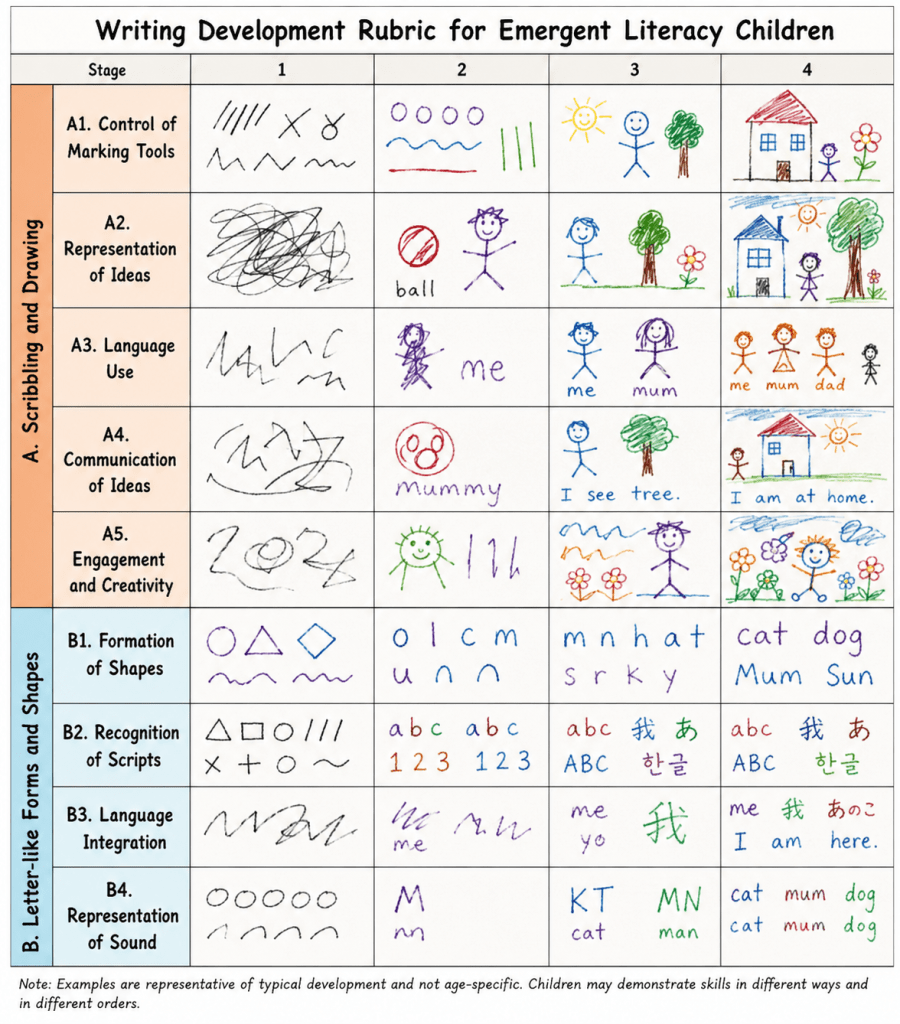
(Adapted from Papadopoulos, 2026)
The rubric illustrates a typical developmental pathway in children’s earliest writing. The visual examples are illustrative rather than prescriptive. Children’s development is rarely linear and they may demonstrate characteristics from several stages simultaneously.
A1. Control Of Marking Tools
This dimension considers how intentionally children use drawing and writing tools.

- Stage 1: Marks are largely uncontrolled and exploratory. Children enjoy making movements with pens, pencils or crayons but their marks show little evidence of deliberate control.
- Stage 2: Children begin to gain control over their movements. You’ll notice that they intentionally make repeated shapes, lines or circles and are beginning to produce marks for a purpose/reason/audience.
- Stage 3: Marks are becoming increasingly deliberate and controlled. Children intentionally create simple drawings to communicate their ideas alongside their emergent writing.
- Stage 4: Children demonstrate confident control of writing tools. Their drawings and writing are purposeful, organised and used intentionally to represent their ideas.
A2. Representation Of Ideas
This dimension focuses on whether children’s marks represent meaning.

- Stage 1: Marks do not appear to represent any identifiable objects or ideas.
- Stage 2: Some drawings or marks occasionally resemble familiar objects or ideas, although child explanation or adult interpretation will likely be needed.
- Stage 3: Children regularly create recognisable representations of people, objects and events.
- Stage 4: Drawings consistently communicate identifiable ideas and often include increasing detail.
A3. Language Use
This dimension is related to the process of making their ‘writing’. It considers children’s use of their available languages during storytelling and composition.

- Stage 1: Children communicate primarily through gesture, expression or action rather than through spoken language.
- Stage 2: Children typically use one language while explaining or discussing their drawings and emergent writing.
- Stage 3: For multilingual children, you’ll notice that they might occasionally move between languages when explaining ideas or composing.
- Stage 4: Some children confidently and naturally draw upon their languages to express and develop their ideas.
A4. Communication Of Ideas
This dimension considers how effectively children communicate meaning through drawing, talk and early writing.

- Stage 1: The intended message is difficult to determine.
- Stage 2: Children communicate simple ideas but often require child explanation and adult questioning to fully make sense of it.
- Stage 3: The main message is usually clear and understandable.
- Stage 4: Children communicate coherent, detailed messages that others can understand independently.
A5. Engagement And Creativity
This dimension reflects children’s motivation to participate in writing and drawing activities.

- Stage 1: Children’s interest in mark making, drawing and book-making can be fleeting.
- Stage 2: Interest and engagement is growing, with occasional creative experimentation.
- Stage 3: Children willingly engage in drawing and writing activities, often developing their own picturebooks (and other writings) in their own time.
- Stage 4: Children show sustained engagement, independence and creativity.
B1. Formation Of Shapes
This dimension considers the development of increasingly conventional graphic forms in children’s book-making.

- Stage 1: Children produce random marks or shapes that do not resemble letters.
- Stage 2: Occasionally, some shapes may begin to resemble letters.
- Stage 3: Children produce a mixture of letter-like shapes and fully conventional letters.
- Stage 4: Letter formation is recognisable.
B2. Recognition Of Scripts
This dimension considers children’s awareness of different writing systems.

- Stage 1: Children do not distinguish between different scripts.
- Stage 2: Children begin recognising one writing system and attempt to reproduce some of its features.
- Stage 3: Children, particularly your multilingual writers, recognise that different languages use different scripts and begin distinguishing between them.
- Stage 4: Children who are multilingual appropriately select and use the correct script for each language. Sometimes they’ll combine different scripts together.
B3. Language Integration
This dimension reflects how children draw upon their linguistic resources while composing.

- Stage 1: Languages remain separate or are not yet used during writing.
- Stage 2: For multilingual children, one language predominates during storytelling and writing.
- Stage 3: Children occasionally combine their languages while developing ideas.
- Stage 4: Children flexibly integrate their languages according to their purpose and audience.
B4. Representation Of Sound
This dimension considers children’s growing understanding of the relationship between sound and print.

- Stage 1: Their marks do not represent the sounds of spoken language.
- Stage 2: Children begin using individual letters or letter-like shapes to represent some of the sounds they know. They will use lines or scribbles for the sounds they don’t yet know (also called ‘kid writing’.
- Stage 3: Many sounds within words are represented, often using plausible phonetic spellings. For example, the opening and last sound in a word. They will continue to use ‘kid writing’ for the sounds they don’t yet know.
- Stage 4: Children consistently represent most sounds in words, with their spellings being plausible and increasingly conventional.
Final thoughts
These stages describe a continuum of development, not a checklist. Children may:
- Demonstrate characteristics from different stages at the same time.
- Progress more rapidly in some dimensions than others.
- Move forwards and backwards depending on context, task or language.
- Show different profiles across drawing, oral language and writing.
The visual exemplars are intended to support professional judgement by providing typical examples of children’s emerging writing behaviours. They should be interpreted alongside children’s talk, intentions and explanations, recognising that meaning often develops through the interaction between drawing, oral language and writing rather than through written marks alone.
Finally, for guidance, we’d typically expect:
- Pre-nursery: Most children will show evidence of Stage 1-2. A few may go beyond this.
- Nursery: Most children will show evidence of Stage 1-2. Some may go beyond this.
- Reception: While some children will be at Stage 1, most children will show evidence of Stage 2-3. Some will be at Stage 4.
- Year One: Most children should be at Stage 4. However, there will be some children showing evidence of being anywhere between Stage 1-4.
References and recommended further reading
- Papadopoulos, I. (2026). Emergent Writing in Early Childhood: Developmental Patterns in Drawing, Scribbling, and Letter-Like Forms. International Journal of Early Childhood, 1-18. [LINK]
- Byington, T. A., & Kim, Y. (2017). Promoting preschoolers’ emergent writing. YC Young Children, 72(5), 74-82. [LINK]
- Young, R. (2026) Debunking edu-myths: Children should only write words they can spell [LINK]