
Why less can be more in early writing instruction
In the early stages of learning to write, particularly in Reception and Key Stage One, it can be tempting to push for ‘extended writing’ as a sign of progress.
Extended writing, often characterised by multi-paragraph pieces, is undoubtedly important later in schooling. However, compelling evidence suggests that asking very young children to produce overly long texts can actually undermine their writing development.
At the same time, this does not mean we should abandon writing at the whole-text level. In fact, composing complete texts, however short, is essential.
The key is finding the right balance: prioritising quality, purpose, and coherence in children’s writing over sheer quantity for quantity’s sake.
Why extended writing isn’t the goal (Yet)
Children in Reception and Year One are often still developing their transcription skills: letter formation, handwriting fluency, encoding, and early spelling. Until these transcriptional foundations are secure, children won’t be able to compose their best texts. When transcription is effortful, children’s cognitive resources are disproportionately consumed by forming letters and encoding words, leaving them with limited capacity for composing at length
Writing is an inherently complex process that draws on multiple skills simultaneously. According to The Science Of Writing, children’s working memory can quickly become overwhelmed if they are expected to juggle handwriting, spelling, grammar, punctuation, and idea generation over extended pieces. This cognitive overload can lead to frustration, poor writing quality, and even writing avoidance (see Motivating Writing Teaching for more on this).
Why whole-text writing still matters
Text-level understanding from the start
Crucially, not expecting extended writing in Reception and Year One does not mean avoiding text-level work. Research stresses that writing should involve an awareness of purpose, audience, and composing at a text level. For example, writing 4-8 sentences as part of a picturebook project constitutes writing a whole text. See these articles for more on the book-making approach:
- Early writing development and our book-making approach [LINK]
- Getting children up and running as writers [LINK]
- How to teach writing in the EYFS [LINK]
- How to teach writing in KS1 [LINK]
Whole-text teaching helps children learn to compose sentences with coherence, to sequence their ideas, and to consider how sentences work together to create a collective meaning.
The power of composing short texts
Research shows that composing short texts is one of the most effective things a teacher of early writing can do (LINK). Writing a handful of well-structured linked sentences:
- Allows meaningful discussion about beginnings, endings, sequencing, text structures and cohesion.
- Acts as a bridge between sentence-level grammar and producing longer compositions later on.
- Encourages children to plan, compose, revise and proof-read on a manageable scale.
- Ensures children are developing their oral language skills at the discourse level.
Our own guidance, along with that of the EEF, Ofsted and the DfE, advocates for starting with ‘short but complete writing opportunities’ that help children practise writing for a purpose and in context. This is in opposition to focusing solely on isolated sentences or disconnected grammar exercises.
Short texts: What the research says
Our Writing Development Map shows how composition and transcription become increasingly integrated. Proficiency in both follows a gradual developmental trajectory, where these components become more and more interconnected and automated over time. Composition and transcription rely on one another for their development. Therefore, writing short texts allows children to successfully develop their composing skills while their transcription skills are developing too.
Practical implications for teachers
- Use mentor texts which realistically match the amount and type of writing you want the children to produce for themselves. For example:

- Model one aspect of writing each day, through the principles of self-regulation strategy development instruction, to show children how short but complete texts are structured.
- Focus on quality, not quantity: Emphasise short, purposeful and coherent writing projects in the EYFS and KS1.
- Use a developmentally appropriate writing process, such as the book-making approach, which includes scaffolds like drawing for planning and oral rehearsal to help children organise, translate, and transcribe their ideas fluently and happily.
- Show children how to revise and proof-read even the shortest pieces of writing.
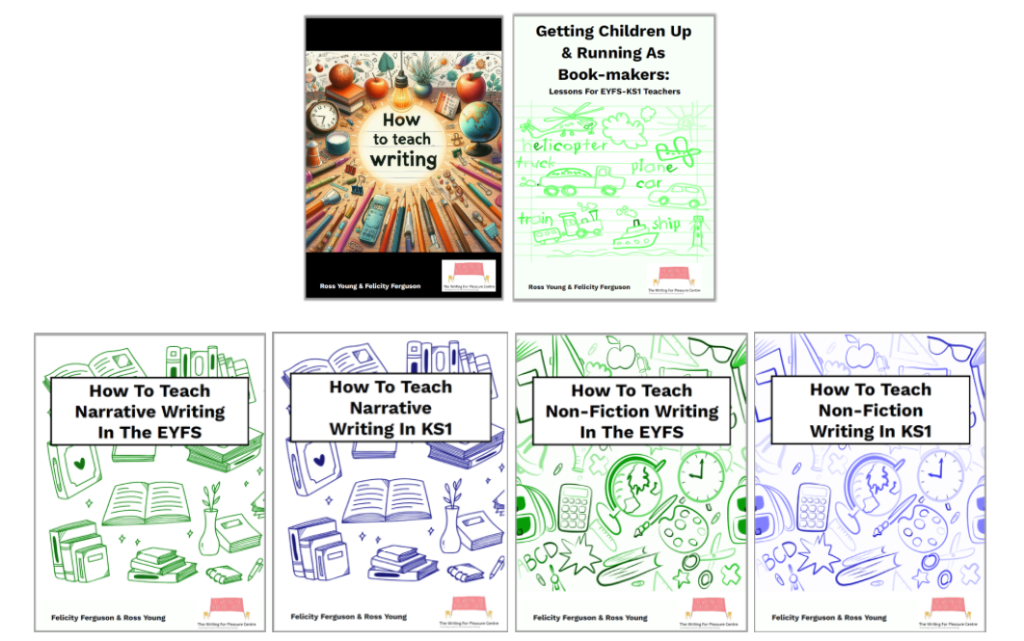
For more details, consider reading the following publications. Alternatively, you can download our EYFS-KS1 units plans and programme of study. Remember, these publications and unit plans are FREE for members. To become a member, follow this link.
Conclusion
The expectation that young children should produce multi-paragraph writing in Reception and early KS1 is not supported by the evidence. Instead, research strongly supports a developmentally appropriate approach that focuses on transcriptional fluency while still teaching children to compose whole, meaningful texts on a manageable scale.
Making short picturebooks and chapter books across EYFS-KS1 is not a compromise or a ‘lesser form of writing’. They are vital, evidence-informed stepping stones to becoming confident and capable writers.