
Original article: LINK | By Douglas J. Hacker
***
When children are in the writing classroom, their brains are like a busy workshop. They are builders and project managers who are crafting texts. An important part of crafting these texts is thinking. Here’s what children are up to while they are writing:
Level 1: The doing
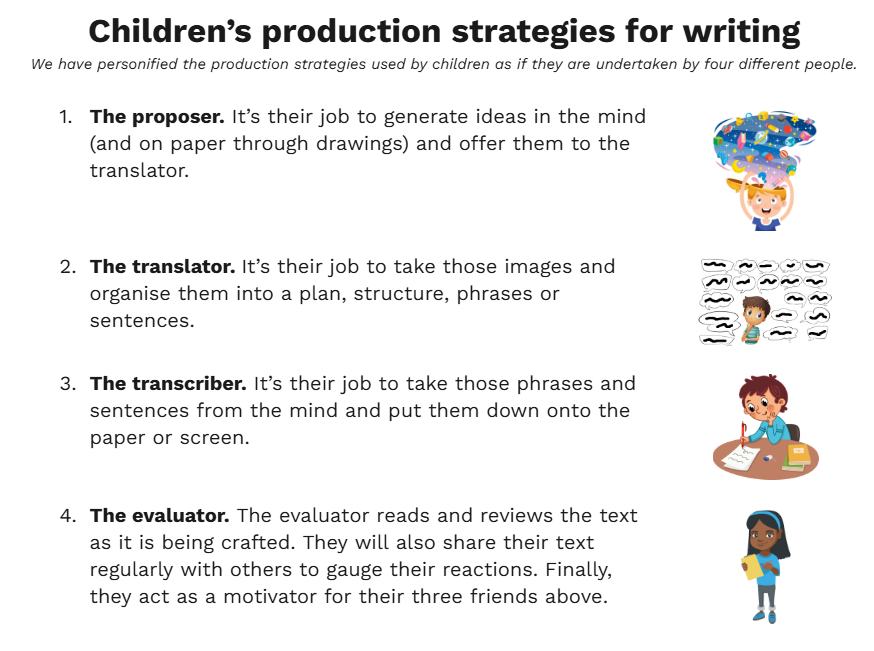
- Their brain gets to work coming up with writing ideas. They are thinking about what they want to write about and are planning it out.
- They then translate these ideas into thoughts, words, phrases and sentences in their mind before transcribing them to paper (or screen).
- They also look at what they’ve written and read it back to themselves.
We can call this ‘the doing.’ They are the production strategies children use as they are writing. Here’s a nice explanation taken from our publication The Science Of Teaching Primary Writing:
Level 2: The thinking
The thinking part of their writing process is acting like a project manager. It looks at what the “doing” part is doing. It thinks about the words they’ve written and the ideas they’ve shared.
They ask themselves questions like: Does this make sense?, Is that the right word? and Will the person reading this understand me?
Based on this thinking, they tell the “doing” part what to do next. They might say: Change that word!, Add more details here!, Rub out that sentence!, or Let’s try planning a bit more…!

When we write, our brains are always doing this merry dance between the doing and the thinking. This goes on and on until we feel like our writing is finished. Children as young as three start doing this kind of thinking and doing while writing (see here for examples).
Scribbles and drawings are where they start. When they are starting out, children will make scribbles, letter-like shapes and drawings (see here for examples). They are already trying to translate their thoughts into marks. Learning that a written mark can stand in for a spoken word is a massive and profound step in children’s thinking about language.
Writing helps children look closely at words. When they write, children are translating their thoughts into words. Writing lets children see these words. This helps them notice how words are built, how sentences go together, and how they need to use different words and sentences depending on who they are writing for (This is called perspective taking and you can read more about it here). Writing helps children think about language itself.
Thinking about their writing helps children improve. The more children practice considering their ideas, turning those ideas into sentences, transcribing those sentences to paper, and revising them, the more fluent they become. As our Writing Map shows, writing fluency is a key factor in children’s writing success.
Implications for classroom practice
According to our Writing Map, when teachers embrace this metacognitive model for writing, they equip their students with the tools to produce high-quality texts. For example:
1. Explicitly teach children the writing processes: Planning class writing projects so that children work through the full writing process can help them develop a deeper understanding of both writing and what it means to be a writer. This helps them become better writers and thinkers.
- Here is a developmentally-appropriate writing process for children in the EYFS-KS1.
- Here is one for children in KS2.
2. Teach monitoring strategies: Encourage children to actively monitor their writing. This involves teaching strategies such as:
- Reading mentor texts [LINK]
- Regularly rereading and retelling your writing with teachers and friends [LINK]
- Formally reviewing their writing through revision checklist sessions [LINK].
3. Teach control strategies: Equip children with strategies that writers use to control their writing, including techniques for:
- Generating ideas [LINK]
- Planning [LINK]
- Translating thoughts into drawings before turning them into sentences [LINK]
- Drafting fluently [LINK]
- Proof-reading [LINK]
4. Encourage reflection and verbalisation: Provide regular opportunities for students to talk about their writing through ego-centric speech [LINK], verbal feedback [LINK], class sharing and Author’s Chair [LINK].
5. Acknowledge and develop children’s metalinguistic and metapragmatic awareness: By teaching both grammar and at the sentence-level in a functional and purposeful way, children are well positioned to discuss the different effects grammatical craft moves have on their writing (See these two links for more – here and here).
Through functional grammar teaching, children’s awareness of language structure (metalinguistics) and awareness of how language is used effectively in different social contexts and for different purposes (metapragmatics) develops in sophisticated ways. These forms of awareness are strongly linked to improvements in children’s writing quality.
6. Build on children’s early writing development: Recognise that children’s early mark-making and drawings are important developmental milestones. It helps children associate marks with meaning and develops their graphomotor skills. Understanding this developmental shift from “first-order representation” (marks directly portray objects) to “second-order representation” (marks represent spoken words) is profound (see link for more).
7. Don’t delay writing instruction: Learning to write should productively run alongside learning to read. By writing, children create a model for representing speech (words, phrases, sentences) that they can then ‘read’ or ‘tell’. This ‘penny drop’ moment can often be the gateway children need to truly engage with reading. It gives them a new kind of intrinsic motivation — as they read aloud words born of their own thoughts and see how others respond. In doing so, they begin to understand the purpose of reading: they have created something worth reading. And now, they read others’ writing in new ways.