
Original article: LINK
By Margaret Vaughn

This article explores the evolution of student agency within recent educational reforms and highlights empirical research from various classroom settings to demonstrate the impact of agency across different contexts. It aims to propose a collaborative approach to understanding and promoting student agency, emphasising the importance of structures and supports that facilitate its development [LINK].
The article also notes that structural inequalities often inhibit student agency, particularly for marginalised groups [LINK]. It explores how creating agentic spaces in schools could transform educational experiences for students and teachers.
Understanding student agency
Student agency refers to the capacity of students to act independently and make their own choices in the writing process. It encompasses several dimensions, each of which contributes to how students engage with their writerly education and exert influence over the writing classroom.
Historical and theoretical perspectives
- John Dewey: Dewey emphasised that agency is about choice and deliberation, highlighting that human nature involves active decision-making rather than being solely driven by extrinsic motivation.
- Lev Vygotsky: Vygotsky’s view of agency is rooted in social interaction. He suggested that individuals develop agency through their engagement with social practices and contexts.
- Albert Bandura: Bandura’s social cognitive perspective associates agency with self-efficacy—the belief in one’s own capabilities—and the effort to control one’s writerly apprenticeship.
- Contesting norms: Some scholars argue that agency involves challenging writing norms and practices [LINK] or is viewed as a motivational concept where individuals make choices and decisions [LINK]
- Identity and dialogue: Other perspectives emphasise that agency is about using writing to reshape one’s world and construct a writer-identity by bring your funds-of-knowledge and funds-of-identity to your writing [LINK].
A model of student agency
The model of student agency proposed in this article includes three key dimensions:
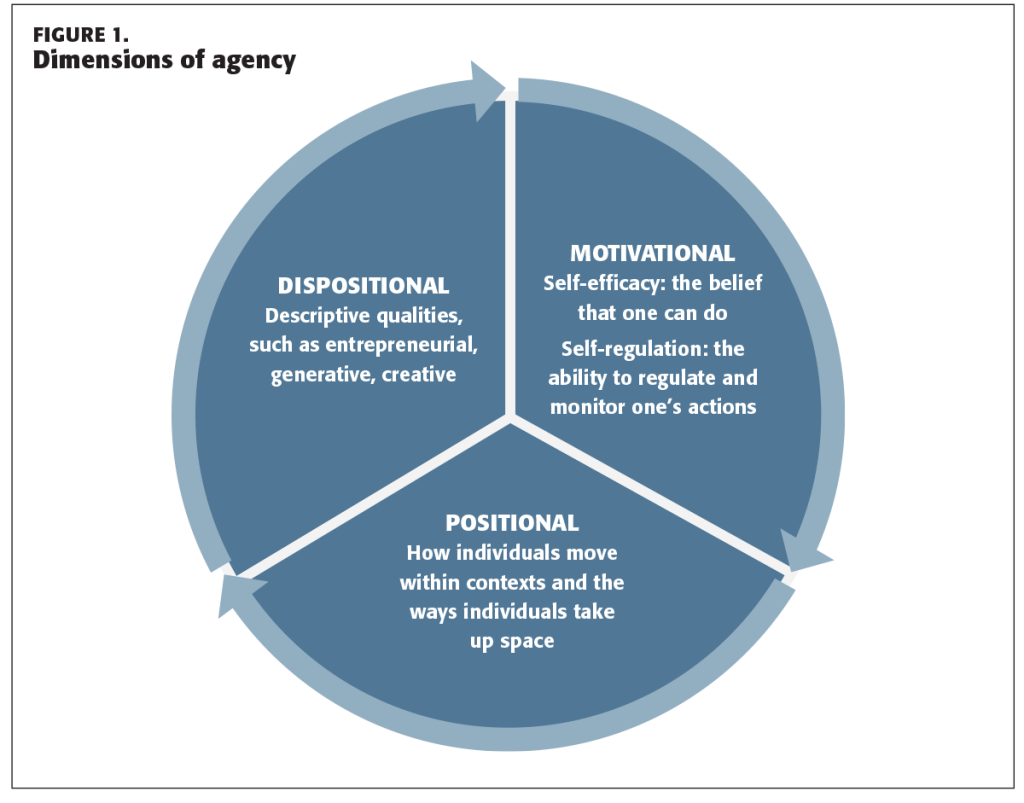
- Dispositional dimension: This dimension focuses on students’ personal dispositions, such as creativity, goal-setting, and resilience. It involves students acting on their intentions and purposes. For example, Ms. Edward’s class initiated and organised a class-wide poetry anthology project based on Christmas to raise money for the charity Shelter.
- Motivational dimension: This aspect of agency is concerned with students’ ability to regulate their actions, persist through challenges, and make decisions [LINK]. An example is Ned’s efforts to make a graphic-novel despite his initial setbacks, showcasing his motivation and persistence in the face of obstacles.
- Positional dimension: Agency is also shaped by how students interact within the writing classroom. It involves co-creating agency through interactions with peers and teachers. For example, Mr. Robinson’s class developed dual-language books in collaboration with Ukrainian refugees, illustrating how agency is constructed through collective efforts with classmates [LINK].
Supporting student agency
To foster student agency in the writing classroom, teachers can:
- Talk with your pupils: Involve students in the process of planning class writing projects and adapt your instruction based on their feedback [LINK, LINK, LINK and LINK]. For example, Ms. Vann gave her class sticky notes asking them what they would like to learn about writing [LINK].
- Integrate children’s cultural and linguistic backgrounds: Invite students to use their cultural and linguistic backgrounds in class writing projects [LINK and LINK]
- Make writing projects real world projects: Connect class writing projects to students’ interests and real-life experiences [LINK]. For instance, Mr. Palmer’s project where children wrote curiosity letters to people of interest [LINK].
- Cultivate a students as knowledge creators and sharers: Develop a classroom culture that views students as active participants and knowledge generators. This involves creating opportunities for students to exert influence and contribute their own funds-of-knowledge to their writing. For example, by inviting children to make a class encyclopedia of knowledge [LINK].
Student agency is a dynamic and multi-dimensional concept that involves students’ personal dispositions [LINK], motivational aspects [LINK], and interactions within social contexts [LINK]. By adopting practices that support these dimensions, educators can create writing classrooms where students are empowered to actively participate in and shape their writerly apprenticeship. Engaging students in meaningful ways [LINK], adapting instruction based on their needs and interests [LINK], and integrating their cultural backgrounds [LINK] are all essential strategies for cultivating agency in the writing classroom.
Conclusion
In schools that foster student agency, opportunities arise when students are empowered to make choices, act on their intentions, and shape their learning experiences [LINK and LINK]. These writing schools allow students to be proactive and influential, positioning them as knowledgeable contributors and leaders within the classroom. Writer-teachers obviously play a crucial role in these contexts by working collaboratively with their students, employing flexible and adaptive teaching strategies that respond to students’ most pressing needs and interests. When students and teachers engage in this dynamic and reciprocal process, it creates rich and meaningful writing space that enhances the writerly experiences for both parties. Such classrooms and schools not only support academic growth but also cultivate a sense of agency that prepares students for future writing challenges and opportunities.