
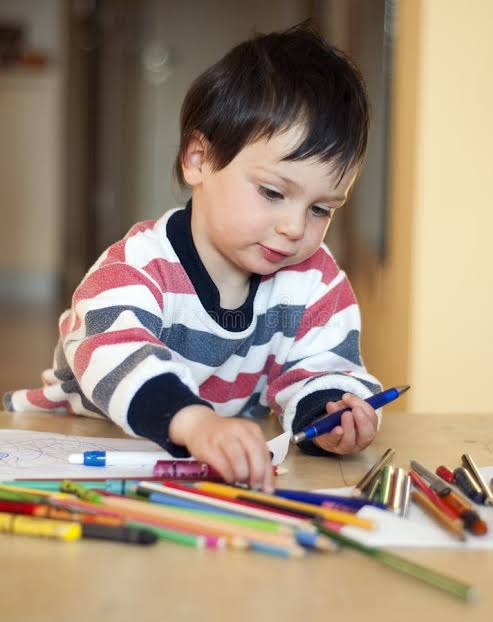
Some people in education try to treat play and writing as rivals. However, book-making shows that this split isn’t needed. When young children make their own picturebooks, they aren’t taking a break from play to do writing. They’re playing, on paper.
Every stage is a kind of play
Look at what children actually do in each stage of a book-making project.
The ‘Ideas Party’ and front cover. Children talk a whole book into being with their friends: what they are going to write about, who their characters are, what happens, who the book is for. This is the same imaginative world-building they do elsewhere. Designing a cover and giving the book a title is how they claim that world as their own, make their mark, and show that they exist (see the work of Anne Haas Dyson for more on this).
Drawing each page. Children narrate aloud as they draw, trying out events, taking suggestions from friends, changing their minds and adding surprises. This book-making through drawing and talk is the kind of symbolic play young children already do.
Oral rehearsal. Children ‘tell’ and otherwise ‘act’ their book ideas aloud, then translate that play into words on each of their pages. They experiment with voices, sounds and word choices, playing with language before committing it to paper.
Transcription and sharing. Children’s informed spellings are playful, low-stakes attempts that just happen to be real phonics practice (Young & Ferguson, 2027). Finished books are then read aloud, performed and acted out with classmates.
What the research tells us
Writing and play produces some of the largest effects in early writing research (Young & Ferguson, 2027). When children compose, illustrate and then act out their own books, their oral language and listening comprehension can improve significantly (Young & Ferguson, 2027). For young children, writing is first an act of playful meaning-making and social connection.
As playful as the teacher allows
The research also makes clear that playing doesn’t teach writing by magic. Writing opportunities in play are often missed or underused (Young & Ferguson, 2027). Children only reach their potential when teachers are writer-teachers who model, join in and teach children cool things about writing (and being a writer). Being a writer-teacher matters so much.
Writing lessons in the Early Years are as playful as the teacher wants them to be.
A teacher can make book-making feel like a chore or they can make it feel like play. They can laugh at their own ideas, invite kooky plots, let children bring their friendships and favourite characters to their writing. They can make time for child-authored books to be performed and enjoyed.
The structure is the same either way. What changes is the teacher’s stance.
Takeaways
- Model your own book-making as a playful act. Think aloud, take creative risks, and show your class they you love making books with and for them.
- Let children’s play shape their books. Stories and information books can come from playing.
- Treat drawing and talk as essential parts of the writing process.
- Value informed spellings as evdience of learning.
- Make time for books to be shared, performed and acted out.