
The job of teachers in the early years of children’s writing development is to nurture a generation of children who will feel themselves to be writers, and who will write happily without the constant need to ask anxiously ‘Is this right?’ or ‘I don’t know how to write it – can you do it?’
That’s why it’s a good idea at the beginning of the year to teach a lesson on the subject of ‘kid writing’. Even before mastering letter/sound correspondence or becoming a formal reader, a student (for example Wyatt) can scribble or approximate every single word they know. Therefore, all children can write if we set up the expectation that they should use a mixture of kid writing (using their approximations to make and use marks) and ‘adult writing’, using their ever developing knowledge of letter/sound correspondence and their sound and word mat resources. Kid writing is obviously a very temporary scaffold but an important one, because it ensures all the children in your class can access daily writing regardless of their ability or experience.
Here is what I typically say when delivering this particular lesson:
When I was your age, only three, four or five, I hadn’t learnt how to do all my ‘adult writing’ yet, so, while I was learning, I used my own writing too – we can call it ‘kid writing’. Let me show you what kid writing can look like.

At this point, I show the class some of the writing I’ve collected from children at different stages of development so they can see for themselves what kid writing can look like:
- Squiggles
- Letter-like shapes
- A selection of known letters
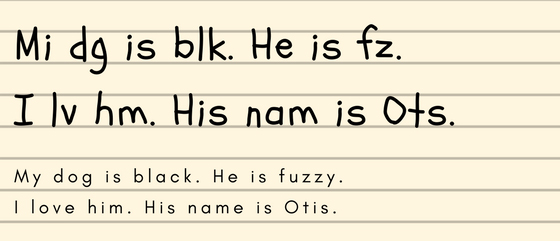
- Informed encoded ‘sound’ spellings [LINK]
I continue with:
As you can see, while these children were learning more about adult writing, they used ‘kid writing’ too. You can use this writing in your books. If you want to use some adult writing that you already know, go for it! By the way, my teacher taught me more and more about adult writing every day and now I can write like an adult. I’m going to teach you how to write like adults this year too!
This lesson is based on what is appropriate in terms of child development and reflects the stages of emergent writing. You can find out more by looking at the diagram below and by following the accompanying link.

(Byington & Kim 2017)
Of course, an added benefit to all this is children learning to use and apply their developing spelling (encoding) skills, something that Ofsted also highlights as important [LINK]. We would certainly agree with Ofsted here. This is something we often pick up on when working with colleagues in the EYFS and KS1. Indeed, it feels like the time is now right for Ofsted to move its focus on how phonics can help children with their early reading to focusing on how it can have a transformative impact on children’s early writing development. It takes a lot of cognitive energy for children to take the phonemes of their speech and present them as graphemes of written language; otherwise called encoding. In the context of writing, phonics instruction should also focus on how to encode and produce ‘sound spellings’ (also known as informed spellings, approximated spellings and phonetic spellings) and be orientated towards how this instruction will be relevant and useful to the class as writers during their daily writing time (Young & Ferguson 2022). We know that when children receive phonics instruction that also encourages them to produce ‘sound spellings’ when they are writing, they outperform those not in receipt of such instruction on a whole variety of writing and reading measures (Rowe 2018).
Find out more:
- Early spelling development [LINK]
- Invented spelling in kindergarten as a predictor for future reading and spelling success [LINK]
- Using encoding instruction to improve the reading and spelling performances of elementary students at risk of literacy difficulties: A best-evidence synthesis [LINK]
- Encoding and ‘informed spelling’ [LINK]
- How can you teach children to write before they know their letters? [LINK]
- A sensible (centralist) approach to early writing teaching [LINK]
- How do children start learning to write before they start school? [LINK]