

“Hi Ross & Phil, we’ve been debating. How can you possibly teach children to write before they have first learnt to form their letters and learnt their sounds?“
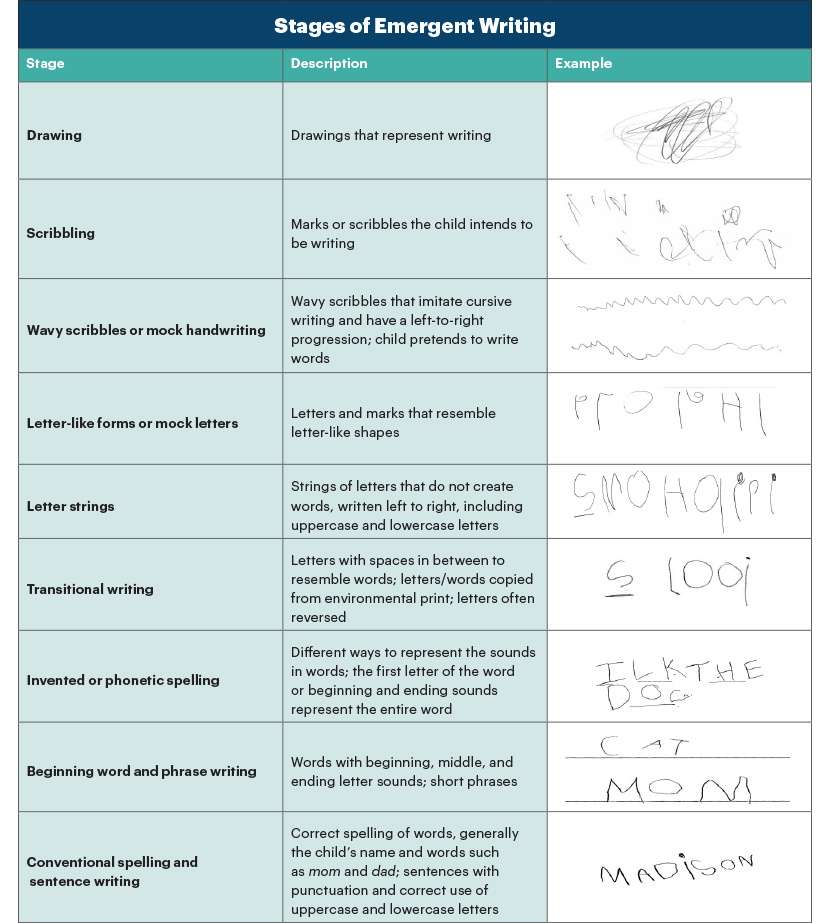
We find ourselves being asked this question more and more. Children actually do a great deal of writing before (and during) learning their letters and sounds. More than we sometimes realise or appreciate. They write using something called emergent writing.
(Byington & Kim 2017)
Emergent writing refers to the early stages of learning to write, typically seen in young children before they are able to transcribe conventionally. It includes various developmental milestones as children progress from scribbling to controlled lines, shapes, and eventually recognisable letters, words and sentences. Emergent writing isn’t just about physical ability to make marks but reflects a child’s growing understanding of the concept of writing as composition and the sharing of ideas with others.
Key features of emergent writing include:
- Scribbling and drawing: Children begin with scribbles, which they may describe as words, drawings or stories. This stage is vital as it shows they understand marks can represent ideas or objects to others.
- Letter-like shapes: As they become more exposed and experienced with print, scribbles evolve into shapes that resemble letters and other symbols they’ve seen in the environment. These may not be always be conventional letters but they are intentional and repeated, showing the child’s awareness that print is important when writing.
- Informed spellings: As children start to receive explicit letter formation and encoding instruction (through phonics and writing lessons), they start using recognisable letters. They use informed spelling, stringing together the sounds they can hear in words they want to transcribe.
- Awareness of writing conventions: Young writers also learn concepts like left-to-right directionality, spaces between words, and the function of punctuation.
Why emergent writing matters in the classroom
Emergent writing is crucial for developing children’s literacy skills. It shows that a child is beginning to grasp the link between spoken language, symbols, and written words, which is foundational for both reading and writing. Teachers can support emergent writing by providing varied opportunities for children to write, modelling writing behaviours, engaging in shared writing, and encouraging children to talk about their writing attempts [LINK]. When we value children’s early writing as developmentally appropriate, utterly legitimate and personally meaningful, we give them the confidence and motivation to continue on their journey towards being a successful writer.
If you really want to dig into the research and practice around developing children’s emergent writing, we’ve provided a whole host of articles and publications below:
Recommended publications
- Getting Children Up & Running As Writers by Ross Young & Felicity Ferguson [LINK]
- Already Ready: Nurturing Writers in Preschool and Kindergarten by Katie Wood Ray & Matt Glover [LINK]
- Kid Writing: A Systematic Approach to Phonics, Journals, and Writing Workshop by Eileen Feldgus & Isabell Cardonick [LINK]
- What Changes In Writing Can I See? by Marie Clay [LINK]
- Handbook On The Science of Early Literacy by Sonia Cabell, Susan Neuman, and Nicole Patton Terry [LINK]
- Literacy Learning For Infants, Toddlers, & Preschoolers by Tanya Wright, Sonia Cabell, Nell Duke & Mariana Souto-Manning [LINK]
- Understanding and Supporting Young Writers from Birth to 8 by Noella Mackenzie & Janet Scull [LINK]
- Writing Begins At Home: Preparing Children For Writing Before They Go To School by Marie Clay [LINK]
- How Very Young Children Explore Writing by Marie Clay [LINK]
- What Did I Write? Beginning Writing Behaviour by Marie Clay [LINK]
- Gnys At Wrk: A Child Learns to Write and Read by Glenda Bissex [LINK]
- Adam’s Righting Revolutions: One Child’s Literacy Development From Infancy Through Grade One by Judith Schickedanz [LINK]
- Our Daughter Learns To Read & Write: A Case Study From Birth To Three by Marcia Baghban [LINK]
- Family Literacy: Young Children Learning To Read & Write by Denny Taylor [LINK]
- Children’s Language: Connecting Reading, Writing & Talk by Judith Wells Lindfors [LINK]
- Before Writing by Gunther Kress [LINK]
Recommended articles
- Let’s use ‘kids writing!’ [LINK]
- Encoding and ‘informed spellings’ [LINK]
- Promoting preschoolers’ emergent writing [LINK]
- The unrealised promise of emergent writing: Reimagining the way forward for early writing instruction [LINK]
- The effects of preschool writing instruction on children’s literacy skills [LINK]
- Early alphabet instruction [LINK]
- Early spelling development [LINK]
- What are children doing as they produce writing? [LINK]
- How do we develop writing fluency? [LINK]
- What is writing fluency? [LINK]
- Spelling and handwriting provision: A checklist [LINK]
- Building up to extended writing projects [LINK]