In Engaging Writing Teaching, writer-teachers Ross Young and Felicity Ferguson explore what it means for children to be truly engaged as writers.
From the authors of The Science of Teaching Primary Writing and Writing for Pleasure, this new title offers an actionable framework for developing writing engagement in schools based on five key drivers:
Behavioural engagement: Will I participate actively? Will I put in effort, stay focused, and persist when things get difficult?
Affective engagement: How do I feel about writing? Am I curious, interested, and emotionally invested enough in what I’m writing?
Cognitive engagement: How much will I think about this? Am I willing to generate great ideas, plan carefully, reflect critically and make thoughtful revisions and edits?
Social engagement: How am I connecting with others through this writing? Am I collaborating, sharing ideas and responding to feedback as part of a community of writers?
Academic engagement: How committed am I to mastering the skills outlined in the curriculum? Am I applying effort, strategy, and persistence to improve my academic competence?
This inspiring and practical book will help you create a writing classroom where every child feels connected, capable, and compelled to write, not because they have to but because they want to.
The goal of this article is to reorientate our understanding of why transcription matters: shifting it away from compliance and correction, and towards a reader-centred, meaning-making approach in which transcription supports effective communication. It also seeks to hold transcription and composition together, rather than privileging one over the other, and to validate emergent writing as a legitimate starting point.
Teachers care about transcription. Walk into any primary classroom and you will find children receiving explicit handwriting and spelling lessons. You’ll see them being reminded to form their letters correctly, to check their spellings and to use capital letters at the start of sentences. Transcription is taught. It is practised. It is marked.
What we may have forgotten though is why it matters.
The DfE’s Writing Framework (2025) puts the problem plainly:
“Too often, pupils learn to write for the circular purpose of learning to write.”
Round and round we go and somewhere along the line we forget the point of it all. We teach about transcription because it’s on the curriculum. We make it a priority because we know Ofsted will like it. We lose sight of the only reason it actually matters: so that the readers of our children’s texts can understand them and enjoy them.
“Let us be clear. If children do not learn and internalise the essential transcriptional skills involved in crafting writing (spelling, handwriting, and punctuation), then their attempts to share meaning with others may be compromised or even fruitless.”
— Ross Young & Felicity Ferguson
This shift in orientation, from transcription as compliance to transcription as communication, changes everything about how we teach it.
The Real Purpose Of Getting It Right
In our Writing Development Map (2025a), we define writing as being the construction of a text to share meaning. That word, share, is doing important work. Writing is an attempt to move and share something from one person to another. Transcription is the mechanism that makes that transfer possible.
Young writers have extraordinary things to say. The tragedy is that when transcription breaks down, those things become inaccessible. It breaks your heart. A reader who has to wrestle with a text (trying desperately to decode wild spelling attempts or else left squinting at the handwriting) loses the thread and is slowly disconnected from the writer and their meaning. That must be depressing. Their voice gets lost in the chaos.
This is the perspective we should be taking when we teach transcription.
Not “your letters need to sit on the line” as the rule handed down from on high, but “I really want your readers to be able to enjoy the bit about the dragon!”
Not “you’ve forgotten your full stops” simply as a correction, but “I want your readers to know when they can stop and talk about your amazing writing before they eagerly read your next thought.”
Not: “Check all the spellings I’ve underlined.” But: “Let’s make sure these words are spelt conventionally so your reader knows exactly what you mean.”
You see the difference?
We don’t need more attention on transcription. We need better-directed attention (Young & Ferguson 2025a, 2025b, 2026a, 2026b). We know children should:
Receive explicit handwriting and spelling lessons.
Engage in plenty of meaningful writing experiences so that they can use and apply what they learn.
Receive feedback on their handwriting and spelling attempts.
Children’s transcriptional development should always be in the service of helping them make and share meaning. It’s always in the name of the reader.
The Motivational Case For Teaching Transcription Well
This is where motivation becomes not a parallel concern but a directly relevant one. Young & Ferguson (2024) note that the word motive derives from Latin meaning to move. As teachers, we need to help children see the value and purpose of writing so that they are genuinely moved to do it (and to do it to the very best of their abilities). When children understand that transcription serves their readership, effort in transcription becomes purposeful rather than merely about obedience. They are not spelling carefully out of fear of punishment or the dreaded red pen. They are spelling carefully because they want their writing (that they really care about) to stand up and be fully understood.
Research on writing motivation in primary-age children makes clear that early experiences with writing can predispose children to seek it out or avoid it altogether (Young & Ferguson 2024). A systematic review of students’ writing motivation found that authentic writing projects and a loving and supportive classroom environment are among the most powerful conditions for developing lasting motivation to write (Alves Wold et al., 2024). Feedback that connects transcriptional effort to a communicative outcome, such as “Because your spellings were so easy to understand; I could concentrate on performing it to everyone in a really entertaining way. I think they really loved it. Don’t you think so?” is precisely that kind of motivational condition. It feels different because children see it as true.
The Cognitive Case For Teaching Transcription Well
The research on why transcription matters is unambiguous. Handwriting and spelling are foundational ingredients of early writing development, not peripheral concerns (Young & Ferguson, 2023). When transcription is effortful (when a child must consciously attend to how to form every letter or how to spell every word), it crowds out cognitive resources that could be much better spent generating great ideas, selecting precise language and organising their thoughts (Young & Ferguson, 2023).
However, none of this means children are not already writers before their transcription is fully secure. Emergent writing (marks, letter-like shapes and informed spellings) are the developmental foundation for later conventional transcription (Young & Ferguson, 2025c). Emergent writing acts as a temporary scaffold, until children get their transcription skills fully up and running. Children who are allowed to use their emergent writing are already writers (Ray & Glover, 2008; Young & Ferguson, 2022). And as their transcription becomes ever more fluent and automatic, their emergent writing disappears.
“Children want to write. They want to write the first day they attend school. The child’s marks say, ‘I am’.
‘No you aren’t,’ say most school approaches to the teaching of writing.
We take control away from children and place unnecessary road blocks in the way. Then we say, ‘They don’t want to write. How can we motivate them?’”
— Donald Graves
The use of emergent writing and especially ‘kid writing’ is the ultimate leveler. It removes the ‘road blocks’ that Donald Graves is talking about. This way, everyone can be a writer from their very first day in Nursery (Young & Ferguson, 2022).
Holding Both Things At Once
The DfE’s Writing Framework (2025) offers a statement that deserves to be on every staffroom wall:
“Transcription is not writing.”
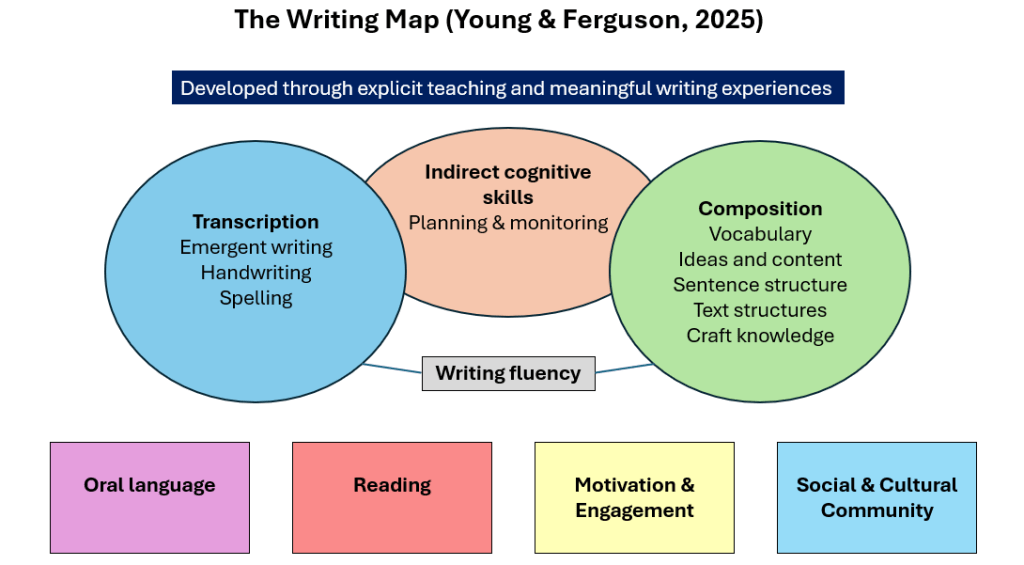
Our Writing Development Map makes the same point. We must care deeply about transcription but we must never mistake it for the whole thing.
Figure 1. The Writing Map (Young & Ferguson, 2025a). Simplified version reproduced for commentary purposes. Full version available [HERE].
Kim et al. (2021) conducted a meta-analysis of 24 studies and found that instruction focused solely on transcription skills (spelling and handwriting) did not yield statistically significant effects on children’s writing quality or productivity. By contrast, multi-component instructional approaches, which teach transcription alongside composition strategies, produced large and consistent improvements across all measured dimensions, including quality, productivity, and text structure. Harris et al. (2023) tested this experimentally with pupils from economically underserved areas. Integrated instruction outperformed a business-as-usual approach across major measures, including writing quality, planning, and spelling. The researchers concluded that young children can (and should) learn about transcription and composition simultaneously. Transcription, taught well, and in the right spirit, lifts everything.
Children arrive at school already knowing their marks mean something. Children are incredibly motivated to learn more about transcription because they want to be heard and understood. Our job is to make that happen.
Every time we sit down to teach transcription, let’s ask: whose needs are we focusing on right now? The answer should always be the same. Theirs, and the lucky people who get to read what they have to share.
Alves-Wold, A., Walgermo, B. R., McTigue, E., & Uppstad, P. H. (2024). The ABCs of writing motivation: A systematic review of factors emerging from K–5 students’ self-reports as influencing their motivation to write. In Frontiers in Education (Vol. 9, p. 1396484). Frontiers Media SA.
Department for Education. (2025). The writing framework.
Graves, D. H. (1983). Writing: Teachers and children at work. Heinemann.
Harris, K.R., Kim, Y-S.G., Yim, S., Camping, A. & Graham, S. (2023). Yes, they can: Developing transcription and compositional skills together to help children write informative essays at grades 1 and 2. Contemporary Educational Psychology, 72, 102131.
Kim, Y-S.G., Yang, D., Reyes, M. & Connor, C. (2021). Multicomponent writing instruction appears to yield better results. Educational Research Review, 34, 100401.
Ray, K. W., & Glover, M. (2008). Already ready. NH: Heinemann.
Young, R., & Ferguson, F. (2022). Getting children up and running as writers: Lessons for EYFS-KS1 teachers. The Writing for Pleasure Centre.
Young, R., & Ferguson, F. (2023). The science of teaching primary writing. The Writing for Pleasure Centre.
Young, R., & Ferguson, F. (2024). Motivating writing teaching. The Writing for Pleasure Centre.
Young, R., & Ferguson, F. (2025a). Visualising the science of writing: The writing map explained. The Writing for Pleasure Centre.
Young, R., & Ferguson, F. (2025b). Underwriting: Should teachers do it? The Writing for Pleasure Centre.
Young, R., & Ferguson, F. (2025c). Debunking edu-myths: ‘Emergent writing’ isn’t necessary before teaching children to writeThe Writing for Pleasure Centre.
Young, R., & Ferguson, F. (2026a). Spelling and handwriting provision: A checklist. The Writing for Pleasure Centre.
Young, R., & Ferguson, F. (2026b). Debunking edu-myths: Children should only write words they can spell. The Writing for Pleasure Centre.
Executive Summary: The Writing Early Learning Goal (DfE, 2024) erroneously focuses solely on the mechanics of transcription (letter formation and phonetic spelling). It does not assess composition, oral language, executive function or purpose and audience. It is therefore not a measure of early writing.
The evidence is unambiguous. A meta-analysis (Kim et al., 2021) found that instruction focused solely on transcription has no significant effect on children’s writing quality. The ELG does not just fail to capture what writing is, it channels schools towards approaches that demonstrably fail to develop it.
The DfE’s own Writing Framework (2025) states explicitly: ‘transcription is not writing’. The ELG assesses children solely on transcription. The DfE defines writing one way and is now measuring it in another. This is a structural contradiction that will have dire consequences.
Children who meet the ELG without ever being required to compose something independently will arrive at Key Stage 1 grossly underprepared for its demands. National data will also overstate children’s writing capabilities.
This briefing calls for the immediate commissioning of an evidence-led review to realign the ELG with the DfE’s own stated model of writing development.
1. What The ELG Measures And What It Misses
The Writing ELG is assessed against three criteria:
writing recognisable letters, most of which are correctly formed.
spelling words by identifying sounds in them.
writing simple phrases and sentences that can be read by others.
Each criterion concerns the mechanics of putting marks on a page. None of them asks whether the child has anything to say. None asks whether they have a reason to write, a sense of a reader, a capacity to plan or revise, or a growing identity as a writer. Recent accompanying guidance makes this explicit: children ‘do not need to compose independently’ to meet the ELG, and dictated sentences (in which the teacher speaks and the child transcribes) are described as valid assessment tools (DfE, 2026).
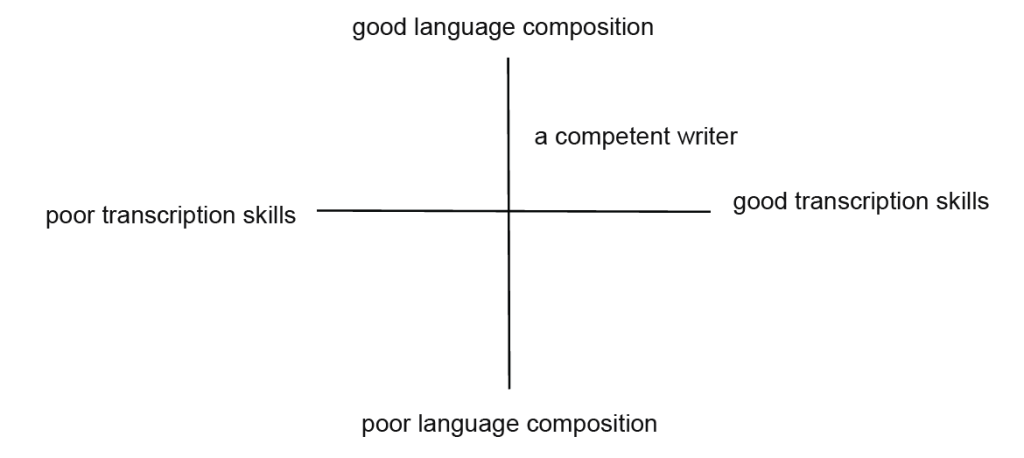
The international research on writing development is often organised around a clear model The Simple View of Writing which identifies three components that must all develop, and must be developed together, for a child to become a writer (Berninger & Winn, 2006; Young & Ferguson, 2025). However, the ELG only addresses one of these three:
Generating ideas, communicating with intent, writing for a reader
Entirely absent
The ELG, as it is currently presented, is not a measure of writing. The ELG can be met by a child who isn’t required to compose a sentence of their own. This is surely one of the lowest educational expectations you can have of a child. That child is not a writer in any sense of the word.
The DfE’s own Writing Framework (2025) recognises this, stating directly: ‘transcription is not writing’. The ELG ignores its own department’s definition.
2. The Evidence: Transcription Alone Does Not Produce Writing
The ELG’s implicit model is sequential: master transcription first and learn to compose later. Children essentially have to ‘earn their right to write’ (Young & Ferguson, 2024). However, this sense of ordering is not supported by research evidence. Indeed, it is contradicted by it.
Transcription-only instruction does not improve writing quality
Kim et al. (2021) conducted a meta-analysis of 24 studies and found that instruction focused solely on transcription skills (spelling and handwriting) did not yield statistically significant effects on children’s writing quality or productivity. By contrast, multi-component instructional approaches, which teach transcription alongside composition strategies, produced large and consistent improvements across all measured dimensions, including quality, productivity, and text structure. Harris et al. (2023) tested this experimentally with pupils from economically underserved areas. Integrated instruction outperformed a business-as-usual approach across major measures, including writing quality, planning, and spelling. The researchers concluded that concerns about cognitive overload were not supported by their data, suggesting that young children can (and should) learn about transcription and composition simultaneously.
The policy implication is direct. An assessment framework that promotes transcription-only teaching is directing teachers towards an approach the evidence shows does not develop children’s writing.
Oral language is critical but entirely absent from the Writing ELG
Oral language is among the most consistent predictors of early writing quality with effects that grow stronger as children develop (Seoane et al., 2025). Rodríguez et al. (2024) found that oral compositional skills contribute to writing quality independently of transcription ability. McIntyre et al. (2025) found that children’s oral story telling directly predicted their written story quality.
Kim & Schatschneider’s expanded model of writing development (2017) shows that oral language serves as the bridge through which higher-order cognitive skills (inference, perspective-taking, content knowledge) reach the written page. A child who has not been given opportunities to compose lacks a critical foundation for later writing success (Young & Ferguson 2025).
The Writing ELG contains no reference to oral language. Indeed, children are not required to speak to meet the goal. Instead, they can have writing dictated to them by their teacher. An assessment that ignores one of writing’s most powerful predictors is not measuring writing well, even on its own terms.
3. The DfE Is Contradicting Itself
The strongest argument for reform does not come from external research. It comes from the DfE itself. The Writing Framework, published in July 2025, adopts the Simple View of Writing.
The Simple View Of Writing As Illustrated In The DfE’ Writing Framework (p.17)
It emphasises the importance of composition and purpose and audience. It also warns explicitly that ‘too often, pupils learn to write for the circular purpose of learning to write.’ It also states: ‘transcription is not writing’. However, the DfE’s own writing model is now abandoned.
The ELG reproduces only the three transcription criteria. Composition is stated not to be required. Dictated transcription is validated as evidence. This is a structural failure: the DfE is defining writing one way and measuring it in another.
4. What The ELG Produces In Classrooms
Assessment shapes teachers’ practice. When the statutory measure for writing only rewards transcription, schools will concentrate on what is rewarded. However, Gerde et al. (2022) report that children in preschool classrooms where teachers support composition and meaning-making alongside transcription demonstrate more advanced writing by the end of the year than peers in classrooms where the focus was restricted to transcription skills alone.
A Reception year shaped by the current ELG produces a predictable profile: children who can form letters and encode phonetically but who have never been asked to generate an idea, write for a reader, plan what they want to say, or experience writing as a joyful and communicative act of meaning-making and meaning-sharing. We run the very real risk of developing the most reluctant, listless and unmotivated writers for a generation.
5. The Important Stuff The ELG Doesn’t See
The ELG’s product-focused, transcription-only framework makes two categories of developmentally significant writing behaviour entirely invisible.
Emergent writing behaviours
Children begin demonstrating compositional behaviour long before they can encode conventionally. Rowe (2018) found that children as young as three can successfully select topics, generate ideas, organise content and revise their writing. Rohloff et al. (2025) found that preschoolers frequently revise mid-composition, adjusting their plans and vocabulary as their thinking develops. These are executive function behaviours: self-regulation, monitoring, revision. They are present in children entering Reception. However, the ELG doesn’t recognise this as important to assess.
Spelling development through informed attempts
The ELG’s phonetic spelling criterion encourages teachers to simply get children to write words they already know their children will be able to spell conventionally. This simply flatters to deceive (Young & Ferguson, 2026). It tells us very little. Research also shows that these kinds of restrictions are counterproductive. Children who are encouraged to attempt words they really want to write (using informed spellings) make greater gains in phonological awareness, orthographic knowledge, reading and conventional spelling than those who are restricted to writing already known words (Ouellette & Sénéchal, 2008). Attempting to spell a word requires active engagement with phoneme-grapheme relationships; reproducing already known words does not. Young & Ferguson (2026) also note that children’s informed spellings are the most valuable diagnostic information for teachers, revealing precisely what each child understands about the alphabetic code.
An ELG that encourages a ‘write only what you can already spell’ culture does not support spelling development. It impedes it while simultaneously constraining vocabulary development, thwarting children’s compositional ambitions and removing the diagnostic information that good writing teaching depends on (Young & Ferguson, 2026).
6. System Consequences
The ELG’s shortcomings do not affect only the Reception year. They will invariably generate system-level consequences.
National data distortion
A child who can transcribe a dictated sentence with correctly formed letters can now meet the ELG. That same child may be unable to independently compose a sentence, sustain a piece of writing, or write for any purpose beyond regurgitation. The data derived from ELG judgements will therefore overstate the proportion of children who are genuinely able to write. While there is no doubt that the lowering of expectations will increase the number of children who technically achieve the ELG for writing, national performance data will be misleading.
The Key Stage 1 transition gap
In KS1, children are required to independently plan, draft, revise and proof-read their compositions. These demands draw on composition, executive function and oral language – the two thirds of the Simple View of Writing the ELG does not assess. Children trained only in transcription will face a sharp increase in cognitive demand at this transition without the foundational development that will equip them to meet it. School leaders and Key Stage One teachers should be concerned.
Assessment integrity
The exemplification video accompanying the ELG carries the following disclaimer: ‘While it features real children in real school settings, their actual developmental levels may differ from what is shown, and some scenes include acting for demonstration purposes.’ Exemplification materials that use acted footage cannot calibrate professional judgement. This is not acceptable.
7. Required Reforms
The core problem is straightforward: The ELG defines writing as a skill it is not. The solution requires no new conceptual framework as the DfE’s own Writing Framework already provides one. What is required is alignment between what the Department says writing is and what it’s choosing to measure.
The research base points clearly to what better provision looks like. Young and Ferguson (2021, 2022, 2024, 2025) describe it as the ‘communicative orientation’: an approach in which transcription and composition are developed together, in which children write daily for genuine purposes and real audiences, in which oral language is treated as a foundation rather than a supplement, and in which the classroom functions as a community of writers in which children see themselves as people who have things to say and the means to say them. Research consistently shows that children in classrooms that take this integrated, communicative approach develop stronger writing skills than those in classrooms dominated by transcription-only drills (Bingham et al., 2017; Young & Ferguson, 2024). This is the model a revised ELG should support.
We call on policymakers to commission an immediate, evidence-led review of the Writing ELG with the following objectives:
1. Adopt the Simple View of Writing as the organising framework. A revised ELG should require evidence across all three components: transcription, executive function and composition. This is the model the DfE’s Writing Framework already endorses. The ELG and the Framework must say the same thing.
2. Require independent composition. Children must demonstrate that they can generate and communicate their own ideas in writing. The guidance stating that composition is not required must be removed. Research demonstrates that teaching transcription and composition together produces better outcomes than teaching transcription alone at every age group studied.
3. Recognise oral language. Oral language is a direct, independent predictor of writing quality. A revised ELG should include criteria that acknowledge oral compositional capacity as a component of the writing picture.
4. Recognise the writing process. Planning, drafting and revision are integral to writing development from the earliest stages. Preschool-age children demonstrate these behaviours when writing is taught well. Criteria should be added that values engagement with the writing processes and not only with the written product.
5. Include purpose and audience. Writing that communicates to a real reader for a genuine purpose develops more advanced writers than writing produced as a transcriptional exercise. Classrooms where children write for genuine purposes can go on to produce better outcomes. An ELG that ignores purpose removes the incentive to create such classrooms.
6. Revise the approach to spelling. Children who attempt to spell words they really want to write (using informed spellings) make greater gains in phonological awareness, orthographic knowledge and conventional spelling than do those children who are restricted to words they already know. A revised framework should value children’s ambitious encoding attempts and not penalise them.
7. Remove dictation as assessment evidence. Dictation measures whether a child can transcribe someone else’s sentence. It cannot measure composition, vocabulary choice, sentence construction or authorial intent. It should be retained as a teaching tool but removed as an assessment instrument.
8. Replace the exemplification materials. Authentic exemplification showing children composing independently in real classroom contexts must replace the current acted footage.
Every year that this issue persists, hundreds of thousands of children will complete the Reception year assessed as writers on a measure that does not assess writing. At present, teachers are being directed towards a version of writing that the DfE’s own guidance tells them is insufficient. We suspect it will be children from disadvantaged backgrounds who will pay the highest price.
Berninger, V.W. & Winn, W.D. (2006). Implications of advancements in brain research for writing development. In C.A. MacArthur, S. Graham & J. Fitzgerald (Eds.), Handbook of Writing Research (pp. 96–114). Guilford Press.
Bingham, G. E., Quinn, M. F., & Gerde, H. K. (2017). Examining early childhood teachers’ writing practices: Associations between pedagogical supports and children’s writing skills. Early childhood research quarterly, 39, 35-46.
Department for Education (2024). Early Years Foundation Stage Statutory Framework.
Gerde, H. K., Wright, T. S., & Bingham, G. E. (2022). Sharing their ideas with the world: Creating meaningful writing experiences for young children. American educator, 45(4), 34.
Harris, K.R., Kim, Y-S.G., Yim, S., Camping, A. & Graham, S. (2023). Yes, they can: Developing transcription and compositional skills together to help children write informative essays at grades 1 and 2. Contemporary Educational Psychology, 72, 102131.
Kim, Y-S.G. & Schatschneider, C. (2017). Expanding the developmental models of writing: A direct and indirect effects model of developmental writing. Journal of Educational Psychology, 109(1), 35–50.
Kim, Y-S.G., Yang, D., Reyes, M. & Connor, C. (2021). Multicomponent writing instruction appears to yield better results. Educational Research Review, 34, 100401.
McIntyre, A., Scott, A., McNeill, B., & Gillon, G. (2025). Comparing young children’s oral and written story retelling: the role of ideation and transcription. Speech, Language and Hearing, 28(1), 2357450.
Ouellette, G. P., & Sénéchal, M. (2008). A window into early literacy: Exploring the cognitive and linguistic underpinnings of invented spelling. Scientific Studies of Reading, 12(2), 195-219.
Rodríguez, C., Jiménez, J. E., & Balade, J. (2025). The impact of oral language and transcription skills on early writing production in kindergarteners: Productivity and quality. Early Childhood Education Journal, 53(4), 1-11.
Rohloff, R., Ridley, J., Quinn, M. F., & Zhang, X. (2025). Young Children’s Composing Processes: Idea Transformations in Verbalizations from Pre-Writing to Post-Writing. Early Childhood Education Journal, 53(6), 1961-1971.
Rowe, D. W. (2018). Research & policy: The unrealized promise of emergent writing: Reimagining the way forward for early writing instruction. Language Arts, 95(4), 229-241.
Seoane, R. C., Wang, J., Cao, Y., & Kim, Y. S. G. (2025). Unpacking the relation between oral language and written composition: A meta-analysis. Review of Educational Research, 00346543251320359.
Young, R. & Ferguson, F. (2021). Writing For Pleasure: Theory, Research and Practice. Routledge.
Young, R. & Ferguson, F. (2022). The Science of Teaching Primary Writing. The Writing For Pleasure Centre.
In some early classrooms, children compose sentences aloud while an adult writes them down. The intention is usually a good one. Teachers recognise that handwriting and spelling can place heavy demands on young writers and they want children to focus on their ideas rather than struggle with transcription.
However, this practice can unintentionally create a powerful misconception: that composing aloud is an appropriate substitute for writing.
When adult scribing becomes the main way children ‘write’, children may learn that writing is something adults do for them rather than something they are utterly capable of doing for themselves.
This is problematic because writing development depends on children practising both composition and transcription together.¹ Fortunately, early writing strategies such as emergent writing and ‘kid writing’ allow children to do exactly that from the very beginning of Nursery.²
What oral composition gets right
Oral rehearsal is a powerful tool for young writers. Saying your texts, sentences, phrases and words before you transcribe them to paper helps children:
Organise their ideas.
Gauge people’s reactions to their ideas before they commit them to paper.
Hear and adjust their sentence structures.
Try out vocabulary choices.
Teachers should model oral rehearsal strategies regularly in writing lessons and make it part and parcel of children’s writing process.³ For example:
“Let me look at my drawing. Ah, yes. I want to write about Buster, my dog, running to the front door to see me. Let me say the sentence first: Buster ran to the door to see me.”
This kind of modelling shows children that writers plan language before writing it down.
Talk also plays a crucial role in writing development. When children discuss ideas, characters and events, they practice the language structures that later appear in written texts. Opportunities to talk about texts at a discourse level (whole ideas, narratives and information) are strongly associated with later writing success.⁴
The problem arises when oral composition replaces writing rather than supports it.
When talking replaces writing
If children rarely attempt to record their own ideas on paper, they lose opportunities to develop two essential abilities:
Transcription – forming letters and spelling words on the page.
Composition – shaping ideas into written language.
We know writing develops through the interaction of composition and transcription.¹
When adults do the writing, that learning opportunity disappears. Children may still generate ideas orally but they do not practice:
Segmenting sounds.
Choosing letters.
Shaping sentences on the page.
Managing the physical act of writing.
Over time, this can lead to slower development in both transcription and composition.⁵
What emergent writing makes possible
Emergent writing recognises an important developmental truth: Children can communicate meaning in writing long before they master conventional spelling and handwriting.
Young children often combine several forms of representation in a single piece of writing:
Drawings.
Marks and shapes.
Letter-like forms.
Conventional letters and words.
Together, these elements carry meaning. Typically, the drawing represents the main idea, while the marks and letters represent specific words or phrases.
The resulting text may not resemble conventional adult writing but it is still genuine composition. The child is deciding:
What to say.
How best to represent it on paper.
This allows children to begin composing texts from the very start of Nursery or Reception.²
The role of ‘kid writing’
Once phonics and encoding instruction are introduced (in earnest), children should transition to using ‘kid writing’. This is where children write their words and phrases using a mixture of:
Conventional spelling for words they do know.
‘Informed spellings’ based on their phonics knowledge.
A line for the sounds or words they don’t know how to spell yet.
The typical process would look like this:
The child looks at their drawing.
The child says their sentence aloud.
The child transcribes what they know to paper.
The teacher undertakes underwritingto provide the conventional adult spellings underneath.
‘Kid writing’
This approach achieves two goals. The child controls the composition and attempts the spelling. The teacher still exposes the child to correct written forms.
Why independent writing matters
When children commit their own writing ideas to paper, several important learning processes occur:
They practice encoding. Each informed spelling requires children to segment sounds and select letters. This strengthens their phoneme-grapheme knowledge.⁵
They practice sentence construction. Children must decide how to express their ideas in written language. This develops their early compositional skills.⁶
They see themselves as writers. Ownership matters. When children produce their own texts, they begin to view writing as something they can do independently – without constant adult supervision or intervention.⁷
They write more. Children who are allowed to control their compositional process produce plenty of texts. Increased writing frequency and volume will invariably lead to faster compositional (and transcriptional) development.
What happens when adult scribing dominates
When early writing experiences are replaced by a heavy reliance on adult scribes and oral composition, several limitations will emerge. Children learn that:
Writing requires adult assistance.
Writing is a performance for the teacher rather than an independent act.
At the same time:
Opportunities to practice encoding decrease.
Writing frequency and volume drop.
The result is slower progress in both transcription and composition.¹
What effective early writing instruction looks like
Strong early writing classrooms combine several elements:⁵
Daily phonics instruction.
Daily handwriting instruction and practice.
Spelling instruction.
Loads of meaningful, motivating and engaging writing experiences.
Within these classrooms:
Children learn to talk about their ideas.
Drawings are accepted as supporting children to transfer their ideas from their mind onto paper in preparation for transcribing.
Emergent writing, ‘kid writing’ and informed spellings are used as temporary scaffolds while transcription is developing.
Teachers engage in underwriting alongside their pupils.
In this environment, oral rehearsal supports writing rather than replaces it. Children speak their ideas, draw their ideas, and then write them. And most importantly, they learn from the very beginning that writing is something they can do themselves.⁷
Children learn a lot about writing by writing…
References
The research on developing children’s transcription and compositional skills [LINK]; Visualising The Science Of Writing: The Writing Map Explained [LINK]
Debunking edu-myths: ‘Emergent writing’ isn’t necessary before teaching children to write [LINK]; Supporting children’s early word writing [LINK]; Debunking edu-myths: Children should only write words they can spell [LINK]
Kim, Y. S. G., Park, C., & Park, Y. (2015). Dimensions of discourse level oral language skills and their relation to reading comprehension and written composition: An exploratory study. Reading and Writing, 28(5), 633-654. [LINK]
Improving children’s reading AND writing: Connecting research and practice
Five online sessions focusing on children’s reading and writing will take place across April-June from 4pm – 5pm. These sessions are designed for UK primary school teachers, primary school leaders, literacy leads and education consultants.
The sessions are designed to provide research insights to support children’s reading and writing acquisition and development. With a focus on supporting both reading and writing skill, all those attending will have greater access and insight into contemporary research to inform their classroom practice.
Participants will gain insight into implications for practice, a curated collection of key open access research articles and, if all sessions are attended, a certificate of completion.
Sessions can be booked individually for £15 each or all four sessions can be booked at a discounted price of £50.
Sessions overview
Free webinar:
Supporting reading for pleasure in primary schools: Examining the evidence and children’s perspectives – Tuesday 14 April, 16:00- 17:00pm
Delivered by Professor Sarah McGeown
Supporting children to reading for pleasure is a key priority in this National Year of Reading, but which ‘reading for pleasure’ practices work? This session will explore common practices, from independent reading and teacher read-aloud, to book-talk, reading diaries, annual celebrations, and the use of rewards. It will examine the research evidence, and children’s perspectives of these practices, to provide teachers with useful insights to support their classroom practice.
Four paid online sessions:
Session 1: Learning to read – Thursday 30 April 2026, 16:00-17:00pm
Delivered by Professor Sarah McGeown
This session highlights the core skills underpinning reading development, research-informed practice to support children’s word reading, and the importance of nurturing an early love and interest in books, words, and stories.
Session 2: Reading motivation and engagement – Thursday 14 May 2026, 16:00-17:00pm
Delivered by Professor Sarah McGeown
This session provides insight into the importance of reading motivation and engagement throughout primary school, research-informed principles to support reading engagement, and the reading, language, social and emotional benefits accrued from reading.
Session 3: Learning to write – Monday 1 June 2026, 16:00-17:00pm
Delivered by Ross Young
This session explores key aspects of writing development, research-informed strategies to support children as apprentice writers, and the importance of nurturing a lifelong love of writing.
Session 4: Writing motivation and engagement – Monday 22 June 2026, 16:00-17:00pm
Delivered by Ross Young
This session provides insight into the importance of writing motivation and engagement throughout primary school, research-informed principles to support children’s engagement with writing, and the social, emotional, and expressive benefits gained through the experience of being a young writer.
Biographies
Professor Sarah McGeown is Director of the University of Edinburgh’s Literacy Lab. She has published widely in academic and professional journals, with research focusing on early reading acquisition and development to motivation and engagement in reading. She is an advocate for research-practice partners and closing the gap between research and practice to improve children’s reading experiences and outcomes.
Ross Young is a former primary school teacher and co-founder of The Writing for Pleasure Centre. His work focuses on translating writing research into effective classroom practice, and he regularly collaborates with teachers and children in schools. He has written several books on teaching writing and leads professional development through organisations such as the UKLA. Ross is currently a PhD researcher at the University of Edinburgh’s Literacy Lab, studying children’s writing lives in partnership with the National Literacy Trust.
Teachers are often warned that transcription is a cognitive bottleneck in writing. The argument goes like this: because young writers must devote so much attention to letter formation and spelling, asking them to compose their own writing creates cognitive overload.
There is truth in this claim. We want children to master transcription as a matter of priority. While children are still learning transcription skills such as handwriting and spelling, these processes can place heavy demands on children’s working memory. When this happens, children’s compositions will not be as good as they could be. This is one reason why explicit instruction in handwriting, phonics and spelling is so important.
However, a misunderstanding often follows from this insight. Some educators conclude that children should not compose their own texts until transcription has reached a certain level of mastery. In other words, transcription becomes a necessary prerequisite for composition.
This conclusion is not supported by writing research.¹
Writing development does not happen in a strict sequence
This confusion often arises when ideas from reading theory are applied directly to writing. The Simple View of Reading explains that reading comprehension depends on two components: decoding and language comprehension. But this model does not prescribe how writing should be taught.
Research on writing points to a different relationship between transcription and composition. In the Simple View of Writing, transcription and composition are understood as interacting processes that develop alongside each other over time.
While weak transcription can certainly constrain composition, the solution is not to delay composing. Instead, research suggests that both capacities should be developed concurrently.¹
Children improve their transcription not only through explicit instruction but also through frequent and meaningful writing opportunities.²
When transcription becomes a barrier
Ironically, we can create the very bottleneck we are trying to avoid! Transcription becomes a barrier when educationalists expect children to write like adults. When this happens, children receive an implicit message:
Only write words you can spell correctly
Limit your vocabulary use
Keep your ideas simple
The result is predictable. Writing becomes constrained and demotivating.
How young children already solve this bottleneck problem
Studies have shown that young writers actually develop strategies that allow them to express ideas before their transcription is fully fluent. These include:
Emergent writing. Young children may combine drawings, marks, letter-like forms and some conventional letters to communicate meaning.³
Informed spelling. Children attempt spellings based on their ever developing understanding of sounds in words (for example, writing TRNSRS for tyrannosaurus).⁴
“Kid writing”. A mixture of lines and conventional spelling within the same text.⁵
All these strategies are rich with evidence of learning.
Research shows that children’s early spellings often reflect their developing phonological and morphological knowledge. When teachers invite children to attempt spellings in this way, they gain valuable insight into what children currently understand about sounds, letters, morphology and orthography.
Incidentally, children who are encouraged to write using these strategies go on to become stronger readers and writers than those who don’t.⁴
If you don’t want transcription to become a bottleneck for your pupils, don’t allow it to be.
Why allowing these strategies matters
When classrooms allow these forms of early writing, several important things happen.
ALL children can begin composing immediately. A child who wants to write about a tyrannosaurus does not need to know the conventional spelling before attempting the word. Every child can begin their writing journey from their very first day of Nursery.
Children write more, and more happily. More writing means more opportunities to connect sounds with letters and to apply their transcriptional knowledge in meaningful contexts.
Children’s ideas no longer need be constrained by their transcription. Children can experiment with ambitious vocabulary and compositions without fear. they can get it all down on paper.
Transcription continues to improve. Through explicit instruction in phonics, handwriting and spelling and frequent writing opportunities, children continue their journey towards mastering transcription early in their school lives.⁴
In other words, transcription develops by:
Providing explicit instruction in letter formation, handwriting, phonics and spelling.⁶
Teaching children strategies for encoding words, including writing ‘informed spellings’.
Using emergent and ‘kid writing’ as temporary scaffolds while transcription is being developed (in earnest).
Planning loads of meaningful, motivating and engaging writing opportunities so children can compose their own texts.
When these elements are in place, transcription does not prevent children from becoming writers. Instead, it develops alongside their growing joy and ability to express their ideas.
References
The research on developing children’s transcription and compositional skills [LINK]
Visualising The Science Of Writing: The Writing Map Explained [LINK]
Debunking edu-myths: ‘Emergent writing’ isn’t necessary before teaching children to write [LINK]
How To Teach Poetry Writing In KS1, authored by Felicity Ferguson and Ross Young, is a comprehensive guide designed to transform the way poetry is taught in your classroom.
This eBook provides a practical, step-by-step roadmap for teachers to lead children through the entire journey of creating their own poetry anthologies. The guide encourages a pedagogy of structure, freedom and playfulness, allowing pupils to “live the poet’s life” by writing about what they are most passionate and knowledgeable about.
Key features include:
Complete project plans: Systematic, colour-coded guides for carrying out poetry units from initial idea generation to the final publication.
A wealth of lessons: Short, direct instructional sessions covering poetic ‘craft moves’ such as alliteration, onomatopoeia, personification, and sensory detail.
Guidance on selecting and using mentor texts: Strategies for using commercial books and teacher-written poems to inspire young writers.
Support for every writer: Specific, actionable advice for supporting pupils with SEND pupils and English language learners, ensuring the writing community is inclusive.
Whether you are a confident writer-teacher, or someone who has previously struggled with teaching poetry, this guide offers the tools and inspiration needed to create a vibrant community of young poets who write with pleasure and purpose.
Hi Ross and Phil. I recently went to some training and it was recommended that we should only be modelling and asking children to write sentences that are at their current phonics level.
I understand the place for this in phonics and spelling lessons but it would surely limit their development in writing lessons? What does the research say?
The myth
Children should only write words they can spell conventionally. If they cannot spell a word correctly, they should not attempt it. Writing should be restricted to their current phonics level. This is the best way to develop children’s early word writing.
Unfortunately, research would suggest that the opposite is true. The idea that children must only write what they can spell is an outdated pedagogy that prioritises neatness of books over children’s learning.
Where this myth comes from
Some early literacy programmes erroneously adopt a reading-first orientation. In this view, writing should only be used in the service of learning phonics. This orientation is not supported by research evidence [LINK].
Restricting children’s oral language development is a bad idea
Before discussing anything else, this narrow focus restricts children’s oral language development. Children use fewer words and aren’t obliged to talk at the ‘discourse level’. This is a problem. Studies have shown that discourse-level talk is possibly the single strongest predictor of later writing success [LINK].
Writing is more than transcription
When we limit children to words they can spell, we aren’t teaching them to write, we are teaching them to copy. As the DfE’s Writing Framework makes clear, transcription is not writing. Research on early writing development shows that transcription and composition should be developed together [LINK, LINK].
The youngest of children can already write
Children begin writing before they can spell words. First, we have their emergent writing which includes marks, scribbles and letter strings [LINK]. Then we have ‘kid writing’. This is a mixture of marks and conventional ‘adult writing’ [LINK]. Children use marks when they don’t know and ‘adult writing’ when they do know.
Take this example.
This child’s writing shows their developing understanding of spelling. They are showing us that they do know:
How to write initial and some final consonant sounds
They can write phonetically plausible spellings like D-nosaw
They are conscientious in identifying and copying the spellings of high-frequency words from the word wall.
The child has the confidence to use the vocabulary they really want to use (dinosaur) rather than ‘playing it safe’ by using a simpler word (cat).
What they are showing us they don’t know yet:
They struggle with vowels in more complex words, using their ‘kid writing’ for the missing sounds.
Here’s another example:
They are showing us that they do know:
How to represent initial consonant blends (e.g. sn- sp-).
How to hear and record some dominant consonant sounds within words (e.g. -gg).
How to correctly spell some high-frequency words such as Tom, up, on, and his.
That they will happily attempt any vocabulary that they really want to use. For example, snuggle and special. They do this rather than simplifying their ideas.
This child is demonstrating strong phonemic awareness. They are segmenting words and making deliberate decisions about what ‘adult writing’ they can confidently represent. The use of ‘kid writing’ for unknown sounds shows strategic problem-solving. They are not abandoning the word; they are marking the gap in their knowledge and moving on. This helps them maintain their compositional flow while letting their teacher know what they still need to work on.
Here’s what they are showing us they don’t know yet:
How to represent vowels within more complex syllables.
How to map less salient internal sounds in polysyllabic words.
Conventional spellings for digraphs and suffixes within longer words.
Overall, these pieces reflect children who see themselves as writers. They hold composition and word choice in high regard and use temporary spelling strategies to ensure that their ideas are fully expressed.
If we’d simply asked these children to write down words we already knew they could spell, we would have learnt very little. This ‘kid writing’ is not a collection of random errors. It reflects a child’s ever growing phonological awareness and letter knowledge. This is how early word writing is developed [LINK].
Importantly for us as teachers, children’s ‘kid writing’ (also known as using ‘sound spellings’ or ‘informed spellings’) shows us what our pupils do know about phoneme-grapheme correspondence and what they don’t know yet. This can then inform our teaching.
Encouraging children to use ‘informed spellings’ is actually best practice
Research shows that encouraging children to write ‘informed spellings’ strengthens their phonemic awareness and orthographic mapping and actually helps them learn conventional spelling faster than if they simply copied out a word they already know how to spell. Children who are encouraged to engage in writing ‘informed spellings’ make greater gains in reading and spelling than those who are denied the opportunity [LINK, LINK, LINK].
Spelling ‘errors’ don’t turn into bad habits
The misconception that ‘mistakes’ form bad habits also underpins this edu-myth. This fear is unsupported [LINK]. Spelling is developmental. Just as a child crawls before they walk, they use ‘informed spellings’ before learning conventional ones. As children continue to receive explicit phonics and spelling instruction, and participate in lots of meaningful reading and writing experiences, their spelling develops [LINK]. For example:
From ‘Supporting children’s early word writing’ [LINK]
Children’s use of sound spellings is an opportunity for responsive teaching
Sound spellings show children’s current understanding. When teachers validate a child’s attempt and then provide the conventional spelling through underwriting, this dual attention supports children’s transcription and compositional development in a healthy way.
Vocabulary use matters
Vocabulary use is an important part of children’s writing development [LINK]. When children are told they should only write words they can spell, their expressive language and ‘writing world’ shrinks. To cap a child’s intellectual expression is to restrict them to the level of a toddler. They will use fewer words. They tell fewer detailed stories. They are denied the opportunity to share exactly what they mean.
How should I model my own writing as a writer-teacher?
When you model writing, aim to write at your pupils’ current level or slightly beyond it. Your role is to model delight in composition while strengthening children’s spelling knowledge and encoding strategies.
If a word contains phoneme-grapheme correspondence the class has not been taught, you have three options. Choose based on your purpose at that moment.
Model how to use the ‘kid writing’ strategy Say something like: “When I was your age, I wouldn’t have known that bit of ‘adult writing’ yet so I would have used my ‘kid writing’. When this happens to you, you can use this strategy too.” This shows children that: writers attempt ambitious words, it is acceptable to use ‘kid writing’ for unknown sounds, and spelling knowledge grows over time.
Teach it Stop and teach it but keep it tight: (1) say the phoneme or morpheme, (2) show the grapheme and (3) link it to any prior learning. Then continue writing.
Use the spelling and move on Sometimes you simply write the conventional spelling and carry on without comment or fuss.
Each option protects compositional flow. Each option strengthens children’s understanding of encoding. Most importantly, none of them restrict or otherwise undermine children’s ability to write for themselves.
What effective practice looks like
Research supports:
Phonics instruction to help develop children’s encoding skills
Encouragement of emergent writing and then ‘kid writing’ from the earliest stages
The explicit teaching and modelling of encoding strategies
Using children’s informed sound spellings as evidence of their developing phonological awareness, orthographic mapping and overall spelling development
Providing children with verbal feedback and undertaking underwriting alongside pupils
Using a writing approach which supports developing children’s transcription, composition and oral language together
Providing lots of meaningful writing experiences
Put simply, children become better spellers by trying to spell the words they want to write most.
Ouellette, G., and Sénéchal, M. (2008). Exploring the cognitive and linguistic underpinnings of invented spelling. Scientific Studies of Reading, 12, 195 to 219. [LINK]
Kim, Y. S. G., & Graham, S. (2022). Expanding the Direct and Indirect Effects Model of Writing (DIEW): Reading–writing relations, and dynamic relations as a function of measurement/dimensions of written composition. Journal of Educational Psychology, 114(2), 215. [LINK]
Feldgus, E. G., Cardonick, I., & Gentry, J. R. (2017). Kid writing in the 21st century: A systematic approach to phonics, spelling, and writing workshop. Hameray Publishing Group [LINK]
Welcome to our new blog series where BIG WRITING IDEAS ARE SIMPLY EXPLAINED! This series is dedicated to sharing key subject knowledge that can make you a better teacher of writing.
Each month, we will share a new concept or figure with you. Over time, we hope this series can build up your expertise. To follow the series, simply sign up to our newsletter here.
This month, we are looking at Donald Murray.
📣 Writer’s block is part of writing
“Sometimes not writing is part of writing.”
🧠 The big idea
In The Essential Delay (1978), Donald Murray reframed so-called writer’s block as an essential part of the writing process. Rather than seeing students sitting and thinking as a lesson failure, Murray distinguished between avoidance (true block) and the need for incubation time (the necessary delay while ideas form, connections surface, and the writer’s purpose clarifies). He urges teachers to help students recognise that the writing process includes productive silences and that pressure to rush to the page can actually undermine their deeper thinking and the quality of their writing.
🔺 Incubation vs. block Not all inactivity is avoidance. It’s often preparation and thinking. 🌱 “The mind is working even when the pen is still.”
🔺 Writing is recursive The writing process involves looping back, pausing and waiting for insight. ♻️ “Delay can be the space where ideas ripen.”
🔺 Patience in process Good writing can require time away from the page.
👤 Key figure
🏛️ Donald M. Murray Pulitzer Prize–winning journalist and influential composition theorist. His work emphasised writing as discovery and the value of process over product.
🛠️ In the writing classroom
✅ Encourage freewriting, conversation and brainstorming during stuck moments. ✅ Model and normalise pauses during writing time. ✅ Avoid seeing students sitting and thinking as always being procrastination.
⚖️ Criticism and debate
🔸 Some fear that normalising delay supports student avoidance. 🔸 Others note that not all writers can afford long incubation due to tight deadlines. 🔸 Still, Murray’s approach remains a touchstone for compassionate, process-based instruction.
💬 Famous quote
“Sitting and thinking is not failure – it’s part of the work.”
Find out more:
A Writer Reforms (The Teaching Of Writing) Donald Murray & The Writing Process Movement, 1963-187 by Michael J. Michaud [LINK]
Teach Writing As A Process Not Product by Donald Murray [LINK]
Welcome to our new blog series where BIG WRITING IDEAS ARE SIMPLY EXPLAINED! This series is dedicated to sharing key subject knowledge that can make you a better teacher of writing.
Each month, we will share a new concept or figure with you. Over time, we hope this series can build up your expertise. To follow the series, simply sign up to our newsletter here.
This month, we are looking at Anne Lamott.
📣 S*** first drafts
“Almost all good writing begins with terrible first efforts.”
🧠 The big idea
In her widely loved essay ‘S*** First Drafts,’ Anne Lamott reframes the messy beginnings of writing as not just inevitable but essential. She argues that no writers (not even professionals) sit down and produce a polished draft in one go. Instead, the first draft is a private, exploratory space where the only job is to get words onto the page. Revision is where real writing happens.
🏛️ In context
Year
Event
1994
Bird by Bird: Some Instructions on Writing and Life published [LINK].
Today
Frequently assigned in creative writing and professional writing contexts.
🔍 Core concepts
🔺 Permission to write badly The first draft doesn’t need to be good — it just needs to exist. ✍️ “You can’t fix what you haven’t written.”
🔺 Silencing the inner critic Worrying about quality too early kills creativity and momentum. 🤫 “Turn off the perfectionist voice until later.”
🔺 Writing as process Good writing emerges through multiple drafts, each with its own purpose. 🔄 “Drafting is discovery.”
🔺 Private first drafts Your first draft is for you alone — no one else needs to see it. 🔒 “The mess can stay behind the curtain.”
👤 Key figure
🏛️ Anne Lamott Novelist, memoirist, and writing teacher known for her humorous, candid, and compassionate approach to the writing life. Bird by Bird is considered a modern classic on writing.
🛠️ In the writing classroom
✅ Model low-stakes drafting to lower students’ writing anxiety. ✅ Use freewriting exercises to encourage children’s risk-taking. ✅ Model the use of revisions strategies as part of class writing projects to normalise revising. ✅ Discuss professional authors’ drafting habits to demystify the process.
⚖️ Criticism and debate
🔸 Some worry it gives children license to turn in underdeveloped manuscripts without revision. 🔸 Others note it risks romanticising ‘chaos’ without teaching concrete revision strategies. 🔸 Still, it’s widely praised for reducing perfectionism and developing a healthier and more realistic writing mindset.
💬 Famous quote
“The first draft of anything is s***” – Ernest Hemingway
Find out more:
Bird by Bird: Some Instructions on Writing and Life by Anne Lamott [LINK]