Welcome to our new blog series where BIG WRITING IDEAS ARE SIMPLY EXPLAINED! This series is dedicated to sharing key subject knowledge that can make you a better teacher of writing.
Each month, we will share a new concept or figure with you. Over time, we hope this series can build up your expertise. To follow the series, simply sign up to our newsletter here.
This month, we are looking at Anne Lamott.
📣 S*** first drafts
“Almost all good writing begins with terrible first efforts.”
🧠 The big idea
In her widely loved essay ‘S*** First Drafts,’ Anne Lamott reframes the messy beginnings of writing as not just inevitable but essential. She argues that no writers (not even professionals) sit down and produce a polished draft in one go. Instead, the first draft is a private, exploratory space where the only job is to get words onto the page. Revision is where real writing happens.
🏛️ In context
Year
Event
1994
Bird by Bird: Some Instructions on Writing and Life published [LINK].
Today
Frequently assigned in creative writing and professional writing contexts.
🔍 Core concepts
🔺 Permission to write badly The first draft doesn’t need to be good — it just needs to exist. ✍️ “You can’t fix what you haven’t written.”
🔺 Silencing the inner critic Worrying about quality too early kills creativity and momentum. 🤫 “Turn off the perfectionist voice until later.”
🔺 Writing as process Good writing emerges through multiple drafts, each with its own purpose. 🔄 “Drafting is discovery.”
🔺 Private first drafts Your first draft is for you alone — no one else needs to see it. 🔒 “The mess can stay behind the curtain.”
👤 Key figure
🏛️ Anne Lamott Novelist, memoirist, and writing teacher known for her humorous, candid, and compassionate approach to the writing life. Bird by Bird is considered a modern classic on writing.
🛠️ In the writing classroom
✅ Model low-stakes drafting to lower students’ writing anxiety. ✅ Use freewriting exercises to encourage children’s risk-taking. ✅ Model the use of revisions strategies as part of class writing projects to normalise revising. ✅ Discuss professional authors’ drafting habits to demystify the process.
⚖️ Criticism and debate
🔸 Some worry it gives children license to turn in underdeveloped manuscripts without revision. 🔸 Others note it risks romanticising ‘chaos’ without teaching concrete revision strategies. 🔸 Still, it’s widely praised for reducing perfectionism and developing a healthier and more realistic writing mindset.
💬 Famous quote
“The first draft of anything is s***” – Ernest Hemingway
Find out more:
Bird by Bird: Some Instructions on Writing and Life by Anne Lamott [LINK]
This article outlines how to support children with their early word writing.
Specific literacy skills for supporting early word writing
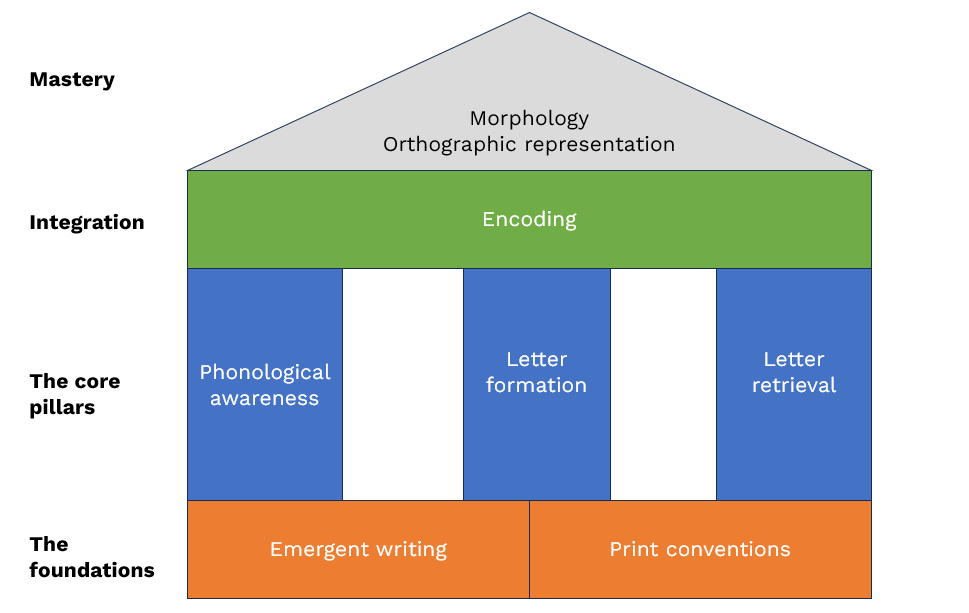
Successful word writing is a complex task requiring the integrated effort of several literacy skills (Feldgus et al. 2017; Treiman & Kessler 2014; Zhang et al. 2025). These include:
Specific literacy skills for supporting early word writing
Emergent writing
This is the most foundational stage and encompasses all of a child’s attempts at writing before they know about phoneme-grapheme correspondence.
It includes scribbling, drawing, making letter-like shapes and writing strings of letters that aren’t necessarily mapped to corresponding sounds (Byington & Kim 2017; Pinto, G., & Incognito 2022).
Children lean on their emergent writing practices while they continue to learn more about conventional ‘adult’ writing (Feldgus et al. 2017; Young & Ferguson 2024a).
Correlation with word writing is strong because it indicates a child has already engaged in exploring the functional purpose of writing (Gerde et al. 2012).
Watching someone write often grabs young children’s attention. Children like to imitate the actions of adults. If a young child sees you writing, they will want to participate and copy you. If children regularly spend time in the company of others writing, they will ‘write’ alongside them. As a result, they can learn to engage with writing long before they can form letters. This gives them valuable early experiences with being a writer.
Print conventions
Understanding that in the English writing system writing typically moves left-to-right, top-to-bottom and spaces are used to separate words.
Essential for readability; should be modelled during reading and writing experiences (Cabell et al. 2007; Dunsmuir & Blatchford 2004).
Letter formation
Knowing how to correctly form individual letters (graphemes).
Crucial. Slow or poor formation consumes working memory and can negatively impact a child’s composing (Puranik & Al Otaiba 2012; Reutzel et al. 2019; Santangelo & Graham 2016).
Letter retrieval
The automaticity of selecting the correct letter shape(s) (grapheme) for a specific sound (phoneme). Also known as automaticity of phoneme-grapheme correspondence.
This is the primary skill for phonetic spelling. The automaticity of retrieving the correct letter pattern (grapheme) for a sound is the strongest immediate predictor of early writing success (Caravolas et al. 2001; Malpique et al. 2020; Puranik & Al Otaiba 2012).
Phonological awareness
The ability to isolate and hear the individual sounds (phonemes) within a spoken word. This is critical for children to translate the sounds they can hear into words on the page.
The ability to break spoken words into individual sounds dictates whether a child can attempt phonetic spelling (Cabell et al. 2022). Inviting children to write can develop their phonological awareness (Vernon & Ferreiro 1999; Zhang et al. 2017).
Encoding
The integrated act of segmenting a word, selecting the correct letter(s) for each sound, and sequencing them to write an informed or otherwise conventionally spelt word (Feldgus et al. 2017; Young & Ferguson 2024a).
This is the output measure itself. If children are successfully encoding words, the above required sub-skills are well integrated and working well (Feldgus et al. 2017; Puranik & Al Otaiba 2012; Treiman & Kessler 2014).
Morphology
The ability to understand and manipulate morphemes (the smallest units of meaning in a word, such as prefixes, suffixes, and root words).
Provides powerful knowledge for spelling longer and more complex words (e.g. un- help -ful), reducing reliance on encoding individual sounds.
Accelerates spelling progress in later stages (Devonshire & Fluck 2010; McCutchen & Stull 2015; Nunes et al. 2003; Wolter et al. 2009).
Orthographic representation
The ability to store and retrieve specific letter sequences from memory (lexical knowledge). This involves recalling a word’s conventional spelling (especially important for irregular words).
Crucial for moving from phonetic spelling (kat for cat, sed for said) to full conventional spelling (Treiman & Kessler 2014).
Cognitive and perpetual skills for early word writing
These seven underlying cognitive and perpetual capacities are the fuel that drive children towards successful word writing.
Cognitive and perpetual skills for early word writing
Cognitive/perceptual focus
Importance to early word writing
Working memory
Arguably the most critical cognitive skill. Working memory holds the spoken word, the segmented sounds, and the sequence of letters being transcribed in the mind (Berninger et al. 2010; Kellogg 2001; Leidershnaider 2025; Hooper et al. 2011; Zhang et al. 2017).
Oral language and vocabulary
A child must know the words that best represent what it is they want to say. Strong oral language, particularly at the full discourse level, is a powerful predictor of overall writing quality (Cabell et al. 2022; Kim & Schatschneider 2017; Puranik & Lonigan 2012; Seoane et al. 2025).
Motor skills
Directly impacts the fluency of word writing. When graphomotor speed is slow, it creates a bottleneck, diverting working memory away from composing (Leidershnaider 2025; Hooper et al. 2011; Puranik & Al Otaiba 2012).
Metacognitive skills
Refers to functions like planning, self-monitoring, and checking (Balade et al. 2025; Limpo & Olive 2021).
Processing speed
The efficiency of converting sounds to letters and physically producing them (Afonso et al. 2020).
Attention and focus
Sustained concentration is necessary for word writing (Kim & Schatschneider 2017).
Long-term memory
The broad category that stores all knowledge (vocabulary, letter forms, orthographic representations). Its function is obviously embedded within the other skills listed (Caravolas et al. 2001).
Engagement with early word writing
As Donald Graves (1983, p.1) famously announced: Children want to write. They want to write from their very first day of school. Keeping that motivation alive is essential as children who are motivated to write are more likely to: put in increased effort, persist for longer, show more enthusiasm, give writing more of their attention and be more willing to seek help from others.
This engagement requires: (1) explicit modelling and instruction in the skills required to be successful and (2) regular meaningful, motivating and pleasurable writing experiences.
Word writing progression
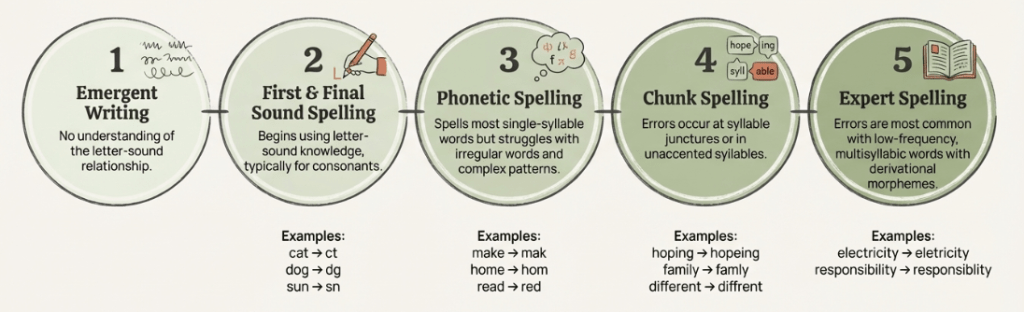
Students’ abilities in word writing develop along a continuum, moving through distinct phases that are greatly facilitated by systematic instruction and meaningful writing experiences. For word writing, this progression is often conceptualised in five phases:
1. Emergent writing
The child hasn’t yet got an understanding of the systematic relationship between letters and sounds. To see the specific stages of emergent writing, click here.
2. First and final sound spelling
The child begins using their letter-sound knowledge but accuracy is usually limited to consonants and short vowels.
cat → ct (child writes the consonants, may omit vowels)
dog → dg
sun → sn
bat → bt
3. Phonetic spelling
The child can spell most single-syllable words but struggles with irregular words and more complex patterns like silent long-vowels.
make → mak or make (may omit the silent e)
home → hom
bike → bik
read → red or reed (confusion with long-vowel spelling patterns)
4. Chunk spelling
Errors typically occur at syllable junctures or in unaccented syllables.
hoping → hopeing (error at the syllable juncture where the silent “e” should be dropped)
running → runing (omitting the doubled consonant at the syllable break)
family → famly (dropping an unaccented syllable)
different → diffrent (leaving out the unstressed middle syllable)
5. Expert spelling
Errors are most common with low-frequency, multisyllabic words involving derivational morphemes.
electricity → eletricity (dropping a syllable within a derived form)
responsibility → responsiblity (omitting the derivational suffix syllable)
biological → bioligical (confusing the placement of the derivational suffix -ical)
nation → natian (misapplying the derivational -ion pattern)
It is important to note that these developmental phases are not rigid and children will move between these stages depending on the specific word they wish to write.
Approaches to early writing
The main approaches to early writing include: writing readiness, naturalistic, reading first and communicative (Young & Ferguson 2024b). Each approach profoundly shapes how you teach young writers. Teachers should adjust how much each approach influences their practice based on what they believe their class needs most.
1. Writing readiness stresses early transcription skills. It helps children who struggle with the foundational skills of writing. However, taken to its extreme, it can deny children meaningful writing experiences. Children can begin to see writing as nothing more than transcriptional drills which serve no purpose (Young & Ferguson 2025a). At its worst, it creates passive and disengaged writers.
2. Naturalistic stresses freedom, self direction and self-expression. It values emergent writing, individual pacing, and children’s own volition to write (Edelsky 1990). Taken to its extreme, it can avoid providing explicit instruction, leave some children without the experiences or support they need, and can be in conflict with modern-day curriculum requirements.
3. Reading first erroneously delays the teaching of writing in favour of teaching early reading. Research does not support such an approach. Writing instruction and experiences boost children’s reading development. Reading and writing are mutually beneficial (Graham & Hebert 2011; Kim 2022a, 2022b; Vernon & Ferreiro 1999).
4. Communicative stresses providing explicit instruction alongside writing for real purposes and audiences (Young & Ferguson 2025b). Daily opportunities to engage in meaningful writing is seen as essential. It balances explicit teacher modelling and instruction with opportunities for meaning making and meaning sharing. It looks to create a community of writers with the focus on successfully communicating with readers.
We view a communicative approach as the best starting point for early writing. This is because it brings together (1) systematic synthetic phonics, (2) letter formation/handwriting instruction, (3) spelling instruction (4) explicit teacher modelling and writing instruction, and (5) daily opportunities to engage in meaningful writing experiences.
Research-supported recommendations
Six key recommendations emerge from research for effective word writing:
1. Teach phonological awareness
This involves systematic instruction in manipulating sounds (e.g. blending, segmenting). This comprehensive sequence reflects a consensus among structured synthetic phonics programs, all of which prioritise a systematic introduction to phoneme-grapheme relationships.
2. Teach letter formation
Explicitly model and teach letter formation (see here for more). Handwriting instruction should focus on: frequent exposure, making name-sound connections, teaching visually similar letters non-sequentially, and building automaticity in both letter recognition and letter writing. Here is a recommended order of teaching:
3. Model encoding strategies and encourage children to write their own informed ‘sound spellings’
Teachers should regularly model how to encode words to paper. An analytic approach should be used for irregular words. Teachers should focus children’s attention on the parts of a word that do follow predictable patterns (e.g. the sh and d in should) (McGeown et al. 2013). Informed‘sound spellings’ let children represent the sounds they hear, even if the spelling is unconventional or incomplete. It is not an error but a sign of their developing phonological awareness and a crucial practice ground for encoding (Ouellette & Sénéchal 2008; Treiman 2017).
4. Model chunking
As students progress, they must learn to process chunks larger than individual graphemes. This includes modelling:
(1) common rime units or phonograms (e.g. -ock, -ight, -ean),
Roots: struct (construct, destruct, structure), port (transport, portable, import)
Activities like word sorts and word building are highly effective for this type of learning.
5. Encourage children to use ‘kid writing’ for the phoneme- grapheme correspondence they don’t yet know and utilise ‘underwriting’
When children encounter a grapheme-phoneme correspondent they haven’t learnt yet, they should be encouraged to use a simple line or squiggle as a placeholder. This is sometimes called using your ‘kid writing’ (Feldgus et al. 2017). Kid writing is a powerful assessment tool as it quite literally shows you the gaps in children’s understanding of word writing.
Underwriting is the practice of transcribing a child’s kid writing or informed spelling into conventional adult spelling. This is typically done under or at the bottom of their original writing. When implemented correctly, it is a powerful teaching tool and feedback mechanism (Ouellette & Sénéchal 2008; Puranik & Lonigan 2014).
Best practice involves ensuring it is done with the child’s consent and presence, celebrating what the child already knew about the word they wanted to write (e.g. underlining their correct sounds), and providing a conventional spelling model for their reference. It offers valuable opportunities for individualised responsive instruction and should be used selectively, never before the child has made their own attempt so as to avoid undermining their confidence and intrinsic motivation to write independently (Treiman & Kessler 2014). For more, see this article.
6. Provide meaningful writing experiences
Children should be regularly invited to use and apply their word writing skills in the context of meaningful writing experiences. Students should be encouraged to apply their ever developing encoding knowledge in daily book-making/writing time (see here for more), reinforcing the connection between skill acquisition and authentic communication.
Afonso, O., Martínez-García, C., Cuetos, F., & Suarez-Coalla, P. (2020). The development of handwriting speed and its relationship with graphic speed and spelling. Cognitive Development, 56, 100965.
Balade, J., Rodríguez, C., & Jiménez, J. E. (2025). Developmental Trajectories of Transcription and Oral Language Skills in Kindergarten Students: The Influence of Executive Functions and Home Literacy Practices. Journal of Intelligence, 13(12), 163.
Berninger V. W., Abbott R.D., Swanson H. L., Lovitt, D., Trivedi, P., Lin, S. J., Gould, L., Youngstrom, M., Shimada, S., Amtmann. D. (2010). Relationship of word-and sentence-level working memory to reading and writing in second, fourth, and sixth grade. Lang Speech Hear Serv Sch, 41(2), 179-93.
Byington, T. A., & Kim, Y. (2017). Promoting preschoolers’ emergent writing. YC Young Children, 72(5), 74-82.
Cabell, S. Q., McGinty, A. S., & Justice, L. M. (2007). Assessing print knowledge In Assessment in emergent literacy (pp. 327-376).
Cabell, S. Q., Gerde, H. K., Hwang, H., Bowles, R., Skibbe, L., Piasta, S. B., & Justice, L. M. (2022). Rate of growth of preschool-age children’s oral language and decoding skills predicts beginning writing ability. Early Education and Development, 33(7), 1198-1221.
Caravolas, M., Hulme, C., & Snowling, M. J. (2001). The foundations of spelling ability: Evidence from a 3-year longitudinal study. Journal of Memory and Language, 45(1), 740–754.
Devonshire, V., & Fluck, M. (2010). Spelling development: Fine-tuning strategy-use and capitalising on connections between words. Learning and Instruction, 20, 361–371.
Dunsmuir, S., & Blatchford, P. (2004). Predictors of writing competence in 4‐to 7‐year‐old children. British journal of educational psychology, 74(3), 461-483.
Edelsky, C. (1990). Whose agenda is this anyway? A response to McKenna, Robinson, and Miller. Educational Researcher, 19(8), 7-11.
Feldgus, E. G., Cardonick, I., & Gentry, J. R. (2017). Kid writing in the 21st century: A systematic approach to phonics, spelling, and writing workshop. Hameray Publishing Group.
Gerde, H. K., Bingham, G. E., & Wasik, B. A. (2012). Writing in early childhood classrooms: Guidance for best practices. Early childhood education journal, 40(6), 351-359.
Graham, S., & Hebert, M. (2011). Writing to read: A meta-analysis of the effects of writing instruction on reading comprehension and reading skills. Review of Educational Research, 81(2), 189–211.
Graves, D. H. (1983). Writing: Teachers and children at work. Heinemann.
Hofslundsengen, H., Gustafsson, J. E., & Hagtvet, B. E. (2019). Contributions of the home literacy environment and underlying language skills to preschool invented writing. Scandinavian Journal of Educational Research, 63(5), 653-669.
Hooper, S. R., Costa, L. J., McBee, M., Anderson, K. L., Yerby, D. C., Knuth, S. B., & Childress, A. (2011). Concurrent and longitudinal neuropsychological contributors to written language expression in first and second grade students. Reading and Writing, 24(2), 221-252.
Kaderavek, J. N., Cabell, S. Q., & Justice, L. M. (2009). Early writing and spelling development. Emergent literacy and language development: Promoting learning in early childhood, 104-152.
Kellogg, R. T. (2001) Competition for working memory among writing processes, American Journal of Psychology, 114(2), 175–191
Kim, Y.-S., Otaiba, S. A., Puranik, C., Folsom, J. S., Greulich, L., & Wagner, R. K. (2011). Componential skills of beginning writing: An exploratory study. Learning and Individual Differences, 21(5), 517–525.
Kim, Y. S., Al Otaiba, S., Folsom, J. S., Greulich, L., & Puranik, C. (2014). Evaluating the dimensionality of first-grade written composition. Journal of Speech, Language, and Hearing Research, 57(1), 199-211.
Kim, Y. S. G., & Schatschneider, C. (2017). Expanding the developmental models of writing: A direct and indirect effects model of developmental writing (DIEW). Journal of educational psychology, 109(1), 35.
Kim, Y. S. G. (2022a). A Tale of Two Closely Related Skills: Word Reading and Spelling Development and Instruction. In Z. A. Philippakos & S. Graham (Eds.), Writing and reading connections: Bridging research and practice. Guilford Press
Kim, Y. S. G. (2022b) Co-Occurrence of Reading and Writing Difficulties: The Application of the Interactive Dynamic Literacy Model, Journal of Learning Disabilities, 00222194211060868
Lacina, J., Roberts, S. K., & Crawford, P. A. (2025). Celebrating Pathways to Joyful and Meaningful Writing with Young Children. Early Childhood Education Journal, 1-6.
Leidershnaider, L. (2025). Investigating the Relationship Between Cognitive Load and Writing Task Complexity in Grades 4-6 School-Aged Children (Master’s thesis, University of Toronto (Canada)).
Limpo, T., & Olive, T. (Eds.). (2021). Executive functions and writing (Vol. 19). Oxford University Press.
Machón, A. (2023). Drawings by Children Between 3 and 4 Years of Age: Developmental Study of the Period of Form and Graphic-Symbolic Representation. In The Routledge International Handbook of Research on Writing (pp. 20-35). Routledge.
Malpique, A. A., Pino-Pasternak, D., & Roberto, M. S. (2020). Writing and reading performance in Year 1 Australian classrooms: Associations with handwriting automaticity and writing instruction. Reading and Writing, 33(3), 783-805.
McCutchen, D., & Stull, S. (2015). Morphological awareness and children’s writing: accuracy, error, and invention. Reading and writing, 28(2), 271-289.
McGeown, S. et al. (2013a). Individual differences in children’s reading and spelling strategies and the skills supporting strategy use. Learning and Individual Differences, 28, 75-81. https://doi.org/10.1016/j.lindif.2013.09.013
McGeown, S. et al. (2013b). Towards an understanding of how children read and spell irregular words: the role of nonword and orthographic processing skills. Journal of Research in Reading. https://doi.org/10.1111/jrir.12007
Nunes, T., Bryant, P., & Olsson, J. (2003). Learning morphological and phonological spelling rules: An intervention study. Scientific Studies of Reading, 7, 289–307. doi:10.1207/S1532799XSSR0703_6
Ouellette, G., & Sénéchal, M. (2008). Pathways to literacy: A study of invented spelling and its role in learning to read. Child development, 79(4), 899-913.
Pinto, G., & Incognito, O. (2022). The relationship between emergent drawing, emergent writing, and visual‐motor integration in preschool children. Infant and Child Development, 31(2), e2284.
Pollo, T. C., Kessler, B., & Treiman, R. (2009). Statistical patterns in children’s early writing. Journal of experimental child psychology, 104(4), 410-426.
Puranik, C. S., & AlOtaiba, S. (2012). Examining the contribution of handwriting and spelling to written expression in kindergarten children. Reading and writing, 25(7), 1523-1546.
Puranik, C. S., & Lonigan, C. J. (2012). Early writing deficits in preschoolers with oral language difficulties. Journal of Learning Disabilities, 45(2), 179-190.
Puranik, C. S., & Lonigan, C. J. (2014). Emergent writing in preschoolers: Preliminary evidence for a theoretical framework. Reading research quarterly, 49(4), 453-467.
Reutzel, P., Mohr, K. A., & Jones, C. D. (2019). Exploring the relationship between letter recognition and handwriting in early literacy development. Journal of Early Childhood Literacy, 19(3), 349-374.
Rose, J. (2006). Independent review of the teaching of early reading. Department for Education and Skills.
Rowe, D. W. (2023). Writing in early childhood. In The Routledge international handbook of research on writing (pp. 187-205). Routledge.
Santangelo, T., & Graham, S. (2016). A comprehensive meta-analysis of handwriting instruction. Educational psychology review, 28(2), 225-265.
Seoane, R. C., Wang, J., Cao, Y., & Kim, Y. S. G. (2025). Unpacking the Relation Between Oral Language and Written Composition: A Meta-Analysis. Review of Educational Research, 00346543251320359.
Thomas, L. J., Gerde, H. K., Piasta, S. B., Logan, J. A., Bailet, L. L., & Zettler-Greeley, C. M. (2020). The early writing skills of children identified as at-risk for literacy difficulties. Early Childhood Research Quarterly, 51, 392-402.
Treiman, R., & Kessler, B. (2014). How children learn to write words. Oxford University Press.
Vernon, S., & Ferreiro, E. (1999). Writing development: A neglected variable in the consideration of phonological awareness. Harvard Educational Review, 69(4), 395-416.
Wolter, J. A., Wood, A., & D’zatko, K. W. (2009). The influence of morphological awareness on the literacy development of first-grade children. Language, Speech, and Hearing Services in Schools, 40(3), 286-298.
Young, R., Ferguson, F. (2024a) Getting children up and running as writers Brighton: The Writing For Pleasure Centre
Young, R., Ferguson, F. (2024b) The different perspectives you can take on teaching early writing.[https://writing4pleasure.com/2024/03/15/the-different-perspectives-you-can-take-on-teaching-early-writing/]
Young, R., Ferguson, F. (2025b) How to teach writing in the EYFS [https://writing4pleasure.com/how-to-teach-writing-in-the-eyfs/]
Zhao, Y., Gerde, H. K., Shu, L., & Gagne, J. R. (2025). Evidence-based instructional support for early writing in preschool and kindergarten: a scoping review. Reading and Writing, 1-27.
Zhang, C., Bingham, G. E., & Quinn, M. F. (2017). The associations among preschool children’s growth in early reading, executive function, and invented spelling skills. Reading and Writing, 30(8), 1705-1728.
Zhang, C., & Bingham, G. E. (2019). Promoting high-leverage writing instruction through an early childhood classroom daily routine (WPI): A professional development model of early writing skills. Early Childhood Research Quarterly, 49, 138-151.
Zhang, X. Y., Bingham, G. E., Branum‐Martin, L., Gerde, H. K., & Bowles, R. P. (2025). Assessing Early Writing in Preschool: Attention to Early Writing Tasks and Component Skills. Reading Research Quarterly, 60(4), e70051.
Further recommended reading
The power of emergent writing
How can you teach children to write before they know their letters? [LINK]
Debunking edu-myths: ‘Emergent writing’ isn’t necessary before teaching children to write [LINK]
Debunking the ‘bones aren’t ready’ and ‘motor skills first’ myths: What research says about young children’s handwriting [LINK]
This free handbook addresses some of the major aspects of teaching writing. The aim is to create an invaluable reference guide for all teachers. We hope to update this handbook every year to take account of the latest research and thinking. We would like this handbook to support teachers in developing sound subject knowledge and exceptional classroom practice. We have tried to make the research as accessible as possible. The handbook includes:
Over 1000 research entries covering the major aspects of developing students as writers.
Short abstracts and keyword tags to help teachers find the research they are looking for.
An analysis of the analysis and what it is the best performing writing teachers do that makes the difference.
A chapter dedicated to each of the 14 principles of world-class writing teaching.
Research on the early teaching of writing including compositional development, phonics, encoding, spelling, letter formation and handwriting.
Extended entries on major topics such as speaking and listening, reading/writing connection, multilingualism, special educational needs and disabilities, and social and emotional disorders.
Focused chapters on the affective needs of student writers, including: self-efficacy (confidence), self-regulation (competence and independence), agency, motivation and writer-identity.
Essential literature and suggested reading offered at the end of each chapter.
This handbook is a useful resource for anyone interested in developing world-class writing teaching. Teachers should find what is shared within these pages utterly interesting, informed and helpful.
We have done our best with this fifth edition to cover many aspects of writing teaching in the best way we can. We have provided a variety of research, from different disciplines, and from a variety of perspectives. We’ve tried to provide a balance between the very latest emerging research and classic studies which contain profound insights and have stood the test of time. If you think some important research entries are missing, then please contact us. You can contact us through our website at: http://www.writing4pleasure.com/contact
New to this fifth edition:
Our handbook now comes in two volumes.
Volume one covers affective factors in children’s writing development. It also summarises findings from meta-analyses, case studies, and organisational reports on world-class writing teaching.
Volume two presents the 14 principles of world-class writing teaching.
This edition also includes the following updates.
Additional reading on theories of writing development.
Recommended reading on initial teacher education.
Significant additions to the motivation and writer identity chapters.
Expanded commentary on writing interventions, supporting children with special educational needs, and developing multilingual writers.
A new section on parental/home support for writing
A new section on writing and AI, including the use of large language models.
Major additions on the importance of a consistent approach to teaching writing in the early years.
Further additions on supporting secondary students.
Expanded reading on early word writing, letter formation, handwriting, encoding, and spelling.
Significant new reading in the personal writing projects chapter.
Major additions to the reading and writing connection chapter.
Welcome to our new blog series where BIG WRITING IDEAS ARE SIMPLY EXPLAINED! This series is dedicated to sharing key subject knowledge that can make you a better teacher of writing.
Each month, we will share a new concept or figure with you. Over time, we hope this series can build up your expertise. To follow the series, simply sign up to our newsletter here.
This month, we are looking at Linda Flowers & John Hayes.
📣 The cognitive process model
“The process of writing is best understood as a set of distinctive thinking processes which writers orchestrate or organise.” – Linda Flowers
🧠 The big idea
Flower and Hayes revolutionised how we understand writing – not just as putting words on a page but as a complex thinking process. Their model shows that writing involves multiple, overlapping mental activities like planning, translating ideas into text, and reviewing. It’s a dynamic, recursive process where writers constantly juggle goals, audience needs, and problem-solving.
In short: Writing isn’t linear – it’s a loop of thinking, writing, and revising.
Their model reshapes composition studies and writing instruction
Today
Foundation of cognitive and process-oriented approaches to writing
🔍 Core concepts
🟠 Planning Deciding what to write, setting goals, and organising ideas. 🗣️ “What do I want to say, who do I want to say it to, and how to I want to say it?”
🟠 Translating Turning ideas into actual words and sentences. 🗣️ “How do I express these ideas as words and sentences?”
🟠 Reviewing Rereading and revising text to improve clarity and effectiveness. 🗣️ “Is this any good? What needs working on?”
🟠 Recursive process Writers don’t move straight through these steps — they loop back and forth, rethink, and revise constantly.
🟠 Working memory and long-term goals Writers juggle immediate sentence choices and their broader writing goals simultaneously.
👤 Key figures
👨🏫 Linda Flower & John R. Hayes Cognitive psychologists and composition researchers who mapped out writing as a mental process, shifting teaching toward process and strategy.
🛠️ In the writing classroom
✅ Teach writing as a flexible, recursive process ✅ Encourage planning and goal-setting before and during writing ✅ Understand that revision is a key part of thinking and improving ✅ Plan class writing projects in a way that manages students’ cognitive load and focuses their attention
⚖️ Criticism and debate
🔸 Some say the model underestimates the social, motivational, and cultural influences on writing. 🔸 Critics argue it’s focused more on developing the individual writer than developing a social group of writers. 🔸 Still highly influential in process-based writing pedagogy.
Find out more:
A Cognitive Process Theory of Writing by Linda Flower & John R. Hayes [LINK]
The Science Of Teaching Primary Writing by Ross Young & Felicity Ferguson [LINK]
Many primary classrooms do not give children enough time to write. If we rush writing, we get rushed and disappointing outcomes. Our aim has to be to help children produce the best writing they can.
Amount of writing time
Renowned writing researcher Steve Graham recommends a minimum of one hour each school day for writing. For children in the early years, this should be at least 30 minutes a day (Graham et al. 2012; see also LINK). Around half of this time should be devoted to instruction and delivering feedback. The other half is for children to write.
Writing is thinking. Children can only think at a superficial level if writing time is short. Bereiter & Scardamalia call this ‘knowledge telling’. To transform ideas while writing, students need time to explore and shape their thinking (LINK). Mihaly Csikszentmihalyi studied deep concentration. He calls this flow (LINK). He found that people reach their best thinking when they are given enough time to be absorbed in a task. Short lessons prevent children from reaching this kind of deep focus. They have to stop writing before they’ve really been able to get to work.
Frequency of writing time
Writer-teacher Donald Graves said that children become writers by writing often. He pointed out that writing once or twice a week forces children to start again each time. They never build momentum or the writer’s discipline. He suggested that children should have a writing lesson at least four times a week (Graves 1983). Teresa Cremin’s work also shows that time and space help children feel like authors. She found that when teachers write with their class, they come to realise just how much time is needed to craft meaningful and successful texts (Cremin et al. 2017).
In our own study of some of the most effective writing teachers in England (LINK), we found that practitioners who taught writing every day and gave protected time to writing, saw strong outcomes. Their lessons followed a reassuringly consistent daily routine (LINK). This wider research all supports Graham’s main message: frequent and extended writing lessons improve the quality of children’s writing (Graham & Perin 2007).
Schools that teach writing daily and for an hour are more likely to give children what they need to write their best possible texts. They give them time to generate ideas, plan, think, write, improve, proof-read and publish (Graham, 2019 and LINK).
Quality writing requires time.
References
Bereiter, C and Scardamalia, M (1987). The Psychology of Written Composition. Lawrence Erlbaum Associates.
Cremin, T, Myhill, D, Eyres, I, Nash, T, Wilson, A and Oliver, L (2017). Teachers as Writers. Arvon and Open University.
Csikszentmihalyi, M (1990). Flow: The Psychology of Optimal Experience. Harper and Row.
Graham, S (2019). Changing how writing is taught. Review of Research in Education, 43, 277 to 303.
Graham, S and Perin, D (2007). Writing Next. Alliance for Excellent Education.
Graham, S, Harris, K and Santangelo, T (2012). Teaching Elementary School Students to Be Effective Writers. Institute of Education Sciences.
Graves, D (1983). Writing: Teachers and Children at Work. Heinemann.
Kellogg, R (1996). A model of working memory in writing. In C Levy and S Ransdell (Eds), The Science of Writing, 57 to 71. Lawrence Erlbaum Associates.
Young, R and Ferguson, F (2021). Writing for Pleasure: Theory, Research and Practice. Routledge.
Welcome to our new blog series where BIG WRITING IDEAS ARE SIMPLY EXPLAINED! This series is dedicated to sharing key subject knowledge that can make you a better teacher of writing.
Each month, we will share a new concept or figure with you. Over time, we hope this series can build up your expertise. To follow the series, simply sign up to our newsletter here.
We are starting off with a real pioneer: Donald Murray. He changed writing instruction by showing that both the finished text and the writer’s ongoing development matter.
Murray taught us to ‘Teach the writer – not just the writing’ and showed that writing is first and foremost a process, which he described as ‘a way of thinking on paper’. He normalised the messiness of creation, reminding teachers that the writing process involves flexibility and that even so-called ‘writer’s block’ is part of writing – a stage of ‘incubation’ where ideas form unseen.
By exploring Murray’s core concepts, you will gain a better approach to feedback, encourage revision and metacognition, and help your pupils develop and value their own unique writing habits.
🔄 Writing as a process
“Teach writing as a process not a product” – Donald M. Murray
🧠 The big idea
Donald Murray transformed writing instruction by focusing on the writer’s process, not just the final product. He argued that writing is an act of discovery – a recursive journey where ideas emerge and evolve through drafting, revising, and reflection.
Rather than correcting students’ writing, Murray believed teachers should coach writers, helping them understand how they write and how they can develop their unique voice over time.
His ideas become foundational in writing education
🔍 Core concepts
🟢 Writing is a process Professional and recreational writers don’t write in one straight run – they plan, explore, rethink, and revise continuously.
🟢 Discovery through writing Writers don’t always start with clear ideas – they discover their ideas through the act of writing itself.
🟢 The writer at the centre Students should be treated as apprentice authors, not just students doing assignments. Their interests, voices, and choices matter.
🟢 Teachers as coaches Teachers should give feedback as readers, ask questions, and support the writer’s growth over time – rather than acting as judges and editors alone.
👤 Key figure
👨🏫 Donald M. Murray Journalist turned teacher. A key figure in the process writing movement, Murray’s essays and classroom work reshaped the way writing is taught from primary school through to university.
🛠️ In the writing classroom
✅ Emphasise idea generation, planning, drafting, and revision ✅ Encourage reflection and metacognition ✅ Respond to children’s ideas and development, not just their use of grammar and conventions ✅ Help students develop and value their own writing habits and writing process
⚖️ Criticism and debate
🔸 Some argue Murray was too student-centered and unstructured 🔸 Still, Murray’s influence is visible in nearly every modern writing classroom
💬 Representative quote
“Teach the writer – not just the writing”
Find out more:
A Writer Reforms (The Teaching Of Writing) Donald Murray & The Writing Process Movement, 1963-187 by Michael J. Michaud [LINK]
Teach Writing As A Process Not Product by Donald Murray [LINK]
Improving children’s reading AND writing: Connecting research and practice
Four online sessions focusing on children’s reading and writing will take place in November and December from 4pm – 5pm. These sessions are designed for UK primary school teachers, primary school leaders, literacy leads and education consultants.
ThE sessions are designed to provide research insights to support children’s reading and writing acquisition and development. With a focus on supporting both reading and writing skill, all those attending will have greater access and insight into contemporary research to inform their classroom practice.
Participants will gain insight into implications for practice, a curated collection of key open access research articles and, if all four sessions are attended, a certificate of completion.
Sessions can be booked individually for £15 each or all four sessions can be booked at a discounted price of £50.
Sessions overview
Session 1: Learning to read – Thursday 20 November 2025, 16:00-17:00pm
Delivered by Professor Sarah McGeown
This session highlights the core skills underpinning reading development, research-informed practice to support children’s word reading, and the importance of nurturing an early love and interest in books, words, and stories.
Session 2: Reading motivation and engagement – Thursday 27 November 2025,16:00-17:00pm
This session provides insight into the importance of reading motivation and engagement throughout primary school, research-informed principles to support reading engagement, and the reading, language, social and emotional benefits accrued from reading.
Session 3: Learning to write – Thursday 4 December 2025,16:00-17:00pm
Delivered by Ross Young
This session explores key aspects of writing development, research-informed strategies to support children as apprentice writers, and the importance of nurturing a lifelong love of writing.
Session 4: Writing motivation and engagement – Thursday 11 December 2025,16:00-17:00pm
This session provides insight into the importance of writing motivation and engagement throughout primary school, research-informed principles to support children’s engagement with writing, and the social, emotional, and expressive benefits gained through the experience of being a young writer.
Biographies
Professor Sarah McGeown is Director of the University of Edinburgh’s Literacy Lab. She has published widely in academic and professional journals, with research focusing on early reading acquisition and development to motivation and engagement in reading. She is an advocate for research-practice partners and closing the gap between research and practice to improve children’s reading experiences and outcomes.
Ross Young is a former primary school teacher and co-founder of The Writing for Pleasure Centre. His work focuses on translating writing research into effective classroom practice, and he regularly collaborates with teachers and children in schools. He has written several books on teaching writing and leads professional development through organisations such as the UKLA. Ross is currently a PhD researcher at the University of Edinburgh’s Literacy Lab, studying children’s writing lives in partnership with the National Literacy Trust.
The UKLA annual student and teacher online conference (2025) explores the notion of the teaching of writing for pleasure. Through the conference delegates will, through three expert-led sessions, develop their subject knowledge and gain practical strategies and lesson ideas to teach writing for pleasure confidently in the classroom. There will be a particular focus on writing for pleasure with SEND pupils.
Designed for both student teachers and teachers, this conference will prove to be invaluable professional development.
Through the day there will be interactive sessions from:
Ross Young – founder of the Writing for Pleasure Centre The 14 Principles which underpin Writing for Pleasure
Billy Allgood – SENCO @ Gallions Primary School The benefits of writing for pleasure for SEND pupils
Felicity Ferguson – founder of the Writing for Pleasure Centre How to develop yourself as an excellent teacher of writing in whatever context you find yourself in.
In this essential new eBook, The Power Of Scaffolds: Utilising Posters & Other Tools In The Writing Classroom, Felicity Ferguson, Tobias Hayden & Ross Young provide practical strategies designed to give children the tools they need to write successfully, independently, and fluently.
Writing is inherently hard, and our job as teachers is to make it easier for young writers. While excellent instruction is key, children must retain and recall the content of writing lessons over time to develop their independence.
This book champions the use of simple, effective scaffolds (primarily posters and handouts) to overcome this obstacle. A writing poster is a large visual illustration of instruction about writing or being a writer, displayed for children, teachers, and teaching assistants to reference for as long as it is useful. These tools are applicable for all ages, from EYFS to Year 6.
Making and using posters is an excellent way to scaffold the writing process. The advice and clear examples within this book show how these scaffolds can:
Support instruction at every stage of the writing process.
Help you teach responsively.
Act as a ‘surrogate teacher’ when you are not immediately available.
Make it easier for children to remember and apply what they have learned.
Encourage true independence in writing.
SRSD: The research behind the scaffolds
A good poster is a vital component of Self-Regulating Strategy Development Instruction (SRSD). While the name sounds complex, SRSD simply means teaching children strategies that enable them to become independent writers by actively using what you have taught them. Research confirms that SRSD instruction is one of the most validated and effective practices a writing teacher can employ, yielding benefits for all children, particularly those with Special Educational Needs (SEND).
By creating and displaying thoughtfully constructed posters, you are reinforcing the quality instruction you are delivering in real-time.
Practical strategies: What you will learn
This lavishly illustrated book invites you to draw inspiration from posters made by teachers and used in real classrooms. It provides practical guidance on creating both temporary and permanent posters tailored to your classroom needs.
Key areas covered include:
Qualities of a good Poster: You will learn that effective posters should be large, simple, clear, visually appealing, and focus on only one thing. They should utilise catchy titles and visual symbols to support retention.
Teaching with two posters: The book advises creating two posters to support each lesson. Poster 1 (selling your craft move) should advertise the benefits and function of the writing technique or strategy you are teaching that day, while Poster 2 (modelling the craft move) shows how the teacher has used the move in their own writing.
Reinforcing subject knowledge: The process of creating effective posters requires you to analyse the structure and function of the craft move you are teaching, which reinforces (and can add to) your own writing subject knowledge.
Organised display: To avoid a cluttered classroom, the book guides you in placing and grouping posters according to the writing process or craft area, suggesting areas like The Ideas Cupboard or Functional Grammar Corner.
Comprehensive coverage: The book provides examples of posters for all aspects of the National Curriculum (and beyond). We cover a wide range of writing stages and needs, including posters to support bookmaking (EYFS/KS1), generating ideas, grammar craft moves, sentence-level strategies, spelling, proofreading, and literary and rhetorical craft moves.
Maximising impact: Revision checklists
Crucially, the book also demonstrates how these scaffolds feed into other high-impact strategies, particularly revision checklist sessions.
Revision is about re-seeing and re-thinking drafted writing, allowing children the space to tackle higher-order writerly techniques. Revision checklists are powerful tools derived from the product goals (success criteria) established with the class. When children evaluate their writing against collaboratively generated product goals, research shows a remarkable positive effect on writing progress.
The book shows you how to turn your posters into revision checklists, ensuring your pupils are already familiar with the examples and instruction contained within them. By providing dedicated time and instruction for revision you can develop a community of writers, increase children’s academic progress, and boost their confidence.
Invest in your practice
This book is informed by ongoing work with classroom teachers and early years educators, grounded in scientific research. If you want effective ways to help all young writers retain and apply instruction independently, this eBook is for you!
At its core, our position is simple: AI cannot write¹. This is because AI cannot think, feel or draw on personal experiences. To write involves thinking, feeling and sharing meaning. All large language models do is generate syntax based on patterns in data². It’s a simulation of language use without understanding. This carries implications for writers, teachers, and students.
Why AI generated syntax is not writing
No thought, no consciousness, no experience. AI models lack lives. They do not think, feel, wonder, doubt, or imagine. They have no personal histories to draw on, no hopes, no fears, no embodied existence. Human writing grows out of lived experiences, emotion, sensory detail, uncertainty, revision, reflection and thought. These are things language models do not possess.
Pattern without understanding. What language models do is statistical pattern-matching. They generate sequences of words based on probabilities from large datasets. It does not shape and make meaning. It carries no intention nor does it understand rhetorical nuance in the way a human does. It is a fake. A phoney.
No agency, no intentionality As writers, we make choices: what to emphasise, what moral stance to take, which metaphor to extend and where to leave ambiguity. These choices are part of the writing process and the author’s voice. AI has no intentions. It cannot choose in the service of meaning beyond what its available data suggests.
Lack of authentic revision, struggle, and joy The writing process is messy. We draft, we abandon, we rewrite, we confront frustration, failure, joy and discovery. But it is precisely this process that makes writing – writing. Out of the difficulty, pleasure and satisfaction comes growth. Writers experience satisfaction and pleasure in shaping a sentence that sings, surprising themselves with an idea, finding just the right word for the occasion and sharing their developing manuscript with others³. Writing is relational too. It connects us to peers, mentors, readers and communities. AI knows nothing of this. It does not struggle but neither does it take delight. It does not revise with care nor does it feel the pride of authorship. It simply produces syntax based on data patterns. The writer’s journey, both its frustrations and its thrills, is entirely absent.
Teachers who outsource their own writing
We must be clear: Teachers who turn to AI to produce ‘mentor texts’ abdicate their responsibility as genuine writer-teachers.
Teachers of writing need to write themselves⁸. Without fully engaging in writing, they are unable to authentically teach writing. Without undertaking a class writing project for themselves, they are in no position to appreciate where their students might need particular instruction or support. They also leave themselves unable to model the idea generating, planning, decision-making, risk-taking, revising, proof-reading, publishing and performing that writing requires³.
When a colleague lets AI generate syntax, they stand at the front of their class without the vital expertise and experiences required to be an effective teacher of that writing. AI cannot explain why a sentence was shaped a certain way, how a certain metaphor came about or why an idea was discarded and then brought back. Also, what message does this send? That writing is simply a product to produce on demand, not a process. All that is learnt in the crafting of writing can be replaced with automation. A writer’s joy, struggle and growth is unnecessary. These are the wrong messages entirely. It is a betrayal of what it means to model the writer’s life for students⁴.
The call for “AI-proof” writing projects
If AI is going to saturate our cultural landscape, then teachers, scheme writers and assessment designers must respond by rethinking the kinds of writing projects they set. The future lies in writing projects that AI cannot possibly reproduce. These are writing projects that demand students to draw deeply on their own:
funds-of-knowledge (the personal expertise they accumulate from home, community and experience)
funds-of-identity (their lived histories, values, passions and perspectives)
funds-of-language (the registers, dialects and linguistic repertoires that make their writing voice distinct)
personal responses (insights, reflections, memories, emotions only they can access)
Such writing insists on authenticity. It asks students to inhabit the page with part of themselves: their thoughts, ideas, voice, experiences and their ways of seeing the world⁵. AI will never be able to replicate this kind of writing because AI has no self to draw from. Teachers, therefore, must design writing projects that insist on meaning over language patterns, originality over generic templates and humanity over writing simulations². That is a necessary pedagogical shift.
When students turn to AI
If students (and teachers) are regularly using AI as a replacement for their own authorship, we must ask ourselves a serious question: Is there enough personal value in the class writing projects we’ve designed?
Students reach for shortcuts when writing tasks feel meaningless, disconnected, or overly formulaic⁷. The solution is not to tighten surveillance but to design projects that genuinely matter to young writers. Again, these will be projects that invite them to draw on their own experiences, funds-of-knowledge, and sense of identity⁵. When students are invested in a piece of writing, when it feels like it is theirs, they are far less likely to want an algorithm to do it for them⁶.
AI cannot assess what matters most
Teachers should resist using AI to assess children’s writing. While AI can provide surface-level feedback on grammar, spelling, or sentence variety, it will never be able to evaluate the aspects of writing we value most: meaning, voice, originality, authenticity, and the emotional and intellectual impact of a piece.
Some argue that AI can handle assessing the transcriptional aspects of a student’s writing rather efficiently, supposedly freeing teachers up to focus more on higher-order concerns like voice and meaning. We are not convinced. As we know only too well, what becomes important in assessment arrangements is what becomes important in our teaching. To delegate assessment to AI is to miss the very point of what reading and assessing students’ writing is all about.
What this means in practice
AI as a tool, not an author. We regard AI as a compositional assistant like a grammar or spell-checker. For students who experience writing as anxiety or paralysis, AI may reduce their fear of the blank page, allowing them to experiment more freely or approach revision with greater confidence⁷. While AI can offer suggestions, alternative phrasing, or surface-level support, the human writer must, within this cognitive partnership, remain in authorial control: steering, revising, choosing, and rejecting. The final text must remain authored.
Teachers should ask students to compare their own writing with AI-generated outputs and critique the differences. In this way, AI can function as a mirror, helping students notice what is inauthentic about a machine’s syntax and clarify what is distinctive and special about their own writing.
Transparency, fairness, digital literacy and ethical use of AI If teachers use AI, they must be transparent about how and why they have done so. Students deserve to know whether a text has been wholly human-written or partially generated by an algorithm. Anything less risks creating a double standard, with teachers relying on tools that students are forbidden to use. By openly sharing drafts, prompt entries, and AI-generated inputs, teachers model honesty and fairness, allowing students to make informed choices about their own AI-related writing practices. What matters most is integrity: students should experience an authentic apprenticeship in writing, not a concealed dependence on technology.
Pedagogical clarity: In writing classrooms, AI should never replace teacher modelling, meaning-making, voice, invention, idea generation, planning techniques, or the teaching of revision and proofreading strategies.
Our hope and ambition
Children and young people believe in the pleasure and satisfaction of human authorship⁷. It’s our view that students want to say something with originality, see the world in unique ways, connect with their readers emotionally and intellectually, and most importantly, surprise and develop themselves as authors. We want students and teachers to stay in contact with the craft of writing and not hand it over to machinery.
We must aim to consider large language models critically and transparently. We mustn’t lose sight of what being a writer-teacher is and what it means to teach and model writing⁸. In every instance, the human author must remain the agent, the thinker, the feeler, the asker of questions, the entertainer, the painter of words, the sharer of knowledge, insight, experience and personal expertise.
Warner, J. (2025). More than words: How to think about writing in the age of AI. Hachette UK.
Sharples, M., & y Pérez, R. P. (2022). Story machines: How computers have become creative writers. London: Routledge.
Young, R., & Ferguson, F. (2021). Writing for pleasure: Theory, research and practice. Routledge.
Kaufman, D. (2002). Living a literate life, revisited. English Journal, 91(6), 51-57.
Young, R., Ferguson, F., Kaufman, D., & Govender, N. (2022). Writing realities. Brighton: The Writing For Pleasure Centre.
Young, R., Ramdarshan‐Bold, M., Clark, C., & McGeown, S. (2025). ‘It’s healthy. It’s good for you’: Children’s perspectives on utilising their autonomy in the writing classroom. Literacy
Picton, I., Clark, C., & Bonafede, F. (2025). Young People’s Use of Generative AI to Support Literacy in 2025. National Literacy Trust.
Smith, J., & Wrigley, S. (2015). Introducing teachers’ writing groups: Exploring the theory and practice. Routledge.
Further recommended reading:
‘The dangers of using AI to grade: Nobody learns, nobody gains’ by Marc Watkins [LINK]
Sharples, M. (2022). Automated essay writing: An AIED opinion. International journal of artificial intelligence in education, 32(4), 1119-1126.