

When a five-year-old writes DRAGN for dragon, it is tempting to say that they’ve simply misspelt the word. A better description is that the child has heard every consonant, represented them in the right order, and has not yet learned how English marks the unstressed vowel in the second syllable.
Every spelling a child produces is a snapshot of what they currently know about how words work: sounds, letters, patterns, meaning and word history. Read that way, a non-conventional spelling is not a failure but interesting evidence of spelling development. It shows us what the child has secured, what they are using but confusing, and what they have not yet met.
This matters because their spelling changes over time. Children’s spellings of the same word can shift over months and years, driven by our teaching, reading, writing for real purposes and feedback from their teachers. This article explains why spelling should be understood developmentally, traces how familiar words change from emergent writing through to conventional spelling, and sets out what this means for classroom practice.
What the research says
Children’s spellings are rarely random. Charles Read’s (1971) study of preschoolers’ spellings showed that young children make principled, consistent decisions based on how sounds are produced in the mouth. A child who writes CHRAN for train is not guessing: before /r/, the /t/ in train really is pronounced close to /tʃ/.
Building on this, researchers described a broad developmental progression. Gentry (1982) analysed one child’s writing over several years, drawing on Bissex’s (1980) case study GNYS AT WRK. Bear and colleagues (2016) later organised the progression into phases:
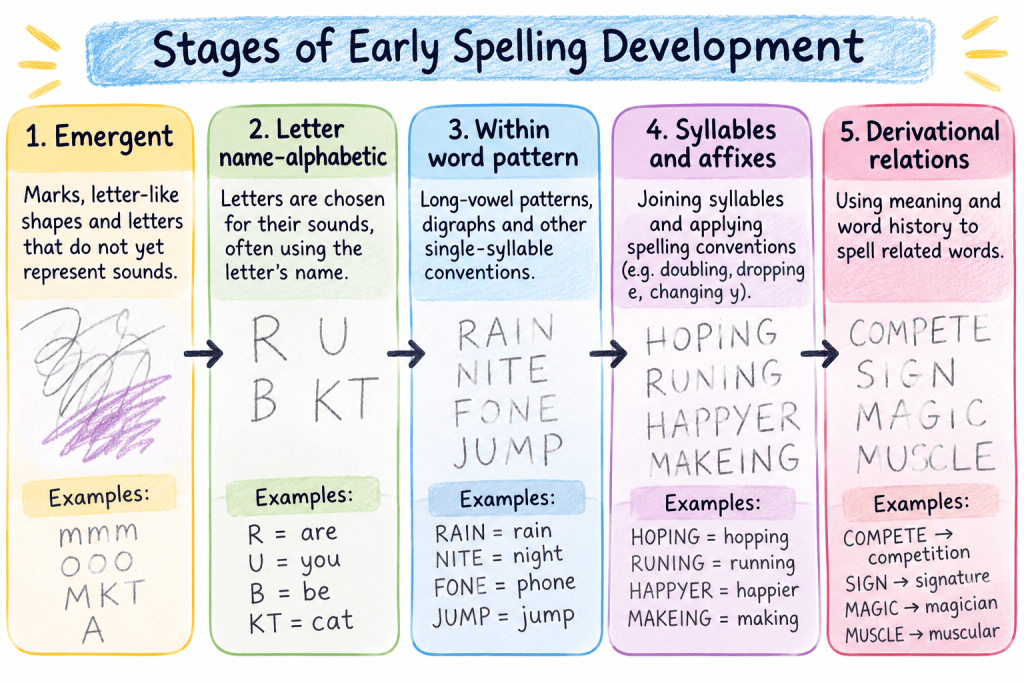
These phases are useful but should not be read too literally. Treiman and Kessler (2014) argue that children learn about the statistical patterns of writing from very early on, before they can represent sounds. Rittle-Johnson and Siegler (1999) found that children use several phases at once, so the same child may spell a word conventionally on Monday and phonetically on Tuesday. Development is better described as overlapping waves eventually working their way up the shore rather than as a staircase.
Adoniou (2016) rightly adds that English spelling represents meaning and history as well as sound. A child who has been taught only to ‘sound it out’ will quickly reach the limits of that strategy.
How spellings of the same word change over time
The table below shows typical attempts at common words as children move from emergent writing to conventional spelling. The examples are illustrative. In reality, children will not pass neatly through every column, and may even produce two versions of a spelling in a single piece of writing.

What each attempt reveals
- Emergent. Children know writing is different from drawing and use particular scribbles or letter-like shapes. They will often borrow letters from their own name. They have also been known to use more letters for bigger objects and less letters for things that are small.
- Early letter name. B for bed shows the child has isolated the first sound and linked it to a letter. J for train is a sound-based choice: say “tr” and “j” and feel how similar they are.
- Late letter name. BAD and SEP use the letter whose name is closest to the short vowel. MOSTR omits the /n/ before a consonant.
- Within word pattern. TRANE and FLOTE show the child knows about long vowels, but has not yet learnt which pattern a particular word takes.
- Syllables, affixes and meaning. JUMPT spells what is heard; JUMPED shows the child now knows -ed marks the past tense whatever its sound. HOPEING shows a child applying a pattern from hope; HOPPING shows they have learned the doubling convention. COMPUTITION becomes competition once the child sees the link to the base word compete.
At every point, the attempt makes sense given what the child currently knows. There is much to celebrate in all of these spelling attempts. Lazily, calling these ‘misspellings’ does children a disservice and erases the very information a teacher needs.
What moves children’s spelling on
Spelling development is not automatic or guaranteed. A child does not move from TRANE to TRAIN simply by getting older. There are four influences:
Teaching. Explicit spelling instruction improves children’s spelling, and its effects extend to reading and writing (Graham & Santangelo, 2014). The most effective teaching explains why words are spelled as they are, covering sound, patterns, meaning and history (Adoniou, 2016). Teaching pitched at what a child is currently “using but confusing” is likelier to stick than teaching far ahead of, or behind, their current understanding (Bear et al., 2016).
Reading. Each time children decode an unfamiliar word, they store information about its spelling (Share, 1995). Wide reading builds a bank of word-specific knowledge and a feel for which patterns are likely. However, reading alone is rarely enough. Being able to recognise a word is a lot easier than producing it from memory for writing.
Writing. Children need frequent opportunities to write for real purposes and readers. Every attempt is practice in segmenting words, choosing letters and applying patterns. Feldgus and colleagues (2017) show how the ‘kid writing’ writing strategy gives teachers a running record of children’s spelling development. You can quite literally see the gaps in children’s understanding. For those who are not familiar with the strategy: you ask children to write down the adult parts of a word that they do know and use a line or ‘kid writing’ for the parts they don’t know yet. This is a brilliant strategy as it means children will attempt any word that they really want to write. No longer do children simply play it safe by choosing words they know they can already spell conventionally. You also no longer need to hear ‘Miss, I don’t know how to spell…’ You can simply ask them to use their ‘kid writing’. Here’s an example of what it can look like:
Teacher feedback. Responsive feedback and the use of ‘underwriting’ names what a child got right as well as what to change to make it more like adult writing in the future. Feedback should focus on what the child is ready for, rather than correcting every single word. It is most powerful when it happens close to the writing and links back to what has been taught. Feedback on spelling comes at too high a price if the result is that the children never wants to write again.
Reading a child’s spelling diagnostically
A child’s attempt is most useful when the teacher asks what it shows rather than whether it is right. Three questions help:
- What is secure? Which sounds, patterns or morphemes are represented correctly? MONSTUR shows every consonant in order, including the tricky /n/.
- What is the child using but confusing? Patterns applied in the wrong place (HOPEING, FLOWT) show knowledge in the making. This is usually the best place to teach next.
- What is absent? Features not attempted at all, such as vowels in every syllable, are not yet within reach and may need additional teaching.
Not every non-conventional spelling is developmental. Like all of us, some are just slips under pressure: a child who spells said correctly in isolation may write SED while concentrating on their story dialogue. It happens to the best of us. Some spellings also reflect children’s accents. For example, when a child writes FINK because that is how they say think. Some reflect gaps in teaching: a child cannot be expected to use a pattern they have never been shown. And where a child’s spellings stay at the same point for a long time despite good teaching, that is a signal for closer assessment. See our guidance on spelling interventions [LINK].
What this means for practice
- Change the language. Talk about a child’s ‘spelling attempt’ or ‘great try for a seven year old!’ rather than ‘mistakes’. Always celebrate what is right first: “Whoa! Excellent! You’ve heard every sound in monster. That’s really well done for a five year old. Now let’s look at how adults write the last bit.”
- Protect composition. Encourage children to write the word as best they can and keep going, then return to spelling during proofreading. Stopping to fix every word mid-sentence costs ideas and confidence. Teach children how to write ‘temporary spelling’ before putting a circle around them to highlight that these will need checking when it comes to proof-reading time.
- Teach one thing next. Choose one thing the child is using but confusing and teach it explicitly, with explanation. Correcting every non-conventional word in a piece teaches nothing in particular. It just kills any confidence and risk-taking the child might have had.
- Connect reading and writing. Draw attention to interesting spellings in shared reading and invite children to hunt for patterns they are learning.
References and further reading
- Adoniou, M. (2016). Spelling it out: How words work and how to teach them. Cambridge University Press.
- Bear, D. R., Invernizzi, M., Templeton, S., & Johnston, F. (2016). Words their way: Word study for phonics, vocabulary, and spelling instruction (6th ed., Global ed.). Pearson.
- Bissex, G. L. (1980). GNYS AT WRK: A child learns to write and read. Harvard University Press.
- Feldgus, E. G., Cardonick, I., & Gentry, J. R. (2017). Kid writing in the 21st century. Hameray Publishing.
- Ferreiro, E., & Teberosky, A. (1982). Literacy before schooling. Heinemann.
- Gentry, J. R. (1982). An analysis of developmental spelling in GNYS AT WRK. The Reading Teacher, 36(2), 192–200.
- Graham, S., & Santangelo, T. (2014). Does spelling instruction make students better spellers, readers, and writers? A meta-analytic review. Reading and Writing, 27(9), 1703–1743.
- Read, C. (1971). Pre-school children’s knowledge of English phonology. Harvard Educational Review, 41(1), 1–34.
- Rittle-Johnson, B., & Siegler, R. S. (1999). Learning to spell: Variability, choice, and strategy use. Child Development, 70(2), 332–348.
- Share, D. L. (1995). Phonological recoding and self-teaching: Sine qua non of reading acquisition. Cognition, 55(2), 151–218.
- Treiman, R., & Kessler, B. (2014). How children learn to write words. Oxford University Press.
- Westwood, P. (2014). Teaching spelling: Exploring commonsense strategies and best practices. Routledge.