
| The goal of this article is to reorientate our understanding of why transcription matters: shifting it away from compliance and correction, and towards a reader-centred, meaning-making approach in which transcription supports effective communication. It also seeks to hold transcription and composition together, rather than privileging one over the other, and to validate emergent writing as a legitimate starting point. |
Teachers care about transcription. Walk into any primary classroom and you will find children receiving explicit handwriting and spelling lessons. You’ll see them being reminded to form their letters correctly, to check their spellings and to use capital letters at the start of sentences. Transcription is taught. It is practised. It is marked.
What we may have forgotten though is why it matters.
The DfE’s Writing Framework (2025) puts the problem plainly:
“Too often, pupils learn to write for the circular purpose of learning to write.”
Round and round we go and somewhere along the line we forget the point of it all. We teach about transcription because it’s on the curriculum. We make it a priority because we know Ofsted will like it. We lose sight of the only reason it actually matters: so that the readers of our children’s texts can understand them and enjoy them.
“Let us be clear. If children do not learn and internalise the essential transcriptional skills involved in crafting writing (spelling, handwriting, and punctuation), then their attempts to share meaning with others may be compromised or even fruitless.”
— Ross Young & Felicity Ferguson
This shift in orientation, from transcription as compliance to transcription as communication, changes everything about how we teach it.
The Real Purpose Of Getting It Right
In our Writing Development Map (2025a), we define writing as being the construction of a text to share meaning. That word, share, is doing important work. Writing is an attempt to move and share something from one person to another. Transcription is the mechanism that makes that transfer possible.
Young writers have extraordinary things to say. The tragedy is that when transcription breaks down, those things become inaccessible. It breaks your heart. A reader who has to wrestle with a text (trying desperately to decode wild spelling attempts or else left squinting at the handwriting) loses the thread and is slowly disconnected from the writer and their meaning. That must be depressing. Their voice gets lost in the chaos.
This is the perspective we should be taking when we teach transcription.
Not “your letters need to sit on the line” as the rule handed down from on high, but “I really want your readers to be able to enjoy the bit about the dragon!”
Not “you’ve forgotten your full stops” simply as a correction, but “I want your readers to know when they can stop and talk about your amazing writing before they eagerly read your next thought.”
Not: “Check all the spellings I’ve underlined.” But: “Let’s make sure these words are spelt conventionally so your reader knows exactly what you mean.”
You see the difference?
We don’t need more attention on transcription. We need better-directed attention (Young & Ferguson 2025a, 2025b, 2026a, 2026b). We know children should:
- Receive explicit handwriting and spelling lessons.
- Engage in plenty of meaningful writing experiences so that they can use and apply what they learn.
- Receive feedback on their handwriting and spelling attempts.
Children’s transcriptional development should always be in the service of helping them make and share meaning. It’s always in the name of the reader.
The Motivational Case For Teaching Transcription Well
This is where motivation becomes not a parallel concern but a directly relevant one. Young & Ferguson (2024) note that the word motive derives from Latin meaning to move. As teachers, we need to help children see the value and purpose of writing so that they are genuinely moved to do it (and to do it to the very best of their abilities). When children understand that transcription serves their readership, effort in transcription becomes purposeful rather than merely about obedience. They are not spelling carefully out of fear of punishment or the dreaded red pen. They are spelling carefully because they want their writing (that they really care about) to stand up and be fully understood.
Research on writing motivation in primary-age children makes clear that early experiences with writing can predispose children to seek it out or avoid it altogether (Young & Ferguson 2024). A systematic review of students’ writing motivation found that authentic writing projects and a loving and supportive classroom environment are among the most powerful conditions for developing lasting motivation to write (Alves Wold et al., 2024). Feedback that connects transcriptional effort to a communicative outcome, such as “Because your spellings were so easy to understand; I could concentrate on performing it to everyone in a really entertaining way. I think they really loved it. Don’t you think so?” is precisely that kind of motivational condition. It feels different because children see it as true.
The Cognitive Case For Teaching Transcription Well
The research on why transcription matters is unambiguous. Handwriting and spelling are foundational ingredients of early writing development, not peripheral concerns (Young & Ferguson, 2023). When transcription is effortful (when a child must consciously attend to how to form every letter or how to spell every word), it crowds out cognitive resources that could be much better spent generating great ideas, selecting precise language and organising their thoughts (Young & Ferguson, 2023).
However, none of this means children are not already writers before their transcription is fully secure. Emergent writing (marks, letter-like shapes and informed spellings) are the developmental foundation for later conventional transcription (Young & Ferguson, 2025c). Emergent writing acts as a temporary scaffold, until children get their transcription skills fully up and running. Children who are allowed to use their emergent writing are already writers (Ray & Glover, 2008; Young & Ferguson, 2022). And as their transcription becomes ever more fluent and automatic, their emergent writing disappears.
“Children want to write. They want to write the first day they attend school. The child’s marks say, ‘I am’.
‘No you aren’t,’ say most school approaches to the teaching of writing.
We take control away from children and place unnecessary road blocks in the way. Then we say, ‘They don’t want to write. How can we motivate them?’”
— Donald Graves
The use of emergent writing and especially ‘kid writing’ is the ultimate leveler. It removes the ‘road blocks’ that Donald Graves is talking about. This way, everyone can be a writer from their very first day in Nursery (Young & Ferguson, 2022).
Holding Both Things At Once
The DfE’s Writing Framework (2025) offers a statement that deserves to be on every staffroom wall:
“Transcription is not writing.”
Our Writing Development Map makes the same point. We must care deeply about transcription but we must never mistake it for the whole thing.
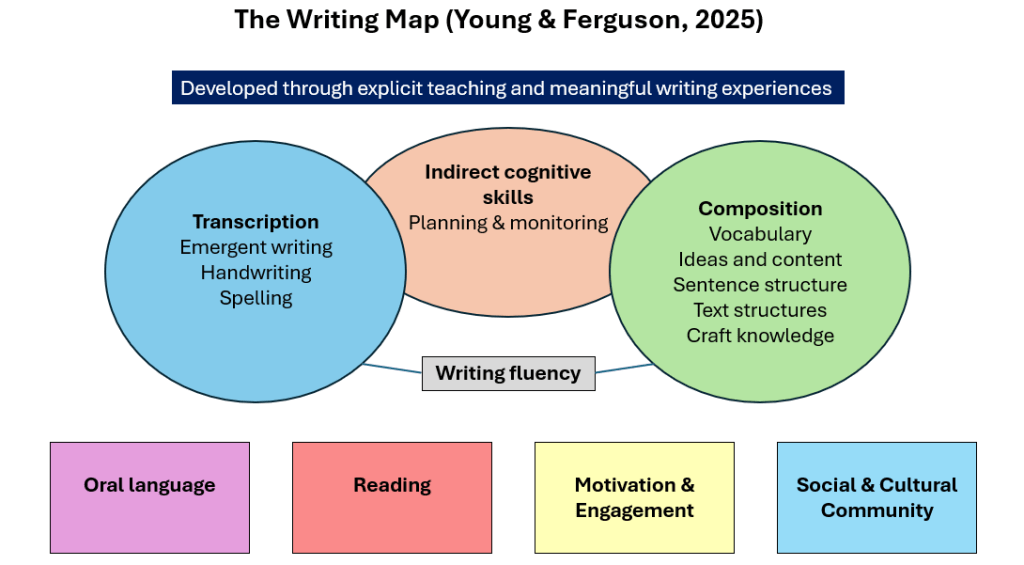
Figure 1. The Writing Map (Young & Ferguson, 2025a). Simplified version reproduced for commentary purposes. Full version available [HERE].
Kim et al. (2021) conducted a meta-analysis of 24 studies and found that instruction focused solely on transcription skills (spelling and handwriting) did not yield statistically significant effects on children’s writing quality or productivity. By contrast, multi-component instructional approaches, which teach transcription alongside composition strategies, produced large and consistent improvements across all measured dimensions, including quality, productivity, and text structure. Harris et al. (2023) tested this experimentally with pupils from economically underserved areas. Integrated instruction outperformed a business-as-usual approach across major measures, including writing quality, planning, and spelling. The researchers concluded that young children can (and should) learn about transcription and composition simultaneously. Transcription, taught well, and in the right spirit, lifts everything.
Children arrive at school already knowing their marks mean something. Children are incredibly motivated to learn more about transcription because they want to be heard and understood. Our job is to make that happen.
Every time we sit down to teach transcription, let’s ask: whose needs are we focusing on right now? The answer should always be the same. Theirs, and the lucky people who get to read what they have to share.
References
- Alves-Wold, A., Walgermo, B. R., McTigue, E., & Uppstad, P. H. (2024). The ABCs of writing motivation: A systematic review of factors emerging from K–5 students’ self-reports as influencing their motivation to write. In Frontiers in Education (Vol. 9, p. 1396484). Frontiers Media SA.
- Department for Education. (2025). The writing framework.
- Graves, D. H. (1983). Writing: Teachers and children at work. Heinemann.
- Harris, K.R., Kim, Y-S.G., Yim, S., Camping, A. & Graham, S. (2023). Yes, they can: Developing transcription and compositional skills together to help children write informative essays at grades 1 and 2. Contemporary Educational Psychology, 72, 102131.
- Kim, Y-S.G., Yang, D., Reyes, M. & Connor, C. (2021). Multicomponent writing instruction appears to yield better results. Educational Research Review, 34, 100401.
- Ray, K. W., & Glover, M. (2008). Already ready. NH: Heinemann.
- Young, R., & Ferguson, F. (2022). Getting children up and running as writers: Lessons for EYFS-KS1 teachers. The Writing for Pleasure Centre.
- Young, R., & Ferguson, F. (2023). The science of teaching primary writing. The Writing for Pleasure Centre.
- Young, R., & Ferguson, F. (2024). Motivating writing teaching. The Writing for Pleasure Centre.
- Young, R., & Ferguson, F. (2025a). Visualising the science of writing: The writing map explained. The Writing for Pleasure Centre.
- Young, R., & Ferguson, F. (2025b). Underwriting: Should teachers do it? The Writing for Pleasure Centre.
- Young, R., & Ferguson, F. (2025c). Debunking edu-myths: ‘Emergent writing’ isn’t necessary before teaching children to writeThe Writing for Pleasure Centre.
- Young, R., & Ferguson, F. (2026a). Spelling and handwriting provision: A checklist. The Writing for Pleasure Centre.
- Young, R., & Ferguson, F. (2026b). Debunking edu-myths: Children should only write words they can spell. The Writing for Pleasure Centre.