

As Writing For Pleasure teachers, we are lucky enough to witness the transformative journey a pupil’s writing goes on – from their initial idea to its final publication or performance. However, a crucial, yet sometimes overlooked, stage in this process is revision.
Revision is about re-seeing, re-thinking, reviewing, and otherwise re-envisioning drafted writing, offering children the privilege to splash around in their existing text and to be playful and take risks. For children to truly develop as writers, developing an effective approach to revision is paramount. This is because, at this stage in the writing process, children have the cognitive space to tackle higher-order writerly techniques.
One impactful strategy is the use of revision checklist sessions.
What are revision checklists?
Revision checklists are powerful tools derived from the product goals (success criteria) you established collaboratively with your class at the beginning of a writing project. These product goals represent all the great craft moves you identified from the high-quality mentor texts you studied together¹. These are the things you and the class want to achieve in their compositions, often extending far beyond mere grammatical features.
Having been taught all these craft moves during the drafting phase, the checklist serves as a guide, prompting children to reflect on whether they have indeed incorporated these desired craft moves into their own writing.
How they are created and look
As the name suggests, a revision checklist lists the product goals on the left-hand side. On the right, children indicate if they have used the craft move in their writing. If a craft move hasn’t been used, they can demonstrate how they could have used it on their ‘revision and trying things out page’. This approach ensures that revision is a proactive, reflective process rather than a punitive one.

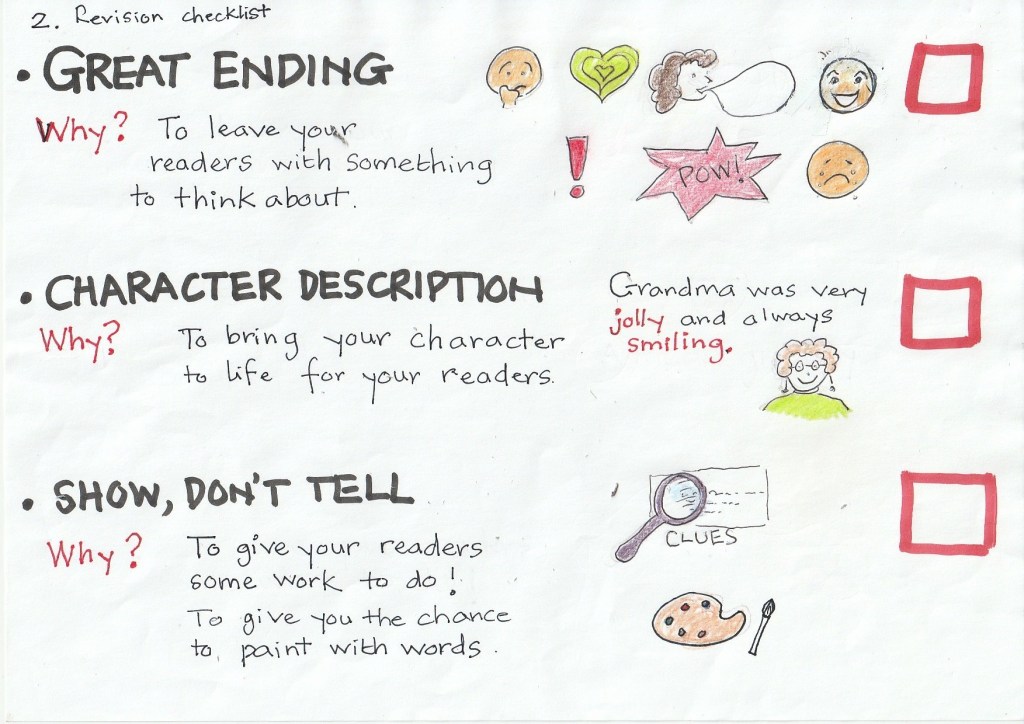
Here’s an example of a double-sided revision checklist for a Year Four short story project. None of the items on this checklist were a surprise to the children. All of the craft moves were modelled and taught during the drafting stage of a class writing project.
The benefits of revision checklist sessions
Implementing revision checklist sessions offers numerous benefits, backed by significant research:
- Increased academic progress: When children are given specific time to revise their compositions for quality, it can lead to a positive effect size of +0.64². Moreover, inviting children to evaluate their writing against class-generated product goals yields a remarkable effect size of +2.03². An effect size above +0.4 is generally considered to have a significant positive impact on children’s writing progress.
- Improved confidence, self-concept and independence: These sessions increase children’s sense of confidence in their writing abilities³. Children also develop a feeling of competence and an ability to write well independently, reducing reliance on constant adult intervention⁴. Students gain a feeling of ownership over their writing and the choices they make about its content and style.
- Increased motivation: Children understand the ‘why’ behind their writing choices, leading to a deeper desire to produce high-quality writing⁵.
- Fostering a community of writers: Collaborative checklist creation and small-group instruction and discussion during these revision sessions promote a feeling of being part of a supportive writing community. Teachers finally have the time to get into deep and rich discussion with children about their writing – often about subjects that go far beyond what’s on the revision checklist itself.
Conducting an effective revision checklist sessions
Here’s how to introduce and run successful revision checklist session in your classroom:
- Collaborative checklist creation: The most effective revision checklists are those constructed in response to the product goals you identified jointly with your class when you read mentor texts at the beginning of your writing project¹. Nothing on the checklist should be a surprise to the children at this point. All the items will have been modelled and taught to the children during the drafting stage of your class project.
- Teacher modelling: You can begin by showing your class how you used the revision checklist with your own writing. Explain your personal process, the decisions you made, and invite questions from the children. This makes the process tangible and relatable.
- Right-hand side for revision: Encourage children to draft on the left-hand side of a double page in their notebooks. This leaves the right-hand side blank for their revisions and “trying things out”. If they like a revision, they can use a star to indicate where it should be incorporated into their final manuscript. This dedicated space allows children to experiment with craft moves they haven’t yet used in their main draft. It’s a low-stakes environment for creativity and risk-taking.


- Small group sessions: It is highly recommended to conduct revision checklist sessions with your class in small groups over a number of days. This allows for focused, individualised instruction and feedback. While you work with a small group, the rest of the class can be engaged in their personal writing projects⁶, ensuring continuous productive writing time.
- Recognising the behaviour of greater-depth writers: It’s crucial to understand that children are not obliged to include everything on the checklist! If a child experiments with a craft move on their ‘trying things out page’ but makes an authorial decision not to include it in their final piece, this is a sign of a greater-depth writer. This approach avoids ‘overwriting’ and encourages genuine authorial voice and independence.
- Assessment: Writing produced on revision pages can (and should) still be formally assessed. This provides valuable evidence of a child’s critical thinking and engagement with the writing process⁷.
- EYFS and KS1 adaptations: For younger children, revision can often occur spontaneously through your daily verbal feedback, using children’s illustrations to elicit more information about their text⁸. Providing extra blank pages allows them to make significant changes to their books if needed.
What to avoid
To ensure your revision checklist sessions are truly effective, steer clear of these common pitfalls with success criteria:
- Narrow focus: Do not limit revision checklists solely to grammar craft moves.
- Completely teacher-imposed: Avoid creating lists without any input from the children.
- Lack of context: Ensure the checklist items are linked to the lessons you taught during the drafting stage of a class project.
- Vague goals: ‘Language devices’ or ‘good grammar’ are too vague. Break these down into specific, named craft moves that children can understand and apply.
- Separate revision from proof-reading: Remember that revision and proof-reading are two distinct cognitive processes⁹. Give them their own dedicated instructional time and checklists.
By embracing the collaborative, reflective, and empowering nature of revision checklist sessions, teachers can cultivate classrooms where young writers not only master curriculum objectives but also develop confidence, agency, and a genuine love for refining their craft.
References
- Reading in the writing classroom: A guide to finding, writing and using mentor texts with your class [LINK]
- The enduring principles of effective writing teaching [LINK]
- Self-efficacy [LINK]
- Self-regulation [LINK]
- Motivating writing teaching [LINK]
- A guide to personal writing projects & writing clubs for 3-11 year olds [LINK]
- Writing development scales and assessment toolkit [LINK]
- How to teach narrative writing in EYFS, KS1 [LINK and LINK]; How to teach nonfiction in the EYFS, KS1 [LINK and LINK]
No more: “My class can’t edit” A whole-school approach to developing proof-readers [LINK]