
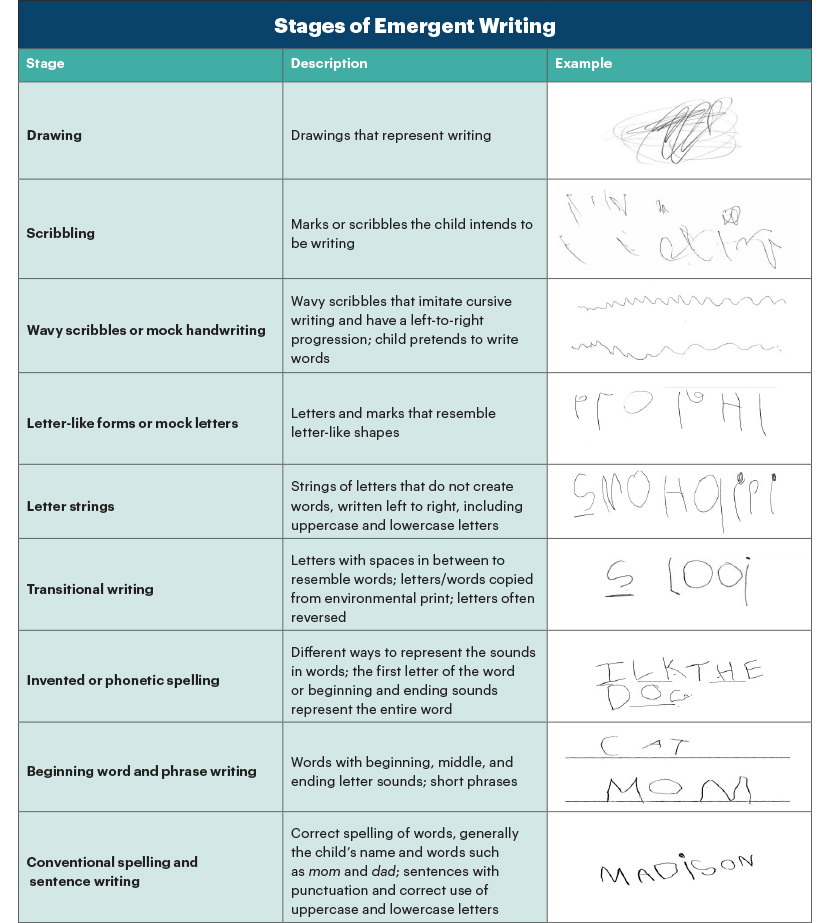
“Emergent writing is not a necessary stage that children have to go through before they can be taught to write letters and words.”
This statement is often presented as a bold truth – one that encourages skipping straight to explicit instruction in letter formation and word writing. But is it actually supported by research? Or is it another edu-myth dressed up as evidence-based practice?
Let’s investigate.
❌ The myth
This claim implies that young children can – and perhaps should – bypass the early scribbles, letter-like shapes and ‘informed spellings’ commonly seen in Nursery and Reception settings. It suggests these behaviours are dispensable, even unnecessary, on the path towards early writing competence.
But this reflects a fundamental misunderstanding of how writing develops in early childhood.
✅ What the research actually says
The truth is, emergent writing is not just a ‘stage’ – it’s a critical foundation that all children (across cultures) go through towards conventional writing (Byington & Kim 2017; Ishimoto 2022). A wealth of research from developmental psychology, early childhood education, and literacy studies demonstrates that these early marks are predictive of later success in writing and reading.
📚 Key findings:
Far from being dispensable, emergent writing has been shown in a wide body of research to be foundational for later literacy success. Here’s what the evidence reveals:
🧠 1. Cognitive and linguistic foundations are built through emergent writing
- Puranik & Lonigan (2011, 2014) show that emergent writing – like informed spelling – is a unique predictor of later writing, reading, and spelling success.
- Hand et al. (2024) found that preschool writing predicted kindergarten and first-grade reading skills above and beyond other early literacy measures.
- Rowe et al. (2024) demonstrate that preschoolers learn the alphabetic principle through the act of writing itself – realising that writing can represent spoken language.
- Ouellette & Sénéchal (2017) found that informed spelling in kindergarten was a strong predictor of both reading and spelling in Grade 1.
✍️ 2. Emergent writing is not random – it’s a meaning-making tool
- Ishimoto (2022) showed that Japanese children’s emergent writing was crucial for inscription-mediated memory, helping them internalise and revisit experiences – as well as laying groundwork for conventional writing.
- Pinto & Incognito (2022) found that emergent writing is closely linked to visual-motor integration, a key skill for later handwriting fluency.
💬 3. Writing emerges through motivation
- Barratt-Pugh et al. (2021) found that young children’s motivation to write is deeply tied to opportunities to use emergent writing, not drills.
- Rowe & Neitzel (2010) demonstrated that even 2- and 3-year-olds engage in writing with intentionality, challenging the idea that they must be explicitly taught conventional adult writing from the start.
- Rowe (2018) argues that early writing instruction too often ignores the benefits of emergent writing.
✍️ 4. Instruction that builds on emergent writing supports all learners
- Hall et al. (2015), in a systematic review, confirmed that preschool writing instruction is most effective when it builds on children’s existing emergent writing skills.
- Gerde et al. (2012) recommend practices that utilise children’s existing emergent writing skills to help them on the road towards producing conventional print.
- Bingham et al. (2017) found that the best performing writing teachers support emergent writing. This support directly predicts gains in children’s future writing development.
- Dennis & Votteler (2012) emphasises that recognising and building on emergent writing is essential for supporting diverse learners, emerging multilingual writers.
🧰 5. Effective instruction utilises, rather than skips, emergent writing
- Rowe et al. (2022) & Quinn et al. (2016) stress the importance of responsive, scaffolded instruction – teaching that adapts to where each child is in their emergent writing journey.
- Daffern (2024) and Critten et al. (2021) show that skills such as spelling and phonemic awareness are best developed in tandem with children’s emergent writing practices.
Together, this body of research provides compelling evidence that emergent writing is not a frivolous or optional stage – it’s a developmentally appropriate, evidence-informed foundation for lifelong writing and reading success.
🧠 Developmentally appropriate writing
It’s important to remember that children aren’t miniature adults. Before they learn to form letters accurately and spell words conventionally, they are already developing:
- Fine motor control
- Visual-motor integration
- Phonological awareness
- Concepts of print
Emergent writing helps children develop all of these. As the DfE’s Writing Framework notes:
“Some children will experiment with what has been called ‘emergent writing’. They will draw and make marks, perhaps beginning to write single letters, their name or whole words as they notice print in books and the wider world. They may start to think of themselves as ‘writers’ and enjoy the feeling of conveying their ideas on paper.”
Emergent writing is an important and temporary scaffold that children use while they are learning to form letters and encode the words they want to write.
⚠️ Where this myth comes from
This myth is often rooted in the misapplication of direct instruction or synthetic phonics principles. Explicit teaching of letter formation and encoding is crucial but children still need to be able to use their emergent writing while their transcriptional skills develop (see Young & Ferguson 2022). Children aren’t going to be able to write formally, like an adult, from the outset. Fortunately, even the most structured approaches to early reading and writing typically acknowledge the value of emergent writing.
🧾 Final word
To say that emergent writing isn’t necessary is to ignore what’s been observed empirically for decades. It does not reflect what the research says about the benefits of emergent writing as a temporary scaffold when working with the youngest writers, or its links to children’s ability to encode once phonics instruction begins (in earnest!).
Children’s emergent writing should be valued as a temporary scaffold as it demonstrates children’s developing understanding of conventional transcription. However, while emergent writing supports children at the earliest stages of learning to write, it is most effective when combined with explicit instruction in handwriting and encoding. Once phonics instruction is introduced, children should be weaned off their emergent writing practices as soon as possible
Let’s not throw away rich foundational gains. Children deserve the opportunity to use their emergent writing while their understanding of conventional transcription develops.
Glossary
- Emergent writing: A temporary scaffold used by children in the earliest stages of writing development, where they create scribbles, marks, and letter-like shapes that lay the foundation for conventional writing skills. As phonics instruction begins, children are weaned off this scaffold and transition towards encoding and writing ‘informed spellings’.
- Encoding: In early writing development, encoding refers to the process by which children use their phonics knowledge to translate spoken language into written form. This involves converting the sounds (phonemes) of speech into corresponding letters or letter patterns (graphemes).
- Informed spellings: Sometimes mistakenly called ‘invented spellings’, are words that are often spelled as they sound, influenced by a child’s growing phonological and morphological awareness. This approach encourages children to use their developing understanding of letter-sound relationships to make informed spelling attempts, serving as a scaffold in their journey toward conventional spelling proficiency.
Recommended literature
- Getting Children Up & Running As Writers by Ross Young & Felicity Ferguson [LINK]
- Kid Writing: A Systematic Approach to Phonics, Journals, and Writing Workshop by Eileen Feldgus & Isabell Cardonick [LINK]
- Already Ready: Nurturing Writers in Preschool and Kindergarten by Katie Wood Ray & Matt Glover [LINK]
- Handbook On The Science of Early Literacy by Sonia Cabell, Susan Neuman, and Nicole Patton Terry [LINK]
- Literacy Learning For Infants, Toddlers, & Preschoolers by Tanya Wright, Sonia Cabell, Nell Duke & Mariana Souto-Manning [LINK]
- Understanding and Supporting Young Writers from Birth to 8 by Noella Mackenzie & Janet Scull [LINK]
- Gnys At Wrk: A Child Learns to Write and Read by Glenda Bissex [LINK]
- Adam’s Righting Revolutions: One Child’s Literacy Development From Infancy Through Grade One by Judith Schickedanz [LINK]
- Before Writing by Gunther Kress [LINK]
- Writing Begins At Home: Preparing Children For Writing Before They Go To School by Marie Clay [LINK]
- What Changes In Writing Can I See? by Marie Clay [LINK]
- How Very Young Children Explore Writing by Marie Clay [LINK]
- What Did I Write? Beginning Writing Behaviour by Marie Clay [LINK]
References
- Barratt-Pugh, C., Ruscoe, A., & Fellowes, J. (2021). Motivation to Write: Conversations with Emergent Writers. Early Childhood Education, 49, 223–234.
- Bingham, G. E., Quinn, M. F., & Gerde, H. K. (2017). Examining early childhood teachers’ writing practices: Associations between pedagogical supports and children’s writing skills. Early Childhood Research Quarterly, 39, 35–46.
- Byington, T. A., & Kim, Y. (2017). Promoting preschoolers’ emergent writing. YC Young Children, 72(5).
- Critten, S., Holliman, A. J., Hughes, D. J., Wood, C., Cunnane, H., Pillinger, C., & Hilton, S. H. (2021). A longitudinal investigation of prosodic sensitivity and emergent literacy. Reading and Writing, 34(2), 371–389. [https://doi.org/10.1007/s11145-020-10077-7](https://doi.org/10.1007/s11145-020-10077-7)
- Daffern, T. (2024). Developing spelling skills. In Understanding and Supporting Young Writers from Birth to 8 (pp. 97–123). Routledge.
- Dennis, L., & Votteler, N. (2012). Preschool Teachers and Children’s Emergent Writing: Supporting Diverse Learners. Early Childhood Education, 41, 439–446.
- Gerde, H. K., Bingham, G. E., & Wasik, B. A. (2012). Writing in early childhood classrooms: Guidance for best practices. Early Childhood Education Journal, 40, 351–359.
- Hall, A. H., Simpson, A., Guo, Y., & Wang, S. (2015). Examining the effects of preschool writing instruction on emergent literacy skills: A systematic review of the literature. Literacy Research and Instruction, 54(2), 115–134.
- Hand, E. D., Lonigan, C. J., & Puranik, C. S. (2024). Prediction of kindergarten and first-grade reading skills: Unique contributions of preschool writing and early-literacy skills. Reading and Writing, 37(1), 25–48.
- Ishimoto, K. (2022). What are conditions for inscription-mediated memory in early childhood? Scribbling and drawing before writing. The Japanese Journal of Educational Psychology, 70(3), 276–289.
- Ouellette, G., & Sénéchal, M. (2017). Invented Spelling in Kindergarten as a Predictor of Reading and Spelling in Grade 1: A New Pathway to Literacy, or Just the Same Road, Less Known? Developmental Psychology, 53(1), 77–88.
- Pinto, G., & Incognito, O. (2022). The relationship between emergent drawing, emergent writing, and visual-motor integration in preschool children. Infant and Child Development, 31(2). [https://doi.org/10.1002/icd.2284](https://doi.org/10.1002/icd.2284)
- Puranik, C. S., & Lonigan, C. J. (2011). From scribbles to scrabble: Preschool children’s developing knowledge of written language. Reading and Writing: An Interdisciplinary Journal, 24(5), 567–589.
- Puranik, C. S., & Lonigan, C. J. (2014). Emergent writing in preschoolers: Preliminary evidence for a theoretical framework. Reading Research Quarterly, 49(4), 453–467.
- Quinn, M. F., & Bingham, G. E. (2018). The Nature and Measurement of Children’s Early Composing. Reading Research Quarterly, 54(2), 213–235.
- Quinn, M. F., Gerde, H. K., & Bingham, G. E. (2016). Help me where I am: Scaffolding writing in preschool classrooms. The Reading Teacher, 70, 353–357.
- Rowe, D. W. (2018). Research & policy: The unrealized promise of emergent writing: Reimagining the way forward for early writing instruction. Language Arts, 95(4), 229–241.
- Rowe, D. W., & Neitzel, C. (2010). Interest and agency in 2‐and 3‐year‐olds’ participation in emergent writing. Reading Research Quarterly, 45(2), 169–195.
- Rowe, D. W., Piestrzynski, L., Hadd, A. R., & Reiter, J. W. (2024). Writing as a path to the alphabetic principle: How preschoolers learn that their own writing represents speech. Reading Research Quarterly, 59(1), 32–56.
- Rowe, D. W., Shimizu, A. Y., & Davis, Z. G. (2022). Essential practices for engaging young children as writers: Lessons from expert early writing teachers. The Reading Teacher, 75(4), 485–494.
- Teale, W. H., & Sulzby, E. (1986). Emergent literacy: Writing and reading. In Writing Research: Multidisciplinary Inquiries into the Nature of Writing Series. Norwood, NJ: Ablex Publishing Corporation.