
Because of formatting, we can recommend downloading the PDF version of this article:
Early writing development & the book-making approach
Children start their writing journey earlier than is generally supposed. By the age of two, children begin to understand that writing gives them a voice to share their thoughts, ideas, stories, opinions and messages with the world around them.
Our Writing Map illustrates how early writers develop both their compositional processes, such as idea generation, and the transcription skills needed to ‘translate’ those ideas into readable and enjoyable writing for others. The Writing Map also recognises how early writing experiences serve children’s oral language, reading and writing development because of the interconnected nature of these skills, and shows that, as children receive more instruction in phonics, handwriting, and encoding, the key components of writing success become increasingly linked.
Children start their writing journey using their emergent writing practices. These are the early marks and scribbles they make (see below). It’s clear, therefore, that young children learn about composition before learning about formal transcription. We can take advantage of this when children are in preschool or Nursery by adopting the book-making approach to writing.

Byington & Kim (LINK)
With the introduction of letter formation instruction, phonics, and encoding strategies, children in Reception naturally transition away from these early practices and begin producing conventional ‘adult’ writing. By the end of KS1, most children write using common spelling rules and varied sentence structures to create very short yet meaningful pieces.
Our book-making approach
Our “book-making approach” is a teaching method where children write short books, combining drawing, oral language and writing to express their ideas. Through book-making, children quickly learn important things about writing that are strong predictors for future writing success. For example:
- Writing moves from left to right and top to bottom in English
- The marks we make on paper have meaning and can be ‘read’ or ‘told’
- Know how to form letters correctly
- Understand letter-sound associations and can encode words quickly and happily
- Generate ideas and communicate those ideas by writing complete sentences
Even before children enter Nursery, many have started their writing journey. For example, 67% of three year olds already know to write linearly with over half knowing to write from left to right (LINK). Children recognise that when they make marks, those marks carry meaning and that what one thinks and says can be drawn and written down. We also know that children write for lots of different purposes and so write in different genres.
Our book-making approach helps children develop their ability to generate and organise writing ideas by first drawing, then writing single words, and finally forming sentences about their drawings. Even before they can write conventionally, children in pre-school and Nursery begin to associate their marks with the rhythm or length of sentences. For example, see four-year-old Wyatt’s book about a dinosaur. He uses two marks to represent his two sentences: He is big. He is scary. Isn’t that wonderful?

Here’s another example. Four-year-old Jenny has made a book about Elsa from Frozen. However, when her friend pointed out that her writing doesn’t match her picture (she reads her writing as saying: Elsa was sad), she proceeds to cross out her old writing and writes: Elsa was happy in her emergent writing. Isn’t that interesting?

Letter formation & handwriting development
Fluent handwriting is a strong predictor of future writing success because it allows children to focus on idea generation, as well as sentence and text organisation, rather than the mechanics of transcribing. As shared earlier, an extensive body of research shows how children’s early handwriting progresses from marks and scribbles on a page during Nursery to conventional forms by the time they enter KS1. To support children’s book-making, schools must have strong handwriting provision and deliver short but regular handwriting instruction. For more, see our Handwriting Provision Checklist.
Phonics, encoding & spelling development
As children receive phonics lessons, they learn about the alphabetic principle (connecting letters to sounds) and begin using encoding strategies (breaking words into phonetic components) to write what’s called informed spellings. Learning to write informed spellings is an essential process. As children engage in writing informed spelling, they are mastering their skills in orally segmenting words and transcribing the letters that represent the sounds they can hear.
When children first start on this spelling journey, they may only write the initial or most salient sounds (e.g., “D” to represent dinosaur or “U ct lef” to represent You can’t leave). They may also use a combination of conventional letters and emergent writing. However, with encoding instruction, and more opportunities to make books, they begin to write word endings and long vowel sounds (e.g. cake and choose).
Children’s informed spelling skills are important because, as you can imagine, they are strongly associated with later writing and reading success (LINK and LINK). Indeed, children who learn to write informed spelling outperform children who don’t receive such an early apprenticeship in spelling. Over time, children gradually acquire spelling rules and progress towards writing more and more words conventionally. To support children’s book-making, schools must have strong phonics and spelling provision and deliver explicit phonics and spelling instruction. For more, see our Spelling Provision Checklist.
However, while clear patterns of progression in early writing development have been well documented, as all teachers know, there can be significant variation in this skill among EYFS-KS1 children! This is what makes our book-making such an inclusive approach. From their very first day of preschool or Nursery, all children can participate in book-making lessons by mark-making. While some specific children in Reception and KS1 may still need to rely on mark-making and informed-spellings at times, almost all will write conventional sentences that are readable to others. Most importantly, all children can engage in book-making because it meets them where they are at developmentally. No one needs to receive a different pedagogy. No one needs to be left out. Instead, it might be the case that some children require additional instruction and practice. See our Identifying And Addressing Children’s Writing Needs toolkit for more on this.
Developing children’s writer identities and taking advantage of their intrinsic writing motivation
Young children come to school excited to learn to write with around 75-80% already believing that they are writers who can write successful stories (LINK). Children don’t tend to enter school with negative feelings or beliefs about writing (LINK). However, as children get older, we know this motivation drops dramatically. EYFS-KS1 teachers can take advantage of this early intrinsic motivation by providing children with book-making opportunities. Research shows that young children find meaningful writing opportunities more engaging than transcription-focused practice. While they do come to appreciate the importance of transcription instruction, this only happens if they get to use and apply these skills in meaningful activities like book-making (LINK).
We know that the best EYFS-KS1 classrooms develop children’s early writing by providing them with:
- A high-quality Writing Centre where they can access various writing materials and use them during continuous provision and at home
- Letter formation, phonics, encoding and spelling instruction
- Teacher-directed class writing projects which cover the foundational purposes for writing (e.g. to entertain and to teach people)
- High-quality direct instruction, scaffolds, modelling and verbal feedback
The least effective EYFS-KS1 classrooms are those with limited expectations, belief, and knowledge about children’s early writing development. These classrooms may delay writing instruction until children show an interest or else wait until they are producing conventional transcription – both of which are an instructional mistake (LINK).
Oral language development
Book-making is a fantastic way to develop children’s oral language and prewriting rehearsal skills. Nursery and Reception teachers can say: Tell me what your writing says or Read me your writing and in the process capture valuable insights into the quality of children’s compositional development. Research has shown that teachers who do this have preschool children whose writing is more aligned with the conventions of different writing genres, purposes and audiences (LINK and LINK).
The beauty of this approach is that children in the EYFS don’t have their compositional development delayed unnecessarily by their lack of transcription skills. In fact, children’s compositional development is so strong that when they begin developing their formal transcriptional skills in Reception, they naturally start refining their ideas into manageable sentences that they know they can transcribe successfully (LINK). This focus on oral language as part of the book-making process is essential as research has noted that children’s future writing skills can be partially predicted by their oral language development. This is particularly true for children with language delays or for English language learners. Indeed, the book-making approach is perfect for English-language learners for this reason (see LINK for more details on this).

Drawing and writing
Drawing is also a profound scaffold for early writers as it allows them to plan and organise their ideas prior to translating and transcribing them into a sentence or sentences. It just happens to be perfect for fine motor-skill development too! Research shows that children who are encouraged to draw what it is they want to write before they transcribe it to paper produce writing of a greater complexity and quality than they would by writing alone (LINK). This is because drawing is amazing at reinforcing the connections between (1) ideas generated, (2) oral rehearsal of those ideas, and (3) successful transcription of those ideas to paper (LINK). As you can see below, it naturally supports children’s production strategies for writing:
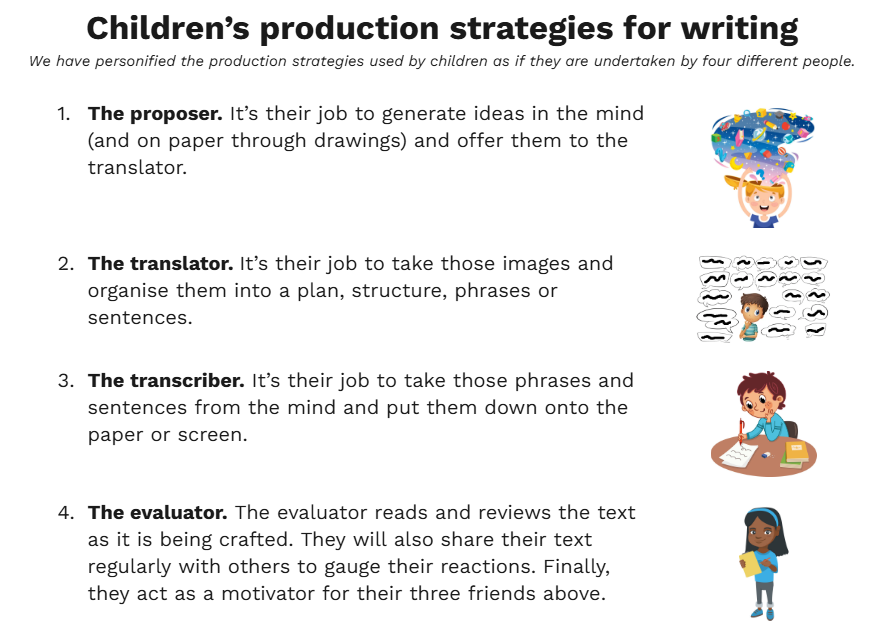
During book-making time, exceptional teachers of writing will model developmentally appropriate writing strategies and engage children in conversations about their drawings and ideas. They will then shift their focus towards transcription-based writing skills, such as letter formation or informed spelling. For example, they’ll undertake Underwriting with pupils (LINK for more details). Evidence clearly points towards the need for children to receive this kind of high-quality interaction when writing (LINK, LINK and LINK).
Explicit instruction has also been identified as a key factor in children’s early writing development. For example, teachers should begin book-making time by modelling the aspect of the writing process they want the children to do for themselves that day. Ideally, this would be done through the principles of SRSD instruction which is one of the most validated and effective things a teacher of writing can do in their classroom to improve children’s confidence and the quality of their writing (LINK for more on this).
Developing children’s writing fluency at the sentence-level
Our book-making approach aims to enhance children’s transcriptional fluency and sentence-level fluency (for more on developing children’s writing fluency see this LINK).

Essentially, to support children’s writing fluency, teachers should scaffold learning and gradually extend children’s writing abilities by encouraging them to work at a level where they can achieve success. School leaders and writing coordinators therefore need to think carefully about how they build up to extended class writing projects over time (LINK for more details on this). Here’s an example:

For example, for some pupils, all they should be asked to do is write a single word or simple sentence about their drawing while others can be asked to write multiple sentences. The links between book-making and teaching at the sentence level are profound. For more information, readers may wish to use our ‘What is a sentence?’ and ‘What is end punctuation’ book-making intervention projects which accompany our book-making method (LINK for more).
Moving forward
Unfortunately, Nursery, Reception, and KS1 teachers too often fail to model writing strategies that support children’s early writing development best (LINK and LINK). There is clearly a need for EYFS-KS1 teachers to access quality resources, planning and professional development opportunities. If you think you could benefit from such CPD, please get in touch with us here. We’d be delighted to come and write with you and your pupils!
To find out more about how you can introduce the book-making approach into your EYFS-KS1 classrooms, download any of the publications below. These can be found in the resources area of our website.
Alternatively, all of our publications and unit plans are FREE to our members. Membership is £28.50 a year. To become a member, follow this link.


