

The Writing For Pleasure Centre operates as both a think tank and an action research community, focused on sharing effective practices, case studies, and research findings. Our central mission is to help all young people become passionate and successful writers by investigating what “world-class writing teaching” means. The Writing For Pleasure approach is built upon extensive research, including meta-analyses and case studies of the most effective writing teachers. In the Early Years Foundation Stage, our approach centres around the idea of getting children up and running as writers.
The core of the approach: Daily book-making
A fundamental aspect of the Writing For Pleasure approach in the EYFS is the expectation that children are invited to make books every single day in Nursery, and expected to make books every day in Reception. Children and teachers make books together daily for various purposes and audiences, driven by what they are knowledgeable and passionate about. Making books also helps children deepen their responses to their reading and learning, entertain others, share knowledge, record memories, and reflect on their experiences and cultures. Sharing and discussing their books with their teachers and peers is also a key part of living a young writer’s life.
At the beginning of the year, especially for children new to the approach, the focus is on establishing the general habits of being a good writer.
Essential habits of writing in EYFS
To get children “up & running” as writers, teachers should repeatedly teach key habits through daily mini-lessons at the start of the year. These habits include:
- A book has a front cover.
- A book has the author’s name on it.
- A book has a picture and some ‘writing’ on every page.
- A book has its ‘date of birth’ on the front.
- We make books to share them with other people.
- We ‘tell’ and ‘read’ our books to our friends as we are making them.
- We should always try to show off what we’ve learnt about ‘adult writing’ in our books.
The role of mini-lessons
Mini-lessons are short, direct, and elegant teaching points, typically lasting 2-10 minutes. They are delivered daily and focus on modelling one specific thing about writing. These lessons help children internalise the key writing strategies and routines they will use throughout the year and into KS1. The rest of the writing session is dedicated to book-making time and teacher-pupil conferencing.
Several lessons are particularly crucial at the beginning of the year:
- Let’s make wordless picturebooks: Starting with wordless picturebooks on the first day allows all children to participate in book-making, regardless of their ability to form letters. This meaning-sharing experience can motivate them to learn more about transcription when it comes to teaching handwriting and phonics (encoding).
- Let’s use ‘kid writing’: This is a vital but temporary scaffold that ensures all children can access daily writing time. It involves children using emergent writing (approximations, scribbles, letter-like shapes, or a selection of known letters to make and share meaning). Teachers model this by showing examples of their own ‘kid writing’ from childhood or collecting examples from children last year.
- I’ve put writing and a picture on every page: Setting this expectation early is important, although children can later learn that not all picturebooks follow this rule. Teachers model this by showing a picturebook they made.
- Make a drawing – tell your drawing – write your sentence: This routine helps inexperienced writers connect drawing, speaking, and writing. It can be taught to the whole class and individually, using posters as reminders. Daily teacher modelling is key here.
- Tell it if you can’t read it: Children using emergent writing may struggle to read their text back. This mini-lesson teaches them to use their memory and pictures to tell their story or information text, thus ensuring that they are using writing time to develop their oral language skills. This also means all children can participate in daily meaning-making. Again, this acts as a temporary scaffold until they learn enough from their handwriting, phonics and encoding lessons.
- Be proud! You’re the author – put your name: Young writers are eager to write their names as it signifies ownership and their identity. We also know that children who learn to write their names early in their writerly lives go on to great things in terms of reading and writing proficiency.
A developmentally appropriate writing process for children in the EYFS
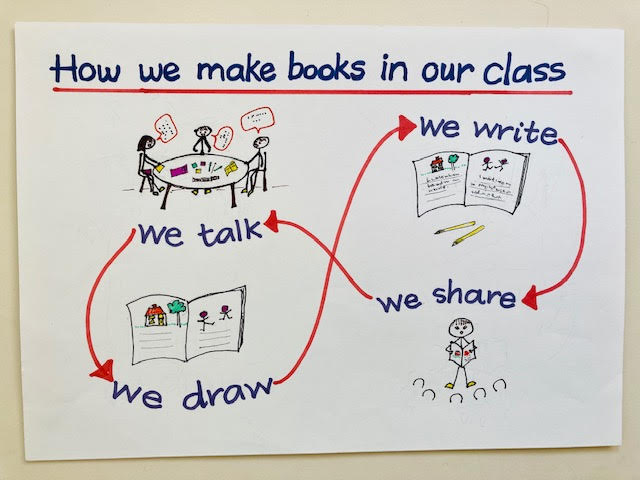
Children learning this developmentally appropriate writing process is central to our approach. This is because it also supports children’s motor skill development (through drawing and writing) and their oral language (talkng and sharing). Teachers in the EYFS need to know the processes involved in crafting a text.
- Idea generation: Children should write about topics they are knowledgeable and passionate about, drawing on their funds of knowledge and identity. Techniques like Ideas Parties and Writing Registers are used to generate and record a wealth of ideas socially. Hearing each others’ ideas sparks creativity.
- Planning: For young writers, drawing is an essential form of planning. Drawings act as children’s fuel for writing, allowing discussion and development of ideas, keywords, phrases, and sentences. Talking about drawings with children is a form of verbal feedback that also adds detail to their content. Children often plan and draft simultaneously, completing one page (drawing and writing) before moving onto the next. Essentially, children learn to translate their ideas in their mind into drawings on paper – before transcribing what those drawings into print.
- Drafting: Teachers set a daily “process goal” – a small, manageable chunk of writing to complete that day (e.g. draw and write page one of your book). Mini-lessons teach a specific craft move related to the project’s goals. This includes strategies for encoding (applying their phonics knowledge) are modelled and encouraged, with the help of sound mats. Other strategies like “say it, draw it, write it”, “stretch, count and write”, “using your pencil microphone”, and “whispering your sentence” help children hold and transcribe their ideas. “Make a page – share a page” involves children sharing aloud each completed page with a friend, helping children stay on track, feel accomplished, receive feedback, practice speaking and listening, and plan their next page.
- Revising: We know that even the youngest of writers like to revise and add value to their drafts. This involves revisiting their books to add details, change drawings, or alter words. A common early revision technique is simply “adding on” text at the end when they think of more to say. Revision checklists based on co-constructed success criteria are also used in small group sessions.
- Proofreading: This stage, sometimes called editing, occurs before publishing to make books “reader friendly”. Age-appropriate editor’s checklists are used, covering habits like having a picture and writing on every page, name and date on the front, a title, sharing the book, reading/telling your words to a friend, using capitals and end punctuation, and using the word wall. These checklist items are modelled by the teacher through repeated mini-lessons. Teachers model proofreading using their own books.
- Publishing and Performing: This is a celebratory stage where children share their completed books with real readers, fulfilling the publishing goal set at the project’s start. Publishing parties are encouraged. Children can read or “tell” their books aloud, and teachers can teach mini-lessons on performing techniques. The “Tickle your writing” mini-lesson helps children understand re-reading print by pointing to the words as they read them.
Exploring genres through book-making
Through daily book-making, children explore various genres. After establishing basic book-making habits, teachers can introduce specific book-making projects. This often starts with simple “list books” (like counting books, ABC books or “my book of first words”). These should mirror the familiar board books they would have been exposed to when they were younger. Once ready, children move on to more genre-based picturebook projects, focusing on narrative (fiction and memoir) and non-fiction. Non-fiction writing in the EYFS is encouraged to be personal, humorous, and artistic, not just objective and impersonal, allowing children to share their knowledge, experiences and passions.
Reading as a writer: Mentor texts and craft moves
High-quality mentor texts are crucial as they provide examples of “good writing” and show children what they can do in their own books. These should be commercial books, teacher-written texts, or the exemplar books in our unit plans. Teachers and children read these texts “as writers,” together helping them notice the techniques and strategies (craft moves) authors use. These observations form the basis for collaboratively created success criteria for the class project. Mini-lessons then teach children how to apply these craft moves in their own writing! Exciting!
Creating a writing community
A genuine writing community is developed in the classroom with passionate writer-teachers leading positive and enthusiastic environments. Classrooms function like creative writing workshops and publishing houses. Oral language development is an integral part of the writing process, occurring before, during, and after writing. Children talk to peers and their teacher to explain ideas, share drafts, rehearse text, check their manuscripts, and celebrate through performance. Establishing clear responsibilities for daily book-making time creates a reassuringly consistent environment. Providing a dedicated Writing Centre, with necessary supplies, also supports children’s independence and self-regulation when writing during continuous provision.
Supporting all learners
The approach includes strategies to support children with Special Educational Needs and Disabilities (SEND) and English Language Learners (EAL). Key supports include the social environment where talking and drawing is encouraged, seated strategically among teacher and peers; support from assistant teachers; ample time for planning, drawing, writing, and sharing; setting and modelling clear daily process goals; using visual resources and teacher-written mentor texts; using the ‘kid writing’ strategy; providing priority conferencing; and children focusing on self-chosen topics. Drawings are especially important for EAL learners, acting as a plan and supporting conversations with their teacher and friends.
Assessment and progression
The progression in narrative and non-fiction writing throughout the EYFS is outlined in our programme of study, showing how children move from using drawings and ‘kid writing’ to incorporating conventional transcription and craft moves over time. Assessment is seen as a way to celebrate growth. Checklists based on the Writing For Pleasure Centre‘s development scales are used to track progress. These development scales align not only with the EYFS Statutory Framework and Development Matters, but also with international understandings of what young children are capable of during the early years.
Conclusion
The Writing For Pleasure approach provides a rigorous and highly-organised framework for teaching writing in the EYFS that is responsive to children’s needs and developmental stages. By making writing a daily, central activity and teaching explicit mini-lessons on habits, processes, and writing craft moves, teachers can accelerate children’s academic progress and, crucially, develop a lifelong love of writing.
Supporting documents and resources:


EYFS programme of study and Unit plans
We work hard to provide very affordable unit plans and resources to schools.
- Individual teachers can purchase our eBooks on How To Teach Writing In The EYFS or our unit plans for £5.95. Schools can purchase a licence for all their staff to gain access to these eBooks for £54.75 [LINK].
- Teachers can purchase an individual licence to our website for £28.50 a year. This gives them access to all our eBooks, unit plans and resources [LINK].
- Schools can purchase a whole-school licence to our website for £400 a year. This gives everyone access to our eBooks, programme of study, assessment guidance, CPD materials, units plans and resources. If you’re a smaller school, get in touch as we may be able to provide you with a discount [LINK].
If you want to get in touch, you can use our contact form or email us: hello@writing4pleasure.com