
A policy briefing on the Writing Early Learning Goal — March 2026
Ross Young & Felicity Ferguson – The Writing For Pleasure Centre
| Executive Summary: The Writing Early Learning Goal (DfE, 2024) erroneously focuses solely on the mechanics of transcription (letter formation and phonetic spelling). It does not assess composition, oral language, executive function or purpose and audience. It is therefore not a measure of early writing. The evidence is unambiguous. A meta-analysis (Kim et al., 2021) found that instruction focused solely on transcription has no significant effect on children’s writing quality. The ELG does not just fail to capture what writing is, it channels schools towards approaches that demonstrably fail to develop it. The DfE’s own Writing Framework (2025) states explicitly: ‘transcription is not writing’. The ELG assesses children solely on transcription. The DfE defines writing one way and is now measuring it in another. This is a structural contradiction that will have dire consequences. Children who meet the ELG without ever being required to compose something independently will arrive at Key Stage 1 grossly underprepared for its demands. National data will also overstate children’s writing capabilities. This briefing calls for the immediate commissioning of an evidence-led review to realign the ELG with the DfE’s own stated model of writing development. |
1. What The ELG Measures And What It Misses
The Writing ELG is assessed against three criteria:
- writing recognisable letters, most of which are correctly formed.
- spelling words by identifying sounds in them.
- writing simple phrases and sentences that can be read by others.
Each criterion concerns the mechanics of putting marks on a page. None of them asks whether the child has anything to say. None asks whether they have a reason to write, a sense of a reader, a capacity to plan or revise, or a growing identity as a writer. Recent accompanying guidance makes this explicit: children ‘do not need to compose independently’ to meet the ELG, and dictated sentences (in which the teacher speaks and the child transcribes) are described as valid assessment tools (DfE, 2026).
The international research on writing development is often organised around a clear model The Simple View of Writing which identifies three components that must all develop, and must be developed together, for a child to become a writer (Berninger & Winn, 2006; Young & Ferguson, 2025). However, the ELG only addresses one of these three:
| Component | What it requires | What the ELG does with it |
| Transcription | Handwriting, spelling, letter formation | The ELG’s sole focus |
| Executive Function | Planning, monitoring, revision, self-regulation, motivation | Entirely absent |
| Composition | Generating ideas, communicating with intent, writing for a reader | Entirely absent |
The ELG, as it is currently presented, is not a measure of writing. The ELG can be met by a child who isn’t required to compose a sentence of their own. This is surely one of the lowest educational expectations you can have of a child. That child is not a writer in any sense of the word.
The DfE’s own Writing Framework (2025) recognises this, stating directly: ‘transcription is not writing’. The ELG ignores its own department’s definition.
2. The Evidence: Transcription Alone Does Not Produce Writing
The ELG’s implicit model is sequential: master transcription first and learn to compose later. Children essentially have to ‘earn their right to write’ (Young & Ferguson, 2024). However, this sense of ordering is not supported by research evidence. Indeed, it is contradicted by it.
Transcription-only instruction does not improve writing quality
Kim et al. (2021) conducted a meta-analysis of 24 studies and found that instruction focused solely on transcription skills (spelling and handwriting) did not yield statistically significant effects on children’s writing quality or productivity. By contrast, multi-component instructional approaches, which teach transcription alongside composition strategies, produced large and consistent improvements across all measured dimensions, including quality, productivity, and text structure. Harris et al. (2023) tested this experimentally with pupils from economically underserved areas. Integrated instruction outperformed a business-as-usual approach across major measures, including writing quality, planning, and spelling. The researchers concluded that concerns about cognitive overload were not supported by their data, suggesting that young children can (and should) learn about transcription and composition simultaneously.
The policy implication is direct. An assessment framework that promotes transcription-only teaching is directing teachers towards an approach the evidence shows does not develop children’s writing.
Oral language is critical but entirely absent from the Writing ELG
Oral language is among the most consistent predictors of early writing quality with effects that grow stronger as children develop (Seoane et al., 2025). Rodríguez et al. (2024) found that oral compositional skills contribute to writing quality independently of transcription ability. McIntyre et al. (2025) found that children’s oral story telling directly predicted their written story quality.
Kim & Schatschneider’s expanded model of writing development (2017) shows that oral language serves as the bridge through which higher-order cognitive skills (inference, perspective-taking, content knowledge) reach the written page. A child who has not been given opportunities to compose lacks a critical foundation for later writing success (Young & Ferguson 2025).
The Writing ELG contains no reference to oral language. Indeed, children are not required to speak to meet the goal. Instead, they can have writing dictated to them by their teacher. An assessment that ignores one of writing’s most powerful predictors is not measuring writing well, even on its own terms.
3. The DfE Is Contradicting Itself
The strongest argument for reform does not come from external research. It comes from the DfE itself. The Writing Framework, published in July 2025, adopts the Simple View of Writing.
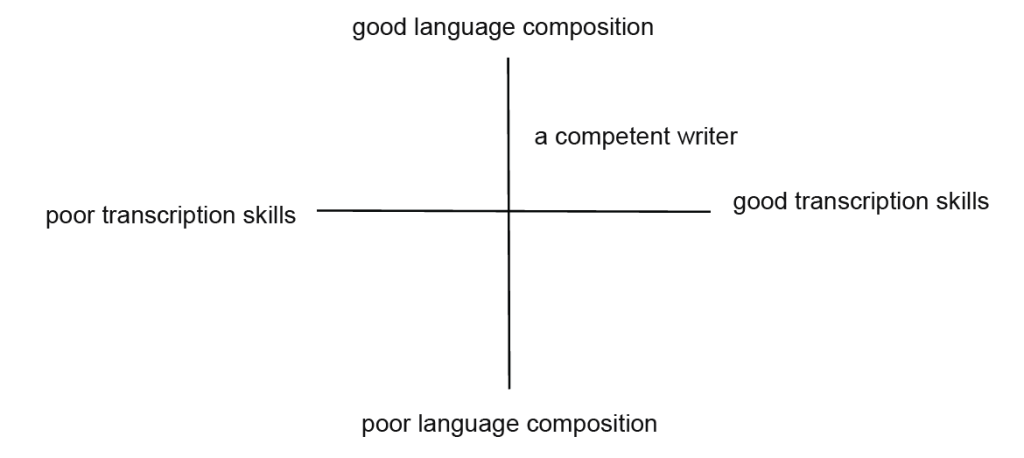
The Simple View Of Writing As Illustrated In The DfE’ Writing Framework (p.17)
It emphasises the importance of composition and purpose and audience. It also warns explicitly that ‘too often, pupils learn to write for the circular purpose of learning to write.’ It also states: ‘transcription is not writing’. However, the DfE’s own writing model is now abandoned.
The ELG reproduces only the three transcription criteria. Composition is stated not to be required. Dictated transcription is validated as evidence. This is a structural failure: the DfE is defining writing one way and measuring it in another.
4. What The ELG Produces In Classrooms
Assessment shapes teachers’ practice. When the statutory measure for writing only rewards transcription, schools will concentrate on what is rewarded. However, Gerde et al. (2022) report that children in preschool classrooms where teachers support composition and meaning-making alongside transcription demonstrate more advanced writing by the end of the year than peers in classrooms where the focus was restricted to transcription skills alone.
A Reception year shaped by the current ELG produces a predictable profile: children who can form letters and encode phonetically but who have never been asked to generate an idea, write for a reader, plan what they want to say, or experience writing as a joyful and communicative act of meaning-making and meaning-sharing. We run the very real risk of developing the most reluctant, listless and unmotivated writers for a generation.
5. The Important Stuff The ELG Doesn’t See
The ELG’s product-focused, transcription-only framework makes two categories of developmentally significant writing behaviour entirely invisible.
Emergent writing behaviours
Children begin demonstrating compositional behaviour long before they can encode conventionally. Rowe (2018) found that children as young as three can successfully select topics, generate ideas, organise content and revise their writing. Rohloff et al. (2025) found that preschoolers frequently revise mid-composition, adjusting their plans and vocabulary as their thinking develops. These are executive function behaviours: self-regulation, monitoring, revision. They are present in children entering Reception. However, the ELG doesn’t recognise this as important to assess.
Spelling development through informed attempts
The ELG’s phonetic spelling criterion encourages teachers to simply get children to write words they already know their children will be able to spell conventionally. This simply flatters to deceive (Young & Ferguson, 2026). It tells us very little. Research also shows that these kinds of restrictions are counterproductive. Children who are encouraged to attempt words they really want to write (using informed spellings) make greater gains in phonological awareness, orthographic knowledge, reading and conventional spelling than those who are restricted to writing already known words (Ouellette & Sénéchal, 2008). Attempting to spell a word requires active engagement with phoneme-grapheme relationships; reproducing already known words does not. Young & Ferguson (2026) also note that children’s informed spellings are the most valuable diagnostic information for teachers, revealing precisely what each child understands about the alphabetic code.
An ELG that encourages a ‘write only what you can already spell’ culture does not support spelling development. It impedes it while simultaneously constraining vocabulary development, thwarting children’s compositional ambitions and removing the diagnostic information that good writing teaching depends on (Young & Ferguson, 2026).
6. System Consequences
The ELG’s shortcomings do not affect only the Reception year. They will invariably generate system-level consequences.
National data distortion
A child who can transcribe a dictated sentence with correctly formed letters can now meet the ELG. That same child may be unable to independently compose a sentence, sustain a piece of writing, or write for any purpose beyond regurgitation. The data derived from ELG judgements will therefore overstate the proportion of children who are genuinely able to write. While there is no doubt that the lowering of expectations will increase the number of children who technically achieve the ELG for writing, national performance data will be misleading.
The Key Stage 1 transition gap
In KS1, children are required to independently plan, draft, revise and proof-read their compositions. These demands draw on composition, executive function and oral language – the two thirds of the Simple View of Writing the ELG does not assess. Children trained only in transcription will face a sharp increase in cognitive demand at this transition without the foundational development that will equip them to meet it. School leaders and Key Stage One teachers should be concerned.
Assessment integrity
The exemplification video accompanying the ELG carries the following disclaimer: ‘While it features real children in real school settings, their actual developmental levels may differ from what is shown, and some scenes include acting for demonstration purposes.’ Exemplification materials that use acted footage cannot calibrate professional judgement. This is not acceptable.
7. Required Reforms
The core problem is straightforward: The ELG defines writing as a skill it is not. The solution requires no new conceptual framework as the DfE’s own Writing Framework already provides one. What is required is alignment between what the Department says writing is and what it’s choosing to measure.
The research base points clearly to what better provision looks like. Young and Ferguson (2021, 2022, 2024, 2025) describe it as the ‘communicative orientation’: an approach in which transcription and composition are developed together, in which children write daily for genuine purposes and real audiences, in which oral language is treated as a foundation rather than a supplement, and in which the classroom functions as a community of writers in which children see themselves as people who have things to say and the means to say them. Research consistently shows that children in classrooms that take this integrated, communicative approach develop stronger writing skills than those in classrooms dominated by transcription-only drills (Bingham et al., 2017; Young & Ferguson, 2024). This is the model a revised ELG should support.
We call on policymakers to commission an immediate, evidence-led review of the Writing ELG with the following objectives:
1. Adopt the Simple View of Writing as the organising framework. A revised ELG should require evidence across all three components: transcription, executive function and composition. This is the model the DfE’s Writing Framework already endorses. The ELG and the Framework must say the same thing.
2. Require independent composition. Children must demonstrate that they can generate and communicate their own ideas in writing. The guidance stating that composition is not required must be removed. Research demonstrates that teaching transcription and composition together produces better outcomes than teaching transcription alone at every age group studied.
3. Recognise oral language. Oral language is a direct, independent predictor of writing quality. A revised ELG should include criteria that acknowledge oral compositional capacity as a component of the writing picture.
4. Recognise the writing process. Planning, drafting and revision are integral to writing development from the earliest stages. Preschool-age children demonstrate these behaviours when writing is taught well. Criteria should be added that values engagement with the writing processes and not only with the written product.
5. Include purpose and audience. Writing that communicates to a real reader for a genuine purpose develops more advanced writers than writing produced as a transcriptional exercise. Classrooms where children write for genuine purposes can go on to produce better outcomes. An ELG that ignores purpose removes the incentive to create such classrooms.
6. Revise the approach to spelling. Children who attempt to spell words they really want to write (using informed spellings) make greater gains in phonological awareness, orthographic knowledge and conventional spelling than do those children who are restricted to words they already know. A revised framework should value children’s ambitious encoding attempts and not penalise them.
7. Remove dictation as assessment evidence. Dictation measures whether a child can transcribe someone else’s sentence. It cannot measure composition, vocabulary choice, sentence construction or authorial intent. It should be retained as a teaching tool but removed as an assessment instrument.
8. Replace the exemplification materials. Authentic exemplification showing children composing independently in real classroom contexts must replace the current acted footage.
Every year that this issue persists, hundreds of thousands of children will complete the Reception year assessed as writers on a measure that does not assess writing. At present, teachers are being directed towards a version of writing that the DfE’s own guidance tells them is insufficient. We suspect it will be children from disadvantaged backgrounds who will pay the highest price.
References and further reading
- Berninger, V.W. & Winn, W.D. (2006). Implications of advancements in brain research for writing development. In C.A. MacArthur, S. Graham & J. Fitzgerald (Eds.), Handbook of Writing Research (pp. 96–114). Guilford Press.
- Bingham, G. E., Quinn, M. F., & Gerde, H. K. (2017). Examining early childhood teachers’ writing practices: Associations between pedagogical supports and children’s writing skills. Early childhood research quarterly, 39, 35-46.
- Department for Education (2024). Early Years Foundation Stage Statutory Framework.
- Department for Education (2025). The Writing Framework. https://assets.publishing.service.gov.uk/media/68bec95444fd43581bda1c86/The_writing_framework_092025.pdf
- Department for Education (2026). EYFS profile assessment support: ELG Writing https://help-for-early-years-providers.education.gov.uk/support-for-practitioners/eyfs-profile-assessment-support/writing-early-learning-goal
- Gerde, H. K., Wright, T. S., & Bingham, G. E. (2022). Sharing their ideas with the world: Creating meaningful writing experiences for young children. American educator, 45(4), 34.
- Harris, K.R., Kim, Y-S.G., Yim, S., Camping, A. & Graham, S. (2023). Yes, they can: Developing transcription and compositional skills together to help children write informative essays at grades 1 and 2. Contemporary Educational Psychology, 72, 102131.
- Kim, Y-S.G. & Schatschneider, C. (2017). Expanding the developmental models of writing: A direct and indirect effects model of developmental writing. Journal of Educational Psychology, 109(1), 35–50.
- Kim, Y-S.G., Yang, D., Reyes, M. & Connor, C. (2021). Multicomponent writing instruction appears to yield better results. Educational Research Review, 34, 100401.
- McIntyre, A., Scott, A., McNeill, B., & Gillon, G. (2025). Comparing young children’s oral and written story retelling: the role of ideation and transcription. Speech, Language and Hearing, 28(1), 2357450.
- Ouellette, G. P., & Sénéchal, M. (2008). A window into early literacy: Exploring the cognitive and linguistic underpinnings of invented spelling. Scientific Studies of Reading, 12(2), 195-219.
- Rodríguez, C., Jiménez, J. E., & Balade, J. (2025). The impact of oral language and transcription skills on early writing production in kindergarteners: Productivity and quality. Early Childhood Education Journal, 53(4), 1-11.
- Rohloff, R., Ridley, J., Quinn, M. F., & Zhang, X. (2025). Young Children’s Composing Processes: Idea Transformations in Verbalizations from Pre-Writing to Post-Writing. Early Childhood Education Journal, 53(6), 1961-1971.
- Rowe, D. W. (2018). Research & policy: The unrealized promise of emergent writing: Reimagining the way forward for early writing instruction. Language Arts, 95(4), 229-241.
- Seoane, R. C., Wang, J., Cao, Y., & Kim, Y. S. G. (2025). Unpacking the relation between oral language and written composition: A meta-analysis. Review of Educational Research, 00346543251320359.
- Young, R. & Ferguson, F. (2021). Writing For Pleasure: Theory, Research and Practice. Routledge.
- Young, R. & Ferguson, F. (2022). The Science of Teaching Primary Writing. The Writing For Pleasure Centre.
- Young, R. & Ferguson, F. (2024) The different perspectives you can take on teaching early writing. https://writing4pleasure.com/2024/03/15/the-different-perspectives-you-can-take-on-teaching-early-writing/
- Young, R. & Ferguson, F. (2025) Visualising The Science Of Writing: The Writing Map Explained. https://writing4pleasure.com/2025/02/27/visualising-the-science-of-writing-the-writing-map-explained/
- Young, R. & Ferguson, F. (2026). Debunking edu-myths: Children should only write words they can spell. https://writing4pleasure.com/2026/02/26/debunking-edu-myths-children-should-only-write-words-they-can-spell/