
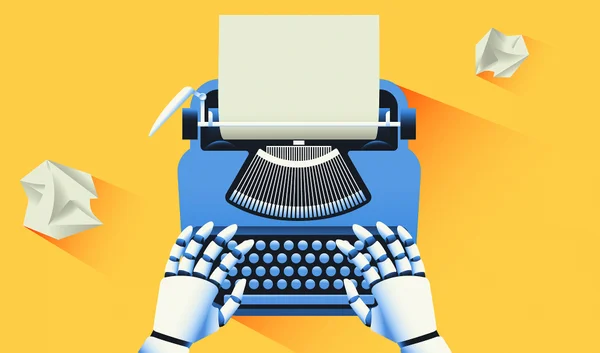
At its core, our position is simple: AI cannot write¹. This is because AI cannot think, feel or draw on personal experiences. To write involves thinking, feeling and sharing meaning. All large language models do is generate syntax based on patterns in data². It’s a simulation of language use without understanding. This carries implications for writers, teachers, and students.
Why AI generated syntax is not writing
- No thought, no consciousness, no experience. AI models lack lives. They do not think, feel, wonder, doubt, or imagine. They have no personal histories to draw on, no hopes, no fears, no embodied existence. Human writing grows out of lived experiences, emotion, sensory detail, uncertainty, revision, reflection and thought. These are things language models do not possess.
- Pattern without understanding. What language models do is statistical pattern-matching. They generate sequences of words based on probabilities from large datasets. It does not shape and make meaning. It carries no intention nor does it understand rhetorical nuance in the way a human does. It is a fake. A phoney.
- No agency, no intentionality As writers, we make choices: what to emphasise, what moral stance to take, which metaphor to extend and where to leave ambiguity. These choices are part of the writing process and the author’s voice. AI has no intentions. It cannot choose in the service of meaning beyond what its available data suggests.
- Lack of authentic revision, struggle, and joy The writing process is messy. We draft, we abandon, we rewrite, we confront frustration, failure, joy and discovery. But it is precisely this process that makes writing – writing. Out of the difficulty, pleasure and satisfaction comes growth. Writers experience satisfaction and pleasure in shaping a sentence that sings, surprising themselves with an idea, finding just the right word for the occasion and sharing their developing manuscript with others³. Writing is relational too. It connects us to peers, mentors, readers and communities. AI knows nothing of this. It does not struggle but neither does it take delight. It does not revise with care nor does it feel the pride of authorship. It simply produces syntax based on data patterns. The writer’s journey, both its frustrations and its thrills, is entirely absent.
Teachers who outsource their own writing
We must be clear: Teachers who turn to AI to produce ‘mentor texts’ abdicate their responsibility as genuine writer-teachers.
Teachers of writing need to write themselves⁸. Without fully engaging in writing, they are unable to authentically teach writing. Without undertaking a class writing project for themselves, they are in no position to appreciate where their students might need particular instruction or support. They also leave themselves unable to model the idea generating, planning, decision-making, risk-taking, revising, proof-reading, publishing and performing that writing requires³.
When a colleague lets AI generate syntax, they stand at the front of their class without the vital expertise and experiences required to be an effective teacher of that writing. AI cannot explain why a sentence was shaped a certain way, how a certain metaphor came about or why an idea was discarded and then brought back. Also, what message does this send? That writing is simply a product to produce on demand, not a process. All that is learnt in the crafting of writing can be replaced with automation. A writer’s joy, struggle and growth is unnecessary. These are the wrong messages entirely. It is a betrayal of what it means to model the writer’s life for students⁴.
The call for “AI-proof” writing projects
If AI is going to saturate our cultural landscape, then teachers, scheme writers and assessment designers must respond by rethinking the kinds of writing projects they set. The future lies in writing projects that AI cannot possibly reproduce. These are writing projects that demand students to draw deeply on their own:
- funds-of-knowledge (the personal expertise they accumulate from home, community and experience)
- funds-of-identity (their lived histories, values, passions and perspectives)
- funds-of-language (the registers, dialects and linguistic repertoires that make their writing voice distinct)
- personal responses (insights, reflections, memories, emotions only they can access)
Such writing insists on authenticity. It asks students to inhabit the page with part of themselves: their thoughts, ideas, voice, experiences and their ways of seeing the world⁵. AI will never be able to replicate this kind of writing because AI has no self to draw from. Teachers, therefore, must design writing projects that insist on meaning over language patterns, originality over generic templates and humanity over writing simulations². That is a necessary pedagogical shift.
When students turn to AI
If students (and teachers) are regularly using AI as a replacement for their own authorship, we must ask ourselves a serious question: Is there enough personal value in the class writing projects we’ve designed?
Students reach for shortcuts when writing tasks feel meaningless, disconnected, or overly formulaic⁷. The solution is not to tighten surveillance but to design projects that genuinely matter to young writers. Again, these will be projects that invite them to draw on their own experiences, funds-of-knowledge, and sense of identity⁵. When students are invested in a piece of writing, when it feels like it is theirs, they are far less likely to want an algorithm to do it for them⁶.
AI cannot assess what matters most
Teachers should resist using AI to assess children’s writing. While AI can provide surface-level feedback on grammar, spelling, or sentence variety, it will never be able to evaluate the aspects of writing we value most: meaning, voice, originality, authenticity, and the emotional and intellectual impact of a piece.
Some argue that AI can handle assessing the transcriptional aspects of a student’s writing rather efficiently, supposedly freeing teachers up to focus more on higher-order concerns like voice and meaning. We are not convinced. As we know only too well, what becomes important in assessment arrangements is what becomes important in our teaching. To delegate assessment to AI is to miss the very point of what reading and assessing students’ writing is all about.
What this means in practice
AI as a tool, not an author. We regard AI as a compositional assistant like a grammar or spell-checker. For students who experience writing as anxiety or paralysis, AI may reduce their fear of the blank page, allowing them to experiment more freely or approach revision with greater confidence⁷. While AI can offer suggestions, alternative phrasing, or surface-level support, the human writer must, within this cognitive partnership, remain in authorial control: steering, revising, choosing, and rejecting. The final text must remain authored.
Teachers should ask students to compare their own writing with AI-generated outputs and critique the differences. In this way, AI can function as a mirror, helping students notice what is inauthentic about a machine’s syntax and clarify what is distinctive and special about their own writing.
Transparency, fairness, digital literacy and ethical use of AI If teachers use AI, they must be transparent about how and why they have done so. Students deserve to know whether a text has been wholly human-written or partially generated by an algorithm. Anything less risks creating a double standard, with teachers relying on tools that students are forbidden to use. By openly sharing drafts, prompt entries, and AI-generated inputs, teachers model honesty and fairness, allowing students to make informed choices about their own AI-related writing practices. What matters most is integrity: students should experience an authentic apprenticeship in writing, not a concealed dependence on technology.
Pedagogical clarity: In writing classrooms, AI should never replace teacher modelling, meaning-making, voice, invention, idea generation, planning techniques, or the teaching of revision and proofreading strategies.
Our hope and ambition
Children and young people believe in the pleasure and satisfaction of human authorship⁷. It’s our view that students want to say something with originality, see the world in unique ways, connect with their readers emotionally and intellectually, and most importantly, surprise and develop themselves as authors. We want students and teachers to stay in contact with the craft of writing and not hand it over to machinery.
We must aim to consider large language models critically and transparently. We mustn’t lose sight of what being a writer-teacher is and what it means to teach and model writing⁸. In every instance, the human author must remain the agent, the thinker, the feeler, the asker of questions, the entertainer, the painter of words, the sharer of knowledge, insight, experience and personal expertise.
AI can’t write – only humans can.
References
- Warner, J. (2025). More than words: How to think about writing in the age of AI. Hachette UK.
- Sharples, M., & y Pérez, R. P. (2022). Story machines: How computers have become creative writers. London: Routledge.
- Young, R., & Ferguson, F. (2021). Writing for pleasure: Theory, research and practice. Routledge.
- Kaufman, D. (2002). Living a literate life, revisited. English Journal, 91(6), 51-57.
- Young, R., Ferguson, F., Kaufman, D., & Govender, N. (2022). Writing realities. Brighton: The Writing For Pleasure Centre.
- Young, R., Ramdarshan‐Bold, M., Clark, C., & McGeown, S. (2025). ‘It’s healthy. It’s good for you’: Children’s perspectives on utilising their autonomy in the writing classroom. Literacy
- Picton, I., Clark, C., & Bonafede, F. (2025). Young People’s Use of Generative AI to Support Literacy in 2025. National Literacy Trust.
- Smith, J., & Wrigley, S. (2015). Introducing teachers’ writing groups: Exploring the theory and practice. Routledge.
Further recommended reading: