
Original article: LINK
By Cynthia Puranik, Molly Duncan & Ying Guo
Our Writing Map shows how transcription and oral language skills contribute significantly to children’s early writing development.
This study also found a strong connection between young children’s transcription skills and the quality of their writing. The ability to transcribe effectively plays a key role in children translating their spoken language onto paper.
While strong oral language skills are linked to better writing, being able to happily and quickly transcribe these “oral tellings” is a much bigger factor in determining how well young children can write. This is one reason why our ‘book-making approach‘ in EYFS and KS1 is such an effective writing process for the youngest of writers. For example, children are regularly required to utilise the following strategy:

Surprisingly, children with particularly good transcription skills but poor oral language skills still tend to produce higher-quality compositions than those with moderate skills in both areas. This is typically because children with strong oral language will attempt more complex compositions than their present transcriptional abilities can cope with. This can lead some people (and some assessments) to assume that the writing is of a lower quality. The study suggests writing assessments are not always sensitive enough to take into account these sorts of young writers.
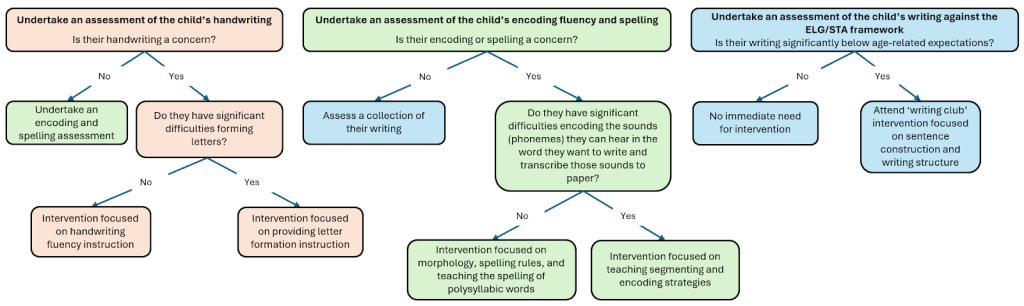
With this in mind, teachers and SENCOs should consider the individual strengths and weaknesses of a pupil when assessing their writing development and recommend scaffolds and interventions that will actually address children’s specific writing needs. To help, SENCOs and teachers may find our free Identifying And Addressing Children’s Writing Needs tool useful.
Implications for schools:
- Teachers should be aware of the significant role transcription skills play in early writing development [see our transcription provision checklist for more – LINK]
- EYFS and KS1 teachers should sensitively wean children off their emergent writing practices by teaching them key encoding strategies [see LINK for more].
- Schools should have a clear plan for how they build up to extended writing projects [LINK for an example].
- Assessing writing in a way that recognises both transcription and content quality is crucial for providing accurate feedback and guiding writing improvement [see our Identifying Children’s Writing Needs tool for more on this].
- Transcription instruction can have diminishing returns for children whose transcriptional skills are already high. This is particularly true for older students.