I was sitting in a lecture for my NASENCO course when we were asked to start thinking about research ideas on ways in which we could support our SEN children with an area of need. My mind went back to my Year 6 class and to one autistic boy in particular, Yahya, who came to us at the end of Year 5 with the dreaded label of ‘not being able to read or write’. The child who entered my Year 6 class was full of life and ideas, interested in everything – especially obscure video games! However, by his own admission, he would shrug his shoulders and say matter-of-factly, “I can’t write.” As a school, we had recently introduced the Writing For Pleasure approach, and I knew I had my research project then: Yahya would be a writer!
Autistic children often face significant barriers to writing (Asaro-Saddler 2016) such as cognitive, social, academic, or rigid literal thinking, but arguably, the way we teach writing is the biggest barrier. When talking with Yahya, it was clear that he thought he couldn’t write for a number of reasons: he found handwriting tiring, believed spelling conventionally whilst drafting was essential to being a good writer, wasn’t interested in teacher-assigned topics, and lacked writing role models.
Luckily for me, Writing For Pleasure had already compiled research into their excellent guide, Supporting Children with SEND to Become Great Writers.
The table below shows the effect-size of best practices in supporting children’s writing development. Understanding these strategies, I set out an action plan for Yahya and other autistic students to think about their writing needs and how to best support them. During my teaching time, I followed these writing approaches and hosted weekly masterclasses with colleagues, where I could explain the approach, share what seemed to be working, and discuss any potential pitfalls.

From Young & Ferguson (2023) Supporting Children with SEND to Become Great Writers [LINK]
Alongside my brilliant TA, we introduced Yahya to what it meant to be taught by a ‘writer-teacher’. We would write alongside him, not for him. We would share our own writerly interests with him and model our writing process in real-time — including our spelling mistakes (and spelling strategies), scrapy handwriting, use of drawings, and even how to deal with writer’s block. Yahya quickly realised that drawing on your own funds-of-knowledge was a big part of our writing process, and he opened up about his love for an obscure Roblox game called Doors.

For Doors, Yahya was the expert. He had willing and ignorant readers, including the class TA and me. He started planning by drawing pictures about the game, explaining what to do, and even writing some fanfiction. He was fully engaged in these projects. Over time, he began writing phrases about the game. More often than not, this writing made little sense to outsiders, but Yahya could explain what he had written and, with support, was beginning to proof-read his own spellings attempts after drafting. Yahya went on to create a whole series of varied picture books about Doors. He then started writing at home too, and combined with targeted mini-lessons, he was becoming a writer.
His classmates were interested in what he was doing, and they bonded over their shared interests. Many autistic children have highly specific interests, and embracing these can be key to engaging them with writing. I began noticing more opportunities in the real world where writing catered to hyper-specific interests. I often scroll through and post on obscure West Ham fanzine forums (which my partner assures me is a niche audience) but there is a market for it! Similarly, for Doors, we found that there are various Reddit communities where people share guides, fanfiction stories, and discuss what they love about it and why. I hope we have given Yahya that same outlet.
Yahya came back to see us in Year 7, seemingly a foot taller! He said that secondary school was quite different, but he was doing okay. He also delivered some writing that he had done in the car on the way down to visit us. I think he is a writer now…
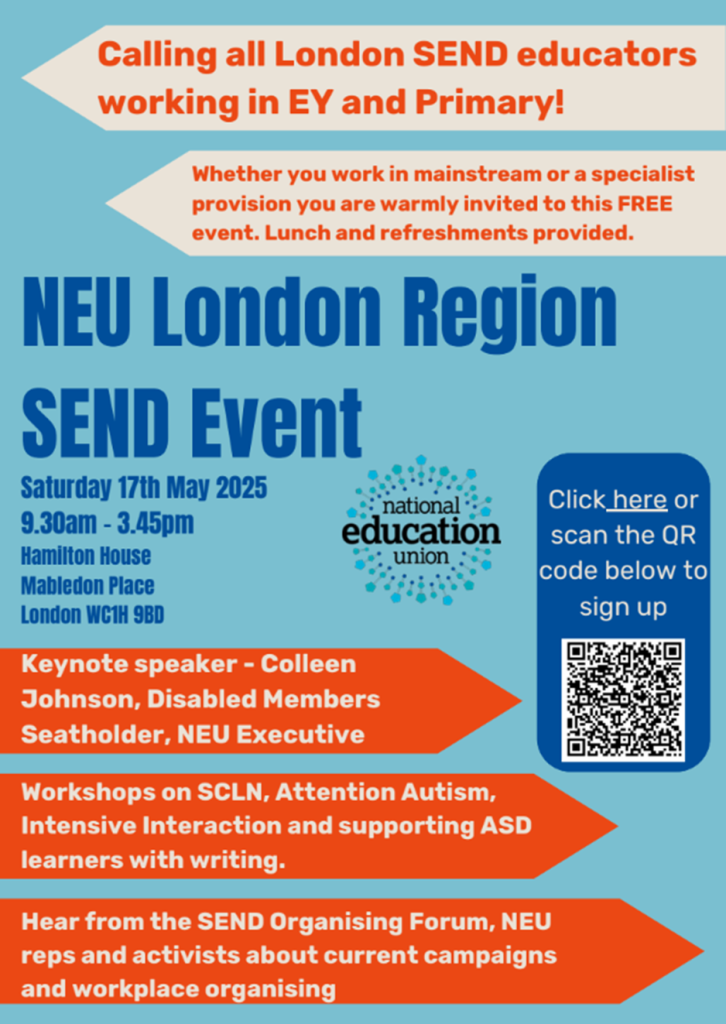
If you’d like to learn more about supporting autistic pupils with writing, I’ll be hosting a FREE masterclasses at the NEU London Region SEND event on Saturday, May 17th. Details are on the flyer below.
By Billy Allgood (SENCO)