
Because of formatting, we can recommend downloading the PDF version of this article:
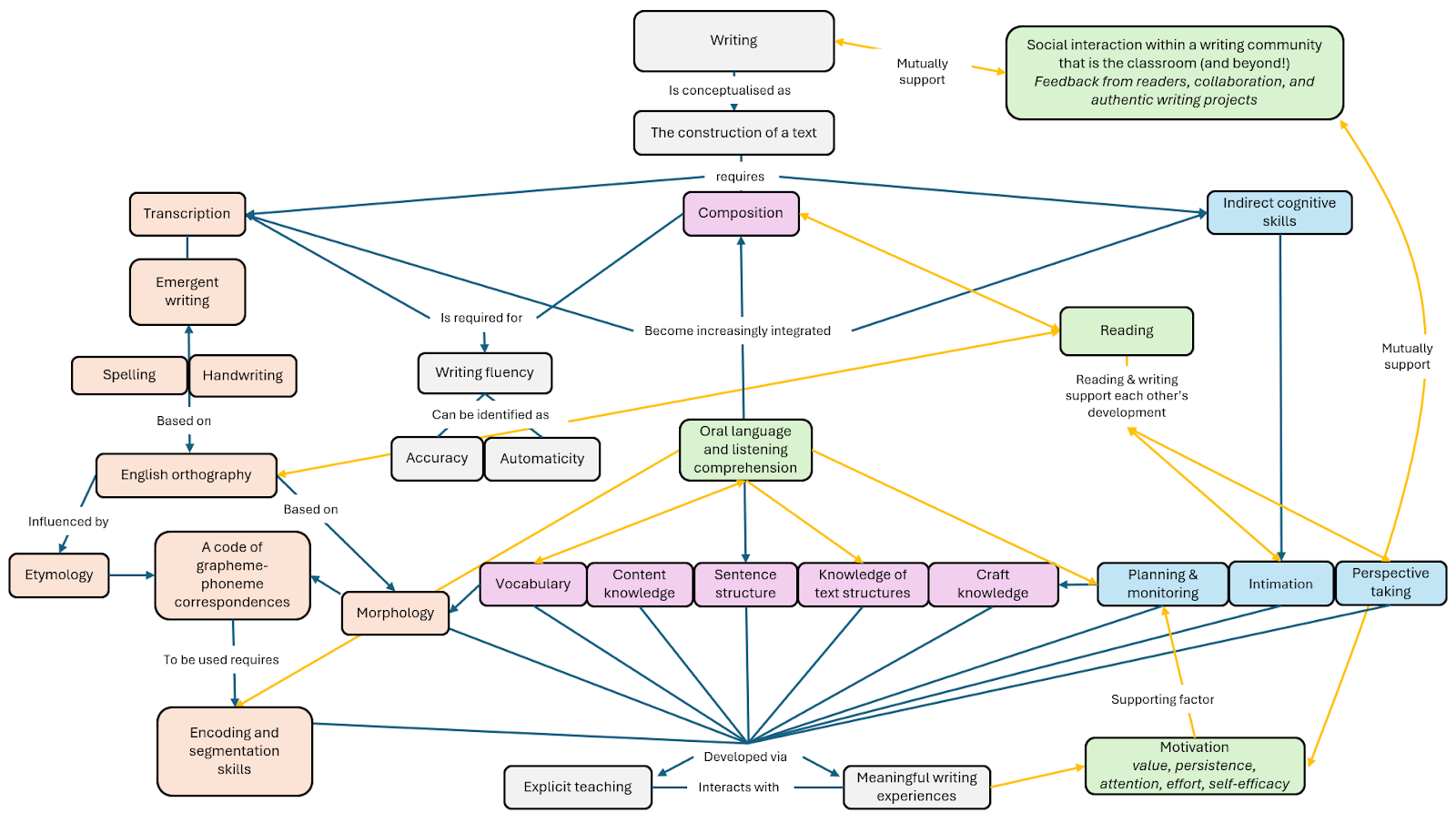
This is a writing map we have started using in our professional development. We tried to create a writing equivalent to Christopher Such’s reading map (which we can highly recommend viewing here).
We see the importance for teachers and school leaders to understand the core principles of writing development – what we refer to as the underlying science of writing. We know that writing is something that is both personal and intensely social, both cognitive and emotive.
Our experience consistently shows that schools with a solid understanding of this theory are better equipped to make informed decisions when developing their writing curriculum. We often collaborate with schools that need more confidence in this area, guiding them to deepen their understanding and refine their approach with greater clarity and intentionality. This writing map has therefore become an increasingly essential part of our work.
In this article, we will look to guide you through the writing map one step at a time. You can download a larger presentation version of the map here.
Conceptualising Writing
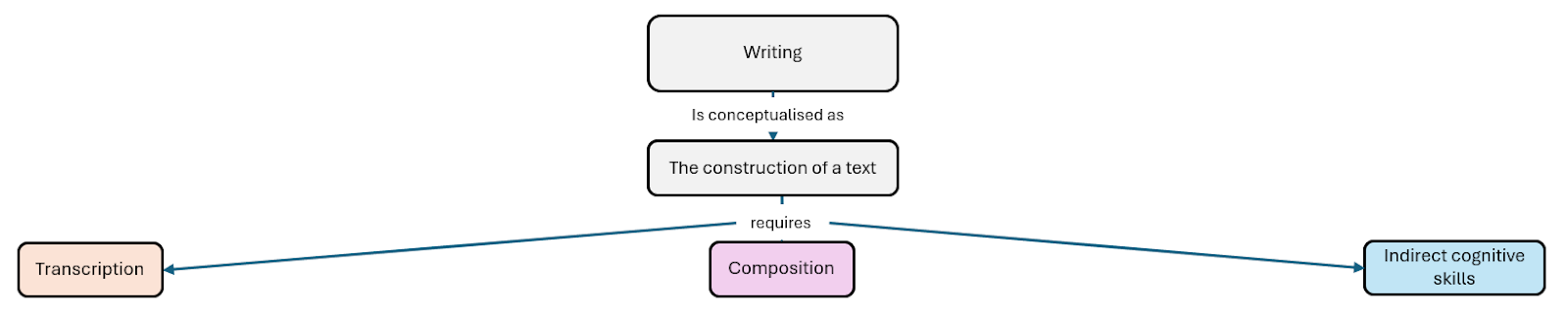
Writing can be defined simply as: the construction of a text to share meaning.
The construction of a text requires a young writer to draw on their knowledge of transcription, composition and other indirect cognitive skills (Berninger & Amtmann 2003).

Transcription, composition, and indirect cognitive skills become increasingly integrated as a young writer develops (Sedita 2022). Their proficiency follows a gradual developmental trajectory, where these components become more and more interconnected and automated over time.
When composing, early writers will often go through a process of writing-telling. This is where they list their ideas, one after another, without too much thought. Developing writers then start writing-transforming. This is where they will plan and revise their compositions to improve its effectiveness. Finally, advanced writers undertake writing-crafting. This is where they will actively and continually consider the needs of their audience (Bereiter & Scardamalia 1987).
Writing development involves the progressive integration of transcription, composition, and cognitive skills.
Transcription
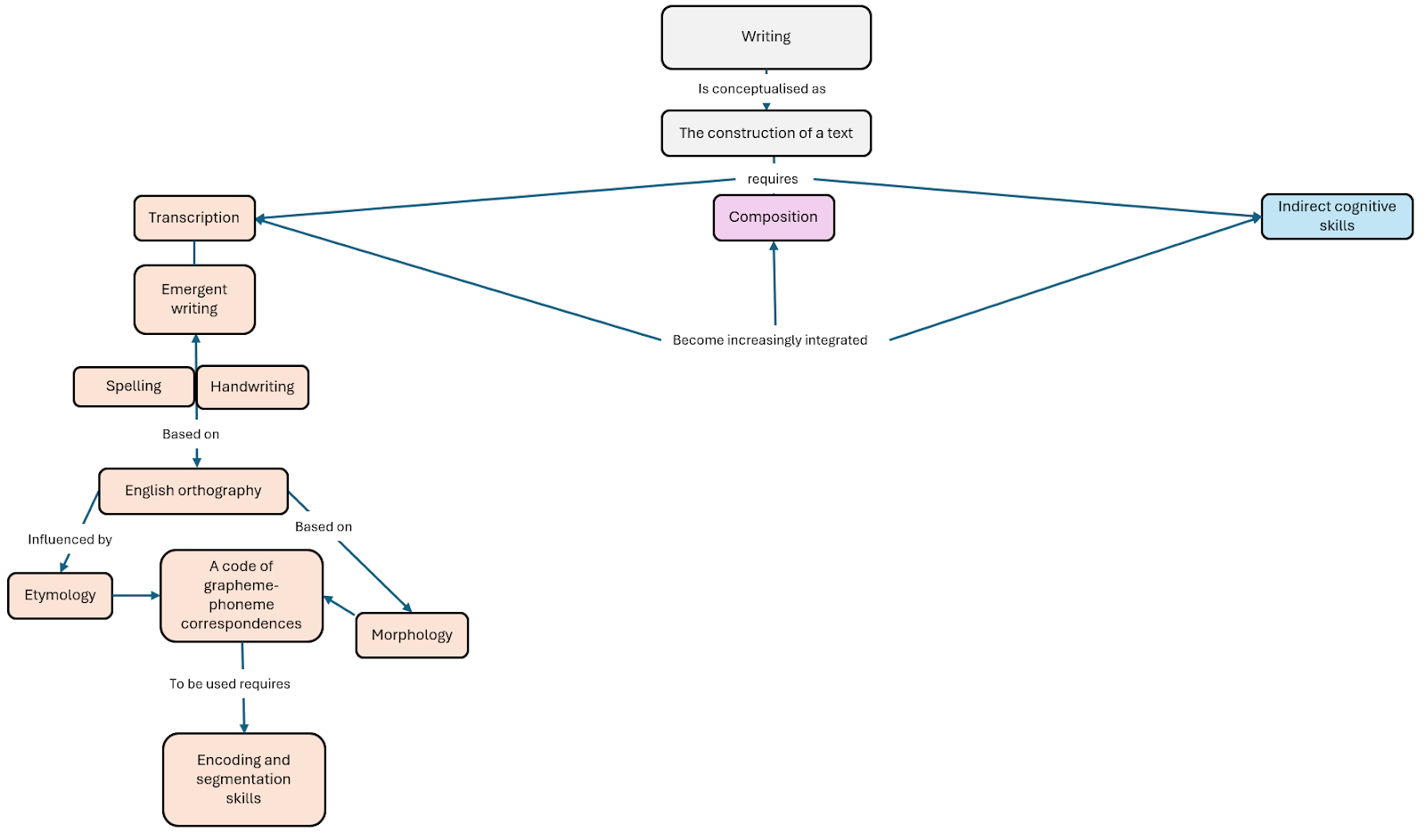
Transcription includes:
1. Emergent writing – producing scribbles, marks and letter-like shapes before eventually using ‘informed spellings’. Emergent writing is the developmental foundation for later conventional transcriptional skills. It acts as a temporary scaffold.

Kim & Byington (LINK)
Emergent writing → develops into → convention transcription
Once letter formation, phonics and encoding instruction are introduced, children’s emergent writing transitions towards using informed spellings.
Informed spellings = words that are spelt as they sound and influenced by the child’s growing phonological awareness and their knowledge of spelling rules and patterns.
2. Handwriting – fluency in forming letters or keyboarding.
3. Spelling – developing phonemic, orthographic, and morphological knowledge.
Transcription is based on our knowledge of → English orthography (the typical conventions used to write the English language) → and is influenced by → etymology (the history of words) → which affects a code of grapheme-phoneme correspondences → which to be used requires → phonemic skills (e.g. encoding and segmentation).
Encoding = the process of translating spoken language into written form. Encoding is the counterpart to decoding.
Segmentation = the ability to break down spoken words into their individual sounds (phonemes). This skill is essential for spelling and writing because it helps children recognise the sounds in words and match them to corresponding letters or letter patterns.
Transcription skills are also supported by morphology (how words are built from smaller units called morphemes, which are the smallest meaningful parts of a word e.g. un-help-ful).
Transcription is developed through explicit teaching and meaningful writing experiences.
Composition
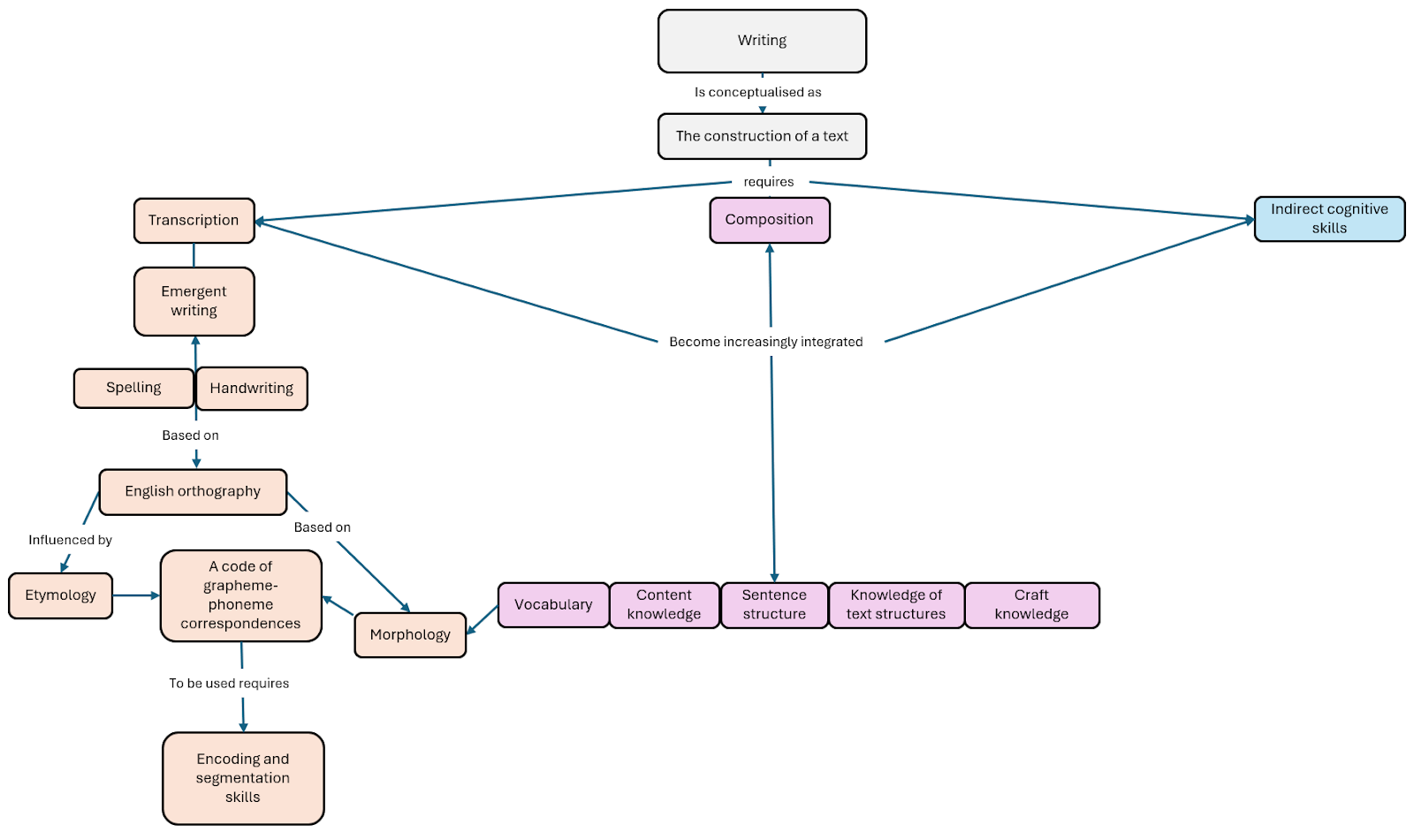
When composing, children will go through the writer’s process of conceptualising, generating ideas, translating, transcribing and reconceptualising their writing (Graham 2018).
- Conceptualise – Consider the purpose and audience for their writing.
- Generate ideas – Generate ideas of what it is they would like to share with their readers.
- Translate – Convert their ideas into possible phrases and sentences.
- Transcribe – Children physically make their marks on paper or screen.
- Reconceptualise – This is something children are doing all the time. They will regularly stop, think, rethink, share, discuss, re-read and perform their developing compositions.
Now we have a good understanding of what composing involves, let’s think about what it requires:
Vocabulary – knowing what words are going to say exactly what you mean.
Content knowledge – the ‘stuff’ you want to write about. If this content is held in children’s long-term memory, it can make writing easier.
Knowledge of sentence structure – includes syntax and punctuation:
- Combining sentences to enhance fluency and coherence.
- Using different sentence types for effect.
- Using grammar as a meaning-making tool.
- Punctuation usage.
Knowledge of text structures:
- Understanding different genres – e.g. narrative, information.
- Applying typical genre features – e.g. magic in fairytales, an abstract for a science report.
- Using cohesive devices – e.g. being chronological, cause-effect, compare-contrast.
Craft Knowledge involves:
- Developing your unique writer identity and style. This may involve using different language varieties, adapting your writing to various tones and levels of formality, and, for multilingual writers, creating dual-language texts and engaging in translanguaging practices (translanguaging = the practice of using multiple languages fluidly in your writing).
- Use of figurative language – e.g. personification, simile.
- Rhetorical devices – e.g. appealing to a reader’s emotions, placing two ideas together to highlight their differences.
Writing Fluency

Both transcription and composition are required for writing fluency which can be identified as:
- Accuracy – e.g. forming letters correctly.
- Automaticity – transcribing to paper or screen what it is you want to say quickly and happily.
| * A quick note on automaticity. This should not be confused with the process of conceptualising and organising ideas which does not always happen quickly and happily! Automaticity is here to indicate that fast transcription can occur once a child has translated their ideas into phrases or sentences in their mind. |
Indirect Cognitive Skills
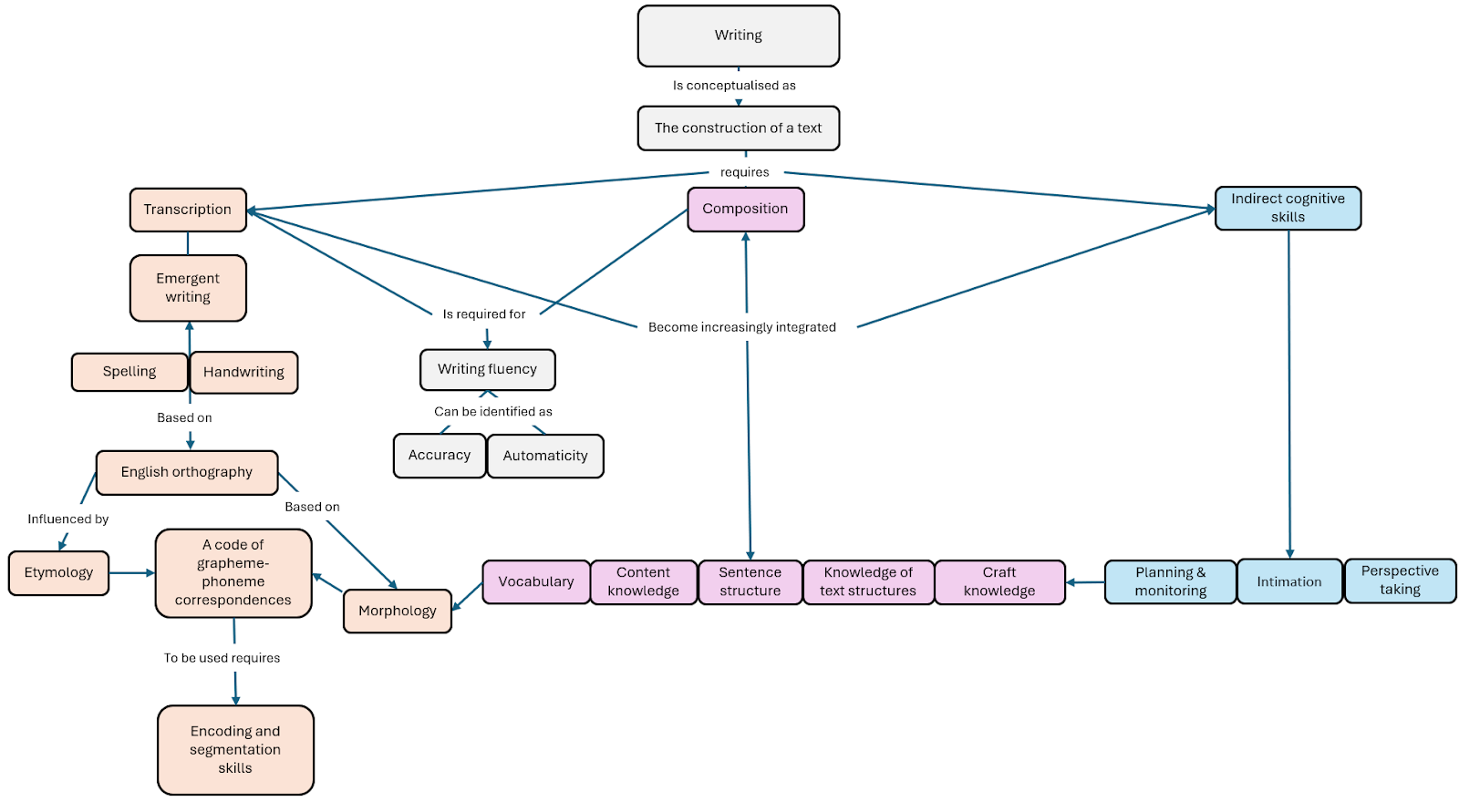
Indirect cognitive skills include (Hacker 2018; Kim & Graham 2022):
Intimation – the writerly technique of suggesting or hinting at ideas, details, or meanings without explicitly stating them.
Perspective-taking – considering how to successfully write for different purposes and audiences – knowing your readers’ needs.
Planning and monitoring includes:
- Metacognition – the awareness a writer has over their own thought processes while writing.
- Self-regulation – a writer’s ability to set goals, monitor their progress, and adjust their strategies to craft and improve their writing.
- Executive function – the mental processes that help a writer start and complete their writing – including knowing how to generate writing ideas, plan, draft, revise and proof-read.
- Working memory – allows a writer to temporarily hold and manipulate information while writing. For example, remembering what they have already written or keeping track of key details they want to include.
We can personify the planning and monitoring strategies children use to craft texts. This would include:
 The proposer. It’s their job to generate ideas in the mind (and on paper through drawings) and offer them to the translator. The proposer. It’s their job to generate ideas in the mind (and on paper through drawings) and offer them to the translator. |
 The translator. It’s their job to take those images and organise them into a plan, structure, phrases and sentences. The translator. It’s their job to take those images and organise them into a plan, structure, phrases and sentences. |
 The transcriber. It’s their job to take those phrases and sentences from the mind and put them down onto the paper or screen. The transcriber. It’s their job to take those phrases and sentences from the mind and put them down onto the paper or screen. |
 The evaluator. The evaluator reads and reviews the text as it is being crafted. They will also share the text regularly with others to gauge their reactions. Finally, they act as a motivator. The evaluator. The evaluator reads and reviews the text as it is being crafted. They will also share the text regularly with others to gauge their reactions. Finally, they act as a motivator. |
These higher-order cognitive skills interact with composition and are required for producing the most meaningful and successful writing.
Explicit Teaching & Meaningful Writing Experiences
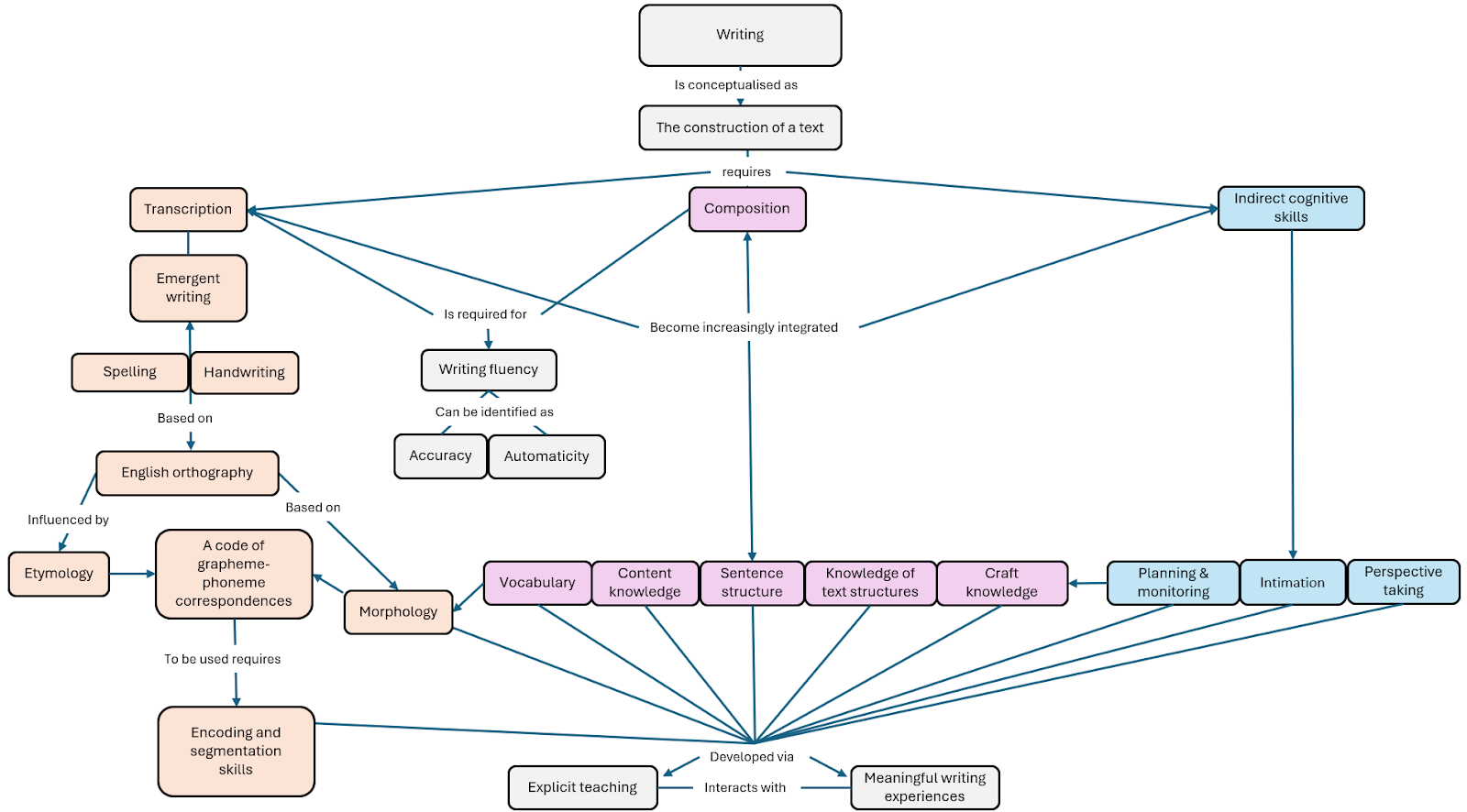
Transcription, composition and cognitive skills are developed via:
- Explicit teaching.
- Meaningful writing experiences.
These interact with one another. Children use and apply what they learn from explicit teaching when undertaking meaningful writing experiences. Because children are undertaking meaningful writing experiences, they become increasingly interested in your explicit teaching.
| Explicit teaching | Meaningful writing experiences |
| Handwriting and spelling instruction Self-regulation strategy development instruction Includes: grammar, sentence-level, literary craft moves, rhetorical devices, planning, drafting, revising, proof-reading, publishing Verbal feedback and pupil-conferencing Scaffolding – including aids, modelling and guided practice | Short ‘fluency’ based writing projects Reading as writers and studying mentor texts Whole-class writing projects Personal writing projects (both school and home) Class sharing and Author’s Chair |
For more on this, see our document The Writing Map & Evidence-Based Writing Teaching [LINK].
Oral Language

Oral language supports (Kim & Graham 2022):
- Encoding & segmentation
- Vocabulary – knowing what words are going to say exactly what you mean
- Talking at the text level – e.g. storytelling
- Monitoring – by re-reading your writing aloud to yourself (and others)
Oral language helps develop fluency, cohesion, and effectiveness and is developed through:
- Time for discussion and storytelling
- Oral rehearsal before transcribing
- Egocentric talk (what’s called ‘self-talk’ while writing)
- Class sharing and regularly reading aloud
The Reading-Writing Connection
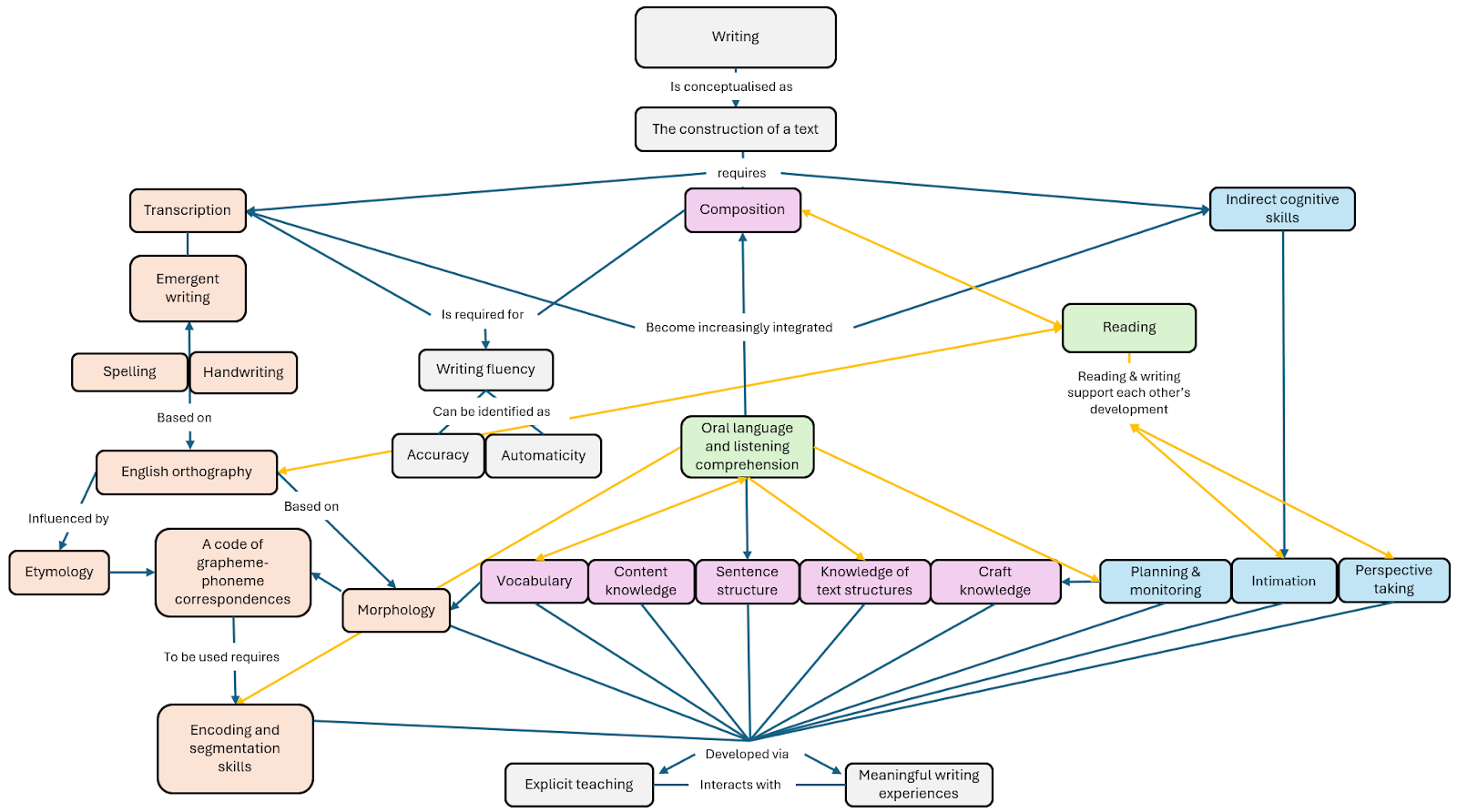
Reading and writing support each other’s development by:
- Understanding and analysing mentor texts (these are texts which realistically match the kind of writing children are trying to produce for themselves).
- Reading, recognising and using typical text structures and genre features in their own writing.
- Reading can help children generate and develop their own writing ideas (this process is called intertextuality).
- Regularly rereading their developing text.
Reading comprehension development supports children’s:
- Vocabulary.
- Knowledge of sentence structures.
- Knowledge of text structures.
- Craft knowledge.
- Content knowledge (For example, when asked to write about their reading in reading lessons. This also includes reading and writing about their learning in the wider curriculum subjects).
- Intimation.
- Perspective-taking.
Decoding mutually supports children’s ability to encode (transcribe the sounds they hear in the words they want to write).
(Kim & Graham 2022; Such 2025)
Motivation

Motivation supports planning & monitoring as it involves value (the importance or significance a young writer places on their writing) which affects their:
- Persistence – their desire to continue working on their writing despite difficulties.
- Attention – their desire to focus on their writing and not get distracted.
- Effort – the time and energy they invest in creating and refining their writing.
- Self-efficacy – their belief in their ability to create successful and meaningful writing.
When students are motivated to write, they pay more attention, put in more effort, persist for longer, and are able to write more independently.
Meaningful writing experiences and explicit teaching support children’s motivation.
| * Quick note. While we have motivation supporting children’s writing development, research is increasingly emphasising it as a core element of writing development. Like cognitive psychologist John Hayes, in his writing model, we could have placed motivation as the first element in the process of writing production [LINK for more]. This makes sense as the word ‘motive’ derives from the Latin movere meaning ‘to move’. As teachers, we need to help students see the value and purpose for writing. They need to be moved to write. |

Social & Cultural Development: Building A Community Of Writers
Finally, and most importantly, writing is a social and cultural activity shaped by participation with a writing community (Graham 2018). Writers develop through:
- Individual cognitive growth
- Positive social interactions within a writing community
- Writing alongside their writer-teacher and peers.
- Receiving feedback and social recognition.
- Making connections with readers by publishing and performing their writing
- Collaborating, co-writing, reading, thinking and talking about writing (and being writers).
- Taking part in authentic class writing projects.
Being part of a supportive and enthusiastic writing community is essential to children’s writing development.
What now?
While we offer one-off professional development sessions to schools and MATs, and recognise their value in strengthening schools’ conceptual understanding of writing and help them identify areas for improvement, we believe long-term and sustained support is essential for translating this knowledge into effective classroom practice. Most schools we work with ultimately seek more than just theoretical guidance – they want to implement a reassuringly consistent approach to writing teaching that they can adopt, adapt, and use as a foundation for change. In these cases, we typically introduce the theoretical foundations of writing instruction before guiding schools through our Writing For Pleasure approach that balances four key priorities:
- Checking the school’s provision for explicitly teaching encoding, handwriting and spelling.
- Developing children’s writing fluency in the EYFS and KS1.
- Providing opportunities for students to craft purposeful and authentic writing.
- Engaging students and teachers in discussions about writing to deepen their understanding of the craft.
To achieve these priorities, we introduce three core writing structures:
- Short ‘book-making’ projects: Focused intervention projects which build automaticity and accuracy in encoding and support sentence construction and cohesion.
- Reading as writers: Analytical and reflective discussions of mentor texts that help students establish ambitious goals for their writing.
- Class writing projects: Opportunities for students to generate ideas, plan, draft, revise, proof-read and publish extended pieces of writing.
These structures are not anything complex. They simply make practical the principles of world-class writing teaching [LINK for more on this]. They support teachers while allowing them flexibility for adaptation and ongoing improvement.
Our support also extends far beyond writing lessons. We help schools tackle challenges such as assessment, supporting children with specific writing difficulties, helping English language learners, and fostering a school-wide culture of writer-teachers. The majority of our work with schools can be summarised as follows:
- Providing constructive feedback on schools’ current approach to writing instruction and their writing curriculum, either through online discussions or in-person consultancy.
- Helping classroom teachers and school leaders develop a deeper understanding of writing development so they can make evidence-informed instructional decisions that feel right for their school.
- Outlining our Writing For Pleasure approach so that schools can adopt, adapt, or use it as a foundation for further development.
Finally, we work hard to provide free or very affordable alternatives to our consultancy work. We believe passionately in ensuring that high-quality professional development is accessible to as many teachers as possible.
- Anyone can send us a message via email, Twitter, Facebook or Blue Sky with any questions, and we’ll do our best to answer them.
- We hear from many schools who have used our website to drive their own CPD. You can access all our free CPD materials here.
- Individual teachers can purchase our eBook How To Teach Writing for £5.95. Schools can purchase a licence for all their staff to gain access for £54.75 [LINK].
- Teachers can purchase an individual licence to our website for £28.50 a year. This gives them access to all our eBooks, unit plans and resources [LINK].
- Schools can purchase a whole-school licence to our website for £400 a year. This gives everyone access to our eBooks, programme of study, assessment guidance, CPD materials, units plans and resources. If you’re a smaller school, get in touch as we may be able to provide you with a discount [LINK].
If you want to get in touch, you can use our contact form or email us: hello@writing4pleasure.com
Ross Young & Felicity Ferguson
References:
- Bereiter, C., & Scardamalia, M. (2013). The psychology of written composition. Routledge.
- Berninger, V.W., Amtmann, D. (2003). Preventing written expression disabilities through early and continuing assessment and intervention for handwriting and/or spelling problems: Research into practice. In Handbook of Learning Disabilities, Swanson, H.L., Harris, K.R., and Graham, S. (Eds.) (pp. 345–363). New York: Guilford Press
- Byington T., Kim, Y. (2017) Promoting preschoolers’ emergent writing, Young Children, 72(5)
- Graham, S., (2018) A revised writer(s)-within-community model of writing, Educational Psychologist, 53:4, 258-279
- Hacker, D. J. (2018). A metacognitive model of writing: An update from a developmental perspective. Educational Psychologist, 53(4), 220-237.
- Hayes, J. (2012) Modeling and remodeling writing, Written Communication, 29, 369–388
- Kim, Y.-S.G. (2022) Co-occurrence of reading and writing difficulties: the application of the interactive dynamic literacy model, Journal of learning disabilities, doi:10.1177/00222194211060868
- Kim, Y.-S. G., & Graham, S. (2022) Expanding the direct and indirect effects model of writing (DIEW): reading–writing relations, and dynamic relations as a function of measurement/dimensions of written composition, Journal of Educational Psychology, 114(2), 215–238
- Sedita, J., & Hasbrouck, J. (2022). The writing rope. Brookes Publishing.
- Such, C. (2025) Primary reading simplified London: Corwin
- Young, R., Ferguson, F. (2022) The science of teaching primary writing Brighton: The Writing For Pleasure Centre